
Here’s the thing: contrary to what the left thinks, when you leave wealth in the hands of the individuals, they don’t just flush it down the toilet or build gigantic bins that they fill with money, in which they go for a refreshing swim every day.
People do things with that money. And even if all they do is buy stuff (thereby allowing someone else to accumulate wealth) or invest it, that money gets aggregated and finds things to do, as it were. Wealth goes to work on things that seem interesting, might be interesting, or are otherwise likely to make money for the individuals who hold the wealth.
Individuals have money to start new businesses that would never have existed if they’d paid that money in taxes. Or they “invest” in free time and a really nice garden, which in turn lifts the spirits of people who invent something because they feel better than they would otherwise.
The left insists that if they leave money in individual hands, it will just be “wasted”. (Because, you know, no money spent on a vast apparatus, most of it a jobs program for useless paper pushers or power-hungry martinets is ever wasted.)
How do they know? Have they tried leaving enough money in the hands of those who earn it to make a difference?
Not in the twentieth century. Though we can infer from the fact that the most sclerotic, dying countries are the highest taxed ones, that perhaps what government considers “best” and what we consider “best” are not the same.
Not just taxes, but regulations too weigh heavily on possibilities. Sure, the left sees “lands saved” (or created. oop) when say, regulations curtail oil drilling. But what I see is energy taking up an excessive amount of every family’s money, wealth that would otherwise be freed for other investments, for starting businesses, even “just” for fun.
The problem we have is that leftists lack utterly in imagination. They see the “pristine” plots of land, or the things government does with our money and they find it good.
But they’re mind’s-eye blind. They can’t see the wealth that has been consumed for almost 100 years now say on the war on poverty to create chronic poverty having instead been used by individuals to create, to invest, to build, so that, in that parallel world in which money stayed in individual hands, we now have interplanetary travel, colonies all over the solar system, and squid farms on Mars that feed all of humanity.
Their lack of vision, their killing of possibilities without the slightest thought to them: That is a tragedy.
Sara Hoyt, “The Tragedy of the Squid Farms on Mars”, Libertarian Enterprise, 2018-12-05.
August 23, 2021
QotD: Leaving money in the hands of individuals
August 10, 2021
QotD: Government workplace regulations still envision the unionized 1930s factory as “normal”
Warren Meyer, “When Regulation Hammers Those It is Supposed to Benefit — A Real Example in California”, Coyote Blog, 2021-05-06.
August 9, 2021
The modern-day threat of being made an “unperson” is real and very dangerous
Sean Gabb explains why even libertarians need to consider the non-state power in the hands of corporations that can — and does — force people out of their jobs, their homes, and even deprive them of the ability to communicate or to access financial services merely for expressing unpopular opinions. As I said in a different venue, it’s a short step from “no fly lists” to “no eat lists”, especially when the enforcing entity is a nominally private organization:

John Stuart Mill (1806-1873)
The old pressures to conform were wrong. So are the new. And they are wrong simply because they are pressures to conform. I find myself at last appreciating a part of Mill’s essay On Liberty for which I never used to have much time. Until recently, I would insist that the only real oppression was by the State: all else was the working of private choice. If the authorities fined a man £5 for having sex with another man, that was outrageous tyranny. If his tastes became public knowledge, and he was unable to find work, that was merely unfortunate. This is, I still believe, essentially true. Indeed, I could argue that, without a State having centralised and corporatised powers of discrimination that ought to be widely distributed, there would be no problem — or there would be a problem that was bearable. But these powers were centralised and corporatised a long time ago. They are now being used to achieve a uniformity of opinion outside the home in which the formal organs of compulsion have no obvious part. This is not the “tyranny of the majority” that worried Mill. I find it inconceivable that anything close to a majority could believe the insane drivel pouring from the regime media. Neither, though, is it the kind of oppression against which liberal bills of rights have traditionally been written. Because of this —
when society is itself the tyrant …, its means of tyrannising are not restricted to the acts which it may do by the hands of its political functionaries. Society can and does execute its own mandates: and if it issues wrong mandates instead of right, or any mandates at all in things with which it ought not to meddle, it practises a social tyranny more formidable than many kinds of political oppression, since, though not usually upheld by such extreme penalties, it leaves fewer means of escape, penetrating much more deeply into the details of life, and enslaving the soul itself. Protection, therefore, against the tyranny of the magistrate is not enough: there needs protection also against the tyranny of the prevailing opinion and feeling; against the tendency of society to impose, by other means than civil penalties, its own ideas and practices as rules of conduct on those who dissent from them …
(J.S. Mill On Liberty, 1859, “Introductory“)
We need protection indeed. But the protection we need is not yet another law telling the police to leave dissidents alone. We already have a stack of these, and they are protections against a threat that largely does not exist. The answer, I suggest, is an amendment to the anti-discrimination laws to outlaw discrimination on the grounds of what may be loosely called political opinion.
I say hardly anyone read my original essay. Sadly, most of those who did read it stand in the more wooden reaches of the libertarian movement, and these set up a cry that I had become a Communist. I was suggesting that private organisations should be coerced in their choices of whom and whom not to employ, and even in their choices of customer and supplier. I had abandoned the non-aggression principle. Here, briefly expressed, is my answer to these claims.
I run the Centre for Ancient Studies. This provides a range of tuition services in Greek and Latin. It is a sole tradership. As such, I reserve the unconditional right to decide what services I offer and to whom. If I dislike the colour of your face, or the status of your foreskin, or your tastes in love, or anything else that I may think relevant, it should be my right not to do business with you. It may be that only a fool turns away customers with money to spend, and I am not that sort of a fool. Even so, I do claim at least the theoretical right, and I ground it on my right to do as I please with my own. But I claim these rights as a human individual. A limited company is not a human individual. Whatever entrepreneurship may exist in them, these companies are artificial persons and creatures of the State. Their owners have the privilege of limited liability. That is, they have the right, in the event of insolvency, not to pay the debts of a company if these are greater than the assets of the company. If this were not a valuable right, there would not be so many limited companies. There are almost no large companies, and none lasting more than a single generation, that do not have limited liability.
This being so, limited companies benefit from a grant of privilege from the State, and are legitimate subjects of regulation by the State for as long as they are receipt of this privilege. No doubt, some forms of state regulation are bad in their objects, or bad as regards the means to their objects. But regulation is not in itself an aggression by the State. It follows that, whether or not we can get it, libertarians should not feel barred from demanding laws to prevent limited companies from discriminating against their employees on the grounds of political opinion, and to require them to do business with customers and suppliers regardless of political opinion.
I appreciate that I am asking for more than the regulation of limited companies. The anti-discrimination laws we have make no distinction between incorporated and unincorporated associations. Even so, the extension of these laws to cover political opinion would mainly affect only the larger limited companies. At the same time, there is an obvious and overriding public interest in the protection of political opinion. People are now scared to speak their minds. Whether intended or just revealed, this is part of the strategy. The reason why the collapse of both freedom and tradition is gathering pace is because no one dares stand up and protest. In the absence of protest, everything will carry on as it is. Given a restored right of protest, there is a chance of stopping the collapse. The only way to lift the blanket of fear that now lies over all but approved opinion is somehow or other to get a law making it clear that no one who speaks his mind can be loaded with shadow punishments.
“Somehow or other!” In a sense, I am making a fool of myself. I am asking the politicians to make a law against what they themselves may not be doing, but that has no effect on their main reason for being in politics, which is to fill their pockets. I am asking them to take on the entire mass of the non-elected Establishment. I am asking a lot of these people. On the other hand, the politicians still need to be elected, and that was the weak point in the Establishment’s plan to stay in the European Union. We had to spend four years voting and revoting, but we did eventually get what we wanted. It is conceivable that, if enough of us call loudly enough for protection, some kind of protection will be granted.
Short of that, we are lost.
July 15, 2021
Out: “War is the health of the state”, In: “Pandemic restrictions are the health of the nanny state”
British MP Andrew Lewer on the inability (and determined unwillingness) of western governments at all levels to back away from all the restrictions they’ve been able to impose on their citizens since the start of the Wuhan Coronavirus pandemic:

The list goes on. By the government’s own calculations it [banning advertising for “junk food” on TV] will reduce children’s diets by a meagre five calories a day – the equivalent of a third of a cherry tomato. And watch out for those Government figures. Pardon the pun, but given that they add weight to the arguments of those opposing their intrusiveness into our lives, would anyone be amazed if new and revised figures emerged during the course of detailed legislation? But even if the impact of these proposals was amplified by “the science”, it would still come at too high a cost to individual freedom and liberty.
And this is just the thin end of the wedge. For a moment back in winter, it looked like we had woken up and smelt the full English breakfast. It was reported that the advertisement ban would be discarded, which allowed the free market minded to hope, especially given the disbanding of Public Health England, that this might signal pushback against nanny state intrusion. Alas, no.
The appetite for ill-conceived, unworkable ideas is growing: we have plans to force pubs to disclose the number of calories in every drink they serve, just as they begin to fill their tills after months of lockdown. Plans to end deals like “buy one get one free” on foods high in fat, sugar and salt – a regressive measure that will hit the poorest consumers hardest while doing nothing to reduce our waistlines. Plans for further legislation around nutritional labelling – adding cost, probably not adding clarity.
We left the EU in part as a reaction to over-regulation. I remember well during my time as an MEP how skewed towards large corporations the regulatory regime could be in Brussels. If, having taken the difficult and painful decision to leave the bloc, we fail to roll back the overreach then people will start to ask what the last four years was all about. If freedoms regained are never applied, then what was the point? The food laws will diminish freedoms in everyday life, not just those of the important, but more esoteric and common room kind, that our political elites from time to time do remember to respect.
June 23, 2021
Bad legislation rammed through in the small hours of the morning
Michael Geist on how one of the worst pieces of legislation to get extruded from the bowels of the Liberal minority government got pinched off by main force and now sits, steaming, on the docket for the Senate to … well, “rubber stamp” isn’t quite the right phrase but it’s pretty rare for our unelected senators to do anything to benefit ordinary Canadians, so we’re depending on them somehow managing to display an almost supernatural effort to slow down this shitty bill until the end of the session:

Canadian Heritage Minister Steven Guilbeault, 3 February 2020.
Screencapture from CPAC video.
The Liberal government strategy of multiple gag orders and a “super motion” to limit debate bore fruit last night as Bill C-10 received House of Commons approval at 1:30 am. The Parliamentary process took hours as the government passed multiple motions to cut short debate, re-inserted amendments that had been previously ruled null and void, and rejected a last-ditch attempt to restore the Section 4.1 safeguards for user generated content. The debate included obvious errors from Liberal MPs who were presumably chosen to defend the bill. For example, Julie Dabrusin, the Parliamentary Secretary to the Minister of Canadian Heritage, said that Section 2.1 in Bill C-10 “specifically excludes content uploaded by users.” Only it doesn’t as Dabrusin should know given that 2.1 covers users not content and she was the MP who introduced the amendment at committee to remove Section 4.1, which was the provision that excluded content uploaded by users.
Given the public support from the Bloc for cutting short debate, the outcome last night was never really in doubt. Perhaps the most interesting vote of the night came with a motion from Conservative MP Alain Rayes, which once again called for the re-insertion of Section 4.1. While the motion was defeated with the support of Liberal, NDP, and Bloc MPs, there were several notable exceptions. Liberal MPs Nate-Erskine Smith and Wayne Long both abstained and former Justice Minister (and now independent MP) Jody Wilson-Raybould voted in favour of the motion. The report stage was limited to one hour of debate, which meant that the 23 amendments were again subject to no real debate or discussion. Once the bill passed the report stage, it was on to third and final reading, which was limited to 15 minutes of debate per party. The vote followed just before 1:30 am with the Liberals, NDP, and Bloc once again supporting Bill C-10. Wilson-Raybould joined with the Conservatives in voting against it.
A rational government would comprehend that their pitch that the real purpose of the bill is to “make the web giants pay” is completely undermined by the obvious and deliberate attempt to introduce government censorship of what ordinary Canadians watch on the internet and share through social media. It’s all about the control, not about any imaginary financial windfall from shaking down tech companies for spare change. Why the rush to get it rammed through parliament right now, with so many other rather more pressing concerns at hand?
June 19, 2021
Proposed new firearms rules “… are ultimately unenforceable, and […] they are dangerous end-runs around due process that threaten fundamental rights”
J.D. Tuccille reports on the latest US federal government proposals on changes to firearm regulations:

As expected, the Biden administration released proposed new rules for pistol braces and model legislation for “red flag” laws that make it easier to confiscate privately owned firearms. Also as expected, the proposals are ludicrous. On the one hand, they are pointless and nitpicky rules that are ultimately unenforceable, and on the other hand they are dangerous end-runs around due process that threaten fundamental rights. Taken together, they illustrate the unserious nature of gun regulations which are crafted more to appeal to political audiences than to achieve positive results.
The silliness inherent in this sort of rulemaking is apparent from the Department of Justice’s announcement of “a notice of proposed rulemaking that makes clear that when individuals use accessories to convert pistols into short-barreled rifles, they must comply with the heightened regulations on those dangerous and easily concealable weapons.”
For those new to this controversy, stabilizing braces were developed to help disabled veterans more accurately shoot pistols (usually those built around AR-15 receivers) one-handed. The “problem” is that many resemble shoulder stocks and can be used in that role. By no means does an attachment that lets a pistol be fired from the shoulder make it especially “dangerous and easily concealable.” Instead, it makes it less concealable since it has a brace sticking off the back. Braces do render pistols more accurate, which could be interpreted as dangerous if you’re upset by shooters hitting where they aim.
But a pistol that can be fired from the shoulder is arguably a short-barreled rifle under the National Firearms Act (NFA), and subject to special restrictions, taxes, and registration requirements that don’t apply to regular pistols or regular rifles, but do apply to (among other weapons) rifles with barrels shorter than 16 inches. These regulations are not evidence that short-barreled rifles are particularly dangerous, but that, like many laws, the NFA is thoroughly idiotic.
Braces have been treated as legal devices for years but have recently been targeted by the sort of people who see advantage in pretending that a firearm with a buttstock and a short barrel is more “dangerous and easily concealable” than stock-less pistols and long-barreled rifles. In compliance with White House direction, proposed rules from the Bureau of Alcohol, Tobacco, Firearms, and Explosives (ATF) would impose new requirements to determine if braced pistols achieve Great Pumpkin-level sincerity, or are super-dangerous and concealable short-barreled rifles in disguise.
Among other tests, the rule would set the maximum length of a pistol at 26 inches (because 27 inches is super-dangerous and concealable). These tests add up to a four-point assessment, ranging from “1 point: Minor Indicator (the weapon could be fired from the shoulder)” to “4 points: Decisive Indicator (the weapon is designed and intended to be fired from the shoulder)” with four points the ultimate sign that a firearm crosses the line into very naughty territory indeed.
[…]
But foolish stabilizer brace rules affect mostly disabled shooters and fanciers of a particular type of firearm. Red flag laws affect potentially any gun owner by allowing for property seizures and confrontations with law enforcement without due process.
Red flag laws “make it easier for states to craft ‘extreme risk protection orders’ authorizing courts to temporarily bar people in crisis from accessing firearms,” insists the Department of Justice. “By allowing family members or law enforcement to intervene and to petition for these orders before warning signs turn into tragedy, ‘extreme risk protection orders’ can save lives.”
Maybe such orders “can save lives”—all sorts of restrictions on personal liberty theoretically “can save lives” if that’s your only criteria. But the model legislation proposed by the Biden administration requires same-day issuance of orders that “prohibit the respondent from possessing, using, purchasing, manufacturing, or otherwise receiving a firearm” with a hearing to be held only after the fact. That certainly deprives those affected of their rights without due process of any sort before cops show up on their doorsteps to search the premises and confiscate property.
June 18, 2021
Feeding “the masses”
Sarah Hoyt looked at the perennial question “Dude, where’s my (flying) car?” and the even more relevant to most women “Where’s my automated house?”:
The cry of my generation, for years now, has been: “Dude, where’s my flying car?”
My friend Jeff Greason is fond of explaining that as an engineering problem, a flying car is no issue at all. It is as a legal problem that flying cars get interesting, because of course the FAA won’t let such a thing exist without clutching it madly and distorting it with its hands made of bureaucracy and crazy. (Okay, he doesn’t put it that way, but I do.)
[…]
But in all this, I have to say: Dude, where’s my automated house?
It was fifteen years ago or so, while out at lunch with an older writer friend, that she said “We always thought that when it came to this time, there would be communal lunch rooms and cafeterias that would do all the cooking so women would be free to work.”
I didn’t say anything. I knew our politics weren’t congruent, but really the only societies that managed that “Cafeterias, where everyone eats” were the most totalitarian ones, and that food was nothing you wanted to eat. If there was food. Because the only way to feed everyone industrial style is to take away their right to choose how to feed themselves and what to eat. And that, over an entire nation, would be a nightmare. Consider the eighties, when the funny critters decided that we should all live on a Russian Peasant diet of carbs, carbs and more carbs. Potatoes were healthy and good for you, and you should live on them.
It will surprise you to know – not — that just as with the mask idiocy, no study of any kind supports feeding the population on mostly vegetables, much less starches. What those whole “recommendations” were based on was “diet for a small planet” and the bureaucrats invincible ignorance, stupidity and assumption of their own intelligence and superiority. I.e. most of what they knew — that population was exploding, that people would soon be starving, that growing vegetables is less taxing on the environment and produces more calories than growing animals to eat — just wasn’t so. But they “knew” and by gum were going to force everyone to follow “the plan”. (BTW one of the ways you know that Q-Anon is in fact a black ops operation from the other side; no one on the right in this country trusts a plan, much less one that can’t be shared or discussed.) Then the complete idiots were shocked, surprised, nay, astonished when their proposed diet led to an “epidemic of obesity” and diabetes. Even though anyone who suffered through the peasant diet in communist countries, could have told the that’s where it would lead, and to both obesity and Mal-nutrition at once.
So, yeah, communal cafeterias are not a solution to anything.
My concern about the “automated house of the future” is nicely prefigured by the “wonders” of Big Tech surveillance devices we’ve voluntarily imported into our homes for the convenience, while awarding untold volumes of free data for the tech firms to market. Plus, the mindset that “you must be online at all times” that many/most of these devices require means you’re out of luck if your internet connection is a bit wobbly (looking at you, Rogers).
June 9, 2021
Bill C-10 – “… what occurred yesterday was far worse than a blunder. It was a betrayal.”
In another country it might be a fascinating and amusing thing to watch Steven Guilbeault faff about pretending to understand what his own bill says and how it will cause havoc for ordinary Canadians, but being in Canada the humour is lacking as Michael Geist shows:
Canadian Heritage Minister Steven Guilbeault, 3 February 2020.
Screencapure from CPAC video.
Several weeks after Canadian Heritage Minister Steven Guilbeault introduced Bill C-10, I started a 20 part blog post series called the Broadcasting Act Blunder (podcast edition here). The series examined many of concerns with the bill, including issues such as over-broad regulation and discoverability requirements that would only garner public attention many months later. I thought about that series yesterday as I watched Guilbeault try in the House of Commons to defend the indefensible: a gag order on committee review of the bill, the first such order in two decades. While the bill is in dire need of fixing, what occurred yesterday was far worse than a blunder. It was a betrayal. A betrayal of the government’s commitment to “strengthen Parliamentary committees so that they can better scrutinize legislation.” A betrayal of the promise to do things differently from previous governments. A betrayal of Canada’s values as a Parliamentary democracy.
The 23 minute and 30 second question and comment period – the House Speaker ruled there could be no debate and that the period could not extend beyond 23 minutes and 30 seconds – notably featured NDP MP Peter Julian and Green MP Elizabeth May, two of the longer serving MPs in the House as among the first to speak. Julian was first elected in 2004, when Guilbeault was only a few years removed from activist stunts such as climbing the CN Tower. Meanwhile, May became the founding Executive Director of the Sierra Club in 1989, the same year Guilbeault started as a university student. It seemed to me that both had a message for an inexperienced cabinet minister elected less than two years ago, namely that some things are bigger than single bill. Bills come and go, but principles – or betrayal of those principles – endures.
Guilbeault clearly did not get it, wondering how the NDP could possibly reject the gag order and effectively support potential delays to his bill. Both the NDP and the Greens may ultimately vote for Bill C-10, but both understand that defending democracy and the freedom of expression of MPs (much less the freedom of expression of all Canadians) is far more important than a delay to any single bill. As May noted, the gag order will do real long term damage. One day it will be a different government on a different issue seeking to use the same procedure to cut short committee study. And the Liberals will have no credible response with no one to blame but themselves.
But we don’t need to look far into the future to see the consequences of the Guilbeault gag order. This past weekend, the Canadian government joined with other countries to criticize the Nigerian government for blocking Twitter and establishing registration requirements for social media. Yet calls for respecting freedom of expression rings hollow when you are shutting down Parliamentary debate on a bill with profound implications for freedom of expression. Indeed, Canada’s lost moral authority on Internet freedoms is an undeniable consequence of Bill C-10 and the Guilbeault gag order.
June 7, 2021
Dude, where’s my (flying) car?
The latest of the reader-contributed book reviews at Scott Alexander’s Astral Codex Ten looks at Where is my Flying Car? by J. Storrs Hall:

What went wrong in the 1970s? Since then, growth and productivity have slowed, average wages are stagnant, visible progress in the world of “atoms” has practically stopped — the Great Stagnation. About the only thing that has gone well are computers. How is it that we went from the typewriter to the smartphone, but we’re still using practically the same cars and airplanes?
Where is my Flying Car? by J. Storrs Hall, is an attempt to answer that question. His answer is: the Great Stagnation was caused by energy usage flatlining, which was caused by our failure to switch to nuclear energy, which was caused by excessive regulation, which was caused by “green fundamentalism”.
Three hundred years ago, we burned wood for energy. Then there was coal and the steam engine, which gave us the Industrial Revolution. Then there was oil and gas, giving us cars and airplanes. Then there should have been nuclear fission and nanotech, letting you fit a lifetime’s worth of energy in your pocket. Instead, we still drive much the same cars and airplanes, and climate change threatens to boil the Earth.
I initially thought the title was a metaphor — the “flying car” as a standin for all the missing technological progress in the world of “atoms” — but in fact much of the book is devoted to the particular question of flying cars. So look at the issue from the lens of transportation:
Hans Rosling was a world health economist and an indefatigable campaigner for a deeper understanding of the world’s state of development. He is famous for his TED talks and the Gapminder web site. He classifies the wealthiness of the world’s population into four levels:
1. Barefoot. Unable even to afford shoes, they must walk everywhere they go. Income $1 per day. One billion people are at Level 1.
2. Bicycle (and shoes). The $4 per day they make doesn’t sound like much to you and me but it is a huge step up from Level 1. There are three billion people at level 2.
3. The two billion people at Level 3 make $16 a day; a motorbike is within their reach.
4. At $64 per day, the one billion people at Level 4 own a car.
The miracle of the Industrial Revolution is now easily stated: In 1800, 85% of the world’s population was at Level 1. Today, only 9% is. Over the past half century, the bulk of humanity moved up out of Level 1 to erase the rich-poor gap and make the world wealth distribution roughly bell-shaped. The average American moved from Level 2 in 1800, to level 3 in 1900, to Level 4 in 2000. We can state the Great Stagnation story nearly as simply: There is no level 5.
Level 5, in transportation, is a flying car. Flying cars are to airplanes as cars are to trains. Airplanes are fast, but getting to the airport, waiting for your flight, and getting to your final destination is a big hassle. Imagine if you had to bike to a train station to get anywhere (not such a leap of imagination for me in New York City! But it wouldn’t work in the suburbs). What if you had one vehicle that could drive on the road and fly in the sky at hundreds of miles an hour?
Before reading this book, I thought flying cars were just technologically infeasible, because flying takes too much energy. But Hall says we can and have built them ever since the 1930s. They got interrupted by the Great Depression (people were too poor to buy private airplanes), then WWII (airplanes were directed towards the war effort, not the market), then regulation mostly killed the private aviation industry. But technical feasibility was never the problem.
Hall spends a huge fraction of the book on pretty detailed technical discussion of flying cars. For example: the key technical issue is takeoff and landing, and there is a tough tradeoff between convenient takeoff/landing and airspeed (and cost, and ease of operation). It’s interesting reading. But let’s return to the larger issue of nuclear power.
May 26, 2021
The Line refutes arguments recently posted in … The Line
Recently the editors at The Line accepted an article from the astroturf “advocacy” group Friends of Canadian Broadcasting, pushing the establishment line that all of us peons and useless idiots in the blogosphere and even a few undisciplined malcontents among the actual mainstream media are totally misunderstanding and misrepresenting what the government is trying to do with their “tax the web giants” initiative. Peter Menzies responds to the latest bullshit propaganda offensive:
[Mouthpiece for Friends of Canadian Broadcasting Daniel] Bernhard makes a great case for the regulation of tech giants, pointing to some truly dreadful things such as the New Zealand massacre streamed on Facebook, and exploitive content uploaded to Montreal’s PornHub.
To the best of my knowledge, none of the people listed above disagree with the Friends on this point. In fact, many have made the case that Bill C-10 is an unnecessary diversion from more serious online industry problems — some of which are addressed in another bill (C-11).
The big matters that need to be addressed by the government involve algorithms, data collection, privacy protection, and anti-competitive practices — not the facility of the Netflix search tool, nor whether the search term “Canadian” should pop up as a default selection.
My main point of disagreement to Bernhard’s piece is that the Internet is no more broadcasting than a cow is a caribou. Further, it’s ridiculous to think that an outmoded relic such as the 1991(!) Broadcasting Act is the proper tool to use to govern communications in the 21st Century (for those inclined, there is a complete policy paper available here that fleshes that out.)
In terms of the sections 2.1 vs 4.1 legal arguments, I’m pretty certain I will lose most of The Line readers if I delve into those details. I’m more than comfortable deferring to my fellow “militants” such as law professors Laidlaw and Geist, whose arguments have been so overwhelming that not even Attorney General David Lametti attempted to refute them in the defence of Guilbeault, who has now established himself as the most regressive Heritage Minister in the history of that ministry.
All readers really need to know is that, yes, Bill C-10 makes it legal for the CRTC to regulate your video or audio uploads if they are posted to “social media”, the definition of which will be left entirely up to the nine government-appointed CRTC commissioners. Who knows what they’ll come up with. There are no minutes of their meetings, so it’s impossible to know what they might be thinking.
I mean, if it was easy to define social media you’d think the government would have just done it, right? Similarly, if the legislation is aimed only at the bad behaviour of the “Web Giants” — the pejorative term Guilbeault has engaged — the bill ought to simply say that. But it doesn’t.
And as for the government-approved Canadian Content industry’s argument that it didn’t want to regulate/suppress the user generated content produced by the rest of us . . .
Oh Yes They Did.
May 21, 2021
Mission creep – to “make the web giants pay”, the feds will “need” to regulate everything Canadians view or post online
Michael Geist explains why we can safely discount any new lies that the Heritage Minister spews about his Bill C-10 censorship bill:

Canadian Heritage Minister Steven Guilbeault has tried to deflect public concern with the regulation of user generated content under Bill C-10 by claiming the intent is to make the “web giants” pay their fair share. Yet according to an internal government memo to Guilbeault signed by former Heritage Deputy Minister Hélène Laurendeau released under the Access to Information Act, the department has for months envisioned a far broader regulatory reach. The memo identifies a wide range of targets, including podcast apps such as Stitcher and Pocket Casts, audiobook services such as Audible, home workout apps, adult websites, sports streaming services such as MLB.TV and DAZN, niche video services such as Britbox, and even news sites such as the BBC and CPAC.
The regulations would bring the full power of CRTC regulation over these sites and services. This includes requiring CRTC registration, disclosure of financial and viewership data, Canadian content discoverability requirements (yes, that could mean Canadian discoverability for pornography services), and mandated payments to support Canadian film, television, and music production. The list also notably identifies potential regulation of Youtube Music, Snapchat Originals, and other social media services whose supposed exclusion has been cited as the rationale to extend regulation to user generated content.
The document was obtained by Postmedia journalist Anja Karadeglija, who first reported it last weekend, focusing on departmental warnings about the importance of excluding user generated content from the scope of regulation in Bill C-10 and the necessity of Sections 2.1 and 4.1 (Section 4.1 was removed by the government). The memo states:
Social media services like YouTube and Facebook greatly expand the number of individuals and other entities that can be said to be transmitting programs over the Internet. This provides an important limitation on the application of the Act by ensuring that under the Act the CRTC cannot regulate the audio or video communications of individuals (or other entities) simply because they use a social media service.
The government obviously ignored the warning and removed the limitation. The document continues by identifying a non-exhaustive list of services that “are likely to regulated under the Act.” The department acknowledges that some services may be exempted by the CRTC, though there are no specifics in the bill that identify thresholds for exemptions. Even if exempted, services may still be required to register with the CRTC and provide confidential commercial data in order to obtain an exemption. Indeed, the default approach is that all services are subject to Canadian regulation, leading to a dizzying array of regulated services identified by the department.
Emphasis mine.
May 14, 2021
Recycling when it makes economic sense? Good. Recycling just because? Not good at all.
Tim Worstall explains why a new push to mandate recycling rare earth from consumer electronic devices will be a really, really bad idea … so bad that it’ll waste more resources than are recovered by the recycling effort:

[Indium is] the thing that makes touchscreens work. Lovely stuff. Normally extracted as a byproduct of getting zinc from spharelite. Usual concentrations in the original mineral are 45 to 500 parts per million.
Now, note something important about a by product material like this. If we recycle indium we don’t in fact save any indium from spharelite. Because we mine spharelite for the zinc, the indium is just a bonus when we do. So, we recycle the indium we’re already using. We don’t process out the indium in our spharelite. We just take the same amount of zinc we always did and dump what we don’t want into the gangue, the waste.
So, note what’s happened. We recycle indium and yet we dig up exactly the same amount of indium we always did. We just don’t use what we’ve dug up – we’re not in fact saving that vital resource of indium at all.
[…]
The number of waste fluorescent lamps arising has been declining since 2013. In 2025, it is estimated there will be 92 tonnes of CRMs in waste fluorescent lamps (Ce: 10 tonnes, Eu: 4 tonnes, La: 13 tonnes, Tb: 4 tonnes and Y: 61 tonnes).
That would be the recovery from all fluorescent lamps in Europe being recycled. In a few – there’s not that much material so therefore only a few plants are needed, meaning considerable geographic spread – plants dotted around.
That’s $50k of cerium, about $100k of europium, $65k of lanthanum, $2.8 million of terbium and $2.2 million of yttrium. To all intents and purposes this is $5 million of material. For which we must have a Europe-wide collection system?
They do realise this is insane which is why they insist that this must be made law. Can’t have people not doing stupid things now, can we?
Just to give another example – not one they mention. As some will know I used to supply rare earths to the global lighting industry. One particular type uses scandium. In a quarter milligram quantity per bulb. Meaning that even with perfect recycling you need to collect 4 million bulbs to gain a kilo of scandium – worth $800.
May 12, 2021
Critics are all conspiracy theorists says minister actively planning to regulate speech online
The Trudeau government has come a long, long way from those far-distant days when they were all about “openness” and “accountability” and especially about protecting free speech:
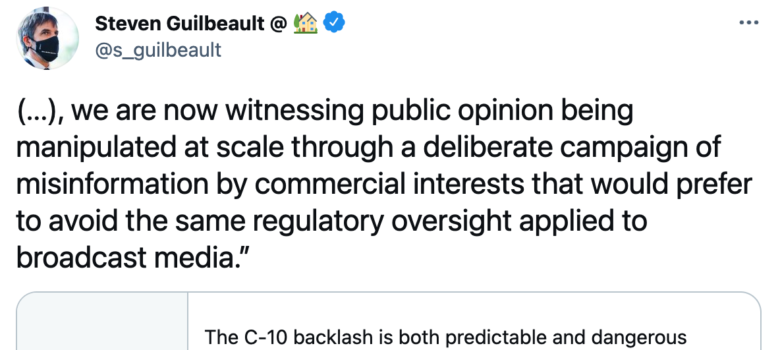
Last night, Canadian Heritage Minister Steven Guilbeault posted a remarkable tweet that should heighten concerns about Bill C-10, forthcoming online harms legislation, and the government’s intent with respect to free speech. In the weeks since it opened the door to treating all user generated content as a “program” subject to CRTC regulation, there has been mounting public criticism and concern about the implications for free speech. While the tech companies have remained relatively silent, Canadians have been speaking out. Those voices now include the Government of Saskatchewan, with Minister of Justice Gord Wyant writing to Guilbeault to urge the federal government to stop Bill C-10 from proceeding or amend it to ensure that “all creative Internet content generated by Canadians will be exempt from any regulatory supervision by federal government agencies.”
Given the opposition – as well as Guilbeault’s well-documented disastrous interviews on CBC and CTV – one would have thought the Minister would be seeking to assuage public concern. Instead, Guilbeault took to Twitter last night to suggest that the public anger over Bill C-10 was a matter of “public opinion being manipulated at scale through a deliberate campaign of misinformation by commercial interests that would prefer to avoid the same regulatory oversight applied to broadcast media.”
Over the past few weeks of intense Bill C-10 debate, nothing has left me angrier or more concerned than this tweet. First, the conspiracy theory amplified by Guilbeault is plainly wrong and itself quite clearly misinformation. The concerns regarding the bill have been backed by law professors, experts, Justice Ministers, former CRTC chairs, and hundreds of others. To claim this is a tech-inspired misinformation campaign lends support to the view that Guilbeault still does not understand his own bill and its implications. Moreover, not only have the tech companies remained relatively quiet, but most did not even appear before the Heritage Committee as part of its study. To suggest that having largely ignored the bill, the companies are now engaged in some grand conspiracy is lunacy.
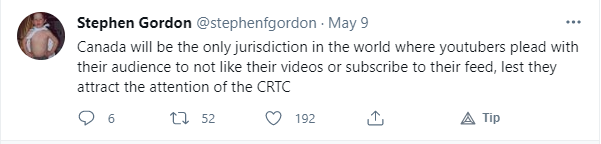
One of the fun notions of C-10 is having some sort of popularity cut-off for regulation to kick in … the more popular your online output becomes, the closer you’ll get to having one of Justin’s CRTC apparatchiks censoring your work:
May 7, 2021
Scott Alexander reviews David Harvey’s A Brief History Of Neoliberalism
[Update: In the comments, “gunker” explains that this is another of Scott’s reader-contributed book reviews, not one of his own work. My apologies for the mistake.] After a quick rundown of the conventional explanation for the decline and fall of the comfortable post-WW2 US economy in the 1970s, Scott gives an overall appreciation of Harvey’s arguments:
… This treatment is almost the opposite of the way ABHoN describes events. Telling the story this way makes me feel like Jacques Derrida deconstructing some text to undermine the author and prove that they were arguing against themselves all along.
Harvey is an extreme conflict theorist. The story he wants to tell is the story of bad people destroying the paradise of embedded liberalism in order to line their own pockets and crush their opponents. At his best, he treats this as a thesis to be defended: embedded liberalism switched to neoliberalism not primarily because of sound economic policy, but because rich people forced the switch to “reassert class power”. At his worst, he forgets to argue the point, feeling it so deeply in his bones that it’s hard for him to believe anyone could really disagree. When he’s like this, he doesn’t analyze any of the economics too deeply; sure, rich people said something something economics, to justify their plot to immiserate the working classes, but we don’t believe them and we’re under no obligation to tease apart exactly what economic stuff they were talking about.
In these parts, ABHoN‘s modus operandi is to give a vague summary of what happened, then overload it with emotional language. Nobody in ABHoN ever cuts a budget, they savagely slash the budget, or cruelly decimate the budget, or otherwise [dramatic adverb] [dramatic verb] it. Nobody is ever against neoliberal reform — they bravely stand up to neoliberal reform, or valiantly resist neoliberal reform, or whatever. Nobody ever “makes” money, they “extract” it. So you read a superficial narrative of some historical event, with all the adverbs changed to more dramatic adverbs, and then a not-very-convincing discussion of why this was all about re-establishing plutocratic power at the end of it. This is basically an entire literary genre by now, and ABHoN fits squarely within it.
Harvey’s theses, framed uncharitably, are:
1. Embedded liberalism was great and completely sustainable. The global economic system collapsing in 1971 was probably just coincidence or something, and has no relevance to any debate about the relative merit of different economic paradigms.
2. Sure, some people say that the endless recession/stagflation/unemployment/bankruptcy/strikes of the 1970s were bad, but those people are would-be plutocrats trying to seize power and destroy the working class.
3. When cities, countries, etc, ran huge deficits and then couldn’t pay any of the money back, sometimes the banks that loaned them that money were against this. Sometimes they even asked those places to stop running huge deficits as a precondition for getting bailed out. This proves that bankers were plotting against the public and trying to form a dystopian plutocracy.
4. Since we have proven that neoliberalism is a sham with no advantages, we should switch back to embedded liberalism.
Let’s go through these one by one and see whether I’m being unfair.
May 5, 2021
Michael Geist’s overview of the federal government’s steady retreat from their 2015 election promises on protecting Canadians’ online privacy and free speech rights
Reposting his most recent Maclean’s article on his website, Michael Geist explains why the federal government’s blatant hypocrisy over Canadians’ rights online has finally gotten many people paying closer attention:
The government had maintained that it had no interest in regulating user generated content, but the policy reversal meant that millions of video, podcasts, and the other audiovisual content on those popular services would be treated as “programs” under Canadian law and subject to some of the same rules as those previously reserved for programming on conventional broadcast services.
The backlash undoubtedly caught the government by surprise, particularly since the policy change garnered little discussion at committee. As the public concern mounted, Guilbeault retreated to his standard talking points about how the opposition parties were unwilling to stand up to the web giants. The arguments fell flat, however, since the new rules were directly targeting users’ content, not the Internet companies. Further, the public reaction pointed to a government increasingly out-of-step with the public, which may support increased Internet regulation, but not at any cost.
The fact that the Liberal government was open to regulating millions of TikTok and Youtube videos was a reminder of how unrecognizable its digital policy approach has become in recent years. The party was elected in 2015 on a platform that promised to entrench net neutrality, prioritize innovation, focus on privacy rather than surveillance, and support freedom of expression. Most of those positions now seemingly reflect a by-gone era.
It is still anxious to demonstrate its tech bona fides, but now progressive policies appear to mean confronting the “web giants” with threats of regulation, penalties, and taxes. Cultural sovereignty has replaced innovation as the guiding principle, which has meant the Minister of Innovation, Science and Industry has been replaced by the Minister of Canadian Heritage as the digital policy lead.
And so for the past 18 months, Guilbeault has been handed Canada’s digital policy keys. In Guilbeault’s eyes, seemingly everything is under threat – Canadian film and television production, a safe space for speech, the future of news – and the big technology companies are invariably to blame.
Few would dispute that an updated tech regulatory model is needed, but evidence-based policies are in short supply in the current approach. For example, the use or misuse of data lies at the heart of the power of big tech, yet privacy reforms have been curiously absent as a government priority. Indeed, Bill C-11 was promoted by Prime Minister Justin Trudeau last November as legislation to give Canadians greater control over their personal information, but under newly named ISI Minister François-Philippe Champagne, it has scarcely been heard from again.
The government has similarly done little to address concerns about abuse of competition, the risks associated with algorithmic decision-making, or the development of a modernized framework for artificial intelligence. Years of emphasis on the benefits of multi-lateral policy development and consensus-building were unceremoniously discarded the recent budget in order to commit to a digital services tax in 2022 that could spark billions in tariff retaliation. In fact, the US-Canada-Mexico Trade Agreement that the government trumpeted as a major success story restricts Canada’s ability to even establish a new liability regime for technology companies.


