Quotulatiousness

June 20, 2021

Is racism a bigger problem than terrorism?

Filed under: Britain, Law, Media, Religion — Tags: , , , , — Nicholas @ 03:00

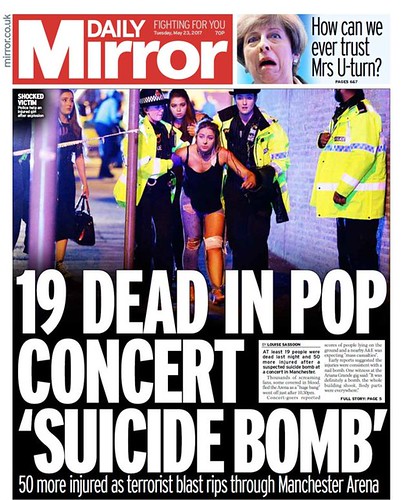
With Americans being urged to report on “radicalized” friends and family by the government and white supremacy being called the greatest threat, have we reached the point that being seen as racist is worse than allowing a terrorist to kill many people? The inquiry into the Manchester Arena bombing shows that’s exactly the state most of the western world is in:

“Manchester Arena Bomb (22 May 2017) – Daily Mirror – 19 dead in pop concert ‘suicide bomb'” by Bradford Timeline is licensed under CC BY-NC 2.0

The independent inquiry into the Manchester Arena bombing of May 2017, in which 22 pop fans were killed by an Islamist extremist, has published the first volume of its report. It makes for chilling reading. The inquiry has found there were numerous “missed opportunities” to confront Salman Abedi, the bomber, and potentially stop him from detonating the device in his rucksack. Most chilling of all is the reason given by one of the key security guards on patrol that evening as to why he failed to question Abedi. He was worried, he said, that asking a brown-skinned man why he was hanging around the arena might be construed as racist.

Take that in. There was a very shifty-looking young man around the foyer and mezzanine of the Manchester Arena towards the end of an Ariana Grande concert, carrying a “bulging” rucksack so large he “struggled” under the weight of it, and a security guard was reluctant to confront him lest he be accused of racism. In the words of the report, this was a significant “missed opportunity”. The “inadequacy” of the security guard’s response to the presence of a highly suspicious individual was one of the many misjudgements made on that black, fateful night, the report says. Is it possible that the fear of being thought of as racist is screwing up everyday life, and even hindering sensible action in threatening situations?

To be clear, the security guard who was cagey about questioning Abedi is not responsible for the failure to stop Abedi from detonating his device. The first volume of the inquiry’s report – which covers security at and around the arena on the night of 22 May 2017 – criticises certain individuals, including the security guard, for not doing their jobs diligently enough. But it says that it was the organisations responsible for security at the arena – the arena’s own security firm and also the British Transport Police – that were “principally” to blame for the “missed opportunities”. It also makes the reasonable point that it is impossible to know what would have happened if Abedi had been confronted. It proposes that there may still have been loss of life – if, for example, he had detonated his device while being questioned – but that it would have been less severe than the horrors that shortly unfolded.

It is disturbing to read the list of “missed opportunities”. Abedi was in the arena for more than an hour and a half before he detonated his bomb. He arrived at 20.51 and blew himself up at 22.31, as the concert attendees started to leave. In that time, this young man with a massive rucksack was seen by numerous people. He was described by some of them as “nervous” and “fidgety”. He looked out of place – his age “meant that he did not fit the demographic of a parent waiting for a child”, as the inquiry says. And yet as a result of individual and organisational failure – including, the inquiry says, insufficient training of the security guards on duty that night – the message didn’t get through that there was a fidgeting, agitated man with a bulging rucksack hanging around for 90 minutes at the exit area of a venue that was largely packed with children and teenagers.

Remarkably, some people at the arena who saw Abedi thought to themselves that he was a suicide bomber. Christopher Wild and his partner, Julie Whitley, who were picking up Whitley’s daughter, discussed the possibility that Abedi had a bomb in his rucksack. Wild actually did confront Abedi and asked him what was in his bag. Abedi nervously brushed him off. Wild reported his concerns to security guards at 22.15 – 16 minutes before the explosion – but he was “fobbed off”. Another parent said the security guards were “really quite dismissive” of Wild’s concerns. It is deeply disturbing that parents at the arena rightly suspected Abedi was a bomber and yet nothing was done to challenge or remove him.

QotD: Cargo cult thinking in education

Filed under: Education, Politics, Quotations, USA — Tags: , , , , , , — Nicholas @ 01:00

There are a lot of things that set the groundwork for this, and I am not an expert on post-modernism and critical race theory. But one factor that is not often credited is a cargo cult mentality. Folks look at successful white people and observe they all went to college, and then infer that if we just get all the black kids into college, they will be successful too. Their resulting plan is to reduce or eliminate standards that are perceived to be keeping black kids out of college.

The problem of course is that college is not the cause of prosperity, but a marker (with prosperity) of other traits — focus on long-term goals, discipline, hard work, and yes knowing 2+2=4. This sort of woke BS just makes it worse, because it attacks the real roots of prosperity. There are real barriers to poor blacks achieving prosperity — eg how do you focus on long-term goals when you don’t know where you are sleeping tonight or when you have no role models who do so — but the purity and objectivity of math is not among these.

This sort of cargo cult thinking can be seen all the time in Progressive economic proscriptions. The government push for home ownership is another — middle class people own homes so if low income people owned homes they would become middle class. Now, this has a bit of accuracy in that, like the stock market, the elite have goosed the housing market to always go up. But leaving that aside for a moment, owning a home vs renting is a terrible decision for many people — it piles on a lot of financial risk but perhaps more importantly it limits geographic mobility which used to be critical to lower-income people improving their lot.

Warren Meyer, “Are the Woke a False Flag Operation of White Supremacists?”, Coyote Blog, 2021-02-16.

June 11, 2021

Latin and Greek are the next sacrifices to the great god Antiracism

Filed under: Education, History, Politics, USA — Tags: , , , , — Nicholas @ 03:00

In the latest edition of It Bears Mentioning, John McWhorter considers the Princeton University classics department decision to get rid of the requirement for students to read classic texts in the original languages:

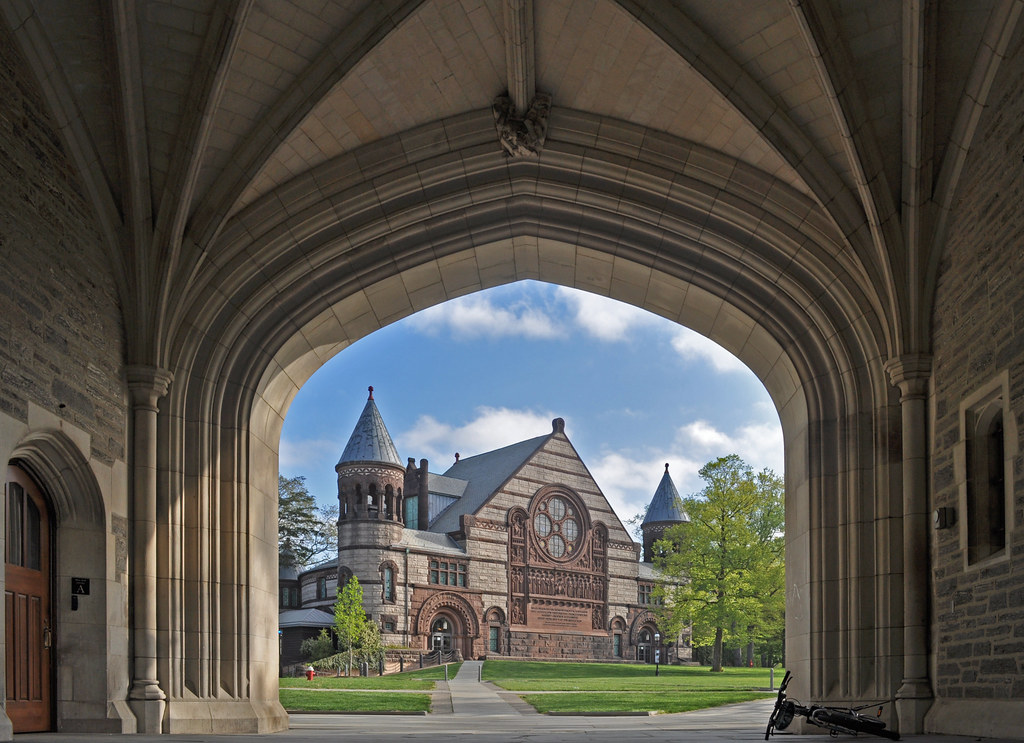
“USA – New Jersey – Princeton” by Harshil.Shah is licensed under CC BY-ND 2.0

I have written recently about the Princeton classics department’s decision to eliminate the requirement that students engaging closely with Latin and Greek texts be able to … read them in Latin and Greek. The new idea is that the department will attract more majors by opening up to ideas from students who may be full of beans but just not inclined to tackle complex, ancient languages. And sub rosa, the idea is clearly – as we can see from words in the official statement like underrepresented, perspectives, and experiences – that of especial interest will be black students, especially in light of today’s racial reckoning which the department openly acknowledges was the primary spur for this change.

My disappointment with this decision is because it is part of a tradition of arguments that we do black people a favor by exempting them from certain kinds of faceless, put-up-or-shut-up challenges to entry. Back in the aughts, the classic example was brilliant, fierce black lawyers confidently arguing that because black firefighter applicants don’t do as well on the entrance exams required for the job, the exams are racist and should be eliminated. More recently there has been the idea that if black kids are rare at top-ranked public schools in New York City like Stuyvesant because few excel on the standardized test one must ace to be admitted, then the solution is to eliminate the test as “racist”. The Princeton decision is a variation: to get black kids into classics, it’s supposedly immoral to expect them to master the intricacies of Latin and Greek, languages which I suppose we can see as foreign, “white” to them as well. Rather, they must be admitted in shining expectation that their class comments will be bracingly “diverse” in good old English.

My Atlantic colleague Graeme Wood is more sanguine about the Princeton decision. He argues sagely that a certain kind of student happens to enjoy working their way through languages like Latin as a kind of puzzle (I openly admit being that type), but that there are others who don’t go in for that particular task and yet are itching and well-equipped to engage and analyze classical texts regardless. Graeme notes that we do not consider it an educational tragedy that specialists in English history are not required to be able to read Old English. (Although I wonder if this analogy would hold if the idea were someone specializing in England of the first millennium, where all of the relevant linguistic matter was in Old English [and Latin].)

I can go with him here to an extent. On the one hand, as I have argued here, to engage work only in translation is, of course, to lose a lot. Yet, in making that argument here, I was referring to my own reading War and Peace in English, as I myself was not inclined to hack through it in Russian (although my being black was not the reason for this disinclination [couldn’t help it!]). The question is how important we consider that loss to be.

Having no facility in languages myself, I’m more sympathetic to the students’ viewpoint than I might otherwise be, but depending on someone else’s translation of the text being studied has unexpected risks, as Sarah Hoyt explained from her own translation studies:

The discussion […] reminded me of when I was sixteen and embarked on a class called “Techniques of Translation”.

Although I had studied French and English and German, the translations I’d done so far were of the “I took the pen of my neighbor” variety. I thought the class would teach me to smooth out the sentence to “I took my neighbor’s pen” and that would be that.

I was wrong. Oh, it taught that also, but that was a minor portion of it. The class mostly hinged on the moral, ethical and — most of all — professional dilemmas of being a translator. I know any number of you are translators, formal or informal, but any number of you are also not. So, for the ones who are not, let me break the news with my usual gentleness:

There is no such thing as translation.

The French have a proverb “to translate is to betray a little” — or at least that’s the closest meaning in English. It’s fairly close to the true meaning, but slightly askew, of course. Every language is slightly askew to other languages.

The idea that there exists in every language a word that is exactly the equivalent of other languages is sort of like assuming that aliens will — of course — live in houses, go to school, ride buses, understand Rebecca Black’s “Friday”. [This was originally written in 2011.]

Language is how we organize our thoughts, and each word, no matter how simple, carries with it the cultural freight and experience of the specific language. Oh, “mother” will generally mean “the one who gave birth to” — except for some tribal, insular cultures where it might mean “the one who calls me by her name” or “my father’s principal wife” — but the “feel” behind it will be different, depending on the images associated with “mother” in the culture.

So, when you translate, you’re actually performing a function as a bridge. Translation is not the straightforward affair it seems to be but a dialogue between the original language and the language you translate into. If you’re lucky, you meet halfway. Sometimes that’s not possible, and you feel really guilty about “lying” to the people receiving the translation. When on top of language you need to integrate different cultures and living systems (which you do when translating anything even an ad) you feel even more guilty, because you’re going to betray, no matter how much you try. At one point, a while back, I had my dad on one phone, my husband on the other, and I was doing rapid-fire translation about a relatively straight forward matter. And even that caused me pangs in conscience, because my dad simply doesn’t understand how things are done here. I had to approach his experience and explain our experience in a way he wouldn’t think I was insane or explaining badly. That meant a thousand minor lies.

June 10, 2021

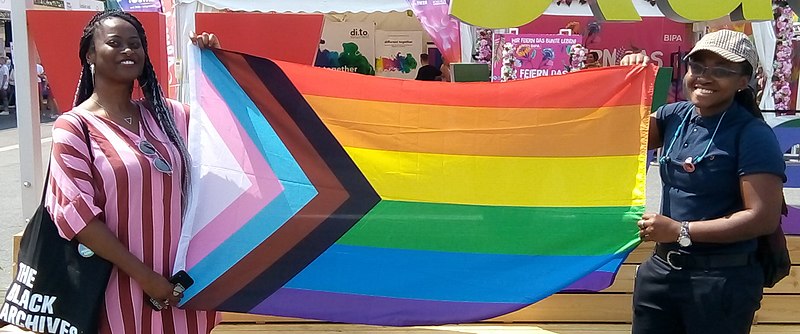
“That’s a nice Pride flag you’ve got there. Be a shame if something were to happen to it …”

Filed under: Media, Politics, USA — Tags: , , , — Nicholas @ 03:00

In The Line, Allan Stratton argues against replacing the common “rainbow” Pride flag with a new “Progress” variant:

Two people at EuroPride 2019 in Vienna holding an LGBTQ+ pride rainbow flag featuring a design by Daniel Quasar; this variation of the rainbow flag was initially promoted as “Progress” a PRIDE Flag Reboot.
Photo by Bojan Cvetanović via Wikimedia Commons.

Question: What do the following have in common: A hammer and sickle, a Union Jack, five interlocked rings, a Black fist, a cross, a Star of David, and the Rainbow flag?

Answer: They are internationally recognized symbols. Not spring fashions. Not cool memes. No. Symbols that communicate across all languages and countries in the world.

That’s what’s so infuriating about the push by hashtag activists to replace the Rainbow flag with the so-called “Progress flag”. The Progress flag takes the pink, blue, and white stripes of the trans flag, adds black and brown stripes for race, turns those five stripes into a chevron tipped on its side, and ploughs it into the rainbow in an eleven-colour pile-up. It’s a regressive, ill-considered mess that looks like a child’s Crayola box.

Naturally, it’s the creation of a Portland designer who whipped it off one night while suffering insomnia. The story of Daniel Quasar (ze/them) and their flag is a real-life satire, featuring moxie, hustle, viral posts and a Kickstarter campaign. Ze and their (not surprisingly) all-white team have leveraged ze’s design into Quasar Digital, a company that sells Progress flags, pins, patches, T-shirts, tank tops, notebooks, clutch bags, coffee mugs, stickers, slappers, socks and more, individually and in bundles.

Marketed with the trendy buzzwords progress, diversity and inclusion, the Progress flag has been a viral hit with woke straights and nouveau queers as well as corporate PR departments at places like Goldman Sachs and TD Bank, who signal virtue while screwing customers of every gender. But by separating specific races and a single identity from the rainbow, the Progress flag creates divisions, hierarchies and exclusions. And it trashes the power and weight that a 43-year-old symbol of hope and strength gives to people worldwide who continue to be imprisoned, beaten and murdered for being LGBT+.

[…]

Slapping the “Progress” chevron on the Rainbow is like slapping the fleur de lys on the Maple Leaf. It creates resentment and division to the sole benefit of performative social climbers keen to wave their Alphabet status and cachet. Step outside the West to see what it really means to have people out to “deny your very existence”. To trade the Rainbow, the symbol of our suffering and resilience, for a viral craze is bourgeois privilege at its self-indulgent worst.

June 6, 2021

George Orwell’s “Politics And The English Language” remains the best guide to writing non-fiction

Filed under: Politics, USA — Tags: , , , , , — Nicholas @ 05:00

Despite pulling most of his writing behind a paywall, I still get the occasional “Weekly Dish” post excerpt from Andrew Sullivan, including his homage to the still-relevant Orwell essay “Politics and the English Language”:

From time to time, I make sure to re-read George Orwell’s classic essay, “Politics And The English Language“. It remains the best guide to writing non-fiction, and it usually prompts a wave of self-loathing even more piercing than my habitual kind. What it shows so brilliantly is how language itself is central to politics, that clarity is as hard as it is vital, and that blather is as lazy as it is dangerous. It’s dangerous because the relationship between our words and our politics goes both ways: “[The English language] becomes ugly and inaccurate because our thoughts are foolish, but the slovenliness of our language makes it easier for us to have foolish thoughts”. We create language and language creates us. If the language is corrupted, so are we.

Near the end of the essay, Orwell lists a few rules to keep writing clear, accessible and meaningful:

    i. Never use a metaphor, simile or other figure of speech which you are used to seeing in print.

    ii. Never use a long word where a short one will do.

    iii. If it is possible to cut a word out, always cut it out.

    iv. Never use the passive where you can use the active.

    v. Never use a foreign phrase, a scientific word or a jargon word if you can think of an everyday English equivalent.

    vi. Break any of these rules sooner than say anything outright barbarous.

Originality, simplicity, brevity, active verbs, everyday language, decency: as simple as it is very, very hard. It’s a relief in a way to recall that Orwell thought things were pretty damn shitty in his day as well, but the more you read broadly across most elite media platforms these days, the more similar it all sounds. To reverse Orwell’s virtues: so much of it is repetition, complexity, length, passive verbs, endless jargon, barbarism.

I was just reading about the panic that occurred in the American Medical Association, when their journal’s deputy editor argued on a podcast that socio-economic factors were more significant in poor outcomes for non-whites than “structural racism”. As you might imagine, any kind of questioning of this orthodoxy required the defenestration of the deputy editor and the resignation of the editor-in-chief. The episode was withdrawn from public viewing, and the top editor replaced it with a Maoist apology/confession before he accepted his own fate.

But I was most struck by the statement put out in response by a group called “The Institute for Antiracism in Medicine”. Here it is:

    The podcast and associated promotional message are extremely problematic for minoritized members of our medical community. Racism was created with intention and must therefore be undone with intention. Structural racism has deeply permeated the field of medicine and must be actively dissolved through proper antiracist education and purposeful equitable policy creation. The delivery of messages suggesting that racism is non-existent and therefore non-problematic within the medical field is harmful to both our underrepresented minoritized physicians and the marginalized communities served in this country.

Consider the language for a moment. I don’t want to single out this group — they are merely representative of countless others, all engaged in the recitation of certain doctrines, and I just want an example. But I do want to say that this paragraph is effectively dead, drained of almost any meaning, nailed to the perch of pious pabulum. It is prose, in Orwell’s words, that “consists less and less of words chosen for the sake of their meaning, and more and more of phrases tacked together like the sections of a prefabricated hen-house.”

It is chock-full of long, compounded nouns and adjectives, riddled with the passive voice, lurching and leaning, like a passenger walking the aisle on a moving train, on pre-packaged phrases to keep itself going.

Notice the unnecessary longevity: a tweet becomes an “associated promotional message”. Notice the deadness of the neologisms: “minoritized”, “marginalized”, “non-problematic”. As Orwell noted: “the normal way of coining a new word is to use a Latin or Greek root with the appropriate affix and, where necessary, the -ize formation. It is often easier to make up words of this kind (deregionalize, impermissible, extramarital, non-fragmentatory and so forth) than to think up the English words that will cover one’s meaning.” Go back and see if you can put the words “minoritized” or “non-problematic” into everyday English.

Part of the goal of this is political, of course. The more you repeat words like “proper antiracist education” or “systemic racism” or “racial inequity” or “lived experience” or “heteronormativity”, the more they become part of the landscape of words, designed to dull one’s curiosity about what on earth any of them can possible mean. A mass of ideological abstractions, in Orwell’s words, “falls upon the facts like soft snow, blurring the outlines and covering up all the details.”

Then this: “Racism was created with intention.” Abstract noun, passive voice, vague meaning. Who “created” it? What was the intention exactly? Hasn’t racist tribalism been a feature of human society for tens of thousands of years? They never say. Or this phrase: “purposeful equitable policy creation”. Again: what are they talking about? It is as vague as “doing the work” — and as deliberate as the use of a highly contested term like “structural racism” to define objective reality. These are phrases not designed to say anything real. They are phrases designed to send a message of orthodoxy, and, as Orwell also noted, “orthodoxy, of whatever colour, seems to demand a lifeless, imitative style”. Try reading Slate or Vox or the Huffington Post: the tedium you feel is the tedium of a language rendered lifeless by ideology.

June 3, 2021

John McWhorter on Affirmative Action

Filed under: Education, History, USA — Tags: , , , , , , — Nicholas @ 03:00

In the latest post at It Bears Mentioning, John McWhorter outlines the history of Affirmative Action in American schooling and explains why it’s no longer doing anything useful and should be re-oriented to actually help disadvantaged students of all races:

John McWhorter’s Twitter thumbnail image

I do not oppose Affirmative Action. I simply think it should be based on disadvantage, not melanin. It made sense – logical as well as moral – to adjust standards in the wake of the implacable oppression of black people until the mid-1960s.

When Affirmative Action began in the 1960s, largely with black people in mind, the overlap between blackness and disadvantage was so large that the racialized intent of the policy made sense. Most black people lived at or below the poverty line. Being black and middle class was, as one used to term it, “fortunate”. Plus, black people suffered open discrimination regardless of socioeconomic status, in ways for more concrete than microaggressions and things only identifiable via Implicit Association Testing and the like. In a sense, black people were all in the same boat.

Luckily, Affirmative Action worked. By the 1980s, it was no longer unusual or “fortunate” to be black and middle class. I would argue that by that time, it was time to reevaluate the idea that anyone black should be admitted to schools with lowered standards. I think Affirmative Action today should be robustly practiced — but on the basis of socioeconomics.

A common objection is that this would help too many poor whites (as if that’s a bad thing?). But actually, brilliant and non-partisan persons have argued that basing preferences on socioeconomics would actually bring numbers of black people into the net that almost anyone would be satisfied with.

I’m no odd duck on my sense that Affirmative Action being about race had passed its sell-by date after about a generation. At this very time, it had become clear, to anyone really looking, that the black people benefitting from Affirmative Action were no longer mostly poor – as well as that simply plopping truly poor black people into college who had gone to awful schools had tended not to work out anyway. It was no accident that in 1978 came the Bakke decision, where Justice Lewis Powell inaugurated the new idea that Affirmative Action would serve to foster “diversity”, the idea being that diversity in the classroom made for better learning.

I highly suspect that most people have always had to make a slight mental adjustment to get comfortable with this idea, as standard as it now is in enlightened discussion. Do students in classes with a certain mixture of races learn better? Really? Not that there might not be benefits to students of different races being together for other reasons. But does diversity make for better learning? Has that been proven?

As you might expect, it has not – and in fact the idea has been disproven, again and again. No one will tell you this when the next round of opining on racial preferences comes about. But this doesn’t mean it isn’t true.

May 30, 2021

New frontiers in cultural appropriation

Filed under: Politics, USA — Tags: , , , , , — Nicholas @ 05:00

John McWhorter considers the notion that white people shouldn’t be allowed to use “black” words and phrases because it’s a form of cultural appropriation and therefore another aspect of white supremacy:

Screencap from NBC’s Saturday Night Live highlights for “Gen-Z Hospital” skit.

A little while ago, a Saturday Night Live skit depicted a multiracial group of teens communicating in what was depicted as “Gen Z slang”, with the doctor they were talking with having to “translate” his thoughts into it to communicate with them.

A lot of people didn’t like it, because the slang in question was mostly of Black English origin. The complaint is that the skit was denying the black roots of these terms, and instead ascribing them to Americans in general – i.e. (shudder) white persons. As in, yes – the problem was cultural appropriation.

As I write, there are still people grousing on social media in the wake of that skit about whites “stealing” black language, with a leitmotif being that we should apply our N-word taboo more widely. To wit, many propose that whites should not be allowed to use Black English terms because they are “ours”. Many who haven’t outright proposed this give the notion Likes, which suggests that a considerable group of people – and from what I can see, quite a few of them are white – concur with this line of reasoning.

Let’s break this down. To do so we must understand the sorts of terms in question. The SNL skit included, among others, yo, bestie, vibes, feels for feelings, salty for irritated, bro / bruh and no cap for “I’m not kidding” (as in, these are actual whole gold teeth, not golden caps on teeth).

Is there a case that you should only use these terms if you’re black, or that if you use them as a white person you should “do the work” of thinking hard about whether or not it is problematic (blasphemous)?

May 29, 2021

Justin Trudeau is clearly not concerned about China or Chinese involvement in Canadian affairs

Filed under: Cancon, China, Government, Health, Science — Tags: , , , , , — Nicholas @ 05:00

In The Line, Jen Gerson outlines the PM’s latest display of insouciance in regard to anything involving China, their ruling Communist party, or the Chinese military:

The Globe and Mail reported last week that Canada’s top infectious disease research centre, the National Microbiology Laboratory in Winnipeg, had hosted and otherwise collaborated with guest researchers and scientists from China — including some with links to that country’s military or government. O’Toole asked about this in the House, and Trudeau gave a very routine Trudeauvian non-answer. O’Toole and other Tories kept up the questioning, Trudeau eventually responded with this (as per Hansard): “Mr. Speaker, we have always and will always take this threat seriously. Public safety officials have met with more than 34 universities to help them keep their research safe. In 2020, CSIS engaged more than 225 different organizations, including universities, to ensure that they were aware of foreign threats. I also want to mention that we are seeing a disturbing rise in anti-Asian racism. I hope that my Conservative Party colleagues are not raising fears about Asian Canadians.”

Sigh. Where do we begin?

First of all, though this may shock our readers, the Sun papers, and its columnists, have been known to exaggerate their criticisms of the PM. The PM gave a more substantive answer than Lilley gave him credit for. You can disagree with the PM — see below! — without getting cute with what he actually said. The racism line was dumb, and shitty. It was beneath the PM and unfair to the legitimate questions that were being asked. Trudeau shouldn’t have said it, and he was right to get called out for it.

So yes, a dick move by the PM — in a hundred years, maybe one of his descendants can apologize for it. But let’s not take our eye off the ball.

Trudeau’s answers were more than Lilley suggested, but they’re still not good enough. O’Toole and the Conservatives are onto something. China’s ruling regime is aggressive, brutal, and thuggish. They’re a threat to security abroad, they’re committing outright crimes against humanity against their own religious minorities, they’ve crushed Hong Kong underfoot, and they’re actively hostile to Canada. None of this is racist to note.

And yet our federal Liberals remain alarmingly unable to admit any of this. We don’t buy that it’s just a matter of political expediency, an awkward but necessary consequence of the ongoing detention of the two Michaels. Hell, we wish that the Liberals were just being publicly cautious with their real views on Beijing while remaining clear-eyed about the threat behind closed doors. The evidence continues to suggest that the federal Liberals, from Trudeau on down, remain hopelessly naïve about the nature of Beijing’s rulers, even as more and more of our allies are getting real about what the next generation or two of geopolitics is gonna look like for the Western alliance. (Which Canada remains a part of, whether Trudeau likes it or not.)

The growing tensions with a rising China are a big deal. It is only going to become a bigger deal. The Liberals need to get with the program. We hope to see more on this across the Canadian media — and hopefully it’s a bit more useful and productive than what the Sun ran with this week. The Liberals look terrible on this file already for entirely legitimate, serious reasons. We don’t need to pop our aging joints as we stretch and contort ourselves to make it seem so.

May 27, 2021

Charles Darwin “was 19th century euro upper class. It’d be stranger if he WASN’T ‘problematic’ by today’s standards”

Filed under: Books, Britain, History, Science — Tags: , , — Nicholas @ 03:00

Robert Wright argues that Charles Darwin is not guilty of the most recent set of sins alleged in an editorial in the journal Science:

Charles Darwin, circa 1874.
Photo by Leonard Darwin via Wikipedia Commons.

The author of the Science piece (which ran under the heading “editorial”) was Agustin Fuentes, an anthropologist at Princeton. He contended that Darwin’s 1871 book The Descent of Man “offers a racist and sexist view of humanity” and is “often problematic, prejudiced, and injurious”. So students who are taught that Darwin was a great scientist “should also be taught Darwin as an English man with injurious and unfounded prejudices that warped his view of data and experience”.

There are things about this essay I like. For example: I understood it, which distinguishes it from many things written by contemporary anthropologists. Also, it’s hard to argue with its claim that Darwin said things about race and gender that would get a guy canceled today. (As one person put it on Twitter, Darwin, “was 19th century euro upper class. It’d be stranger if he WASN’T ‘problematic’ by today’s standards”.)

Still, Fuentes does seem to have gotten one important thing about Darwin wrong. And in the process he demonstrated a kind of confusion I consider so pernicious that I’ve decided to add it to my list of “existential psychological threats”, along with such cognitive biases as attribution error and confirmation bias (“existential” in the sense of grave threats to Planet Earth, a subject pondered often in this newsletter).

Here’s the confusion: In reading Darwin, Fuentes fails to distinguish between an explanation of something and a justification of something.

I want to emphasize that, though Fuentes seems to be on the left, this conflation of explanation and justification is common on both sides of the political spectrum. If you suggest that some terrorist act committed in America was a response to America’s bombing of majority-Muslim countries, someone on the right may respond to this attempt to explain why the terrorism happened by saying, “Oh, so you’re justifying the slaughter of Americans? You’re excusing the terrorists?”

The fact that I’m often on the receiving end of this kind of question may be one reason I’ve come to see this conflation — let’s call it the “explain/excuse conflation” — as something whose extinction would be a wonderful thing. But there’s another reason: I believe this conflation is a genuine impediment to solving some of the world’s biggest problems. If people get shouted down every time they start a sentence with, “I think the reason bad thing X happened is …” then we’ll have trouble understanding enough about bad things to reduce their frequency.

Here’s the assertion by Fuentes that, so far as I can tell, is flat-out wrong. After (accurately) writing that Darwin “asserted evolutionary differences between races,” he adds: “He went beyond simple racial rankings, offering justification of empire and colonialism, and genocide, through ‘survival of the fittest.'”

H/T to Colby Cosh for the link.

May 25, 2021

John McWhorter’s new book announced

Filed under: Books, Media, Politics, USA — Tags: , — Nicholas @ 05:00

Following on to his Nine Nasty Words, which just became a New York Times best-seller (somewhat to his surprise), John McWhorter’s next book will be Woke Racism: How a New Religion Has Betrayed Black America from Random Penguin:

That manuscript will be released as a book by Portfolio (also a Penguin Random House imprint) in October. It will be published under a new title: Woke Racism: How a New Religion Has Betrayed Black America.

I should mention that the often sharp and insightful subscriber comments, as well as the brilliant editorial counsel of Bria Sandford at Portfolio, have already made Woke Racism significantly different from the The Elect excerpts. Woke Racism will express what the Substack excerpts did and then some. It will still analyze Third-Wave Antiracism as a religion. It will still make legions of black people see me as a race traitor. It will still make legions of white people see me as a tragically deluded white supremacist with brown skin who merits dismissal and ostracization.

And amidst all of that, it will still represent what I consider the most pro-black book I have ever written.

But this does mean that from now on, my Substack “newsletter” will be exactly that. I am glad many of you have enjoyed my posts here beyond the The Elect excepts, and they will continue, at the rate of once or twice (and I hope, more often, twice) a week. I have loved communicating to you as well as the feedback I get. Let’s keep this going.

Only: get “The Elect” as a real book, Woke Racism, around Halloween. Here, get my take on things as they happen, unfiltered.

“Latinx”

Filed under: Politics, USA — Tags: , , — Nicholas @ 03:00

At Ace of Spades H.Q., Buck Throckmorton explains why “Latinx” is a silly word-like mouthing that we should not encourage anyone to use:

Original image from inclusion.uoregon.edu

“Latinx” is a white supremacist term used by racist, left-wing Americans to marginalize Spanish speakers and to disparage their culture.

The term “Latinx” itself is overtly racist. Not only is Latinx not a Spanish word, it can’t even be pronounced in Spanish. How offensively paternalistic maternalistic mxternxlistic(?) is it of liberal, white Americans to rip the identity from brown-skinned people, and then impose on them a new identity, which is an unpronounceable collection of consonants … and THEN demand that Hispanics identify by this new, unpronounceable English word.

One of the embarrassing bigotries of left-wing, monolingual, white supremacists is that they are oblivious to the fact that the entire Spanish language is gendered. Because of their racist ignorance of the Spanish language, they don’t understand that the gender of a noun is indicated by the definite article (“el” / “la” ) or the indefinite article (“un” / “una” ) more so than if a word ends in “a” instead of “o”.

American lefties have changed exactly one Spanish word to gender-neutral, and with that done, they now demand that Spanish speakers somehow converse like weird, left-wing English-speakers and remove all gender from their speech. This simply isn’t possible in Spanish. So, in effect left-wing white supremacists are shaming Spanish language speakers for using their native language. I can’t believe such ugly bigotry exists in 21st Century America.

In addition, by imposing the transsexual term “Latinx” on all Hispanics, left-wing whites are asserting that all Hispanics are transsexuals, which could be culturally insulting. A liberal, white American woman may think she is complimenting an Hispanic man by telling him that she sees him as no different than a castrated cross-dresser, but he probably won’t take it as a compliment. But to be fair, most of the men in the orbit of woke white women would be flattered to be thought of that way.

May 23, 2021

Portlanders “have developed rituals, devotions, and self-criticisms to fight ‘systemic racism’ and ‘white supremacy'”

Filed under: Education, Politics, USA — Tags: , , , , — Nicholas @ 05:00

In City Journal, Christopher F. Rufo talks about the “child soldiers of Portland”:

“Portland, Oregon” by Ben Amstutz is licensed under CC BY-NC 2.0

There are only a few places on earth where radicals and their children ritualistically burn the American flag and chant “Death to America”: Tehran, Baghdad, Beirut, Kabul, Ramallah — and Portland, Oregon.

The City of Portland, a cloud-covered metro on the south bank of the Columbia River, has become known for its political protesters. Anarchists, Communists, ecofascists, and various other agitators regularly denounce the police, politicians of both parties, and America itself, and flag-burning has become part of the protesters’ liturgy. Last summer, protesters associated with Antifa upped the ante with chants of “Death to America” and participated in months of violent protests to avenge the death of George Floyd while he was in police custody in Minneapolis. Children as young as four marched with the crowd to the federal courthouse, raising the Black Power fist and chanting “Fuck the Police!”

Famously the “whitest city in America”, Portland has become the unlikely headquarters of race radicalism in the United States. The city has elevated white guilt into a civic religion; its citizens have developed rituals, devotions, and self-criticisms to fight “systemic racism” and “white supremacy”. The culminating expression of this orthodoxy is violence: street militias, calling themselves “antiracists” and “antifascists”, smash windows and torch the property of anyone transgressing the new moral law.

We might be tempted to dismiss this as the work of a few harmless radicals “keeping Portland weird”, but in recent years, their underlying ideology on race has become institutionalized. The city government has adopted a series of Five-Year Plans for “equity and inclusion”, shopkeepers have posted political slogans in their windows as a form of protection, and local schools have designed a program of political education for their students that borders on propaganda.

I have spent months investigating the structure of political education in three Portland-area school districts: Tigard-Tualatin School District, Beaverton School District, and Portland Public Schools. I have cultivated sources within each district and obtained troves of internal documents related to the curriculum, training, and internal dynamics of these institutions. We can best understand the political education program in Portland schools by dividing it into three parts: theory, praxis (or practice), and power. The schools have self-consciously adopted the “pedagogy of the oppressed” as their theoretical orientation, activated it through a curriculum of critical race theory, and enforced it through the appointment of de facto political officers within individual schools, generally under the cover of “equity and social-justice” programming. In short, they have begun to replace education with activism.

The results are predictable. By perpetuating the narrative that America is fundamentally evil, steeping children in race theory, and lionizing the Portland rioters, they have consciously pushed students in the direction of race-based “revolution”. In the language of the Left, the political education programs in Portland-area districts constitute a “school-to-radicalism pipeline”: a training ground for child soldiers. This is not hyperbole: some of the most active and violent anarchist groups in Portland are run by teenagers, and dozens of minors were arrested during last year’s riots. These groups have taken up the mantle of climate change, anticapitalism, antifascism, and Black Lives Matter — whatever provides a pretext for violent “direct action”.

Contrary to those who believed that the end of the Trump presidency would bring a “return to normalcy”, the social and political revolution in Portland has only accelerated under President Joe Biden. On Inauguration Day, teenage radicals marched through southeast Portland, smashing the office windows of the state Democratic Party and unfurling large banners with hand-painted demands: “We don’t want Biden, we want revenge”; “We are ungovernable”; “A new world from the ashes”. Intoxicated by revolution and enabled by their elders, Portland’s kids are not all right.

May 19, 2021

Racism of the US Army – Fighting for Freedom? – WW2 Special

Filed under: History, Military, USA, WW2 — Tags: , , , — Nicholas @ 04:00

World War Two
Published 18 May 2021

While the US was fighting for freedom and liberty across the globe, their home country and armies are still deeply segregated, causing minority groups in the USA to fight not one but two wars.
(more…)

May 18, 2021

In future, if you’re on TV, do not use your hands or fingers under any circumstances … OK?

Filed under: Media, Politics, USA — Tags: , , , , , — Nicholas @ 03:00

… as a Jeopardy contestant has recently discovered, there is no hand gesture that is free from the slightest hint of an emanation of a penumbra of white supremacy:

And then they came for the integers. The small social universe surrounding the syndicated game show Jeopardy has been boiling over for the past month because of a hand gesture made by a contestant, Kelly Donahue, at the outset of the April 27 episode. Donahue, returning to the show as a three-time winner, held up three fingers in a gesture of triumph and tapped his chest with them. He had done something similar on earlier episodes, flashing a “one” after his first win and a “two” after his second.

Needless to say, he had to be immediately chastised. A small number of conspiracy theorists felt his use of three fingers to represent three of something “resembled very closely a gesture that has been co-opted by white power groups, alt right groups and an anti-government group that calls itself the Three Percenters.”

That quote is taken from an indignant open letter signed by almost 600 members of a private Facebook group for former Jeopardy contestants, in which the signers demanded to know why Donahue’s heinous Nazi code, “whether intentional or not,” hadn’t been cut from the show before broadcast.

[…]

Smith’s column doesn’t actually get around to answering the question, although with a little legwork he was able to establish that the Facebook group had actually approached the Anti-Defamation League (ADL), the Jewish grandparent of all anti-hate monitoring groups, for advice. The ADL told the addled ex-contestants, “Uh, it looks to us like the guy’s just making a three,” which led some in the internet cocoon to conclude they were being “gaslit.” Smith also talked to members of the Facebook group who knew that their fellow contestants were talking twaddle and fomenting harassment of an innocent man, but who were afraid to contradict the leaders of a witch hunt, lest the purifying fire be kindled beneath their own tootsies.

Smith does identify a crucial point in what is otherwise a workaday tale of cancel culture run mad. Former Jeopardy contestants, every last three-o-phobic one of them, are people selected specifically for high intelligence and wide knowledge. This didn’t make the signers of the letter any less obtuse, or any more resistant to a complicated conspiracy theory. It was their knowledge of disaggregated facts that made them susceptible in the first place.

May 17, 2021

An older BBC dramatization on the slave trade that seems to have gone down the memory hole

Filed under: Africa, Britain, History, Media, USA — Tags: , , , , , — Nicholas @ 03:00

At Samizdata, Niall Kilmartin wondered why the BBC hadn’t gotten around to showing a 1970s historical series through the year-and-more of the pandemic lockdowns. He doesn’t mention the name of the series, and an unusually unhelpful BBC site search didn’t turn up a name but IMDB suggests it was 1975 and the series was called The Fight Against Slavery:

Fifty years ago, the BBC screened a dramatised documentary series about the fight to abolish the slave trade. Even a year of the virus limiting new series, at a time of great BBC eagerness to talk about racism, has not made them screen it again.

– I see one reason why they have not: the series displayed sleazy white slave traders and abusive white slave owners prominently, but it also showed white people eager to end the slave trade and (much worse) black people eager to continue it. It included the king of Dahomey’s threat: “if you do not allow me to sell you my slaves, their fate will be a great deal worse” (a very brief scene of the Dahomey murder spectacle lent meaning to his remark). After abolition was voted, it showed a white slave trader assuring the Dahomans, as a drug dealer might his suppliers, “It is one thing for parliament to pass a law …”, hinting at the Royal Navy’s long and hard campaign to enforce it.

– Only recently did I spot another reason why they would not want to show it again – the scene in which a corrupt old white slave trader warns his young colleague that “it’s more than your life’s worth” to doubt the ability of their slave-selling hosts to count very accurately the quantity of trade goods being handed over in exchange, and to assess their quality knowledgeably. The traders well knew that Africans counted two plus two as four, just as they did. Any trader who imagined that black ability to add diverged enough from white to enable an attempt to short-change them had learned otherwise long before the 1780s.

– The southern Confederacy thought the same. Until its death throes, it forbade enlisting a southern black as a Confederate soldier because, as one Confederate senator put it, “If blacks can make good soldiers then our whole theory of slavery is wrong.” (Perhaps also because even southern white Democrats realised that southern black desire to fight against blacks being freed was likely to be a very minority taste.) But there was one exception. Every regiment had its regimental band, which played to set the pace at the start and end of marches, used trumpets to signal commands in battle – and fought when other duties did not supervene. From its start to its end, Confederate law said any black could enlist as bandsman, with the same pay and perquisites as a white – a very rare example of formal legal equality. (Playing music requires the ability to count time. For the woke, “dismantling the legacy of the Confederacy” apparently includes dismantling its realisation – shared by the Victorian composer Dvorak – that blacks often excelled in music so much as to overcome prejudice against black ability. Today, it’s “racist” to value instrumental skill.)

“Politically correct” has meant “actually wrong” ever since the first commissar explained to the first party comrade that it was neither socialist nor prudent to notice a factual error in the party line. “Structurally racist” is PC’s modern companion. No longer are the woke content merely to imply (“mathematics is racist”, “punctuality is racist”, “politeness is racist”) that blacks can’t count, can’t tell the time and can only behave crudely. They’re starting to say it in words of fewer syllables.

If I’d scrolled down to the comments, I’d have discovered that Natalie Solent had also dug up the name of the series:

Natalie Solent (Essex)
May 10, 2021 at 4:30 pm
Outstanding post, Niall. Was the BBC series you mentioned “The Fight Against Slavery“, written and narrated by Evan Jones? I have not seen it – given that I was ten or eleven in 1975 my parents probably thought I was too young too see it.

However someone called “InternetPilgrim” has put up three videos of the series on YouTube. There is a link to Part I here, Part II here and Part III here, so I will try to remedy that lack soon.

« Newer PostsOlder Posts »

Powered by WordPress