
In a small town, the impulse to assist the poor and disorganized was direct, and the people being helped were known to everyone. Big cities with their concentrated slums of poor immigrants led to social service agencies, funded at first by churches and cities, and then by state and federal governments. As the source of the assistance became impersonal, so did the aid — and the direct contact between those assisting and those assisted declined. Instead of the local church matrons with their bourgeois ideas of proper behavior and work, harassed social workers with enormous caseloads processed cases quickly, and the ideology of government assistance changed so that any behavioral expectation of the client population was viewed as an affront to their dignity.
In time, the government assistance ethos spread to every corner of the country and crowded out the local community services. Meanwhile, locally-controlled schools were gradually taken over by higher levels of government and distant union bureaucracies so that the influence of local parents was minimized. This was viewed as “progressive,” since distant elites thought local school boards and parents were too parochial and backward to be entrusted with decisions, and would get in the way of teaching the correct materials.
The incorrect application of emotions of sympathy and support to faceless categories of people like “the poor” and “the undocumented” removes any possibility of understanding the real situations of each of the category’s members. A hazy idealized poor family is envisioned, then a response that would be appropriate if that family lived next door (help them!) leads to voting for politicians that offer new programs to help “people like that.” By misapplying family and community feelings to higher levels of government, voters put into place a bureaucracy that misses most of the social signalling features of local groups and takes tax money to grow itself, crowding out local groups (and the valuable social signals that maintained bourgeois standards.)
Jeb Kinnison, “Real-life ‘Hunger Games'”, According to Hoyt, 2015-09-25.
July 26, 2017
QotD: From local private charity to national government social program
July 23, 2017
Requiem for an SJW heavyweight
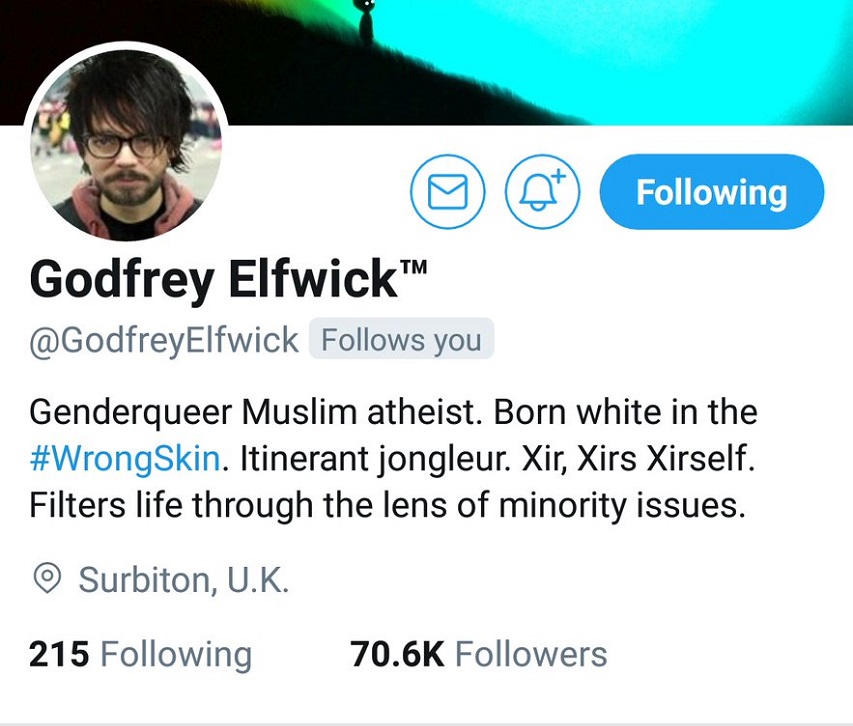
James Delingpole on the Twitter phenomenon Godfrey Elfwick:
Linda Sarsour/Sally Kohn/Graham Linehan/Caroline Criado Perez/Gary Lineker/Diane Abbot/someone from the Guardian/a guy from CNN/ISIS has said something really hateful, stupid, and wrong on Twitter. Again.
Back in the day, this would have been a cause for celebration, not dismay. Why? Because within milliseconds of their fatuous utterance tainting the ether with its embittered, warped, politically correct insanity it would have been endorsed – and simultaneously destroyed – by the mighty Godfrey Elfwick.
Godfrey Elfwick was the funniest and best thing on Twitter.
To have your tweet singled out for praise by Godfrey was the kiss of death. It meant that you were a humorless, self-righteous, deluded, smug, sanctimonious, insufferable Social Justice Warrior. Just like Godfrey purported to be.
Which is why, of course, Twitter had to silence him. Sure, the official reason given for Godfrey’s permanent ban was because he had broken Twitter’s terms of service – apparently having upset a millionaire potato chip salesman called Gary Lineker.
QotD: Australian aboriginal languages
Little moments like that kept adding up, incrementally nudging me away from leftism but not yet to full conversion. In 1988, watching a John Pilger documentary with lefty friends, another such moment occurred.
Pilger, as usual, was complaining about colonialism and racism and Aboriginal injustice, so naturally we — uniformly white, urban and privileged — were lapping it up. The documentary then shifted to the former nuclear testing site at Maralinga in South Australia, where seven British bombs were detonated in the 1950s and 1960s. Pointing to a sign warning of radiation danger, Pilger observed mournfully that it was written in several languages — “but not in the Aboriginal language”.
Startled by this claim, I looked around the room. Everyone was silent, including a few who had studied Aboriginal history in considerable depth, and so must have known that Pilger’s line was completely wrong. So I just said it: “There is no single Aboriginal language. And no Aboriginal language has a written form.”
I didn’t last long with that bunch of friends, either. Small note to self: my comrades will deny even their own knowledge if it runs counter to a preferred leftist version of events.
Tim Blair, “The Setting of Their Leftist Suns”, Quadrant, 2017-06-17.
July 20, 2017
Deirdre McCloskey defines libertarianism as “Liberalism 1.0”
The introduction to her “Manifesto for a New American Liberalism, or How to Be a Humane Libertarian” [PDF] states:
I make the case for a new and humane American “libertarianism.”
Outside the United States libertarianism is still called plain “liberalism,” as in the usage of the president of France, Emmanuel Macron, with no “neo-” about it. That’s the L-word I’ll use here. The economist Daniel Klein calls it “Liberalism 1.0,” or, channeling the old C. S. Lewis book Mere Christianity on the minimum commitments of faith (1942-44, 1952), “mere Liberalism.” David Boaz of the Cato Institute wrote a lucid guide, Libertarianism — A Primer (1997), reshaped in 2015 as The Libertarian Mind. I wish David had called it The Liberal Mind.
In desperate summary for you Americans, Liberalism 1.0 is Democratic in social policy and Republican in economic policy and non-interventionist in foreign policy. It is in fact mainly against “policy,” which has to be performed, if there is to be a policy at all, through the government’s monopoly of violence. (To confirm this experimentally, try not paying your taxes; then try to escape from prison.) Liberals 1.0 believe that having little or no policy is a good policy.
That does not put the Liberals 1.0 anywhere along the conventional one-dimensional left-right line, stretching from a compelled right-conservative policy to a compelled left-”liberal” policy. The real liberals instead sit happily up on a second dimension, the non-policy apex of a triangle, so to speak, the base of which is the conventional axis of policy by violence. We Liberals 1.0 are neither conservatives nor socialists — both of whom believe, with the legal mind, as the liberal economist and political philosopher Friedrich Hayek put it in 1960, that “order [is] … the result of the continuous attention of authority.” Both conservatives and socialists, in other words, “lack the faith in the spontaneous forces of adjustment which makes the liberal accept changes without apprehension, even though he does not know how the necessary adaptations will be brought about.”
Liberals 1.0 don’t like violence. They are friends of the voluntary market order, as against the policy-heavy feudal order or bureaucratic order or military-industrial order. They are, as Hayek declared, “the party of life, the party that favors free growth and spontaneous evolution,” against the various parties of left and right which wish “to impose [by violence] upon the world a preconceived rational pattern.”
At root, then, Liberals 1.0 believe that people should not push other people around. As Boaz says at the outset of The Libertarian Mind, “In a sense, there have always been but two political philosophies: liberty and power.” Real, humane Liberals 1.0 […] believe that people should of course help and protect other people when we can. That is, humane liberals are very far from being against poor people. Nor are they ungenerous, or lacking in pity. Nor are they strictly pacifist, willing to surrender in the face of an invasion. But they believe that in achieving such goods as charity and security the polity should not turn carelessly to violence, at home or abroad, whether for leftish or rightish purposes, whether to help the poor or to police the world. We should depend chiefly on voluntary agreements, such as exchange-tested betterment, or treaties, or civil conversation, or the gift of grace, or a majority voting constrained by civil rights for the minority.
To use a surprising word, we liberals, whether plain 1.0 or humane, rely chiefly on a much-misunderstood “rhetoric,” despised by the hard men of the seventeenth century such as Bacon and Hobbes and Spinoza, but a practice anciently fitted to a democratic society. Liberalism is deeply rhetorical, the exploration (as Aristotle said) of the available means of non-violent persuasion. For example, it’s what I’m doing for you now. For you, understand, not to you. It’s a gift, not an imposition. (You’re welcome.)
July 19, 2017
Devising a constitutional role for aboriginal groups in Australia
Peter O’Brien outlines the proposal to incorporate a permanent formal role for Australian aborigines in the federal government:
It started out as a limited initiative to ‘recognise’ indigenous Australians as the first occupiers of this land in the Constitution. At least that’s what Tony Abbott, an enthusiastic supporter even before he became Prime Minister, thought. And initially, it was thought that a majority of Australians could support such an initiative.
But since that time it has morphed into something much more sinister as revealed by the final report of the Referendum Council.
[…]
Since all government policy specifically relating to indigenes is intended to eliminate discrimination and disadvantage so that they may take their place, as equal in material and aspirational aspects, as they already are in citizenship, then, presumably, one of the aims of the advisory body should be to work towards its own demise. If it is embedded in the Constitution, that will never happen. It will linger on, a cancerous sinecure rather like the HRC, manufacturing reasons to justify its own existence.
Liebler gives the game away before the starting gun has even gone off:
“The option of inserting a new provision into the Constitution prohibiting discrimination on the basis of race was determined by delegates to be a “shield”, vulnerable to interpretation by the High Court, whereas a voice to parliament was viewed as a “sword”.”
Since when has a Constitution been envisaged as a mechanism to provide to some of its citizens a “sword” to use against others of its citizens. Yet Leibler disparages the idea of a ‘shield’ in the Constitution since it is vulnerable to interpretation by the High Court. By using the term ‘vulnerable’ he tacitly acknowledges that activist judges can distort the original good intent of legislation.
If that is true for the ‘shield’ of a Constitutional anti-discrimination provision, why would it not be equally true of the ‘sword’ of an advisory body. Here is one example of logic that might be employed thus:
“If the intent of the framers of this provision was that the Indigenous Council should have no powers other than advisory, why was it put into the Constitution rather than just left to legislation?”
If this sounds simplistic, it is, but it wouldn’t take a legal mind much more sophisticated than mine to turn it into the kind specious nonsense with which we are constantly bombarded by members of the Legal Left.
There is no doubt that the ultimate aim of the activists is sovereignty, because they have repeatedly told us so. This advisory body, this sword’, is the mechanism by which they hope to progress their aim. Some, on the Left, will argue that the activists only represent a hard core and that, if the indigenous population get their way on this, the majority will be happy, that will be an end to the matter and the remaining activists will become irrelevant. Yeah, sure! Pretty much the same way that jihadis have become irrelevant.
July 18, 2017
QotD: Where progressives and libertarians agree
Actually, there are four other big areas where the two ideologies converge.
1. Immigration. Immigration restrictions deprive billions of basic liberties, impoverish the world, and do so on the backs of the global poor, most of whom are non-white.
2. Occupational licensing. Licensing laws bar tens of millions of people from switching to more lucrative and socially valuable occupations, all to benefit richer insiders at the expense of poorer outsiders.
3. War, especially the War on Terror. Since 2002, the U.S. has literally spent trillions fighting the quantitatively tiny problem of terrorism by waging non-stop wars in the Middle East. We don’t know what the Middle East would have looked like if the U.S. had stayed out, but it’s hard to believe it would be worse. And there’s no end in sight.
4. The criminal justice system, especially the War on Drugs. Hundreds of thousands of non-violent people, disproportionately poor and non-white, are in prison. Why? To stop willing consumers from doing what they want with their own bodies.
These four issues are so massive, you’d expect a staunch progressive/libertarian alliance would have been forged long ago. But of course it hasn’t. Why not? Some progressives flatly disagree with one or more of these policies; see Bernie contra open borders. But the bigger stumbling block is that progressives place far lower priority on these issues than libertarians. That includes war, unless the Republicans hold the White House.
Why not? I regretfully invoke my Simplistic Theory of Left and Right. The heart of the left isn’t helping the poor, or reducing inequality, or even minority rights. The heart of the left is being anti-market. With some honorable exceptions, very few leftists are capable of being excited about deregulation of any kind. And even the leftists who do get excited about well-targeted deregulation get far more excited about stamping out the hydra-headed evils of market.
Bryan Caplan, “Progressive/Libertarian: The Alliance That Isn’t”, Library of Economics and Liberty, 2017-06-22.
July 17, 2017
Some candidates to be added to the Catallaxy Files style guide
A selection of terms used at Australia’s Catallaxy Files to be considered for addition to their in-house style guide:
Allaholic Frenzy. (1) – “Display of highly agitated behaviour, often in a crowd setting. Can be triggered by almost anything that can be interpreted as disrespectful to Islam, esp. cartoon. Frequently seen in Islamic areas such as Pakistan, Afghanistan and England. Patients suffering from Allaholic Frenzy are advised to be cautious when operating machinery or motor vehicles. References. (1). Diagnostic and Statistical Manual of Mental Disorders, 6th Edition: DSM-6.”
Alutheran – “A forward-thinking progressive who thinks a man should be judged by the colour of his skin, not the content of their character, and who is thus supercilious and condescending towards an Alt-Racist.”
Billabonk – “Having a root next to a waterhole.”
Bolshie Ballet – “The carefully choreographed routine employed by all leftards when the hideous crimes and failures of socialism are brought up. Responses such as “but that wasn’t real communism”, “but Scandinavia” and “but outside forces” are very common.”
Dingoat.
Dodgeridoo – ‘A fake Aboriginal artefact.”
Faulty-cultural – “A multi-cultural society gone wrong which tends to occur after importing a backward 7th Century culture incompatible with your societal norms.”
Faulti-culti – “(See above). A particular culture that, once introduced, will eventually corrupt and destroy a host culture.”
Fauxboriginal – “White people who claim aboriginality based on a fraction of their DNA or ‘how they feel.”
Fauxb/Fauxbia/Fauxbic – “The dishonest and slanderous labelling of an individual who publicly questions the narrative imposed by a self-selected moral elite regarding specific favoured groups which share characteristics such as race, gender, sexual preference, religious or cultural belief. e.g. Homofauxbia, Islamofauxbia. The labelled individual is portrayed as suffering from an irrational fear, akin to a dangerous mental illness, of one or more of the favoured groups, thus consciously separating themselves from the societal ‘norm’ and voluntarily surrendering any rights, protections or privileges. This pathologising of dissent is analogous to the historical concept of outlawry, wherein an individual was legally stripped of the rights enjoyed by fellow citizens as the result of an alleged crime committed by the accused. Said outlaw could be ‘hunted’ using means not otherwise permitted by the contemporary legal system. The Post-Rational branding of an individual as a ‘fauxb’ presently submits them for hunting (by any and all persons who express an interest) in a reputational and social sense only, though Self-Elected Retributive Justice Magistrates (SERJMs, or simply RJMs) aim to progress legislation to the point where the hunting of fellow humans is again sanctioned by society as a whole, or its unelected representatives.”
July 8, 2017
Demonizing the Koch brothers
Julian Adorney on the amazing contrast between the way the Koch brothers actually spend their money and the demonic sins they are regularly accused of by progressives:
The Koch Brothers recently announced a $21 million anti-poverty program in Dallas, designed to reduce gang violence and encourage young entrepreneurs. But their efforts to end poverty are unlikely to earn credit from progressives, who frequently demonize the family. Senate Majority Leader Harry Reid routinely blasts them for, “crooked works” and “nefarious actions”; and when Charles and David Koch donated $100 million to New York-Presbyterian Hospital, leftists demanded (unsuccessfully) that the hospital return the gift.
Why are the Kochs so often criticized by the left, while far less progressive individuals are given a free pass?
Unlikely Alliances
The Koch brothers have spent at least $1.5 billion working to advance traditionally progressive causes. They have funded public television, museums, and hospitals. They contributed $25 million to the United Negro College Fund, the nation’s largest minority education group. The donation offers scholarships and support for historically black universities.
Politically, the Kochs have pushed for criminal justice reform. The brothers worked with Van Jones on his Cut50 project, which aims to cut America’s incarcerated population in half over the next ten years. The Kochs have partnered with the American Civil Liberties Union and the Center for American Progress to reduce prison populations and enact more humane criminal sentencing. And in 2011, the National Association of Criminal Defense Lawyers gave Charles Koch its annual Defender of Justice award.
But criminal justice reform is far from the only progressive cause the Kochs have embraced. They publicly oppose corporate tax breaks and subsidies — including the ethanol subsidies that boost their bottom line.
In spite of this, many progressives disdain the Kochs as far-right extremists. On his Senate website, Bernie Sanders claims that the goal of these, “right wing billionaires” is to, “repeal every major piece of legislation … that has protected the middle class, the elderly, the children, the sick, and the most vulnerable in this country.” The Koch’s high-profile efforts to help the most vulnerable population in the nation, those victimized by the criminal justice system, receives no mention.
[…]
Progressives vilify the Kochs for the same reason that many venerate FDR: politics encourages black and white formulations. Prominent Democrats lambast the Kochs as ill-intentioned billionaires, and the specter of the Kochs has played heavily in Democratic fundraising attempts. Fear motivates, and boogeymen inspire fiercer opposition than the complicated reality of the Koch brothers.
Similarly, Democrats may turn a blind eye to FDR’s anti-progressive actions because they don’t wish to tarnish one of their own. FDR’s economic policies owe much to fascism: Roosevelt admitted that he was, “deeply impressed by what [Mussolini] has accomplished.” Roosevelt’s National Recovery Administration stated it more directly: “The Fascist Principles are very similar to those we have been evolving here in America.”
This similarity is easy to brush off if FDR is perceived as a leftists titan, because in the public eye progressives and fascists are diametrically opposed. It is harder to ignore when one accepts that FDR’s record on human rights was only a few degrees better than Mussolini’s.
July 4, 2017
QotD: Direct democracy and representative democracy
Progressives generally are sentimentally supportive of direct local politics — they especially favor the ideals of the New England town meeting, where everyone who showed up had a say. The reason why this form of local government was generally abandoned is that it is simply too time-consuming for larger communities, and allows the motivated minority to capture control. Election of representatives was an advance which allowed voters to go about their own lives most of the time while exerting control through their representative, who had time to understand the issues thoroughly and vote in council in the best interests of the voters. Being in the 1% of local voters who cares deeply enough about an item to show up at a public meeting about it does not mean your feelings about it are more important than the views of those who didn’t show up; the once-every-few-years election is more likely to reflect what most voters want.
Jeb Kinnison, “Real-life ‘Hunger Games'”, According to Hoyt, 2015-09-25.
June 17, 2017
QotD: The Progressive comedy pause
Tell a joke to a liberal. Between your punchline and his laughter, there is a Progressive Comedy Pause. In this second or two, the liberal will process the joke to make sure he is allowed to laugh.
Is that joke racist? He mentioned Obama, but didn’t make light of him, so to speak. He also mentioned Michelle, but I didn’t notice sexism. Is it dismissive of the LGBTQIA community? Latinos? Muslims? Vegans? Will this joke hurt progressive causes? Will my laughter trivialize oppressed communities? Will I appear intolerant? I think it’s okay if I laugh. Yes, I’ll laugh now to signal my appreciation and to indicate that I’m not a joyless liberal scold.
“Ha ha.”
I first noticed the Progressive Comedy Pause while sharing my hilarity at office staff meetings. The majority would laugh but the committed lefties would stare blankly, each eye like that spinning wheel your smartphone shows while an app is loading. (The PCP might be why progressives just hoot and clap at Bill Maher’s jokes; the laughter reflex is considered problematic.)
[…]
It’s harder to laugh when you’re scared and much of the left is terrified. They know that an inappropriate chuckle, the wrong tweet, or last year’s term for an aggrieved minority can lessen their standing with progressive peers, if not get them fired from a job. Lefties also have turned the negative of humorlessness into the positive of moral superiority. Sniffing “That’s not funny!” at an inoffensive Caitlyn Jenner joke signals that you are more evolved than the average cis-het-white-oppressor. The same people who laughed at Dana Carvey’s “Church Lady” now aspire to be her.
Jon Gabriel, “Jerry Seinfeld and the Progressive Comedy Pause”, Ricochet, 2015-06-08.
June 16, 2017
June 8, 2017
QotD: The Cloud People look out upon the land of the Dirt People
In the French Revolution, after the White Terror, the Constitution of 1795 established The Directory. This was the start of a new phase in which the lower classes were mostly ignored, as the new ruling class consolidated its power. That may be what we are seeing with our managerial class as they largely ignore the results of recent elections and enforce discipline in their own ranks. It’s not a perfect analogy, but it may be useful in analyzing what we are seeing.
There is another angle, one you can see in this Scott Alexander post a few weeks ago, that was popular with the cognoscenti. Star Slate Codex is popular with people who not only think they are smart, but see themselves as steely-eyed reason machines. It’s also popular with people who like to believe stuff like this:
Yes, CNN leans liberal, but it’s not as liberal as FOX is conservative, and it’s not as open about it – it has a pretense of neutrality that FOX doesn’t, and although we can disagree about how realistic that pretense is I think few people would disagree that the pretense is there. Nor is there a liberal version of FOX that lacks that pretense of neutrality.
That’s a very believable argument if you have no familiarity with cable news or you look out at the world from deep inside the Progressive fever swamps. It is the sort of thing people write when they want to seem like the people who write things like this. It’s the worldview of someone confusing a mirror with a telescope. To Alexander, Fox is way out on the fringe and they are brazen about it. CNN, on the other hand, is maybe a little biased, but they are good people, my people, so they mean well.
Of course, there is the omnipresent hive mindedness. The world for Scott Alexander, and most of his readers, is a world of black hats and white hats. There are those inside the walls, the people of light, and the people outside the walls, in the outer darkness. The people outside are an undifferentiated collection of eyes peering out of the darkness, which is why they routinely misuse works like “conservative” when describing the people outside the walls. Words like “conservative” and “right-wing” just mean the outsiders.
The Z Man, “Ruminations On The Way Down The Mountain”, The Z Blog, 2017-05-24.
June 3, 2017
Secondary boycotting
Ace describes the way political groups can exercise economic pressure on third parties to influence or even to eliminate media voices with which they disagree:
The tactic being objected to — and I didn’t make this clear yesterday — is the tactic created by the left called a “secondary boycott.”
None of you can “boycott” Rachel Maddow — you’re already not watching her, and you enjoy not watching her, and you recommend not watching her to all of your friends.
Well, leftists realized that about Rush Limbaugh — you can’t boycott that which you already don’t use — and so invented the tactic of telling advertisers: Stop advertising on his show or we will boycott you.
That’s the “secondary” part of the boycott: You’re not boycotting the primary target. Which is obviously your right. You’re now conducting political campaigns against businesses to make them stop advertising, and get the show taken off the air entirely.
This is why Cars Dot Com and USAA boycotted Hannity — because the losers of this movement decided to start pressuring the advertisers to stop advertising there.
This is what I mean by “constant political campaigns being run against people not actually running for any office.” These are actual political campaign style efforts — with websites, donor buttons, etc. — being run not just during campaign season, and not just against an office-seeker, but 24 hours a day, seven days a week, fifty two weeks a year, against just about anybody.
Note that the fringe actors who do this shit do so to raise money. They’re fringe, and they’re not going to be hired by actual political campaigns, for the most part.
But they have to make money, don’t they?
So they just decided to invent their own political campaign which is not time-limited as ordinary campaigns are, and just buckrake endlessly to get this or that person silenced.
And they’ve had some success.
Even where they don’t succeed outright, they make themselves permanent residents of your mind: Because they’ve taught you to fear them.
This is what I’m objecting to — I understand that there will be politics in politics, but I don’t want fundraising political campaigns constantly running against anyone the left doesn’t like making all of lives, every single day, every single hour, part of and endless and ugly War of All Against All just so some energetic obsessives can make a dime and feel powerful.
June 2, 2017
Schrödinger’s Paris Accords
As Ace points out, the Paris Accords apparently have the same kind of precarious state of existance as Schrödinger’s cat:
The central argument of Trump's rationale is false. The agreement is non-binding. Nothing in it stops the US from doing whatever it wants.
— Daniel Dale (@ddale8) June 1, 2017
This is a common signal from Progressive Messaging Central. The claim being made is that the Paris Accords are simultaneously an ineffectual nothingburger of meaningless symbolism, so why even bother withdrawing?, but also are The Only Thing That Will Keep the Earth from Literally Dying.
Obviously, these can’t both be true at once: Either the Accords do something, or they do not do something. They cannot exist in a state of quantum indeterminacy where they remain in a mixed probabilistic waveform of both “doing something” and “doing nothing” until a Progressive Political Physicist takes a measurement of which state is most helpful for his Religious Fervor at this moment.
This one isn’t over the top, so much as stupid.
Update: Brendan O’Neill posted this to Facebook:
The demented response to Trump pulling out of the Paris Agreement — the world is doomed, our children will die, people will drown, locusts will swarm, fires will burn, and any criticism whatsoever of climate-charge alarmism is a species of heresy that must be destroyed — has reminded me why environmentalism is my least favourite ideology. Fearful, shrill, anti-progress, censorious and shamelessly marshalling sad-eyed children to the political end of stymying economic growth despite the fact that half of humankind still lives in poverty: greens are the worst. Trump is a rank amateur in the politics of fear in comparison with these bourgeois moaners and misanthropes.
May 28, 2017
The Handmaid’s Tale, is indeed timely, but not the way they mean
In the Los Angeles Times earlier this month, Charlotte Allen discusses the “timeliness” of Hulu’s TV adaptation of Margaret Atwood’s novel The Handmaid’s Tale:
I’ve lost count of the articles I’ve read about Hulu’s adaptation of Margaret Atwood’s 1985 novel The Handmaid’s Tale that used the word “timely.” Timely, that is, in the sense of the presidency of Donald Trump. Here’s just a short list of print and online outlets where the T-word appears in connection with the re-creation of Atwood’s fictional America turned into a grim theocracy called Gilead that treats women like breeding cattle: the Hollywood Reporter, the Washington Post, the Guardian, Mother Jones, Harper’s Bazaar, the Daily Beast, Bustle, NPR, and CNN. The 77-year-old Atwood herself chimed in, telling the Los Angeles Times’ Patt Morrison: “We’re no longer making fiction — we’re making a documentary.”
The idea, in these mostly liberal media outlets, seems to be that under President Trump, America has become — or will become terrifyingly soon — a militant Bible-based patriarchy (hello Texas, hello Mike Pence) in which women have no rights, especially no reproductive rights, and are divided into rigidly stratified social classes whose very names give their status away: privileged, churchy Wives at the top, Econowives in the lower social orders, and cook-and-bottle-washer Marthas who do the housework for the Wives and their powerful husbands, the Commanders.
At the very bottom are Handmaids, political pariahs (wrong ideas, such as feminism) who become the literal property of the top-dog men and are forced to bear their children. (The Wives suffer from environmental pollution-related fertility problems.) As the New Republic’s Sarah Jones, one of the “timely” crowd, explains, “Of course, we don’t divide women into classes of Marthas, Handmaids, Econowives, and Wives; we call them ‘the help,’ ‘surrogates,’ the working class, and the one percent.”
At first I scoffed. There couldn’t be any more unlikely a theocrat than Trump, what with his misquotes from the Bible and speculation that he hasn’t been in a church more than twice since the inauguration. But then I realized that the liberal paranoiacs were right. Except not in the way they think. Instead of seeing Atwood’s fictional Gilead as a near-future militant fundamentalist Christian elite dystopia, we should see it as the mostly secularist elite dystopia we live in right now.


