
Ever since Hegel or maybe Plato, statists have been telling a story about government in which government itself is the hero in an epic struggle. At least for Hegel, the state was the mechanism by which God worked out His will. For Marx, the state was an expression of cold immutable forces. For the socialists who followed, control of the state was a kind of MacGuffin but over time it became the hero itself.
When Obama talks about the moral arc of the universe bending towards justice, the physical manifestation of that pie-eyed treacle is always government. When liberals talk about the progress we’ve made as a society, the hero is always the state (and the heroic individuals who bent it to their will). It doesn’t matter that the market, non-state institutions, and heroic individuals tend to solve most of the problems in life; the government is always shoe-horned in as the indispensable author of beneficence.
Of course, the often unstated heroes are the people who put their faith in government. When Obama says, “Government is us,” what he’s really saying is that we can be heroic on the cheap by letting the government do what liberals want. That’s the real moral of their story. And conservatives need to get better at telling a better one.
Jonah Goldberg, “The Goldberg File”, 2015-09-11.
May 18, 2017
May 13, 2017
QotD: Sneering at the “farmers” in fly-over country
If Star Wars was written by today’s establishment, Luke would have to be a girl who suffered oppression by the bigoted farm boys, then escaped to the Empire (which was, of course, politically correct and ruled by wise, learned Socialist oligarchs) to wield its military might against the hicks and unlearned morons of Planet Redneck.
Such disdain is everywhere, now. It’s not hard to find in the media, in entertainment, or social media. Some time ago, I remember watching a Youtube video where a man with a strong Southern accent went to great lengths to demonstrate his education and intelligence, discussing complex matters of science, history, and philosophy in an effort to disprove the notion that a Southern accent somehow implies stupidity. I remember wondering why this was even necessary. I’ve met many intelligent, educated individuals in the South, and I’ve encountered no more idiots here than in the other places I’ve been to. Why would this even have to be disproved?
Then it hit me. The new American myth, carefully constructed by the SJWs and their ilk, is that farmers are stupid. Mechanics are dumb. Plumbers only ply their trade because they are too stupid to take gender studies courses. And since they are all idiots, of course their children must be idiots too. Indeed, they are all far too stupid to be permitted a say in how their own lives are run. As Tom Nichols once explained to me: Americans are too stupid to read maps, so why bother informing them about terrorist incidents? Being something of a Centrist, Tom is more charitable than most of the Leftists, whose disdain is much more direct. To those folks, America (and by extension, Americans themselves) is nothing more than a backward nation full of bigots, greedy thieves, murderers, and utter morons in desperate need of extinction.
[…]
But now, a two and a half centuries later, we’re back to where we started. The anointed, ivory tower aristocrats telling us what’s good for us — when we all know it’s a steaming pile of horse manure constructed solely to fool enough good people to keep the nobles planted atop their wobbly thrones. Their underestimation of the regular folks in the world, the farm boys and plumbers, may be what saves us, in the end. After all, it’s worked for America before, time and time again. It’s why, despite all the agitprop to the contrary, today America still remains the most powerful nation on Earth.
Dystopic, “From Farm to Space: A Lost Cultural Myth”, The Declination, 2017-05-01.
May 10, 2017
BC Greens the biggest winners in provincial election
Jay Currie explains why, even though they didn’t “win” the election, the BC Green Party is the biggest winner from yesterday’s general election in the province:
There are two losers tonight: the Liberals and the NDP. And there is one winner: the Greens. They managed to split the NDP vote and likely cost the NDP a majority government.
However, where the NDP and the Liberals have no obvious room to grow their electorate, the Greens have a very good shot at expanding theirs. The fact is that the people who shop at Whole Foods, send their kids to “French Immersion” if they can’t afford private (not for racist reasons of course) and think recycling is an act of benediction are legion. They used to vote NDP, now they have an alternative.
Andrew Weaver may be a lousy climate scientist but he is not an unintelligent man. He can count (so long as it does not involve climate change time series) and there are six ridings where the Greens came second. A rational, non-coalition, support of the Liberals would let him pass legislation of greater consequence than a ban on mandatory high heels for women in serving jobs. The Liberals, who will likely be reduced to a rural rump despite having likely won the most seats, are basically being elected by BC’s version of “deplorables”. Nice people think they are a bit, well, common.
Dr. Weaver, well educated, Oak Bay resident and articulate guy that he is should be able to target those nice, white, very liberal people and peel them away from both the Liberals and the NDP. Plus, Weaver has the children who have grown up on Green ideology masquerading as education.
One winner tonight: the Greens.
May 2, 2017
Cultural appropriation, to the max!
In the latest issue of Libertarian Enterprise, L. Neil Smith talks about the logical conclusion to the cultural appropriation discussion:
Not all of the transgressions that precious snowflake-thugs accuse real human beings of are sexual in nature. The most ludicrous I’ve heard of is “cultural appropriation”. If I were sitting here, writing this in my sombrero and grass skirt, instead of a t-shirt and jeans, I would be guilty of it. If I adopt any custom, article of clothing, item of cuisine, (yes, chili beans are evil, and kung-pao is beyond the pale) or turn of phrase from another culture (G’day, cobber!), I can be accused — and gotten rid of — by the Cult of Correctness.
But here’s the thing: there is no original American culture. The way we live — pass the spaghetti, please — is made up of bits and pieces from hundreds of different cultures, all mixed delightfully together. I can have Mexican beer — made by German brewers — with my pizza (or kung-pao) and my life is enriched. It is America’s great strength. The leftist crybullies know this, of course. I think it may have been Ayn Rand (we appropriated her from Russia) who pointed out the underhanded collectivist tactic of attacking a person or thing for its virtues.
If I eschew tableware (a French invention, I believe) and knap myself an obsidian knife before dinner, am I appropriating Neanderthal culture?
They don’t give a rat’s ass; it’s just another thing to get people they don’t like with. Whether they know it or not (most likely they do not), their moral exemplars are Pierre-Joseph Proudhon, who infamously said “Property is theft.” and Jean-Jacques Rousseau, who commanded them to “Eat the rich.” So deep and ancient is their resentment of the achievements of others and despite the fact that their ideological leaders have all hypocritically gorged themselves at the public trough, that they’d insanely rather see the right-wing wealthy destroyed than have enough to eat, themselves. […]
Proudhon and Rousseau are bandits on the highway of life, their “philosophies” a crude attempt to render theft respectable. And their vile spawn, Anti-fa, are giving anarchism a bad name. And that is the naked, unvarnished truth. Life is hard enough without trying not to commit “microaggressions” which are simply another way of playing the leftist Gotcha! game with people who actually work — and think — for a living.
April 8, 2017
The “Three Stooges of the Apocalypse”
David Warren takes a well-deserved kick at Lloyd George, Clemenceau, and (especially) Woodrow Wilson:
A century has now passed since President Wilson disowned President Washington’s advice to his successors — to stay out of European conflicts — and war was declared by the United States on Germany. A moral preener, Wilson justified himself by declaring an even more extravagant mission to go with it:
“The world must be made safe for democracy.”
However large, a war is just a war. It should have a beginning and an end. As my old Indian girlfriend explained, “Too much war only leads to peace. Too much peace only leads to war.” As most people prefer peace, most of the time, it is well that war is not a permanent condition. But a war to some idealistic purpose can get very large, and go on for a long time, and morph into conditions which resemble peace, but are not peace. We’ve been making the world safe for democracy for at least a century. By now we have far too much.
[…]
In my view, that Great War, that Totaler Krieg, hasn’t ended yet. The old etiquette, that war was for soldiers — that non-combatants should be non-involved — became a thing of nostalgia. Vast conscript armies had been summoned, and would never be fully demobilized. The men I call the “Three Stooges of the Apocalypse” — Wilson, Lloyd George, Clemenceau — clinched at Versailles this new normal. It was not simply the punitive terms that were imposed on the war’s losers, but a more fundamental reorganization of all national and international affairs: “statecraft” became “policy.”
For Wilson was also the pioneer of progressive schemes to change the American way of life. He was, in some sense, a second Washington, consolidating a second American Revolution that had begun more modestly with Lincoln and the Union victory in the Civil War. America would be recreated, along bureaucratic lines, in a tireless campaign for full secularization, under centralized government control. The general mobilization of the First World War, now in America as well as Europe, created a new opportunity, by accustoming men to following orders; by the propaganda that made them identify with huge abstractions.
This is of course an inexhaustible topic, at which I pick away, in my attempts to explain if only to myself what makes our world so different from all preceding. It embraces more than any single force or event. We must also go back to the Prussian invention of the welfare state, and for that matter to the Gatling gun. Post-modernity is an invention of modernity, as modernity was an invention of the Middle Ages. The contemporary revolution has antecedents that may be found in the Enlightenment and in the Reformation. (What will post-modernity beget?)
March 28, 2017
Champion for Democracy? – Woodrow Wilson I WHO DID WHAT IN WW1?
Published on 27 Mar 2017
Woodrow Wilson, 28th President of the United States, is one of the most controversial characters of his era. His racial views, his view on peace and the post-war world, his decision to go to war with Germany in 1917 are still being debated to this day. We take a look at the life of Wilson to better understand his motivation.
March 23, 2017
The “Resistance” chooses some Nazi-era symbology for self-labelling
Curtis Edmonds shared this on the Facebook Conservative and Libertarian Fiction Alliance page. We really do live in a post-parody world (link is to an archived version of the post):
Shortly after the presidential election, “Trump Nation/Whites Only” was written on the wall outside a majority-immigrant church in Maryland. The response is to either quietly wash the wall or stand against hatred and promote tolerance. “All citizens of good conscious must join the Resistance to Donald J. Trump’s authoritarian administration,” writes public relations consultant Len Stein. To visualize and unite the various resistance groups and present the movement with a unifying symbol, Stein proposes that resisters wear a triangle ‘R’ badge on their sleeves when protesting—immigrants, refugees, people of every ethnicity, religion, sexual orientation or political affiliation. The ‘R’ triangle symbols were designed by Tucker Viemeister. I asked Stein to talk more about this act of resistance.
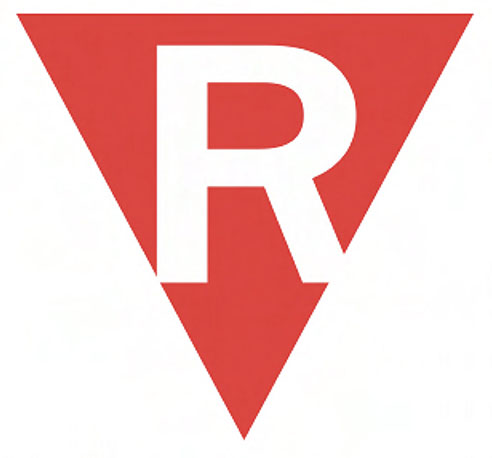
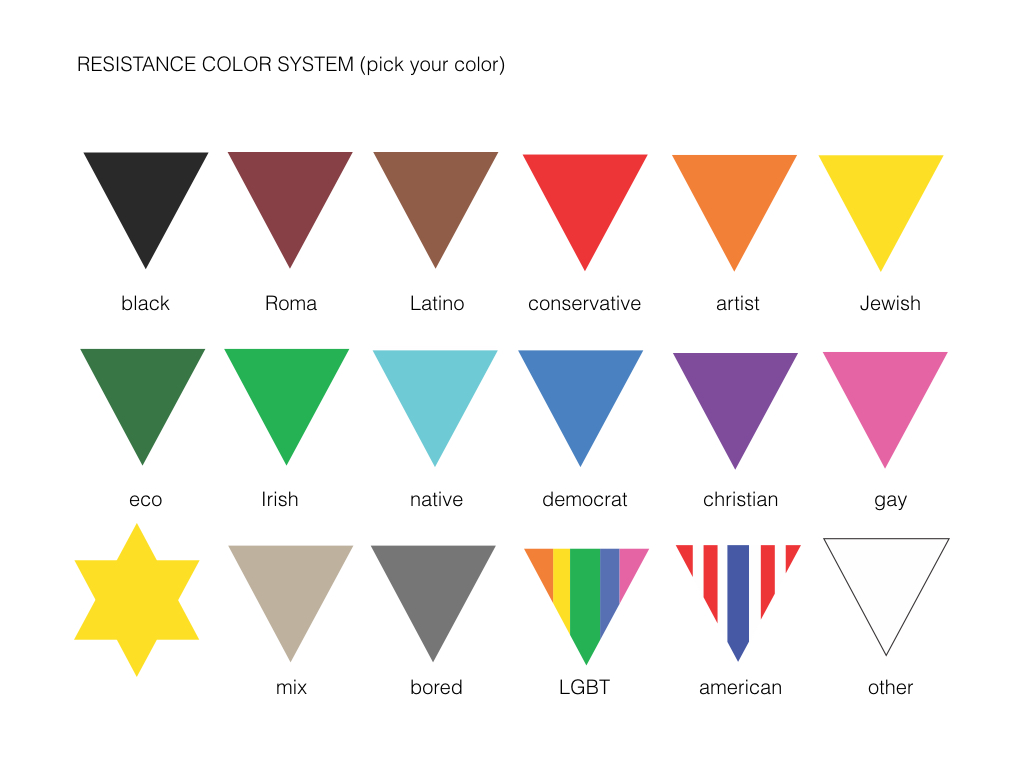
If that one’s not setting off your historical symbol alarm, here are the recommended variations for Trump Resistance folks to display:
March 13, 2017
“Intersectionality” as an Orwellian “smelly little orthodoxy”
Andrew Sullivan is still disturbed by the Middlebury College incident in Vermont, calling it “the latest in the assault on liberal democracy”:
But what grabbed me was the deeply disturbing 40-minute video of the event, posted on YouTube. It brings the incident to life in a way words cannot. At around the 19-minute mark, the students explained why they shut down the talk, and it helped clarify for me what exactly the meaning of “intersectionality” is.
“Intersectionality” is the latest academic craze sweeping the American academy. On the surface, it’s a recent neo-Marxist theory that argues that social oppression does not simply apply to single categories of identity — such as race, gender, sexual orientation, class, etc. — but to all of them in an interlocking system of hierarchy and power. At least, that’s my best attempt to define it briefly. But watching that video helps show how an otherwise challenging social theory can often operate in practice.
It is operating, in Orwell’s words, as a “smelly little orthodoxy,” and it manifests itself, it seems to me, almost as a religion. It posits a classic orthodoxy through which all of human experience is explained — and through which all speech must be filtered. Its version of original sin is the power of some identity groups over others. To overcome this sin, you need first to confess, i.e., “check your privilege,” and subsequently live your life and order your thoughts in a way that keeps this sin at bay. The sin goes so deep into your psyche, especially if you are white or male or straight, that a profound conversion is required.
Like the Puritanism once familiar in New England, intersectionality controls language and the very terms of discourse. It enforces manners. It has an idea of virtue — and is obsessed with upholding it. The saints are the most oppressed who nonetheless resist. The sinners are categorized in various ascending categories of demographic damnation, like something out of Dante. The only thing this religion lacks, of course, is salvation. Life is simply an interlocking drama of oppression and power and resistance, ending only in death. It’s Marx without the final total liberation.
It operates as a religion in one other critical dimension: If you happen to see the world in a different way, if you’re a liberal or libertarian or even, gasp, a conservative, if you believe that a university is a place where any idea, however loathsome, can be debated and refuted, you are not just wrong, you are immoral. If you think that arguments and ideas can have a life independent of “white supremacy,” you are complicit in evil. And you are not just complicit, your heresy is a direct threat to others, and therefore needs to be extinguished. You can’t reason with heresy. You have to ban it. It will contaminate others’ souls, and wound them irreparably.
March 10, 2017
The rise of toxic “intellectual tribalism” on campus
George Leef on how the protests at Middlebury College in Vermont against Charles Murray show just how thin the veneer of civilization has become at America’s institutes of higher learning:
The reason why, I think, is explained by the intellectual tribalism that grips much of America.
I mean that many people label others as either being in their tribe (consisting of people who are righteous and always correct) and the opposing tribe (consisting of people who are evil, stupid, and wrong on everything). Real scholars never impart such ideas because they know that reasonable and moral people can disagree on almost everything. They also know that the only way for civilized people to counter error is through debate; they know that people cannot be persuaded with violence.
Unfortunately, intellectual tribalism is spreading like the Black Death among so-called progressives. Anyone who disagrees with progressive policies is likely to be labeled an enemy, much as Karl Marx labeled everyone who rejected his beliefs a “class enemy.” The more influential such a person is, the more vehement the attacks and hatred against him. Murray, for example, is called a “racist” and “white supremacist” even though he is neither.
(Try this thought experiment. What would have happened if one of the good, liberal students had piped up and asked, “But shouldn’t we find out if this guy really is a white supremacist before we shout him down?”)
And turning to the toxic effects of this indoctrination, one is the growing idea that the enemy tribe must be fought by any means necessary. Not only do evil people like Murray not deserve to be heard, they deserve to be punched.
Professor Michael Munger of Duke University recently commented on this disturbing phenomenon after he discovered a flier on campus. The flier, he wrote, “encouraged students to ‘bash the fash!’ meaning physically assault fascists. The definition of ‘fascist,’ conveniently, appears to be anyone who disagrees with the smothering leftist orthodoxy that the flier-istas embrace.” Just smear your opponents with a nasty name and it’s easy to whip up hatred and violence.
In Orwell’s 1984, Big Brother’s regime utilized the Two Minute Hate against an imaginary villain to maintain support among the people. At Middlebury, it was more like two hours, and the “villain” perfectly real, but the effect was the same. The leftist zealots “won” by preventing discussion and forcing “bad” people to flee in fear.
The veneer of civilization is thin enough under the best of circumstances. Education ought to strengthen it by making people more willing to listen respectfully to others, disagree rationally, and peacefully walk away from intractable disputes. The behavior of the Middlebury mob shows that for a significant number of students, education has taken them away from civilization, putting them back into the mindset of primitive tribalism.
March 8, 2017
“…the anti-fascists look a lot closer [to] Nazi brownshirts than the people they’re trying to stop”
Megan McArdle on the sudden willingness — even eagerness — on the part of progressive activists to move from agitation to literally beating up the objects of their hatred:
Sticks and stones may break your bones, but words will never hurt you. Or so we were told by our mothers. But events on both sides of continent in recent weeks seem to belie that old adage. A new generation of protesters has come to the conclusion that words do hurt — and that therefore, extreme measures, up to and including physical force, are justified to keep them from being spoken.
At Berkeley last month, a riot broke out over a speech planned by Milo Yiannopoulos, a sort of professional conservative troll who worked for Breitbart until a scandal over some hebephilic remarks cost him his job and his book contract. This was not simply setting things on fire or breaking a few windows (though those would have been quite bad enough); multiple people seem to have been beaten by the “antifas” (anti-fascists). In the videos that have been released so far, the anti-fascists look a lot closer [to] Nazi brownshirts than the people they’re trying to stop. There was further violence this weekend in Berkeley at a pro-Trump march.
Then a few days ago, a speech by Charles Murray at Middlebury College in Vermont also turned violent, and a professor was injured as she walked with Murray after his speech. Murray has given his own personal account of what occurred, and a lengthy video of the proceedings is available on the web. They are not as frightening as what happened at Berkeley, but they are plenty horrifying enough: they shouted him down, refusing to allow him to speak, then banged on the building and pulled fire alarms when he was transferred him to a private room to do a streaming talk they were unable to disrupt. Finally, they tried to physically prevent him from leaving.
The fact that two different speeches triggered violence at two different campuses within the space of a month suggests that we may be entering into a new and more dangerous phase of the anti-free-speech movement. Free-speech advocates, particularly the Foundation for Individual Rights in Education, have done a great job pushing back against overweening college administrations that try to curtail the speech of students and professors. But these are actions coming from the students. Who do you sue to keep a mob of students from resorting to the heckler’s veto, or their fists, to combat ideas they don’t like?
As more than a few folks on the right have pointed out, if the “antifa” activists continue translating their distaste for certain words and concepts into actual violence, the right is significantly better armed and nobody in their right mind should want to provoke a descent into reciprocal violence when the other side has all the weapons.
February 25, 2017
QotD: Redefining “White Fragility”
In the spirit of reciprocity, I’ll attempt an alternative, and perhaps more realistic, definition. “White fragility” is the unremarkable fact that people by and large don’t like being slandered as racists and then assigned with some pretentious collective guilt, the supposed atonement for which requires deference to actual racists and predatory hokum merchants.
As Hippogryph notes in the comments, the official definition of “white fragility” looks an awful lot like Kafkatrapping, a dishonest and pathological manoeuvre, a form of emotional bullying, in which the denial of an unproven and insulting accusation is instantly seized upon as damning confirmation of said accusation. The object being to inculcate pretentious guilt via some notional group association, making a person feel somehow responsible for the actions of others, even strangers long dead, over whom he or she has zero influence. It’s an attempt to induce a profound unrealism, and thereby compliance.
David Thompson, “Fashionable Malice”, davidthompson.com, 2017-02-15.
February 18, 2017
QotD: “How the ctrl-Left drove me away from American liberalism”
A good friend of mine, who also happens to be an outstanding author, once quipped, “If I am forced to choose a side, I choose the side which is not forcing me to choose sides.”
Seldom have I ever encountered phrasing more apt. Because that’s precisely how I feel. I’ve been feeling that way, for years now. It was not a sudden thing. It was a gradual realization. The slow clarity of an underlying sentiment, incrementally surfacing.
[…]
Liberalism — the kind I was attracted to in my teens, and early twenties — mostly focuses on brighter futures with better choices.
Yet at many points over the past quarter century, that shining picture of what the Left supposedly stands for, has been undermined again, and again, and again, and again, by the behavior of self-styled Leftists.
Maybe it all comes down to the fact that I decided Alinsky’s ballyhooed rules are pernicious. Not once do they involve self-reflection, nor questions of higher moral obligation to a power or a need beyond simple political expediency. Like with the 2004 Washington State governors race, the ends justify the means. If you’re a Leftist and you have to lie to get what you want, then lie. If you’re a Leftist and you have to cheat to get what you want, then cheat. If you’re a Leftist and you have to hurt people to get what you want, or if you have to frighten people into not opposing you, then hurt and frighten people.
Never doubt that everything you — the Leftist — says or does, is done justifiably.
Everyone and everything is a fair target. Lash out. Incriminate. Slander. Punish. Make them quake in their boots. They deserve it, the jerks. “If you’re not with us, you’re with the terrorists!” Oops, Leftists excoriated Bush 43 for saying that. Now they themselves live it every day. “If you didn’t vote for Hillary, you’re with the KKK and the Nazis!”
Leftists now give all of us a political litmus test, without exception. Wrong-thinkers will be singled out for eviction from the human equation.
Brad Torgerson, “How the ctrl-Left drove me away from American liberalism”, Blue Collar Spec Fic, 2017-02-06.
February 13, 2017
Lessons from repeat bestseller Nineteen Eighty-Four
Brendan O’Neill hopes that some of the folks just encountering George Orwell’s novel for the first time are able to draw the correct lessons from the text:
It’s great to see that leftists and millennials and others are snapping up George Orwell’s Nineteen Eighty-Four in a bid to make some sense of Trump’s presidency. Because when they get deep into this dystopian tale — into the Newspeaking, sex-fearing, history-rewriting meat of it — they might realize that it describes their authoritarianism better than Trump’s. I can picture their faces now: “Guys… is this novel about us?”
The book shot to the top of Amazon’s bestseller list after Kellyanne Conway used the phrase “alternative facts” to describe the Trump administration’s belief that the crowds at his inauguration were larger than the media had let on. People pointed out that “alternative facts” sounds creepily like something the Party in Orwell’s story would say. Trump seems to believe he can fashion facts from thin air, to boost his own political standing.
“Alternative facts is a George Orwell phrase,” said Washington Post reporter Karen Tumulty. MSNBC correspondent Joy Reid tweeted the following lines from the novel: “The Party told you to reject the evidence of your eyes and ears. It was their final, most essential command.” Within hours Nineteen Eighty-Four was a bestseller again, people buying it as a map to the liberty-challenging Trump era.
But the novel is a better guide to what preceded Trump, to the nannying, nudging, speech-policing, sex-panicking, P.C. culture that Trumpism is in some ways a reaction against.
Consider the Junior Anti-Sex League, the prudish youths in Orwell’s story who think the “sex impulse” is dangerous and devote themselves to spying on interactions between the sexes. “Eroticism was the enemy,” they believed. “Desire was thoughtcrime.” If this prissiness finds its echo in anyone today, it isn’t in the creepily oversexed, pussy-grabbing Trump — it’s in the stiff buzz-killers of the campus feminist movement.
February 5, 2017
What a finely crafted Super Bowl ad can convey to different audiences
ESR linked to this Audi ad analysis saying, “The author may not have intended it this way, but this brilliant analysis could be part of the continuing “Why Trump won” series. Because eventually people get fed up with the contempt, and they push back.”
The Internet is in the proverbial tizzy about Audi’s “feminist” Super Bowl advertisement, in which the automaker comes out in favor of equal pay for women.
At first blush, the spot seems to be nothing but the usual corporate slacktivism, a feel-good fluff-vertorial making a “brave stand” in support of an issue that was decided long ago. I’m reminded of Joaquin Phoenix’s brilliant portrayal of Commodus in Gladiator, arriving in full armor as soon as he can do so without any risk. “Father, have I missed the battle?” Well, Audi, you’ve missed the war; if there’s a place in the United States where women are actually paid significantly less for doing the same job as men, it’s not evident from what I’m reading.
After watching the one-minute advertisement carefully, however, I understood feminism, or equal pay, is the last thing Audi wants you to take away from it. The message is far subtler, and more powerful, than the dull recitation of the pseudo-progressive catechism droning on in the background. This spot is visual — and as you’ll see below, you can’t understand it until you watch it and see what it’s really telling you.
Let me tell you up front: chances are you won’t like what Audi has to say.


