Quotulatiousness

June 25, 2026

Passively shaping public opinion is one of big tech’s favourite techniques

Filed under: Media, Politics, Technology, USA — Tags: , , , , , , — Nicholas @ 05:00

In the portion of this post above the paywall, Celina shows a good example of how social engineering doesn’t have to be blatant to be effective:

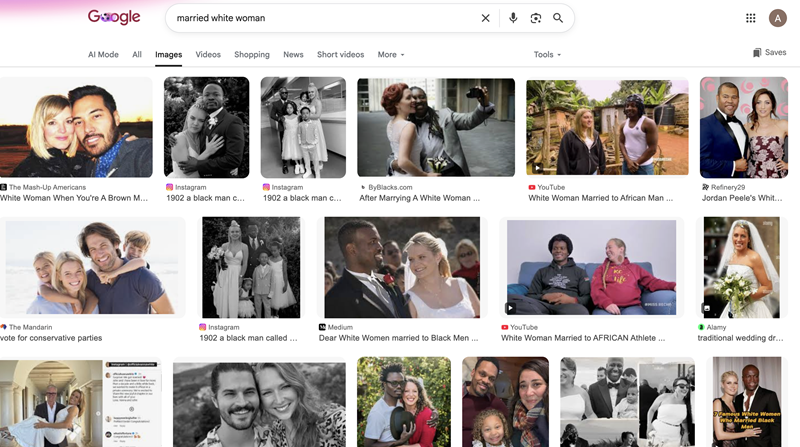
Before reading further, open a new browser tab and type the search term “married white woman” into Google Images. Scroll through the first several rows of results. What do you see?

The output which is consistently replicated across different devices and geographic locations is a deluge of mixed-race couples. The output is overwhelmingly dominated by images of white women intimately paired with black or non-white men. To the casual observer passively consuming this digital output, the presentation establishes an immediate baseline for normalcy. The volume and priority of these specific demographic pairings create the distinct impression that such relationships are the standard, ubiquitous, and foundational reality of modern Western society.

Yet, when we contrast this algorithmic simulation with reality, a massive discrepancy emerges. Statistically, interracial marriages remain a distinct minority of overall unions in the United States and across the broader Western world. According to comprehensive data from the Pew Research Center, in 2020, only 11% of all married couples in the United States were interracial or interethnic. When we drill down into the specific pairing that dominates the aforementioned image search, the numbers shrink even further. Marriages specifically between a white woman and a black man account for a mere 7% of that already small 11% sliver of intermarriages. In absolute terms, out of over 51 million married white women in the United States, less than 1% are married to black men.

Despite this statistical rarity, the digital simulation feels entirely “normal” to the modern consumer because media giants like Google, alongside massive stock photography conglomerates like Getty Images and Shutterstock, consciously and relentlessly curate it that way. This immense disparity between reality is the result of neutral, blind code cataloging human existence. It is an intentional act of social enforcement, by artificially elevating specific demographic pairings, media platforms execute a subtle but pervasive socio-cultural engineering project.

It can thus be argued that this engineered visual output serves a distinct ideological purpose: pushing European women toward demographic change and eroding the visual primacy of the homogeneous nuclear family that built and sustained Western nation-states for centuries. When digital representations are manipulated to consistently overwrite physical realities, a significant ontological shift occurs within the host population. The native majority is conditioned to view their own demographic decline as an organic, inevitable, and morally righteous progression. This forces us to confront the question: If images precede and dictate reality, who is engineering our extinction?

I’m long out of the habit of watching TV, so when the NFL season gets started and I’m presented with three-plus hours per week of commercial TV to watch my favourite team play, I can’t help but notice that most commercials that include representations of married couples are inter-racial or non-white. The advertisers are also presenting a small minority of marriages in North America as being the overwhelming majority in their TV ads. Why might they want to do that?

June 22, 2026

Progressive intellectual arrogance

Filed under: Media, Politics, USA — Tags: , , , , , — Nicholas @ 03:00

John Konrad tries to explain the apparently universal intellectual snobbery of progressives, which has brought pretty much every western country into the era of the expert:

Why is the left so arrogant?

Because they put their trust in a global elite. Not directly, but through the media and the universities the elite manipulate.

My dad always said it the other way around: privilege comes with responsibility. But responsibility is hard. Responsibility requires knowledge.

And in a world growing more complex and unpredictable by the year, understanding what’s happening around you takes more and more of it.

Twenty years ago you could walk through Manhattan around noon on a Sunday and watch half the city reading the Times. The thing was massive, but a fast, educated reader could come away with a decent picture of the whole world in a few hours.

Then two things happened.

Craigslist gutted newspaper revenue, and DEI mandates swapped great reporters for morally indignant j-school hacks. The quality and accuracy of information cratered.

At the same time, the internet roared to life and the world got radically more interconnected overnight.

So the elite grew less informed exactly as complexity exploded.

To cope, they borrowed a trick from NASA. There aren’t enough hours in the day to be the best rocket scientist and the best navigator and the best flight surgeon all at once. So mission control compartmentalized. The best person in each silo got a desk. Thruster problem? Everyone turns to the engine expert. Someone’s hurt? Everyone turns to the flight surgeon. The rocket guy never had to learn a thing about medicine.

The elite copied the model. They switched their brains off for anything outside their lane. Everyone specialized inside their own bubble.

But compartmentalization runs on trust. Put one bad actor in mission control, and the moment everyone turns to him, bad things happen.

To guard against that, they doubled down on credentialism. They learned to trust only the experts minted by certain colleges and blessed by certain think tanks.

And the bad actors had a field day. Fraud, disinformation, theft, all of it could happen inside a silo, unseen. And it did.

Then came a mission control director who told them not to worry. Everything was fine. They didn’t know what was going on, but he did, and he was smarter than all of them. He said so, right there in the meetings.

Everyone loves a brilliant, competent boss, especially a charismatic one who seems kind, because it means they no longer have to worry. He’s got it handled. Just trust him.

And trust Obama they did.

But he had nothing handled except his own aura. And he let Marxist actors run loose inside the silos that mattered, education and HR chief among them.

The right was skeptical, so they kept reading, kept hunting for alternative sources, kept trying to make sense of the complexity themselves. Nobody cracked it completely. But they started seeing the big red anomaly lights blinking across the dashboard.

So the smart people on the right kept building broad knowledge while the left stayed siloed. Ten years passed, and the left’s elite fell far, far behind.

They’re starting to see that Obama was a fool. But they’re stuck. You can’t cram ten years of missed homework into a few months. And they’re rich and powerful and have no interest in going back to school.

They have two options. Admit they were wrong and put in months, maybe years, of hard work to take responsibility for their actions. Or keep acting like sheep. If the rewards weren’t there, some might choose the work.

But the system is so riddled with fraud, so many hollowed-out silos kept on life support, that there’s more than enough money sloshing around the NGOs to fund their posh lives.

They have the privilege with none of the responsibility. It’s a comfortable place to sit. They don’t want to change.

But holding that position requires one thing: they have to believe their mission control director has it all under control and is smarter than anyone on the right.

The bottom line is the have to be arrogant. Or the whole house of cards comes down.

June 21, 2026

Jean Rapail’s The Camp of the Saints, translated by Robert Laffont

Filed under: Books, France, India — Tags: , , , , — Nicholas @ 06:00

Copernican reviews Jean Raspail’s The Camp of the Saints which was reprinted in an English translation by Robert Laffont earlier this year:

It is time that I throw my own hat into the ring regarding this particular piece of polemic fiction. It’s particularly topical given the recent events in the UK and the Western World. A look at toxic progressive empathy taken its natural conclusion.

Written by Jean Raspail and published in 1973, Camp of the Saints is a book infamous among those the media describes as “Far Right” and virtually unknown outside of that. Were history set upon an even keel, Camp of the Saints would sit on the bookshelf of every high school right next to the classic works of the same genre: notably 1984, Brave New World, and Fahrenheit 451.

This book was so dangerous that for decades, now, the English translation has been out of print, available only as an expensive antique, or through the Internet Archive, [as] a single shoddy .pdf. The corporate owners of the English translation rights have, despite considerable interest, refused to republish it. That was until September of 2025, when a new translation was created and distributed.1

As of now, what was once an antique book is now cheap and in-print. What’s more, it’s been converted to an audiobook available on Audible.2 It took the destruction of Western Culture for us to see published the one work of dystopian fiction that warned us of it.

Given its relevance, it makes sense that over ten percent of the run-time consists of various forwards from the author, translator, and the publisher, that describe the political and cultural push against its own publication. It’s worth it to read (or listen) through the numerous forwards to better understand the context and the author.

An Introduction to the Text

Among the dangerous books written in the late 20th century, Camp of the Saints takes the self-destructive anti-nativism of the neoliberal world order and draws it forward to its own natural conclusion. Like other works of fiction, it takes popular ideas and asks the question: “What if these beliefs are taken to their ultimate logical end?”

The book is written from the perspective of an omniscient historian who witnessed the events of the text; he knows that his work will be censored, silenced, or redacted. In the context of the book, the accurate recollection of the events described is inherently destructive to the (now) dominant anti-racist political regime. The force of political progressivism will destroy any such history on the basis that it may “incite racial hatred” or “create division”.

A fascinating bit of forethought in that those are the exact reasons why Camp of the Saints was itself banished from public view for the last half-century: Liberal cultural diversity transitioned smoothly to violent censure and virulent “anti-White” or “anti-Western” genocidal hatred.

The book is a dramatization of the Fall of the West. Not in pitched battle, but as it has lost its spiritual core to rampant idealism. The “other” is always to be given deference over our own people. The sympathy that is demanded for the “other” is also silenced and denied for our own. At what point do a people become so spiritually deracinated that they lose all legitimacy to exist? At what point do they become so deluded as to lack totally a theory-of-mind of the “other”, and at what point does sympathy for the foreigner overwhelm survival?

Camp of the Saints answers these questions in sometimes graphic detail. Some of the horrors written on those pages hadn’t happened to innocent Western children yet … but now, fifty years on, and they have happened. Many times over, in many places and nations, across the West.3 In comparison to the reality of the West in the 21st Century, Camp of the Saints is a tame warning.

The book begins with a great migrant fleet setting off from Calcutta, India. The poor, the starving, the diseased, and the malformed set out for the West- A land where milk and honey flow freely and where the rivers are rich with Fish. The people of India want a better life for themselves, even if they have to walk, unarmed, onto foreign lands to get it. They, like many peoples, believe that their land is simply poor and that Western nations are simply rich. Failing to understand that it is not some “magic dirt” that made France, England, Australia, and the United States rich, but rather it was the French, English, Australians, and Americans. The West doesn’t horde “magic dirt” but “magic people”, so to speak. Were the West to be flooded with Indians, it would become just like India, not magically make the invading Indians wealthy and intelligent.4

I doubt that it’s possible to explain that fact to third-world migrant retards.

To conclude a spoiler-free version of the review: You should read it. It should have been taught in high schools for the last 50 years. You should probably buy a copy before the beast of Progressivism finds a new way to censor it. If you buy the Audible copy, use a tool to convert it to an .mp3 file so that it can’t be deleted from your personal library after the fact.5 There’s a reason it’s been censored for the last 30 years or so. It’s dangerous, subversive, and intelligent in a way that modern dystopian authors wish they could be.


  1. Here is a direct link [https://www.amazon.com/Camp-Saints-Jean-Raspail/dp/B0FG4MJS8K] to where you can purchase the book on Amazon. A shoutout to Vauban Books for doing the work that every other publisher has been unable, or too scared, to do.
  2. I kind of enjoy audiobooks. Though Camp of the Saints can be particularly tricky to listen to over reading directly due to its complex cast and jumping around in the timeline.
  3. The Rape Gang Inquiry Report by Rupert Lowe is particularly poignant and well-timed here.
  4. A fact that is in stark relief as of 2026, with over 10% of their population (official sources say it’s close to 7%, but I don’t believe them) now being Skaven imports from India … and the wealth, safety, culture, and prosperity of Canada now vanishing at an alarming rate.
  5. The “Open Audible” tool is works for this, but it isn’t free.

June 20, 2026

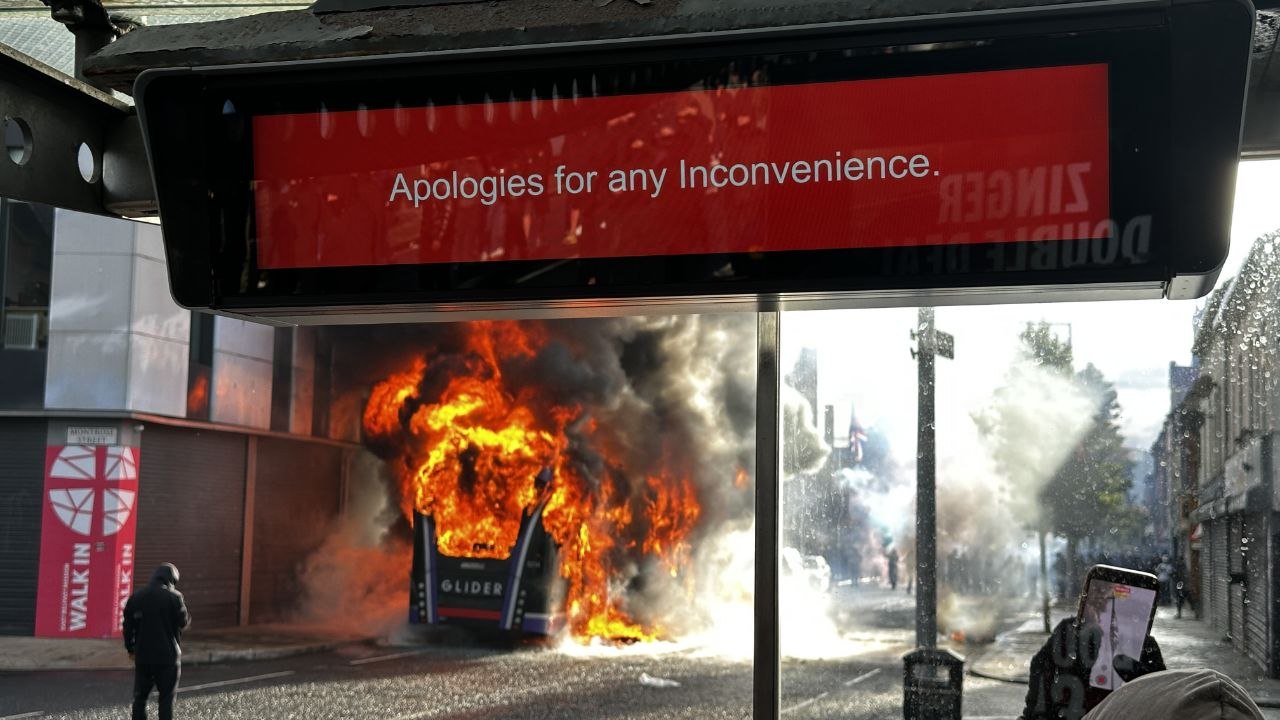
Lessons learned: “In Ballymena and Belfast, violence worked; in Epping, peaceful protest did not”

The flare-up of anti-immigrant/anti-government violence in Belfast has drifted out of the headlines lately, as state-oriented media try to get their audiences back onto safer topics like footy and hissing at the Bad Orange Man. But the situation in Northern Ireland has not resolved itself in the preferred way — preferred, that is, by the British government. John Carter responds to some American social media users who loudly wonder why British men generally are not “doing something” now:

In response to the migroid atrocity du jour, one often hears Americans ask “why haven’t British men done anything?”, to which Americans will flatteringly reply to themselves, “It’s because those BRITCUCKS have gone SOFT, they gave up their GUNS like little BITCHES, but you won’t see anyone trying THAT in a SMALL TOWN”. Which conveniently elides the awkward detail that American men, armed to the teeth as no other people on Earth, have allowed themselves to be pushed around this way and that since the sleep of the good Reverend Doctor Martin Luther King, Junior (PBUH) was disturbed by his little dream. “Just you wait”, Americans will promise when this is pointed out, “The electric boogaloo will come any day now, you’ll see!” Sure we will. In the meantime, all those guns have done precisely nothing to prevent the relentless incursions of Section 8 housing, disparate impact, affirmative action, DEI, anti-discrimination training, Title IX, human resources, and all the rest of the soft tyrannies that flew out of the Pandora’s box of America’s ersatz race communist constitution. There was no resistance to any of this. Heavily armed red state Americans abandoned the cities for the suburbs rather than standing and fighting for them, and then stolidly watched as their kids were sidelined in education and employment while being terrorized by black criminals.

American speech is protected by the first amendment and backstopped by the second, yet nevertheless you will not find many Americans daring to even so much as mutter the forbidden word of power. This is not because white Americans don’t understand the problems. They have developed an elaborate vocabulary of “bad neighbourhoods” and “good schools” and “urban crime” and “troubled youth” and so on and so forth with which to discuss, in whispers, after glancing twice over their shoulders, the realities of life in the USSA. There is no law against parrhesia [Wiki], technically an American citizen may say whatever he pleases without consequence, but of course frank speech in this Greek sense requires courage by definition, and there has been a great shortage of that. You can say whatever you please, yes, of course, fill your boots, but you will find yourself ostracized, divorced, unemployed, and homeless if you speak too directly, so you know, shut up. The unspoken strictures of the longhouse are a more effective prison than iron bars for those whose spirits have been cowed.

Meanwhile, last week there was a minor uprising in Belfast. Hadi Alodid, a gentlemen of Sudanese extraction, enriched the face of Stephen Ogilvie, a local bloke with special needs, providing him with extensive tribal scarring in a generous act of cross-cultural exchange, and only claiming two of his eyes in payment. The entire incident was caught on video. Ogilvie’s life, though not his sight (and he was already hard of hearing) was saved by three Irish men who rushed in to beat the innocent Sudanese rocket surgeon off with their hurling sticks. In the aftermath, it emerged that Ogilvie had helped Alodid move in to his new accommodations just a few days before. No good deed, etc.

[…]

The uprising was variously described as a protest and as a riot, but it was neither of these. A protest is when an angry crowd gathers to chant some slogans and wave around some signs, pretending that their numbers are a display of power, and deluding themselves that Power will redress their grievances because a noisy lump of quivering biomass is somehow intimidating to Power. A riot is an explosive release of emotional energy that results in some property destruction and futile confrontations with armoured riot police, typically ending with the rioters being rounded up and jailed. In some cases, it’s true, protests and riots appear to produce political change, but this is almost invariably because Power has orchestrated these little carnivals in order to sanctify the policies it’s already decided upon under the guise of “bowing” to “pressure” from the “public”. The Canadian government, by the way, has long since mastered a non-violent variant of this dark art: practically every “public policy research group” in the country is funded by the government to pressure the government to do what the government already wants to do. Show me what Our Democracy looks like; this is what Our Democracy looks like.

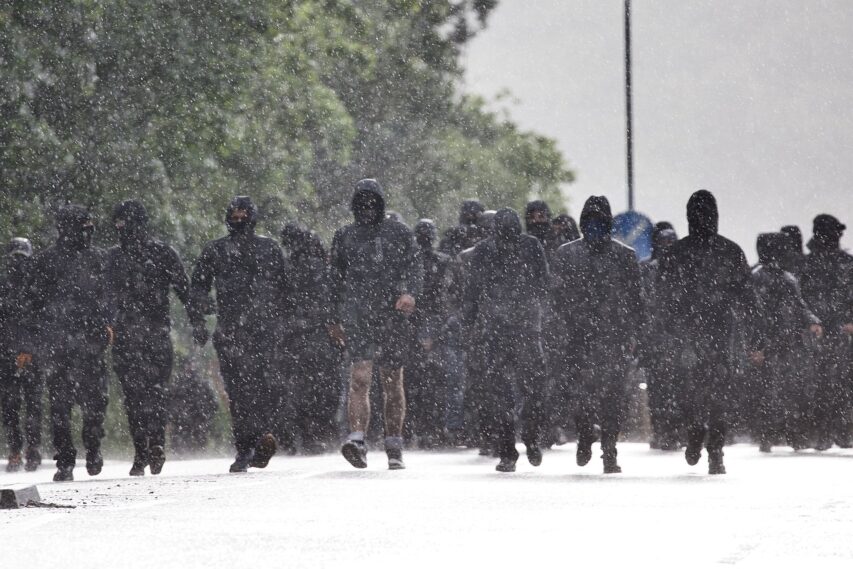
There were no signs being waved around in Belfast, no chanting of slogans. While there was a great deal of violence, it was not random and senseless, but methodical and carefully targeted. It unfolded with the tight discipline of a coordinated military operation.

The day before the uprising started, a communique was sent out to local businesses, instructing them to close before the fun started. At the appointed hour loose formations of young men, indistinguishable in black hoodies, fanned out across the city.
[…]

The uprising in Belfast was not nihilistic violence for the sake of violence, though I’ve no doubt the lads were enjoying the opportunity for mayhem. It was violence towards a specific political objective: driving the foreigners out. Migrants whose domiciles were destroyed were directly deprived of housing. Migrants who managed to avoid this were made to worry that they will be next. Landlords taking government money to house migrants, or even thinking about doing so, now need to worry about the immediate cost of repairs and the ongoing expense of higher insurance premiums, making the Home Office’s lucre a lot less attractive. Landlords also need to worry about escalation: reportedly, letters were circulated which heavily implied that bricks and petrol bombs were just the first step on the violence ladder, and that the paramilitaries would be quite happy to take more decisive measures against the landlords themselves should the message not be received.


All of this is very sad, and I don’t want to seem heartless. The immigrants whose houses were destroyed were probably innocent; there was one particularly touching video of a nurse from Ghana or somewhere. Unfortunately, that is the nature of these things. They were brought in by the government en masse as a form of biological warfare against the native population. The government wants them there, the people want them gone, and the government refuses to listen, so, this is what happens.

Only 27 migrants were actually made homeless by the arson, but reportedly, quite a few are already clearing out on their own. The British government quite naturally condemned the violence, organizing a rally against racism in the aftermath, but it also responded by instructing the media to emphasize that it would be cracking down on illegal immigration into Northern Ireland. Underneath the condemnation, there is a clear message to all of this: in this case, violence worked.

That message has been sent before in Northern Ireland. Exactly one year to the day before the uprising in Belfast, there were riots in the small town of Ballymena after the courts let two gypsy boys off with delicate wrist taps for raping an Irish girl. The rioting went on for two weeks, and resulted in two thirds of the gypsy population clearing out. Again: violence worked.

Contrast Ballymena with the other major British protest movement last summer: the anti-migrant hotel protest in Epping, a London exurb populated largely by Londoners driven out of their city by diversity, which started when one of the migrants diversified a teenage girl. In contrast to the eruption in Ballymena, the protest in Epping was explicitly non-violent: the only violence came at the hands of the cops arresting people for flying Union Jacks. The mothers of Epping spent months gathering outside the migrant hotel, holding signs and raising awareness. The council also fought the migrant hotel in the courts, and enjoyed early success when a judge found that the location was zoned as a hotel but not as a migrant dormitory, essentially telling the Home Office that they didn’t have a loicense for that. This legal victory was short-lived. The decision was overturned almost immediately by a higher court judge, who explicitly found that whatever the concerns of the people of Epping as to their children’s safety, these were outweighed by the human rights of the mystery meat that had washed up on Britain’s shores, and by the government’s interest in housing them. As a result, parallel lawsuits that had been launched by councils across the country were dropped. The migrant hotel in Epping was eventually shut down, but this likely had more to do with the government’s switch to “Operation Scatter” in which migrants were garrisoned in smaller houses all over the country, rather than concentrated in a few large centres, than it did with the government responding to the concerns of British subjects.

In Ballymena and Belfast, violence worked; in Epping, peaceful protest did not.

Update, 22 June: Welcome, Instapundit readers! Have a look around at some of my other posts you may find of interest. I send out a daily summary of posts here through my Substackhttps://substack.com/@nicholasrusson that you can subscribe to if you’d like to be informed of new posts in the future.

June 13, 2026

The intellectual dangers of “nostalgia economics”

Filed under: Britain, Economics, History, Media — Tags: , , , — Nicholas @ 05:00

Mani Basharzad explains that although resurgent socialist beliefs are a bad sign, there’s actually a worse danger to modern economies that isn’t a coherent ideology but all the more potent because of it:

Custom image by FEE

If someone asked me what the most dangerous economic ideology is, many would expect an Austrian to give a typical answer: Marxism, socialism, or Modern Monetary Theory. Yet I believe there is another way of thinking that is even more pervasive. It is not a coherent body of ideas like those ideologies. Rather, it is a sentiment so widespread and socially accepted that it threatens not merely economic freedom, but our very understanding of progress itself. I call it “nostalgia economics”.

Recently, the singer Sting suggested that the rise of toxic masculinity is partly the result of the “loss of manual jobs”, claiming that because many men no longer use their hands and physical strength in their daily work, unhealthy masculine traits are on the rise. Like many commentators on the political left, he also blamed Margaret Thatcher for Britain’s economic transformation. “Britain’s wealth was created in the coalfields and the steel towns and the mill towns and the shipyards”, Sting said. “All of those skill sets were thrown on the scrapheap … for Thatcher’s dream of a service economy.”

This is nostalgia economics in action. A global celebrity whose music can be streamed instantly on another continent, who earns income through digital platforms, and whose career depends on modern communications and services, criticizes the very service economy that makes his success possible.

A person in thrall to nostalgia economics will take the blessings of progress for granted while romanticizing a past that never truly existed. Imagine living in the world of Charles Dickens: you would not have had access to a typewriter for much of your life, if at all, since it was only commercialized in the late 19th century. More importantly, you would not have had access to electricity. The conveniences we now consider basic would have been unimaginable luxuries.

The economic historian Norman Stone illustrated the extraordinary pace of modern progress through the experience of the novelist Henry James:

    In 1895 the novelist Henry James acquired electric lighting; in 1896 he rode a bicycle; in 1897 he wrote on a typewriter; in 1898 he saw a cinematograph. Within very few years, he could have had a Freudian analysis, travelled in an aircraft, understood the principles of the jet-engine or even of space-travel.

Had Sting been alive in 1890, a world tour would have looked very different. A journey from London to New York would have taken more than a week rather than a few hours. International audiences, instant communication, and global entertainment markets would have been beyond imagination.

The glorification of manual labor is one of the most overrated ideas in modern political discourse. This tendency is not confined to the left. Ambitions to revive manufacturing employment through government policy often draw on the same nostalgic impulse. But what exactly are we trying to return to?

Perhaps literature offers a more honest answer than politics. Oscar Wilde observed that “all unintellectual labour, all monotonous, dull labour” involved unpleasant conditions. He went even further, commenting that “there is nothing necessarily dignified about manual labour at all, and most of it is absolutely degrading”.

The reality of industrial labor was far harsher than many modern observers imagine. In Britain, workplace fatalities have fallen dramatically over the last century: fatal injuries to employees dropped from around 4,400 a year early in the 20th century to around 200 a year by the end of the century. Coal mining, one of the occupations most frequently romanticized today and the first industry Sting evoked, exposed workers to constant danger and disease. Throughout the 1950s and 1960s, coal workers’ pneumoconiosis (“black lung”) claimed well over a thousand lives annually. What would a laborer enduring dangerous conditions, long hours, and chronic health risks have given for an air-conditioned office job?

One thing Sting did identify is that men generally do need more physical activity in their lives both for general physical health but also for mental health.

June 9, 2026

QotD: The temptations of totalitarianism

In 1977, the French essayist, Jean-François Revel, published a tract with the title The Totalitarian Temptation. In it, he condemned the western intelligentsia’s faiblesse, which was at the same time dishonest, posturing, stupid, and evil, for Stalinist-style dictatorships.

One might have thought — I certainly thought — that with the downfall of the Soviet Union, the totalitarian temptation had been exorcised once and for all. This, of course, was a very superficial view. Instead of disappearing, the temptation balkanised, so to speak, and was also repatriated. Totalitarianism had been shown almost as conclusively as anything in the sphere of human affairs to be inherently absurd, intellectually nugatory, and catastrophic in practice. This fact was not sufficient, however, to destroy its attractions — at least for those who desire a complete solution to all of life’s little problems such as how to live and what to live for. A solution in the mind is worth a thousand disasters in the world.

Naturally, it takes a certain level of education to feel the temptations of totalitarianism: they do not occur to the illiterate, for example, but only to the intelligentsia. The latter has increased in size almost exponentially with the expansion of tertiary education, or at least with attendance at institutions of tertiary instruction. In retrospect, it is not surprising that totalitarianism should continue to exert its siren-song in previously liberal societies, particularly when the young, always tempted by radical ideas, face genuine if intractable problems, seemingly worse than those of the previous generation.

Theodore Dalrymple, “The Temptations of Power”, The Iconoclast, 2020-09-06.

June 5, 2026

Canada’s AI “strategy”

I’m at the point where I honestly can’t tell whether this is parody or actual Canadian government policy:

AI in Canada lost before it even got started.

They literally are trying to get AI to give a Land acknowledgement before any session.

Here are 6 statements that show how Canada already blew AI like we all knew it would.

1. “The Government of Canada commits to applying Gender-Based Analysis Plus in a meaningful way across policy design, skills development, innovation, and governance to ensure that AI reflects our values, protects those most impacted, and leads to outcomes that are safe, inclusive, and beneficial for all Canadians.”

2. “Canadian AI must support, reflect, and project Canadian culture, which includes our customs, our history, and our heritage. Canadian voices, languages, communities, and knowledge must also be represented in how AI systems are designed, built, and used.”

3. “support Indigenous self-determination over how AI is built and used in Indigenous contexts, and build domestic capacity to address the specific harms Indigenous Peoples face”.

4. “promote the world’s first AI equity-based national standard on accessible AI to drive inclusive and accessible AI and remove accessibility barriers from AI systems, and ensure Canadian AI reflects the Accessible Canada Act principles.”

5. Repeated framing around “disproportionate exposure and impacts of AI harms to equity-seeking groups” and the need to “address the systemic barriers experienced by racialized communities, persons living with disabilities, and others who too often fall on the wrong side of the digital divide”.

6. “Canada will support and amplify Indigenous-led AI initiatives that reinforce cultural expression and linguistic vitality in Canada and around the world, building on existing efforts …”

June 4, 2026

Bill C-9 is “what happens when the Frankfurt School gets a government badge, a pension, and a corner office in Ottawa”

L. Wayne Mathison explains how the Canadian government persuaded itself to push a “hate speech” bill that will upend centuries of free speech practice and criminalize good-faith arguments. Like many such brainfarts, they cannot imagine what consciously evil people will do with these legal tools in hand:

AI-generated image by L. Wayne Mathison

If you want to see what happens when the Frankfurt School gets a government badge, a pension, and a corner office in Ottawa, look at Bill C-9.

This is not just another “hate speech” bill. It is a sign of a much bigger shift.

The old political arguments were about wages, factories, class, ownership, and the economy. That was the old Marxist world. Today’s politics is about language, symbols, identity, emotion, culture, and who gets to decide what “harm” means.

Parliament has stopped arguing about who owns the factory.

Now it wants to control the dictionary.

Bill C-9 reads like a critical theory seminar that escaped campus, found a suit, and got hired by the Department of Justice.

Under the older liberal model, the law punished actions. Assault someone? Crime. Vandalize property? Crime. Block access to a building? Crime. The state dealt with what you actually did.

But C-9 moves the centre of gravity from action to meaning.

What did your words mean?

What did your symbol represent?

What was your motive?

What cultural message did your expression create?

That is not law as a neutral referee. That is law as a cultural therapist with police powers.

The most revealing part is the proposed removal of the long-standing “good faith” religious defence for hate propaganda. That defence existed for a reason. It protected freedom of conscience. It recognized that in a free country, people may express religious beliefs that others find offensive, outdated, or wrong, as long as they are not wilfully promoting hatred or violence.

That was not a loophole.

It was a guardrail.

But to the modern ideological mind, an ancient religious text is not treated as a source of conscience. It is treated as an artifact of power. A legal protection for religious speech is no longer seen as freedom. It is seen as oppression wearing a church hat.

So the guardrail has to go.

And what does government offer instead?

Trust us.

Trust that prosecutors will be reasonable. Trust that judges will interpret the law narrowly. Trust that ordinary Canadians will not get dragged through the process for saying something unpopular, traditional, religious, or politically unfashionable.

Sorry, but that is not how liberty works.

Rights are not protected by hoping the state behaves itself. Rights are protected by limiting what the state is allowed to do in the first place.

That is what makes the Senate debate so revealing. The Senate was supposed to be sober second thought. The old establishment airbag. The place where bad laws were supposed to slow down before hitting the public at full speed.

But now even the Senate is wrestling with a bill built from an intellectual toolkit designed to dismantle the very traditions the Senate was created to preserve.

Bill C-9 does not build social cohesion. It does not repair trust. It does not ask why people are angry, alienated, or radicalized in the first place.

It does what modern bureaucratic progressivism always does.

It manages symptoms by expanding state power.

It turns culture into a compliance file. It treats offensive expression less like a social problem to be answered with argument, courage, and moral confidence, and more like a hazardous substance to be regulated by experts.

The Frankfurt School wrote in dense, foggy jargon to expose hidden systems of power.

The joke is on everyone.

The modern state did not reject those tools. It absorbed them, stripped out the revolutionary romance, bolted them onto the Criminal Code, and called it public safety.

Bill C-9 is what happens when cultural theory becomes administrative power.

It is what happens when the state stops protecting public order and starts managing public meaning.

And that should worry anyone who still thinks freedom means more than government-approved speech.

June 1, 2026

Social media echo chambers

Filed under: Media, Politics, Technology — Tags: , , , , — Nicholas @ 03:00

One of the phenomena noted about most social media platforms was the ease of creating political echo chambers that allowed (mostly) progressive views to be aired but not challenged, which convinced a lot of people that these views were far more widely held than they were. When Elon Musk bought Twitter and reduced the automatic echo chamber mechanism, many formerly happy Twitter users discovered the unpleasantness of dissenting voices (triggering a rush to Bluesky, which allowed the re-creation of those comfortable bubbles for those most distressed). Twitter, now X, has been a much better site since then:

One of the reasons X terrifies soft ideologues is that it has become one of the last places where ideas are forced to compete in the open.

I don’t block people and certainly don’t deliberately curate an echo chamber. My replies are full of people who disagree with me.

And yet every day I watch the same thing happen.

The people who spent years convinced they represented the silent majority get ratioed into the earth by ordinary Americans.

Not because of brigading, coordination, or because some shadowy force is helping.

Because their ideas suck.

That realization should horrify them. But it doesn’t, because they’re dented.

For years they mistook institutional power for public support. They confused HR departments, media outlets, universities, and bureaucracies with actual consensus.

Now the walls are gone and the ideas have to stand on their own. And many of them just can’t.

What’s happening on this platform is not the triumph of a movement. It’s the collapse of an illusion.

The worst part isn’t that they’re losing. It’s that they’re finding out how few people ever agreed with them in the first place.

QotD: The progressive concept of an “American”

Filed under: Politics, Quotations, USA — Tags: , , , , — Nicholas @ 00:00

… the Left’s version, which insists that an “American” is a CisHetPatWhite gun nut. And rayciss, obviously, which somehow encompasses all that, but is distinct from it. Like the famous filioque controversy, the true relationship between them probably can’t be determined on this plane of existence, but it doesn’t really matter. But the terms are worth a little “unpacking”, as the grad school term d’art was back in the days:

“Cis” is “cisgender”, the radical notion that your “gender expression” has some systematic relationship to your chromosomal sex. In other words, an “idea” so uncontroversial that it has to be in quotation marks, because try explaining what “gender expression” means to even the most brilliant mind of, say, fifty years ago. He’d laugh right in your danger-haired, tattooed, multi-pierced face.

“Heterosexual” ties in with “cisgender”, in that it means “the observed sexual behavior of 99% of humanity in all times and places, because it is a biological necessity for the species to thrive”.

“Pat” means “patriarchal”, and see above, it’s the observed behavior of 100% of all human societies that have ever existed heretofore. As I like to quip to obnoxious atheists, I’m the only guy I know who really believes in evolution. Ever seen monkeys in the wild? I have. No society is more based than a chimpanzee troop. They’re so patriarchal, Iceberg Slim weeps salty tears of joy at the thought. It’s hardwired.

“White” of course means “chromosomally Caucasian”, and it’s very important to note that of the earth’s teeming billions, White folks are only a small fraction.

“Rayciss” is worth exploring, if only because they never get around to defining it. Do I believe other human subpopulations are inferior to mine? Heavens no. But see above, about being the only guy I know who really believes in evolution. It’s simply a fact that subpopulations evolve in response to environmental pressures. So are some subpopulations better adapted to their environment than others? Hell yes. Not only do I believe this, it’s a stone cold fact, one so trite that they don’t even bother putting it in the biology textbooks anymore.

Severian, “What’s an American?”, Founding Questions, 2022-07-04.

May 29, 2026

Progressives, suddenly – “We’ve gotta protect our phony baloney jobs!”

Apologies to Mel Brooks for hijacking that line from Blazing Saddles. On the social media site formerly known as Twitter, signs of panic from the media and media-adjacent progressive ranks as they realize Silicon Valley is an existential threat to their media monopoly:

    Tim Shipman @ShippersUnbound

    One aside on the Blair conversation

    I’m absolutely gobsmacked at the level of hostility to “tech bros” and the belief that we can just insulate ourselves from AI and technology

    Like listening to weavers on the spinning Jenny or Hanson cab drivers on the advent of the motor car

Look this isn’t complicated.

The left hates you because they’re (correctly) worried AI is going to replace the “work” they do for their comfortable professional-managerial class sinecures, while at the same time they are (correctly) concerned that AI generated video will completely neutralize the remaining cultural influence they wield via their control of entertainment media.

The right (correctly) views you with suspicion and contempt because you already replaced white men with H1Bindians, which hurt us economically, and also enshittified the Internet, which was further enshittified due to your perfidious collaboration with leftists during the peak of the Great Awokening’s censorship and deplatforming push.

Despite your years of service to them, the left wants to immolate your headless corpses on funeral pyres built from your burning data centres, merely because you MIGHT be a threat to them in the near future.

Despite your record of pusillanimity, the right — some of us — are willing to work with you. That is a godsend for you, because we are literally your only defence right now.

But we have conditions, and those conditions are not negotiable.

May 26, 2026

“She is hoping to disturb them in their privilege and veiled racism”

Filed under: Education, Politics, USA — Tags: , , , , — Nicholas @ 04:00

Millennial Woes on having sympathy for the Midwit:

In August 2022 I stumbled upon this video of a young female teacher in Utah. She is what we would once have called an SJW. She describes how she has equipped her fourth-grade classroom in a way that she expects will annoy the parents of her (aged 9-10) pupils: all of the materials have been vetted by her to ensure that they include no images whatsoever of White people — “not a single White face there”.

Even though she knows the school is majority White (over 85%), she has designed her classroom, in her own words, “for non-white students”. To be fair, this could be simply because she is bringing materials from her previous school, which was much more diverse. But even then, you would think the sensible thing would be to buy materials more fitting for her new school. She does not.

So the woke attitude goes far beyond merely accommodating non-white people, and beyond even the absurdity of giving them equal prominence in our ancestral society, but actually to giving them precedence over us there.

What I found striking about this video, apart from the mindboggling fact that this is someone presumably vocated to help people yet doing something that will clearly harm her pupils, is how she delights in the fact that what she has done will annoy parents. To be precise, it will annoy parents who, whether conscious of it or not, are “racist”. After all, if they really “don’t see race”, then how can they possibly care about this? Thus, they cannot argue that their kids should see representations of their racial kin without outing themselves as “racist”, which in turn will make them very vulnerable. So this younger teacher feels not just morally sound, but bulletproof against reprisals, and very clever.

There is also a social class element to this. She specifies that these will be “posh White parents”. Despite appearing to be all of 23 and only having taught in very diverse schools, she alludes to experience in dealing with such upper-class White parents before. She is hoping to disturb them in their privilege and veiled racism.

She also clearly assumes that, if any parents do complain, she will be safe. The institution — not just her school but the entire education sector, including all of the academics and every university department that sustains them — will be on her side. If and when the parents complain (having navigated their way through the minefield of realising they are “racist” and painstakingly forming some lame argument to hopefully avoid that accusation) they will find that she is protected not just by her employer but by an entire segment of society. They, the parents, might get some small local newspaper to back them, or more likely to report the story impartially, but in all likelihood they will find themselves shamed by some much bigger newspaper. That is what she was clearly expecting when she made this video.

[…]

What I find troubling about this story is that it illuminates both the viciousness and the vulnerability of the midwit. It wouldn’t be worth fretting over, except that there are many millions of these people about. Every one of them is bright enough to grasp the drivel at teacher training college, but not bright enough to realise that it is drivel. Every one of them is vicious enough to harm children and take pleasure in disturbing the parents and sadistically putting them in an impossible position … but every one of them is literally just doing what they have been told to do, and is spreading the ideas they have been trained to believe are good, healthy, and crucially needed.

QotD: Entropy versus Revolution

Filed under: Media, Politics, Quotations, USA — Tags: , , , , — Nicholas @ 01:00

… the “Left” has nothing to do with even Marx anymore, much less anything so CisHetPatWhite as “the Rights of Man and Citizen”. Your “rights” are whatever the State says they are today, as determined by a snap poll of Blue Checkmarks. The “left” is, ironically, a bit better about paying lip service to their “tradition” than is the “right” — the “left” will still give you a good sermon about Evil Corporations, for instance, even as they’re using Big Tech, Big Bank, and Big Pharma to stomp you — but it’s clear that they believe in nothing, Lebowski, nothing!

They’re simply nihilists, and their nihilism is just a way station to suicide. Their “program”, such as it is, aims at absolute stasis — they want everyone and everything to be exactly one thing, now and forever, because this is the closest to annihilation they can get without being forced to admit to themselves that what they’re really longing for is the sweet release of death. The purpose of all those bespoke sexualities, for instance, clearly isn’t “to find a likeminded person to have sex with”; rather, it’s to make sure you can never have sex with anyone at all.

Ooops, sorry, you only fulfill 459 of the 462 bullet points on the checklist.

Which is weird, I realize, because the “Left” (for rhetorical convenience) are always in frantic motion. But it’s displacement activity. As I’ve written before, you can call it “permanent revolution”, but it’s Isaac Newton’s version, not Leon Trotsky’s — forever spinning in place, going nowhere. So long as they never stop spinning, they’ll never hear the vast emptiness of their own lives. They’ll never have to look their death wish straight in the eye.

The “Right” (again for rhetorical convenience) seems to be locked in a never-ending battle against entropy. That’s what it seems to boil down to. Things fall apart and pass away, and in their breakdown we are robbed of our fundamental dignity. In the end, that’s the only thing worth “conserving” — your fundamental dignity; the only “right” that matters is the right not to be a clown.

One always loses the battle against entropy eventually, but the dignity is in the fight. For the “left”, who have no dignity, the fight is just a distraction, sound and fury to distract from the nothingness that always threatens to overwhelm them … and that they secretly long for.

Severian, “Entropy vs. Revolution”, Founding Questions, 2022-06-21.

May 25, 2026

“When I was in high school, I was taught that every single Canadian adored Pierre Elliott Trudeau”

Filed under: Cancon, Education, Media, Politics — Tags: , , , , , , — Nicholas @ 03:00

My family arrived in Canada in October 1967, just as the last of the Centennial events were shutting down. Pierre Trudeau became Liberal leader and Prime Minister not long afterwards. I think the “Trudeaumania” of 1968 was nearly 100% media generated, but it was new to Canadian voters who liked the idea of Canada being led by a sophisticated international playboy rather than the stolid, rather unfashionable men who preceded Trudeau. The media continued to “love him long time”, which definitely helped keep him in power and then back into power after the brief Joe Clark experiment. Since he left office, his reputation has been cherished and burnished by progressives in the educational system, as Harrison Lowman relates:

A Toronto Sun editorial cartoon by Andy Donato during Pierre Trudeau’s efforts to pass the Canadian Charter of Rights and Freedoms. You can certainly see where Justin Trudeau learned his approach to human rights.

“When I was in high school, I was taught that every single Canadian adored Pierre Elliott Trudeau. I learned that when the rose-pinned prime minister winked and pirouetted, the whole nation swooned.

It wasn’t until first-year university that I was first exposed to the fierce Western backlash to his National Energy Program.

It wasn’t until I graduated that I learned about any opposition to his Charter of Rights and Freedoms, his policy of national bilingualism, and official multiculturalism.

It was my Ontario high school civics teacher’s fault. While she was a great educator in other ways, the politics lessons she taught us were clearly slanted in the Liberal direction; a direction she supported.

My experience as a young person 20 years ago demonstrates the immense power teachers hold in moulding young minds. It’s a power that concerns me when I imagine dropping off my eight-month-old son at school in three years. Today, that teaching slant has become even steeper, with too many educators unwilling or unable to provide political or ideological balance in their classes.

This week, I interviewed Stephen Reich, a PhD student at The Ontario Institute for Studies in Education (OISE) who researches the proliferation of critical theory in kindergarten to Grade 12 policymaking.

Reich told me I should be concerned—that the educational leaders in this country have all but abandoned what should be the true purpose of education: imparting civilizational knowledge to the next generation. Instead, they’ve replaced it with seeking multiple “truths” and a narcissistic obsession with oppression narratives. Never mind that 92 percent of Canadians polled say they don’t want their children separated by race: taught to see themselves as “privileged” vs. “oppressed”. Reich says certain teachers are far less interested in producing independent thinkers and far more interested in producing activists.

“I have a feeling that success [for them] is ideological conformity,” he explained. That they aim to help foment some sort of “liberation.”

QotD: Modern movie casting

Filed under: Media, Politics, Quotations, USA — Tags: , , , — Nicholas @ 01:00

In the English speaking world, it has become common to “blackwash” movies and television shows. This is the process of removing white characters and replacing them with non-white characters. The stated claim is that popular entertainment needs to reflect the changing nature of the audience. Of course, the reason the audience is changing is that the same people blackwashing films and television shows are ethnically cleansing white societies with mass immigration.

For a long time now, Hollywood has been taking great care to make the good characters black and the bad ones white. For a short while, the bad guys could be Arab terrorists, but now bad guys are white again. If they need to be foreign baddies, then they are neo-Nazis from eastern Europe or Russian gangsters. Of course, the smartest characters are black or female. If we’re lucky, the brainiac is a black lesbian. Every computer hacker is now non-white or female.

On occasion the blackwashing gets ridiculous. Some figure from white history is played by a black actor. A black guy in a show about medieval Europe could be amusing, but that’s not how it is done. Instead, we get black cowboys saving a white town or a black playing King Lear. It will not be long before we have historical dramas in which well-known figures from white history are played by black actors as black people. Imagine Ben Franklin played by Morgan Freeman.

The Z Man, “Blackwashing”, The Z Blog, 2020-10-02.

« Newer PostsOlder Posts »

Powered by WordPress