
Real Time History
Published 4 Apr 2025Hitler’s victories in 1940 present a historic opportunity to Italian dictator Benito Mussolini to expand the Italian Empire. Instead, Italy suffers a series of humiliating disasters in Greece and North Africa. So why did Mussolini declare war on the Allies at this moment, and could Germany be ultimately responsible for the Italian fiasco?
(more…)
September 4, 2025
Mussolini’s Blunder: Greece and North Africa 1940
Comments Off on Mussolini’s Blunder: Greece and North Africa 1940
July 10, 2025
Was Matilda II the BEST Tank of WWII?
The Tank Museum
Published 21 Feb 2025Forget the Sherman, forget the Panther, forget the T-34 … Should Matilda II be considered the best tank of WWII?
Emerging from the request for a new and improved infantry tank, Matilda II debuted on the battlefield in France. The heroic actions of Matilda crews at Arras stopped Blitzkrieg in its tracks and allowed the British army to be evacuated from the beaches of Dunkirk.
The Matilda’s fighting peak was during the North Africa campaign, where the 2pdr gun was more than a match for any of the Italian armour it came up against. Despite some mechanical issues, the performance of Matilda II at this time would earn her the title “Queen of the Desert”. Once the Germans arrived in North Africa, Matilda started to become obsolete but remained useful as a testbed for experimental equipment that would eventually be used on D-Day.
Matilda II saw service in all theatres of the Second World War. Around 900 tanks were deployed by the Soviets in 1942, filling the gap as the Red Army increased its roster of T-34s. Matilda made great contributions to campaigns in the Pacific – its small and solid profile making it ideal for jungle bashing. The Australians made effective use of the Matilda, creating variants including a mortar launcher and a flamethrower.
Some say that if it wasn’t for Matilda II we would be speaking German right now. Watch this video to find out why …
00:00 | Introduction
00:36 | Heroics at Arras
03:29 | It Takes Two
06:00 | Matilda II – Inside and Out
13:03 | Queen of the Desert
18:14 | Soviet Service on The Eastern Front
19:49 | The Pacific – Welcome to the Jungle…
(more…)
Comments Off on Was Matilda II the BEST Tank of WWII?
May 25, 2025
Rommel’s Dark Secrets in North Africa – WW2 Fireside Chat
World War Two
Published 24 May 2025Indy and Sparty handle your questions on the German intervention in North Africa. Why did Rommel make such an impact so quickly? What was the war like for the local populations? How deeply involved was Rommel in the persecution of North African Jews?
(more…)
Comments Off on Rommel’s Dark Secrets in North Africa – WW2 Fireside Chat
May 18, 2025
Why it Sucked to be an Italian Prisoner in North Africa – WW2 Fireside Chat
World War Two
Published 17 May 2025Today, Indy and Sparty tackle some questions on the North African theatre. Why did the Italians think invading was a good idea in the first place? Was Allied treatment of Axis POWs a war crime? How did Italian and Allied tanks stack up?
(more…)
Comments Off on Why it Sucked to be an Italian Prisoner in North Africa – WW2 Fireside Chat
May 16, 2025
A Very Basic Introduction To Ancient Carthage
MoAn Inc.
Published 1 Jan 2025Images Used
Hamilcar Barca and The Oath of Hannibal – Benjamin West (1738–1820) – https://en.wikipedia.org/wiki/Ancient…
Ancient Carthage. (2024, December 27). In Wikipedia. https://en.wikipedia.org/wiki/Ancient…
Numerius Fabius Pictor (antiquarian). (2023, October 11). In Wikipedia. https://en.wikipedia.org/wiki/Numeriu…)
Aristotle. (2024, December 27). In Wikipedia. https://en.wikipedia.org/wiki/Aristotle
Herodotus. (2024, December 30). In Wikipedia. https://en.wikipedia.org/wiki/Herodotus
Cassius Dio. (2024, November 28). In Wikipedia. https://en.wikipedia.org/wiki/Cassius…
Plutarch. (2024, December 23). In Wikipedia. https://en.wikipedia.org/wiki/Plutarch
Polybius. (2024, December 31). In Wikipedia. https://en.wikipedia.org/wiki/Polybius
Livy. (2024, November 23). In Wikipedia. https://en.wikipedia.org/wiki/Livy
File:Death Dido Cayot Louvre MR1780.jpg. In Wikipedia. https://commons.wikimedia.org/wiki/Fi…
Colosseum. (2024, December 21). In Wikipedia. https://en.wikipedia.org/wiki/Colosseum
Carthage Ports Puniques, https://commons.wikimedia.org/wiki/Fi…
File:Bardo National Museum tanit-edit.jpg. In Wikipedia. https://commons.wikimedia.org/wiki/Fi…
File:Bardo Baal Thinissut.jpg. In Wikipedia. https://commons.wikimedia.org/wiki/Fi…
File:Ginnasium Solunto.jpg. In Wikipedia. https://commons.wikimedia.org/wiki/Fi…
File:Carthage 323 BC.png. In Wikipedia. https://commons.wikimedia.org/wiki/Fi…A Bit About MoAn Inc. –
Trust me, the ancient world isn’t as boring as you may think. In this series, I’ll be walking you through a VERY basic idea of what happened during Rome’s famous Punic Wars.Donate Here: https://www.ko-fi.com/moaninc
Free Marble Image Photo by Henry & Co.thanks to https://unsplash.com/wallpapers/desig…
#AncientRome #AncientHistory #PunicWars
Comments Off on A Very Basic Introduction To Ancient Carthage
May 15, 2025
QotD: The Donatist heresy
The Donatist heresy argued that, for the sacraments to be effective, the priest must himself be in a faultless state of grace. You can see their point — if the sacraments are effective regardless, what’s the point of the priesthood? It also makes the sacraments seem perilously close to magic spells, but whatever, the theology of it all is above my pay grade. Donatism has been roundly condemned several times, by real popes (not that fraud Bergoglio, who is quite clearly in league with The Other Guy), and that’s good enough for me.
But like all things theological in the Christian Centuries, Donatism had important socio-political implications. Again, I’m about the furthest thing from a medievalist, but as I understand it, Jan Hus — a proto-Luther if anyone was — advanced a kind of Donatist argument against the Holy Roman Emperor (and / or the King of Bohemia, I forget which, or even if they were separate guys at that point). He was also, IIRC, echoing the English heretic John Wyclif, whose arguments had a similar political import in a similarly anarchic time. They held (again IIRC, which I might not) that since kings derive their authority from God, any king that is obviously on the outs with the Lord has lost his right to rule. A heretic or schismatic king, in other words, is no king at all.
You could call this a Christian version of the old Chinese idea of “The Mandate of Heaven”, and if you want to do that I’m not going to argue with you, but it’s considerably easier to identify a heretic. A Christian king’s most basic responsibility is to his own spiritual health; closely followed by his obligation to his realm’s spiritual health. It’s pretty easy to tell when a king’s not doing that.
Severian, “The New Donatism?”, Founding Questions, 2021-11-20.
Comments Off on QotD: The Donatist heresy
March 24, 2025
How Greece Humiliated Mussolini’s Army – WW2 Fireside Chat
World War Two
Published 22 Mar 2025Today Indy and Sparty answer your questions about the Italian invasion of Greece, Hitler and Mussolini’s relationship and the different types of fascism!
(more…)
Comments Off on How Greece Humiliated Mussolini’s Army – WW2 Fireside Chat
March 9, 2025
Italy’s Italian Fiasco
World War Two
Published 8 Mar 2025Today Sebastian puts Indy and Sparty in the hot seat for questions about the war in China and North Africa. Just what is the deal with the Italian Army anyway? How much fighting did the CCP do against the Japanese? And what’s the most overlooked event of the first year of war?
(more…)
Comments Off on Italy’s Italian Fiasco
May 8, 2024
The nonsensical “right of return” debate
George Monastiriakos explains why he should have the right of return to his ancestral homeland:
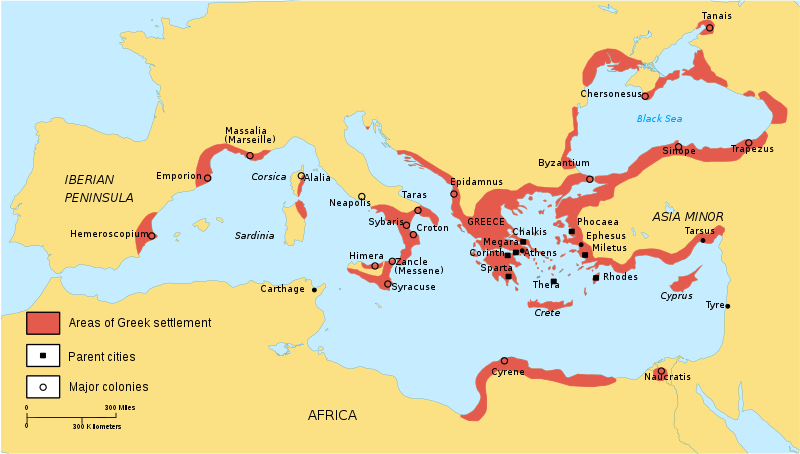
Greek colonization in the Archaic period.
Map by Dipa1965 via Wikimedia Commons.
My family hails from a small Greek village in Anatolia, in modern day Turkey, but I have unfortunately never been to my ancestral homeland because I was born a “refugee” in Montreal. Living in the “liberated zone” of Chomedey, Que., one of the biggest Greek communities in Canada, is the closest I’ve ever felt to my beloved Anatolia.
The Republic of Turkey does not have a legal right to exist. It is an illegitimate and temporary colonial project built by and for Turkish settlers from Central Asia. My ancestors resided on the Aegean coast of Asia Minor for thousands of years before the first Turks arrived on horseback from the barren plains of Mongolia. I will never relinquish my right to return to my ancestral homeland.
If you think these assertions are ridiculous, it’s because they are. I copied them from the shallow, even childish, anti-Israel discourse that’s prevalent on campuses in the United States and Canada, including the University of Ottawa, where I studied and now teach. I am a proud Canadian citizen, with no legal or personal connection to Anatolia. I have no intention, or right, to return to my so-called ancestral homeland. Except, perhaps, for a much-needed vacation. Even then, my stay would be limited to the extent permitted by Turkish law.
The Second Greco-Turkish War concluded with the Treaty of Lausanne in 1923. Among other things, this agreement finalized the forced displacement of nearly one-million Ottoman Greeks to the Kingdom of Greece, and roughly 500,000 Greek Muslims to the newly formed Republic of Turkey. This ended the over 3,000 years of Greek history in Anatolia, and served as a model for the partition of British India, which saw the emergence of a Hindu majority state and a Muslim majority state some two decades later.
With their keys and property deeds in hand, my paternal grandmother’s family fled to the Greek island of Samos, on the opposite side of the Mycale Strait at a nearly swimmable distance from the Turkish coast. While they practised the Greek Orthodox religion and spoke a dialect of the Greek language, they were strangers in a foreign land with no legal or personal connection to the Kingdom of Greece.
The Great War channel produced an overview of the Greco-Turkish War of 1919-1923 that resulted in the vast human tragedy of the expulsion of ethnic Greek civilians from Anatolia and ethnic Turkish civilians from mainland Greece here.
Comments Off on The nonsensical “right of return” debate
February 7, 2024
The Magician Who Fooled the Nazis (and all of us)
World War Two
Published 7 Nov 2023Military deception is tricky. Sometimes you need to destroy a crucial piece of war industry or make an entire harbour disappear. Who do you call for this sort of job? Well, someone who knows a thing or two about tricking the eye. You need a professional magician. You need Jasper Maskelyne. But is there more to this illusionist than meets the eye?
(more…)
Comments Off on The Magician Who Fooled the Nazis (and all of us)
October 24, 2023
See Inside The M3 Grant | Tank Chats Reloaded
The Tank Museum
Published 30 Jun 2023With a crew of six and a chaotically crowded interior, the Grant was a US-produced WW II tank more used by the British and Indian Armies than anyone else. Join Chris Copson as he explores probably the best preserved example of this rare vehicle – and listen out for the cheese sandwich …
(more…)
Comments Off on See Inside The M3 Grant | Tank Chats Reloaded
September 30, 2023
Why did the North Africa Campaign Matter in WW2?
The Intel Report
Published 8 Jun 2023As Erwin Rommel’s Afrika Korps rolled into Egypt in 1942, the only thing standing between them and Cairo and the Suez Canal was the British 8th Army. In this video we look at what was at stake for both sides, and why the North African campaign made a crucial impact on the outcome of the Second World War.
(more…)
Comments Off on Why did the North Africa Campaign Matter in WW2?
June 17, 2023
Why Rommel Lost the Battle for North Africa
Real Time History
Published 16 Jun 2023The North African campaign of WW2 is one of the most famous ones. The almost mythical story of the British “Desert Rats” defeating Erwin Rommel’s Afrika Korps. But why did Rommel lose in North Africa?
(more…)
June 7, 2023
QotD: A “second front” in 1943
There are some points in their favour. The invasions of North Africa definitely took resources that could have been built up in Britain, and therefore slowed things down. (And the withdrawal of the new escort carriers, escort groups, and shipping from the Battle of the Atlantic for the North African adventure, definitely did huge damage in the loss of shipping and supplies, slowing things down further.) As a result the huge buildup in North Africa was much easier to use against Italy before moving on to France. Certainly another distraction or delay … but only if you don’t think that knocking Italy out of the war would make Germany weaker!
But once Sledgehammer [the plan to invade France in 1942] was abandoned, this operation was the only possible way to get US troops into combat in Europe, short of shipping some to Russia. It was also the only possible way of coming close to keeping Roosevelt’s ridiculous promise to the Russians.
[…]
Nonetheless it is wrong to think that the British never had any intention of [mounting Operation] Roundup. Despite what Roosevelt and many other Americans convinced themselves, the British were, at the start of 1942, far more optimistic about the possibility of invading Europe through France in 1943 than they had been about Sledgehammer. Their studies seemed to show that Germany would only have to be weaker, not suddenly collapse, to make invasion in 1943 a realistic possibility. Realistic that is as long as the rest of the plans for training and shipping troops, building and concentrating invasion craft, and moving enough supplies to make it sustainable, all came together.
They didn’t.
For the British, the middle of 1942 revealed how little would be available in time for the middle of 1943. Even on the best assumptions of American training and preparation, there was no chance that the majority of forces for Roundup would not be British … assuming they could supply them either. In practice mid-1942 saw the Axis continue to advance on every front. Burma collapsed; the Allied position in New Guinea was under threat; the Japanese were still expanding to places like Guadalcanal; Rommel was advancing in Egypt; the Germans were advancing on the Caucasian oil fields and towards the Middle East; and more and more was needed just to keep Russia in the war. As a result British troops, shipping and supplies were continuing to flow away from Britain, not towards it.
Much of the Royal Navy was trying to save the dangerous losses caused by [US Chief of Naval Operations Admiral] King’s refusal to have convoys in American waters (too “defensive-minded” he thought.) These alone, the worst eight months of the war, were threatening to scupper Roundup. The rest was so busily deployed in the Indian and Pacific Oceans against the Japanese, or North Atlantic trying to fight supplies through to Russia (a high proportion of tanks and planes defending Moscow were British-supplied), that there was virtually nothing left in the Med to slow Rommel’s advance. The merchant ships surviving the fight across the oceans were actually more vitally needed to take men and equipment from the UK to other places than to bring in a buildup for the UK.
Nor was the American buildup going to plan. Less well-trained troops were becoming available too slowly, could not be shipped in adequate numbers anyway, and were in no condition to face German veterans. (The very best US units to go into action in 1942 – the Marines in Guadalcanal – and 1943 – the 1st Infantry and 1st Armored divisions which were actually professional troops not conscripts in North Africa – had very steep learning curves. Particularly at Kasserine. They were clearly not fit to face German veterans yet.
And American resource buildup was also not up to promises. King and MacArthur were milking supplies far beyond what had originally been agreed under “Germany first”. In practical terms they were doing so for the same reasons the British were: an immediate desperate situation had to be saved before a future ideal one could be pursued.
Nonetheless I have read all sorts of apparently serious suggestions that after North Africa was cleared, or at the very least after Sicily was cleared, an invasion of France should have happened.
Delusional.
Nigel Davies, “The ‘Invasion of France in 1943’ lunacy”, rethinking history, 2021-06-21.
Comments Off on QotD: A “second front” in 1943
April 28, 2023
QotD: The high-water mark of the Panzerarmee Afrika
Even here, however, let us be honest. Smashing 8th Army at Gazala and taking tens of thousands of prisoners at Tobruk did little to solve the strategic problem. Unless the British were destroyed altogether, they would reinforce to a level the Axis could not match. Many later analysts argue that the Panzerarmee should have paused now, waited until some sort of combined airborne-naval operation had been launched against Malta to improve the logistics, and only then acted. Such arguments ignore the dynamic of the desert battle, however; they ignore the morale imperative of keeping a victorious army in motion; above all they ignore the personality of Rommel himself.
Pause? Halt? Wait? Anyone who expected Rommel to ease up on the throttle clearly hadn’t been paying attention. Instead, the Panzerarmee vaulted across the border into Egypt with virtually no preparation. To Rommel, to his men, and even to Hitler and Mussolini, it must have looked like a great victory lay just over the next horizon: Cairo, Alexandria, the Suez Canal, the British Empire itself.
In reality, it is possible today to see what the great Prussian philosopher of war Karl von Clausewitz once called the “culmination point” — that moment in every campaign when the offensive begins to lose steam, run down, and eventually stop altogether. The Panzerarmee was exhausted, its equipment was worn out and in desperate need of repair. Captured British stores and vehicles had become its life-blood, Canadian Ford trucks in particular. The manpower was breaking down. A chronic shortage of potable water had put thousands of soldiers on the sick rolls. Colonel Siegfried Westphal, the Panzerarmee‘s operations chief (the “Ia”, in German parlance), was yellow with jaundice. The army’s intelligence chief (the “Ic”), Colonel Friedrich Wilhelm von Mellenthin, was wasting away with amoebic dysentery. Rommel had a little of both, as well as a serious blood-pressure problem (no doubt stress-induced) and a chronic and bothersome sinusitis condition. While it would be easy to view all these illnesses as simple bad luck, they were, in fact, the price Rommel and all the rest of them were paying for fighting an overseas expeditionary campaign with inadequate resources.
The same might be said for the rest of the campaign. The Panzerarmee made an ad hoc attempt to break thought the British bottleneck at El Alamein in July. It failed, coming to grief against British defenses on the Ruweisat ridge. There was a second, more deliberate, attempt in August. After an initial breakthrough, it crashed into strong British defenses at Alam Halfa ridge and it, too, failed. After yet another long pause, a “third battle of El Alamein” began in late October. This time, it was the well supplied British on the attack, however, and they managed to smash through the Panzerarmee and drive Rommel and company back, not hundreds of miles, but more than a thousand, out of the desert altogether and into Tunisia. There was still fighting to be done in Africa, but the “desert war” was over.
Robert Citino, “Drive to Nowhere: The Myth of the Afrika Korps, 1941-43″, The National WWII Museum, 2012. (Originally published in MHQ, Summer 2012).
Comments Off on QotD: The high-water mark of the Panzerarmee Afrika


