Quotulatiousness

November 30, 2019

Toynbee’s warning

Filed under: History, Liberty, Politics — Tags: , , , , , — Nicholas @ 03:00

In the National Post, Barbara Kay wonders if conservative democracy can shore up the civilizational boundaries that liberal democracy has abandoned:

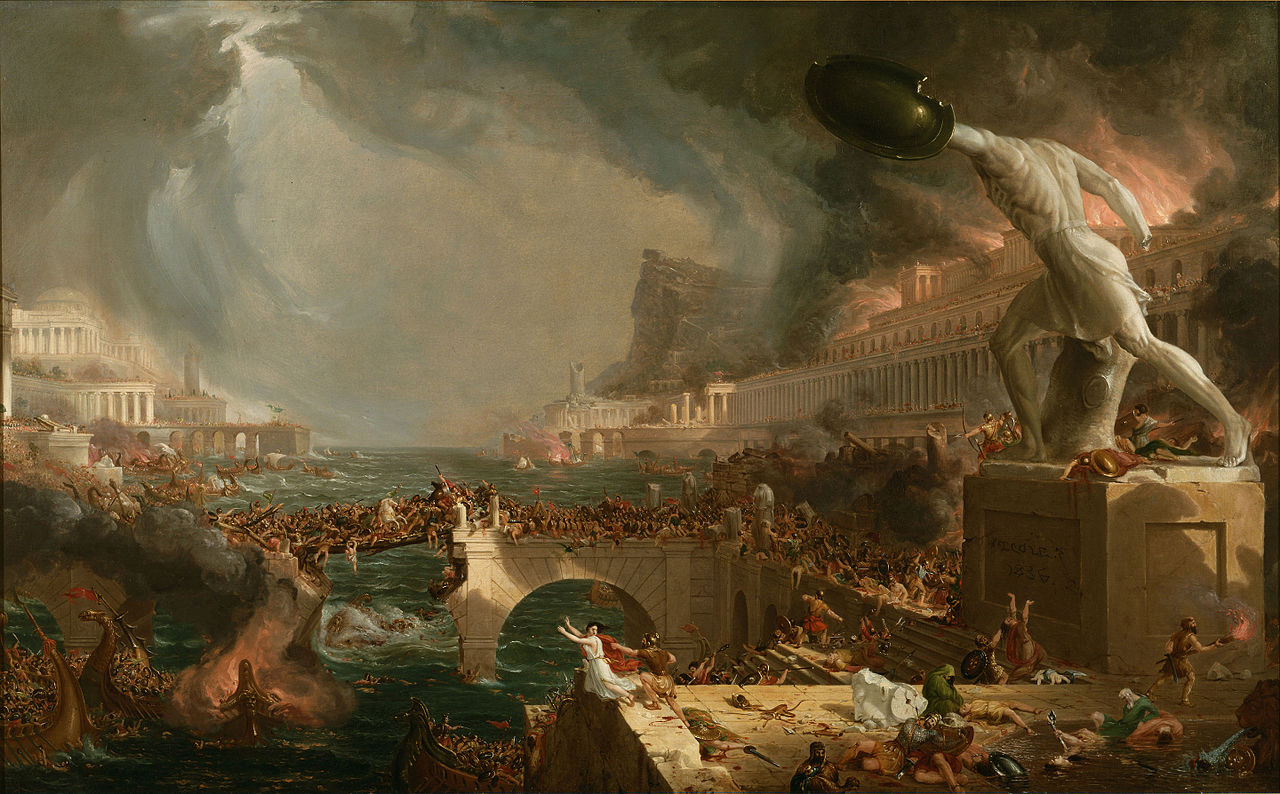
The Course of Empire – Destruction by Thomas Cole, 1836.
From the New York Historical Society collection via Wikimedia Commons.

The historian Arnold Toynbee warned that “civilizations die from suicide, not by murder.” He said they begin to disintegrate when they abandon moral law and yield to their impulses, which in turn brings about a state of passivity, a sense that there is no point in resisting incoming waves of foreigners driven by confidence and purpose.

Since Toynbee, other writers, notably James Burnham in his influential 1964 essay, “Suicide of the West: An essay on the Meaning and Destiny of Liberalism”, have picked up on the theme. In every case in which the word “suicide” features, the root cause comes down to the effects of a universalist liberal democracy over time. These observers are not trading in fear-mongering for its own sake. We must pay respectful attention to their warnings.

Liberal democracy is, broadly speaking, a political doctrine consecrated to the belief that reason, universally accessible and everywhere the same, can by itself create the conditions for enlightened progress in human affairs.

With social justice as the end and social transformation as the means, liberals are not perturbed by the erosion of Christianity, the traditional family and the cultural particularism such transformation requires. The instinct to jettison cultural babies in order to refresh our cultural bathwater is a feature, not a bug, of liberal democracy.

Conservatives, even those who don’t embrace social conservatism, view the crumbling of these building blocks of civilization with anxiety and fear. Their view is that reason alone, without spiritual ballast and deference to the traditions that created our civilization, can produce social instability and even violence. Nobody considered himself more reasonable than Vladimir Lenin. Nobody considers herself more reasonable than a minister of sport who conflates subjective gender identification with biological sex.

Conservatives’ fears are driving the nationalist/nativist counter-movement liberals view with disgust and anger. Conservatives find it difficult to get an unbiased hearing in the prevailing progressive zeitgeist. Liberals have been successful in linking nationalism with history’s most odious incarnations of racism and imperialism in the popular imagination, while ignoring the equally tragic history of internationalist movements, because Marxist utopianism casts a spell they find irresistible.

So in the matter of immigration, for example, liberals are not concerned by mass immigration from countries with different religious and cultural traditions, because they rely on the universal appeal of liberal principles to even out the initial wrinkles. Conservatives regard these different traditions as deeply entrenched and likely to be negatively transformative to our own culture. They are inclined to impose strictures that encourage integration into, along with recognition of, our own culture’s dominant status. Far from being racist, conservatives view this precaution as a hedge against the kind of inter-cultural tensions spilling over into expressed hatreds that are presently roiling Europe. But as we saw in the last election, even the mildest criticism of mass immigration is the kiss of death to a politician.

Recently, I posted a Quote of the Day from Sarah Hoyt that emphasized the persistence of culture, which is a warning to those who think unlimited immigration from other cultures won’t have negative impacts on the receiving culture:

Societies don’t work that way. Culture doesn’t work that way. In fact culture is so persistent, so stubborn, it leads people to think it’s genetic. (It’s not. A baby taken at birth to another culture will not behave as his culture of origin.) It changes, sure, through invasions and take overs, but so slowly that bits of older cultures and ideas stay embedded in the new culture. It has been noted that the communist rulers of Russia partook a good bit of the Tsarist regime, because the culture of the people was the same and that came through. (They just dialed up the atrocities and lowered the functionality because their ideology was dysfunctional. They blame their failure on Russia itself, but considering how communism does around the world, I’ll say to the extent countries survive it’s because of the underlying culture.)

August 27, 2019

QotD: Salvador Dali and the “benefit of clergy”

Filed under: Books, Europe, History, Quotations — Tags: , , , , — Nicholas @ 01:00

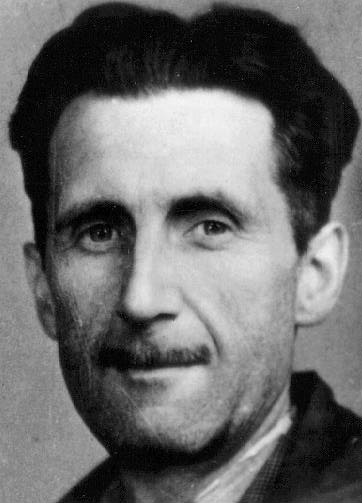
Orwell’s press card portrait, 1943

Now, if you showed this book, with its illustrations, to Lord Elton, to Mr. Alfred Noyes, to The Times leader writers who exult over the “eclipse of the highbrow” — in fact, to any “sensible” art-hating English person — it is easy to imagine what kind of response you would get. They would flatly refuse to see any merit in Dali whatever. Such people are not only unable to admit that what is morally degraded can be aesthetically right, but their real demand of every artist is that he shall pat them on the back and tell them that thought is unnecessary. And they can be especially dangerous at a time like the present, when the Ministry of Information and the British Council put power into their hands. For their impulse is not only to crush every new talent as it appears, but to castrate the past as well. Witness the renewed highbrow-baiting that is now going on in this country and America, with its outcry not only against Joyce, Proust and Lawrence, but even against T. S. Eliot.

But if you talk to the kind of person who can see Dali’s merits, the response that you get is not as a rule very much better. If you say that Dali, though a brilliant draughtsman, is a dirty little scoundrel, you are looked upon as a savage. If you say that you don’t like rotting corpses, and that people who do like rotting corpses are mentally diseased, it is assumed that you lack the aesthetic sense. Since Mannequin rotting in a taxicab is a good composition. And between these two fallacies there is no middle position, but we seldom hear much about it. On the one side Kulturbolschevismus: on the other (though the phrase itself is out of fashion) “Art for Art’s sake.” Obscenity is a very difficult question to discuss honestly. People are too frightened either of seeming to be shocked or of seeming not to be shocked, to be able to define the relationship between art and morals.

It will be seen that what the defenders of Dali are claiming is a kind of benefit of clergy. The artist is to be exempt from the moral laws that are binding on ordinary people. Just pronounce the magic word “Art”, and everything is O.K.: kicking little girls in the head is O.K.; even a film like L’Age d’Or* is O.K. It is also O.K. that Dali should batten on France for years and then scuttle off like rat as soon as France is in danger. So long as you can paint well enough to pass the test, all shall be forgiven you.

One can see how false this is if one extends it to cover ordinary crime. In an age like our own, when the artist is an altogether exceptional person, he must be allowed a certain amount of irresponsibility, just as a pregnant woman is. Still, no one would say that a pregnant woman should be allowed to commit murder, nor would anyone make such a claim for the artist, however gifted. If Shakespeare returned to the earth to-morrow, and if it were found that his favourite recreation was raping little girls in railway carriages, we should not tell him to go ahead with it on the ground that he might write another King Lear. And, after all, the worst crimes are not always the punishable ones. By encouraging necrophilic reveries one probably does quite as much harm as by, say, picking pockets at the races. One ought to be able to hold in one’s head simultaneously the two facts that Dali is a good draughtsman and a disgusting human being. The one does not invalidate or, in a sense, affect the other. The first thing that we demand of a wall is that it shall stand up. If it stands up, it is a good wall, and the question of what purpose it serves is separable from that. And yet even the best wall in the world deserves to be pulled down if it surrounds a concentration camp. In the same way it should be possible to say, “This is a good book or a good picture, and it ought to be burned by the public hangman.” Unless one can say that, at least in imagination, one is shirking the implications of the fact that an artist is also a citizen and a human being.

* Dali mentions L’Age d’Or and adds that its first public showing was broken up by hooligans, but he does not say in detail what it was about. According to Henry Miller’s account of it, it showed among other things some fairly detailed shots of a woman defecating.

George Orwell, “Benefit of Clergy: Some Notes on Salvador Dali”, Saturday Book for 1944, 1944.

July 26, 2019

QotD: Preparing for war

Filed under: Government, History, Military, Quotations — Tags: — Nicholas @ 01:00

A nation that does not prepare for all the forms of war should then renounce the use of war in national policy. A people that does not prepare to fight should then be morally prepared to surrender. To fail to prepare soldiers and citizens for limited, bloody ground action, and then to engage in it, is folly verging on the criminal.

T.R. Fehrenbach, This Kind of War: A Study in Unpreparedness, 1963.

June 11, 2019

QotD: Advice to young men

Filed under: Books, Humour, Quotations, USA — Tags: , , — Nicholas @ 01:00

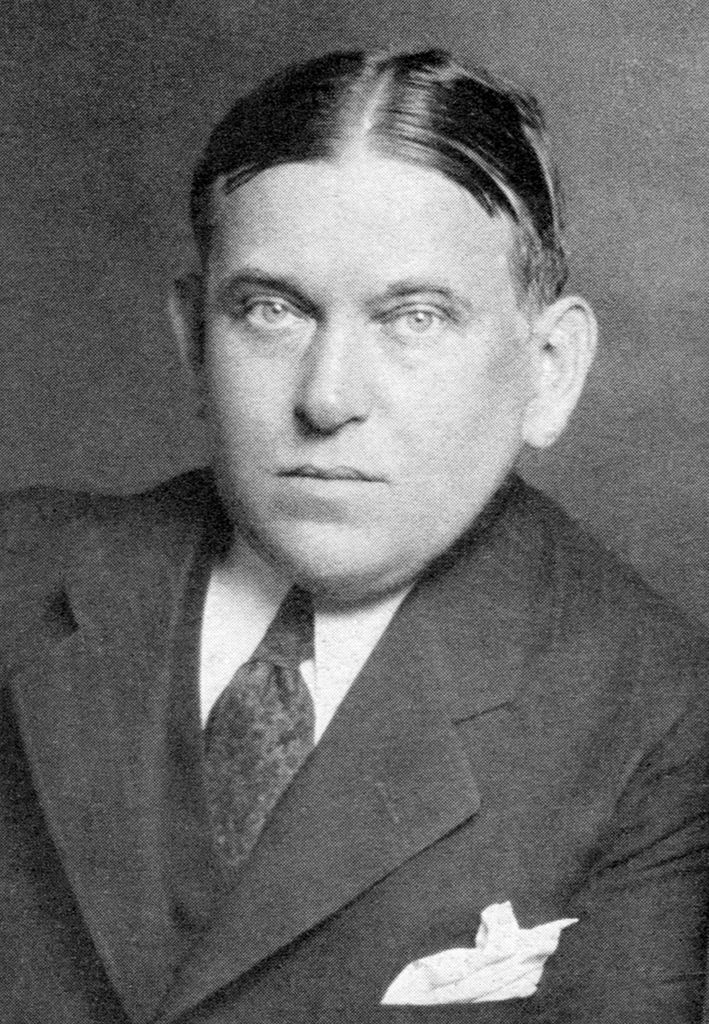
H.L. Mencken in 1928.
Photo by Ben Pinchot for Theatre Magazine, August 1928.


Since Philip Dormer Stanhope, Earl of Chesterfield, published his celebrated letters to his morganatic son, in 1744, there has been no adequate book, in English, of advice to young men. I say adequate, and the adjective tells the whole story. There is not, of course, a college president or a boss Y.M.C.A. secretary, or an uplifting preacher in the United States who has not written such a book, but all of them are alike filled with bilge. They depict and advocate a life that no normal young man wants to live, or could live without ruin if he wanted to. They are full of Sunday-school platitudes and Boy Scout snuffling. If they were swallowed by the youth of today the Republic of tomorrow would be a nation of idiots.

H.L. Mencken, “Another Long-Awaited Book”, Chicago Tribune, 1926-09-12.

April 4, 2019

QotD: Anti-masculinity

Filed under: History, Quotations, USA — Tags: , , , — Nicholas @ 01:00

One of the many harms inflicted on us by the hive minded lunatics running our society is the binary world view. Everything is either all good or all bad. As such, everyone must either fully embrace something or completely reject something. Indifference, ambivalence and moderation are not permissible in a world run by zealous fanatics. The only things that matter, that can matter, are those things that require a moral position. Everything else falls outside the set of things that exist, at least to the hive minded.

The most obvious example is homosexuality. Like all normal men, I am mildly intolerant of homosexuals. I get that they cannot help themselves and I get that it is “natural” in the same way schizophrenia is natural. I’m fine with them doing what they must, just as long as they do it in private. Of course, that makes me a monster. In the hive, you must either fully embrace homosexuality and what comes with it, or you are a homophobe and not fit for decent company. There’s no room for indifference or mild intolerance.

Hive mindedness is much more of a female attribute, than a masculine one. That’s not to imply that all women are howling at the moon zealots. It’s just that the fairer sex is much more inclined to deal in absolutes. The reason is that men have ways to arbitrate disputes that do not require a transcendent set of rules. One chimp squares off with the other chimp and the winner is the one who was right about where to find the best bananas. Women don’t have that so they look for a set of rules to figure out winners and losers.

It’s why it was no accident, that as soon as the girls got the vote, and the boys were off fighting the Kaiser, the girls banned alcohol and prostitution. To quote Judge Roy Bean, “Drinking and gambling and whoring were declared unlawful. All those things which come natural to men became crimes.” Morality, at least in the modern age, is the set of rules the girls use to control the boys, which is why the prim-faced moralizers of today are running around trying to stamp out anything that smacks of masculinity.

“The Z Man”, “Pouf-berries”, The Z Blog, 2017-04-08.

January 26, 2019

QotD: Racism, paranoia, and Presidential Derangement Syndrome

Filed under: Politics, Quotations, USA — Tags: , , , , — Nicholas @ 01:00

Political prejudice is not the moral equivalent of racial prejudice, but they operate in very similar ways, as anybody who ever has spent much time around a genuine racist or anti-Semite knows. Taxes too high? Blame the blacks. Not making enough money? Blame the Mexicans. Foreign policy seem overwhelmingly complex? Blame the Jews. Whataburger gave you a full-on corn-syrup Coke instead of a Diet Coke? Blame the blacks, Mexicans, Jews, subcontinental immigrants … somebody. Racism and anti-Semitism are metaphysical creeds, and those who adhere to these creeds see the work of the agents of evil everywhere. For them, there is no world outside race and racism.

In this, they are very similar to the Hillary Clinton–voting Manhattan balletomanes who seethe that they must endure being seated in the David Koch theater. David Koch’s brand of libertarianism is mild and constructive, and it has about as much to do with ballet as Keith Olbermann has to do with astrophysics. But for the fanatic, even to hear the name spoken is unbearable.

The people who believe that there can be no art, literature, culture, or life apart from politics are people who do not understand art, literature, culture, or politics.

Imagine being so mentally poisoned and so spiritually sick that you feel the need to organize a protest at New York–Presbyterian Hospital because the institution accepted $100 million — the largest gift in its history, being put to purely philanthropic health-care purposes — from someone whose political views are at odds with your own. Imagine what it must be like to feel that doing that is a moral imperative. Imagine sitting down to listen to a Beethoven string quartet and being filled with paralyzing anxiety that the cellist might not share your views on the Arab–Israeli conflict.

Kevin D. Williamson, “No Republicans Need Apply”, National Review, 2017-02-12.

January 20, 2019

QotD: Emotion and loyalty

Filed under: Politics, Quotations — Tags: , , — Nicholas @ 01:00

As social psychologist Jonathan Haidt has argued for years, doing things in groups is really hard, and the larger the group, the harder it gets. Moral values like group loyalty — an instinctive group loyalty, not some dry intellectual thing carefully reasoned from first principles and self-interest — make it possible for us to do this very difficult thing. And the reason you can’t simply rely on a more intellectually attractive, well-reasoned version is that other people will not trust it. Your reasoning could change, or your self-interest could dictate that you betray them. Bedrock emotions are stickier. This makes them problematic, but it also makes them necessary.

Megan McArdle, “In Defense of Trump’s ‘Day of Patriotic Devotion'”, Bloomberg View, 2017-01-26.

November 12, 2018

Woodrow Wilson

Filed under: History, USA, WW1 — Tags: , , , , , , — Nicholas @ 05:00

In City Journal, Lance Morrow looks back at the successes and failures of President Wilson:

It’s been a century since President Woodrow Wilson arrived in Europe, weeks after the Armistice ending World War I. A crowd of 2 million cheered him in Paris. The papers called him the “God of Peace,” the “Savior of Humanity,” a “Moses from America.” He bowed, he tipped his silk top hat — the newsreel images come flickering to us from an earlier world. He sat down with Georges Clemenceau and David Lloyd George and the others to hash out the fiasco of the Versailles Treaty. He returned home to the fatal wrangle over the League of Nations with Henry Cabot Lodge in the Senate. Then came the cross-country tour to sell the treaty to the American people, his collapse on the train near Wichita, and, back in Washington, the terrible stroke and the long twilight — a sequence that led, further down the road, to Warren G. Harding and, in the fullness of time, to Adolf Hitler and World War II.

Woodrow Wilson, 1919
Photo via Wikimedia Commons.

The Woodrow Wilson story is an American classic — a set piece, like the rise and fall of Joseph McCarthy, or the fable of John F. Kennedy. Of Wilson, the historian Barbara Tuchman wrote: “Since Americans are not, by and large, a people associated with tragedy, it is strange and unexpected that the most tragic figure in modern history — judged by the greatness of expectations and the measure of the falling off — should have been an American.”

People speak of “settled science.” One might also speak of “settled myth.” (The Kennedys are one of those.) But Wilson’s myth remains vexed and unsettled. He persists, in American memory, as a sort of botched paragon — a man who remains almost irritatingly alive and imperfect and somehow touching. The respect that he deserves is complicated — and so is the contempt. The same has been said of American idealism itself.

As with America, there are two basic versions of Wilson: the sacred and the profane. Was his greatness real or fake? He ranks in polls in the top quarter of American presidents, but with a dissenting asterisk. Was he the superbly effective Progressive president (who introduced the Federal Reserve and the graduated income tax and much else) and the prophet of twentieth-century internationalism? (Wait: Are we to thank Wilson for Vietnam? Iraq? Afghanistan?) Or was he the last fling of nineteenth-century moralism and hypocrisy — a Southern-born racist or near-racist, and a brute on the subject of civil liberties? (He tossed Eugene V. Debs in jail merely for disagreeing with him on the war, leaving it to Warren G. Harding to pardon Debs.) Some said that his mind was a Sunday school; others, that it was the pool of Narcissus. Yet he managed to be a great man all the same. It’s too bad that he did not leave the presidency, one way or another, in 1919, after the damage from his stroke became evident. Amazingly, even in the summer of 1920, the broken man had delusions of running for a third term. He felt embittered and betrayed when the Democratic nomination went to Governor James Cox of Ohio. Woodrow Wilson’s ego died harder than Rasputin.

An indispensable aspect of Wilson’s genius—and a key, perhaps, to his failure — was his lambent but vaguely narcissistic prose style, sweet in its clarities but sometimes too supple and manipulative. Unlike most presidents, he wrote his own speeches. He governed a good deal by means of language, and he used words to impose his will or to conjure up an ideal world that might be mistaken, from a distance, for the Kingdom of God. He was also a theatrical man, an actor, an excellent mimic: a performer. Was he Prospero? Or was he, in the end, Christ crucified? People spoke routinely of his messiah complex. At one point during the Paris Peace Conference, he seemed to suggest that he was actually an improvement on the messiah. Lloyd George listened in amazement as Wilson observed that organized religion had yet to devise practical solutions to the problems of the world. Christ had articulated the ideal, Wilson said, but he had offered no instructions on how to attain it. “That is the reason why I am proposing a practical scheme to carry out his aims.” Self-righteousness is tiresome in the end. Many concluded that Wilson should be remembered, without appeals to either religion or literature, as the stiff-necked, hypochondriacal son of a Presbyterian minister, led astray by his own moral vanity — either that, or as the uxorious hero of ladies’ teas. He loved the companionship of doting women but not necessarily that of strong men.

H.L. Mencken wrote of Wilson, shortly after the President’s death, in a review of The Story of a Style by Dr. William Bayard Hale:

Two or three years ago, at the height of his illustriousness, it was spoken of in whispers, as if there were something almost supernatural about its merits. I read articles, in those days, comparing it to the style of the Biblical prophets, and arguing that it vastly exceeded the manner of any living literatus. Looking backward, it is not difficult to see how that doctrine arose. Its chief sponsors, first and last, were not men who actually knew anything about the writing of English, but simply editorial writers on party newspapers, i.e., men who related themselves to literary artists in much the same way that Dr. Billy Sunday relates himself to the late Paul of Tarsus. What intrigued such gentlemen in the compositions of Dr. Wilson was the plain fact that he was their superior in their own special field — that he accomplished with a great deal more skill than they did themselves the great task of reducing all the difficulties of the hour to a few sonorous and unintelligible phrases, often with theological overtones – that he knew better than they did how to arrest and enchant the boobery with words that were simply words, and nothing else. The vulgar like and respect that sort of balderdash. A discourse packed with valid ideas, accurately expressed, is quite incomprehensible to them. What they want is the sough of vague and comforting words – words cast into phrases made familiar to them by the whooping of their customary political and ecclesiastical rabble-rousers, and by the highfalutin style of the newspapers that they read. Woodrow knew how to conjure up such words. He knew how to make them glow, and weep. He wasted no time upon the heads of his dupes, but aimed directly at their ears, diaphragms and hearts.

But reading his speeches in cold blood offers a curious experience. It is difficult to believe that even idiots ever succumbed to such transparent contradictions, to such gaudy processions of mere counter-words, to so vast and obvious a nonsensicality. Hale produces sentence after sentence that has no apparent meaning at all — stuff quite as bad as the worst bosh of the Hon. Gamaliel Harding. When Wilson got upon his legs in those days he seems to have gone into a sort of trance, with all the peculiar illusions and delusions that belong to a frenzied pedagogue. He heard words giving three cheers; he saw them race across a blackboard like Socialists pursued by the Polizei; he felt them rush up and kiss him. The result was the grand series of moral, political, sociological and theological maxims which now lodges imperishably in the cultural heritage of the American people, along with Lincoln’s “government for the people, by the people,” etc., Perry’s “We have met the enemy, and they are ours,” and Vanderbilt’s “The public be damned.” The important thing is not that a popular orator should have uttered such grand and glittering phrases, but that they should have been gravely received, for many weary months, by a whole race of men, some of them intelligent. Here is a matter that deserves the sober inquiry of competent psychologists. The boobs took fire first, but after a while even college presidents — who certainly ought to be cynical men, if ladies of joy are cynical women — were sending up sparks, and for a long while anyone who laughed was in danger of the calaboose. Hale does not go into the question; he confines himself to the concrete procession of words. His book represents tedious and vexatious labor; it is, despite some obvious defects, very well managed; it opens the way for future works of the same sort. Imagine Harding on the Hale operating table!

September 4, 2018

QotD: Law and morality

Filed under: Law, Liberty, Quotations — Tags: , , — Nicholas @ 01:00

In the first place, it would efface from everybody’s conscience the distinction between justice and injustice. No society can exist unless the laws are respected to a certain degree, but the safest way to make them respected is to make them respectable. When law and morality are in contradiction to each other, the citizen finds himself in the cruel alternative of either losing his moral sense, or of losing his respect for the law — two evils of equal magnitude, between which it would be difficult to choose.

Frédéric Bastiat, The Law, 1850.

March 26, 2018

QotD: Virtue signalling

Filed under: Media, Politics, Quotations — Tags: , , , — Nicholas @ 01:00

It’s noticeable how often virtue signalling consists of saying you hate things. It is camouflage. The emphasis on hate distracts from the fact you are really saying how good you are. If you were frank and said, ‘I care about the environment more than most people do’ or ‘I care about the poor more than others’, your vanity and self-aggrandisement would be obvious, as it is with Whole Foods. Anger and outrage disguise your boastfulness.

One of the occasions when expressions of hate are not used is when people say they are passionate believers in the NHS. Note the use of the word ‘belief’. This is to shift the issue away from evidence about which healthcare system results in the greatest benefit for the greatest number of people. The speaker does not want to get into facts or evidence. He or she wishes to demonstrate kindness — the desire that all people, notably the poor, should have access to ‘the best’ healthcare. The virtue lies in the wish. But hatred waits in reserve even with the NHS. ‘The Tories want to privatise the NHS!’ you assert angrily. Gosh, you must be virtuous to be so cross!

Comedians make use of virtue signalling of the vituperative kind. With the right audience they can get laughs scorning the usual suspects: Ukip, the Daily Mail, Eton, bankers and the rest. The audience enjoys the caricaturing of all of these, sneering at them and, in the process, joining together as a congregation of the righteously contemptuous. What a delight to display your virtue, feel confirmed in your views, enjoy a sense of community, let off some anger and have a laugh all at the same time! It is so easy, too!

No one actually has to do anything. Virtue comes from mere words or even from silently held beliefs. There was a time in the distant past when people thought you could only be virtuous by doing things: by helping the blind man across the road; looking after your elderly parents instead of dumping them in a home; staying in a not-wholly-perfect marriage for the sake of the children. These things involve effort and self-sacrifice. That sounds hard! Much more convenient to achieve virtue by expressing hatred of those who think the health service could be improved by introducing competition.

James Bartholemew “The awful rise of ‘virtue signalling’: Want to be virtuous? Saying the right things violently on Twitter is much easier than real kindness”, The Spectator, 2015-04-18.

February 18, 2018

“The minority of one is the most oppressed minority of all”

Filed under: Britain, Liberty, Politics, USA — Tags: , , , , , — Nicholas @ 06:00

Matt Ridley on the rising tide of neo-Victorian prudery in western society:

Is it so different here or are we slipping down the same slope? Pre-Raphaelite paintings that show the top halves of female nudes are temporarily removed from an art gallery’s walls; young girls are forced to wear headscarves in school; darts players and racing drivers may not be accompanied by women in short skirts; women are treated differently from men at universities, as if they were the weaker sex, and saved from seeing upsetting paragraphs in novels; sex is negotiated in advance with the help of chaperones. We have been here before.

In Orlando, Virginia Woolf’s novel of 1928, she portrayed the transition from the 18th century to the Victorian period thus: “Love, birth, and death were all swaddled in a variety of fine phrases. The sexes drew further and further apart. No open conversation was tolerated. Evasions and concealments were sedulously practised on both sides.”

How we laughed at such absurdity in my youth. But even for making the point that some of the new feminism seems “retrograde” in promoting the view that women are fragile, the American academic Katie Roiphe suffered a vicious campaign to have her article in Harper’s magazine banned before publication. “I find the Stalinist tenor of this conversation shocking,” she told The Sunday Times. “The basic assumption of freedom of speech is imperilled in our culture right now.”

The sin of blasphemy is back. There are things you simply cannot say about Islam and increasingly about Christianity, about climate change, about gender, to mention a few from a very long and growing list, without being accused of, and possibly prosecuted for, “hate speech”. Is it hate speech to say that Muhammad “delivers his country to iron and flame; that he cuts the throats of fathers and kidnaps daughters; that he gives to the defeated the choice of his religion or death: this is assuredly nothing any man can excuse”? That was Voltaire, one of my heroes. You may disagree with him but you should, in accordance with his principle, defend his right to say it. In demanding tolerance of minorities, many younger people seem to be remarkably intolerant.

There is an odd contradiction between the declared wish to live and let live — “diversity!”, “don’t judge!” — and the actual behaviour, which is ruthlessly and priggishly judgmental. They never stop drafting acts of uniformity, always in the name of the collective against the individual. The minority of one is the most oppressed minority of all.

February 7, 2018

Better Safe than Sorry! l THE HISTORY OF CONTRACEPTION

Filed under: Health, History — Tags: , , — Nicholas @ 02:00

IT’S HISTORY
Published on 26 Sep 2015

The development of contraceptives has come a long way. It all started with questionable ointments and rituals to avoid pregnancy. The effectiveness of new inventions have since improved greatly. Especially the invention of rubber and latex for condoms or contraceptive ideas like the diaphragm or the pill. Learn about the development of contraceptives and their societal standing this episode on IT’S HISTORY.

January 20, 2018

Sir Humphrey Appleby: The Consummate Civil Servant

Filed under: Britain, Government, Humour, Weapons — Tags: , — Nicholas @ 02:00

rubatirabbit
Published on 3 Feb 2017

From Yes Minister S03E06: “The Whisky Priest”

January 13, 2018

Actors and public morality

Filed under: History, Media, Religion, USA — Tags: , , — Nicholas @ 03:00

Jonah Goldberg on the differences in the way actors were viewed historically and today:

It may be hard for some people to get the joke these days, but for most of human history, actors were considered low-class. They were akin to carnies, grifters, hookers, and other riffraff. In ancient Rome, actors were often slaves. In feudal Japan, Kabuki actors were sometimes available to the theatergoers as prostitutes — a practice not uncommon among theater troupes in the American Wild West.

In 17th century England, France, and America, theaters were widely considered dens of iniquity, turpitude, and crapulence. Under Oliver Cromwell’s Puritan dictatorship, the theaters were forced to close to improve moral hygiene. The Puritans of New England did likewise. A ban on theaters in Connecticut imposed in 1800 stayed on the books until 1952.

Partly out of a desire to develop a wartime economy, partly out of disdain for the grubbiness of the stage, the first Continental Congress in 1774 proclaimed, “We will, in our several stations, … discountenance and discourage every species of extravagance and dissipation, especially all horse-racing, and all kinds of gaming, cock-fighting, exhibitions of shews [sic], plays, and other expensive diversions and entertainments.”

[…]

The most recent Golden Globes ceremony has already been excoriated for being a veritable geyser of hypocritical effluvia, as the same crowd that not long ago bowed and scraped to serial harasser and accused rapist Harvey Weinstein, admitted child rapist Roman Polanski, and that modern Caligula, Bill Clinton, congratulated itself for its own moral superiority.

The interesting question is: Why have movie stars and other celebrities become an aristocracy of secular demigods? It seems to me an objective fact that virtually any other group of professionals plucked at random from the Statistical Abstract of the United States — nuclear engineers, plumbers, grocers, etc. — are more likely to model decent moral behavior in their everyday lives. Indeed, it is a bizarre inconsistency in the cartoonishly liberal ideology of Hollywood that the only super-rich people in America reflexively assumed to be morally superior are people who pretend to be other people for a living.

I think part of the answer has to do with the receding of religion from public life. As a culture, we’ve elevated “authenticity” to a new form of moral authority. We look to our feelings for guidance. Actors, as a class, are feelings merchants. While they may indeed be “out of touch” with the rest of America from time to time, actors are adept at being in touch with their feelings. And for some unfathomably stupid reason, we now think that puts us beneath them.

December 26, 2017

QotD: Most consumers say they want local-grown food, but won’t pay the costs to get it

Filed under: Business, Food, Quotations, USA — Tags: , , — Nicholas @ 01:00

Food grown locally, on small-lot farms without modern chemical assistance, is really expensive. The complex modern food-supply chain that ensures restaurants and food processors can get the same consistent mix of staple ingredients year-round also relentlessly beats down the price of food, sourcing wherever supply is cheapest, redistributing temporary local abundance to a steady global diet of everyday low prices. This is also not such a terrible way to eat; it is the foundation of much of our modern prosperity. But it is not local, artisanal, organic. It is global, industrial, indifferent. It has to be, both because organic inputs are much more expensive, and because trying to separate and track all the food so that restaurateurs can be sure of provenance and process would mean abandoning many of the efficiencies that make the stuff so cheap.

And Americans expect cheap. Cheap, after all, is what makes it possible for us to spend so much money at restaurants; if we had to pay all the workers $20 an hour and ensure that all our meat and produce had been farmed in the latest and most approved 19th-century methods, few of us could afford to have weekly dining out in our budget. Restaurants might be more authentic, delicious, moral places. They would also be much emptier ones.

Reading the Tampa Bay Times article, you get the sense that many of these restaurateurs tried to provide an authentic farm-to-table experience and found that customers were not willing to pay what it would cost — in money or variety — to have one. People are probably willing to pay some premium for that kind of food, but the premium is probably closer to 10 to 15 percent than it is to the sky-high sums that it would actually cost to rely on those sorts of farms, those sorts of methods. So the restaurateurs inevitably sold them what they were happily willing to pay for: food from an industrial supply chain, with a side of moral satisfaction.

It’s hard to be too angry at consumers. To be sure, they probably should have known that you couldn’t really buy organic, locally sourced food year-round at just a smidge more than you’d pay for a regular meal. After all, the average American spent half their income on food in 1900, while the modern American now spends a paltry 12 percent, even including a lavish helping of restaurant meals. That should give us some sign that local, artisanal food is not going to be cheap. But most Americans are not economic historians.

But it’s not even that easy to be mad at the restaurants. They’re in a viciously competitive business where most places don’t survive. In a competitive equilibrium where so many people want to be told they’re eating farm-fresh food — and so few people seem willing to pay for it — many of them probably feel that their choice is “lie or die.”

Megan McArdle, “Dining Out on Empty Virtue”, Bloomberg View, 2016-04-15.

« Newer PostsOlder Posts »

Powered by WordPress