
One of the many harms inflicted on us by the hive minded lunatics running our society is the binary world view. Everything is either all good or all bad. As such, everyone must either fully embrace something or completely reject something. Indifference, ambivalence and moderation are not permissible in a world run by zealous fanatics. The only things that matter, that can matter, are those things that require a moral position. Everything else falls outside the set of things that exist, at least to the hive minded.
The most obvious example is homosexuality. Like all normal men, I am mildly intolerant of homosexuals. I get that they cannot help themselves and I get that it is “natural” in the same way schizophrenia is natural. I’m fine with them doing what they must, just as long as they do it in private. Of course, that makes me a monster. In the hive, you must either fully embrace homosexuality and what comes with it, or you are a homophobe and not fit for decent company. There’s no room for indifference or mild intolerance.
Hive mindedness is much more of a female attribute, than a masculine one. That’s not to imply that all women are howling at the moon zealots. It’s just that the fairer sex is much more inclined to deal in absolutes. The reason is that men have ways to arbitrate disputes that do not require a transcendent set of rules. One chimp squares off with the other chimp and the winner is the one who was right about where to find the best bananas. Women don’t have that so they look for a set of rules to figure out winners and losers.
It’s why it was no accident, that as soon as the girls got the vote, and the boys were off fighting the Kaiser, the girls banned alcohol and prostitution. To quote Judge Roy Bean, “Drinking and gambling and whoring were declared unlawful. All those things which come natural to men became crimes.” Morality, at least in the modern age, is the set of rules the girls use to control the boys, which is why the prim-faced moralizers of today are running around trying to stamp out anything that smacks of masculinity.
“The Z Man”, “Pouf-berries”, The Z Blog, 2017-04-08.
April 4, 2019
QotD: Anti-masculinity
January 26, 2019
QotD: Racism, paranoia, and Presidential Derangement Syndrome
Political prejudice is not the moral equivalent of racial prejudice, but they operate in very similar ways, as anybody who ever has spent much time around a genuine racist or anti-Semite knows. Taxes too high? Blame the blacks. Not making enough money? Blame the Mexicans. Foreign policy seem overwhelmingly complex? Blame the Jews. Whataburger gave you a full-on corn-syrup Coke instead of a Diet Coke? Blame the blacks, Mexicans, Jews, subcontinental immigrants … somebody. Racism and anti-Semitism are metaphysical creeds, and those who adhere to these creeds see the work of the agents of evil everywhere. For them, there is no world outside race and racism.
In this, they are very similar to the Hillary Clinton–voting Manhattan balletomanes who seethe that they must endure being seated in the David Koch theater. David Koch’s brand of libertarianism is mild and constructive, and it has about as much to do with ballet as Keith Olbermann has to do with astrophysics. But for the fanatic, even to hear the name spoken is unbearable.
The people who believe that there can be no art, literature, culture, or life apart from politics are people who do not understand art, literature, culture, or politics.
Imagine being so mentally poisoned and so spiritually sick that you feel the need to organize a protest at New York–Presbyterian Hospital because the institution accepted $100 million — the largest gift in its history, being put to purely philanthropic health-care purposes — from someone whose political views are at odds with your own. Imagine what it must be like to feel that doing that is a moral imperative. Imagine sitting down to listen to a Beethoven string quartet and being filled with paralyzing anxiety that the cellist might not share your views on the Arab–Israeli conflict.
Kevin D. Williamson, “No Republicans Need Apply”, National Review, 2017-02-12.
January 20, 2019
QotD: Emotion and loyalty
As social psychologist Jonathan Haidt has argued for years, doing things in groups is really hard, and the larger the group, the harder it gets. Moral values like group loyalty — an instinctive group loyalty, not some dry intellectual thing carefully reasoned from first principles and self-interest — make it possible for us to do this very difficult thing. And the reason you can’t simply rely on a more intellectually attractive, well-reasoned version is that other people will not trust it. Your reasoning could change, or your self-interest could dictate that you betray them. Bedrock emotions are stickier. This makes them problematic, but it also makes them necessary.
Megan McArdle, “In Defense of Trump’s ‘Day of Patriotic Devotion'”, Bloomberg View, 2017-01-26.
November 12, 2018
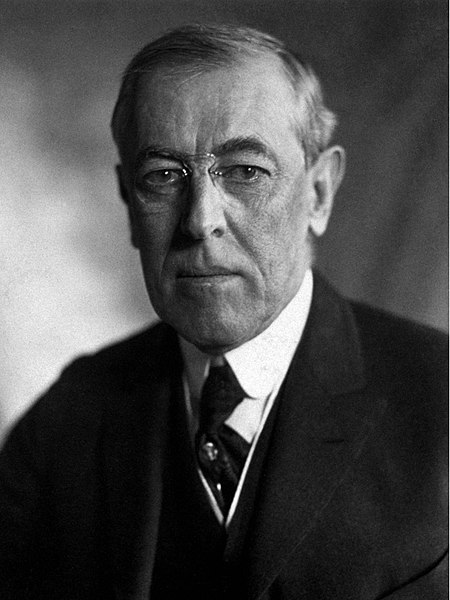
Woodrow Wilson
In City Journal, Lance Morrow looks back at the successes and failures of President Wilson:
It’s been a century since President Woodrow Wilson arrived in Europe, weeks after the Armistice ending World War I. A crowd of 2 million cheered him in Paris. The papers called him the “God of Peace,” the “Savior of Humanity,” a “Moses from America.” He bowed, he tipped his silk top hat — the newsreel images come flickering to us from an earlier world. He sat down with Georges Clemenceau and David Lloyd George and the others to hash out the fiasco of the Versailles Treaty. He returned home to the fatal wrangle over the League of Nations with Henry Cabot Lodge in the Senate. Then came the cross-country tour to sell the treaty to the American people, his collapse on the train near Wichita, and, back in Washington, the terrible stroke and the long twilight — a sequence that led, further down the road, to Warren G. Harding and, in the fullness of time, to Adolf Hitler and World War II.
Woodrow Wilson, 1919
Photo via Wikimedia Commons.The Woodrow Wilson story is an American classic — a set piece, like the rise and fall of Joseph McCarthy, or the fable of John F. Kennedy. Of Wilson, the historian Barbara Tuchman wrote: “Since Americans are not, by and large, a people associated with tragedy, it is strange and unexpected that the most tragic figure in modern history — judged by the greatness of expectations and the measure of the falling off — should have been an American.”
People speak of “settled science.” One might also speak of “settled myth.” (The Kennedys are one of those.) But Wilson’s myth remains vexed and unsettled. He persists, in American memory, as a sort of botched paragon — a man who remains almost irritatingly alive and imperfect and somehow touching. The respect that he deserves is complicated — and so is the contempt. The same has been said of American idealism itself.
As with America, there are two basic versions of Wilson: the sacred and the profane. Was his greatness real or fake? He ranks in polls in the top quarter of American presidents, but with a dissenting asterisk. Was he the superbly effective Progressive president (who introduced the Federal Reserve and the graduated income tax and much else) and the prophet of twentieth-century internationalism? (Wait: Are we to thank Wilson for Vietnam? Iraq? Afghanistan?) Or was he the last fling of nineteenth-century moralism and hypocrisy — a Southern-born racist or near-racist, and a brute on the subject of civil liberties? (He tossed Eugene V. Debs in jail merely for disagreeing with him on the war, leaving it to Warren G. Harding to pardon Debs.) Some said that his mind was a Sunday school; others, that it was the pool of Narcissus. Yet he managed to be a great man all the same. It’s too bad that he did not leave the presidency, one way or another, in 1919, after the damage from his stroke became evident. Amazingly, even in the summer of 1920, the broken man had delusions of running for a third term. He felt embittered and betrayed when the Democratic nomination went to Governor James Cox of Ohio. Woodrow Wilson’s ego died harder than Rasputin.
An indispensable aspect of Wilson’s genius—and a key, perhaps, to his failure — was his lambent but vaguely narcissistic prose style, sweet in its clarities but sometimes too supple and manipulative. Unlike most presidents, he wrote his own speeches. He governed a good deal by means of language, and he used words to impose his will or to conjure up an ideal world that might be mistaken, from a distance, for the Kingdom of God. He was also a theatrical man, an actor, an excellent mimic: a performer. Was he Prospero? Or was he, in the end, Christ crucified? People spoke routinely of his messiah complex. At one point during the Paris Peace Conference, he seemed to suggest that he was actually an improvement on the messiah. Lloyd George listened in amazement as Wilson observed that organized religion had yet to devise practical solutions to the problems of the world. Christ had articulated the ideal, Wilson said, but he had offered no instructions on how to attain it. “That is the reason why I am proposing a practical scheme to carry out his aims.” Self-righteousness is tiresome in the end. Many concluded that Wilson should be remembered, without appeals to either religion or literature, as the stiff-necked, hypochondriacal son of a Presbyterian minister, led astray by his own moral vanity — either that, or as the uxorious hero of ladies’ teas. He loved the companionship of doting women but not necessarily that of strong men.
H.L. Mencken wrote of Wilson, shortly after the President’s death, in a review of The Story of a Style by Dr. William Bayard Hale:
Two or three years ago, at the height of his illustriousness, it was spoken of in whispers, as if there were something almost supernatural about its merits. I read articles, in those days, comparing it to the style of the Biblical prophets, and arguing that it vastly exceeded the manner of any living literatus. Looking backward, it is not difficult to see how that doctrine arose. Its chief sponsors, first and last, were not men who actually knew anything about the writing of English, but simply editorial writers on party newspapers, i.e., men who related themselves to literary artists in much the same way that Dr. Billy Sunday relates himself to the late Paul of Tarsus. What intrigued such gentlemen in the compositions of Dr. Wilson was the plain fact that he was their superior in their own special field — that he accomplished with a great deal more skill than they did themselves the great task of reducing all the difficulties of the hour to a few sonorous and unintelligible phrases, often with theological overtones – that he knew better than they did how to arrest and enchant the boobery with words that were simply words, and nothing else. The vulgar like and respect that sort of balderdash. A discourse packed with valid ideas, accurately expressed, is quite incomprehensible to them. What they want is the sough of vague and comforting words – words cast into phrases made familiar to them by the whooping of their customary political and ecclesiastical rabble-rousers, and by the highfalutin style of the newspapers that they read. Woodrow knew how to conjure up such words. He knew how to make them glow, and weep. He wasted no time upon the heads of his dupes, but aimed directly at their ears, diaphragms and hearts.
But reading his speeches in cold blood offers a curious experience. It is difficult to believe that even idiots ever succumbed to such transparent contradictions, to such gaudy processions of mere counter-words, to so vast and obvious a nonsensicality. Hale produces sentence after sentence that has no apparent meaning at all — stuff quite as bad as the worst bosh of the Hon. Gamaliel Harding. When Wilson got upon his legs in those days he seems to have gone into a sort of trance, with all the peculiar illusions and delusions that belong to a frenzied pedagogue. He heard words giving three cheers; he saw them race across a blackboard like Socialists pursued by the Polizei; he felt them rush up and kiss him. The result was the grand series of moral, political, sociological and theological maxims which now lodges imperishably in the cultural heritage of the American people, along with Lincoln’s “government for the people, by the people,” etc., Perry’s “We have met the enemy, and they are ours,” and Vanderbilt’s “The public be damned.” The important thing is not that a popular orator should have uttered such grand and glittering phrases, but that they should have been gravely received, for many weary months, by a whole race of men, some of them intelligent. Here is a matter that deserves the sober inquiry of competent psychologists. The boobs took fire first, but after a while even college presidents — who certainly ought to be cynical men, if ladies of joy are cynical women — were sending up sparks, and for a long while anyone who laughed was in danger of the calaboose. Hale does not go into the question; he confines himself to the concrete procession of words. His book represents tedious and vexatious labor; it is, despite some obvious defects, very well managed; it opens the way for future works of the same sort. Imagine Harding on the Hale operating table!
September 4, 2018
QotD: Law and morality
In the first place, it would efface from everybody’s conscience the distinction between justice and injustice. No society can exist unless the laws are respected to a certain degree, but the safest way to make them respected is to make them respectable. When law and morality are in contradiction to each other, the citizen finds himself in the cruel alternative of either losing his moral sense, or of losing his respect for the law — two evils of equal magnitude, between which it would be difficult to choose.
Frédéric Bastiat, The Law, 1850.
March 26, 2018
February 18, 2018
“The minority of one is the most oppressed minority of all”
Matt Ridley on the rising tide of neo-Victorian prudery in western society:
Is it so different here or are we slipping down the same slope? Pre-Raphaelite paintings that show the top halves of female nudes are temporarily removed from an art gallery’s walls; young girls are forced to wear headscarves in school; darts players and racing drivers may not be accompanied by women in short skirts; women are treated differently from men at universities, as if they were the weaker sex, and saved from seeing upsetting paragraphs in novels; sex is negotiated in advance with the help of chaperones. We have been here before.
In Orlando, Virginia Woolf’s novel of 1928, she portrayed the transition from the 18th century to the Victorian period thus: “Love, birth, and death were all swaddled in a variety of fine phrases. The sexes drew further and further apart. No open conversation was tolerated. Evasions and concealments were sedulously practised on both sides.”
How we laughed at such absurdity in my youth. But even for making the point that some of the new feminism seems “retrograde” in promoting the view that women are fragile, the American academic Katie Roiphe suffered a vicious campaign to have her article in Harper’s magazine banned before publication. “I find the Stalinist tenor of this conversation shocking,” she told The Sunday Times. “The basic assumption of freedom of speech is imperilled in our culture right now.”
The sin of blasphemy is back. There are things you simply cannot say about Islam and increasingly about Christianity, about climate change, about gender, to mention a few from a very long and growing list, without being accused of, and possibly prosecuted for, “hate speech”. Is it hate speech to say that Muhammad “delivers his country to iron and flame; that he cuts the throats of fathers and kidnaps daughters; that he gives to the defeated the choice of his religion or death: this is assuredly nothing any man can excuse”? That was Voltaire, one of my heroes. You may disagree with him but you should, in accordance with his principle, defend his right to say it. In demanding tolerance of minorities, many younger people seem to be remarkably intolerant.
There is an odd contradiction between the declared wish to live and let live — “diversity!”, “don’t judge!” — and the actual behaviour, which is ruthlessly and priggishly judgmental. They never stop drafting acts of uniformity, always in the name of the collective against the individual. The minority of one is the most oppressed minority of all.
February 7, 2018
Better Safe than Sorry! l THE HISTORY OF CONTRACEPTION
IT’S HISTORY
Published on 26 Sep 2015The development of contraceptives has come a long way. It all started with questionable ointments and rituals to avoid pregnancy. The effectiveness of new inventions have since improved greatly. Especially the invention of rubber and latex for condoms or contraceptive ideas like the diaphragm or the pill. Learn about the development of contraceptives and their societal standing this episode on IT’S HISTORY.
January 20, 2018
Sir Humphrey Appleby: The Consummate Civil Servant
rubatirabbit
Published on 3 Feb 2017From Yes Minister S03E06: “The Whisky Priest”
January 13, 2018
Actors and public morality
Jonah Goldberg on the differences in the way actors were viewed historically and today:
It may be hard for some people to get the joke these days, but for most of human history, actors were considered low-class. They were akin to carnies, grifters, hookers, and other riffraff. In ancient Rome, actors were often slaves. In feudal Japan, Kabuki actors were sometimes available to the theatergoers as prostitutes — a practice not uncommon among theater troupes in the American Wild West.
In 17th century England, France, and America, theaters were widely considered dens of iniquity, turpitude, and crapulence. Under Oliver Cromwell’s Puritan dictatorship, the theaters were forced to close to improve moral hygiene. The Puritans of New England did likewise. A ban on theaters in Connecticut imposed in 1800 stayed on the books until 1952.
Partly out of a desire to develop a wartime economy, partly out of disdain for the grubbiness of the stage, the first Continental Congress in 1774 proclaimed, “We will, in our several stations, … discountenance and discourage every species of extravagance and dissipation, especially all horse-racing, and all kinds of gaming, cock-fighting, exhibitions of shews [sic], plays, and other expensive diversions and entertainments.”
[…]
The most recent Golden Globes ceremony has already been excoriated for being a veritable geyser of hypocritical effluvia, as the same crowd that not long ago bowed and scraped to serial harasser and accused rapist Harvey Weinstein, admitted child rapist Roman Polanski, and that modern Caligula, Bill Clinton, congratulated itself for its own moral superiority.
The interesting question is: Why have movie stars and other celebrities become an aristocracy of secular demigods? It seems to me an objective fact that virtually any other group of professionals plucked at random from the Statistical Abstract of the United States — nuclear engineers, plumbers, grocers, etc. — are more likely to model decent moral behavior in their everyday lives. Indeed, it is a bizarre inconsistency in the cartoonishly liberal ideology of Hollywood that the only super-rich people in America reflexively assumed to be morally superior are people who pretend to be other people for a living.
I think part of the answer has to do with the receding of religion from public life. As a culture, we’ve elevated “authenticity” to a new form of moral authority. We look to our feelings for guidance. Actors, as a class, are feelings merchants. While they may indeed be “out of touch” with the rest of America from time to time, actors are adept at being in touch with their feelings. And for some unfathomably stupid reason, we now think that puts us beneath them.
December 26, 2017
QotD: Most consumers say they want local-grown food, but won’t pay the costs to get it
Food grown locally, on small-lot farms without modern chemical assistance, is really expensive. The complex modern food-supply chain that ensures restaurants and food processors can get the same consistent mix of staple ingredients year-round also relentlessly beats down the price of food, sourcing wherever supply is cheapest, redistributing temporary local abundance to a steady global diet of everyday low prices. This is also not such a terrible way to eat; it is the foundation of much of our modern prosperity. But it is not local, artisanal, organic. It is global, industrial, indifferent. It has to be, both because organic inputs are much more expensive, and because trying to separate and track all the food so that restaurateurs can be sure of provenance and process would mean abandoning many of the efficiencies that make the stuff so cheap.
And Americans expect cheap. Cheap, after all, is what makes it possible for us to spend so much money at restaurants; if we had to pay all the workers $20 an hour and ensure that all our meat and produce had been farmed in the latest and most approved 19th-century methods, few of us could afford to have weekly dining out in our budget. Restaurants might be more authentic, delicious, moral places. They would also be much emptier ones.
Reading the Tampa Bay Times article, you get the sense that many of these restaurateurs tried to provide an authentic farm-to-table experience and found that customers were not willing to pay what it would cost — in money or variety — to have one. People are probably willing to pay some premium for that kind of food, but the premium is probably closer to 10 to 15 percent than it is to the sky-high sums that it would actually cost to rely on those sorts of farms, those sorts of methods. So the restaurateurs inevitably sold them what they were happily willing to pay for: food from an industrial supply chain, with a side of moral satisfaction.
It’s hard to be too angry at consumers. To be sure, they probably should have known that you couldn’t really buy organic, locally sourced food year-round at just a smidge more than you’d pay for a regular meal. After all, the average American spent half their income on food in 1900, while the modern American now spends a paltry 12 percent, even including a lavish helping of restaurant meals. That should give us some sign that local, artisanal food is not going to be cheap. But most Americans are not economic historians.
But it’s not even that easy to be mad at the restaurants. They’re in a viciously competitive business where most places don’t survive. In a competitive equilibrium where so many people want to be told they’re eating farm-fresh food — and so few people seem willing to pay for it — many of them probably feel that their choice is “lie or die.”
Megan McArdle, “Dining Out on Empty Virtue”, Bloomberg View, 2016-04-15.
December 19, 2017
QotD: Do-gooders, busybodies and other nuisances
Wealthy people – by which I mean people healthy, well-fed, well-clothed, well-shod, well-housed, and well-leisured and literate – are often deformed by the lovelier angels within their breasts into saviors. Busybodies. Officious do-gooders. Arrogant meddlers. Tyrants seeking as personal payoff not crass material gain but the perverted satisfaction of lording it over other people for what these tyrants sincerely believe to be the good of these other people.
Saviors need victims to save. And if such victims are not real and readily available, the saviors conjure them up by convincing themselves that this or that group of people are helpless victims eager to be raised from the muck of their misfortunes by the saviors. Sometimes the saviors convince even the groups they seek to save that they – the members of these groups – are indeed mired in a muck from which they can be extracted only by the saviors.
As society grows wealthier, the need to be saved by others from earthly misfortunes grows steadily less frequent and less dire while the itch to save others from earthly misfortunes grows steadily more frequent and more intense. A great irony is that, insofar as this itch to save grows faster than the need to be saved declines, the need to be saved might actually rise because the actions of those who itch to save more often than not worsen, rather than improve, the well-being of those who are the targets of the saviors’ efforts.
Don Boudreaux, “Saviors Need Victims Who Need Saving”, Cafe Hayek, 2016-04-23.
November 19, 2017
The case for a “social” statute of limitations
Megan McArdle recounts a few incidents and wonders if it’s rational or fair to apply today’s social rules to interactions that happened years or decades ago:
These events, after all, took place at least two decades ago. In some cases, cultural norms really have changed. I’d be shocked now to hear a really dirty joke told at work, but in my early twenties, I don’t recall even being mildly nonplussed. I’m not saying that the norms of those workplaces were right, but I am saying that the men who told them did not have mens rea: the knowledge that they were doing something wrong. And in general, it’s a bad idea to punish people for trespassing against rules they didn’t know. Or rules that didn’t exist.
But even if they had known, I still wouldn’t be eager to out and punish them now. I did a lot of things decades ago that I regret, and I would hate to be held accountable for them now as if they’d happened last week. And since I hope to grow and change a bit in the coming decades, I’d also hate to be punished in some far tomorrow for the norms — or even the folly — of today.
So it seems worth asking whether we need some sort of statute of limitations on these kinds of offenses in our culture, not just in our laws. It would not be a blanket pardon for anyone who manages to go unreported through the five- or 10-year mark. It would be a mitigating factor in deciding how to respond in the present to actions from another time: autre temps, autre moeurs.
The question when confronted with reports of decades-old misdeeds is not “Would this guy be a creep if he did this today?” Better to ask: “Was he better or worse than his environment?” And also: “Is there reason to believe he might have changed since then?”
Some cads and criminals would fail all these tests. And if the offense was last year, or if the accused attempts to intimidate the victim or explain away the transgression, then the answer to those questions is probably “No.” But if a man shamefacedly confesses that he made a mistake decades ago, through bad understanding or bad judgment, just how far are we willing to go in shunning him? To the same extreme we would for a recent, remorseless, serial offender?
If so, how many of us are willing to live under that standard — in which the sins of our distant past are ripe for litigation at any moment? In which the court of public opinion issues the same summary judgment immediately after every accusation? In which every defendant’s reputation and contributions are discarded into the same garbage heap, no matter what the age or nature of the offense?
November 12, 2017
QotD: Why politicians are all the same kind of people
Why is it, then, that the virtues and decencies that we generally expect people to have in their private life are so manifestly absent in the people who succeed best in politics and government? The answer lies in the nature of government itself — at least, government as we currently know it all over the world, a system of imposed, involuntary, monopoly rule whereby the system’s kingpins use military and police power along with ideological enchantment to plunder and bully innocent people — and to get away with doing so year after year. Just as only physically tough, fearless, aggressive persons succeed as prize fighters, so only dishonest, slick, evasive, power-hungry, unscrupulous, and vicious persons have what it takes to succeed in a system whose very foundations — violence, aggression, extortion, and misrepresentation — are completely at odds with private standards of just and virtuous conduct.
If someone like me — elderly, small, weak, timid, and untrained — were put in the ring to fight for the heavyweight boxing championship, you would not expect me to survive more than a few seconds. Likewise, if someone like me — someone who respects other persons’ natural rights to life, liberty, and property and who abhors dishonesty, extortion, aggression, and unnecessary violence — were thrown into the political or governmental arena, I would scarcely last much longer. There’s a reason why today’s leading campaigners are such morally ugly individuals: they have a comparative advantage in taking the kinds of actions one must take in order to reach the pinnacle of government power.
Robert Higgs, “Why the Worst Get on Top: Comparative Advantage”, The Beacon, 2016-03-16.
October 30, 2017
QotD: Responding to “do my homework for me” requests from students
There is one certain kind of email interview, however, which I’m going to single out for attention. Just recently, I got an interview request from a high school student which was clearly nothing more than the questions he received as part of a assignment, and he thought he could fool me into answering them for him. Now, this wasn’t the first time I’ve received such a letter, so even though I’m answering him the rest of you smartass students need to listen up as well: Listen, kiddo, I didn’t just fall off of the fucking turnip truck. Don’t let my spectacular bod fool you; I’m old enough to be your grandmother, and I was probably outwitting teachers before your parents were born. I’ve been around the block more times than you’ve masturbated, and if you think you can trick me into doing your homework, you need to be slapped harder than I’m willing to give you for what you can afford. It’s bad enough when adult reporters try to get me to do their work for them, but it reaches a higher level of impudence when the person who thinks he can outwit me isn’t even as old as the last bottle of wine I drank. So cut that shit out; if you want to interview me come up with some proper questions, record it, then write the damned paper yourself. The practice will do you good, and one day you’ll thank me when you become an actual writer rather than a fucking stenographer whose “craft” consists of parroting whatever moronic propaganda the cops are shoveling out at press conferences in the late 2020s.
Maggie McNeill, “Not Last Night”, The Honest Courtesan, 2016-03-17.


