
In their insistence on judging the value of a work of art principally in terms of its moral qualities, the publishers of today are heirs to a tradition of puritanism going back to Plato. But there has long been an anti-puritanical argument available too, the most notorious of them being the one articulated by Oscar Wilde: that to assess art in moral terms is to commit some sort of category mistake. “There is no such thing as a moral or an immoral book. Books are well-written, or badly written. That is all.” But that argument was never very persuasive by itself, and contains a large non sequitur. Why should that be “all”? Why can’t it be that part of what we’re saying in calling a book well-written is that it is morally exemplary? Surely it is those who call on us to leave our moral values at the door who have some explaining to do.
George MacDonald Fraser himself sometimes seemed to take Wilde’s view of the matter. He zealously repudiated, in his non-fiction, all attempts to defend his fiction as covertly anti-colonial, taking great pleasure in mocking critics who “hailed it as a scathing attack on British imperialism”. Was he “taking revenge on the 19th century on behalf of the 20th”? “Waging war on Victorian hypocrisy”? Were the books, as one religious journal was supposed to have claimed, “the work of a sensitive moralist” highly relevant to “the study of ethics”? No, he said, The Flashman Papers were to be taken “at face value, as an adventure story dressed up as the memoirs of an unrepentant old cad”.
Is Fraser’s avowed amoralism the whole story? In one respect, the Flashman books are certainly amoral: they embody no systematic view that colonialism was wrong, illegitimate, unjust. (Nor, come to it, do they embody the view that it was right, legitimate and just.) As Fraser appears to see it in his fiction, empire was simply the default mode of political life in much of the world. This indeed was the case for much of human history. To be colonised was generally a misfortune for the colonised, but the individual coloniser was neither hero nor villain, just a self-interested actor acting on what he believed to be the necessities of his time and place.
We live in a world where we are constantly exercised by the problem of complicity. We wonder: am I complicit in climate change because I just put on the washing machine? In a sufficiently inclusive sense of the word “complicit”, of course I am: one of countless agents whose everyday actions add a tiny bit more carbon to the atmosphere. But outside an ethics seminar, what I’d tell you is that I was just doing my laundry because the clothes were beginning to stink.
Fraser was a deft enough writer to force his characters to confront the larger, what we today might call “structural” questions, in terms that belong to their own times, not to ours. At a pivotal moment in Flash for Freedom, Flashman is enslaved himself in America. Thrown into a cart with a charismatic slave called Cassy, he gets to hear her relish the irony of his position: “Well, now one of you knows what it feels like … Now you know what a filthy race you belong to.” Is there any hope of escape, he asks her desperately. None, she replies, “there isn’t any hope. Where can you run to, in this vile country? This land of freedom! With slave-catchers everywhere, and dogs, and whipping-houses, and laws that say I’m no better than a beast in a sty!” Flashman has the grace to be silent; what can he say?
Nikhil Krishnan, “Harry Flashman’s imperial morality”, UnHerd, 2022-12-26.
April 5, 2023
QotD: Harry Flashman’s adventures were not intended as “covert anticolonialism”
March 6, 2023
Updating Pascal’s Wager
David Friedman discusses moral realism and comes up with an improvement to Blaise Pascal’s famous wager:
Blaise Pascal from Practical Physics (1914), by Macmillan and Company.
Wikimedia Commons.
Blaise Pascal famously argued that one ought to believe in the Catholic faith because the enormous payoff if it was true, heaven instead of hell, made it in your interest to believe even if you thought the probability that it was true was low.
There are three problems with the argument. The first is that belief is not entirely a matter of choice — I cannot make myself believe that two plus two equals five however much I am offered for doing so. The second is that belief motivated not by love of God but by love of self, the desire to end up in Heaven instead of Hell, might not qualify you for admission. The third is that the argument applies to many doctrines other than Catholicism and so gives you no way of choosing among Christian sects or between Christianity and alternative religions, short of somehow estimating the probability that each is true and the associated payoff and choosing the one with the highest expected return.
I, however, have an improved version of the argument free from all of those problems, an argument not for Christianity but for moral realism.
One explanation of our moral feelings is that right and wrong are real and our beliefs about right and wrong at least roughly correct. The other is that morality is a mistake; we have been brainwashed by our culture, or perhaps our genes, into feeling the way we do, but there is really no good reason why one ought to feed the hungry or ought not to torture small children.
If morality is real and you act as if it were not, you will do bad things — and if morality is real you ought not to do bad things. If morality is an illusion and you act as if it were not you may miss the opportunity to commit a few pleasurable wrongs but since morality correlates tolerably, although not perfectly, with rational self interest, the cost is unlikely to be large. It follows that if you are uncertain which of the two explanations is correct you ought to act as if the first is.
No god is required for the argument, merely the nature of right and wrong, good and evil, as most human beings intuit them. The fact that you are refraining from evil because of a probabilistic calculation does not negate the value of doing so — you still haven’t stolen, lied, or tortured small children. One of the odd features of our intuitions of right and wrong is that they are not entirely, perhaps not chiefly, judgements about people but judgements about acts.
January 31, 2023
QotD: Religious rituals
I want to start with a key observation, without which much of the rest of this will not make much sense: rituals are supposed to be effective. Let me explain what that means.
We tend to have an almost anthropological view of rituals, even ones we still practice: we see them in terms of their social function or psychological impact. Frank Herbert’s Children of Dune (the Sci-fi miniseries; I can’t find the quote in the text, but then it’s a lot of text) put it wonderfully, “Ritual is the whip by which men are enlightened.” That is, ritual’s primary effect is the change that takes place in our minds, rather than in the spiritual world. This is the same line of thinking whereby a Church service is justified because it “creates a sense of community” or “brings believers together”. We view rituals often like plays or concerts, experiences without any broader consequences beyond the experience of participation or viewing itself.
This is not how polytheism (ancient or modern) works (indeed, it is not how most modern Christianity works: the sacraments are supposed to be spiritually effective; that is, if properly carried out, they do things beyond just making us feel better. You can see this articulated clearly in some traditional prayers, like the Prayer of Humble Access or Luther’s Flood Prayer).
Instead, religious rituals are meant to have (and will have, so the believer believes, if everything is done properly) real effects in both the spiritual world and the physical world. That is, your ritual will first effect a change in the god (making them better disposed to you) and second that will effect a change in the physical world we inhabit (as the god’s power is deployed in your favor).
But to reiterate, because this is key: the purpose of ritual (in ancient, polytheistic religious systems) is to produce a concrete, earthly result. It is not to improve our mood or morals, but to make crops grow, rain fall, armies win battles, business deals turn out well, ships sail, winds blow. While some rituals in these religions do concern themselves with the afterlife or other seemingly purely spiritual concerns (the lines between earthly and spiritual in those cases are – as we’ll see, somewhat blurrier in these religions than we often think them to be now), the great majority of rituals are squarely focused on what is happening around us, and are performed because they do something.
This is the practical side of practical knowledge; the ritual in polytheistic religion does not (usually) alter you in some way – it alters the world (spiritual and physical) around you in some way. Consequently, ritual is employed as a tool – this problem is solved by a wrench, that problem by a hammer, and this other problem by a ritual. Some rituals are preventative maintenance (say, we regularly observe this ritual so this god is always well disposed to us, so that they do X, Y, and Z on the regular), others are a response to crisis, but they are all tools to shape the world (again, physical and spiritual) around us. If a ritual carries a moral duty, it is only because (we’ll get to this a bit more later) other people in your community are counting on you to do it; it is a moral duty the same way that, as an accountant, not embezzling money is a moral duty. Failure lets other people (not yourself and not even really the gods) down.
Bret Devereaux, “Collections: Practical Polytheism, Part II: Practice”, A Collection of Unmitigated Pedantry, 2019-11-01.
January 29, 2023
“That is what Westerners like about Dubai: the indentured servitude. And the weather.”
Tanya Gold at The Free Press:

“Royal Atlantis Resort hotel under construction, Palm Jumeirah, Dubai” by Jpbowen is licensed under CC BY-SA 4.0 

 .
.
I went to Dubai once. It is where tyranny meets hyper-capitalism, and it is as awful as it sounds.
I was helping a journalist friend research an article. I spent my days admiring an undersea bedroom in a lagoon and a ski slope inside a mall. At night I would meet trafficked maids, or a woman imprisoned for adultery. I asked an ancient British tourist why he came here for his holidays. He said, “The staff will hold your dick if you ask them.” That is what Westerners like about Dubai: the indentured servitude. And the weather.
Last week, at the grand opening of Atlantis The Royal, Dubai’s newest luxury hotel, Beyoncé gave her first live performance in five years. This gig featured a 48-person all-female orchestra — how feminist — a Lebanese dance troupe, and her daughter. She was reportedly paid $24 million for the occasion.
Her latest album, Renaissance, is, among other things, an homage to black queer culture. She performed no songs from it; how could she in a country where homosexuality is punishable by death? So she sang her back catalog for the equivalent of ten Bugatti Chirons. Oil-rich tyrannies have generous marketing budgets; they’re selling tyranny itself.
What Beyoncé does or doesn’t do for money wouldn’t matter but for the trend of celebrity activism, which insinuates that morality travels with a star like her wardrobe. Beyoncé acolytes say that just by arriving in Dubai she made the city gayer, a kind of subtle protest. Perhaps so subtle that even Dubai’s ruler Sheikh Mohammed bin Rashid — accused of abducting two of his daughters for noncompliance with his wishes, one from England, and another from a ship as she tried to flee Dubai — wouldn’t notice. Did his enforcers reconsider their stance on gayness as they sang along to “Drunk in Love”? Or are they laughing themselves stupid at the PR coup of persuading an until-now gay ally to perform at the opening of a hotel in a country that hates gays?
Dubai, along with Saudi Arabia, wants to reinvent itself as a tourist destination for when the oil runs out. There is nothing understated there — the Burj Khalifa, which is the tallest building in the world; the Palm Jumeirah, a man-made archipelago in the shape of a palm tree. Everything is vast and highly colored, a distraction. It has to be: To enjoy yourself in Dubai, you must close your eyes to suffering. Almost 90 percent of Dubai’s residents are migrant workers, and many of them live in conditions amounting to indentured slavery.
December 24, 2022
The abiding influence of A Christmas Carol by Charles Dickens
So many of our fading-but-still-fondly remembered Christmas traditions seem to come back to Victorian times, and especially those featured in Charles Dickens’ most famous Christmas story (certainly helped by the popularity of the Alistair Sim film adaptation):
Even in our supposedly rationalist secular era, we find one of these thin places or times in the unlikely guise of Christmas and its rich repository of ghost stories. The supernatural was not banished by the developments of modernity but rather it evolved and adapted, moving from enchanted woods to gothic houses to the streets and rooms of Victorian cities. Just as in earlier times, they found their place where it is dark, in the dead of winter, when the nights close in and fireside stories cause the mind to play tricks and shadows to seemingly change their forms.
Among the many writers who have tried their hand at yuletide ghost stories, none loom larger than Charles Dickens who, with A Christmas Carol (subtitled Being a Ghost Story of Christmas), fundamentally influenced the way we perceive and celebrate the festivity. To fully understand how and why Christmas became a thin place and remains so, we have to delve into a scourge at the very heart of Dickens’s story and our society still — loneliness.
Christmas is one of those times when, as a much earlier writer, Dante, put it: “There is no greater sorrow than to recall in misery the time when we were happy.” And what time is happier, or more melancholic when irretrievable, than a childhood Christmas? Victorian writers knew that when we are alone at Christmas, a time that seems intrinsically meant for loved ones congregating (the perpetual renewal of the Nativity scene), our ghosts, borne by memory, absence and regret, would instead arrive.
Dickens knew the power of myth, and how the beautiful lie might reveal the hidden truth. Determined to speak out about the horrors of child labour and poverty he had directly experienced and witnessed, Dickens first toyed with writing a strident but fairly unwieldly political jeremiad until he realised, correctly, that there was a much more seductive approach available, through the Trojan Horse of storytelling. It was all too easy to turn away from a lecture or respond with platitudes and fallacies, but a heart-stirring tale had the ability to get under one’s skin. His characters and settings were constructed not just from satirical observations of the powerful but from encounters Dickens had had with the powerless, during his lengthy night walks around London. He was also deeply inspired, and haunted, by macabre tales that his cockney nursemaid Mary Weller used to delight in telling him as a child — full of Faustian pacts, treacherous innkeepers, poisons “distilled from toads’ eyes and spiders’ knees”, the Black Cat and Captain Murderer. To add to the unease, Weller would claim the horrors were true and she had witnessed them herself or had heard them from relatives who were eyewitnesses. As Dickens later recounted, in The Uncommercial Traveller, she “took a fiendish enjoyment of my terrors, and used to begin, I remember — as a sort of introductory overture — by clawing the air with both hands, and uttering a long low hollow groan”.
A Christmas Carol has this oral tradition feel, albeit delivered in a short, and affordable, novella form. It also rebalances Dickens’s heavy lean towards sentimentality (the pitiable figure of Tiny Tim, for instance) with the resolutely unsentimental tactic of terrifying child readers. This was necessary for reasons of veracity — existence was unsentimental in those days — but also as a myth-making technique. There are few lessons that stay with us longer and deeper than those which strike mortal fear in us and then propose a way out.
At the heart of the story and its extraordinary legacy is loneliness. Rereading A Christmas Carol, its power initially comes from its status as a social tract and a fable. What is crucial, however, is its existential quality. It shows that the system then in place, and perhaps still, not only oppresses and squanders but it also alienates. Dickens takes the traditional Christmas theme of visitation (the announcing angel, the wandering star leading to the Christ child, the shepherds, the Magi) and makes it sinister. Salvation can come only through the painful process of facing the truth (“Without their visits,” said the Ghost, “you cannot hope to shun the path I tread”). It can only emerge from Scrooge seeing that he has betrayed and marginalised not only his fellow human beings but himself, acknowledging that he belongs to the Malthusian “surplus population” he castigates, that he is alone and bereft (“Will you not speak to me?” he begs the final phantom), and the only precious hope he has left is to be found through gratitude and selfless communion with others.
December 14, 2022
Point – “Society cannot be so radically changed”
Counterpoint – Western culture since 1960:

“The Pill” by starbooze is licensed under CC BY-ND 2.0  .
.
The discussion of the causes of the problem is clear enough, whereas the discussion of possible solutions leaves much to be desired.
It seems to me rational to say that if the loss of family life was caused by the pill leading to abortion leading to the normalization of fornication, which in turn leads to ten percent of high-status males being sought by sixty percent of females, which in turn incentivizes fornication — because any woman unwilling to play the unpayed whore on the first date will be quickly replaced by one more willing — and if this in turn leads to a anti-child culture where the normal expectations and social support for mothers with children is lost, that therefore the solution is not to have maternal women try harder and made more sacrifices than the grandmothers were asked to make.
The solution is to normalize monogamy, which is impossible as long as contraception is not seen as the grave moral evil it is. Hence the solution, as soon as the culture atmosphere permits it, is to illegalize contraception.
After 1930 Lambeth Conference, the Anglicans spoke of contraception as permissible. The resolution, which passed 193 to 67 with 47 abstentions, is said to be the first instance where any responsible authority – not simply in Christendom but in any culture – had publicly supported, in any way at all, the use of artificial contraception.
Many other denominations followed suit and caved in on this issue.
The Roman Catholic Church teaches, and maintains, that contraception, in addition to being imprudent and damaging to the woman’s long-interests best interests, is a sin.
This is an ancient teaching which reaches back to the First Century. See, for example, the teaching manual of the Apostles, the Didache reads: “You shall not practice birth control, you shall not murder a child by abortion, nor kill what is begotten”. — Many scholars translate this as “practice sorcery” or “use potions” because the Greek word “pharmakon” (from which we get our word for pharmaceutical) sometimes has that meaning. However, it also means to use medicines, potions, or poisons, and the term was also used to refer to contraceptive measure, as it does here.
This is a core Christian teaching, and always has been.
The medical knowledge that chemical contraception, aka “the pill”, meddles with female hormones and induces depression and other mental disorders apparently is an insufficient motivator to reverse this poisonous addiction by the whole society.
Does returning to a society that respects women, follows wisdom, and disapproves of sex desecrated to mere recreation, and forbids our womenfolk to be degraded to harlots, seem impossible? Look around you. The sexual grooming of gradeschoolers and the surgical mutilation of their genitals due to sexual neurosis is a direct result of the sexual revolution, as is the abomination and absurdity of Orwellian gay marriage.
It may not be as impossible to convince the public that the alternative of happy marriages is so much less desirable than the hell of sexual self-mutilation, pornography, and perversion seen around us. It is not as if the Left will be satisfied with castration and mastectomy performed on children, once this is normalized. They will move on to the next thing, and after that, the next.
There is no final level. Hell is bottomless.
December 12, 2022
The “masher” in US towns and cities
Virginia Postrel wrote an article for the Wall Street Journal on how changes in US retailing in the late 19th century helped women achieve more equal status with men (non-paywalled here). Some interesting parts had to be cut for space reasons, so she’s posted them on her Substack:
As I write in the essay, urban department stores helped to liberate women:
Urban shopping districts were where women claimed the right to dine outside their homes, walk unescorted and take public transportation without loss of reputation. Thousands of female sales clerks flowed out of stores in the evenings, when downtowns had previously been male territory. Department stores provided ladies’ rooms that gave women places to use the toilet and refresh their hair and clothing. They offered female-friendly tearooms. Directly and indirectly, modern shopping enlarged women’s public role.
But as “respectable” women claimed their right to public space, they also attracted unwanted male attention:
It also made sexual harassment a more prominent issue. Men known as “mashers” gathered in shopping districts to ogle and chat up women. Some were no more than well-dressed flirts, violating Victorian norms in ways that few today would find objectionable. Many contented themselves with what an outraged clubwoman termed “merciless glances”. Others followed, catcalled and in some cases fondled women as they strolled between stores, paused to look in windows or waited for trams.
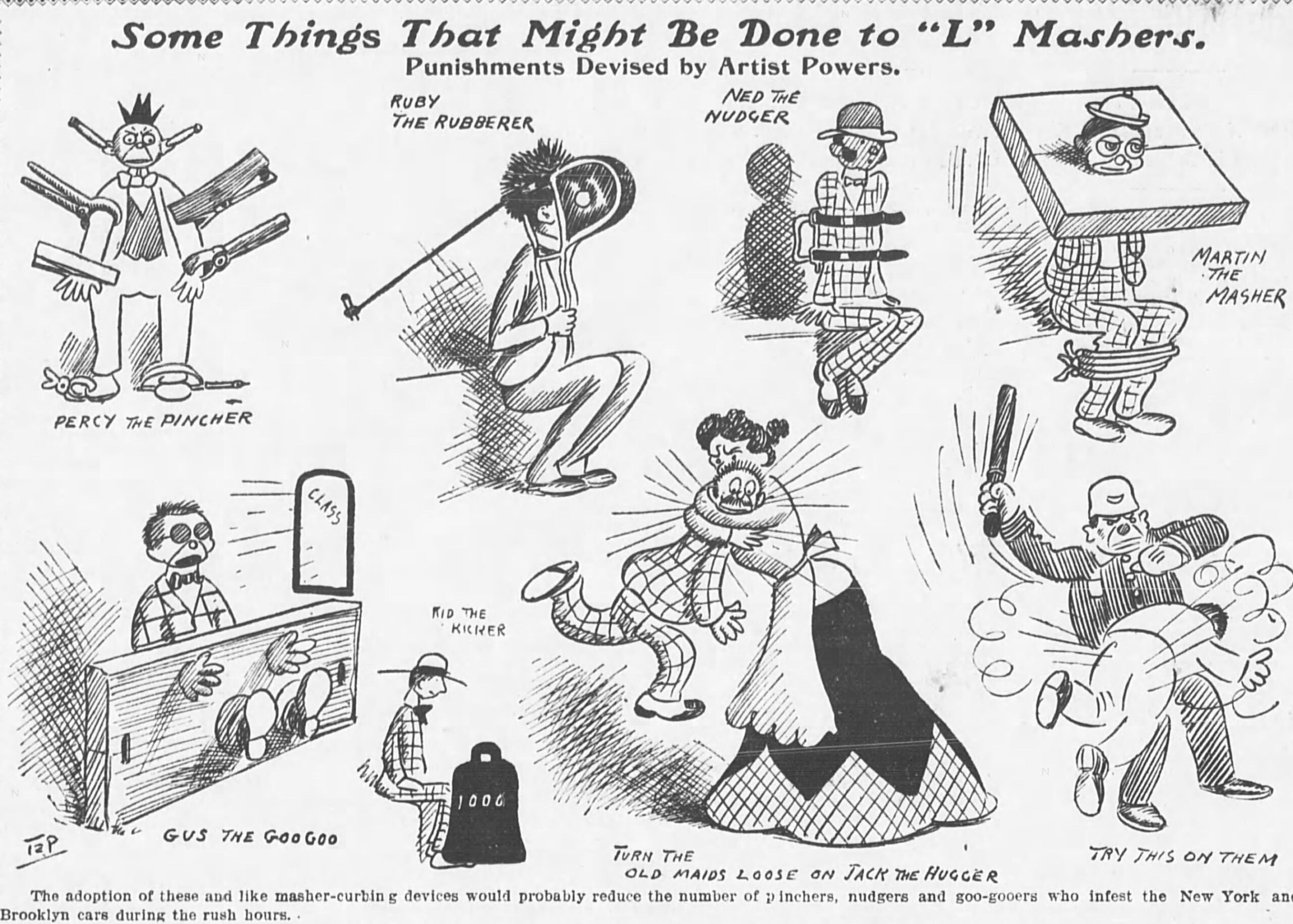
This cartoon from the October 30, 1902 New York Evening World gives some idea of the public outrage toward “mashers”, in this case on streetcars.
Mores were in flux. By old-fashioned standards, everything from a friendly smile or conversation starter to stalking and groping was an insult to a woman’s virtue. Newspapers launched anti-masher crusades and prominent women demanded stricter law enforcement and stern punishment.
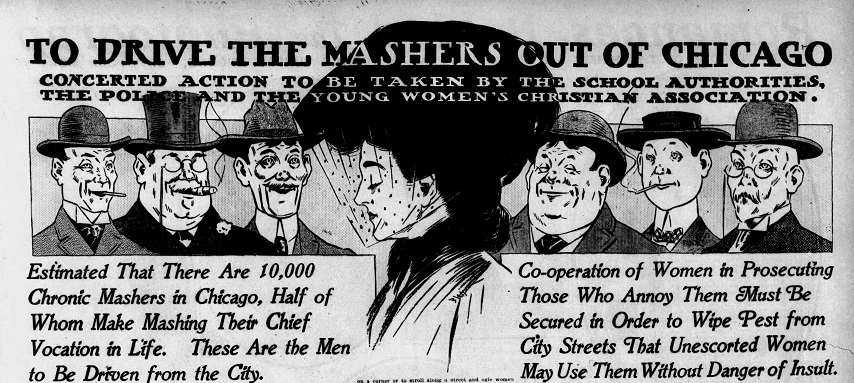
“No other feature of city life offers so many opportunities for making life a burden to the woman who for any reason must go about the city alone or with a woman companion,” opined the Chicago Tribune in 1907, leading a crusade against mashers. Outraged society ladies called for hard labor or public flogging as punishment. “Ogling is just as disgusting and offensive to a good woman as any other mode of attack,” declared the president of the Chicago Women’s Club.
When the Chicago police chief suggested that women avoid harassment by staying home and limiting their time in stores, he was roundly denounced by prominent women, business interests and civic leaders. A clergyman declared it “humiliating … that the authorities responsible for the maintenance of public order should feel themselves compelled to refuse the right of the road to any of the city’s citizens.” Americans increasingly assumed that women deserved the same freedom as men to move about in public — a freedom in which retailers and their suppliers had a large economic stake.
But there’s a darker side to the story that didn’t make it into the essay’s published version. The crusade against mashers, while based on a real problem, had a strong element of moral panic.
In Chicago, where the police chief was soon out of office, police won the power to arrest vagrants, including mashers, without warrants and to seek punishment by hard labor rather than fines. Crusading newspapers didn’t give mashers a chance to defend themselves. Nor did they report on the wrongly accused. In the same era that society women were calling for mashers to be publicly whipped, lynching reached its peak — often sparked by the allegation of masher-type offenses that crossed color lines.
Giving police broad powers to arrest men who made shoppers uncomfortable was an extreme solution. (Many women declined to testify in court, so prosecutions were spotty.) It did help to make streets safer for women, but so did a shift in mores that more clearly distinguished between flirtation and assault.
December 9, 2022
Caesar versus Cato
In The Critic, Daisy Dunn reviews Uncommon Wrath: How Caesar and Cato destroyed the Roman Republic by Josiah Osgood:
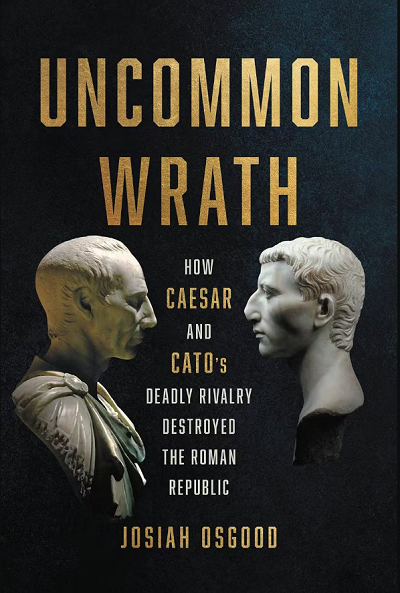
If there was one thing the Romans did well — aside from sanitation, irrigation and concrete — it was polemic. Cicero composed fourteen fiery Philippics against Mark Antony in the 40s BC, and Catullus jibed at Julius Caesar so profusely in his poems that he had to issue an apology. Less famous, but equally explosive, was Caesar’s own collection of vitriol. The Anticato survives today only in fragments, but according to an ancient satirist, it was originally so long that it took up two scrolls and almost outweighed the penis of Publius Clodius Pulcher, apparently among the best-endowed politicians in Rome.
Caesar wrote it shortly before he became dictator, with the intention of denigrating the memory of Marcus Porcius Cato, “Cato the Younger”. For years the two men had been locked in furious rivalry. Caesar blasted Cato as cold and miserly. Cato despaired at Caesar’s profligacy and tireless womanising. If Caesar was louche in his barely-belted toga and exotic unguents, Cato was positively austere — a prime hair-shirt candidate — with his bare feet, rustic diet, extreme exercise and strict sexual mores; it was most unusual for a Roman to make his wife the first woman he slept with.
Few would argue with Josiah Osgood, Professor of Classics at Georgetown, when he describes Caesar and Cato as opposites. Even Donald Trump and Joe Biden have more in common than they did. Caesar was the nephew of the wife of Gaius Marius, the populist enemy of Sulla, who as dictator had thousands of Italians proscribed and killed in his bid to restore the authority of the Senate. Cato could count Sulla as an old family friend. Caesar belonged to a well-established Roman family and claimed descent from Venus via her son Aeneas. Cato’s family was Sabine, and his most famous ancestor was a mere mortal in the shape of the plebeian writer and highly conservative statesman Cato the Elder.
The differences between Caesar’s and Cato’s personalities mattered because they reflected the differences in their visions for Rome. Osgood sums these up as “an empire wielding its power for the people” (Caesar) versus “a Senate protecting the people from the all-powerful empire builders” (Cato). It is little wonder they came to blows.
Osgood takes the tense relationship between Cato and Caesar as the central focus of his book. He argues that their feud has been overlooked as a contributing factor to the civil war that erupted in 49 BC and brought the Roman Republic crashing to the ground. Blame for this war has more usually been placed on the collapse of the First Triumvirate — an illegal alliance for power forged between Julius Caesar, Pompey the Great and Marcus Licinius Crassus in 60 BC — and the breakdown in relations between Caesar and Pompey in particular. But all wars have long-term and short-term causes. For Osgood, the dispute between Caesar and Cato was significant in at least the medium term.
November 27, 2022
“The uncomfortable truth is that autocrats and architects share complimentary motivations”
In UnHerd, Wessie du Toit sets the Saudi Arabian “Neom” development in its true and unsavoury proper context:

There may be no philosopher kings, but there are sci-fi princes. The dreams of Mohammed bin Salman, crown prince of Saudi Arabia and chairman of the Neom board, make the techno-futurism of Silicon Valley look down to earth. Bin Salman is especially fond of the cyber-punk genre of science fiction, which involves gritty hi-tech dystopias. He has enlisted a number of prominent Hollywood visual specialists for the Neom project, including Olivier Pron of Marvel’s Guardians of the Galaxy franchise. A team of consultants was asked to develop science-fiction aesthetics for a tourist resort, resulting in “37 options, arranged alphabetically from ‘Alien Invasion’ to ‘Utopia'”. One proposal for a luxury seaside destination, which featured a glowing beach of crushed marble, was deemed insufficiently imaginative.
Such spectacular indulgence must be causing envy among the high-flying architects and creative consultants not yet invited to join the project — if there are any left. But it also makes the moral dimension difficult to ignore: how should we judge those jumping on board bin Salman’s gravy train? Saudi Arabia — in case anyone has forgotten in the years since the journalist Jamal Khashoggi was murdered at its consulate in Istanbul — is a brutal authoritarian state.
In recent weeks, this has prompted some soul-searching in the architecture community, with several stinging rebukes aimed at Neom. Writing in Dezeen, the urbanist Adam Greenfield asks firms such as Morphosis, the California-based architects designing The Line, to consider “whether the satisfaction of working on this project, and the compensation that attends the work, will ever compensate you for your participation in an ecological and moral atrocity”. Ouch. Greenfield’s intervention came a week after Rowan Moore asked in The Observer: “When will whatever gain that might arise from the creation of extraordinary buildings cease to outweigh the atrocities that go with them?”
[…]
The uncomfortable truth is that autocrats and architects share complimentary motivations. The former use architecture to glorify their regimes, both domestically and internationally, whereas the latter are attracted to the creative freedom that only unconstrained state power can provide. In democratic societies, there is always tension between the grand visions of architects and the numerous interest groups that have a say in the final result. Why compromise with planning restrictions and irate neighbours when there is a dictator who, as Greenfield puts it, “offers you a fat purse for sharing the contents of your beautiful mind with the world?”
This is not just speculation. As Koolhaas himself stated: “What attracts me about China is that there is still a state. There is something that can take initiative on a scale and of a nature that almost nobody that we know of today could even afford or contemplate.”
But really this relationship between architect and state is a triangle, with financial interests making up the third pole. Despite the oft-repeated line that business loves the stability offered by the rule of law, when it comes to building things, the money-men are as fond of the autocrat’s empty canvas as the architects are. When he first pitched the Neom project to investors in 2017, bin Salman told them: “Imagine if you are the governor of New York without having any public demands. How much would you be able to create for the companies and the private sector?”
This points us to the deeper significance of the Gulf States and China as centres of high-profile architecture. These were crucial regions for post-Nineties global capitalism: the good illiberal states. Celebrity architects brought to these places the same spectacular style of building that was appearing in Europe and North America; each landmark “iconic” and distinct but, in their shared scale and audacity, also placeless and generic. Such buildings essentially provided a seal of legitimacy for the economic and financial networks of globalisation. Can this regime’s values really be so different to ours, an investor might say, when they have a museum by Jean Nouvel, or an arts centre by Norman Foster? British architects build football stadiums and skyscrapers in Qatar and Saudi Arabia, while those governments own football stadiums and skyscrapers in Britain, such as The Shard and Newcastle’s St James’s Park.
November 23, 2022
QotD: Humour and political correctness
But I never fully understood Wilde’s caustic satire of Victorian philanthropists and humanitarians until the present sludgy tide of political correctness began flooding government, education, and media over the past two decades. Wilde saw the insufferable arrogance and preening sanctimony in his era’s self-appointed guardians of morality.
We’re back to the hypocrisy sweepstakes, where gestures of virtue are as formalized as kabuki. Humor has been assassinated. An off word at work or school will get you booted to the gallows. This is the graveyard of liberalism, whose once noble ideals have turned spectral and vampiric.
Camille Paglia, “Hillary wants Trump to win again”, Spectator USA, 2018-12-04.
October 5, 2022
Are the protests in Iran about to tip over into actual revolution?
In The Line, Kaveh Shahrooz reports on the still-ongoing public protests after the death of a young woman at the hands of the morality police:

Aftermath of anti-government protests in Bojnord, North Khorasan Province, Iran, 22 September, 2022.
Photo from Tasnim News Agency Bojnord Desk via Wikimedia Commons.
Revolutions are funny things. They sometimes appear impossible until, in one single moment, they become inevitable. In Iran, that moment came on September 13th with the murder of a young woman.
Mahsa Amini, a 22-year-old who was also known by her Kurdish name “Gina”, had come from Iran’s Kurdistan region to visit her brother in Tehran. It was during that trip that she faced a particular humiliation that has become a fact of life for tens of millions of women in that country: a run-in with the country’s gasht-e ershad (“Guidance Patrol”). The role of this roving gang, seemingly imported from Atwood’s Gilead and called Iran’s “morality police”, is to monitor the streets to find and punish violations of the regime’s seventh-century moral and dress codes.
Having determined that Mahsa’s hijab exposed a little too much hair — a few strands of a woman’s hair and men will simply be incapable of controlling their sexual urges, the logic goes — they detained and beat her severely. The story for most women who deal with the morality police typically ends there, after which they are released to seethe at having endured another round of state-imposed gender apartheid. For Mahsa, the story ended differently: with a skull fracture that caused her to be brought, brain dead, to a local clinic. She died there on September 16th.
The murder of Mahsa Amini was the spark that set off a revolution. The killing reminded women of their daily misery at the hands of a regime that, both de facto and de jure, treats them as second-class citizens. And it reminded everyone of the million other senseless cruelties, large and small, that they must endure daily at the hands of a barbaric theocracy. Outraged by the death of an innocent young woman, the people took to the streets in protests that continue to this day.
There have been mass protests in Iran before. In 2009, in response to a widespread belief that Mahmoud Ahmadinejad had illegally stolen the presidential election — to the extent the word “election” means anything in a country where candidates must first be approved by a clerical body loyal to the regime — citizens protested by the millions. Their slogan, “Where’s my vote?” rested on the premise that a fair, albeit controlled, election was something that could change the system for the better. The protesters typically avoided confrontation with security forces. Even when they happened to corner a regime thug periodically, they ensured that no harm was done to him.
September 5, 2022
“In this version of the story, the little boy points out that the naked emperor has no soul, and the people begin to notice”
Chris Bray uses the example of a new Disney show featuring the literal daughter of Satan — for the LULs — to illustrate just how unhinged our culture has become:
Give me a minute, and let me show you something without framing or a narrative. Then I’ll talk about it, but first just notice it. The company founded by Walt Disney has a new show about a middle school girl who has an awkward dilemma: She’s the Antichrist (as her mom reveals to her one day, after a weird day at school), and her Cool Dad is Satan, who has lots of funny lines about what a wild guy he is. Funny teen girl dilemmas follow, like this one time her parents show up to a party — which, like, super bummer and everything, but it’s even funnier when your dad is actually, literally Satan.
[…]
But no lines are being crossed, because there are no lines. Satan is a television character; immorality is impossible in a culture without morality, without a moral framework and moral anchors. Lacking principles, no one in power can violate any. They’re completely adrift, completely free, and completely ruined. They can go anywhere, and they often do. You can’t sin when nothing is a sin. Well, except for using the wrong pronouns, but more or less.
Now: There are people who are not adrift, who have moral reference points. I continue to believe they’re the majority, geographically prevalent and often thick on the ground, morally attuned as communities and families in a global and national milieu of amoral disconnectedness.
So we have people who see no lines, traveling freely across discarded boundaries, watched by people who are appalled by line-crossing that the line-crossers don’t perceive at all.
See also this essay from Dr. Robert Yoho, “Guess Who Passes the Psychopath Test?”
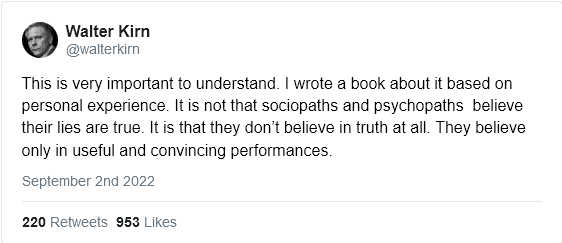
Psychopathic lying is successful because normal people do not believe that anyone lies as a routine. Debates with sociopaths are useless. No matter what we say, no matter how much evidence is given, it has no meaning for them. Their sole goal is to fool us into classifying them as normal so they can continue to deceive, control, and use us …
When major positions of power in business, government, industry, and society are filled by sociopaths, a downward spiral begins. The normal people eventually recognize what their leaders are and devise survival strategies.
We’re there, though it’s hard to place “there” on a map. We can see that a significant share of power and status — in politics, in economics, and in culture — belongs to people who have no perception of social rules or moral limits at all. And we see that some lines need to be reimposed, urgently and firmly.
After a few years of, “but these are the experts, right?” it feels like the beginning of the phase in which everybody finally knows the game and the stakes. In this version of the story, the little boy points out that the naked emperor has no soul, and the people begin to notice. And then?
June 21, 2022
QotD: The modern age of ad hominem
Hence, I myself have developed a particular enmity and impatience with the art of merely labeling opposing viewpoints as anathema, and dismissing them, sight unseen, with no further investigation.
These are not cases where a particular person known to have an ulterior motive or suffering a well earned reputation for dishonesty find his remarks being regarded with judicious skepticism. These are cases where to disagree with the party line or popular gossip provokes the accusation of being such a person.
While not all scalawags are Morlocks, all Morlocks are scalawags. Scalawaggery is the core of their philosophy. Morlock borrowed from the generous genius of HG Wells, for anyone who imagines himself to be evolved beyond human norms and into the realm of moral inversion, so that all rules of right and wrong, only for oneself, are flipped downside up.
In Wells, the Morlock is a cannibal troglodyte who treats other human descendants as cattle. In my wry jest, a Morlock is an intellectual trapped in a structure of reasoning he erected, at first, to justify his inhumanity toward his fellow human beings. That structure has since become for his his thought-prison. The bars and chains are mental and spiritual. Impalpable, they are unbreakable.
Their inhumanity include treating the children of other men as lab experiments and a mass attempt at sexual social engineering, namely, the elimination of the two sexes. Inhumanity also includes treating individuals as fungible and interchangeable nonentities in the great game of identity politics, so that simplistic and bigoted generalizations about minorities or majorities become not merely permitted, but mandatory. Inhumanity includes treating the prosperity and freedom of other men as optional, or even as hindrances, in the headlong panics and stampedes inspired by orchestrated ecological scaremongering and virtue-signaling.
Inhumanity includes regarding other men as meat-robots, or hairless apes, or helpless cells of blind historical forces, and hence as nothing more than the raw materials to be bred like livestock or organized like chain gangs or stacked like cordwood or slaughtered like scapegoats to create the foundations of the towers of Utopia.
The inhumanity, sadly, also and finally includes an inhumanity toward themselves, whenever a godless and soulless mind turns inward, and develops terminal narcissism. All men beyond the narrow orbit of self-absorbed self-regard are reduced to flitting shadows, and seem to Narcissus to be merely echoes, not real.
John C. Wright, “Ad Hominem and Illusion”, John C. Wright, 2022-03-18.
May 28, 2022
Morality is Dead. Hollywood Killed It.
Foundation for Economic Education
Published 27 May 2022What’s with all the nihilistic, amoral, dark anti-hero leads in movies and shows? Are we supposed to treat horrible characters as pinnacles of human behavior now?
The bleak content that’s crept its way mainstream over the last 10 years should concern us all. The stories we tell matter, for they influence what we believe and what values we adopt.
Fortunately, a renewed appreciation for natural rights and individualism could be the antidote to the immense darkness that’s blanketed American culture as of late. That’s what we’ll get down to on this feature episode of Out of Frame.
______________________________
FOLLOW/SUPPORT US:Support Out of Frame on Patreon or SubscribeStar:
https://www.patreon.com/OutofFrameShow
https://www.subscribestar.com/outoffr…Join our Discord: https://discord.gg/RKc4AcGQ9k
Sign up for our mailing list and never miss an episode again:
https://fee.org/oof-newsletterCheck out our podcast, Out of Frame: Behind the Scenes: https://www.youtube.com/channel/UCiS5…
Follow us EVERYWHERE!
https://linktr.ee/outofframefee
______________________________
CREDITS:
Written by Sean W. Malone
Produced by Sean W. Malone
Edited by Michael Ozias
Asst. Edited by Abby Richardson

May 17, 2022
Mary Whitehouse, “The avenging angel of Middle England”
At First Things, Jonathon Van Maren considers the legacy of Mary Whitehouse, the often mocked champion of public decency and crusader against pornography and blasphemy in the media from the mid-60s onwards:

I was surprised to find few public domain images of Mary Whitehouse available, so here is a selection of thumbnails (hopefully this won’t violate any copyright restrictions)
We have reached the point where our post-Christian elites, having safely enshrined the sexual revolution in law, can afford the luxury of occasionally admitting that their opponents were right. Exhibit A is the new BBC documentary Banned! The Mary Whitehouse Story, which details the life of Great Britain’s most infamous morality campaigner. Beginning with a crusade to keep smut and blasphemy off TV in 1964, Whitehouse rallied hundreds of thousands of women (and ordinary Britons) to her campaigns against “the permissive society”, culminating in her war against the porn industry. Alas, she lost most of her battles — but her warnings proved prophetic.
Mary Whitehouse was born in Warwickshire in 1910. She first started organizing in the 1960s because she — and millions of other mothers — did not like what her children were seeing on TV. A committed traditional Christian, she watched with dismay as the country she loved began to change around her. The metropolitan elites she faced off with thought she was “a provincial Birmingham housewife”. They didn’t underestimate her for long. She hosted her first mass meeting in 1964, and her organizing skills soon highlighted the subterranean power of Britain’s women. Whitehouse tapped into the gardening associations, the mothers’ unions, and other grassroots community organizations filled with folks who cared deeply about their children and the moral fabric of their nation. She brought them together, and when she spoke, it was with the voices of legions of little people. Her nickname summed it up: “The avenging angel of Middle England”.
Whitehouse’s first major campaign was to “Clean Up TV”, and her parliamentary petition to that end garnered around 500,000 signatures. In 1971, Whitehouse began organizing against sex ed in schools, triggered by an “educational” video she saw that was filled with pornographic scenes. Whitehouse was accused of hysteria — but Banned! features a pornographer admitting that, by using sex ed, “we gradually pushed back the barriers”, much as Whitehouse warned they would. Now that they’ve won, they can admit they were lying.
Whitehouse and others appalled by attempts to corrupt their children were accused of being “horrified by sex”. In reality, they were horrified by the version of sex presented by sex educators — in much the same way an art lover would be appalled to see vandals approaching a great masterpiece with cans of spray-paint and lewd laughter. Progressives never understood this, and consequently Whitehouse has been almost entirely defined by what she fought against rather than what she fought for.
Whitehouse’s lobbying resulted in several pieces of legislation, including the 1981 Indecent Displays Act, which sought to restrain sex shops and the display of porn, as well as the 1984 Video Recordings Act, intended to limit the sale of extreme video content. Unfortunately, these acts were rendered moot by the internet. But her greatest achievement was the 1978 Protection of Children Act, which criminalized child pornography. It seems remarkable that such a law did not already exist, but in the ’70s the Paedophile Information Exchange (PIE) was operating openly in Britain; it was supported by some British elites who believed that sex with children was the natural next step in sexual liberation.


