
Modern History TV
Published on 7 Mar 2019A look at medieval hoods, how they’re used, how they’re worn and something you probably didn’t know about them.
Credits
Direction, Camera, Editing, Sound Kasumi
Presenter Jason Kingsley OBEMusic licensed from PremiumBeats
April 11, 2019
Modern History: A Funny Thing About Medieval Hoods
Comments Off on Modern History: A Funny Thing About Medieval Hoods
March 20, 2019
History Summarized: Medieval China (Ft Jack Rackam)
Overly Sarcastic Productions
Published on 15 Mar 2019Check out our website at http://www.OverlySarcasticProductions.com
Tale as old as time
Song as old as rhyme…
China broke agaiiinnnnnn — dammit china you only had one jobJack Rackam’s Channel: https://goo.gl/EgwpGu
PATREON: https://www.patreon.com/OSP
Comments Off on History Summarized: Medieval China (Ft Jack Rackam)
March 18, 2019
6 Worst British Rulers – Anglophenia Ep 8
Anglophenia
Published on 15 Jul 2014Britain has had a number of great kings and queens, but also some truly terrible ones. Siobhan Thompson looks at the worst of the worst.
Comments Off on 6 Worst British Rulers – Anglophenia Ep 8
QotD: The eternal bad bet that was feudalism
From time immemorial, the reigning myth of rule has been that the rulers provide a quid pro quo: in exchange for the people’s submission and payment of tribute, the rulers protect the people from the enemies who lurk “out there.” The promise was often unfulfilled, however. The lord of the manor might well flee into his castle, leaving the peasants outside the walls to suffer whatever outrages an invader chose to wreak on them. Or the lord might haul them off to a distant war in which they had no real interest, merely to satisfy the lord’s feudal obligation to the baron or duke just above him in the feudal pecking order.
Most important, however, is the sheer fact that the ordinary people’s most dangerous enemy, the one by far the most likely to plunder and abuse them, was their own impudent lord, the selfsame “nobleman” who forbade them to leave their place of birth or to engage in a variety of tasks and pleasures they might prefer — that is, the man who held and exploited them in a condition of serfdom.
Robert Higgs, “I Reject the Right of the Government to Choose My Friends and Enemies for Me”, The Beacon, 2017-04-03.
Comments Off on QotD: The eternal bad bet that was feudalism
March 10, 2019
QotD: Surnames and taxes
… (related: Scott examined some of the same data about Holocaust survival rates as Eichmann In Jerusalem, but made them make a lot more sense: the greater the legibility of the state, the worse for the Jews. One reason Jewish survival in the Netherlands was so low was because the Netherlands had a very accurate census of how many Jews there were and where they lived; sometimes officials saved Jews by literally burning census records).
Centralized government projects promoting legibility have always been a two-steps-forward, one-step back sort of thing. The government very gradually expands its reach near the capital where its power is strongest, to peasants whom it knows will try to thwart it as soon as its back is turned, and then if its decrees survive it pushes outward toward the hinterlands.
Scott describes the spread of surnames. Peasants didn’t like permanent surnames. Their own system was quite reasonable for them: John the baker was John Baker, John the blacksmith was John Smith, John who lived under the hill was John Underhill, John who was really short was John Short. The same person might be John Smith and John Underhill in different contexts, where his status as a blacksmith or place of origin was more important.
But the government insisted on giving everyone a single permanent name, unique for the village, and tracking who was in the same family as whom. Resistance was intense:
What evidence we have suggests that second names of any kind became rare as distance from the state’s fiscal reach increased. Whereas one-third of the housholds in Florence declared a second name, the proportion dropped to one-fifth for secondary towns and to one-tenth in the countryside. It was not until the seventeenth century that family names crystallized in the most remote and poorest areas of Tuscany – the areas that would have had the least contact with officialdom. […]
State naming practices, like state mapping practices, were inevitably associated with taxes (labor, military service, grain, revenue) and hence aroused popular resistance. The great English peasant rising of 1381 (often called the Wat Tyler Rebellion) is attributed to an unprecedented decade of registration and assessments of poll taxes. For English as well as for Tuscan peasants, a census of all adult males could not but appear ominous, if not ruinous.
Scott Alexander, “Book Review: Seeing Like a State”, Slate Star Codex, 2017-03-16.
Comments Off on QotD: Surnames and taxes
February 2, 2019
Did People in Medieval Times Really Wear Lockable Chastity Belts?
Today I Found Out
Published on 28 Mar 2016Never run out of things to say at the water cooler with TodayIFoundOut! Brand new videos 7 days a week!
In this video:
The lasting images of what most of us perceive to be the “medieval times” includes heroic knights, stampeding horses, court jesters, giant turkey legs, ruling kings, and pure maidens wearing chastity belts. But the fact is that, besides the more obvious of those that aren’t accurate, most scholars believe that the chastity belt didn’t actually exist during medieval times, but rather is a product of 18th and 19th century obsession with masturbation as a societal ill and safeguarding women in the workplace.
Want the text version?: http://www.todayifoundout.com/index.p…
Comments Off on Did People in Medieval Times Really Wear Lockable Chastity Belts?
December 6, 2018
“Marx was right”
An interesting little bit of history and philosophy over at Rotten Chestnuts:
Marx was right: Society really is shaped by relations between the means of production.
The Middle Ages, for instance, organized itself around defense from marauding barbarian hordes. Fast, heavy cavalry were the apex of military technology at the time; the so-called “feudal” system were the cavalry’s support. The system was field tested in the later Roman empire — medieval titles like “duke” came from the ranks of the Roman posse comitatus — and perfected in the Dark Ages.
When the barbarians had been pacified sufficiently that Europeans had leisure time to think about this stuff, they took the feudal system — at that point a cumbersome relic — as their model for society. Hobbes, Locke, et al saw it as the origin of the Social Contract; Marx saw it as finely tuned oppression. But here’s the fun part:
Hobbes ends his Leviathan with the most absolute monarch that could ever be. He starts* with… wait for it… the equality of man. Marx, on the other hand, ends with the equality of man. He starts with a frank, indeed brutal, acknowledgment of man’s inequality. As much as I love Hobbes (and consider Leviathan the only political philosophy book worth reading), he’s wrong — fundamentally wrong — and Marx is right. Marx went wrong somewhere down the line; Hobbes jumped the track from page one.
Marx only went wrong when he started dabbling in metaphysics. Marxism isn’t the original underpants gnome philosophy, but it’s certainly the best — not least because Marx’s followers were so successful at hiding the deus ex machina that was supposed to bring Communism about. Marx didn’t just say “The Revolution will happen because that’s the way all the trend lines are pointing.” He said “the trend lines are pointing that way, and oh yeah, the animating Spirit of History demands that the Revolution shall happen.” This is so obviously sub-Hegelian junk that his followers dropped it as fast as they could, but to Marx himself it was the key to his philosophy. For all its formidable technobabble, Marxism is just another chiliastic mystery cult.
[…] Enlightenment-wise, Hobbes was the start, Marx the end of political philosophy, and both are flawed beyond redemption. Hobbes sure sounds like a viable alternative to Marx, because Hobbes’s reasoning seems sound, and based on an irrefutable premise: That in the State of Nature, life is nasty, poor, solitary, brutish, and short. But that’s not Hobbes’s premise — the fundamental equality of man in the State of Nature is. Life in the State of Nature is brutal because all men are equal.
* If you’ve read Leviathan, of course, you know he starts the book itself with a long discourse on contemporary physics. Hobbes was an innovator there, too — he’s the first person to put forth his humanistic ideas as the coldly logical deductions of physical science. It’d be fun to taunt the “I fucking love science” crowd with that, except they think Hobbes is a cuddly cartoon tiger and “Leviathan” one of the lesser houses at Hogwarts.
Comments Off on “Marx was right”
November 12, 2018
Viking Expansion – Ireland – Extra History – #3
Extra Credits
Published on 10 Nov 2018When Thorgest arrived on the coasts of Ireland with over a hundred long ships, he was ready to raid — and to establish cities like Dublin and many others that shaped the religion and culture of Ireland, much to the population’s excitement.
Join us on Patreon! http://bit.ly/EHPatreon
Comments Off on Viking Expansion – Ireland – Extra History – #3
November 6, 2018
Viking Expansion – Rollo the Walker – Extra History – #2
Extra Credits
Published on 3 Nov 2018Rollo the Walker led the Great Heathen Army and had his sights set on sacking Paris, in a time when relations between the Vikings and the Franks had become, essentially, getting paid to raid. Eventually his sights would turn to stability — and he became the founder of Normandy.
Join us on Patreon! http://bit.ly/EHPatreon
Comments Off on Viking Expansion – Rollo the Walker – Extra History – #2
October 30, 2018
Viking Expansion – The Serpent-Riders – Extra History – #1
Extra Credits
Published on 27 Oct 2018The medieval Scandinavians left an impact not just on Greenland and Iceland, but on France, England, Russia, and even briefly North America. But how did Scandinavian society begin, and what incited its voyage across the seas?
Join us on Patreon! http://bit.ly/EHPatreon
Comments Off on Viking Expansion – The Serpent-Riders – Extra History – #1
September 19, 2018
The Byzantine Empire should really be called the “Medieval Roman Empire”
Sean Gabb makes the case for the least well-known part of the Roman world that outlasted the western empire by a thousand years:
Properly considered, the history of what I will from now call not the Byzantine Empire, but the Mediaeval Roman Empire, is perhaps the most astonishing instance of how courage and determination can keep civilisation alive in the face of the most forbidding and apparently overpowering challenges. In setting out my argument, I hope you will forgive me if I begin with an introduction covering much that many of your will know at least as well as I do, but that may not be so familiar to those reading the text or watching the speech on YouTube.
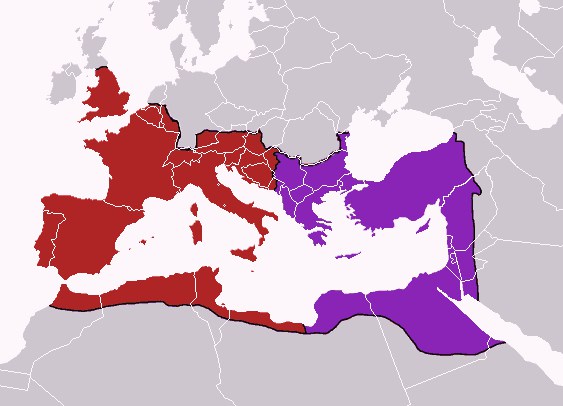
If you look at the first of the maps that I have put on your tables, you will see the Roman Empire as it was in the year 395 AD. This shows the Empire at something close it its greatest extent. The conquests that Trajan made to the north of the Danube and east of the Euphrates have been given up. But it includes the whole of the Mediterranean World and its various hinterlands – an area stretching from the North of England to Upper Egypt, from Casablanca to Trebizond. In that year, however, nearly a century of political experiments is formally ended with the division of the Empire into two administrative zones. There is the Western or the red Empire, ruled by an Emperor in Rome or Milan or Ravenna. There is the Eastern or the purple Empire, ruled by an Emperor in Constantinople.
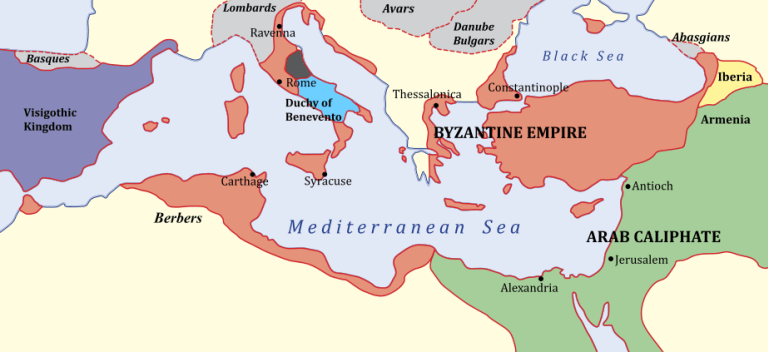
If you look at the second map, dated roughly 650 AD, you will see that the Western Empire has disappeared. Excepting North Africa and parts of Italy, now ruled from Constantinople, the whole of the Western Empire has disappeared – replaced by a set of barbarian kingdoms from which modern Europe takes its origin. The Eastern Empire itself has lost both Syria and Egypt to the Arabs.
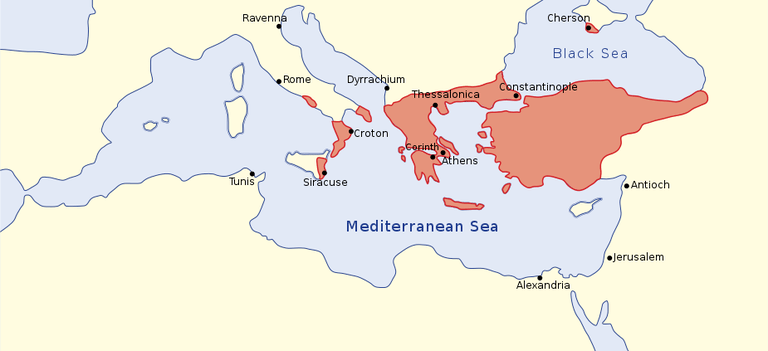
If you look at the third map, dated roughly 867 AD, you will see that the Empire has suffered the further loss of Cyprus and North Africa and most of Sicily. Nevertheless, what we have in that year should undeniably be called the Mediaeval Roman Empire. It has weathered the storm of the Early Middle Ages. It is the richest and most powerful state in the Mediterranean World. Indeed, during the next few centuries, it will expand. It has already reconquered Greece. It will conquer the Bulgarian Kingdom and re-establish its ancient frontier on the Danube. It will even retake Antioch and make Egypt for a while its economic and diplomatic client.
After 1071, the Empire falls on evil days. In that year, the Turks deprive it of its Anatolian heartland. But this loss is stabilised and in part reversed by a skilful handling of the Crusades. There is another disaster in 1204, when the Venetians take and plunder Constantinople. But this is not the end. The Empire is restored in large parts in 1261; and, even if as little more than a city-state based around Constantinople, it continues to the final Turkish conquest of 1453. Indeed, the formal extinction of the Empire comes nearly a decade after 1453, with the annexation of its last territories in Southern Greece.
There was a time when school textbooks in England dated the fall of the Roman Empire to 476 AD. Its continued survival for a thousand years after then had to be explained, where admitted, by taking a contemptuous view of what was called the Byzantine Empire. See, for example, W.E.H. Lecky:
Of that Byzantine empire, the universal verdict of history is that it constitutes, without a single exception, the most thoroughly base and despicable form that civilization has yet assumed. There has been no other enduring civilization so absolutely destitute of all forms and elements of greatness, and none to which the epithet “mean” may be so emphatically applied… The history of the empire is a monotonous story of the intrigues of priests, eunuchs, and women, of poisonings, of conspiracies, of uniform ingratitude.
Lecky is one of my favourite historians. But, if you look even at the mediaeval Greek and Italian historians of the Empire, you will see that this is a bizarre judgement. Undoubtedly, these historians tended to focus on intrigues in and about the Imperial Palace. But they also record much else. They record the story of a rich and powerful empire, directed with high military and diplomatic ability – an empire in which slavery and the death penalty have been almost abolished, where people lived, and knew that they lived, under a set of divinely-ordained laws that protected life, liberty and property to a degree unknown in any other mediaeval state.
Comments Off on The Byzantine Empire should really be called the “Medieval Roman Empire”
September 14, 2018
Are Guards Historically Accurate? | Feature Enquiry
Feature History
Published on 22 Aug 2018Use this link to get your first 2 months of Skillshare for FREE! http://skl.sh/featurehistory2
———————————————————————————————————–
Often fantasy and medieval media will show armoured guards patrolling settlements and enforcing the law. Is that historically accurate? No.
———————————————————————————————————–
Patreon
https://www.patreon.com/FeatureHistory
https://twitter.com/Feature_History
Discord
https://discord.gg/Zbk4CvR
———————————————————————————————————–
I do the research, writing, narration, art, and animation. Yes, it is very lonely
Music by Epidemic Sound: http://epidemicsound.com
Comments Off on Are Guards Historically Accurate? | Feature Enquiry
August 31, 2018
Experimental strip farm demonstrates why strip farming was eventually abandoned
Tim Worstall uses an article in the Guardian about a National Trust experimental replication of medieval farming patterns to point out exactly why modern farms do not use them:
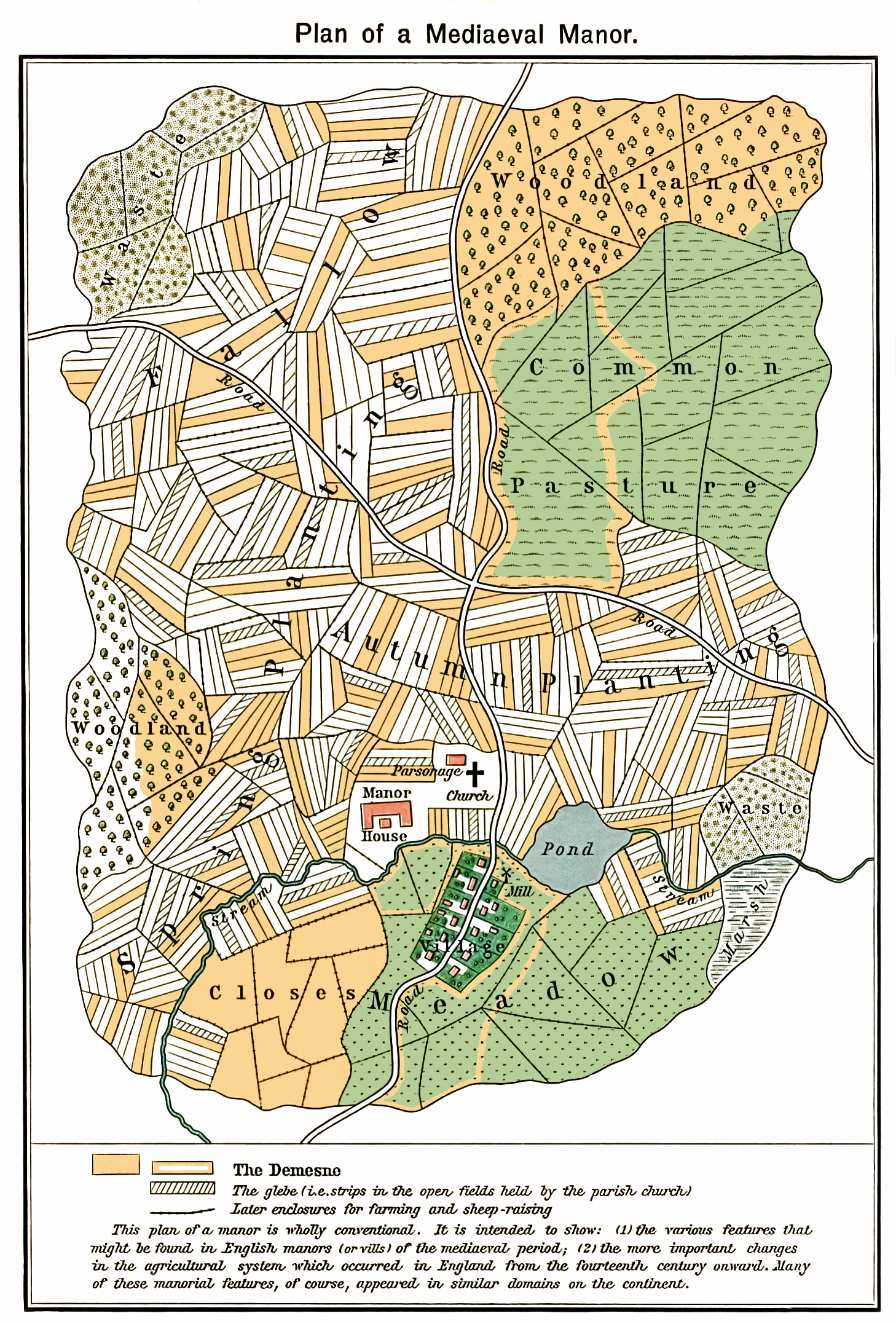
Plan of a fictional medieval manor. The mustard-coloured areas are part of the demesne (owned by the lord), the hatched areas part of the glebe (reserved to support the parish priest).
Illustration from William R. Shepherd’s Historical Atlas, 1923 via Wikimedia Commons.
The proof of the inefficiency is in the presence of that lots more wildlife. We’re trying to grow food for humans to eat recall. So, more wildlife eating off the same earth is less food for humans. We have more butterflies around? That’s nice, but that does mean more caterpillars munching on those now not for humans crops. Hen harriers? Great, but they’re eating the mice and the voles living off those crops. Land that’s growing wildflowers isn’t growing grain or veggies for us, is it?
Sure, it’s nice to have hen harriers, great to have wildflowers. But their very existence on this land shows that this method of farming is less efficient at doing the job of farming – growing food for us. Which is why we abandoned this method of farming of course. Under the simple and basic pressures of trying to gain more output from our inputs. And yes, land is, obviously enough, an input into farming.
And if we’d like to have flowers and harriers? Then we should be using the most efficient farming methods on those areas we do farm so as to leave more space, more land, for the pretty things we’d also like to have. That is, prairies of glycophosphate drenched wheat for us, the other 30 or 50 or 70% of the land left alone for them. And the more chemicals we use on our bit the smaller that bit devoted to us is going to be.
The very fact that we’ve more wildlife as a result of this inefficient farming method shows us that we must be using the more efficient industrial methods. You know, to save the wildlife?
Comments Off on Experimental strip farm demonstrates why strip farming was eventually abandoned
July 1, 2018
Mapping medieval trade routes
Open Culture linked to a fascinating new map by a Swedish grad student, showing trade routes during the Medieval period:
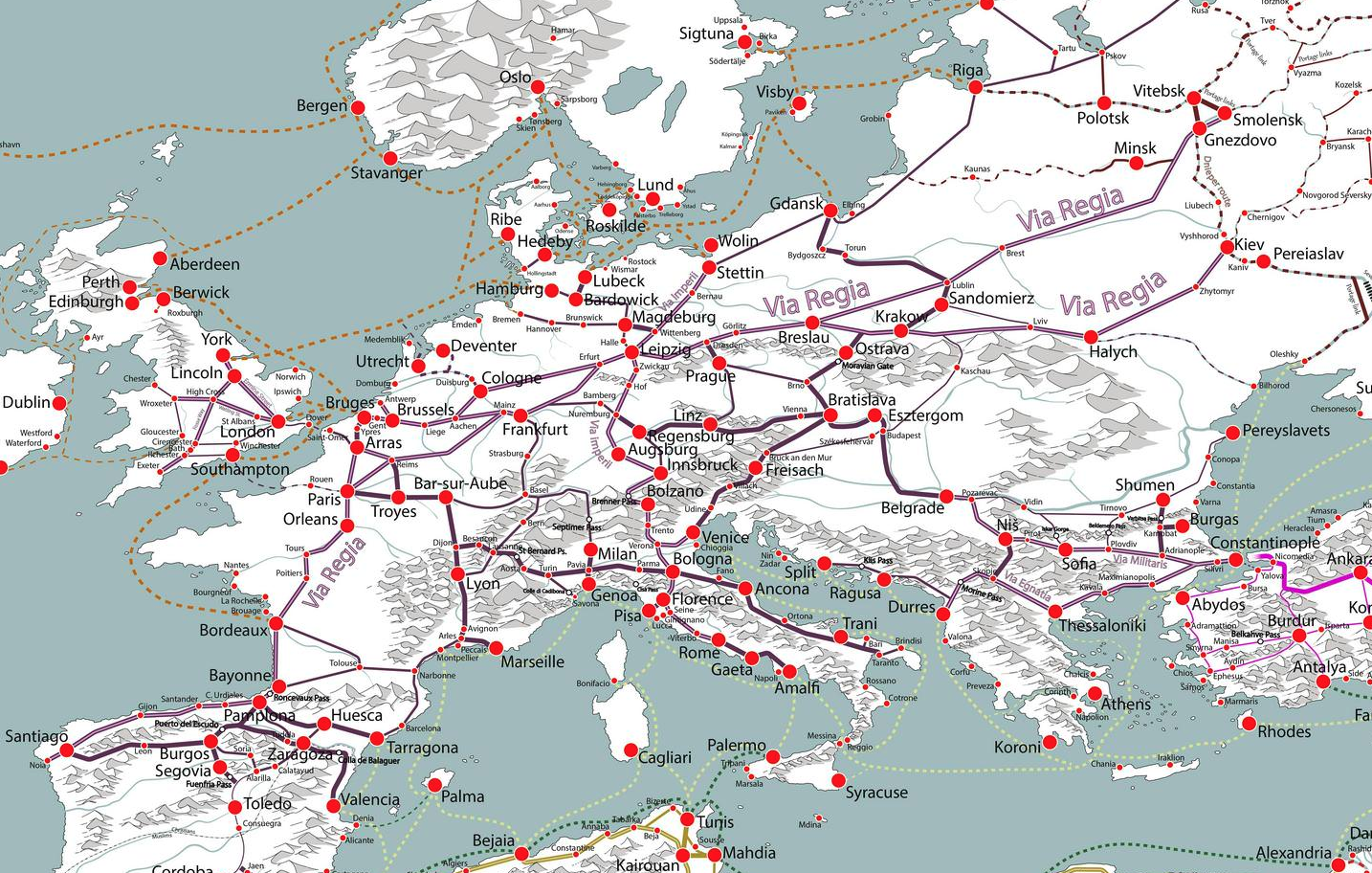
A small portion of Martin Jan Månsson’s trade map of the Middle Ages.
“I think trade routes and topography explains world history in the most concise way,” Månsson explains in the very small print at the map’s lower right corner. “By simply studying the map, one can understand why some areas were especially important–and remained successful even up to modern times.”
The map covers 200 years, spanning both the 11th and 12th centuries, and “depicts the main trading arteries of the high Middle Ages, just after the decline of the Vikings and before the rise of the Mongols, the Hansa and well before the Portuguese rounded the Cape of Good Hope.”
It also shows the complex routes already available to Africa and Asia, and the areas where Muslim and Christian traders would meet. The open-to-trade Song Dynasty ruled China, and the competitive kingdoms in the Indonesia region provided both Muslims and Europeans with spice.
Looking like a railway map, Månsson’s work shows how interconnected we really were back in the Middle Ages, from Greenland in the west to Kikai and Kagoshima in the East, from Arkhangelsk in the frozen north to Sofala in modern-day Mozambique.
The full-sized, high-resolution map can be downloaded here.
Update: Tim Worstall was kind enough to link to this post and uses Månsson’s map to help explain the gravity model of trade:
A standard observation is that places which are closer together trade with each other more than places which are further apart. Add to that the thought that larger economies will trade more with other larger economies – well, you know, more economic activity means more economic activity – and you get the gravity model of trade. So, therefore Britain’s trade future lies with those places nearby, in the EU, than with places further away like the Commonwealth or the US.
This is, sadly, actually the level of debate over Brexit at times. We should trade with France because it’s 26 miles away, so there. The point being that while the gravity model is true – among the best empirically supported of all economic observations – that’s not actually what it says. Rather, that those places which are closer by trade distance trade more with each other. Trade distance being a more complex point than mere geographical location.
[…]
The point here being that by showing the trade routes it is showing us this trade, or perhaps economic, distance which is what the gravity model is about. Valencia and Palma were very much closer – and trade very much more – than Valencia and Toledo, despite roughly equal distances crowfly wise.
May 24, 2018
Medieval tank – The 13th Century Knight I IT’S HISTORY
IT’S HISTORY
Published on 23 May 2018This time we will take you back to middle ages. It’s 13th century – what did medieval armor look like?
Comments Off on Medieval tank – The 13th Century Knight I IT’S HISTORY


