
HardThrasher
Published 6 Jan 2024If you’d like to be a cool kid, then become a Patreon or if you’d like to email me send a message to lordhardthrasher@gmail.com
0:00 Intro
4:30 We’re Going to North Africa 1st
8:36 But you’re not doing it properly
16:16 Play it Again Ira
22:30 Mid 1943 – The Crisis Begins
26:53 The Black Summer
28:03 Operation Tidal Wave
34:21 Into The Valley of Death – Schweinfurt
41:34 What Now?
48:37 Survivors Club
(more…)
May 28, 2025
Masters of the Air – The Bomber War Episode 4 – 8th Air Force 1942-1943
Comments Off on Masters of the Air – The Bomber War Episode 4 – 8th Air Force 1942-1943
May 14, 2025
The Korean War Week 47 – MacArthur’s Big Lie Exposed – May 13, 1951
The Korean War by Indy Neidell
Published 13 May 2025The MacArthur Hearings continue in Washington, and George Marshall is adamant that what Mac says about the January 12th proposal is just plain not true. There’s still a war going on in the field, although this week is really a week of deployments, as 8th Army moves north to reoccupy former lines, even as reports come in of the Chinese massing for a possible attack.
Chapters
00:00 Intro
00:43 Recap
01:18 McMahon and MacArthur
06:28 Day Two
08:28 George Marshall’s Turn
12:20 Van Fleet Plans and Deploys
17:03 Summary
17:11 Conclusion
(more…)
Comments Off on The Korean War Week 47 – MacArthur’s Big Lie Exposed – May 13, 1951
May 8, 2025
Dambusters – Was It Worth It?
HardThrasher
Published 5 May 2025The third and final part in a series on the Dambusters Raid; looking at the attacks themselves and their aftermath
(more…)
Comments Off on Dambusters – Was It Worth It?
May 7, 2025
The Korean War Week 46 – The MacArthur Senate Hearings Begin – May 6, 1951
The Korean War by Indy Neidell
Published 6 May 2025The Senate Hearings digging into Douglas MacArthur’s dismissal as UN forces commander begin this week, though they’ll likely continue for some time. Meanwhile in the field, the Chinese Spring Offensive that raged all last week continues, although it cannot reach Seoul, and by the end of the week the enemy seems to be withdrawing on all fronts.
(more…)
Comments Off on The Korean War Week 46 – The MacArthur Senate Hearings Begin – May 6, 1951
May 5, 2025
The Bloody Battle of Agincourt | Animated Episode
The Rest Is History
Published 30 Nov 2024“We few, we happy few, we band of brothers”.
The Battle of Agincourt in 1415 endures as perhaps the most totemic battle in the whole of English history. Thanks in part to Shakespeare’s masterful Henry V, the myths and legends of that bloody day echo across time, forever enshrining the young Henry as the greatest warrior king England had ever known. So too the enduring idea of the English as plucky underdogs, facing down unfavourable odds with brazen grit. And though the exact numbers of men who fought in the two armies is hotly contested, the prospect was certainly intimidating for the English host looking down upon the vast French force amassed below them the day before the battle. Hungry and weary after an unexpectedly long march, and demoralised by the number of French that would be taking to the field, the situation certainly seemed dire for the English. One man amongst them, however, held true to his belief that the day could still be won: Henry V. An undeniably brilliant military commander, he infused his men with a sense of patriotic mission, convincing them that theirs was truly a divinely ordained task, and therefore in this — and his careful strategic planning the night before the battle — he proves a striking case of one individual changing the course of history. However, the French too had plans in place for the day ahead: total warfare. In other words, to overwhelm the English in a single devastating moment of impact, sweeping the lethal Welsh archers aside. So it was that dawn broke on the 25th of October to the site of King Henry wearing a helmet surmounted by a glittering crown and bearing the emblems of both France and England, astride his little grey horse, and riding up and down his lines of weathered silver clad men, preparing them to stride into legend … then, as the French cavalry began their charge, the sky went black as 75,000 arrows blocked out the sun. What else would that apocalyptic day hold in store?
Join Tom and Dominic as they describe the epochal Battle of Agincourt. From the days building up to it, to the moment that the two armies shattered together in the rain and mud of France. It is a story of courage and cowardice, kings and peasants, blood and bowels, tragedy and triumph.
00:00 What is to come …
00:50 Shakespeare and Henry V
02:53 Agincourt is exceptional
04:15 The battle is a test of God’s favour
05:27 The English see the French forces …
09:30 The French aren’t offering battle
10:40 Why the French delay
11:13 The French think they’re going to win
11:35 An ominous silence
12:35 Henry’s plan
20:50 The French plan
24:28 How big were the armies
28:49 The lay of the land
34:50 Henry makes the first move
37:00 The French charge into darkness
38:57 The French army advances
45:50 Reaction to the slaughter
(more…)
Comments Off on The Bloody Battle of Agincourt | Animated Episode
May 1, 2025
Military Tactics In The Falklands
Pegasus Tests
Published 27 Dec 2024A discussion with Ian McCollum of Forgotten Weapons about Argentine and British tactics during the Falklands War.
#forgottenweapons
Comments Off on Military Tactics In The Falklands
April 19, 2025
Downfall: The Battle of Berlin 1945
Real Time History
Published 6 Dec 2024April 1945. After nearly six years of war, the Red Army stands massed on the banks of the Oder River in eastern Germany. The Nazi capital and Hitler’s bunker are just 60km away, but the Nazi Party and the Wehrmacht are preparing to fight to the bitter end in the final struggle of WW2 in Europe – the Battle for Berlin.
(more…)
Comments Off on Downfall: The Battle of Berlin 1945
April 10, 2025
Canadian political aspirations to being “very mid” on the world stage
In The Line, Matt Gurney reflects on a recent statement by caretaker prime minister Mark Carney about Canada taking a “leadership role” on the international stage and supplanting the United States under President Trump:
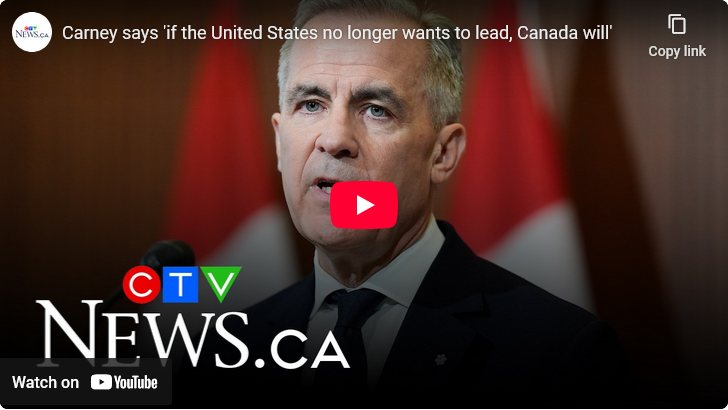
Oh, we will, eh?
Don’t get me wrong, I like the sound of it. He’s certainly manifesting that elbows-up spirit that seems to be so impressing Canadians.
But, like — Carney knows which country he’s in, right? Canada? The one full of Canadians? Because as I heard him say what Canada would do in response to the accelerating American withdrawal from global affairs, I couldn’t help but note that there is a problem here.
Canada isn’t a leader. Canada doesn’t lead.
Even as I write this, I know it’s going to be a fraught statement. Canadian patriotism is a bit supercharged right now. It’s nice to see. But a lot of stupidity gets overlooked — or even caused — by patriotic outbursts. Internal dissent becomes a lot less popular when everybody is sewing the Maple Leaf onto their backpack. So I want to make my point respectfully and politely, largely to spare myself the agony of wading through idiotic replies for a few days. So here goes: many Canadians do indeed lead in their fields, and there is nothing inherent about Canada that makes us incapable of exercising leadership. If Mark Carney remains prime minister — or if someone with similar ambitions should replace him and make a point of pursuing a policy of broad-based Canadian global leadership — I don’t write that off as a doomed proposition.
There is more that we could choose to do. There are practical constraints that would bind us, and we’ll talk about those in a minute, but just to get into the spirit of the moment: sure. We could choose to exercise global leadership.
But we would first have to start with the recognition that it has been generations since we have actually tried to do that. This is not a moral judgment on Canada or Canadians. It is simply a recognition of the historical record. This country has not pursued a national policy — or even a series of smaller policies that take on a greater form in the aggregate — that sought to establish this country as a leader in the world.
If we’re being honest, we’ve typically pursued almost the opposite policy, and deliberately. I’m not saying we’re slavish followers. But this is a country that for generations has been quite comfortable thinking of itself as an overachieving middle power, nestled comfortably in a supporting role for allied countries that do seek to lead. Usually the Americans. Maybe sometimes the British or French. Or something like the UN or NATO. We’ve never claimed to land the hardest punches, or tried to. We’d settle for punching above our weight. We haven’t tried to conquer or command or even compel. In the words of a member of the incumbent government, our aspiration largely maxed out at wishing to convene.
But, of course, as we’re learning these days, Canadian politicians of almost all parties (Maxime Bernier is the only exception I’m aware of) consider the beneficiaries of our trade-distorting supply management system to be the only ones whose interests they always champion:
The most interesting field of international relations, though, and the most germane to what Carney said on Liberation Day, is in the field of trade. Canada definitely likes trade. I’ll even give some credit here to both Liberals and Conservatives. It has been broadly understood that Canada thrives when we have access to markets all over the world. The pursuit of expanded trading relationships has been a bipartisan priority for Liberals and Conservatives alike … so long as it doesn’t cost us anything on the domestic political front.
And yes, I’m talking about dairy. Some other things, too. But mostly the milk and eggs.Seriously. Scroll up a bit. Look at that big quote I dropped in at the top from Carney. Watch the CTV feed again. Canada is going to pursue a role of leadership in defending liberalized free trade?
Really? Forgive me for squinting. I’m struggling with my middle-aged eyes to find the tiny text appended to Carney’s pledge that notes that “conditions apply”. Because that very same Mark Carney has already gone out of his way to say that protecting Canada’s supply-managed dairy and egg producers is an absolute, unbendable priority for him and his party.
So yes. Let’s all pledge ourselves to a new era of Canadian leadership in defence of free trade and unfettered market access, right up until the moment some weirdo foreigner gets it into their pathetic little brain that they should be allowed to sell me a stick of butter. Because that ain’t on, friends. Let’s get our elbows up, and bury them deep into this wheel of filthy xenocheddar.

Comments Off on Canadian political aspirations to being “very mid” on the world stage
April 9, 2025
The Korean War Week 42 – Seize Hwacheon Reservoir? A Dam Good idea – April 8, 1951
The Korean War by Indy Neidell
Published 4 Apr 2025Operation Rugged is in full swing, and it’s taking a decent amount of territory, but Matt Ridgway is worried about the possibility of the enemy blowing the dam at the Hwacheon Reservoir and flooding his army, so he gets set to try and soon take it. Meanwhile there’s an explosion in Congress in Washington DC, when the Minority Leader openly reads Douglas MacArthur’s letter of his plans for the war that are diametrically opposed to those of President Harry Truman. Truman realizes that he’s going to have to remove MacArthur from UN command.
Chapters
00:57 Recap
01:31 When to Fire MacArthur?
03:53 Joe Martin Speaks
07:11 Operation Rugged
09:23 The Hwacheon Reservoir Dam
13:35 Summary
13:51 Conclusion
(more…)
Comments Off on The Korean War Week 42 – Seize Hwacheon Reservoir? A Dam Good idea – April 8, 1951
March 25, 2025
QotD: The nature of kingship
As I hammer home to my students, no one rules alone and no ruler can hold a kingdom by force of arms alone. Kings and emperors need what Hannah Arendt terms power – the ability to coordinate voluntary collective action – because they cannot coerce everyone all at once. Indeed, modern states have far, far more coercive power than pre-modern rulers had – standing police forces, modern surveillance systems, powerful administrative states – and of course even then rulers must cultivate power if only to organize the people who run those systems of coercion.
How does one cultivate power? The key factor is legitimacy. To the degree that people regard someone (or some institution) as the legitimate authority, the legitimate ruler, they will follow their orders mostly just for the asking. After all, if a firefighter were to run into the room you are in right now and say “everybody out!” chance are you would not ask a lot of questions – you would leave the room and quickly! You’re assuming that they have expertise you don’t, a responsibility to fight fires, may know something you don’t and most importantly that their position of authority as the Person That Makes Sure Everything Doesn’t Burn Down is valid. So you comply and everyone else complies as a group which is, again, the voluntary coordination of collective action (the firefighter is not going to beat all of you if you refuse so this isn’t violence or force), which is power.
At the same time, getting that compliance, for the firefighter, is going to be dependent on looking the part. A firefighter who is a fit-looking person in full firefighting gear who you’ve all seen regularly at the fire station is going to have an easier time getting you all to follow directions than a not-particularly-fit fellow who claims to be a firefighter but isn’t in uniform and you aren’t quite sure who they are or why they’d be qualified. The trappings contribute to legitimacy which build power. Likewise, if your local firefighters are all out of shape and haven’t bothered to keep their fire truck in decent shape, you – as a community – might decide they’ve lost your trust (they’ve lost legitimacy, in fact) and so you might replace them with someone else who you think could do the job better.
Royal power works in similar ways. Kings aren’t obeyed for the heck of it, but because they are viewed as legitimate and acting within that legitimate authority (which typically means they act as the chief judge, chief general and chief priest of a society; those are the three standard roles of kingship which tend to appear, in some form, in nearly all societies with the institution). The situation for monarchs is actually more acute than for other forms of government. Democracies and tribal councils and other forms of consensual governments have vast pools of inherent legitimacy that derives from their government form – of course that can be squandered, but they start ahead on the legitimacy game. Monarchs, by contrast, have to work a lot harder to establish their legitimacy and doing so is a fairly central occupation of most monarchies, whatever their form. That means to be rule effectively and (perhaps more importantly) stay king, rulers need to look the part, to appear to be good monarchs, by whatever standard of “good monarch” the society has.
In most societies that has traditionally meant that they need not only to carry out those core functions (chief general, chief judge, chief priest), but they need to do so in public in a way that can be observed by their most important supporters. In the case of a vassalage-based political order, that’s going to be key vassals (some of whom may be mayors or clerics rather than fellow military aristocrats). We’ve talked about how this expresses itself in the “chief general” role already.
I’m reminded of a passage from the Kadesh Inscription, an Egyptian inscription from around 1270 BC which I often use with students; it recounts (in a self-glorifying and propagandistic manner) the Battle of Kadesh (1274 BC). The inscription is, of course, a piece of royal legitimacy building itself, designed to convince the reader that the Pharaoh did the “chief general” job well (he did not, in the event, but the inscription says he did). What is relevant here is that at one point he calls his troops to him by reminding them of the good job he did in peace time as a judge and civil administrator (the “chief judge” role) (trans. from M. Lichtheim, Ancient Egyptian Literature, vol 2 (1976)):
Did I not rise as lord when you were lowly,
and made you into chiefs [read: nobles, elites] by my will every day?
I have placed a son on his father’s portion,
I have banished all evil from the land.
I released your servants to you,
Gave you things that were taken from you.
Whosoever made a petition,
“I will do it,” said I to him daily.
No lord has done for his soldiers
What my majesty did for your sakes.Bret Devereaux, “Miscellanea: Thoughts on CKIII: Royal Court”, A Collection of Unmitigated Pedantry, 2022-02-18.
Comments Off on QotD: The nature of kingship
March 15, 2025
QotD: Strategy
Strategy itself is a slippery term, used in slightly different ways in different contexts. In everyday usage, it is simply a plan to accomplish some task, whereas formal military definitions tend to specify the particular end. The US joint doctrinal definition, for instance, is: “A prudent idea or set of ideas for employing the instruments of national power in a synchronized and integrated fashion to achieve theater, national, and/or multinational objectives”. If strategy is not quite a theory for victory, the connection between them is apparent.
There is a subtle problem with this definition, however. Victories are rarely won in precisely the way the victors anticipate. Few commanders can call their own shots, as Napoleon did in Italy or William Slim in Burma. Wars are complex and messy things, and good strategy requires constant adaptation to circumstance — a system of expedients, as Moltke put it. Even with the benefit of hindsight, the cause of a war’s outcome is not always perfectly clear, as the ongoing debate over strategic bombing bears witness.
Indeed, the very idea that strategy represents a plan is very recent. From the first adoption of the word into modern languages,1 strategy was defined more as an art: of “commanding and of skilfully employing the means [the commander] has available”, of “campaigning”, of “effectively directing masses in the theater of war”. The emphasis was decidedly on execution, not planning. As recently as 2001, the US Army’s FM 3-0 Operations defined strategy as: “the art and science of developing and employing armed forces and other instruments of national power in a synchronized fashion to secure national or multinational objectives”. Something one does, not something one thinks.
This is best understood by analogy to tactics, a realm less given to formalism and abstraction. What makes a good tactician? Devising a good plan is certainly part of it, but most tactical concepts are not especially unique — there are only so many tools in the tactical toolkit. The real challenge lies in execution: providing for comms and logistics, ensuring subordinates understand the plan, going through rehearsals, making sure that everyone is doing their job correctly, then putting oneself at the point where things are likely to go wrong and dealing with the unexpected.
Ben Duval, “Is Strategy Just a Theory of Victory? Notes on an Annoying Buzzword”, The Bazaar of War, 2024-12-01.
1. This was before Clausewitz’s inadvertent redefinition of strategy, when the term still referred to what we now call “operational art”.
Comments Off on QotD: Strategy
March 14, 2025
“CDU Chancellor hopeful Friedrich Merz is screwing up”
I don’t follow German politics closely, so I depend on regular updates from euygppius, like this post from the other day which I’m sure wasn’t popular among CDU voters or personal fans of Friedrich Merz, the likely next German Chancellor:

For some time now, I’ve wanted to catalogue in one place all the ways that CDU Chancellor hopeful Friedrich Merz is screwing up. His strategic failures are really a thing to behold; I’ve never seen anybody screw up this frequently and this dramatically before. Yet I have delayed writing this post, above all because I wanted Merz to reach the end of his present streak and stop screwing up for a while. I wanted to have a complete unit – a full collection of screwups – to present to my readers for analysis. I now accept that this is never going to happen, and that the coming months and years are going to provide nothing but an unending parade of screwups, one after the other, each more inexplicable and baffling than the last. We must begin the tiresome work of trying to understand Merz’s screwing up now, because there will only ever be more of this.
As with all deeply rooted phenomena, it is hard to tell where the present parade of screwing up began. There was the lacklustre CDU election campaign and Merz’s ill-advised flirtations with the Greens that began last autumn, which cost the Union parties precious points in the polls. None of that looked auspicious, but the screwing up did not begin in earnest until January, in the wake of Aschaffenburg – when Merz decided to violate the firewall against Alternative für Deutschland. For the first time in history, the CDU, the CSU and the FDP voted with AfD in the Bundestag, first in a successful attempt to pass a meaningless if sternly worded anti-migration resolution, and then in a failed attempt to pass an actual piece of legislation that would take real steps to stem the influx of asylees from the developing world.
This manoeuvre had the real glimmerings of strategy, and so we would do well to ascribe it to Merz’s underlings rather than to Merz himself. It was only superficially an attempt to stop the tide of voter defections to the AfD. Above all, it was an effort to gain leverage over the Greens and the Social Democrats in any future coalition negotiations. Merz and his CDU, sobered by polls showing a left so weakened that they feared having to govern in a nightmare Kenya coalition with the SPD and the Greens both, wanted to send a clear message: “We’re not afraid to achieve parliamentary majorities with the AfD if you won’t go along with our programme”. Had Merz stuck to this line, he’d be in a far better place than he is today. Alas, the man chose to screw up instead. Spooked by yet another wave of leftist protests “against the right” – a “right” which now included not only the AfD but also the CDU and the CSU – Merz lost himself in a string of disavowals. A minority government with AfD support would be unthinkable, he and his lieutenants said. The Union parties would never work with the AfD, he and his lieutenants said.
In this way, Merz’s firewall gambit succeeded only in outraging and energising his future coalition partners, while achieving nothing for himself or his own party. A lot of CDU voters would like to see some measure of cooperation between the Union parties and the AfD, and for his constant never-again-with-the-AfD rhetoric Merz paid a price. The CDU underperformed the polls, crossing the finish line with a catastrophic 28.5% of the vote on 23 February. The Greens whom Merz had spent months courting – at the cost of alienating his own base! – emerged from the vote too weak to give his party a majority, and so the man was left to deal with the Social Democrats, newly radicalised not only by their own dim showing but also by Merz’s firewall trickery.
Thus it came to be that Merz ceded the high ground in negotiations to the SPD, the biggest losers in the 2025 German elections. That is itself remarkable, the kind of thing you could not be certain of achieving even if you tried. And yet it is only the beginning!
Comments Off on “CDU Chancellor hopeful Friedrich Merz is screwing up”
March 12, 2025
The Korean War 038 – The US President is Angry! – March 11, 1951
The Korean War by Indy Neidell
Published 11 Mar 2025Operation Ripper kicks off this week, and gains plenty of ground … but the enemy is almost nowhere to be found. Douglas MacArthur gives what becomes known as his “die for a tie” speech, which could have a serious negative effect on UN troop morale. But the Chinese are building up their forces for an eventual counterstrike, and the North Koreans even have a new Chief of Staff.
Chapters
00:00 Intro
00:50 Recap
01:15 Plans for Operation Ripper
04:45 Die for a Tie
06:34 MacArthur Won’t Toe the Line
08:17 The KPA Build-Up
10:38 Nam Il
12:31 The Chinese Build-Up
14:01 Ripper Begins
15:33 Summary
15:45 Conclusion
(more…)
Comments Off on The Korean War 038 – The US President is Angry! – March 11, 1951
March 5, 2025
The Korean War 037 – Matt the Ripper! – March 4, 1951
The Korean War by Indy Neidell
Published 4 Mar 2025This week is really a week of planning, as Matt Ridgway unveils the plans for Operation Ripper — to follow the somewhat disappointing Operation Killer, but there are South Korean spies involved, the blockade of Wonsan, and the continuing escalation of tensions between Douglas MacArthur and Harry Truman, with people in American High Command concerned that MacArthur is bent on starting World War 3.
Chapters
00:00 Intro
00:25 Recap
00:44 Killer and Ripper
04:14 Intel and Distractions
06:57 South Korean Spies
08:06 Truman and MacArthur (Again)
(more…)
Comments Off on The Korean War 037 – Matt the Ripper! – March 4, 1951
March 3, 2025
All The Basics About XENOPHON
MoAn Inc.
Published 7 Nov 2024I actually found this video really tricky considering I want to go into the texts of Xenophon and if I told you everything about the march of the ten thousand then I would have just told you the whole Anabasis?? Which defeats the whole purpose of an introductory video?? So I PROMISE more clarity will come in future videos as Xenophon himself breaks down his journey home from Persia and why they were there in the first place. Therefore, you have ALL OF THAT to look forward to — coming soon!!!
(more…)
Comments Off on All The Basics About XENOPHON


