Nothing in ancient religion strikes my students as so utterly strange and foreign as that idea [of divinized kings and emperors]. The usual first response of the modern student is to treat the thing like a sham – surely the king knows he is not divine or invested with some mystical power, so this most all be a con-job aimed at shoring up the legitimacy of the king. But as we’ve seen, the line between great humans and minor gods is blurry, and it is possible to cross that line. It is not necessary to assume that it was all an intentional sham.
Divine rulership was not universal however – it was subject to cultural context. In Egypt, the Pharaoh was the Living Horus, a physical incarnation of the divine; when he died he became Osiris, the ruler over the underworld. The mystery of the duality whereby a Pharaoh was both a specific person (and might be a different person in the future) but also the same god each time seems to owe something to the multipart Egyptian conception of the soul. Naram-Sin, an Akkadian King (2254-2218 B.C.) represents himself as divine (shown by his having horns) on his victory stele; future kings of Akkad followed suit in claiming a form of divinity, albeit a lesser one than the big-time great gods.
But in Mesopotamia, the rulers of Akkad were the exception; other Mesopotamian kings (Sumerian, Babylonian, etc) did not claim to be gods – even very great kings (at least while alive – declaring a legendary ruler a god is rather more like a divine founder figure). Hammurabi (king of Babylon, c.1810-c.1750 B.C.) is shown in his royal artwork very much a man – albeit one who receives his mandate to rule from the gods Shamash and Marduk. Crucially, and I want to stress this, the Achaemenid kings of Persia were not considered gods (except inasmuch as some of them also occupied the position of Pharaoh of Egypt; it’s not clear how seriously they took this – less seriously than Alexander and Ptolemy, quite clearly). The assumption that the Persians practiced a divine kingship is mostly a product of Greek misunderstandings of Persian court ritual, magnified in the popular culture by centuries of using the Persian “other” as a mirror and (usually false) contrast for European cultures.
But the practice that my students often find most confusing is that of the Roman emperors. To be clear, Roman emperors were not divinized while they were alive. Augustus had his adoptive father, Julius Caesar divinized (this practice would repeat for future emperors divinizing their predecessors), but not himself; the emperor Vespasian, on his deathbed, famously made fun of this by declaring as a joke, “Alas! I think I’m becoming a god” (Suet. Vesp. 23.4). And yet, at the same time, outside of Rome, even Augustus – the first emperor – received cult and divine honors, either to his person or to his genius (remember, that’s not how smart he is, but the divine spirit that protects him and his family).
I think it is common for us, sitting outside of these systems, to view this sort of two-step dance, “I’m not a god, but you can give me divine honors in the provinces and call me a god, just don’t do it too loudly” as fundamentally cynical – and to some degree it might have been; Augustus was capable of immense cynicism. But I think it is possible to view this relationship outside of that cynicism through the lens of the ideas and rules we’ve laid out.
Bret Devereaux, “Collections: Practical Polytheism, Part IV: Little Gods and Big People”, A Collection of Unmitigated Pedantry, 2019-11-15.
June 20, 2023
QotD: When kings and emperors become gods
February 15, 2023
Ancient Rome’s Naked Fertility Festival (Lupercalia)
Tasting History with Max Miller
Published 8 Feb 2022
(more…)
January 18, 2023
The Roman Army, With Adrian Goldsworthy
Well That Aged Well
Published 12 May 2021In this episode we take a look at the Roman Army, and its comanders. What made the Roman Army so efficent? Was it the practice? The motivation? Their courrage? Or was it more to it? Find out in this week’s episode of “Well That Aged Well”, With Erlend Hedegart.
(more…)
December 27, 2022
Marcus Licinius Crassus, the richest man in Rome
In The Critic, Bijan Omrani reviews Crassus: The First Tycoon by Peter Stothard:
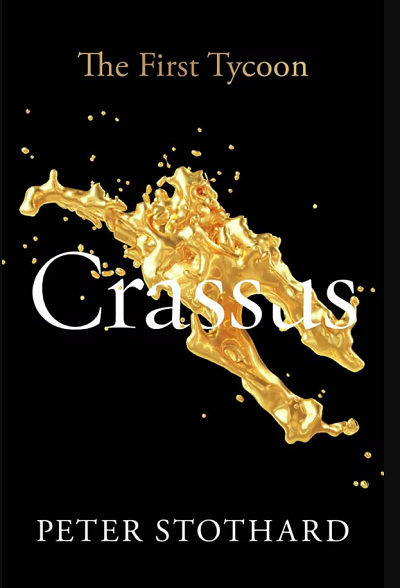
If you are feeling despondent about the dismal quality of the current generation of politicians, it may be some comfort to remember that even in the golden age of Rome such complaints were legion.
The poet Horace wrote at length about how the ruling class had gone downhill. Once, there had been paragons of virtue such as Cincinnatus, who after saving Rome as dictator laid down his power without demur and returned to live on his humble farm; or the consul Regulus, who refused to make any concessions after being captured by the Carthaginians, although he knew they would torture him to death. Instead of these titans, the modern age had brought forth a base generation. Marcus Licinius Crassus, the richest man in Rome and subject of this new biography, was foremost among them.
The formidable influence wielded by Crassus in the final years of the Roman Republic — he was an ally, and rival, of Julius Caesar and Pompey the Great — came not by way of old-fashioned heroics and victories on the battlefield. His methods were recognisably modern. Peter Stothard characterises him as a “disrupter of old rules, fixer and puller of the puppet strings of power”. His tools were money and the economy of favours. He employed them with a coldness, ruthlessness and level of calculation that makes him unappetising, but deeply compelling. Stothard’s description of him as “The First Tycoon” is apt. He is the sort of character one might expect to find wearing red braces in a New York boardroom, rather than a brocaded toga in the Roman Forum.
By origin, Crassus was a member of one of Rome’s blue-blooded families. His pursuit of political influence by means of business rather than military prowess would seem at first sight unexpected, given the traditional prohibition against the senatorial aristocracy engaging in trade. Yet, the turmoil of Crassus’s formative years overturned these niceties. The last sight he had of his father, who had served as a consul, was of his head on a spike in the Forum.
He was a victim of the perennial strife that plagued Rome at the beginning of the 1st century BC, caused by imbalances in wealth and tensions between Rome and wider Italy, not to mention discord over land, military and constitutional reforms. With the death of his father and two of his brothers, Crassus had to flee Rome and hide in a cave for eight months in Spain, where his family still had allies. It is doubtless these upheavals — similar to those of Julius Caesar, who lost his father young and had to go into hiding during this chaos — led Crassus to seek an inviolable security, regardless of whether he trampled on old Roman conventions and upset others to do so.
When the aristocratic faction seized power in the late 80s BC, Crassus was able to return to Rome. There, he pursued every commercial method, no matter how disreputable, to accumulate wealth. It satisfied not only his needs for security but, as Stothard argues, it was also a way of seeking revenge for the death of his father. He bought up the properties of those families allied to the earlier populist regime which had just been displaced.
These came at a knock-down price, as the families had been outlawed, with some executed and others sent into exile. Crassus appears to have been on a committee which determined the loyalty of citizens to the new government and appears not to have scrupled to condemn those whose property he coveted. His other prime method for enlarging his portfolio was to buy up cheaply buildings that were on fire, or else in the path of a fire. He organised his slaves along military lines, using them with relentless efficiency to acquire, rebuild and sell on property for a huge profit.
December 9, 2022
Caesar versus Cato
In The Critic, Daisy Dunn reviews Uncommon Wrath: How Caesar and Cato destroyed the Roman Republic by Josiah Osgood:
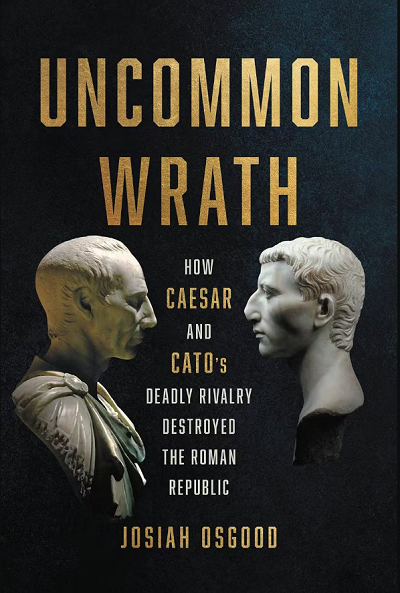
If there was one thing the Romans did well — aside from sanitation, irrigation and concrete — it was polemic. Cicero composed fourteen fiery Philippics against Mark Antony in the 40s BC, and Catullus jibed at Julius Caesar so profusely in his poems that he had to issue an apology. Less famous, but equally explosive, was Caesar’s own collection of vitriol. The Anticato survives today only in fragments, but according to an ancient satirist, it was originally so long that it took up two scrolls and almost outweighed the penis of Publius Clodius Pulcher, apparently among the best-endowed politicians in Rome.
Caesar wrote it shortly before he became dictator, with the intention of denigrating the memory of Marcus Porcius Cato, “Cato the Younger”. For years the two men had been locked in furious rivalry. Caesar blasted Cato as cold and miserly. Cato despaired at Caesar’s profligacy and tireless womanising. If Caesar was louche in his barely-belted toga and exotic unguents, Cato was positively austere — a prime hair-shirt candidate — with his bare feet, rustic diet, extreme exercise and strict sexual mores; it was most unusual for a Roman to make his wife the first woman he slept with.
Few would argue with Josiah Osgood, Professor of Classics at Georgetown, when he describes Caesar and Cato as opposites. Even Donald Trump and Joe Biden have more in common than they did. Caesar was the nephew of the wife of Gaius Marius, the populist enemy of Sulla, who as dictator had thousands of Italians proscribed and killed in his bid to restore the authority of the Senate. Cato could count Sulla as an old family friend. Caesar belonged to a well-established Roman family and claimed descent from Venus via her son Aeneas. Cato’s family was Sabine, and his most famous ancestor was a mere mortal in the shape of the plebeian writer and highly conservative statesman Cato the Elder.
The differences between Caesar’s and Cato’s personalities mattered because they reflected the differences in their visions for Rome. Osgood sums these up as “an empire wielding its power for the people” (Caesar) versus “a Senate protecting the people from the all-powerful empire builders” (Cato). It is little wonder they came to blows.
Osgood takes the tense relationship between Cato and Caesar as the central focus of his book. He argues that their feud has been overlooked as a contributing factor to the civil war that erupted in 49 BC and brought the Roman Republic crashing to the ground. Blame for this war has more usually been placed on the collapse of the First Triumvirate — an illegal alliance for power forged between Julius Caesar, Pompey the Great and Marcus Licinius Crassus in 60 BC — and the breakdown in relations between Caesar and Pompey in particular. But all wars have long-term and short-term causes. For Osgood, the dispute between Caesar and Cato was significant in at least the medium term.
July 25, 2022
“Yond Cassius has a lean and hungry look; He thinks too much: such men are dangerous“
Rob Henderson considers the character of Julius Caesar (as filtered through Plutach and Shakespeare), and the “Dominance-Oriented Status Seekers” identified in a recent paper:
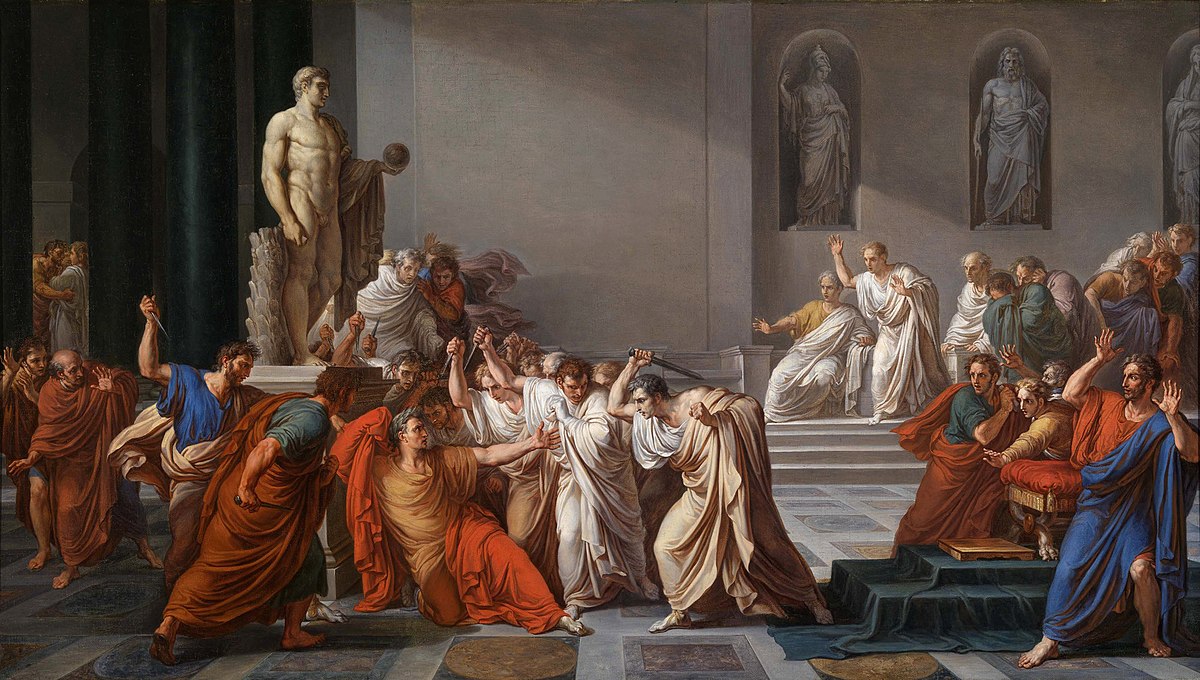
La morte di Cesare (The death of Caesar)
Oil painting by Vincenzo Camuccini between 1804 and 1805. via Wikimedia Commons.
In the opening scene of Shakespeare’s Julius Caesar (which is drawn from Plutarch’s Lives), the commoners of Rome are seen celebrating Caesar’s recent triumph over Pompey.
Two tribunes (elected officials), Flavius and Marullus, accost two of the commoners, asking them to name their trades and explain why they are out in their best attire rather than working.
The commoners respond to the tribunes’ condescension with indirect answers and puns that annoy the tribunes even more.
Eventually, Flavius and Marullus learn that the plebeians are cheering Caesar. The tribunes scorn them for doing this.
They tell the commoners that Pompey was a Roman too. So Caesar’s success was not truly a triumph for Rome.
Flavius later tells Marullus that they should remove the decorations from Caesar’s statues during Caesar’s parade.
Marullus questions this plan, stating that it also happens to be the Feast of Lupercal, a celebration of fertility.
But Flavius is adamant that they remove the ornaments, because the removal will help prevent Caesar from seeing himself as too great.
This first scene of Julius Caesar shows that the tribunes want to prevent the rise of a potential tyrant. But they themselves are more than willing to push the commoners around.
Later, two other prominent Romans — Brutus and Cassius — are likewise shown expressing their concerns about Caesar’s growing popularity.
Cassius asks Brutus how Caesar has any more right to greatness than Brutus or himself.
Cassius tells Brutus a story: When they were young, Cassius saved young Julius Caesar from drowning. Cassius always viewed himself as superior for rescuing Caesar. He is now aggravated that Caesar has risen above him.
Cassius decides to orchestrate Caesar’s assassination. Cassius gradually convinces other members of the Roman elite to help him carry out the conspiracy.
Meanwhile, Caesar himself, speaking privately with Mark Antony, expresses suspicions about Cassius:
CAESAR
Let me have men about me that are fat,
Sleek-headed men, and such as sleep a-nights.
Yond Cassius has a lean and hungry look.
He thinks too much. Such men are dangerous.
ANTONY
Fear him not, Caesar; he’s not dangerous.
He is a noble Roman, and well given.
CAESAR
Would he were fatter! But I fear him not.
Yet if my name were liable to fear,
I do not know the man I should avoid
So soon as that spare Cassius. He reads much,
He is a great observer, and he looks
Quite through the deeds of men. He loves no plays,
As thou dost, Antony; he hears no music;
Seldom he smiles, and smiles in such a sort
As if he mocked himself and scorned his spirit
That could be moved to smile at anything.
Such men as he be never at heart’s ease
Whiles they behold a greater than themselves,
And therefore are they very dangerous.
I rather tell thee what is to be feared
Than what I fear; for always I am Caesar.
Come on my right hand, for this ear is deaf,
And tell me truly what thou think’st of him.Caesar is saying all men are hungry, either for food, entertainment (“he loves no plays … he hears no music”), or power. If prosperous men aren’t tempted by food and entertainment, then they crave power. Thus, prosperous men who are lean are dangerous.
Mark Antony dismisses Caesar’s concerns about Cassius, because Cassius is a “noble Roman”. But as events unfold, we see that Antony was misguided.
Caesar was correct in his judgment of Cassius.
The eminent literary critic (and my former professor) Harold Bloom has stated that Caesar’s “estimate of Cassius shows him to be the best analyst of another human being in all of Shakespeare”.
Bloom goes on to characterize Cassius as embodying a “spirit of resentment, unhappy as he is at contemplating greatness beyond him”.
Cassius secretly arranges to have fake notes sent to Brutus, who is fooled into thinking the notes have been written by ordinary Roman citizens who want the Roman elites to stand up against Caesar.
When persuading the other conspirators to help him carry out the assassination plot, Cassius’s stresses his concern for the future of Rome.
But Cassius’s story to Brutus indicates that the assassination was in part fueled by his resentment that Caesar grew into someone more powerful than himself, thus upending their former status disparity.
July 5, 2022
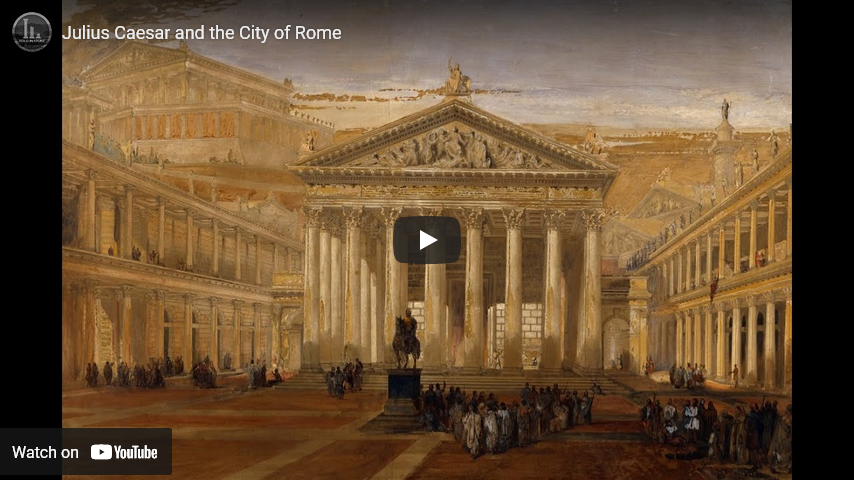
Julius Caesar and the City of Rome
toldinstone
Published 14 May 2021Julius Caesar was not only a gifted general and fiercely ambitious politician. He was also a great builder, who reshaped the heart of Rome in his own image.
For much more on Caesar and his successors, check out my book Naked Statues, Fat Gladiators, and War Elephants: Frequently Asked Questions about the Ancient Greeks and Romans.
https://www.amazon.com/Naked-Statues-…
If you’re so inclined, you can follow me elsewhere on the web:
https://www.patreon.com/toldinstone
https://www.reddit.com/r/AskHistorian…
https://www.instagram.com/toldinstone/
https://www.goodreads.com/author/show…0:00 Introduction
1:29 The Forum in Caesar’s time
3:30 Caesar’s new forum
4:42 The Temple of Venus Genetrix
5:37 The Basilica Julia
6:10 The Curia and Rostra
6:57 Dedication games
8:02 Caesar the godThanks for watching!
June 10, 2022
The Early Roman Emperors – Part 1: Augustus
seangabb
Published 26 Sep 2021The Roman Empire was the last and the greatest of the ancient empires. It is the origin from which springs the history of Western Europe and those nations that descend from the Western Roman Empire. It is the political entity within which the Christian faith was born, and the growth of the Church within the Empire, and its eventual establishment as the sole faith of the Empire, have left an indelible impression on all modern denominations. Its history, together with that of the ancient Greeks and the Jews, is our history. To understand how the Empire emerged from a great though finally dysfunctional republic, and how it was consolidated by its early rulers, is partly how we understand ourselves.
Here is a series of lectures given by Sean Gabb in late 2021, in which he discusses and tries to explain the achievement of the early Emperors. For reasons of politeness and data protection, all student contributions have been removed.
More by Sean Gabb on the Ancient World: https://www.classicstuition.co.uk/
Learn Latin or Greek or both with him: https://www.udemy.com/user/sean-gabb/
His historical novels (under the pen name “Richard Blake”): https://www.amazon.co.uk/Richard-Blak…
April 11, 2022
Republic to Empire: The Ides of March to Actium
seangabb
Published 13 Mar 2021In 120 BC, Rome was a republic with touches of democracy. A century later, it was a divine right military dictatorship. Between January and March 2021, Sean Gabb explored this transformation with his students. Here is one of his lectures. All student contributions have been removed.
(more…)
April 7, 2022
Republic to Empire: The Triumph of Caesar
seangabb
Published 5 Mar 2021In 120 BC, Rome was a republic with touches of democracy. A century later, it was a divine right military dictatorship. Between January and March 2021, Sean Gabb explored this transformation with his students. Here is one of his lectures. All student contributions have been removed.
(more…)
April 3, 2022
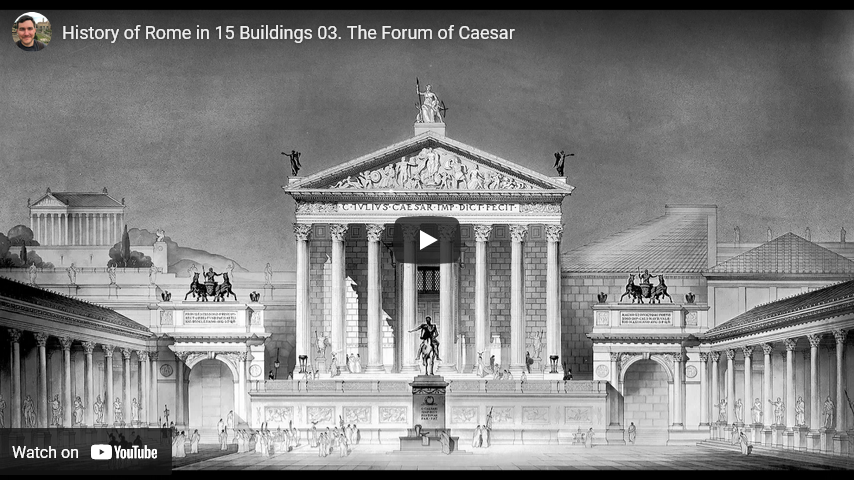
History of Rome in 15 Buildings 03. The Forum of Caesar
toldinstone
Published 27 Sep 2018In this third episode of our History of Rome, focused on the Forum of Julius Caesar, we discuss (as might be expected) Julius Caesar, the last and greatest of the generals who reshaped the Roman Republic in their own image. Caesar dominates the stage, but there are walk-on bits for a crew of pirates, forty trained elephants, and Cleopatra.
If you enjoyed this video, you might be interested in my book Naked Statues, Fat Gladiators, and War Elephants: Frequently Asked Questions about the Ancient Greeks and Romans. You can find a preview of the book here:
https://toldinstone.com/naked-statues…
If you’re so inclined, you can follow me elsewhere on the web:
https://www.reddit.com/r/AskHistorian…
https://www.instagram.com/toldinstone/To see the story and photo essay associated with this video, go to:
https://toldinstone.com/the-forum-of-…Thanks for watching!
March 28, 2022
Republic to Empire: Catiline, Cicero, Crassus, Pompey, Caesar the Death Spiral
Update 6 Feb 2024: Dr. Gabb replaced the original part 7 which discussed the cultural impact of Ancient Greece on the rising Roman Republic.
seangabb
Published 20 Feb 2021
In 120 BC, Rome was a republic with touches of democracy. A century later, it was a divine right military dictatorship. Between January and March 2021, Sean Gabb explored this transformation with his students. Here is one of his lectures. All student contributions have been removed.Here is the seventh lecture, which discusses the Catiline Conspiracy and the rise and disintegration of the First Triumvirate of Caesar, Pompey and Crassus. There is a digression on Eastern politics and the Parthian Empire.
(more…)
March 21, 2022
Republic to Empire: Sulla A Failed Reaction
seangabb
Published 10 Feb 2021In 120 BC, Rome was a republic with touches of democracy. A century later, it was a divine right military dictatorship. Between January and March 2021, Sean Gabb explored this transformation with his students. Here is one of his lectures. All student contributions have been removed.
(more…)
February 6, 2022
QotD: Marcus Tullius Cicero
Cicero was a key politician in the Late Republic, but it was his misfortune that his life was spent in an era where words meant less than weapons. He sided with Pompey against Caesar, but was granted clemency after Pompey’s defeat. He was not involved in Caesar’s assassination – he was still too much an outsider for some of the stuck-up Roman elitists who made up the conspiracy (though he correctly pointed out at the time that leaving Antony alive would be a fatal mistake). In the aftermath of the assassination, he identified (correctly) Antony as the key threat to the Republic and worked to discredit him politically in a devastating series of speeches named the Philippics (in honor of a similar set of speeches made by the Athenian Demosthenes against Philip II of Macedon, father of Alexander). Cicero’s political assault on Antony succeeded – his reputation was ruined and his popularity in Rome never recovered – but it cost Cicero his life when Antony, in league with Octavian, moved into the capital and had Cicero murdered. Cicero’s literary legacy survived him, however, in part because it was useful for Augustus’ own political ends (e.g. Plut. Cic. 49.5-6).
Cicero’s position as the most eloquent orator of the Latin language – and probably its best prose stylist – is largely uncontested. It was his speaking skills – honed in the courts – that made him so politically successful. He was also a prolific writer and a tremendous amount of his writings survive, including both legal and political speeches, private letters, handbooks on oratory, and a set of philosophical works. As anyone who has read Cicero can tell you, he also has a deserved reputation for pride and self-aggrandizement. While many of Cicero’s contemporaries and readers down to the modern era have been impressed by Cicero’s thinking and eloquence, I feel confident in asserting no one – alive or dead – will ever be more impressed by Cicero than Cicero was impressed by himself.
Bret Devereaux, “Collections: A Trip Through Cicero (Natural Law)”, A Collection of Unmitigated Pedantry, 2019-12-12.
December 30, 2021
The Cursus Honorum of the late Roman Republic
At Founding Questions, Severian notes that the Cursus Honorum — the formal “career path” for ambitious men in the late Roman Republic was a remarkably effective process … that ended up being a victim of its own success:
Ahhh, God bless the autists at Wiki, they’ve got it down to a chart:
This is from Caesar’s time, and since one of this blog’s main themes is the confusion between process and outcome, let’s put it right up front: This system, the cursus honorum, was designed to produce men like Julius Caesar …
… and you can take that in either sense.
Caesar is one of the most mulled-over men in history, but nobody seriously doubts that he was at least competent at pretty much everything. Maybe he didn’t make the big list of “Greatest Pontifices Maximi” (or however the Latin goes), but he wasn’t a disgrace to the toga, either. If it was a public function in the Late Roman Republic, Caesar was at least decent at it.
And that’s what the cursus honorum was designed to do. It was a three-fer: It gave you competent public officials, but it also gave young ruling class men some seasoning. Most importantly, it was a way of nurturing talent that also hedged against the Peter Principle. If you want to argue that that makes it a four-fer, go nuts, but the point is, it was a pretty good system … up to a point, and if you’re a regular reader, you know what that point is: The Dunbar Number, at which point relationships become too complex to be managed personally, and bureaucratic structures replace them.
One wishes later governments had something like this — if a guy starts out as a quaestor and discovers he can’t handle it, he’ll bring that knowledge with him to the Senate. (Of course, if he can’t even manage to get elected to that, he’ll know full well his level of talent, and he’ll sit down and shut up on the Senate’s back benches). Note too that the bottom rung is military service — since at that time legionaries were all militia, the voters got a good look at you where it really matters, right from the beginning.
By the time a man reaches the top, then, he has intimate experience of ALL the public offices. Not only that, but he’s well known to everyone who matters, since in between the various offices he’s in the Senate, making connections (or out in the provinces, making other — but no less valuable — connections). A consul, then, is pretty much by definition omnicompetent. He did a good enough job in all the previous public offices that he didn’t disqualify himself for the top slot. Also, he’s been thoroughly vetted — everyone who matters, at pretty much every level of society, has had a good look at him (or, at worst, has a good friend who has had a good look at him).
Obviously it wasn’t a perfect system. Rome had her share of inept consuls, because people are people and sometimes “promotion to your level of incompetence” means “promotion to the very top job”. But for the most part it worked well, and even if a guy turned out to be a dud as consul, well, what can you do? Everyone had at least a reasonable expectation that he’d be able to handle it, which is pretty much the best one can consistently achieve in human affairs. Not only that, but because of the candidate’s long experience and careful vetting, you had a much better than average chance of getting a real winner …
… a man like Caesar, who is at minimum competent at everything, and outstanding at lots of things.