The dramatic force of the New Atheist moral fable of the Great Library of Alexandria not only comes from the Library’s supposed size and unique nature, but also from its supposed cataclysmic and fiery end. The moral of this story has added impact if the Great Library ends in a violent catastrophe, so this is the story that tends to get told by those who use the tale as a stick with which to beat Christianity. The fact is, however, that libraries are delicate institutions and most decline slowly rather than ending in a sudden disaster, or – as in the Great Library’s case – decline slowly while suffering a series of disasters. Anyone who works in library services will tell you that the main enemy of a library’s continuation is a lack of funding. Ancient libraries in particular needed constant financial patronage from their founders and sponsors to survive. Papyrus scrolls decayed and fell apart from use, suffered damage from mice and other vermin and, in a period where artificial light tended to be from open oil lamps, were in constant danger from fires, great and small. The Mouseion, like all ancient libraries, needed a large staff to undertake the constant and unending task of repairing, replacing and recopying books and these staffs, even when made up of slaves, were expensive to maintain.
During the Mouseion‘s heyday in the third and second centuries BC the funding for this labour and the upkeep of the institution generally would have been regular and reliable. The Mouseion was, after all, one of the jewels in the crown of the Ptolemaic kingdom and it sat in the Broucheion or Royal Quarter where the Ptolemies themselves lived. By the first century BC, however, there is some indication that the prestige of the institution had begun to decline. In its first two centuries the Mouseion‘s directors were famous scholars, renowned for their intellects throughout the Greek-speaking world. By the time of the later Ptolemies, however, we find administrators, court favourites and even a former commander of the palace guard taking up the role, which seems to have become, as Lionel Casson puts it, “a political plum” to be awarded to flunkies rather than scholars. This continued under the Romans in the first century AD, with Tiberius Claudius Balbilus being awarded the post by Claudius, though he at least was something of a scholar if not a leading intellect. It is likely that the later Ptolemies began to neglect the institution and Roman imperial patronage of it was probably even less reliable.
But war has always been one of the main destroyers of libraries down the ages and the Great Library’s slow decline was marked by several sacks of the Broucheion which eventually led to the end of the Mouseion. The first and probably the most significant came in 47 BC when Julius Caesar took the side of Cleopatra in her claim on the Ptolemy’s throne and besieged her younger brother, the boy king Ptolemy XIII, in Alexandria. Caesar’s own account mentions that he burned a fleet in the docks of the city, but makes no mention of this fire destroying anything else (Civil Wars, III.11). His account was continued by his lieutenant Aulus Hirtius in his Alexandrine War and he too makes no mention of any fire damaging the city, but he does go out of his way to say “Alexandria is well-nigh fire-proof, because its buildings contain no wooden joinery and are held together by an arched construction and are roofed with rough-cast or tiling” (Alexandrine War, I.1) which could be read as an attempt at a defence against accusations of damage through fire, given his role in the siege. The earliest account of Caesar’s siege damaging Alexandria comes from a lost work by Livy via an epitome by Florus (Florus, II.13) which describes Caesar burning the area around the docks to deprive enemy archers of a position on which to fire on his troops, and this is echoed by Lucan (The Civil War, X.24). It is Plutarch who first depicts this fire destroying the Great Library in an almost casual mention that perhaps assumes this as common knowledge:
In this war, to begin with, Caesar encountered the peril of being shut off from water, since the canals were dammed up by the enemy; in the second place, when the enemy tried to cut off his fleet, he was forced to repel the danger by using fire, and this spread from the dockyards and destroyed the Great Library, and thirdly, when a battle arose at Pharos, he sprang from the mole into a small boat and tried to go to the aid of his men in their struggle, but the Egyptians sailed up against him from every side, so that he threw himself into the sea and with great difficulty escaped by swimming. (Plutarch, Caesar, 49)
Aulus Gellius’ mention of the Great Library says that the collection numbered “nearly seven hundred thousand volumes” and then adds “but these were all burned during the sack of the city in our first war with Alexandria”, referring to Caesar’s siege (Gellius, Attic Nights, VII.17). Dio Cassius gives a slightly longer account:
After this many battles occurred between the two forces both by day and by night, and many places were set on fire, with the result that the docks and the storehouses of grain among other buildings were burned, and also the library, whose volumes, it is said, were of the greatest number and excellence. (Dio Cassius, Roman History, XLII.36)
There is some debate about how literally we can take the reports that the whole Great Library was destroyed, especially given that the docks area of Alexandria were some distance from the Mouseion‘s likely location. The fact that so many writers agree that Caesar’s fire destroyed the Great Library simply can’t be ignored, however, and at the very least the fire seems to have destroyed a substantial portion of the book collection, probably stored in warehouses on the docks. It is clear that the losses were huge, as Plutarch also tells the (probably apocryphal) story of Mark Antony confiscating the whole collection of the Great Library of Pergamon and giving them to Cleopatra to replace the books lost in the fire (Plutarch, Antony, 58). While this was not the end of the Mouseion and not the end of its whole collection, writers from around the end of the reign of Caesar’s dynasty onwards tend to refer to the Great Library in the past tense and any surviving collection was probably greatly reduced after 47 BC.
Scholarship continued in the Mouseion, however, and the Roman emperors seem to have continued its funding under their patronage when the Ptolemaic dynasty came to an end with the death of Cleopatra. Claudius built a new wing or annex to the Mouseion, which was to house his works of history and see the public reading of them twice a year. But it was the calamitous third century AD that saw a succession of military disasters in Alexandria and seems to have seen the final end of the Mouseion.
In 215 AD Caracalla punished Alexandria for mockery of him with a wholesale massacre of its young men, after which his troops plundered parts of the city. It is not known if the Mouseion was sacked in this action, but John Malas records that its funding was stopped by Caracalla at this time (Delia, p. 1463). The real end probably came in 272 AD when Aurelian stormed the Broucheion with Ammianus noting “[Alexandria’s] walls were destroyed and she lost the greater part of the district called Bruchion.” (Ammianus, History, XII.15). If that sack didn’t mean the death blow for the institution, Diocletian probably finished the job when he too sacked the city in 295 AD, and it was later devastated by a major earthquake in 365 AD. The only mention of the Mouseion after this is found in a late source, the tenth century Byzantine encyclopaedia called the Suda, which describes the fourth century philosopher Theon as “the man from the Mouseion“, though it is hard to tell exactly what this means. Given that the Mouseion was most likely long gone by Theon’s time, it could be that some other successor “Mouseion” had been established and Theon studied there or it could be that “the man from the Mouseion” is stylised honorific or even a personal nickname – meaning “a scholar like one from the old days”.
The Mouseion and its library were almost certainly a memory by the late third century, destroyed in a series of calamities after a long period of decline. But what is missing from all this evidence is any howling, pyromaniacal Christian mob. If the Great Library ceased to exist in the century before Chrisitanity came to power in the Empire, how did Christians get stuck with the charge of destroying it? The answer lies not in the evidence about the Great Library, but in the history of its daughter library and annex in the Serapeum.
Tim O’Neill, “The Great Myths 5: The Destruction Of The Great Library Of Alexandria”, History for Atheists, 2017-07-02.
June 15, 2021
QotD: The destruction of the Great Library of Alexandria
March 30, 2021
Caesar in Britain II: There and Back Again (54 B.C.E.)
Historia Civilis
Published 21 Mar 2017Patreon | http://historiacivilis.com/patreon
Donate | http://historiacivilis.com/donate
Merch | http://historiacivilis.com/merch
Mailing List | http://historiacivilis.com/mailinglist
Twitter | http://historiacivilis.com/twitter
Website | http://historiacivilis.comMusic is:
“Day Bird,” by Broke For Free
“Drums of the Deep,” by Kevin MacLeod
“Flood,” by Jahzzar
March 29, 2021
Caesar in Britain (55 B.C.E.)
Historia Civilis
Published 22 Feb 2017Patreon | http://historiacivilis.com/patreon
Donate | http://historiacivilis.com/donate
Merch | http://historiacivilis.com/merch
Mailing List | http://historiacivilis.com/mailinglist
Twitter | http://historiacivilis.com/twitter
Website | http://historiacivilis.comMusic is:
“Light Thought var 2,” by Kevin MacLeod
“Bird Day,” by Broke For Free
“Drums of the Deep,” by Kevin MacLeod
“Thinking Music,” by Kevin MacLeod
“Flood,” by Jahzzar
“Hallon,” by Christian Bjoerklund
February 14, 2021
History’s Best(?) Couples — Valentine’s Day Special
Overly Sarcastic Productions
Published 5 Feb 2021Celebrate Valentine’s Day with a look at some of the best couples in history. Well, “Best” is a stretch — definitely most entertaining — but the pairings on display today are FAR from healthy. Enjoy the slow descent into insanity that is “Me Discussing These Stories”.
SOURCES & Further Reading: Suetonius’ Twelve Caesars, Plutarch’s Parallel Lives: Julius Caesar, China: A History by John Keay, “Song of Everlasting Sorrow” by Bai Juyi, Smithsonian Magazine & Biography.com entries on Marie Antoinette & Louis XVI.
Our content is intended for teenage audiences and up.
TRACKLIST: “Scheming Weasel (faster version),” “Local Forecast – Elevator”, “Sneaky Snitch” Kevin MacLeod (incompetech.com)
Licensed under Creative Commons: By Attribution 4.0 License
http://creativecommons.org/licenses/b…PATREON: https://www.Patreon.com/OSP
PODCAST: https://overlysarcasticpodcast.transi…
DISCORD: https://discord.gg/osp
MERCH LINKS: http://rdbl.co/osp
OUR WEBSITE: https://www.OverlySarcasticProductions.com
Find us on Twitter https://www.Twitter.com/OSPYouTube
Find us on Reddit https://www.Reddit.com/r/OSP/

November 14, 2020
The Decline of the Great Library of Alexandria
The History Guy: History Deserves to Be Remembered
Published 27 Mar 2019Presented by Ms History. The Great Library was a center of knowledge. Its decline was not the single cataclysmic event that may seem to think, but its slow decline is perhaps, even more tragic. It is history that deserves to be remembered.
This is original content based on research by The History Guy. Images in the Public Domain are carefully selected and provide illustration. As images of actual events are sometimes not available, images of similar objects and events are used for illustration.
All events are portrayed in historical context and for educational purposes. No images or content are primarily intended to shock and disgust. Those who do not learn from history are doomed to repeat it. Non censuram.
Ms. History Guy is an avid reader and former reference librarian, and reviews around 100 books per year. Feel free to follow her progress or befriend her on Goodreads where she goes by the name “Heidi the Reader”: https://www.goodreads.com/MsHistory
Patreon: https://www.patreon.com/TheHistoryGuy
The History Guy: History Deserves to Be Remembered is the place to find short snippets of forgotten history from five to fifteen minutes long. If you like history too, this is the channel for you.
Awesome The History Guy merchandise is available at:
teespring.com/stores/the-history-guyScript by JCG
#history #thehistoryguy #library

October 10, 2020
I AM Julius Caesar
The Study of Antiquity and the Middle Ages
Published 2 Jul 2020Politician, warrior, priest, lover.
My name is Gaius Julius Caesar and I led one of the most extraordinary lives in recorded history.
My victories over foes both foreign and domestic are still studied today. I upended the Roman Republic and became its first dictator.
I loved Cleopatra.
My brutal assassination has been synonymous with bitter betrayal for 2000 years.
New videos from The Study of Antiquity and the Middle Ages, the I AM series allows the great figures of history to introduce themselves in brief, compelling, historically-accurate episodes. Look for more I AM videos of your favorites!
I AM Julius Caesar! Welcome to the first episode of the I AM series where you live history itself through the mind, viewpoints and lives of a historical character!
See and experience the world they lived and celebrate their triumphs and feel their defeats.
This first episode is on Julius Caesar, the revolutionary who set into place the foundations of what would become the Roman Empire.
This was written, directed and created by the extraordinary professional DW Draffin! He is an audio book narrator, stage actor, and independent author.
AUDIOBOOK NARRATOR
https://www.audible.com/search?search…STAGE ACTOR
https://www.youtube.com/watch?v=xTept…INDEPENDENT AUTHOR
https://www.amazon.com/DW-Draffin/s?k…If you need a professional then contact him!
To support the channel, become a Patron and make history matter!
Patreon: https://www.patreon.com/The_Study_of_…
Donate directly to PayPal: https://paypal.me/NickBarksdale
Check out our newly opened store!
teespring.com/stores/antiquity-and-th…Get your SPQR Face Masks today!
https://spqr-emporium.com/collections…Enjoy history merchandise? Check out affiliate link to SPQR Emporium!
http://spqr-emporium.com?aff=3*Dislaimer, the link above is an affiliate link which means we will earn a generous commission from your magnificent purchase, just another way to help out the channel!
Join our community!
September 19, 2020
History RE-Summarized: The Roman Republic
Overly Sarcastic Productions
Published 18 Sep 2020The Roman Republic is a fascinating story all on its own, but it also serves as an excellent object lesson in civics.
This video is a Remastered, Definitive Edition of three previous videos from this channel — History Summarized: “The Roman Republic”, “The Punic Wars”, and “Julius Caesar and the Fall of The Republic”. This video combines them all into one narrative, fully upgrades all of the visuals, and adds extra historical notes and clarifications along the way. Please let me know if you enjoyed this, and are interested in more videos like this. There are many historical miniseries on this channel that would fit neatly into a compilation like this, and I’d be thrilled to make them!
SOURCES & Further Reading: Virgil’s Aeneid, Polybius’ Histories, Livy’s Ab Urbe Condita Plutarch’s Parallel Lives, Caesar’s De Bello Gallico, SPQR by Mary Beard, Rome: A History in Seven Sackings by Matt Kneale, Rubicon by Tom Holland, The Storm Before the Storm by Mike Duncan, (and also my degree in Classical Studies).
Note for 14:15 — I mention Livy’s History Of Rome (“Ab Urbe Condita“) by name, but made the lizard-brain mistake of showing Polybius instead. Poor Livy, first 75% of his work is lost, and now this.
Our content is intended for teenage audiences and up.
DISCORD: https://discord.gg/kguuvvq
PATREON: https://www.Patreon.com/OSP
MERCH LINKS: http://rdbl.co/osp
OUR WEBSITE: https://www.OverlySarcasticProductions.com
Find us on Twitter https://www.Twitter.com/OSPYouTube
Find us on Reddit https://www.Reddit.com/r/OSP/
May 6, 2020
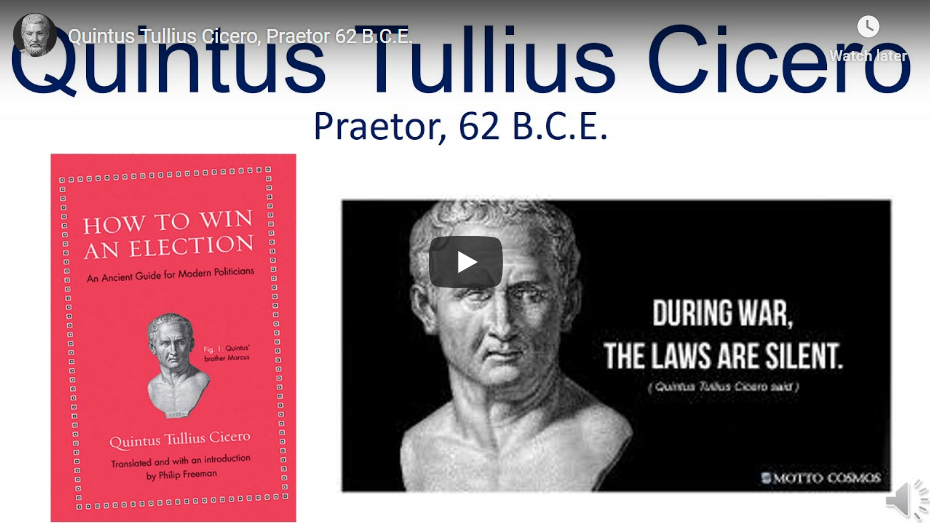
Quintus Tullius Cicero, Praetor 62 B.C.E.
Thersites the Historian
Published 25 Jul 2018Quintus Tullius Cicero is best known as the younger brother of Marcus Tullius Cicero who wrote a pamphlet on running for the Consulship, but he was also one of Caesar’s legates in Gaul and a braver than average Roman.
Patreon link: https://www.patreon.com/thersites
PayPal link: paypal.me/thersites
Twitter link: https://twitter.com/ThersitesAthens
Minds.com link: https://www.minds.com/ThersitestheHis…
Steemit/dtube link: https://steemit.com/@thersites/feed
Backup Channel: https://www.youtube.com/channel/UCUrD…
February 15, 2020
Lupercalia
Historia Civilis
Published 4 Sep 2014Patreon: https://www.patreon.com/HistoriaCivilis
Website: https://www.historiacivilis.com
Twitter: https://twitter.com/HistoriaCivilis
Plus a bonus video with a Julius Caesar connection:
February 1, 2020
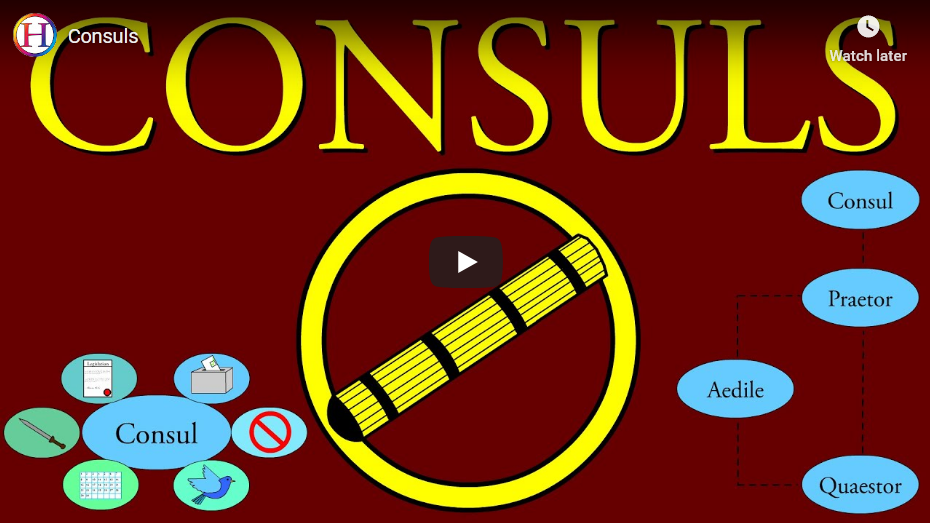
Cursus honorum – Consuls
Historia Civilis
Published 18 May 2015Patreon: https://www.patreon.com/HistoriaCivilis
Website: https://www.historiacivilis.com
Twitter: https://twitter.com/HistoriaCivilisMusic is “The Life and Death of a Certain K. Zabriskie, Patriarch” by Chris Zabriskie. (http://chriszabriskie.com/)
January 29, 2020
The Roman Triumph
Historia Civilis
Published 5 Dec 2018Patreon | http://patreon.com/HistoriaCivilis
Donate | http://www.paypal.com/cgi-bin/webscr?…
Merch | http://teespring.com/stores/historiac…
Twitter | http://twitter.com/HistoriaCivilis
Website | http://historiacivilis.comSources:
The Jewish War, by Josephus: https://amzn.to/2Ub8JRq
Parallel Lives: The Life of Pompey, by Plutarch: https://amzn.to/2BP6vjq
Parallel Lives: The Life of Julius Caesar, by Plutarch: https://amzn.to/2BP6vjq
Letters to Atticus, Book 13, by Cicero: https://amzn.to/2Qa9SKv
The History of Rome, Book 1, by Livy: https://amzn.to/2PbCkX7
Natural History, Book 3, by Pliny the Elder: https://amzn.to/2PhX3Za
Roman History, Book 43, by Cassius Dio: https://amzn.to/2PgJ99C
Roman History, Book 44, by Cassius Dio: https://amzn.to/2PgJ99C
Roman History, Book 53, by Cassius Dio: https://amzn.to/2Pgdq8Q
Roman History, Book 54, by Cassius Dio: https://amzn.to/2Pgdq8Q
Roman History, Book 55, by Cassius Dio: https://amzn.to/2Pgdq8Q
The Life of Julius Caesar, by Suetonius: https://amzn.to/2QuwULE
The Fasti Triumphales http://www.attalus.org/translate/fast…
The Roman Triumph, by Mary Beard: https://amzn.to/2UafiDD
Rubicon, by Tom Holland: https://amzn.to/2E0x5HX
Cicero, by Anthony Everitt: https://amzn.to/2PgJJnO
Julius Caesar, by Philip Freeman: https://amzn.to/2DXortC
Caesar: Life of a Colossus, by Adrian Goldsworthy: https://amzn.to/2Q9rtlO
The Rise of Rome, by Anthony Everitt: https://amzn.to/2PeSEGw
“Circum Metas Fertur: An Alternative Reading of the Triumphal Route,” by Ida Östenberg. From Historia: Zeitschrift für Alte Geschichte, vol. 59, no. 3: https://bit.ly/2SpsjHJMusic:
“Honey,” by Nctrnm
“XY,” by Nctrnm
“The House Glows (With Almost No Help),” by Chris Zabriskie
“Hallon,” by Christian BjoerklundWe are a participant in the Amazon Services LLC Associates Program, an affiliate advertising program designed to provide a means for us to earn fees by linking to Amazon.com and affiliated sites.

January 25, 2020
Cursus honorum – Praetors
Historia Civilis
Published 19 Feb 2015Patreon: https://www.patreon.com/HistoriaCivilis
Website: https://www.historiacivilis.com
Twitter: https://twitter.com/HistoriaCivilisMusic is “Sea” by Jahzzar (http://betterwithmusic.com)
January 19, 2020
Cursus honorum – Aediles
Historia Civilis
Published 6 Feb 2015Patreon: https://www.patreon.com/HistoriaCivilis
Website: https://www.historiacivilis.com
Twitter: https://twitter.com/HistoriaCivilisMusic is “Clap Your Hands” by Jahzzar (http://betterwithmusic.com)
January 14, 2020
Cursus honorum – Quaestors
Historia Civilis
Published 20 Dec 2014Patreon: https://www.patreon.com/HistoriaCivilis
Website: https://www.historiacivilis.com
Twitter: https://twitter.com/HistoriaCivilisMusic by audionautix.com

January 3, 2020
The Battle of Alesia (52 B.C.E.)
Historia Civilis
Published 24 Apr 2015Patreon | http://patreon.com/HistoriaCivilis
Donate | http://www.paypal.com/cgi-bin/webscr?…
Merch | http://teespring.com/stores/historiac…
Twitter | http://twitter.com/HistoriaCivilis
Website | http://historiacivilis.comMusic is “The Life and Death of a Certain K. Zabriskie, Patriarch” by Chris Zabriskie. (http://chriszabriskie.com/)