The first date in English History is 55 B.C., in which year Julius Caesar (the memorable Roman Emperor) landed, like all other successful invaders of these islands, at Thanet. This was in the Olden Days, when the Romans were top nation on account of their classical education, etc.
Julius Caesar advanced very energetically, throwing his cavalry several thousands of paces over the River Flumen; but the Ancient Britons, though all well over military age, painted themselves true blue, or woad, and fought as heroically under their dashing queen, Woadicea, as they did later in thin red lines under their good queen, Victoria.
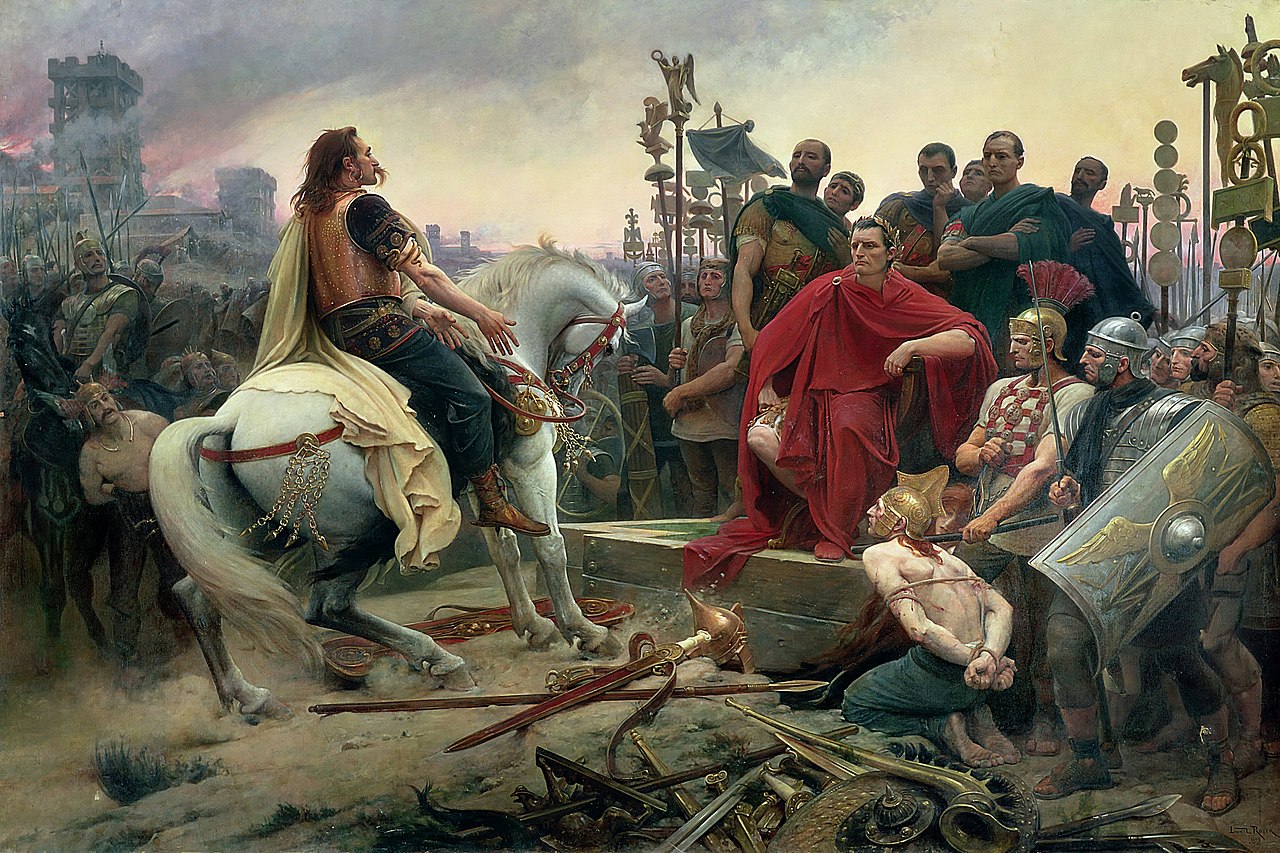
Julius Caesar was therefore compelled to invade Britain again the following year (54 B.C., not 56, owing to the peculiar Roman method of counting), and having defeated the Ancient Britons by unfair means, such as battering-rams, tortoises, hippocausts, centipedes, axes, and bundles, set the memorable Latin sentence, “Veni, Vidi, Vici“, which the Romans, who were all very well educated, construed correctly.
The Britons, however, who of course still used the old pronunciation, understanding him to have called them “Weeny, Weedy, and Weaky”, lost heart and gave up the struggle, thinking that he had already divided them All into Three Parts.
W.C. Sellar & R.J. Yeatman, 1066 And All That, 1930.
November 13, 2018
QotD: Julius Caesar’s invasion of Britain
April 21, 2018
History Buffs: Rome Season One
History Buffs
Published on 18 Aug 2017Rome is a British-American-Italian historical drama television series created by John Milius, William J. MacDonald, and Bruno Heller. The show’s two seasons were broadcast on HBO, BBC Two, and RaiDue between 2005 and 2007. They were later released on DVD and Blu-ray. Rome is set in the 1st century BC, during Ancient Rome’s transition from Republic to Empire.
The series features a sprawling cast of characters, many of whom are based on real figures from historical records, but the lead protagonists are ultimately two soldiers named Lucius Vorenus and Titus Pullo, who find their lives intertwined with key historical events. Rome was a ratings success for HBO and the BBC. The series received much media attention from the start, and was honored with numerous awards and nominations in its two-series run. The series was filmed in various locations, but most notably in the Cinecittà studios in Italy.
January 6, 2018
Caesar in Gaul: REVOLT! (54 to 53 B.C.E.)
Historia Civilis
Published on 21 Jun 2017
December 2, 2017
Breaking news from 55 BC
Despite the written records left by Julius Caesar, Cicero, and Tacitus, until now there had apparently been no physical evidence of Caesar’s invasion of Britain:
… a chance excavation carried out ahead of a road building project in Kent has uncovered what is thought to be the first solid proof for the invasion.
Archaeologists from the University of Leicester and Kent County Council have found a defensive ditch and javelin spear at Ebbsfleet, a hamlet on the Isle of Thanet.
The shape of the ditch at Ebbsfleet, is similar to Roman defences at Alésia in France, where a decisive battle in the Gallic War took place in 52 BC.
Experts also discovered that nearby Pegwell Bay is one of the only bays in the vicinity which could have provided harbour for such a huge fleet of ships. And its topography echoes Caesar’s own observations of the landing site.
Dr Andrew Fitzpatrick, Research Associate from the University of Leicester’s School of Archaeology and Ancient History said: “Caesar describes how the ships were left at anchor at an even and open shore and how they were damaged by a great storm. This description is consistent with Pegwell Bay, which today is the largest bay on the east Kent coast and is open and flat.
“The bay is big enough for the whole Roman army to have landed in the single day that Caesar describes. The 800 ships, even if they landed in waves, would still have needed a landing front 1-2 km wide.
“Caesar also describes how the Britons had assembled to oppose the landing but, taken aback by the size of the fleet, they concealed themselves on the higher ground. This is consistent with the higher ground of the Isle of Thanet around Ramsgate.”
Thanet has never been considered as a possible landing site before because it was separated from the mainland until the Middle Ages by the Wanstum Channel. Most historians had speculated that the landing happened at Deal, which lies to the south of Pegwell Bay.
June 11, 2017
His Year(s) – Pompey (56 to 52 B.C.E.)
Published on 4 Apr 2017
April 16, 2017
Damnatio memoriae
The Latin in the title is a modern construction, but it describes a fairly common way that Romans would (to borrow from Orwell) push memories down the memory hole, including even former Emperors:
In the Soviet Union, Josef Stalin didn’t just defeat his political enemies – he purged their memories from existence. Photographs were altered and history texts changed to eliminate any trace of those who stood against him, a practice that inspired George Orwell to write 1984. But Stalin was far from the first leader to erase his enemies. The ancient Romans, too, tried to erase people from history – even Emperors.
A new show on now at the British Museum explores the use of memory sanctions against Roman emperors and their families in antiquity. It also evaluates the physical treatment of objects deemed “pagan” or heretical in the Christianized empire of Late Antiquity.
But what was the point of “damnatio memoriae“? And can you ever fully expunge someone from the historical record?
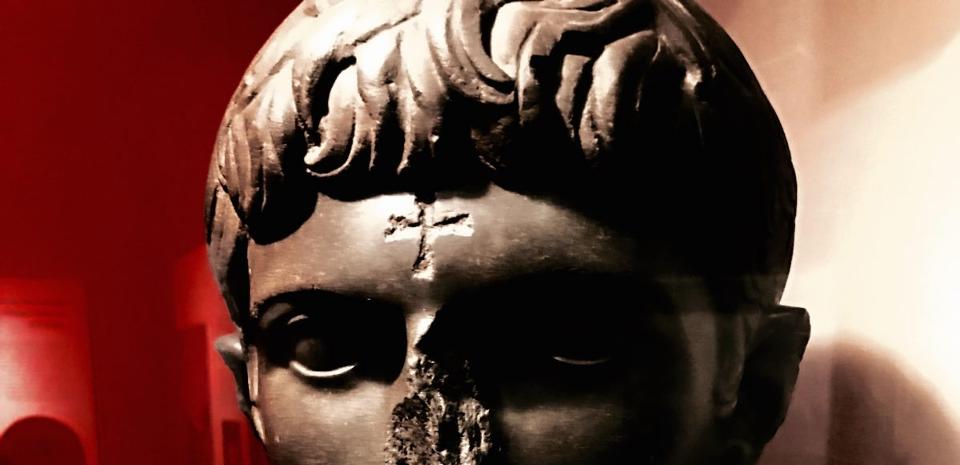
A Basanite bust of Germanicus that has a series of cuts around his ear, a shorn nose, his right ear chipped away and a cross etched on his forehead. The bust is on display now at the British Museum. (Photo by Sarah E. Bond)
The British Museum is currently displaying an exhibit on ancient memory sanctions called: “Defacing the Past: Damnation and desecration in imperial Rome.” It is a fascinating look into the ways in which we interact with objects as a proxy for the actual person. It is also a look into what ancient historian Harriet Flower has called the “art of forgetting.” Although such sanctions are often called “damnatio memoriae,” this is a modern Latin phrase and thus a construct that did not in fact exist in antiquity. Use of the term suggests a monolithic way in which Romans could legally damn the memory of a disgraced or unpopular Roman emperor, when in fact there was no one term for such sanctions or even a fully systematized procedure for it. What we have today is instead the material remnants of various senatorial, imperial, and ecclesiastical decrees — as well as a number of personal choices.
Sanctions against the commemoration of a person could take many forms in ancient Rome and can be traced back to the Republican period. The dictator Sulla had the statues of his rival, Marius, pulled down. He also banned the display of wax imagines carried in funeral processions. We are told by Plutarch (Caes. 5) that the nephew of Marius, Julius Caesar, displayed these wax casts of Marius’ face for the first time in the funeral for his aunt Julia in 69 BCE. Julia had been Marius’ wife and was Caesar’s aunt. The disgraced general and his consorts were earlier declared hostes (enemies) of the Roman state, but their memory was clearly not forgotten. The absence of the imagines under Sulla had in fact always been conspicuous, rather than a tactic that led to the erasure of their deeds or memory.
October 2, 2015
Marcus Porcius Cato – the man who almost stopped Julius Caesar
In The Freeman, Lawrence W. Reed talks about one of the last few Republicans in the Rome of Julius Caesar’s ascendance:
In the estimations of many historians, two men hold the honor as the most notable defenders of the Roman Republic. Marcus Tullius Cicero was one. Marcus Porcius Cato, or “Cato the Younger,” was the other.
Since there was a “younger,” there must have been an “elder,” too. Cato the Elder was the great grandfather of the younger. Both men, separated by more than a century, were influential in public office. Think of the elder as the social conservative, concerned in his day with preserving the customs and traditions of Rome. The younger was one of history’s early libertarians, interested more in personal and political liberties because he believed that if they were lost, nothing else mattered. It is this second one to whom I refer in the balance of this essay as simply “Cato.”
By the time of Cato’s birth in 95 BC, the Roman Republic was long in the tooth. Founded four centuries earlier, it had risen from obscurity to political and economic dominance in the Mediterranean. Rome was easily the world’s wealthiest and most powerful society. It wasn’t a libertarian paradise — slavery was a part of its makeup, as it was even more brutal everywhere else — but Rome had taken liberty to a zenith the world had never seen before and wouldn’t see again for a long time after it finally fell. The constitution of the republic embodied term limits; separation of powers; checks and balances; due process; habeas corpus; the rule of law; individual rights; and elected, representative legislative bodies, including the famous Senate. All of this was hanging by a thread in the first century BC.
Cato was just five years of age when Rome went to war with its former allies in the Italian peninsula — the so-called “Social War.” Though the conflict lasted just two years, its deleterious effects were huge. The decades to follow would be marked by the rise of factions and conflict and local armies loyal to their commanders instead of the larger society. A “welfare-warfare” state was putting down deep roots as Cato grew up. The limited government, personal responsibility and extensive civil society so critical to the republic’s previous success were in an agonizing, century-long process of collapse. Even many of those who recognized the decay around them nonetheless drank the Kool-Aid, succumbing to the temptations of power or subsidies or both.
Before the age of 30, Cato had become a supremely disciplined individual, a devotee of Stoicism in every respect. He commanded a legion in Macedon and won immense loyalty and respect from the soldiers for the example he set, living and laboring no differently from day to day than he required of his men. He first won election to public office (to the post of quaestor, supervising financial and budgetary matters for the state) in 65 BC and quickly earned a reputation as scrupulously meticulous and uncompromisingly honest. He went out of his way to hold previous quaestors accountable for their dishonesty and misappropriation of funds, which he himself uncovered.
Later he served in the Roman Senate, where he never missed a session and criticized other senators who did. Through his superb oratory in public and deft maneuverings in private, he worked tirelessly to restore fealty to the ideals of the fading Republic.
August 28, 2012
What can Caesar’s Gallic War commentary tell us about Afghanistan?
According to this reading, lots and lots:
I finished Caesar’s Commentaries on the Gallic War this weekend […] and a few things struck me:
a. The successful Roman counterinsurgency campaign in Gaul took eight years.
b. The enemies against which Rome fought were not a unitary actor, and neither were Rome’s allies.
c. Rome’s allies one summer were often Rome’s enemies by winter. And visa versa.
But the two things that made the biggest impression on me were the following:
d. Caesar was the commander for eight full years, and he enjoyed similar continuity among his subordinate commanders.
e. Caesar very rarely sent green units into the offensive. By the fourth and fifth year of the campaign, he is still making those legions which were the last to be raised in Italy responsible for guarding the freaking baggage. He relies over and over again on those legions — most especially the Tenth — that have proven themselves in combat in Gaul.
With Caesar’s commentaries in mind, I read Doug Ollivant’s lament about Gen. Joe Dunford. Gen. Dunford will be the fifteenth commander of NATO-ISAF in eleven years of combat in Afghanistan and the ninth U.S. commander in Afghanistan. Each of his subordinate commanders have rotated on an annual basis. Gen. Dunford — who is, by all accounts, an excellent officer and highly respected by his peers — has never served in Afghanistan.
The cultures, politics, tribes and peoples of Afghanistan are at least as complex as those of ancient Gaul, yet we Americans are so arrogant to think that we can send officers there with no experience and, owing to our superior knowledge of combat operations, watch them succeed. We will then send units which have never deployed to Afghanistan to partner with Afghan forces and wonder why they do not get along.
H/T to Tim Harford for the link.