
I have heard some reactionaries say that although there are not intellectual differences between men and women, there are emotional differences, and that women are (either for biological or cultural reasons) more “submissive” to men’s “dominant” – and a quick search of the BDSM community seems to both to validate the general rule and to showcase some very striking exceptions.
But my money would be on a simpler hypothesis. Every marriage involves conflict. The traditional concept of gender contains two roles that are divided in a time-tested way to minimize conflict as much as possible. In a perfect-spherical-cow sense, either the husband or the wife could step into either role, and it would still work just as well. But since men have been socialized for one role since childhood, and women socialized for the other role, it seems that in most cases the easiest solution is to stick them in the one they’ve been trained for.
We could also go with a third hypothesis: that women aren’t actually bizarre aliens from the planet Zygra’ax with completely inexplicable preferences. I mean, suppose you had the following two options:
1. A job working from home, where you are your own boss. The job description is “spending as much or as little time as you want with your own children and helping them grow and adjust to the adult world.” (but Sister Y also has a post on the childless alternative to this)
2. A job in the office, where you do have a boss, and she wants you to get her the Atkins report “by yesterday” or she is going to throw your sorry ass out on the street where it belongs, and there better not be any complaints about it this time.
Assume both jobs would give you exactly the same amount of social status and respect.
Now assume that suddenly a bunch of people come along saying that actually, only losers pick Job 1 and surely you’re not a loser, are you? And you have to watch all your former Job 1 buddies go out and take Job 2 and be praised for this and your husband asks why you aren’t going into Job 2 and contributing something to the family finances for once, and eventually you just give in and go to Job 2, but also you’ve got to do large portions of Job 1, and also the extra income mysteriously fails to give your family any more money and in fact you are worse off financially than before.
Is it so hard to imagine that a lot of women would be less happy under this new scenario?
Now of course (most) feminists very reasonably say that it’s Totally Okay If You Want To Stay Home And We’re Not Trying To Force Anyone. But let’s use the feminists’ own criteria on that one. Suppose Disney put out a series of movies in which they had lots of great female role models who only worked in the home and were subservient to their husbands all the time, and lauded them as real women who were courageous and awesome and sexy and not just poor oppressed stick-in-the-muds, and then at the end they flashed a brief message “But Of Course Working Outside The Home Is Totally Okay Also”. Do you think feminists would respond “Yeah, we have no problem with this, after all they did flash that message at the end”?
Scott Alexander, “Reactionary Philosophy In An Enormous, Planet-Sized Nutshell”, Slate Star Codex, 2013-03-03.
October 13, 2015
QotD: Reactionary views on marriage
September 24, 2015
A case study – Nik-Mart in Subsistia
Don Boudreaux looks at the different effects of international aid and capitalist exploitation in a desperately poor, far-away country:
The far-away land of Subsistia is inhabited by people who are desperately poor, not only relative to the typical person elsewhere on the globe but also in absolute terms. For decades well-meaning, well-educated, and well-funded people from the United States and other wealthy countries have visited Subsistia to help raise Subsistians out of poverty.
Alas, while these efforts by governments, NGOs, and churches have been many and munificent, all ordinary Subsistians continue to live in deep poverty – that is, until recently. A few short years ago a large U.S. corporation, Nik-Mart, set up factories in Subsistia. The wages that Nik-Mart pays to its Subsistian workers, while much higher than the average wage in Subsistia, are only a tiny fraction of the wages that Nik-Mart pays to its production-line employees in America.
Nik-Mart sells the goods produced in its Subsistian factories all around the world. One result of Nik-Mart’s operations in Subsistia is that the real prices that poor Americans and Europeans pay for shoes, clothing, and home furnishings have fallen significantly.
Nik-Mart is consistently one of the world’s most profitable corporations. It is also one of the world’s most hated.
When word recently leaked out of Nik-Mart’s record sales revenues and of the healthy rate of return on Nik-Mart’s assets, protests erupted in all major capitals of the developed world. Washington, Ottawa, Santiago, London, Amsterdam, Stockholm, Paris, Berlin, Madrid, Rome, Prague, Moscow, Tokyo, Pretoria, Canberra – these and other cities were swarmed by protestors demanding “social justice” and criticizing Nik-Mart for exploiting workers. “Nik-Mart’s profits are in the billions,” screamed U.S. Sen. Elsbeth Walter, who gave a rousing speech to protestors on the Washington Mall, “and yet it exploits poor workers in Subsistia while it off-shores jobs from America, hurting poor Americans! Have you no shame, Nik-Mart? Have! You! No! Shame?!!” Sen. Walter rhetorically asked, her index finger pointing accusingly at an imaginary Nik-Mart executive presumably hovering, phantasmically yet bloatedly, before her.
The Sunday talking-head shows were filled with heads talking of little else. “It’s really unconscionable,” said Harmon Nicholson, a famous progressive columnist, “that Nik-Mart takes advantage of the freedom that this country gives it to produce the things it sells in America outside of America. It’s no wonder our jobs picture is so weak and that American wages have stagnated.”
Sen. Lawrence Greenham, a Republican from the south, chimed in: “I don’t normally agree with Harmon, but he’s right on this. American plutocrats are gettin’ richer an’ richer off the backs of America’s poor. It’s gotta stop.”
September 18, 2015
What is killing small US businesses? Compliance costs and regulatory overstretch
Okay, perhaps the headline is a bit strong, but Warren Meyer explains why even “small” businesses need to be bigger than ever in order to be able to file all the appropriate government forms, rather than concentrating on serving their customers and growing their client base:
Over the last four years or so we have spent all of this capacity on complying with government rules. No capacity has been left over to do other new things. Here are just a few of the things we have been spending time on:
- Because no insurance company has been willing to write coverage for our employees (older people working seasonally) we were forced to try to shift scores of employees from full-time to part-time work to avoid Obamacare penalties that would have been larger than our annual profits. This took a lot of new processes and retraining and new hiring to make work. And we are still not done, because we have to get down another 30 or so full-time workers for next year.
- The local minimum wage movement has forced us to rethink our whole labor system to deal with rising minimum wages. Also, since we must go through a time-consuming process to get the government agencies we work with to approve pricing and fee changes, we have had to spend an inordinate amount of time justifying price increases to cover these mandated increases in our labor costs. This will just accelerate in the future, as the President’s contractor minimum wage order is, in some places, forcing us to raise camping prices by an astounding 20%.
- Several states have mandated we use e-Verify on all new employees, which is an incredibly time-consuming addition to our hiring process.
- In fact, the proliferation of employee hiring documentation requirements has forced us through two separate iterations of a hiring document tracking and management system.
- The California legislature can be thought of as an incredibly efficient machine for creating huge masses of compliance work. We have to have a whole system to make sure our employees don’t work over their meal breaks. We have to have detailed processes in place for hot days. We have to have exactly the right kinds of chairs for our employees. We have to put together complicated shifts to meet California’s much tougher overtime rules. Just this past year, we had to put in a system for keeping track of paid sick days earned by employees. We have two employee manuals: one for most of the country and one just for California and all its requirements (it has something like 27 flavors of mandatory leave employers must grant). The list goes on and on. So much so that in addition to all the compliance work, we also spent a lot of work shutting down every operation of ours in California, narrowing down to just 3 contracts today. There has been one time savings though — we never look at any new business opportunities in CA because we have no desire to add exposure to that state.
Does any of this add value? Well, I suppose if you are one who considers it more important that companies make absolutely sure they offer time off to stalking victims in California than focus on productivity, you are going to be very happy with what we have been working on. Otherwise….
September 16, 2015
QotD: A booming economy gives more power to individual workers
A few days ago there was a big debate about a New York Times expose on working conditions at Amazon.com. (BTW, it would have been useful for the NYT to compare labor practices at the Seattle company to working conditions at firms operating in the Amazon region of Brazil.)
Many liberals were appalled, while conservatives often wondered why, if working conditions were so bad at Amazon, people didn’t simply “get another job.” I have sympathy for both sides, but probably a bit more for the conservative side.
One liberal objection might be that it’s not easy to get another job. And perhaps that’s because monetary policy since 2008 has been too contractionary. And perhaps that’s because conservatives have complained about the Fed’s QE/low interest rate policies, which has made the Fed reluctant to do more.
Regardless of how you feel about monetary policy, it’s clear that if employers feel they have a “captive audience” of workers, who are terrified of losing their jobs, it would be easier for the employer to crack the whip and drive the employees to work extremely hard. One advantage of a healthy job market is that workers have more power to negotiate pleasant working conditions.
Scott Sumner, “How bad government policies make us meaner”, Library of Economics and Liberty, 2015-08-25.
September 9, 2015
When part of your job offends your religious beliefs, you have two choices…
… and those choices are either get a different job or accept that your religious objection does not free you from having to perform all of the normal duties of the job. Some people, however, have the fixed notion that their religious beliefs must be respected and deferred to by everyone:
I’ve said it before but religious people really seem to believe that their religion ought to grant them special, legal privileges which are not provided to the rest of us. For some reason, certain people are so entitled that they believe their spiritual beliefs can be used to justify their own idiotic behavior, and if you dare to criticize them for their idiotic, unfair, or immature decisions that is evidence that you are simply an anti-religious bigot. What’s especially bizarre is that no other ideology is treated in the same way. If I were an investment banker and started refusing to do my job on the grounds that I was a socialist or if I were a cop and started refusing to make drug arrests on the grounds that I was a libertarian, no one would ever even attempt to argue that this was justifiable behavior. However, if I refuse to do my job because I’ve decided certain aspects of that job are against my religion, suddenly millions of people will view me as a martyr and I can expect pro bono legal counsel as members of my religious sect rush dutifully to my aid.
This situation is getting frankly ridiculous. The most famous recent example, obviously, is Kim Davis — a woman who was elected to a position that required her to issue marriage licenses and began refusing to do her job after the Supreme Court legalized gay marriage. If she didn’t want to do her job, there was one relatively simple option which was available to her since the very beginning and is still available to her should she choose to exercise that option — she could just quit. That would, in fact, be the adult thing to do if she feels that her religious beliefs do not allow her to meet her current job requirements, but instead she has decided to turn herself into some sort of ridiculous martyr to the religious right … and of course her $80,000 a year government salary, courtesy of the tax payers of Rowan County, Kentucky, probably had something to do with this decision. She deeply and truly loves her God, you see, but doesn’t love him quite enough to forego that sweet-ass government pension plan on his behalf.
Everyone knows the Kim Davis story, but what many people do not know is that at this very instant there is a virtually identical story involving a Muslim employee’s dispute with a Midwestern regional airline called ExpressJet. The woman’s name is Charee Stanley. Three years ago she became a stewardess for ExpressJet and then two years ago, presumably after sustaining some sort of catastrophic brain injury, she decided to convert to Islam. After her conversion, she found that her new faith frowned upon the serving of alcoholic beverages, so she began refusing to serve alcohol to passengers. More recently, she was suspended from her position pending a review because other flight attendants complained that they were being required to do her work in addition to their own. I personally don’t feel this is a particularly unreasonable complaint, and if it had been up to me, Ms. Stanley wouldn’t have simply been suspended, she would have been fired immediately for failure to meet her job requirements.
And just to prove you don’t need to actually be religious to hold this kind of belief, there’s also mention of Canada’s own Christian atheist, Reverend Gretta Vosper of West Hill United Church.
September 7, 2015
Arguments Against International Trade
Published on 25 Feb 2015
In this video, we discuss some of the most common arguments against international trade. Does trade harm workers by reducing the number of jobs in the U.S.? Is it wrong to trade with countries that use child labor? Is it important to keep a certain number of jobs at home for national security reasons? Can strategic protectionism increase well-being in the U.S.? Join us as we discuss these common concerns.
September 5, 2015
Raising the minimum wage also means raising prices for many retailers
Louis DeBroux on the plight of some marginal businesses in California who are seeing lower support from their customers as they raise prices to ensure they can keep paying their current employees at the new mandated minimum wage:
Earlier this year, labor unions in Los Angeles whipped up low-wage workers into a frenzy with demands for a minimum “living” wage of $15 per hour. They achieved their goal and the $15/hour wage bill was signed into law. This was supposed to be a huge victory for the workers (though, it should be noted, within days of the law going into effect, the same labor unions that lobbied for the $15/hour minimum wage were lobbying government for an exemption for union companies, so that union companies could pay well below the new minimum wage).
Even so, some California business owners decided to show solidarity with the cause of low-wage workers, significantly increasing their starting wage of their own volition.
Vic Gumper, owner of Lanesplitter Pizza (with stores in Albany, Berkeley, Oakland, and Emeryville, California), voluntarily raised wages for his employees to between $15 to $25 per hour. In order to cover the cost of the higher “living” wage, Gumper began advertising $30 “living wage pizzas” to his customers, which include patrons from the Pixar Animation Studios and biotech companies located near his shops. In doing so he declared these pizzas “sustainably served, really … no tips necessary”.
The result? Sales have dropped by 25% as liberals in these communities have balked at having to pony up more money for the pizzas. The hit has been so significant that Gumper has had to close during lunch hour at several locations (think about that…a restaurant that has to close during LUNCH because it can’t afford to stay open!).
Gumper says that “The necessity of paying a living wage in the Bay Area [which has one of the highest costs of living in the nation] is clear, so it’s hard to argue against it, and it’s something I’m really proud to be able to try doing…At the same time, I’m terrified of going out of business after 18 years.”
There really isn’t a free lunch … if you use the power of government to raise the costs of doing business, either the local businesses pass on that increased cost by way of the prices they charge to their customers or they economize by reducing their labour costs (and the number of employees they support). A more drastic solution is going out of business or moving out of the jurisdiction: neither of which is typically considered during the legislative process.
August 19, 2015
Canada looks very good on an international ranking you won’t hear about from our media
Our traditional media are quick to pump up the volume for “studies” that find that we rank highly on various rankings of cities or what-have-you, but here’s someone pointing out that Canada’s ranking is quite good, but it’s not the kind of measurement our media want to encourage or publicize:
First, we must identify a nation’s currently employed population. Next, all public sector employees are removed to obtain an adjusted productive workforce. It may be objectionable that certain professions, like teaching, nurses in single payer systems and fire fighters, are classified as an unproductive workforce, but as our system is currently designed, the salaries of these individuals are not covered by the immediate beneficiaries like any other business but are paid through dispersed taxation methods.
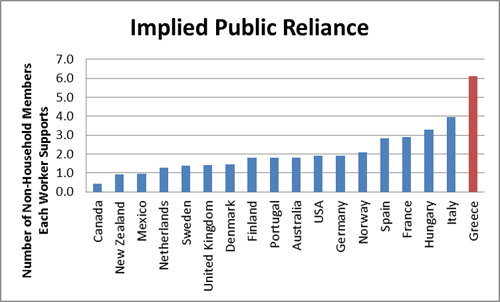
Finally, this productive population is divided into the nation’s total population to identify the total number of individuals a worker is expected to support in his country. To remove bias toward non-working spouses and children, the average household size is subtracted from this result to get the final number of individuals that an individual must support that are not part of their own voluntary household. In other words, how many total strangers is this individual providing for?
The Implied Public Reliance metric does a far better job of predicting economic performance:
Greece, the nation with the debt problem, is currently expecting each employed person to support 6.1 other people above and beyond their own families. This explains much of the pressure to work long hours and also explains the unstable debt loads. Since a single Greek worker can’t possibly hope to support what amounts to a complete baseball team on a single salary, the difference is covered by Greek public debt, debt that the underlying social system cannot hope to repay as the incentives are to maintain the current system of subsidies. To demonstrate how difficult it is to change these systems within a democratic society, we just have to look at the percentage of the population that is reliant on public subsidy.

Oh, and by the way … Greece is doomed:
The numbers imply that 67 percent of the population of Greece is wholly reliant on the Greek government to provide their incomes. With such a commanding supermajority, changing this system with the democratic process is impossible as the 67 percent have strong incentives to continue to vote for the other 33 percent — and also foreign entities — to cover their living expenses.
August 11, 2015
The range and striking power of the Card and Krueger study
At Coyote Blog, Warren Meyer explains how one particular economic study wields far more influence in the fast food/minimum wage debate than any other similar study:
Pick a progressive on the street, and in the unlikely event they can name any economic study, that study will probably be Card and Krueger’s study of the effect of a minimum wage increase in New Jersey. Sixty bazillion studies have confirmed what most of us know in our bones to be true, that raising the price of labor decreases demand for that labor. Card and Krueger said it did not — and that a minimum wage increase may have even increased demand for labor — which pretty much has made it the economic bible of the Progressive Left.
What intrigues me is that Card and Krueger specifically looked at the effect of the minimum wage on large chain fast food stores. In this study (I will explain the likely reason in a moment) they found that when the minimum wage increased for all businesses in New Jersey, the employment at large chain fast food restaurants went up.
So I wonder if the Progressives making this ruling in New York thought to themselves — “we want to raise the minimum wage. Well, the one place where we KNOW it will have no negative effect from Card and Krueger is on large fast food chains, so…”
By the way, there are a lot of critiques of Card & Krueger’s study. The most powerful in my mind is that when a minimum wage is raised, often the largest volume and highest productivity companies in any given business will absorb it the best. One explanation of the Card & Krueger result is that the minimum wage slammed employment in small ma and pa restaurants, driving business to the larger volume restaurants and chains. As a whole, in this theory, the industry saw a net loss in employment and a shift in employment from smaller to larger firms. By measuring only the effect on larger firms, Card and Krueger completely missed what was going on.
July 30, 2015
QotD: Not your mother’s feminist movement
Feminism won, they succeeded, they got what they were after. They destroyed the glass ceiling, they smashed sexism in the culture, they’ve wiped out all kinds of barriers. A strong feminist would say there’s plenty of work to do but if they are honest, they’ll admit there really isn’t much left.
Compared to 1966 when NOW was founded, today is amazingly triumphant for the cause.
And when you succeed, people strangely feel no need to keep supporting the cause. Once the airplane was designed and functional, people stopped trying to make airplanes. Once Jackie Robinson broke the color barrier in Major League Baseball[, …] there wasn’t any need to keep pushing to get blacks in baseball.
The truth is, feminists got what they were after. Even in bad economic times, women are doing well. Women lost far fewer jobs and lost less earning power during the recession than men. Women are accepted in pretty much every position and job they try for. There are women on submarines these days in the Navy.
Feminism, at least as defined by the NOW crowd, is pretty much rejected by young women today. They don’t want any part of the “never shave, men are rapists, we are oppressed” outlook of the modern feminist. They liked the “stop treating me like an idiot child and let me have that job” sort of feminist, but that’s not what NOW offers.
Like most activist groups, NOW and other feminist organizations are casualties of their own success. They did what they set out to do. They succeeded. They won. And having won, now they have no purpose and are losing influence, power, and money.
But they also suffer what most organizations — especially activist ones — face. Each successive generation of leadership tends to get more radical rather than less. Unless the organization consciously and continuously strives to remain neutral or conservative, it becomes increasingly leftist over time. This is an artifact of the very nature of activists. People who are so driven and passionate about any one cause tend to be more emotionally driven and more radical by nature. Over time that increases each step and eventually you end up with loons in charge.
The Sierra Club was founded to enjoy and protect beautiful areas, they were naturalists. These days they’re radical environmentalists. Most large religious denominations face this as well, as more conservative and doctrinally-concerned leadership gives way to more “modern” and culturally-driven leadership and they lose their way.
So the organizations of feminism are facing success not with joy and triumph, but with greater wails of despair as they see (or invent) greater areas of horror and crisis. And as they grow ever more radical, they get ever less influential and meaningful in the culture.
Most women today would call themselves feminist but they usually will qualify that with “but not like those feminists.” The only ones who cling to the “those feminist” sort are college sorts and the kind of radical men-haters that folks like Rush Limbaugh like to ridicule.
Christopher Taylor, “WOMYNISTS”, Word Around the Net, 2014-06-04.
July 26, 2015
The problems when you try to resolve complicated discrimination problems with laws
Warren Meyer explains why he — who organized and lead an effort to legalize gay marriage in Arizona — is not reflexively in favour of using the blunt force of the law to “solve” problems of discrimination:
There are multiple problems with non-discrimination law as currently implemented and enforced in the US. Larger companies, for example, struggle with disparate impact lawsuits from the EEOC, where statistical metrics that may have nothing to do with past discrimination are never-the-less used to justify discrimination penalties.
Smaller companies like mine tend to have a different problem. It is an unfortunate fact of life that the employees who do the worst job and/or break the rules the most frequently tend to be the same ones with the least self-awareness. As a result, no one wants to believe their termination is “fair”, no matter how well documented or justified (I wrote yesterday that I have personally struggled with the same thing in my past employment).
Most folks grumble and walk away. But what if one is in a “protected group” under discrimination law? Now, not only is this person personally convinced that their firing was unfair, but there is a whole body of law geared to the assumption that their group may be treated unfairly. There are also many lawyers and activists who will tell them that they were almost certainly treated unfairly.
So a fair percentage of people in protected groups whom we fire for cause will file complaints with the government or outright sue us for discrimination. I will begin by saying that we have never lost a single one of these cases. In one or two we paid someone a nominal amount just to save legal costs of pursuing the case to the bitter end, but none of these cases were even close.
[…]
To make all this worse, many employees have discovered a legal dodge to enhance their post-employment lawsuits (I know that several advocacy groups in California recommend this tactic). If the employee suspects he or she is about to be fired, they will, before getting fired, claim all sorts of past discrimination. Now, when terminated, they can claim they where a whistle blower that that their termination was not for cause but really was retaliation against them for being a whistle-blower.
I remember one employee in California taking just this tactic, claiming discrimination just ahead of his termination, though he never presented any evidence beyond the vague claim. We wasted weeks with an outside investigator checking into his claims, all while customer complaints about the employee continued to come in. Eventually, we found nothing and fired him. And got sued. The case was so weak it was eventually dropped but it cost us — you guessed it — about $20,000 to defend. Given that this was more than the entire amount this operation had made over five years, it was the straw that broke the camel’s back and led to us walking about from that particular operation and over half of our other California business.
July 20, 2015
Price Floors: The Minimum Wage
Published on 25 Feb 2015
Price floors, when prices are kept artificially high, lead to several consequences that hurt the consumer. In this video, we take a look at the minimum wage as an example of a price floor. Using the supply and demand curve and real world examples, we show how price floors create surpluses (such as a surplus in labor, or unemployment) as well as deadweight loss.
July 18, 2015
“No Irish need apply”
Megan McArdle on the imaginary-then-not-so-imaginary prejudice against Irish workers in the United States:
“No Irish Need Apply.” The signs are legendary in the collective memory of Irish Americans. Our ancestors were warned away from the jobs that were open only to “real Americans,” not to the Papist hordes streaming across the Atlantic, with their drinking and their brawling and their unsavory politicking. It is the epigraphic summation of a long war with America’s WASP elite, one that may now be forgotten by the Anglo Protestants who waged it, but not by the great-great-grandchildren of Erin.
I call it legendary. Historian Richard Jensen actually called it a myth.
Jensen, a professor at the University of Illinois, Chicago, wrote a long article in 2002, in which he argued that these advertisements were rare, and when they were found, applied almost exclusively to women, who disproportionately worked as domestics. Jensen searched the digital archives of a number of newspapers, and found that “ads for men were extremely rare — fewer than two per decade. The complete absence of evidence suggests that probably zero such signs were seen at commercial establishments, shops, factories, stores, hotels, railroads, union halls, hiring halls, personnel offices, labor recruiters etc. anywhere in America, at any time.”
This is a bit of a blow to the pride of Irish Americans, who do love a good martyrdom. Something in me rebelled when I saw this article, but as an empirical matter, there’s no reason it couldn’t be true. I filed it away under “History, maybe not quite as bad as you thought, though still quite bad” and moved on to contemplating the perfidy of Oliver Cromwell.
Then, the other day, another article caught my eye. It seems that Rebecca Fried, a high school student from the Sidwell Friends school in Washington, has done a more thorough search of newspaper archives, made possible by advances in digitizing archives since Professor Jensen did his work. Her results have been published in the Oxford Press Journal of Social History, the same place where the original paper was published. And she found lots of examples of both “No Irish Need Apply” advertisements and newspaper accounts of “No Irish” signs, even though the available archives still cover only a small fraction of the thousands of papers in which such ads and accounts might have appeared.
July 17, 2015
QotD: Feminism’s uneasy attitudes to motherhood
Last week a person named Amy Glass wrote a breathtakingly honest — and breathless — rejection of traditional motherhood:
I hear women talk about how “hard” it is to raise kids and manage a household all the time. I never hear men talk about this. It’s because women secretly like to talk about how hard managing a household is so they don’t have to explain their lack of real accomplishments. Men don’t care to “manage a household.” They aren’t conditioned to think stupid things like that are “important.”
Women will be equal with men when we stop demanding that it be considered equally important to do housework and real work. They are not equal. Doing laundry will never be as important as being a doctor or an engineer or building a business. This word play is holding us back.
First, a few small points.
I hear men talk about how hard it is to manage a household and raise kids all the time. (We may not talk about it in terms Glass can recognize, but as a subscriber to the Happy Wife, Happy Life school of marriage, it’s my experience that husbands who don’t recognize and appreciate how hard it is to run a home soon become ex-husbands or miserable husbands.) Glass also may only be hearing what she wants to hear. Or, she may know only asinine men. Who knows? Frankly I don’t care which one is right because I don’t put a lot of stock in what Glass has to say.
Second, this is truly shabby work:
Doing laundry will never be as important as being a doctor or an engineer or building a business. This word play is holding us back.
Talk about word play! You see the sleight of hand, right? “Doing laundry” is a single, discrete task, a subset of a vast realm of responsibilities that often come with running a household and being a mother. Being a doctor, engineer, or business-builder are total careers or vocations. In other words, it’s a false analogy. Like saying being a chef isn’t as worthwhile as being a truck driver because chefs “cut vegetables.” Every career or calling involves unpleasant or tedious tasks.
Just in case you still don’t get it, another illustration. Raising kids involves taking the barbarian clay of a baby and through the alchemy of love and the application of intellect turning it into an emotionally, spiritually, and physically healthy human being and citizen. Meanwhile, doctors put their fingers in old men’s butts. So, to sum up: “Putting fingers in old men’s butts will never be as important as raising children. The word play is holding us back.”
Third (as a reader flagged for me), Glass is not exactly a rigorous thinker. On January 15 she writes:
Every time I hear someone say that feminism is about validating every choice a woman makes I have to fight back vomit.
On January 17 she writes:
The great thing about Feminism is that it means that women can do anything. You can be a working woman or a stay at home mother and both choices are equally valid. There is no “wrong way” to do feminism.
This means that as good feminists, we never judge the choices of other women.
Assuming there isn’t a technical explanation for what’s going on here (a false byline, a prank, or maybe an angry capuchin monkey loose in the IT department) this is the kind of inconsistency that doesn’t invite refutation so much as medication.
Jonah Goldberg, “It’s Still Only Two Cheers for Capitalism”, The Goldberg File, 2014-01-31
June 29, 2015
More on the “self-driving truck” issue
In the comments to this post, Tom Kelley provided a worthwhile digression on the topic that I felt deserved a wider audience, so with his permission, here’s Tom’s response:
Given that the trucking industry has been my sandbox for quite some time, I can safely extend Megan’s prognosis to also include the low long-term risk of job losses due to self-driving vehicles.
Frankly, I have to be wary of any “expert” who can’t even get the name of his source (the American Trucking Associations — yes, plural — not the American Trucker Association) transcribed correctly.
Apart from the myriad technical issues standing in the way of driverless trucks, the insurmountable barrier is anti-competitive trucking regulations passed on behalf of the government’s favorite white elephant, the rail industry. Invariably, these regulations are tarted up under some guise of safety (Let’s see, was it a truck or a train that blew the town of Lac-Mégantic off the map??? Hmm).
The bottom line is that any change that would have the slightest possibility of making trucking more productive is quickly met with massive dis-information campaigns, and even more massive lobbying from the rail industry. Even the most minor dimensional changes designed to reflect the current realities of truck freight transportation stand little if any chance of making it past regulators with a permanent disdain for free enterprise.
We can’t have electronically actuated brakes on trucks because the regulators have no grasp of brakes or electronics, and somebody wants to replace the driver with electronics? Seriously? Of course these same folks seen to have no problem flying cross-country at 500 MPH in a commercial jetliner that is literally flown by wire.
And even if the government types were perfect actors in this little tale, then you have the American tort law system, run/regulated by, for, and about the trial lawyers. Even with professional truck drivers who can deftly avoid putting incompetent car drivers on their way to a Darwin award, hundreds of four-wheeler drivers still manage to commit suicide-by-truck every year, followed quickly by their otherwise destitute estates suing innocent trucking companies for millions.
Can’t you just hear the jury summation now: “The eeevvilll trucking company wanted to save a few pennies by outsourcing the driver’s job to a microchip! The must be punished! My client, a fourth cousin of the homeless man who jumped off a bridge in front of a truck MUST be awarded $10 million for the pain and suffering from losing a relative he never met. No justice, no peace!”
No insurance company in their right mind would insure a driverless truck for real-world operation.
There’s no question that the technology is available to make the concept work, I was on-board numerous autonomous vehicles of all sizes back in 1997.
It will take several major societal shifts before any serious degree of autonomy makes it into real world trucking operations.


