J.J. McCullough
Published 2 Mar 2019Hypocrisies and blind spots stemming from the role played by French Canadians and the French language in Canada’s politics.
FOLLOW ME:
🇨🇦Support me on Patreon! https://www.patreon.com/jjmccullough
🤖Join my Discord! https://discord.gg/xQzjBRE
👾Watch me on Twitch! https://www.twitch.tv/jj_mccullough
🇺🇸Follow me on Instagram! https://www.instagram.com/jjmccullough/
🇨🇦Visit my Canada Website http://thecanadaguide.com
November 20, 2020
Quebec makes Canada’s politics really weird
September 30, 2020
New Orleans History 101
Atun-Shei Films
Published 2 Apr 2019A brief crash course in the history of the city, from the founding in 1718 to the 20th century.
Support Atun-Shei Films on Patreon â–º https://www.patreon.com/atunsheifilms
#NewOrleans #Louisiana #AmericanHistory
Watch our film ALIEN, BABY! free with Prime â–º http://a.co/d/3QjqOWv
Reddit â–º https://www.reddit.com/r/atunsheifilms
Twitter â–º https://twitter.com/alienbabymovie
Instagram â–º https://www.instagram.com/atunsheifilms
Merch â–º https://atun-sheifilms.bandcamp.com
August 27, 2020
QotD: Racism and the minimum wage
Minimum-wage laws can even affect the level of racial discrimination. In an earlier era, when racial discrimination was both legally and socially accepted, minimum-wage laws were often used openly to price minorities out of the job market.
In 1925, a minimum-wage law was passed in the Canadian province of British Columbia, with the intent and effect of pricing Japanese immigrants out of jobs in the lumbering industry.
A Harvard professor of that era referred approvingly to Australia’s minimum wage law as a means to “protect the white Australian’s standard of living from the invidious competition of the colored races, particularly of the Chinese” who were willing to work for less.
In South Africa during the era of apartheid, white labor unions urged that a minimum-wage law be applied to all races, to keep black workers from taking jobs away from white unionized workers by working for less than the union pay scale.
Some supporters of the first federal minimum-wage law in the United States — the Davis-Bacon Act of 1931 — used exactly the same rationale, citing the fact that Southern construction companies, using non-union black workers, were able to come north and underbid construction companies using unionized white labor.
These supporters of minimum-wage laws understood long ago something that today’s supporters of such laws seem not to have bothered to think through. People whose wages are raised by law do not necessarily benefit, because they are often less likely to be hired at the imposed minimum-wage rate.
Thomas Sowell, “Why racists love the minimum wage laws”, New York Post, 2013-09-17.
August 11, 2020
QotD: Our culture shapes what we can see
One of the things I keep trying to explain to my “woke” colleagues, when they stand tall and righteous and put their shoulders back and say that Heinlein was racisthomophobicsexist or that great authors of the past should have been better than to follow the prejudices of their time, is that when you’re immersed in your time, you don’t see the prejudices and the blind spots.
I have a little more insight into how culture shapes what’s possible to think, because I changed my culture as an adult. While this can be done (obviously) and immigrants should be encouraged to do it, (or go home), the acculturation is never complete. What happens is that you acquire a sort of cultural double vision. Depending on how far your acculturation goes, you’ll see the defects in thought or at least the unquestioned assumptions in one of the countries better, but also have a strong feeling of being outside enough to see some flaws in your dominant culture. In my case, for instance, I see the flaws in Portugal very clearly, like the obsession with speed over diligence or being decisive over being right, but I still see some in the US which is why sometimes I say “what people born and raised here don’t see.”
I have, of course, even more insight, due to being a conservative in the US, in a culture and profession (the arts/publishing) that is not only majority left, but majority extreme left. For many years, the only way to stay at least plausibly under cover was to see what they were seeing, and what they expected.
But without that, most people are blind to the … ah, unconscious or unthinking parts of their culture. Heck, even with what I’ve been through, I still tend to accept a lot of things unconsciously, unless I step back and go “Now wait a minute.”
Sarah Hoyt, “Slouching Into Shackles”, According to Hoyt, 2018-04-27.
July 16, 2020
Canada should welcome immigrants from Hong Kong with open arms
The PRC communist government is clearly set on extinguishing the unique status of Hong Kong within China and a lot of Hong Kong residents are considering getting out before the gloves come off. Canada should join Britain and Australia in offering a safe refuge, regardless of the attitude of Beijing. Sadly, this probably won’t happen, as Justin Trudeau has demonstrated that he’s willing to kow-tow whenever his paymasters demand:

“Hong Kong night Panorama” by Andos_pics is licensed under CC BY-NC-SA 2.0
Britain has taken the lead by announcing that Hongkongers holding a British National Overseas (BNO) Passport will be allowed to live and work in the UK for five years, after which they can apply for settled status, and, one year later, citizenship. This could mean that almost three million people will be able to relocate to Britain if they so choose. In response to earlier British overtures along these lines, China made clear in no uncertain terms that Hong Kong is their concern, and that the UK should mind its own business, with China’s foreign ministry spokesman Zhao Lijian saying that the “UK has no right to lecture or interfere in China’s internal affairs …”.
However, a BNO Passport is only available to Hong Kong residents born before the 1997 transfer of the city back to Chinese control, which leaves around 4.5 million of the city’s residents — including many of the younger generation born after the handover occurred — unable to access that option.
This is why this sort of idea must be expanded on more broadly by all liberal democracies, who should consider granting special dispensations allowing Hong Kong residents who wish to emigrate to do so. The United States is considering following Britain’s example, and Australia has opened the door to citizenship for any Hongkongers with work or student visas. Hopefully, they are just the first of many.
It wouldn’t be the first time liberal democracies have taken in a large influx of exiles from specific countries.
Consider the influx of refugees which started with the Boat People, who originally were mostly South Vietnamese fleeing after the U.S. pulled out of the war and their country fell to the communist north. They, and many more from other southeast Asian countries who fled their homes in the 1970s and 80s, many ending up in Western nations. The United States took in the majority, with Canada, Australia, and a few others accepting large numbers as well.
There are some major differences however when it comes to opening our doors to residents of Hong Kong who wish to leave the increasingly oppressive rule from Beijing. Unlike many who flee war-torn or poverty-stricken nations searching for a better life, Hongkongers are among the most educated and wealthy people on the planet. Most important though, many of them love freedom, and have grown up in a society where many of the things we claim to value — rule of law, personal liberty, freedom of conscience, free speech, and a free market — are (or, at least, were) paramount.
Accepting Hongkongers into our countries would be good for us. It seems that in the last few decades, liberal democracies have been growing complacent about our hard-won freedoms. We have forgotten or ignored history, and seem not to realize that the foundations on which our freedoms are built need constant maintenance and defense.
July 7, 2020
QotD: The first invasion of Britain
Before about 2500 BC, ancient Albion was inhabited largely by farmers tracing back to the Fertile Crescent. Suddenly, steppe barbarians, bearing the Bell Beaker culture, arrived, and almost immediately most of the old Britons died off.
Since then, 90 percent of subsequent skeletons in England reflect the DNA of the steppe invaders.
What happened to most of England’s earlier inhabitants? One of the less violent scenarios is that the steppe migrants introduced bubonic plague.
In general, “migration” and “mixture” tend in Reich’s book to serve as euphemisms for genocide of the native males and rape of the native females. Reich lists numerous examples from around the world where genetic data show that newcomers enslaved or murdered the local men and turned their women into concubines.
Fortunately, for the past 4,500 years, “ancient Britons harbored a blend of ancestries very similar to that of present-day Britons.” The Roman conquest didn’t leave much of a genetic mark, and the later Anglo-Saxon, Danish, and Norman invaders were genetically similar enough to earlier Britons that geneticists have only recently begun to disentangle them.
After 1066, the island race enjoyed a long halcyon era without new invaders raping and pillaging. But all good things evidently have to come to an end. As Benjamin Schwarz has pointed out, “In fact, Britain today receives more immigrants in a single year than it did in the entire period from 1066 to 1950.”
Steve Sailer, “Reich’s Laboratory”, Taki’s Magazine, 2018-03-28.
April 16, 2020
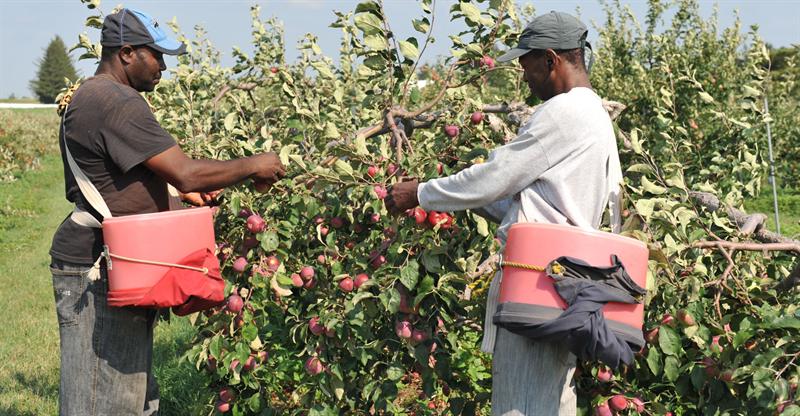
Canada’s temporary foreign workers
Chris Selley points out some of the weirdness of Canada’s claimed dependence on temporary foreign workers because “Canadians still need to eat.”:

Temporary foreign workers picking fruit in a Canadian orchard.
Image from http://www.yorkfeed.com/apple-picking-urgently-canada/
If all goes as it should at Canada’s airports, temporary foreign workers will be informed of their responsibilities. They should be made aware of their employers’ responsibilities as well. And there’s no particular epidemiological reason to worry about them more than anyone else landing on a Canadian runway from abroad — or domestically, for that matter. The vast majority of temporary foreign workers are from Mexico, Jamaica or Guatemala, which have reported 39, 25 and nine COVID-19 cases per million residents. Canada’s tally works out to 713 per million.
But the official advice to employers provides little comfort. It doesn’t prohibit putting people up in shared accommodations; it merely says residents must be able to keep two metres from each other at all times. We know the limitations of such measures from experience in seniors’ homes and homeless shelters. It’s not necessarily “the state’s duty” to quarantine arriving temporary foreign workers, as Bloc Québécois leader Yves-François Blanchet argued this week. But the state could certainly do far more than it is.
For one thing, the cities in which workers typically first arrive are much better suited to proper self-isolation — i.e., in a hotel or motel room — compared to the farm country they are eventually headed for. Sourcing 45,000 hotel rooms is a huge job even in cities — that’s roughly how many rooms there are in the entire Greater Toronto Area — but it will never be easier than right now. It would prevent any bad-actor employers from breaking the rules. It would be much more reassuring than a government cheque for what works out to less than $80 per worker per day of isolation.
The whole situation is completely bizarre, though — one of several longstanding, bizarre and sometimes embarrassing Canadian situations that COVID-19 has highlighted. Economically speaking, the idea of temporary foreign workers essentially amounts to cheating. It reaches peak absurdity when businesses like Tim Hortons outlets claim to need them — that is, when they’re being brought in to do work that Canadians are demonstrably willing to do. It’s just a skeevy way to artificially depress wages and the price of fast food. People seemed to sense that back in 2014, when the government tightened the rules.
In agriculture, however, the idea seems thoroughly entrenched. Perhaps it’s a case of out of sight, out of mind. But it’s the same absurdity: If you can identify a group of 45,000 people without whose labour we literally wouldn’t be able to feed ourselves — or so we are told — then on what possible grounds are we denying them a path to Canadian citizenship? In 2017, the Toronto Star profiled a 66-year-old Saint Lucian man who had busted his hump on Canadian farms for 37 years in a row, with his paycheques deducted for income tax, EI and CPP, but who had no claim to stay. The highly skilled and educated immigrants we compete to attract bring many important things to Canada’s table; they don’t bring anything more important than food. And food is something COVID-19 has very much taught us not to take for granted. Who would have thought supermarket checkout clerks would achieve hero status?
February 28, 2020
A history lesson from Roman Thessalonika
At Samizdata, Niall Kilmartin recounts a story that has some interesting modern parallels for those who choose to look:

The Course of Empire – Destruction by Thomas Cole, 1836.
From the New York Historical Society collection via Wikimedia Commons.
It happened in Thessalonika near the end of the Roman Empire.
The empire had been in trouble for some time. It was not reproducing itself – “The human harvest was bad” (Seeley). “Agri Deserti” – once-cultivated lands now abandoned for lack of people to till them – could be found in every province.
Internally, the empire tried its usual solution: more government, more laws, more force. Legislation to reward large families and tax bachelors was kept on the statute books for centuries although “successful it was not” (Power). As the empire waned, laws to deal with the consequence of this failure were added: binding cultivators to the soil (the origin of serfdom) was merely the most common example of assigning a hereditary obligation to more and more of the professions the state relied on as soon as a shortfall appeared in them, legally punishing any son who did not follow in his father’s footsteps. To draft and regulate these laws, the numbers and privileges of bureaucrats ballooned from Rome’s former proportion (though still small by our standards).
Successful all these laws were not – so, externally, the empire addressed its chronic shortage of manpower by immigration,
to dose it with barbarian vigour. Just a small injection to begin with and then more and more
Goths arrived, first as recruits to Roman army units, then as foederate units under their own leaders, growing like a cancer within the armed forces until an Egyptian mother quite naturally wrote the emperor to return her citizen son who “has gone off with the barbarians” – by which she meant he had joined the “Roman” army.
Emperor Theodosius made the Goths obey him, but his was an insecure authority over them. He used Gothic troops in battles where pyrrhic victories may have been welcome. As one summary of the costly victory of Frigidius (394 AD) puts it,
The loss of 10,000 Goths cannot have distressed Theodosius unduly.
Theodosius also had little choice but to use some of their leaders as governors. Mostly, the empire’s soldiers were also its police – so the leaders of those who were now increasingly providing those soldiers had to be both rewarded by, and used in, such posts. Thus did Butheric the Goth became governor (magister militum) over Illyricum, which included Thessalonika.
The urban elite of Thessalonika were university-educated Greeks.
It would be hard to imagine an education less suited to help them understand the dangers they faced. The study of rhetoric, its links with reality long severed, …
So Eileen Power described the “learned” of the dying Roman world. (Today, 8 decades after she wrote those sentences, it is easier to imagine an education even less suited to helping elite intellectuals understand the dangers facing them, one whose links with reality are even more completely severed.) In the empire’s second century, Hadrian had dispersed those Jews he did not kill around the empire, confident they’d soon lose their primitive prejudices and assimilate to being broad-minded Graeco-Roman intellectuals like himself. Fourth/fifth century Graeco-Roman intellectuals thought the same of the immigrants. Sidonius Appolinaris wrote a “good-natured” description of the “embarrassing friendliness” of the new barbarian neighbours he encountered on a fifth-century visit to Lyons:
“How can he be expected to compose six-foot metres”, [Sidonius] asks, “with so many seven-foot patrons all around him, all singing and all expecting him to admire their uncouth stream of non-Latin words.”
The shrug of the shoulders, the genial contempt of one conscious of an infinite superiority – how familiar it all seems.
Perhaps the Thessalonikan city leaders greeted their new governor in this spirit, as sure as Hadrian was about the Jews that this uncouth Goth would soon lose his barbaric prejudices.
February 21, 2020
British wages to be further impacted by Brexit
As we were told for years, if Brexit happened there were going to be dire consequences to the British economy, and here’s the latest one:
Employers are complaining that without badly paid immigrant labour they’ll just not be able to get the staff. The answer to which is that they’d better start paying higher wages then, eh?
[…]
The analysis here stems from something Marx got right. It’s competition among capitalists for scarce labour which pushes wages up. If there’s a vast reserve army of the unemployed then anyone needing more straining backs just tosses a crust to those in that army and gets as many limbs and torsos to exploit as desired. But if all are already employed then any desire for extra labour requires tempting it away from current employer and occupation to the new. That means a better job offer. Some mixture of conditions, enjoyment of the job, cash and so on that makes up a more attractive package.
The combination of cheap flights and free movement of labour has meant that the reserve army lives in Wroclaw and Debrecen. It’s also been near unlimited – compared to the size of the UK economy – these past couple of decades.
The absence of free movement – what is being complained about here – will mean that to gain the desired labour those employers are going to have to offer higher wages, higher compensation rather, to those not ordinarily resident or stemming from central Europe.
[…]
But back to the basic complaint here. These employers are complaining that Brexit will mean they’ve got to raise the wages they pay. To which the correct response is “Ah, Diddums”.
February 19, 2020
February 16, 2020
QotD: Immigration and diversity
Let me be clear that I think immigration and diversity are good things, overall. The economists seem to agree that immigration brings large economic benefits. The complete dominance of America in Nobel prizes, music, and the arts, and now the technology sector, would not have happened if we had not been open to immigrants. But as a social psychologist, I must point out that immigration and diversity have many sociological effects, some of which are negative. The main one is that they reduce social capital — the bonds of trust that exist between individuals. The political scientist Robert Putnam found this in a paper titled “E Pluribus Unum,” in which he followed his data to a conclusion he clearly did not relish: “In the short run, immigration and ethnic diversity tend to reduce social solidarity and social capital. New evidence from the US suggests that in ethnically diverse neighborhoods residents of all races tend to ‘hunker down.’ Trust (even of one’s own race) is lower, altruism and community cooperation rarer, friends fewer.”
In short, despite its other benefits, diversity is a centrifugal force, something the Founders were well aware of. In Federalist 2, John Jay wrote that we should count it as a blessing that America possessed “one united people — a people descended from the same ancestors, the same language, professing the same religion.” I repeat that diversity has many good effects too, and I am grateful that America took in my grandparents from Russia and Poland, and my wife’s parents from Korea. But Putnam’s findings make it clear that those who want more diversity should be even more attentive to strengthening centripetal forces.
Jonathan Haidt, “The Age of Outrage: What the current political climate is doing to our country and our universities”, City Journal, 2017-12-17.
February 4, 2020
Andrew Sullivan – “Our fate was almost certainly cast as long ago as 1964 and 1965”
In his most recent New York magazine column, Andrew Sullivan reviews two new books on the same issues from different perspectives: Ezra Klein’s Why We’re Polarized and Christopher Caldwell’s The Age of Entitlement.
… both books agree on one central thing: Our fate was almost certainly cast as long ago as 1964 and 1965. Those years, in the wake of the Kennedy assassination, saw the Civil Rights Act upend the Constitution of a uniquely liberal country in order to tackle the legacy of slavery and racism, and the Immigration and Nationality Act set in motion the creation of a far more racially and ethnically diverse and integrated society than anyone in human history had previously thought possible. Still, at the time, few believed that either shift would have huge, deep consequences in the long term. They were merely a modernization of American ideals: inclusivity, expansiveness, hope.
As someone who was born just before these two changes were instigated, I regarded those tectonic shifts as simply part of the landscape — something that seemed always to have been here. And what could be questioned about either? One was reversing a profound moral evil; the other was banishing racism from the immigration laws. No-brainers. The strongest resistance to civil rights came from former segregationists or obvious racists, and there was little resistance to the Immigration Act, because most in the congressional debate seemed to think it wouldn’t change anything much at all. (The House sponsor of the Immigration Act, as Caldwell notes, promised that “quota immigration under the bill is likely to be more than 80 percent European,” while Ted Kennedy insisted: “The ethnic mix of this country will not be upset.”) There were a few dissenters to the 1964 Act, such as Robert Bork, who identified a significant erosion in the freedom of association. And there were southern senators who worried about immigrants from the developing world. But the resisters were easily dismissed on both counts, in the wake of LBJ’s 1964 landslide.
In fact, as Klein shows, a pivotal moment had arrived. The civil-rights movement quickly broke apart the old Democratic party, which had for decades combined the interests of blacks and southern whites into a single multiracial coalition. The result was a sorting of the two political parties into much purer vessels for their diverging ideologies, and into groupings that were also increasingly racially distinct. The GOP became whiter and whiter; the Democrats more and more became the party of the marginalized nonwhites as the years rolled by. Blacks and southern whites ceased to communicate directly within a single party, where compromises could be hammered out through internal wrangling. In the aggregate this was, as Klein emphasizes, a good thing — because blacks kept coming out the losers in those intraparty conversations, and with civil rights, they had a chance of winning in a clearer, less rigged, debate.
But it was also problematic because human beings are tribal, psychologically primed to recognize in-group and out-group before the frontal cortex gets a look-in. And so the whiter the GOP became, the whiter it got, and the more diverse the Democrats got. Simultaneously, the economy took a brutal toll on the very whites who were alienated by the culture’s shift toward racial equality, and then racial equity. Klein recognizes that this racial polarization, is, objectively, a problem for liberal democracy: “Our brains reflect deep evolutionary time, while our lives, for better and worse, are lived right now, in this moment.” So he can see the depth of the problem of tribalism — and its merging with partisanship, which goes on to create a megatribalism.
If humans simply cannot help their tribal instincts, then a truly multicultural democracy has a big challenge ahead of it. The emotions triggered are so primal, that conflict, rather than any form of common ground, can spiral into a grinding cold civil war. And you can’t legislate or educate this away. One fascinating study Klein quotes found that “priming white college students to think about the concept of white privilege led them to express more racial resentment in subsequent surveys.” Anti-racist indoctrination actually feeds racism. So tribalism deepens.
Klein sees this spiral more clearly than most on the left. He acknowledges the truth that in a period of extraordinary demographic and racial change — the U.S. is the first majority-white nation that will become majority nonwhite in human history — every group begins to feel like an oppressed minority. Including whites: “To the extent that it’s true that a loss of privilege feels like oppression, that feeling needs to be taken seriously, both because it’s real, and because, left to fester, it can be weaponized by demagogues and reactionaries.” And the truth is: It was left to fester. Whenever whites resisted ever-expanding concepts of civil rights or mass illegal and legal immigration, they were cast outside the arena of permissible disagreement, deemed racists, and stigmatized. Even the GOP scorned them. Eventually, Hillary Clinton named them: the deplorables. By 2016, plenty of Americans decided to embrace the label, and voted for Trump.
December 30, 2019
The federal Conservative Party’s dilemma
Canadians currently have two left-of-centre federal parties (three if we count the Greens), but only one party on the right (Maxime Bernier’s PPC), leaving the right-of-left-of-centre to the hapless, leaderless, useless, spineless, craven Conservative Party. “Conservative” in name only, of course, for those of you who don’t follow Canadian politics (and neither blame nor shame to you if you fall into that happy group). Bernier’s been labouring under an almost complete media blackout except where engineered drama can be used to demonize him or members of his party, so the roughly one-third of Canadian voters who would prefer an actual conservative alternative don’t really have anyone to vote for.
Jay Currie offers his analysis of the Conservative dilemma (but he’s also a known PPC sympathizer, so good Canadians must pay no attention to what he says):
Frank Graves and Michael Valpy ask the question, “What if the Conservatives had a ‘centrist’ leader?” like Rona Ambrose or Peter MacKay. To their credit Graves and Valpy recognize that while a centrist Conservative party would appeal to the media and various elites in Canada it would effectively maroon the 30% of Canadians who might loosely be described as “populist”.
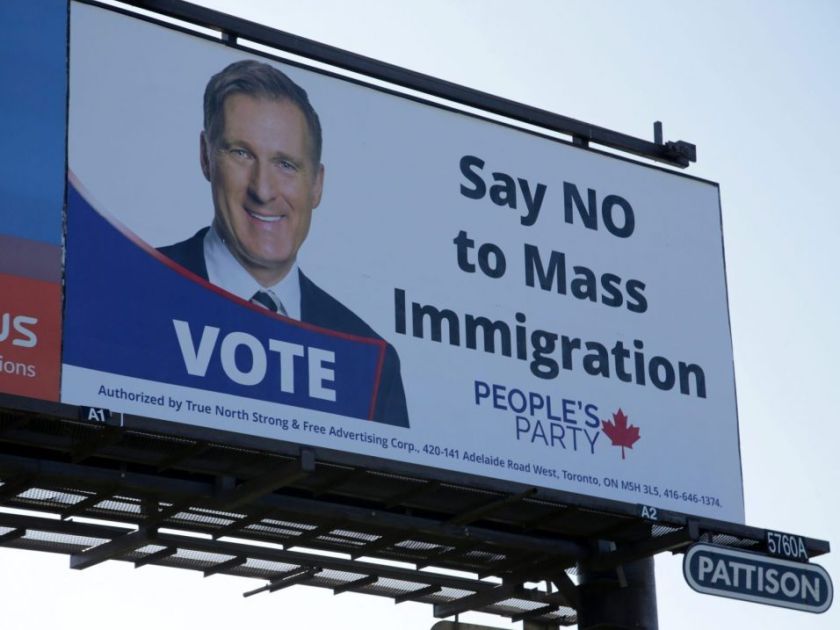
A billboard in Toronto, showing Maxime Bernier and an official-looking PPC message.
Photo from The Province – https://theprovince.com/opinion/columnists/gunter-berniers-legitimate-position-on-immigration-taken-down-by-spineless-billboard-company/wcm/ecab071c-b57d-4d93-b78c-274de524434cI think Graves and Valpy are right and I can’t wait for that exact outcome.
Scheer managed to hoodwink a lot of natural populists with a combination of Liberal-lite policies and some goofy socon gestures (I am not sure Pride Parade non-attendance really counts for much with the serious socons.)
Graves and Valpy maintain that this was enough to avoid “orphaning the party’s biggest lump, and he more or less cut off oxygen to Maxime Bernier’s People’s Party of Canada (PPC).” It might have been last election but if the CPC goes centrist with its next leader, the lump will be looking elsewhere.
I am fairly certain that the CPC will go for a centrist leader if only because there are really no populist candidates available to it. Pierre Poilievre might fill the bill but it is not obvious that the CPC will be willing to support an MP who is as “direct” as Poilievre.
Which will leave “the lump” looking for a home. Graves and Valpy give a rundown of the lump’s core issues,
Like the United States, the United Kingdom and sizeable chunks of Western Europe, Canada has a significant portion of citizens — about 30 per cent — who are attracted to the current psychographic and demographic binge of ordered populism. They are profoundly economically pessimistic and mistrustful of science and the elites. They have no interest in climate change, they don’t really see an active role for public institutions and believe there are too many immigrants. Of those immigrants coming to Canada, they think that too many are not white.
Other than the dig about thinking “too many are not white”, that is a pretty good summary. (On the “not white” thing, I suspect it is more nuanced than that: more along the lines of the current Quebec government’s desire to preserve its culture in the face of immigration.)
November 30, 2019
Toynbee’s warning
In the National Post, Barbara Kay wonders if conservative democracy can shore up the civilizational boundaries that liberal democracy has abandoned:

The Course of Empire – Destruction by Thomas Cole, 1836.
From the New York Historical Society collection via Wikimedia Commons.
The historian Arnold Toynbee warned that “civilizations die from suicide, not by murder.” He said they begin to disintegrate when they abandon moral law and yield to their impulses, which in turn brings about a state of passivity, a sense that there is no point in resisting incoming waves of foreigners driven by confidence and purpose.
Since Toynbee, other writers, notably James Burnham in his influential 1964 essay, “Suicide of the West: An essay on the Meaning and Destiny of Liberalism”, have picked up on the theme. In every case in which the word “suicide” features, the root cause comes down to the effects of a universalist liberal democracy over time. These observers are not trading in fear-mongering for its own sake. We must pay respectful attention to their warnings.
Liberal democracy is, broadly speaking, a political doctrine consecrated to the belief that reason, universally accessible and everywhere the same, can by itself create the conditions for enlightened progress in human affairs.
With social justice as the end and social transformation as the means, liberals are not perturbed by the erosion of Christianity, the traditional family and the cultural particularism such transformation requires. The instinct to jettison cultural babies in order to refresh our cultural bathwater is a feature, not a bug, of liberal democracy.
Conservatives, even those who don’t embrace social conservatism, view the crumbling of these building blocks of civilization with anxiety and fear. Their view is that reason alone, without spiritual ballast and deference to the traditions that created our civilization, can produce social instability and even violence. Nobody considered himself more reasonable than Vladimir Lenin. Nobody considers herself more reasonable than a minister of sport who conflates subjective gender identification with biological sex.
Conservatives’ fears are driving the nationalist/nativist counter-movement liberals view with disgust and anger. Conservatives find it difficult to get an unbiased hearing in the prevailing progressive zeitgeist. Liberals have been successful in linking nationalism with history’s most odious incarnations of racism and imperialism in the popular imagination, while ignoring the equally tragic history of internationalist movements, because Marxist utopianism casts a spell they find irresistible.
So in the matter of immigration, for example, liberals are not concerned by mass immigration from countries with different religious and cultural traditions, because they rely on the universal appeal of liberal principles to even out the initial wrinkles. Conservatives regard these different traditions as deeply entrenched and likely to be negatively transformative to our own culture. They are inclined to impose strictures that encourage integration into, along with recognition of, our own culture’s dominant status. Far from being racist, conservatives view this precaution as a hedge against the kind of inter-cultural tensions spilling over into expressed hatreds that are presently roiling Europe. But as we saw in the last election, even the mildest criticism of mass immigration is the kiss of death to a politician.
Recently, I posted a Quote of the Day from Sarah Hoyt that emphasized the persistence of culture, which is a warning to those who think unlimited immigration from other cultures won’t have negative impacts on the receiving culture:
Societies don’t work that way. Culture doesn’t work that way. In fact culture is so persistent, so stubborn, it leads people to think it’s genetic. (It’s not. A baby taken at birth to another culture will not behave as his culture of origin.) It changes, sure, through invasions and take overs, but so slowly that bits of older cultures and ideas stay embedded in the new culture. It has been noted that the communist rulers of Russia partook a good bit of the Tsarist regime, because the culture of the people was the same and that came through. (They just dialed up the atrocities and lowered the functionality because their ideology was dysfunctional. They blame their failure on Russia itself, but considering how communism does around the world, I’ll say to the extent countries survive it’s because of the underlying culture.)
November 22, 2019
QotD: Politicians, like scorpions, cannot change their nature
Whatever you think of current immigration policy (too lax, too tight, just right) and whatever you think of current policies controlling Americans’ access to guns (too lax, too tight, just right), surely you must be amused – if only wistfully – by those who complain, whenever some tragedy occurs, that politicians “politicize” that tragedy. Feigning surprise about politicians politicizing tragedies makes no more sense than feigning surprise that dogs bark at mailmen: it’s in the nature of the beasts. (I don’t mean by this comparison to insult man’s best friend. Dogs’ instinct to bark is typically beneficial to humanity; politicians’ instinct to politicize anything that moves is typically harmful to humanity.)
Don Boudreaux, “Dogs Bark!”, Café Hayek, 2017-11-02.