
For history’s rare multiracial and multiethnic republics, an “e pluribus unum” cohesion is essential. Each particular tribe must owe greater allegiance to the commonwealth than to those who superficially look or worship alike.
Yet over the last 20 years we have deprecated “unity” and championed “diversity”. Americans are being urged by popular culture, universities, schools and government to emphasize their innate differences rather than their common similarities.
Sometimes the strained effort turns comical. Some hyphenate or add accents or foreign pronunciations to their names. Others fabricate phony ethnic pedigrees in hopes of gaining an edge in job-seeking or admissions.
The common theme is to be anything other than just normal Americans for whom race, gender and ethnicity are incidental rather than essential to their character.
But unchecked tribalism historically leads to nihilism. Meritocracy is abandoned as bureaucrats select their own rather than the best-qualified. A Tower of Babel chaos ensues as the common language is replaced by myriad local tongues, in the fashion of fifth century imperial Rome. Class differences are subordinated to tribal animosities. Almost every contentious issue is distilled into racial or ethnic victims and victimizers.
History always offers guidance to the eventual end game when people are unwilling to give up their chauvinism. Vicious tribal war can break out as in contemporary Syria. The nation can fragment into ethnic enclaves as seen in the Balkans. Or factions can stake out regional no-go zones of power as we seen in Iraq and Libya.
In sum, the present identity-politics divisiveness is not a sustainable model for a multiracial nation, and it will soon reach its natural limits one way or another. On a number of fronts, if Americans do not address these growing crises, history will. And it won’t be pretty.
Victor Davis Hanson, “Things That Can’t Go on Forever Simply Don’t”, PJ Media, 2019-04-17.
July 15, 2022
QotD: Modern and historical multiculturalism
April 24, 2022
Let us bid an unfond farewell to all the “cool city” initiatives
Elizabeth Nickson on a few of the ways that governments’ and pan-national organizations’ love for urban intensification looks to be finally fading away:
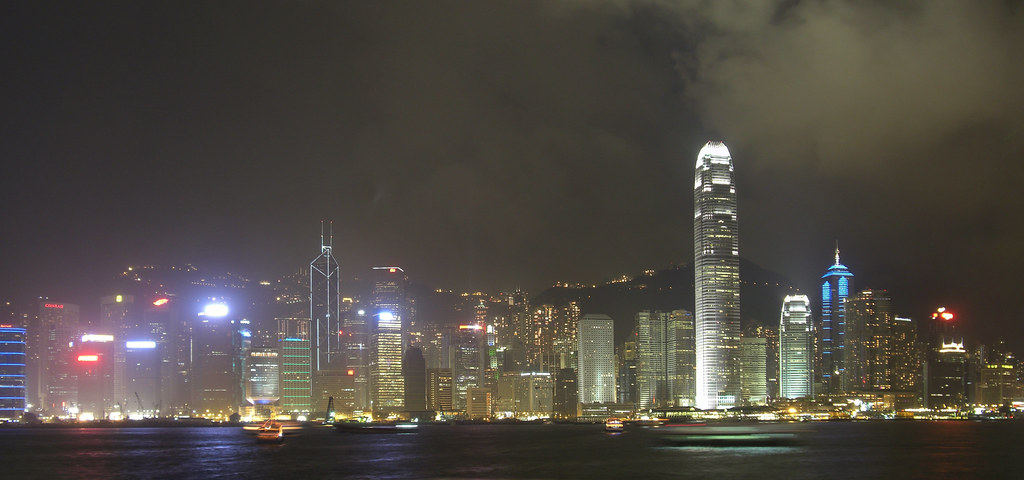
“Hong Kong night Panorama” by Andos_pics is licensed under CC BY-NC-SA 2.0


A decade ago cool cities were all the rage and tax money was pouring into cultural events and buildings to “attract” and densify people because “climate change”. Richard Florida, drawing upon a dubious book about cultural creatives had started his ferocious PR drive towards the mega-city as the apex of modernist civilization, a mixed-race cauldron of creativity and more, an economic engine that would power the world and leave the countryside to the bees and trees. Smart Growth was insinuated into every regulatory structure in order to, just like Captain Picard, make it so.
There were a few oppositional voices. There was me, a very minor chord along with Randal O’Toole, Wendell Cox, Joel Kotkin who detailed the risks. But mostly it was all rah rah rah. If we build it they will come. Masses of public money poured in to attract “them”. Country infrastructure was starved, and if broken, left to rust.
And did they come. To all the glamorous cities came the genius thieves of the modern age, oligarchs creating bolt holes for their money and mistresses, looters from Communist regimes, ditto for Africans stealing aid money. Every crime syndicate facing looser immigration rules started branch-plants, laundering money, and seducing the marginal into lives of misery.
Increased levels of crime was one of our objections, but hell on wheels, the devastation in LA, San Francisco, Chicago, New York and Vancouver sure wasn’t foreseen.
Housing affordability would collapse said Wendell Cox, and was he right. In Vancouver, which has been taken over by Chinese mega-crime-syndicates, is the third most expensive city in the world. People whose families founded the city, can’t afford a studio apartment.
Politicians did nothing but take the laundered cash earned by ruining the lives of their citizens, and used it to build casinos so laundering drug money from all over North America would be easier. We Canadians are so helpful. And nice. To everyone, Even child traffickers. Yeah, come here, the scenery is grand and we can take care of all the people you broke with our “free” health care.
I objected to the potential noise being noise sensitive. Also viruses. That was a big one. Courtesy of my ex-husband’s trips to Asia, I picked up a couple viruses which my immune system couldn’t suppress, since I had no built immunity. The indiscriminate mixing, flooding of people overwhelming resources would create health catastrophes I thought, and lo and behold, it looks like WHO is planning for world-wide pandemics as far as the eye can see.
So, like all the other bad ideas of the age, cool cities failed leaving massive massive debt. Everyone with a scrap of money and initiative is plotting to leave the mega cities for the distinctly uncool country these days. Out here we are bracing ourselves for your bad ideas, but we are also ready. We know what you are like. You are as dumb as rocks, and you would destroy the country just like you ruined the cities. You have zero humility. You are a nightmare coming to join the other nightmare visited on our home places, the mass confiscation of our land. The land that feeds you idiots.
February 7, 2022
American pizza
At An Eccentric Culinary History, H.D. Miller makes a strong case for pizza being more an American dish than an Italian one:

“Pizza” by rdpeyton
Today, standing atop the sprawling edifice that is the American restaurant industry, it’s hard to imagine a time when pizza wasn’t popular. But, prior to World War Two, pizza was barely known in the United States outside of a few Italian enclaves in the Northeast. For all of the praise heaped upon Lombardi’s in New York City, until the war, few people north of Houston Street had heard of it, or the dish it served.
From the mid-19th century forward, there were plenty of Italians in America, in places like New York, New Orleans and San Francisco. Most of those early Italian immigrants — around 75,000 before 1880 — were from northern Italy, not the South, and the restaurants they built were usually serving multi-course, table d’hôte meals of meat, bread, macaroni, wine and coffee at reasonable prices. The model was Caffe Moretti’s in Manhattan. Established in 1858 by Stefano Morretti, an ex-seminarian from the Veneto, Morretti’s offered diners generous portions and cheap prices. It did not, however, offer pizzas.
I have to emphasize this, you couldn’t order a pizza in the vast majority of Italian restaurants in America prior to 1945. And the reason you couldn’t order a pizza in Italian restaurants is because pizza isn’t Italian.
Let me repeat that: Pizza isn’t Italian.
Pizza is Neapolitan. It’s a distinct speciality of Naples, developed at at time when Italy didn’t even exist as a nation. Saying pizza is Italian is like saying haggis is British. It might be technically true, but not really.
As in America, prior to the 1950’s, pizza wasn’t something most Italians knew or cared about. In 1900, there were supposedly no pizzerias in Italy anywhere outside of the medieval walls of Napoli. You couldn’t even get pizza in the suburbs. Pizza was strictly street food for poor people in the crowded tangled alleys near the port. […]
In other words, pizza was not something the average Tuscan, Ligurian or Venetian would have thought suitable for a sit-down meal. Or, if they ever did think of it, it was to revile pizza as oily, unappetizing and a likely vector of cholera. This is because Naples was really famous at the time for being dirty and disease-ridden. (If you’re serious about early pizza history, one that strips away the just-so stories, then go read Inventing the Pizzeria by Antonio Mattozzi.)
What brought pizza to America was the mass immigration of southern Italians between 1880 and 1910, when more than 4 million people moved to the United States. That’s why Lombardi’s didn’t get going until 1905, when there were finally enough Neapolitans in Little Italy to keep the doors open.
The same dynamic played out in South America, in Argentina, Uruguay and Brazil. The first successful pizza restaurant in the world located outside of Naples was founded in Buenos Aires in 1882, when a Neapolitan immigrant baker named Nicolas Vaccarezza started selling the pies out of his shop in Boca. For reference purposes, a decade earlier, an attempt to open a pizzeria in Rome, Italy, had ended in bankruptcy, meaning, at the turn of the last century, you could get a pizza in Buenos Aries, São Paulo or New York, but not in Rome, Florence or Venice.
H/T to Ed Driscoll for the link.
December 12, 2021
“[T]oday’s antiracism paradoxically requires the crudest of racist categories to justify and explain itself”
Andrew Sullivan on the racism of modern “anti-racist” movements and his hope that Hispanic Americans may provide a way out of the current political deadlock:
Of all the acronyms, euphemisms and sophisms pioneered by critical theory, one of the most revealing is the term “black and brown people”. You hear it all the time now. Whether it’s about “the lack of Black and brown representation in Hollywood”, vaccine hesitancy in “Black and brown neighborhoods in large cities”, the right to vote for “Black and brown people”, or “allyship between Black and brown people”, the “B&b” formula is now yet another ubiquitous media virtue-signal. It’s subtler than some others. It doesn’t shriek woke like “BIPOC”; it isn’t as instantly risible as “2SLGBTQIA+”; it gives “Black” a Capital Letter, and “brown” feels a bit like a lower-case add-on — but at least it uses actual English words, and doesn’t end in an X.
Still: what does it tell you that a staggering and brilliant array of totally different ethnicities, races, religions, histories and cultures can now routinely be reduced to just two drab colors?
I think it speaks to two things. The first is that today’s antiracism paradoxically requires the crudest of racist categories to justify and explain itself. A whole kaleidoscope of immigrant difference — from Kurds and Mexicans and Somalis to Dominicans, Chileans, Nigerians, and Pakistanis — has now been turned into one monochrome racial “brown” — just to fit into an oppressor/oppressed, white/black narrative.
Equally, a diverse African diaspora — ranging from Nigerian immigrants to descendants of Southern slaves to biracial men and women with mainly European ancestry who go back to this country’s miscegenated origins — is now just “Black”. And this new racial unit has one politics: left-Democrat. Individuals disappear; diversity of opinion within groups evaporate; all that matters is a single skin color and oppression.
The second aspect of critical theory that “B&b” helps reveal is that the crude binary of “black” and “white” simply has less salience with every passing day, as more and more races, ethnicities and cultures complicate and enrich our society, and render it structurally, demographically and culturally unrecognizable from even the recent past. To give one example: 60 years ago, four percent of Americans approved of inter-racial marriage; today, it’s 94 percent. Or check out the rapid decline in the “white Christian” share of the population — from 80 percent in 1996 1976 to 44 percent today. Look around you and you’ll see how the crude rubric of “white supremacy” is, in fact, wildly out of date.
This is why so many of the most passionately woke are so obsessed with history in America, and the further back the better, as the 1619 Project shows. The past is a world they are much more comfortable in than the present, a place where the racial divide was infinitely simpler, and racial inequality both brutal and actively enforced by the government. Before the Civil Rights Act in 1964, before mass non-white immigration began in 1965, before mass non-white illegal immigration since the 1990s, the “white supremacy” rubric had some lingering traction.
But in the 21st Century, it’s been hopelessly compounded by layer upon layer of mass immigration from every conceivable corner of the planet. The Latino population in the US is now larger than the African-American one; and Asians, of many different varieties, are now immigrating in higher numbers than Latinos. Before too long, the black/white dynamic may disappear into the multi-colored, multi-hued background entirely.
December 8, 2021
What if the refugee flow was crossing the Channel the opposite way?
In The Critic, Joel Rodrigues considers what the media narrative would say if the constant stream of migrants from the EU to Britain was reversed, as all the major media outlets predicted would happen if Brexit went through:
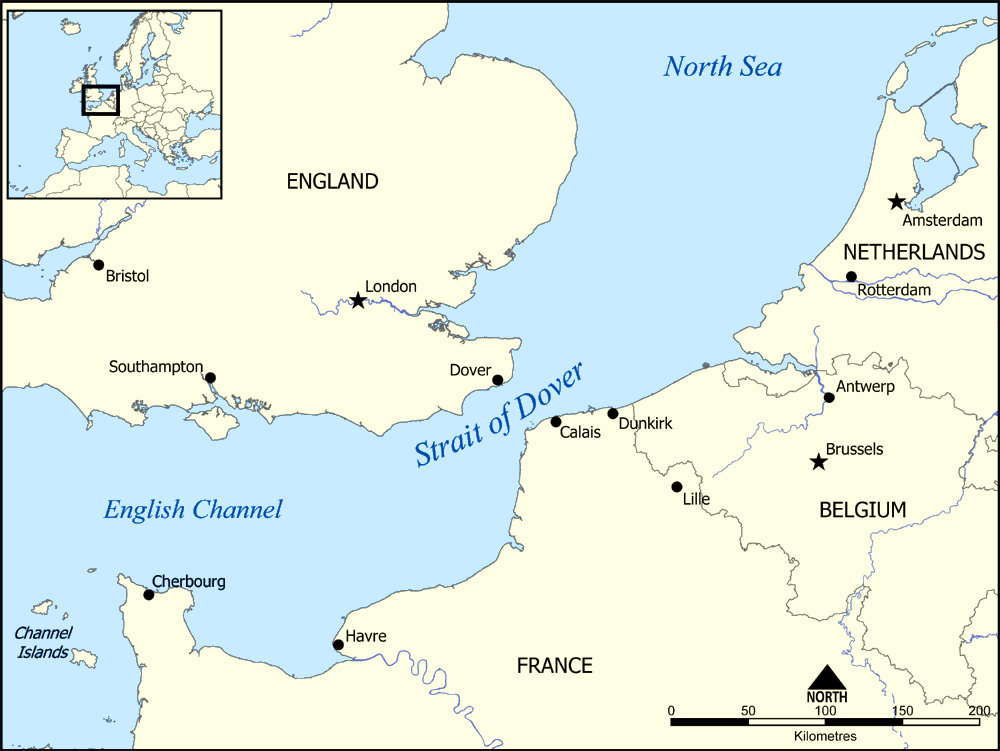
This map shows the location of the Strait of Dover between England and France, and part of the English Channel and the North Sea. It also shows nearby towns such as Dover, Calais, and Dunkirk.
Image created by NormanEinstein via Wikimedia Commons.
Imagine “tent” cities on the Kent coast, similar to “the Jungle” that existed in Calais up until 2016. These camps are the type of camps that the Remain campaign (wrongly) warned would spring up if Britain voted to leave the EU, as part of their Project Fear campaign. The tent cities are full of migrants, hoping to reach the French coast and the “sunlit uplands” of the European Union.
The camps are filthy, riddled with violent crime, and it is here that people traffickers sell spaces on dinghies to cross the channel for thousands of pounds a ticket. The British police and immigration services are aware of undocumented people living in squalor in the camps, but largely do nothing.
Occasionally a camp is cleared to placate the locals, but it quickly springs up somewhere else. The British government make no effort to document, accommodate or process the migrants living in appalling conditions on its territory. Instead, it blames the “pull factor of the EU’s single market”, saying that many of these migrants have family in France and want to live in a French or German speaking society. A junior British minister suggests that the black market economies in the EU are also a pull factor, and that there are a “lack of safe asylum routes” into the EU.
People smugglers continue operating from the British coast, and the migrant camps expand. Dinghies are now launched daily from the UK towards the continent. Police are aware of the launches, but do nothing. The RNLI and Royal Navy escort these flimsy boats until they are in EU waters, despite their not being seaworthy. Thousands succeed in making the crossing.
Then, tragedy strikes when a boat sinks. Statements are released from the British and French governments lamenting the loss of life. Trying to find a solution, Emmanuel Macron writes a letter to Boris Johnson urging increased collaboration, with joint patrols if necessary, to prevent a repeat of the tragedy.
The British government issue a response claiming that the perfectly conciliatory letter is in fact unacceptable, a “threat to British sovereignty”, and that France is uninvited from crisis talks. British media later reports that in a meeting with some of his advisors, Boris Johnson branded Emmanuel Macron as “a clown in charge of a circus”.
Imagine the media commentary and narrative in the UK surrounding such a situation, especially post-Brexit.
“Migrants die fleeing racist, Brexit-ridden, plague island,” says an op-ed in the Guardian. The comments are largely agreed that Boris Johnson is personally responsible for each of their deaths.
“UK condemned as using migrants to destabilise the EU’s single market,” reports the BBC. Parallels are also drawn in The Times between Boris Johnson and Belarus’ Lukashenko. There are mass demonstrations outside Parliament as the crisis worsens.
One can imagine the EU Commission swiftly and publicly denouncing the UK and drawing up sanctions. The Labour party would likely call it a national scandal, and demand resignations, as well as accusing the government of taking a hardline stance as cynical electioneering.
I searched for public domain or Creative Commons images of the English Channel migrant crisis, but came up surprisingly empty, hence the generic map to illustrate this post. I had expected to be inundated with lots of heart-rending images of desperate refugees, but not this time…
October 29, 2021
Ten years after After America, how are Mark Steyn’s predictions going?
Mark Steyn published his book After America ten years ago:
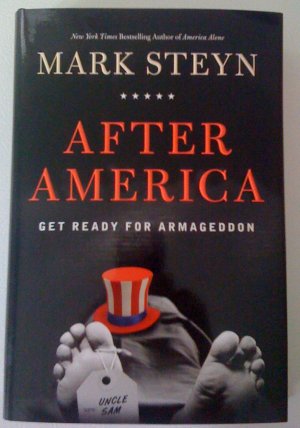
Speaking of which, we are marking the tenth anniversary of my bestselling book After America. The observances are muted because, from the underpass at Del Rio to the school board meetings of Loudoun County, it has proved too accurate. Nonetheless, I remind you of the book’s opening chapter:
Look around you. From now on, it gets worse. In ten years’ time, there will be no American Dream, any more than there’s a Greek or Portuguese Dream. In twenty, you’ll be living the American Nightmare, with large tracts of the country reduced to the favelas of Latin America, the rich fleeing for Bermuda or New Zealand or wherever on the planet they can buy a little time, and the rest trapped in the impoverished, violent, diseased ruins of utopian vanity.
‘After America’? Yes. It will linger awhile in a twilight existence, arthritic and ineffectual, declining into a kind of societal dementia, unable to keep pace with what’s happening and with an ever more tenuous grip on its own past. For a while, there may still be an entity called ‘the United States’, but it will have fewer stars in the flag, there will be nothing to ‘unite’ it, and it will bear no relation to the republic of limited government the first generation of Americans fought for. And life, liberty and the pursuit of happiness will be conspicuous by their absence.
On the other hand:
The United States is still different. In the wake of the economic meltdown, the decadent youth of France rioted over the most modest of proposals to increase the retirement age. Elderly ‘students’ in Britain attacked the heir to the throne’s car over footling attempts to constrain bloated, wasteful and pointless ‘university’ costs. Everywhere from Iceland to Bulgaria angry mobs besieged their parliaments demanding the same thing: Why didn’t you the government do more for me? America was the only nation in the developed world where millions of people took to the streets to tell the state: I can do just fine if you control-freak statists would shove your non-stimulating stimulus, your jobless jobs bill and your multi-trillion-dollar porkathons, and just stay the hell out of my life, and my pocket.
On the world stage, Joe Biden is the literal embodiment of America’s “twilight existence, arthritic and ineffectual, declining into a kind of societal dementia”. The favelas are here in many American cities, and I see that the citizens of what only a quarter-century ago alleged conservative David Brooks hailed as the future — Burlington, Vermont, the chichi post-political latte town of do-gooder liberalism – is now getting used to routine stabbings on Main Street.
I miss the Tea Party because their grievances were mainly economic. Today’s dissatisfactions are more profound and primal: We are not arguing about socialized health care, but about the agreed meaning of America, and whether it will come to more blood than it’s already coming to.
September 30, 2021
Petrol shortages in the UK
I’ve seen several reports on the somewhat sudden rash of petrol (gasoline to US/Canadian readers) shortages in Britain, and most of those reports airily pin the blame for the situation on Brexit. To the media, Brexit seems to be an all-purpose explanation for anything that goes wrong (in the same way that previous administrations get the blame for current problems even many years after they left power). Sean Gabb says that despite the frequent glib blaming of Brexit, in this case it is part of the reason:
There is in the United Kingdom a shortage of lorry drivers. This means a dislocation of much economic activity. Because it cannot be delivered, there is no petrol in the filling stations. Because there are not enough drivers, and a shortage of fuel, we may soon have shortages of food in the shops. Christmas this year may not involve its usual material abundance.
These difficulties are wholly an effect of the new political economy that has emerged in England and in many other Western countries since about 1980. An army of managers, of agents, of administrators, of consultants and advisers and trainers, and of other middle class parasites has appropriated a growing share of the national income. This has happened with at least the active connivance of the rich and the powerful. Since, in the short term, the distribution of the national income is a zero-sum game, the necessary result is low and falling real wages for those who actually produce. So long as the productive classes can be kept up by immigration from countries where even lower wages are on offer, the system will remain stable. Because leaving the European Union has reduced the supply of cheap labour, the system is no longer stable in England.
There are two obvious solutions. The first is to rearrange the distribution of income, to make the productive classes more able and more willing to produce. Since this would mean reducing the numbers or incomes or both of the parasite classes, the second is the solution we mostly read about in the newspapers. This is to restore the flow of cheap foreign labour.
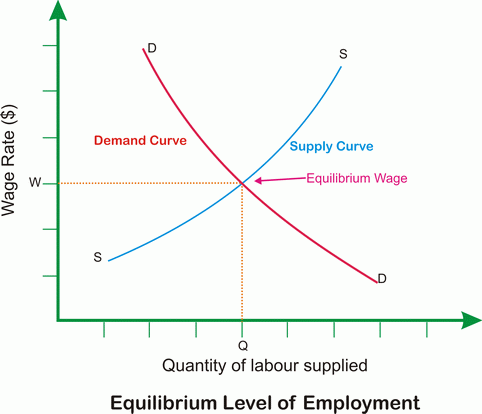
In summary, that is my explanation of what is happening. For those who are interested, I will now explain at greater length. According to the mainstream theory of wages, labour is a commodity. Though workers are human beings, the labour they supply to employers is of the same general nature as machine tools and copper wire and cash registers and whatever else is bought and sold in the markets for producer goods. A wage therefore is a price, and we can illustrate the formation of wage rates with the same supply and demand diagrams as we use for illustrating the formation of prices:
The supply curve slopes upwards because most work is a nuisance. Every hour of labour supplied is an hour that cannot be spent doing something more enjoyable. Beyond a certain level, workers can only be persuaded to supply more labour if more money is offered for each additional hour of labour. As with other producer goods, the shape of the demand curve is determined both by the price of what labour can be used to produce and by the law of diminishing returns.
[…]
Our problem in England is that large areas of economic activity have been rigged. There is an immensely large state sector, paid for by taxes on the productive. Most formally private activity is engrossed by large organisations that are able to be so large either because of limited liability laws or by regulations that only large organisations can obey. The result is that wages are often determined less by market forces than by administrative choice. In this kind of rigged market, we cannot explain the distribution of income as a matter of continual choice between marginal increments of competing inputs until the whole has been distributed. It may be better to look at a modified wages fund theory. A large organisation has a pot of money left over from the sale of whatever its product may be, minus payments to outside suppliers, and minus whatever the directors choose to classify as profit. This is then distributed according to the free choice of the directors, or how hard they can be pushed. Or we can keep the mainstream cross-diagrams, but accept that the demand curve is determined less by marginal productivity than by the overall prejudices of those in charge.
Therefore the growth of a large and unproductive middle class, and the screwing down of all other wages to pay for this. This is not inevitable in rigged markets, but is possible. It has come about since the 1980s for three reasons:
First, the otherwise unemployable products of an expanded higher education sector have used all possible means to get nice jobs for themselves and their friends;
Second, the rich and the powerful have accommodated this because higher wages and greater security for the productive might encourage them to become as assertive as they were before the 1980s;
Third, that these rich and powerful see the parasite classes as a useful transmitter of their own political and moral prejudices.
August 23, 2021
Canada is extremely good at posturing on the international stage … not so good at performing
Kevin Newman on the continuing failure of the Canadian government and Canadian Armed Forces to protect and retrieve the people in Afghanistan we’ve promised to help:

On the second day of the Taliban’s rule in Kabul, the front of Hamid Karzai International Airport was crowded with people trying to travel abroad, but were stopped by Taliban militants, 17 August, 2021.
Public domain image from VOA via Wikimedia Commons.
It is impossible to piece together, or understand, why no one from Canada would come out of the military protection of the airport to speak to them over the past two days. Because there must have been a whole lot of talking happening on the safe side of the razor wire barrier separating the Afghans from the terminal. Late Friday, a Canadian C-17 carrying more soldiers and a few diplomatic and immigration staff arrived at Kabul’s military air terminal. They had a plan to work with American forces to get some of the gas station people out of the country. There seemed to be renewed confidence expressed in media interviews by Immigration Minister Marco Mendicino that, finally, things would happen.
Instead the Americans started executing rapid-retrieval missions into Kabul to get their own people out, sealed the entrance where Canada’s gas station people were waiting, and co-operation with Canadian forces seemed to disintegrate.
In the meantime, there was a game of numbers to play. With so few Canadian cases on that C-17 ready to return to a third country, the big grey plane was loaded with Afghans that other countries had successfully brought to the airport. A picture and story was fed to political reporters on the campaign trails in Canada declaring broadly that “106 Afghans have been flown out on a Canadian C17” – but National Defence would not reveal if any of those passengers had been Canadian cases.
According to the Globe and Mail‘s Stephen Chase there had been none on the only other Canadian flight of 175 to leave the airport twenty-four hours earlier, even as the government boated of another “success”. For weeks, the Prime Minister and his besieged cabinet had also been talking about 20,000 refugees coming to Canada. That too was misleading in is vagueness, according to Global News’ Mercedes Stephenson, as all but a handful are coming from outside Afghanistan and even then, it’s over many years.
There is zero evidence from multiple Afghan sources around the airport that any of those the Prime Minister boasts they’re “rescuing”, (LGTBQ2, human rights advocates, women and journalists) have come from Kabul or any part of Afghanistan in the past month.
With all that, the government continues to claim a C-17 will come and go each day. But do the math. If even a hundred daily Canadian cases make those flights, (no where near that many have so far), there is no way the vast majority of applicants will make it here before the window closes for evacuations. Canada’s commitment of men and materials in no way matches the need. So, will Immigration officials those with no hope now of rescue and admit that they won’t get out in time? That number is likely in the thousands. They need to develop a more realistic way to survive the Taliban.
The mystery in this deadly absurdity is the government’s obsession with paperwork. Even today Canadian officials on the safe side of the airport controlling who might get through were reported by eyewitnesses to be taking an “extremely strict” approach to paperwork verification. Only those granted full Canadian citizenship under the government’s Special Immigration Measure are being told they qualify to leave. That requires a lot more work to process and is perhaps less than a tenth of all the Afghans who are known to have applied and are in various stages of completing multiple forms.
Other countries have also been willing to grant refugee status to their interpreters and families, which doesn’t guarantee citizenship, but is it is a much faster way to process many more people, and it gives Afghans more choices should air rescue be impossible. In a news conference, Mendicino claimed his department’s agent in Kabul has authority to overlook the passport and biometric fingerprint requirements. But the evidence on the ground suggests he is being ignored.
July 29, 2021
Buster Keaton, British Imperialism, and the Era of Spectacle | B2W: ZEITGEIST! I E.23 Spring 1924
TimeGhost History
Published 28 Jul 2021There’s no business like show business and in the spring of 1924, you can see why. Buster Keaton and Hollywood as a whole are producing some iconic films, the British Empire is putting on a massive exhibition, and there is even talk of a death ray.
(more…)
April 14, 2021
Schrödinger’s photo ID requirements
Mark Steyn notes the odd inconsistency of US authorities insisting on or ignoring the need for photo ID for different demographics. So much for equal treatment in the United States.

“TSA Checkpoint” by phidauex is licensed under CC BY-NC-SA 2.0
Whenever you fly anywhere in America, you require picture ID — so that, when you get to the head of the great endless security line, the TSA agent can get out his jeweler’s loupe and examine how the ink lies on the paper. And, when he’s finished doing that, he can fish out his UV light to study the watermark on your ID.
Which is all bollocks even by the standards of American security-state bureaucracy. Why bother going to all the tedious trouble of fake ID when real ID is so easy to acquire? On September 11th 2001, four of the terrorists boarded the flight with genuine, valid picture ID issued by the state of Virginia and obtained through the illegal-immigrant day-workers’ network run out of the parking lot of the 7-Eleven in Falls Church.
If that didn’t get Americans mad about the cosseting of the undocumented, I doubt they’ll care a fig about this latest privilege. But I thought it worth mentioning anyway: While you’re stuck with the Loupe & Light guy poring over your ID, the federal government announced last week that migrants crossing the southern border will be permitted to fly within the United States without any valid ID. You’re on orange alert now and forever, they’re in the express check-in.
This is where selective enforcement of the laws always leads — to a broader contempt for all law, and an end to equality before the law. In 2021 no developed nation needs mass unskilled immigration. Some have it for historical reasons — a hangover of empire, as in Britain and France; some have it for sentimentalist pseudo-humanitarian reasons, as in Sweden and Norway. But neither of these rationales account for what the laughably misnamed Department of Homeland Security is doing at America’s southern border.
March 21, 2021
The two Britains, gastronomically speaking
Theodore Dalrymple on the British diet (at least before the neverending lockdowns):
“The Joy of Cookbooks” by shoutabyss is licensed under CC BY 2.0
As in many other things, the population has divided into two: those with increasingly refined tastes in gastronomy, and those who eat mainly junk and takeaway food for the quickest but also crudest possible gratification.
Gastronomy often seems the only aesthetic sphere in which the modern British display any real interest. Their dress, their music, their art (or at least such as gains any publicity), their literature, and of course their architecture, are hideously ugly, even militantly so, but a Michelin-starred restaurant receives their adulation — or did in the now-distant days when restaurants were open.
But the modern interest in food is not the same as a mass market for fish, which has, alas, mainly to be cooked, and the fact is that the British are, grosso modo, too lazy and ignorant to cook properly. Many millions of them would be horrified by the sight of a whole fish, or even any part of a raw fish: they don’t want to eat anything that hasn’t been through a complex industrial process, had chemicals and preservatives added to it, and cannot be just stuck in a microwave for a few minutes before consumption in front of the television. Besides, they wouldn’t know what to do with a fish, let alone a crustacean.
It is said that about a fifth of British children do not eat a meal with another member of their household (family would, perhaps, be a misleading term) more than once a fortnight, turning meals into asocial and even furtive occasions. Many households do not have a dining table, and in my visiting days as a doctor I discovered that the microwave is often a household’s entire batterie de cuisine.
This slovenly and asocial approach to eating — evident in the detritus left behind in British streets as people eat wherever they happen to be, in their cars, walking along, in trains and buses, in fact anywhere but a dining room and with others — is not the consequence of poverty, but of a degraded style of life.
Many years ago I noticed that shops in poor areas where there were many immigrants of Indian origin had enormous piles of a vast array of vegetables so cheap that the problem was carrying them home rather than their cost. I would see Indian housewives selecting their purchases with care and attention: the quality and not just the price mattered to them. Uncompelled by economic necessity to shop there, I would nevertheless do so; but I never saw poor whites doing so. The problem with all those vegetables was that they required cooking, preferably with skill, which very few poor whites, as against poor Indians, had. And this is a cultural problem, if the taste for and consumption of a diet of junk food (what the French more vividly call malbouffe) is a problem.
The Indians are fat, with bad health consequences, from eating too much good food; the native British, with bad health consequences, from eating too much bad food. The prevalence of obesity in Britain, greater than in most other European countries, is possibly one of the reasons that its death rate from COVID-19 is so high, among the highest if not actually the highest. And this obesity is immediately obvious on arrival in Britain from any European country.
November 20, 2020
Quebec makes Canada’s politics really weird
J.J. McCullough
Published 2 Mar 2019Hypocrisies and blind spots stemming from the role played by French Canadians and the French language in Canada’s politics.
FOLLOW ME:
🇨🇦Support me on Patreon! https://www.patreon.com/jjmccullough
🤖Join my Discord! https://discord.gg/xQzjBRE
👾Watch me on Twitch! https://www.twitch.tv/jj_mccullough
🇺🇸Follow me on Instagram! https://www.instagram.com/jjmccullough/
🇨🇦Visit my Canada Website http://thecanadaguide.com

September 30, 2020
New Orleans History 101
Atun-Shei Films
Published 2 Apr 2019A brief crash course in the history of the city, from the founding in 1718 to the 20th century.
Support Atun-Shei Films on Patreon ► https://www.patreon.com/atunsheifilms
#NewOrleans #Louisiana #AmericanHistory
Watch our film ALIEN, BABY! free with Prime ► http://a.co/d/3QjqOWv
Reddit ► https://www.reddit.com/r/atunsheifilms
Twitter ► https://twitter.com/alienbabymovie
Instagram ► https://www.instagram.com/atunsheifilms
Merch ► https://atun-sheifilms.bandcamp.com
August 27, 2020
QotD: Racism and the minimum wage
In 1925, a minimum-wage law was passed in the Canadian province of British Columbia, with the intent and effect of pricing Japanese immigrants out of jobs in the lumbering industry.
A Harvard professor of that era referred approvingly to Australia’s minimum wage law as a means to “protect the white Australian’s standard of living from the invidious competition of the colored races, particularly of the Chinese” who were willing to work for less.
In South Africa during the era of apartheid, white labor unions urged that a minimum-wage law be applied to all races, to keep black workers from taking jobs away from white unionized workers by working for less than the union pay scale.
Some supporters of the first federal minimum-wage law in the United States — the Davis-Bacon Act of 1931 — used exactly the same rationale, citing the fact that Southern construction companies, using non-union black workers, were able to come north and underbid construction companies using unionized white labor.
These supporters of minimum-wage laws understood long ago something that today’s supporters of such laws seem not to have bothered to think through. People whose wages are raised by law do not necessarily benefit, because they are often less likely to be hired at the imposed minimum-wage rate.
Thomas Sowell, “Why racists love the minimum wage laws”, New York Post, 2013-09-17.
August 11, 2020
QotD: Our culture shapes what we can see
I have a little more insight into how culture shapes what’s possible to think, because I changed my culture as an adult. While this can be done (obviously) and immigrants should be encouraged to do it, (or go home), the acculturation is never complete. What happens is that you acquire a sort of cultural double vision. Depending on how far your acculturation goes, you’ll see the defects in thought or at least the unquestioned assumptions in one of the countries better, but also have a strong feeling of being outside enough to see some flaws in your dominant culture. In my case, for instance, I see the flaws in Portugal very clearly, like the obsession with speed over diligence or being decisive over being right, but I still see some in the US which is why sometimes I say “what people born and raised here don’t see.”
I have, of course, even more insight, due to being a conservative in the US, in a culture and profession (the arts/publishing) that is not only majority left, but majority extreme left. For many years, the only way to stay at least plausibly under cover was to see what they were seeing, and what they expected.
But without that, most people are blind to the … ah, unconscious or unthinking parts of their culture. Heck, even with what I’ve been through, I still tend to accept a lot of things unconsciously, unless I step back and go “Now wait a minute.”
Sarah Hoyt, “Slouching Into Shackles”, According to Hoyt, 2018-04-27.


