Quotulatiousness

September 13, 2019

The new German populists – Alternative für Deutschland (AfD)

Filed under: Europe, Germany, Politics — Tags: , , , — Nicholas @ 05:00

Sabine Beppler-Spahl discusses the rise of Alternative für Deutschland:

Germany is just two months away from commemorating the 30th anniversary of the fall of the Berlin Wall. But for many commentators, east and west Germany are more divided than ever. The success of the right-wing Alternative für Deutschland (AfD) in the recent state elections in Brandenburg and Saxony has fueled this concern. The AfD came second in both elections. In Brandenburg, it won 23.5 per cent of the vote, just 2.7 per cent below the ruling centre-left SPD. In Saxony, it won 27.5 per cent of the vote, 4.6 per cent behind the incumbent centre-right CDU. “When I, a Wessi [west German], leave Berlin … I see nothing but right-wingers … These are people whose sensitivities I don’t understand… Thirty years after the fall of the wall, there is still no unity”, said a writer for Der Spiegel.

Many in the east are just as keen as their western counterparts to distance themselves from AfD voters. The “most important message” from Saxony’s election result was that the “friendly Saxony” had won, said Michael Kretschmer, the state’s CDU minister president. As if reading from the same script, Brandenburg’s minister president, the SPD’s Dietmar Woidke, emphasised that “the face of Brandenburg would remain friendly”. Of course, “friendly” is a code word for mainstream or pro-establishment. But presenting the elections in these terms may have helped the governing parties to their narrow victories. Some analysts suggest that voters, who would otherwise have opted for the Greens or Die Linke (the Left Party), supported the ruling parties for fear of the AfD coming first.

The debate about the east-west divide is deeply anti-political. It focuses solely on the question of what is wrong with east German voters – and the roughly one million AfD voters in particular – rather than on what has gone wrong with German politics as a whole. As a result, there is a great deal of snobbery in the discussion. For Brigitte Fehrle, former editor of the left-liberal Berliner Zeitung, the AfD‘s success can be explained by a mixture of voters’ “disappointment” and their “unrealistic expectations about what is possible in politics”. Sociologist Cornelia Koppetsch, author of a bestselling book on right-wing populism, describes AfD voters as a “cross-section of globalisation’s losers”. This is despite research finding that people who voted for the AfD in 2017 don’t see themselves as “losers” of globalisation at all, and even rate their personal economic situation as above average. That AfD voters might simply hold different political values or views on climate policy, immigration and the family is rarely considered.

[…]

The established parties have ceded ground to the AfD by refusing to take it seriously. Instead of engaging AfD representatives in as many debates as possible, they have relied on trying to expose the party’s far-right connections. For instance, the AfD leader in Brandenburg has been accused of joining a Neo-Nazi demonstration in Greece in 2007. Though these accusations are not trivial by any means, they have only helped to strengthen the impression among AfD supporters that the established parties prefer to vilify the party morally, rather challenge it politically.

Ultimately, the desire for political change is not limited to east Germany. If the mainstream parties continue to be complacent, all voters will look elsewhere. On this front at least, the east and west might be closer than suspected.

August 28, 2019

The political football of “mass” immigration in the Canadian federal election campaign

Filed under: Cancon, Media, Politics — Tags: , , , , — Nicholas @ 03:00

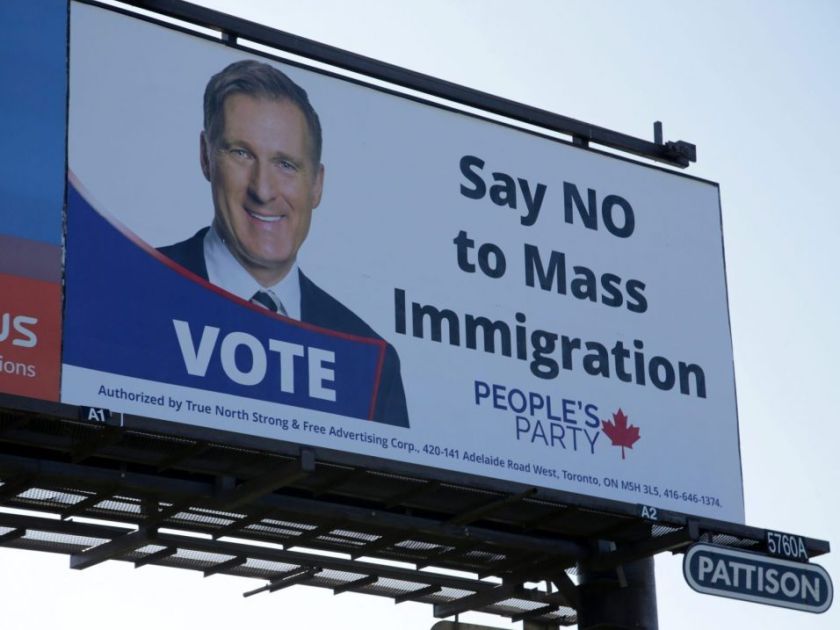
Recently a registered third-party (under Canadian election rules) paid to have billboards put up in major cities that appeared to be from Maxime Bernier’s People’s Party of Canada:

A billboard in Toronto, showing Maxime Bernier and an official-looking PPC message.
Photo from The Province – https://theprovince.com/opinion/columnists/gunter-berniers-legitimate-position-on-immigration-taken-down-by-spineless-billboard-company/wcm/ecab071c-b57d-4d93-b78c-274de524434c

Colby Cosh discusses the issues raised:

I offer sarcastic congratulations to everyone who gave Maxime Bernier the stupid controversy he wanted over the “Say NO to mass immigration” billboard, bearing his image, that briefly appeared in a few Canadian cities and was taken down in a hurry Monday morning. The billboards were purchased from Pattison Outdoor Advertising by a third-party supporter of Bernier’s People’s Party. The company’s initial response to the resulting outcry was to observe that the message of the billboard complied with advertising standards; it did not contain any hateful, disparaging, or discriminatory language.

“We take a neutral position on ads that comply with the ASC (Advertising Standards Canada) Code as we believe Canadians do not want us to be the judge or arbiter of what the public can or cannot see,” was Pattison’s original statement in the face of controversy. (Most everybody, including the company, seems to have missed the point that election advertising is explicitly “excluded from the application” of the Code on the grounds that political expression deserves the highest degree of deference; the Code does say, for what it’s worth, that “Canadians are entitled to expect” that such advertising respects the underlying principles.)

[…]

The question I have for objectors and denouncers of the billboard is how they think it could have been rewritten, expressing the same underlying idea, so as to be acceptable. If the unpleasant-sounding word “mass” were replaced with “large-scale,” would there have been less of a ruction? Maybe any objection to prospective levels of immigration to Canada is to be regarded as inherently racist and hateful, even when no racist or hateful language is used.

If that is the case, it is perfectly predictable that the People’s Party will exploit this and cry “mob censorship,” and public polls on immigration suggest they will have some success, in case recent history everywhere didn’t offer enough of a hint. Moreover, we are left with an awkward question how any limit upon or criteria for immigration, any government immigration policy per se, can be justified at all. What, indeed, can be the objection to “mass immigration”? Who will have the courage to put up a “Say YES to mass immigration” billboard?

August 5, 2019

More on the still-damaged diplomatic relationship between India and Canada

Filed under: Cancon, India, Politics — Tags: , , , , , , — Nicholas @ 03:00

Ted Campbell quotes from a recent article in the Hindustan Times about the not-yet-healed damage in the diplomatic world between Justin Trudeau’s government and the Indian government of Narendra Modi:

Justin Trudeau and family during India visit
Image via NDTV, originally tweeted by @vijayrupanibjp

In the influential Hindustan Times, Toronto based journalist Anirudh Bhattacharya writes … “in an astonishing attack that will not help heal fraught ties between India and Canada, the former top advisor to the North American nation’s Prime Minister has accused the Indian Government of sabotaging Justin Trudeau’s visit to India in February 2018 to favour his political opponents [and] This scathing statement is in the forthcoming book, Trudeau: The Education of a Prime Minister, written by senior Canadian journalist John Ivison. The author [Ivison] confirmed to the Hindustan Times that Butts’ comment came during an interview.” The article adds that “Indian diplomats didn’t comment on the matter because it is so politically charged and the Canadian Government has yet to respond to questions from HT on its stand on the incendiary remark from Butts.”

So, while some pundits forecast that the return of Gerald Butts would reignite the whole SNC-Lavalin/Jane Philpott and Jody Wilson-Raybould scandal, it appears that the damage will be deeper and we will get a chance to revisit the disaster that Justin Trudeau and Chrystia Freeland visited upon Canadian foreign policy in 2018. India is a rising great power; it helps to contain China in new “Western Approaches:” the Arabian Sea, Indian Ocean and the Bay of Bengal. India is a growing trading power; it is a HUGE potential market for Canadian goods and services. India is one of the top three providers of new Canadians ~ and that’s where our problems with India originated. Someone in the Trudeau PMO thought (since thinking was the problem that probably lets Justin Trudeau off the hook) that it would be a good idea for Prime Minister Trudeau to attend a Khalsa Day parade in Toronto back in April 2017. I explained, back at the time of the India trip fiasco, why that was a mistake and how Jason Kenney had already set the example of doing it right. Now Khalsa Day, also known as Vaisakhi, is an important festival for Sikhs, it marks their New Year. But the festivities, especially in Toronto where 300,000 Sikhs live, are, sometimes, taken over or interrupted by Sikh separatists who advocate violent revolution in India. Jason Kenney saw that in 2012 and he stormed off a stage and berated his hosts, in public for trying to use him to undermine Canadian foreign policy, which valued, as it should, good relations with India. But, in 2017 all the Trudeau PMO (headed by Gerald Butts and Katie Telford) could see were all those Sikh voters. Neither the PMO team nor new Canadian foreign minister Chrystia Freeland was able to prevent Trudeau from being used as a photo-op prop by avowed Sikh separatists … there is no indication that anyone tried although, even though, given the bureaucracy’s corporate memory of events in 2012, I would be amazed in alarms were not sounded.

June 13, 2019

Americans “don’t really believe in foreigners”

Filed under: Europe, History, Media, Politics, USA — Tags: , , — Nicholas @ 03:00

A few days back, Sarah Hoyt wrote a long post about the actual differences between American culture and the many different cultures that most Americans have difficulty understanding:

I don’t think anyone who hasn’t actually acculturated between two countries understands how different cultures can be, deep down, at the bone level and the most basic reactions level, let alone what causes the difference, from inherited influences to just deep built in assumptions about climate/physical plant/fauna.

And some of the people who have acculturated, at that, might not be self-aware enough to see the difference, and just replace one set of assumptions with another and roll with it. (Or get caught somewhere between. Well, to some extent we all get caught somewhere between. The question is, what percentage is in the new country. I’d say for me, after being in Portugal recently, probably 95% American. There are things trained in before the age of 3 which I’ll never let go of, though some got truly weird with the acculturation, like how I react to “shame.”)

That experience this weekend was the “clicking in” of something that’s been bothering me for a long time. In our writers’ group I used to run across people who projected modern AMERICAN female back into the time of pharaohs. One of my best friends refused to believe me when I told her there was zero chance of an alien race having the same university system as the US since even Portugal (avowedly human) doesn’t. There were other things. You guys have heard me rant about several “historical” books that make the past exactly like the future only with different tech. The fact that they don’t understand that tech affects not just how people live but how they think, feel and react is another of those things I don’t get, as I think even within living memory we should be able to see how different things have gotten. See for instance not wearing of aprons, because the clothes are cheap enough and abundant enough that ruining a shirt is not a big deal, unless it’s a very good shirt.

Technological shifts in living memory have made ordinary life from before the new technology (like cheap, dependable cell phones) almost unimaginable. How many movies and TV shows from before the mobile phone became widely available depended as a plot point on the characters being unable to communicate with one another at key moments? Many mystery novels of the pre-mobile-phone era probably make no sense at all to modern readers because instant communication has become “baked in” to our world.

The clothing aspect has been less obviously important, yet only a couple of generations back, most people owned perhaps three changes of clothing, including one “good” suit/dress for church-going or special occasions. We’ve become so wealthy as a culture that almost everyone has more than enough clothes for any imagined need … although church-going has become almost exotic to urban and even suburban folks, and formal attire is becoming more and more rare. (But everyone has more T-shirts and shorts than they know what to do with.)

But until this weekend I didn’t realize how prevalent and universal it is, since the clash took place between two people from native anglophone cultures, both of which are denizens of the net and contact people of other countries, regularly. Okay, one of them didn’t know she was dealing with a foreigner […] This weekend I realized people don’t really believe in foreign countries either. They’re willing to accept that some things (and those usually conform to their mental picture of the generic “culture” or “region”) are different, but that the fundamentals and the cherished unexamined assumptions might be different is unthinkable — literally. And if we can think of them, we still assume the other country is somehow “wrong” or worse “pretending” to be different to be contrary.

This means, ultimately, that even an era of instant all over the world communication, human tribalism still wins. And with it, I suppose, nationalism.

The wave of populism in the west that has taken the establishment and the mainstream media by surprise is a predictable response to the globalist attitudes of the elites. If you work hard enough at it, you can provoke unpleasant responses from those who don’t agree with your worldview, and the transnational elites have been working very hard indeed.

There are other implications: since it’s virtually impossible to avoid faster communication and more widespread travel in the future, this is going to make the next couple/three centuries a series of epic clashes, until either some sort of understanding emerges or polarized cultures can immigrate to the stars and far far away from each other.

Mass immigration is a REALLY bad idea (‘mkay) not that this is a surprise to any of you. People inhabiting enclaves of “their kind” are slow to acculturate (three generations, if it happens at all.) And the number of people coming over the Southern border is like nothing we’ve ever experienced before. And trust me, in terms of functionality, you do NOT want to import any culture descended from 17th century Spain. There is a reason that the American countries South of us are in crisis on a more or less permanent basis, and that Brazil, screwed up though it is, is more functional than the others. No, just no.

I’m certainly not against immigration, but I strongly believe it is possible to have too much immigration, as Europe and the United States are being forced to confront. When people leave their native land to go somewhere else, be it for economic or political reasons, there’s a natural expectation that they will at least attempt to acculturate to their new country. To western elites, this is wrong (or at least, misguided) and “we” should encourage new immigrants to avoid acculturation and to embrace and celebrate the culture they came from. Because reasons. And a lot of immigrants are happy to avoid the hard work of learning how to fit in to the foreign culture they find themselves in — and it is hard work — leading to second or third generations who still can’t or won’t fit in and adapt to the culture.

Let me just say that is one more proof of “people don’t really believe in foreigners.”

Sure, a lot of American culture is triumphant and imitated. Only it’s more “spoofed” because what they imitate is what they see in movies, and proving that humans prefer narrative to lack there of, even when it makes no sense, the bad parts are often picked up first. And they’re often bad parts only seen in movies, btw. Like certain underclass behaviors being seen as glamorous.

But it’s an overlay. At a deep down level, these people dressing in jeans and t-shirts are still foreign and — THIS IS VERY IMPORTANT — don’t believe Americans software-in-the-head is different, which leads to cargo-cultish attempts to import American successes without getting what brings them about, from innovation, to social mobility to freedom of speech. Not really, not at a deep level.

[…]

This means the left’s project of “fighting nationalism” is not just doomed, but it’s stupid as eating rocks, and will cause only unending misery suffering and war. (So, SOP for Marxists. In fact, chalk this whole internationalism bullshit as something else Marx was wrong about. Workers of the world unite, my little sore feet.)

May 13, 2019

U.S. Civil War – Surprising Soldiers – Extra History

Filed under: Americas, History, Military, USA — Tags: , , , , — Nicholas @ 04:00

Extra Credits
Published on 11 May 2019

Historians have been learning that the US Civil War armies were a lot more diverse than previously accounted for — partly because many soldiers who hailed from other countries and nations used adopted names. Chinese, Hawaiian, Hispanic, and Cherokee soldiers all participated on both sides of the US civil war — suffering even more conflict in some cases.

Researchers are beginning to learn that the makeup of the Union and Confederate armies in the US Civil War was a lot more nuanced and diverse than we had previously known. Here is an episode on the accounts of some of those surprising soldiers!

Join us on Patreon! http://bit.ly/EHPatreon

March 18, 2019

Reconciling the libertarian and anti-immigration wings of Maxime Bernier’s PPC

Filed under: Cancon, Liberty, Politics — Tags: , , , — Nicholas @ 03:00

In the Post Millennial, Brad Betters looks at how the PPC’s libertarian ideals co-exist with skepticism about current government immigration plans:

While there are many patterns of abuse in the mass media’s everyday coverage of Maxime Bernier — i.e. the constant comparisons to Donald Trump, the failure to actually engage with his policies, quoting those who accuse him of “pandering”, while failing to quote his supporters (although there is the occasional exception) — one that jumps out is the routine questioning of his ideological bona fides.

Being ideologically inconsistent is a serious charge for many among Bernier’s base. While not a concern for liberals and progressives (they just want power and results), it is for many conservatives, even if it means becoming “beautiful losers”, as one US conservative commentator put it years back.

Recently, the National Post’s John Ivison referred to Bernier’s party, the People’s Party of Canada (PPC), as being plagued by a “fundamental contradiction” in that it’s “led by a libertarian free-marketer and supported by anti-globalists.”

Although vague, Ivison is no doubt, at least in part, referring to the PPC’s call to reduce immigration levels. His Post colleague Stuart Thomson was more express, calling Bernier’s immigration position “a diversion from his ideological playbook” — a criticism repeated by Global News’ West Block host Mercedes Stephenson among others.

In calling to reduce immigration, Bernier is being perfectly faithful to free-market thought. Importing workers from abroad, if high enough, can lead to supply shocks in the domestic labour market, weighing down and distorting wage rates in the process — indeed, economists are mystified why wages in Canada have flatlined despite years of growing GDP.

For large employers, these expansions can lead to giant windfalls and a chance to avoid facing market discipline — i.e. by not innovating or offering the wages needed to draw in new workers. Markets which are expanded artificially are not “free”, and profits pumped-up with the help of government we usually call ‘subsidies’: two things free-marketer libertarians revile.

Equally reviled among libertarians is ‘big government’; something that goes hand in hand with mass immigration. Large populations with diverse languages, cultures, and religions serve as a perfect excuse for new government programs and bureaucratic meddling: from government-funded language instruction, translators, and signage, to more housing and educational and job-training initiatives for unprepared newcomers.

Overlaying all this is the array of government watchdogs mandated to ensure immigrating visible minorities get the requisite (i.e. ever-increasing) amount of cultural sensitivity and achieve economic parity with old-stock Canadians.

March 10, 2019

Irish Potato Famine – The American Wake – Extra History – #4

Filed under: Britain, Cancon, Food, History, Religion, USA — Tags: , , , , , — Nicholas @ 06:00

Extra Credits
Published on 9 Mar 2019

Not all of the 214,000 Irish immigrants in 1847 made it safely to their new homes — and of those who did, many faced classism and xenophobia and even bullying from the “Ulster Irish” or “Scots-Irish” folks who had previously established themselves. In New York City specifically, the Five Points neighborhood became an infamous center of conflict — while local Irish-American John Joseph Hughes became instrumental in restoring Irish Catholicism.

Join us on Patreon! http://bit.ly/EHPatreon

March 7, 2019

Anti-semitism in Europe

Filed under: Europe, History, Religion — Tags: , , , , — Nicholas @ 03:00

Mark Steyn discusses the unexpected result of a few generations of Europeans feeling guilt for allowing the Holocaust to happen: renewed feelings of anti-semitism all around.

As Laura Rosen Cohen likes to say, everyone meets at Jew-Hate Junction: excitable young Mohammedans, secular polytechnic Euro-lefties, anti-globalist conspiracy theorists… It’s getting pretty crowded over there. As I wrote almost exactly a decade ago about the Ismalization of Europe:

    There are already many points of cultural friction — from British banks’ abolition of children’s ‘piggy banks’ to the enjoining of public doughnut consumption by Brussels police during Ramadan. And yet on one issue there is remarkable comity between the aging ethnic Europeans and their young surging Muslim populations…

…Jews.

Young Muslims do not like Jews: that is a simple fact, and it’s a waste of everybody’s time denying it. Where Muslims predominate, Jews vanish – as in Molenbeek, across the canal from downtown Brussels. I remember from my childhood the main drag, the Chaussée de Gand (or Steenweg op Gent, if you’re Flemish, as my mum was), as a bustling strip with many Jewish businesses. But in the first decade of the 21st century they all disappeared, and their former owners chose to remain silent – because it was easier that way.

One hairdresser, for example, had “DIRTY KIKE” sprayed on his window and was punched in the face by a gang of half-a-dozen “youths”. So he went to the police and filed a complaint. One hour later, the “youths” returned and smashed all his hairdressing mirrors. His clients didn’t want to come after that, and so a 35-year business closed its doors.

Now they’re all gone.

Ethnic Continentals, on the other hand, do not like Muslims, and they see where this is headed, and it’s easy to blame Jews. The logic is not difficult: ‘Tween-wars Europeans would never have entertained for a moment the construction of mosques in every corner of their countries. But then the Holocaust happened, and “nationalism” got blamed, and mass immigration was instituted as a form of penance, and in one of history’s blacker jests the principal beneficiary of Holocaust guilt was Islam. So, in the newest variant of the oldest hatred, Jews get hated for the Islamization of Europe.

And then there’s simply the crude arithmetic of day-by-day remorseless demographic transformation in democratic societies: Muslims are where the votes are, and Jews aren’t. Which is why Jeremy Corbyn’s Labour Party is happy to while away the hours on such vital debates as the question of whether Hitler was a Zionist.

January 10, 2019

A timely reminder about the dangers of expanding government power

Filed under: Government, Liberty, Politics, USA — Tags: , , , , — Nicholas @ 05:00

At Coyote Blog, Warren Meyer points out to the Republicans that if it was bad during the last presidency, it’s just as bad during this one:

Dear Republicans:

The last thing we need now is even more expansion of executive power. I remember when, gosh it was like only two or three years ago, you Republicans were (rightly) bemoaning Obama’s executive actions as unconstitutional expansions of Presidential power. You argued, again rightly, that just because Congress did not pass the President’s cherished agenda items, that did not give the President some sort of right to do an end-around Congress.

But now, I hear many Republicans making exactly the same arguments on the wall that Obama made during his Presidency, with the added distasteful element of a proposed declaration of emergency to allow the army to go build the wall.

[…]

I can pretty much guarantee you that if Trump uses this emergency declaration dodge (and maybe even if he doesn’t now that Republicans have helped to normalize the idea), the next Democratic President is going to use the same dodge. I can just see President Warren declaring a state of emergency to have the army build windmills or worse. In fact, if Trump declares a state of emergency on a hot-button Republican issue, Democratic partisans are going to DEMAND that their President do the same, if for no reason other than tribal tit for tat.

December 3, 2018

US immigration – two views

Filed under: History, Politics, USA — Tags: , — Nicholas @ 03:00

In the latest Libertarian Enterprise, John Walker presents two fascinating charts illustrating the levels of immigration to the United States since the beginning of the nineteenth century. Depending on which one you see, your interpretation will likely differ substantially. The first, the way the statistics are usually presented, show the current rate of immigration to be a very significant — even unprecedented — economic and political concern:

Immigration shown in raw numbers.

The less common way of illustrating the immigration numbers is showing it proportional to the whole population, which would not work anywhere near as well to support certain narratives:

Immigration to the US shown in proportion to the population.

This is a very different picture. There are clearly two different epochs. In the first, between 1820 and 1930, the U.S. was “filling up the empty country” by admitting large numbers of immigrants. Then, due to immigration restrictions in the Immigration Act of 1924 and the subsequent economic depression and war, immigration remained at low levels until 1946 when, in the immediate postwar period, it jumped. In this view, the impact of the Immigration and Nationality Act of 1965 was not the discontinuous change some present it as (at least in terms of absolute numbers; it may have changed the composition of the immigrant population, which is not captured in these statistics).

Instead, the trend established after 1946 continued to rise continuously until 1989–1991 when it went all whacko. These numbers, as a fraction of the population, haven’t been seen 1923 or since. If you take out those crazy years, the overall trend of immigration as a fraction of the existing population continues to rise almost linearly since 1946.

September 28, 2018

The staunch Progressive dismissal of Warren Harding and Calvin Coolidge

In Richard Epstein’s review of Jill Lepore’s recent book These Truths: A History of the United States, there’s some interesting discussion of the Harding and Coolidge administrations:

Lepore’s narrative of this period begins with President Warren Harding, who, she writes, “in one of the worst inaugural addresses ever delivered,” argued, in his own words, “for lightened tax burdens, for sound commercial practices, for adequate credit facilities, for sympathetic concern for all agricultural problems, for the omission of unnecessary interference of Government with business, for an end to Government’s experiment in business, for more efficient business in Government, and for more efficient business in Government administration.” Harding’s sympathetic reference of farmers is a bit out of keeping with the rest of his remarks. Indeed, farmers had already been a protected class before 1920, and the situation only got worse when Franklin Roosevelt’s administration implemented the Agricultural Adjustment Acts of the 1930s, which cartelized farming. But for all her indignation, Lepore never explains what is wrong with Harding’s agenda. She merely rejects it out of hand, while mocking Harding’s conviction.

Given her doggedly progressive premises, Lepore may have predicted a calamitous meltdown in the American economy under Harding, but exactly the opposite occurred. Harding appointed an exceptionally strong cabinet that included as three of its principal luminaries Charles Evans Hughes as Secretary of State, Andrew Mellon as Secretary of Treasury, and Herbert Hoover as the ubiquitous Secretary of Commerce, with a portfolio far broader than that position manages today. And how did they perform? Lepore does not mention that Harding coped quickly and effectively with the serious recession of 1921 by refusing to follow Hoover’s advice for aggressive intervention. Instead, Harding initiated powerful recovery by slashing the federal budget in half and reducing taxes across the board. Both Roosevelt and Obama did far worse in advancing recovery with their more interventionist efforts.

To her credit, Lepore notes the successes of Harding’s program: the rise of industrial production by 70 percent, an increase in the gross national product by about 40 percent, and growth in per capita income by close to 30 percent between 1922 and 1928. But, she doesn’t seem to understand why that recovery was robust, especially in comparison with the long, drawn-out Roosevelt recession that lingered on for years when he adopted the opposite policy of extensive cartelization and high taxes through the 1930s.

Lepore is on sound ground when she attacks Harding and Coolidge for their 1920s legislation that isolated the American economy from the rest of the world. The Immigration Act of 1924 responded to nativist arguments by seriously curtailing immigration from Italy and Eastern Europe, subjecting millions to the ravages of the Nazis a generation later. Harding and Coolidge also increased tariffs on imports during this period. What Lepore never quite grasps is that any critique of these actions rests most powerfully on the classical liberal worldview that she rejects. Indeed, Harding and Coolidge exhibited the same intellectual confusion that today animates Donald Trump, who gets high marks for supporting deregulation and tax reductions at home, while simultaneously indulging in unduly restrictive immigration policies and mercantilist trade wars abroad. Analytically, however, the same pro-market policies should control both domestically and abroad. Hoover never got that message — as president, he signed the misguided Smoot-Hawley Tariff Act of 1930 that sharply reduced the volume of international trade to the detriment of both the United States and all of its trading partners, which helped turn what had been a short-term stock market downturn in 1929 into the enduring Great Depression of the 1930s.

September 14, 2018

The Mencken Society versus the alt-right “Mencken Club”

Filed under: History, Liberty, Media, Politics, USA — Tags: , , , — Nicholas @ 03:00

In the current issue of Reason, Mencken biographer Marion Elizabeth Rodgers explains why the great essayist would not welcome the adulation of the alt-right “Mencken Club”:

Libertarians and conservatives have always admired H. L. Mencken, the 20th century journalist and satirist famous for his literary and political commentary. Now the Baltimore author and editor, whose heydey lasted from the 1920s to the late 1940s, has become a hero to the alt-right, who have cherry-picked his views to support their white supremacist vision. For white nationalist leader Richard Spencer and fellow enthusiasts, Mencken embodies “worthy ideals,” namely, a questioning of “the egalitarian creed, democratic crusades, and welfare statism” that American democracy has become since the New Deal. Such is the essence of humor: It is hard to believe that Mencken would have ever given his worshippers the time of day.

[…]

Unlike the Mencken Society — a scholarly organization founded in 1976 in Baltimore that hosts talks on Mencken’s life and works by such luminaries as the late Christopher Hitchens, Arnold Rampersad, and Alfred Kazin — the Mencken Club holds pseudo-academic conferences ranging in themes as “The West: Is It Dead Yet?” or “The Right Revisited.” In 2016, the club focused on the populism of Donald Trump and the preservation of white Christian heritage through anti-immigration policies. White House speechwriter Darren Beattie spoke to members alongside Peter Brimelow, white nationalist and founder of the anti-immigrant website Vdare.com — a gig that ultimately cost Beattie his job.

Speakers rarely mention Mencken’s name at their meetings, except for random recitals from Chrestomathy or his earliest works: The Philosophy of Friedrich Nietzsche (1908), whom the alt-right see as a great visionary, and from Men Versus the Man: A Correspondence between Rives La Monte, Socialist, and H. L. Mencken, Individualist (1910), an epistolary debate where Mencken explores Social Darwinism, eugenics, heredity, and race. In the most offensive passage, Mencken defines “the American negro” as “a low-caste man,” and that the “superior white race will be fifty generations ahead of him.” In its podcast, club members touted Men Versus the Man as “a fun book” and asserted “race realists, anti-globalists, educational reductionists and immigration restrictionists can draw nourishment from Mencken … and his disdain for the low-caste man.”

In reality, Mencken would have shunned the white identity politics of the alt-right. To Mencken, Nietzsche’s “superior man” was the enlightened individual of honor and courage, regardless of race, creed, or social background. Soon after 1910, Mencken reversed his views of white superiority and began calling for civil rights for African Americans. Despite the fact that his Diary contains racial slurs and ethnic slang, Mencken rebelled against “the Aryan imbecilities of Hitler” and stated: “To me personally, race prejudice is one of the most preposterous of all the imbecilities of mankind. There are so few people on earth worth knowing that I hate to think of any man I like as a German or a Frenchman, a gentile or a Jew, Negro or a white man.”

He was especially contemptuous of white Anglo-Saxon Southerners, describing them as “shiftless [and] stupid,” and extolled African Americans as “superior to the whites against whom they are commonly pitted.” Unique for the mid-1900s and into the ’20s and ’30s, he collaborated with black intellectuals and was the first white editor to publish their work in his magazine, The American Mercury, and energetically promoted their writings in his books and columns and to his publisher Alfred Knopf. He was relentless in his campaigns against the Ku Klux Klan, and he joined forces with the NAACP to testify against lynching before the U.S. Congress. He repeatedly wrote against segregation; behind the scenes he discussed strategies with African-American leaders to promote civil rights.

August 23, 2018

Cultural Appropriation Tastes Damn Good: How Immigrants, Commerce, and Fusion Keep Food Delicious

Filed under: Americas, Business, Food, Health, USA — Tags: , , — Nicholas @ 02:00

ReasonTV
Published on 1 Aug 2018

Writer Gustavo Arellano talks about food slurs, the late Jonathan Gold, and why Donald Trump’s taco salad is a step in the right direction.
———-

Reason is the planet’s leading source of news, politics, and culture from a libertarian perspective. Go to reason.com for a point of view you won’t get from legacy media and old left-right opinion magazines.

—————————

The late Jonathan Gold wrote about food in Southern California with an intimacy that brought readers closer to the people that made it. The Pulitzer Prize–winning critic visited high-end brick-and-mortar restaurants as well as low-end strip malls and food trucks in search of good food wherever he found it. Gold died of pancreatic cancer last month, but he still influences writers like Gustavo Arellano, Los Angeles Times columnist and author of Taco USA: How Mexican Food Conquered America.

Arellano sat down with Reason‘s Nick Gillespie to talk about Gold’s legacy, political correctness in cuisine, and why Donald Trump’s love of taco salad gives him hope in the midst of all of the president’s anti-Mexican rhetoric. The interview took place at Burritos La Palma, named by Gold as home to one of the five best L.A. burritos.

August 15, 2018

Maxime Bernier on sensible limits to “unlimited” diversity

Filed under: Cancon, Politics — Tags: , , , , — Nicholas @ 03:00

Maxime Bernier responds to Prime Minister Trudeau’s apparently unlimited desire for more and more diversity in Canada:

The following tweets as a screencap, to avoid slowing down the whole page loading (as often happens with multiple tweet embeds):

July 25, 2018

Britain, refugees, and migrants

Filed under: Britain, Economics, Law, Politics — Tags: , , , , — Nicholas @ 03:00

Alex Noble explains why Britain needs migrants, but not all migrants:

Nurses, doctors, engineers, scientists, computer programmers – our society is very advanced and a big chunk of our economic strength is based on advanced services that need skilled people like these. And there aren’t enough native Brits skilled in these areas – our demand outpaces our supply of people. We need lots of computer programmers and only relatively few native Brits are qualifying in computer sciences. And the shortage of young Brits taking STEM subjects is worsening.

So far so good – we need a supply of skilled migrants for the foreseeable future. Hopefully we can all agree on that.

Do we need unskilled migrants?

Because when people with no skills come to the UK, we suffer and so do they. They are either forced into crime, fall into modern slavery, or find themselves exploited working on the black market.

When they are forced into crime, we see more stabbings and rapes and burglaries and murders.

When they fall into modern slavery we see more people-trafficking, more forced prostitution.

When they are exploited, they are forced to work below minimum wage, and the jobs that young British teenagers might have taken are taken by those willing to work for a pittance just to stay alive. When they find themselves working in the black market, they pay no tax and have no protections.

Modern Britain does not need or desire these things – young people enslaved and forced to work for low pay, exploited, or forced into crime. These are profoundly negative developments for our society, and a grotesque abuse of people who were mislead into coming here for what they thought would be a new life.

Modern Britain does not need unskilled migrants, and should not enrich their slavers.

And that brings us to refugees.

Are there genuine refugees? Yes of course.

But we know what refugees look like – men, women and children staggering over the border into the nearest safe nation with the clothes on their backs and often not much else. Poverty-stricken and unable to return to the homelands, they throw themselves on the mercy of their neighbours. Refugees don’t abandon their families in war zones and travel thousands of miles alone. They do not have thousands of dollars to give to slave traders for a seat on their rickety barges.

What we see on the boats are not refugees.

They are mostly young men coming for a better life. And while we cannot begrudge them those intentions, we have already discussed why unskilled migrants cannot be welcomed here in large numbers. And unskilled migrants they mostly are, because skilled migrants come armed with work permits and speak the language. At the very least they have documentation to prove who they are, because being able to prove you are an Iranian heart surgeon is important. Being able to prove you are a penniless and unskilled Eritrean, who doesn’t speak English……………that’s not an identity worth retaining at a border check.

And so the Mediterranean sea floor is littered with their travel documents.

Genuine refuges stagger over the nearest safe border – we must help them if we can.

The unskilled migrants travel here in boats, trafficked by modern-day slavers into the underworlds of our nations. They may have hope in their hearts, but they are bringing misery into a society that cannot absorb them.

« Newer PostsOlder Posts »

Powered by WordPress