Quotulatiousness

July 24, 2018

The impact of licensing on previously unlicensed jobs

Filed under: Business, Economics — Tags: , , , , , — Nicholas @ 03:00

In the current Libertarian Enterprise, Sean Gabb looks at the recent outrage at Jeff Bezos and Amazon and recounts how at least one job he’d done in the past is now closed off to casual entrants due to the growth of licensing:

Let us imagine a natural order — that is, a world without states, or at least a world without the extended patterns of state-intervention that now exists. In such a world, wage labour would continue to exist. There are benefits in working for someone else. An employee commits to a contract of permanent service, in return for which he receives reasonable certainty of payment. Not everyone is or wants to be an entrepreneur. Not everyone finds it suitable to keep looking for unsatisfied wants and the most rewarding means of satisfying those wants. This being said, there would probably be much less wage labour than there is now.

If the present order of things does little to deter men like Mr Bezos, it does much to deter little people from starting little businesses — little business that sometimes replace, but more often supplement employed income. When I was much younger, the easiest way I found of making extra money was to drive a mini-cab. I went to the nearest cabbing office. I showed my clean driving licence. I showed a certificate of hire and reward insurance. I handed over £25 rent for the week, and was given a two-way radio and a cabbing number. That evening, I was taking prostitutes to their clients and pushing drunks up their garden paths. You cannot do this nowadays. Cabbing is licensed and regulated. It costs thousands to get a licence, and the regulations about age and type of vehicle add tens of thousands more to the costs of entry. You cannot get into cabbing unless you can pay these entry costs, and unless you are able to pay them back by working there full-time and long-term. A casual business has been made into a profession.

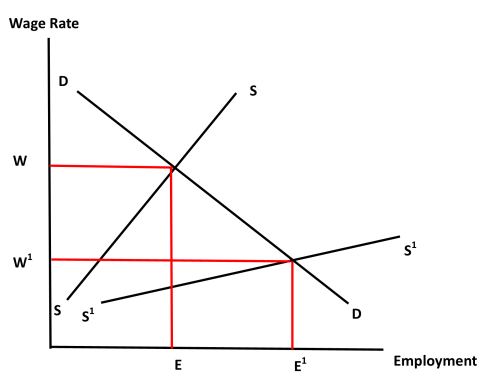
This is an example of which I have personal knowledge. But there is a vast range of little businesses that bring some money to little people. They have nearly all been placed out of reach. The effect is to increase the supply of unskilled labour seeking employment. Think of a supply and demand diagram. Shift the supply curve to the right. Make it more elastic. Money wages will be lower than they would otherwise be. Conditions of work — and these are part of the overall wage — will be worse. Make laws to prevent the market from clearing, and there will be more unemployment.

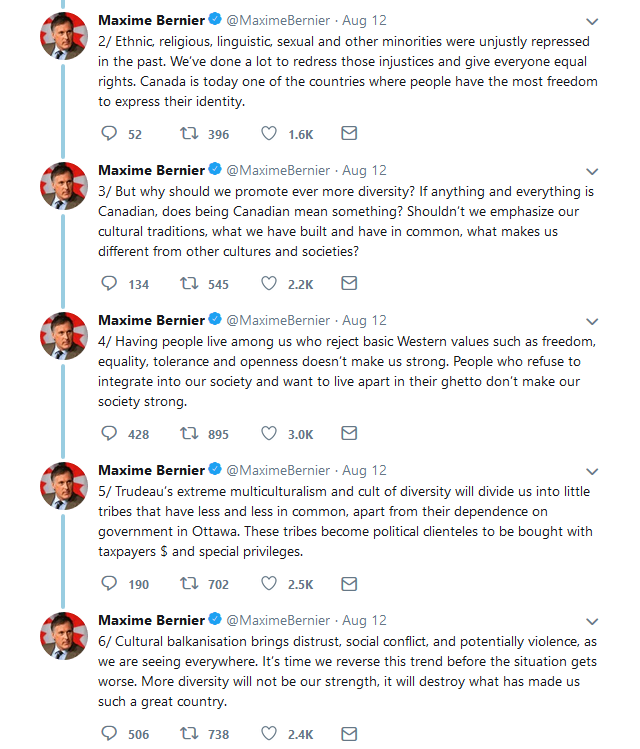
A further point I mention without choosing to develop is mass-immigration. This is not the kind of movement you would see in a natural order, where virtually the whole cost of entry and adjustment fell on the individual entrant. It is a movement encouraged and subsidised by the State — encouraged by institutional political correctness, and subsidised by laws that amount to forced association. The effect in economic terms is again on the supply curve for labour.

I have no reason to believe that Mr Bezos and Amazon have done anything to bring about this state of affairs. They simply operate in the labour market as they find it. No one is forced to work for Amazon. Amazon is not a legal monopoly, and has no power to force down wages. It pays at least the going rate. It is not a charity, and cannot be expected to behave as a charity. Blaming Amazon for how it pays and treats its workers makes no more sense than blaming a clock for telling the time.

He also touches on the state-created legal situation of limited liability:

I turn to the objection that Amazon is a limited liability company. This is an objection I accept. Limited liability companies exist because of a grant of privilege by the State. They are treated as persons, responsible for their own debts. Their owners have no liability beyond the value of the shares they own. This grant allows companies to gain more investment capital than they otherwise might. It allows them to grow larger and to exist for longer than they otherwise might. It allows even the most entrepreneurial company to turn gradually into a private bureaucracy, trading favours with the various state bureaucracies. Limited liability turns business into the economic arm of a malign ruling class.

So far as Amazon benefits from limited liability, it is an illegitimate enterprise. But this is not the end of the matter. Amazon almost certainly could exist without limited liability. It would instead have raised its investment capital by selling bonds. It would then only be in form what it plainly is in substance — that is, a projection of its owner’s ambition to achieve greatness. It would still have grown large, and it would have grown large by giving its customers what they want.

June 28, 2018

Shifting attitudes toward mass immigration in Europe

Filed under: Africa, Europe, Middle East, Politics — Tags: , , , — Nicholas @ 03:00

At Gates of Vienna, Baron Bodissey maps the way public sympathies are changing in the wake of the immigration/refugee waves of the last few years:

From Szczecin in the Baltic to Trieste in the Adriatic, a Razor-Wire Curtain Has Descended…

Immigration-related events are moving rapidly this in Europe summer. The situation is in such flux that now would be a good time to step back and try to get an overview of the process.

Three years ago the dead baby hysteria, followed by Chancellor Merkel’s invitation to the world (“Y’all come in and set a spell, bitte!“), launched the Great European Migration Crisis. Since then I’ve read hundreds of news articles and analyses about the flow of “refugees” and the reactions to their violent and fragrant arrival in Western Europe.

After digesting all that information I created the following map, which presents my subjective evaluation of the different approaches to migration by various European countries. I’ve rated the policies of 28 different countries (the EU 27 minus Croatia, plus Switzerland) on a scale from 0 to 100, from zero (red) for the open-borders attitude of the “Welcoming Culture” to 100 (blue) for the absolute refusal of mass migration by the Visegrád Four (Hungary, Poland, Slovakia, and the Czech Republic). Data from the last six months weighs more heavily in the score assigned to each country — for example, Spain and Italy recently changed governments, which has strongly affected each country’s migration policy.

[Click to see full-sized image]

The grouping of countries based on their stance on migration bears a striking resemblance to the division of Europe into East and West by the Iron Curtain. This is especially true if we roll the clock back three months — back then Italy and Bavaria would have been quite red. And the analogy becomes even more apt if we remember that Austria was occupied by Soviet troops until 1955, which gives it one foot in the Eastern camp.

The biggest change in the past three months has been the formation of a new anti-immigration government in Italy. The “xenophobia” of the East Bloc has now broken through the razor-wire curtain and gained a foothold in Western Europe. No wonder EU politics is in such turmoil! After failing to contain the “anti-European” attitudes of Poland and Hungary, Brussels now has to contend with Matteo Salvini. Italy is one of the “big four” pillars of the European Union, so its defection to the anti-migration side carries enormous significance for continental politics.

The situation is metamorphosing rapidly, but before we analyze the process of change — the “delta”, as they say in the military-industrial complex — let’s go over the snapshot of current European migration policies.

June 24, 2018

Europe and the refugees

Filed under: Africa, Europe, Government, Italy, Law, Middle East, Politics — Tags: , , , , — Nicholas @ 05:00

Theodore Dalrymple on the various European governments’ attitudes and actions on the refugee problem:

Europe, despite its Union, is as divided as ever. Recently, when Italy’s new right-wing government — anxious to prove its credentials — refused to allow a boat carrying 629 African migrants to dock in Italy, Spain’s new left-wing government — equally anxious to do the same — accepted the boat. When the French president, Emmanuel Macron, criticized the Italians for their decision, the Italian government accused the French of hypocrisy, inasmuch as they had refused to take more than 9,000 migrants from Italy that they had previously agreed to accept.

This story is revealing in several aspects. The first is that, whatever attitude governments take to the migrants, no one truly believes that they are more of an asset than a liability. Madrid’s action, for example, was taken on “humanitarian” grounds, rather than because it believed that Spain would benefit from the migrants’ presence. When European leaders discuss the migrant question, it is always in terms of sharing the burden, not the assets, equitably. No one speaks of foreign investment in this way, which suggests that European politicians believe, whether rightly or wrongly, that the free movement of people and capital are different in an important way.

The leaders speak of sharing the burden, then, and are incensed when countries such as Hungary and Poland refuse point-blank to take any migrants from Africa or the Middle East. But I have never seen mentioned in this context the question of where the migrants themselves want to go. They might as well be inanimate toxic waste as far as the discussion is concerned, rather than human beings with wishes, desires, ambitions, and so forth. They are but pawns in a political game. Hungary, for example, is deemed duty-bound to take x number of migrants: no one asks whether x number of migrants can be found who want to go to Hungary. Nor is the question ever discussed in public whether Hungary, having open borders, would be held responsible for making the migrants stay there once they had arrived. Short of penning them in, how exactly would you keep them in Hungary, or in Poland?

June 19, 2018

Time to throw Mutti Merkel under the bus?

Filed under: Europe, Germany, Politics — Tags: , , , — Nicholas @ 03:00

Sabine Beppler-Spahl thinks Angela Merkel’s time is running out:

Angela Merkel’s days may be numbered. ‘She will never recover from this crisis’, said an article in a German newspaper last week, about the rift within her government over immigration.

This latest crisis began after the interior minister, Horst Seehofer, announced that he wanted to introduce tougher rules for asylum seekers, including turning away those who have already been registered in another EU country. Merkel responded by saying that Europe needed a common solution to the refugee crisis, and that she would discuss it with French president Emmanuel Macron during his upcoming visit, and at the EU summit later this month. She blocked Seehofer from unveiling his immigration ‘master plan’, and he has insisted that a solution should be found by today. He has also threatened to sidestep Merkel and impose his plan regardless, leading to speculation about a government breakdown, and a confidence vote, little more than 100 days since the new ruling coalition, led by Merkel’s Christian Democratic Union (CDU), was formed.

[…]

Merkel’s decision to put the brakes on Seehofer’s ‘master plan’ reflects her evasive and anti-democratic style. No voter has yet been able to read this plan, let alone discuss it. Her concern about publishing it reflects the contempt in which she holds democratic debate. Meanwhile, her carefully prepared statements on the issue (mostly in the form of TV interviews with choice journalists or her own weekly podcast) rarely tell us very much at all. Despite opening Germany’s doors to refugees in 2015, she has never made a proper public case for the benefits of immigration. Her inability, or unwillingness, to explain her politics to the electorate has contributed to the narrow and technical way in which immigration is being discussed in Germany these days, with a focus on numbers and deportation practices.

Taking an issue to the ‘European level’ has become Merkel’s default solution to everything. ‘This is a European challenge that also needs a European solution’, she said in her latest podcast. Of course, a joint European solution would be preferable, but not if this means bypassing national electorates. Her original plan of imposing migrant quotas on other EU member states has failed completely. Excluding the public from the debate, and discussing politics behind closed doors, is simply not cutting it with voters. Whatever one thinks of Seehofer’s ‘master plan’, he is right that immigration needs to be discussed and decided upon at the democratic, national level.

April 24, 2018

The Windrush scandal in Britain

Filed under: Britain, Bureaucracy, Government, Media, Politics — Tags: , , , , — Nicholas @ 05:00

Brendan O’Neill discusses the bureaucratic idiocy that lead to thousands of people who’d been living and working in Britain are threatened with loss of jobs, loss of healthcare rights, and even deportation:

The Windrush scandal and its fallout might have exposed the incompetence of Theresa May and her political set. But it has done something far worse to Remainers. It has laid to waste their entire worldview. It has shattered their defining myth: that where they brave few are nice and pro-immigrant, the rest of the country, especially those little-educated inhabitants of ‘Brexitland’, are a seething pit of 1930s-style racism. In the palpable public discomfort with how the Windrush migrants have been treated, we see yet again what a libel this Remainer depiction of Brexit Britain has been.

For nearly two years, the liberal intelligentsia has talked about vast swathes of the electorate as a hateful throng whose prime motor is disgust with foreigners. These people yearn for a time when ‘faces were white’, says Vince Cable. The vote for Brexit was a ‘whitelash’, said Guardian columnist Polly Toynbee, which was quite the slur against the one in three ethnic-minority voters who chose Brexit. These mad voters just want ‘less foreign-looking people on their streets’, said Diane Abbott. The police churned out ridiculous hate-crime stats, using entirely subjective criteria to declare there had been an outpouring of violent hate after the referendum, and columnists lapped it up. Brexit Britain was divided between an enlightened elite that doesn’t care about skin colour or national origins and the fever-minded masses who apparently think about little else.

It was a lie, of course, as many of us argued, and as many more should now see in the wake of the Windrush scandal. With every revelation of the Home Office’s mistreatment of Caribbean migrants, public displeasure grows. People can see the grave injustice of treating as criminals people who have been here since the 1940s and 50s and who were given leave to remain by an act of law in 1971. The way these Britons have been thrown out of their jobs or deprived of NHS care or in some cases deported — because rules introduced when Theresa May was home secretary stipulate that all migrants must now have official documentation — has grated with the populace. This was reflected in a poll published by iMix and the Runnymede Trust last week, which found that 60 per cent of Britons, rising to 71 per cent for over-65s, are opposed to what the government has done to the Windrush people. Those same over-65s who for the past two years have been talked about as racist scum by the Remainer chattering classes.

The Remainer elites’ religious conviction that huge parts of Britain are little more than racist-mobs-in-waiting is falling apart, fast. Even before the public concern with the mistreatment of the Windrush generations, there was the survey carried out by Open Europe at the end of last year which challenged the idea that the vote for Brexit was a ‘mandate to pull up the drawbridge’. On the contrary, many Britons still see the value in migration — they simply want some say over it, they want it to be a democratic concern. Open Europe found ‘little evidence’ that this ‘desire to control immigration’ was driven by ‘racism or xenophobia’. Even the EU now accepts Britons are not horrible racists. Its attitudes survey found the proportion of Brits who are ‘very positive’ or ‘fairly positive’ about migrants rose from 43 per cent to 63 per cent over the past four years, which includes the post-Brexit period when we were supposedly taking to the streets to bash a foreigner.

Sweden’s free speech problem

Hugo Brundin explains why the social unrest Sweden is experiencing over immigration issues today is made much worse by restrictions on free speech:

Few in Sweden have escaped the circus of its migration politics. During the migration crisis of 2015, we had the somewhat dubious claim to fame of receiving record-breaking numbers of asylum-seekers. A year later, in Spring 2016, the ruling Social Democrats closed the borders. For a while, calling attention to problems in Sweden’s immigrant-dominated suburbs would have you branded an alarmist or a racist. Then in January 2018, the Swedish PM Stefan Löfven said he would consider using the military to curb gang violence in those same suburbs (a comment he later retracted). More recently, the Social Democrats have proposed a ban on all religious schools, clearly aimed at those of the Muslim faith. No party in the Swedish parliament supported such a ban a couple of years ago.

Those concerned with immigration have held Sweden up as a warning of the consequences of open-door migration. But the deeper problem in Sweden is one of public discourse, debate and freedom of speech. You see, Sweden has a consensus culture. The Overton Window is so notoriously narrow that it has been termed the ‘opinion corridor’. And when you’re hurtling down the corridor, unable to see what is around the next corner, much less the one after that, you never know where its twists and turns will take you. Opinions that would have had you vilified a few years ago are now part of the political mainstream, and frankly this can feel downright creepy. Sweden should not be a warning of how not to handle migration – it should be a warning of how not to handle public discussion.

Proposals such as the one to ban religious schools, a deeply intolerant and authoritarian idea, are exactly the sort of thing you get when public opinion changes on a dime, when conflicts have not been properly hashed out in public debate. It used to be said that open-door migration would save the economy and welfare state (rather than put strain on them) and that talk of cultural differences between the Middle East and Sweden was just racist myth-making. Yet now, Islamism is the issue du jour, and the political class is desperate to signal that it is doing something about it, with little thought paid to civil liberties.

April 17, 2018

The renewed controversy over Enoch Powell’s “Rivers of Blood” speech

Filed under: Britain, History, Politics — Tags: , , , , — Nicholas @ 03:00

In Spiked, Mick Hume discusses the resurgent controversy after a BBC re-broadcast of the original Powell speech this past weekend:

Here are the news headlines. There were no reports of race riots, pogroms or waves of hate crimes across Britain on Saturday night, as the BBC broadcast a radio show marking the 50th anniversary of Enoch Powell’s infamously anti-immigration ‘Rivers of Blood’ speech. In other news, the US, UK and France have bombed Syria…

Why all the overblown fuss about the BBC Radio 4 programme that broadcast the full text of Powell’s 1968 speech for the first time? To judge by the political denunciations and demands for a ban and the many ‘what next – Hitler’s Mein Kampf as Book at Bedtime?’-type tweets, one might imagine that the BBC had cleared the primetime schedules to give the late Powell the full Nuremburg Rally treatment.

In fact, the radio programme, ‘50 Years On: Rivers of Blood’, presented by BBC media editor Amol Rajan, was tucked away in the quiet Saturday evening Archive on 4 slot, where few might have noticed if not for all the calls for it to be taken off air. Far from giving us the full Enoch, the speech was cut up into chunks read by an actor and interspersed with critical commentary that went on rather longer than Powell.

But then, the ruckus over this programme really had little to do with Enoch and the anti-immigrant politics of 1968. The pre-emptive backlash was more about Brexit, and the anti-working-class politics of 2018. The essential message of the protests was that if the demos today heard Powell’s words from 50 years ago, they might go straight out to attack Britain’s immigrant or ethnic-minority communities and turn the Thames or the Tees into real-life rivers of blood. They think we are all Enochs now.

Ironically, it is these leading Remainers who sound more like modern-day Enochs, echoing a PC version of his warnings about a coming race war caused by anti-immigrant feeling. If Powell’s rhetoric was overdone back then, theirs is ridiculous today.

For us colonials who may not have been fully immersed in late-60s British politics, the Wikipedia page helps put it into some sort of perspective.

The “Rivers of Blood” speech is a speech given by British Member of Parliament Enoch Powell on 20 April 1968, addressing a meeting of the Conservative Political Centre in Birmingham in the United Kingdom. The speech strongly criticised mass immigration, especially Commonwealth immigration to the UK and the then-proposed Race Relations Bill.

Powell always referred to it as “the Birmingham speech” and the expression “rivers of blood” did not appear in the original speech. The phrase is an allusion to a line from Virgil’s Aeneid quoted by Powell (“As I look ahead, I am filled with foreboding; like the Roman, I seem to see the River Tiber foaming with much blood”).

The speech caused a political storm, making Powell one of the most talked about, and divisive, politicians in the country, and leading to his controversial dismissal from the Shadow Cabinet by Conservative Party leader Edward Heath. According to most accounts, the popularity of Powell’s perspective on immigration may have played a decisive contributory factor in the Conservatives’ surprise victory in the 1970 general election, and he became one of the most persistent rebels opposing the subsequent Heath government.

February 27, 2018

Many Americans feel that the elites have “betrayed and abandoned them for a mess of virtue signaling and glib ideologizing”

Filed under: Politics, USA — Tags: , , , , , — Nicholas @ 05:00

ESR on the fraught subject of US immigration policy:

Crime is a real issue. Legal immigrants have a slightly higher criminal propensity than the native born (the difference is small enough that its significance is disputed) but illegals’ propensity is much higher, to the point that 22% of all incarcerees are illegals (that’s 92% of all jailed immigrants).

But the elephant in the room is the impact of illegal immigration on social trust.

Diversity erodes social trust, trust being that extremely valuable form of social capital that enables people to make handshake deals, leave their doors unlocked, and trust institutions to treat them fairly. Sociologist Robert Putnam was so shocked to discover this that he sat on his results for seven years before publishing. In diverse communities trust drops not only between ethnolinguistic groups but within them. It’s insidious and very harmful – low-trust societies are bad, bad places to live.

The U.S. has a proud tradition of assimilating legal immigrants into a high-trust society, but it succeeds in this by making them non-diverse – teaching them to assimilate folk values and blend in. Putnam’s work suggests strongly that without the ability to rate-limit immigration to be within some as yet undetermined maximum, the harm from erosion of trust would exceed the benefits of immigration.

We are probably above the optimal legal immigration rate – the highest compatible with avoiding net decrease in social trust over time – already (later in this post it will become obvious why I believe this). There is little doubt that we would greatly exceed it without immigration controls.

Anyway, even if ending border enforcement were a good idea (and I conclude that it is not, despite my libertarian reflexes) it’s a political nonstarter in the U.S. Trump got elected by appealing to sentiment against illegals, and beneath that is a phenomenon one might call Putnam backlash; everywhere outside a few blue-state enclaves, Americans sense the erosion of social trust and have connected it to illegal immigration.

And on the very strong divergence of opinion between the elite (very pro-immigration) and non-elite (becoming much more anti-immigration over time):

One of the major forces currently poisoning our politics is a breakdown in trust between people like you and me – the cognitive elites – and the rest of America. Deplorables. Flyover country. Brexit, and Trump’s election, slapped me upside the head. I’ve been forced to confront some uncomfortable truths.

They think we’ve betrayed and abandoned them for a mess of virtue signaling and glib ideologizing. On the left: identity politics, PC, and open borders justified on multiculturalist grounds. On the right: free trade and open borders justified on laissez-faire principle.

They have a point. I’m seeing that now.

I mean, I might still think free trade is a good idea and have lots of arguments for it. But my arguments don’t mean fuck-all to a Rust-Belt steelworker who’s watched his livelihood get exported and the community around him wither and has nothing left but a cheap high on opioids. Nor to an unskilled black or legal-immigrant urbanite who can’t get a job because the restaurants can hire illegals for cheaper.

We owe these people more than we have given them. What we owe can’t mainly be paid in money. It’s compassion; a fair hearing. Respect. Not dismissing them as trash or troglodytes because they don’t love the brave new globalized world that gives us options but – too often – closes off theirs.

I don’t have easy solutions to these problems. But is it too much to ask that people like you and me should stop being arrogant assholes about them?

February 14, 2018

QotD: Portuguese quality of life … or “Is Portugal a shithole?”

Filed under: Europe, History, Quotations — Tags: , , , — Nicholas @ 01:00

You see, you can judge a country’s status as an … ah… excrement sinkhole by figuring out “Migration out or in?”

In Portugal this picture is complicated. They are suffering “brain drain” as their youngest, brightest and most educated decamp for Germany, England, or even Brazil (where the picture is also complicated) but at the same time they receive immigrants from Africa, Brazil, South America, China and, weirdly, Russia (I’ve never figured out if these are descendants from people who took their crappy cars when the wall came down, and drove until they hit the ocean (or drove/walked till they hit the ocean) or whether they’re a fresh migration. I know the first existed, but I haven’t sussed out the other particulars.)

So, Portugal is not a shithole. What it is is a country so tied down by regulations, rules, and the ever present weight of tradition (Portugal, like many Baltic countries produces way more history than it can consume locally) that it works at cross purposes to itself.

Looking at what Portuguese (at least some) can do abroad, in terms of insane amounts of work and sometimes success, one assumes that if Portugal could eschew its perennial fascination with socialism, it would … well… I don’t know, but it would be scary for good or ill.

I mean for a country tied up with socialism (first national, then international) for the best part of a century, it’s not doing badly at all. Look at it this way: it hasn’t gone Venezuela. And the gentleman in the back who just said that’s because they can’t do anything efficiently, not even socialism, is just being mean. Yes, the Portuguese have been locked in a tragic fight throughout history with their traditional enemies, the Portuguese, but that’s no reason to look down on them.

Sarah Hoyt, “On Shaking The Dust From One’s Sandals”, According to Hoyt, 2018-01-17.

December 7, 2017

QotD: Why mid-20th century Americans ate what they did – 6

Filed under: Economics, Food, Health, History, Quotations, USA — Tags: , , — Nicholas @ 01:00

Look at the sources of our immigrants. Immigration is still the major way that countries get new foods (if you don’t believe me, go out for Mexican food in any European country and report back). With the notable exception of the Italians, in the 19th century, most immigrants were from places with short growing seasons and bland cuisines, heavy on the cream and carbohydrates. After we restricted immigration in the 1920s, that’s what we were left with until immigrants started coming again in the 1960s. Of course, Louisiana had good French food, California and Texas had a Mexican influence, but by and large what we ate in 1960 was about what you’d expect from a German/English/Irish/Eastern European culinary heritage, adapted for modern convenience foods. And people liked it for the same reason I like jello salad: It’s what they were used to.

Megan McArdle, “Friday Food Post: The Economics Behind Grandma’s Tuna Casseroles”, Bloomberg View, 2015-10-30.

November 3, 2017

Why Does American Beer Taste Like Water?

Filed under: Business, Germany, History, Law, USA — Tags: , , , — Nicholas @ 02:00

The Good Stuff
Published on 29 Jun 2016

Americans drink 51 Billion Pints of beer every single year. Despite the abundance of craft beers available, the most popular variety is the traditional light American Lager. But why do these mass produced beers taste so watery? And how did they get to be so popular in the first place?

Special Thanks To:
Ray Daniels, and the Cicerone Certification Program
https://www.cicerone.org/

September 26, 2017

When virtue signalling is more important than tens of thousands of jobs

In Spiked, Brendan O’Neill slams the (mostly left-leaning) critics of Uber for their blatant two-faced attitudes:

The satire writes itself these days. For the past 16 months, ever since voters said No to the EU, the supposed liberal set has been signalling its virtue over migrant workers. These Remainer types have filled newspaper columns and dinner-party chatter with sad talk about foreigners losing the right to travel to and work in Britain. Yet now these same people have chortled as London mayor Sadiq Khan and his pen-pushers at Transport for London (TfL) have refused to renew Uber’s licence in the capital. Which means 30,000 people will lose work. Many of them migrants. They cry over migrant workers one day, and laugh as they lose their livelihoods the next.
Anyone would think their overriding concern is less with migrants’ right to work than with their own insatiable need to engage in political posturing. And right now, when it’s trendy to be anti-capitalist, to sneer at Silicon Valley fat-cats who make apps that employ people in far from ideal conditions, the posture that guarantees one’s spot in liberal circles is to be Uberphobic. Sticking it to Uber, making a spectacle of one’s haughty disdain for the vagaries of life in 21st-century capitalist society, takes precedence over concern for workers themselves. Welcome to 2017, where it’s cool to be anti-capitalist but not pro-worker.

[…]

One of the ugliest sentiments behind Uberphobia is the idea that this service is a threat to the public, especially women. Darkly, the new left is at one with the anti-migrant hard right on this question: both have cheered Uber’s licence loss on the basis that women of London must be protected from unregulated drivers. Let’s get this into perspective. Last year it was revealed that between February 2015 and February 2016 there were 32 allegations of sexual assault against Uber drivers in London. There were a total of 154 allegations against all taxi and car firms, meaning Uber made up a minority of complaints. What’s more, there are millions of Uber journeys in London every year, so the chances of assault are minuscule. It’s the same in the US. There was scandal when it was revealed that Uber had received complaints from women who said they had been raped by drivers. It received five complaints between 2012 and 2015, which means 0.0000009% of car journeys involved an alleged act of rape. Uber is very safe indeed.

It is hard to avoid the conclusion that, from both leftish feminists and the hard right, the panic about Uber is driven partly by fear of unregulated foreign men driving around our cities. The state must regulate, they say — and they mean it must regulate both business and foreigners, both fat cats and untrustworthy outsiders, both moneymen and migrants. Cheering as migrant workers lose their work and being complicit in the depiction of migrant drivers as a rapacious threat: sections of the liberal-left have really exposed their prejudices through their posturing against Uber. The tragedy of Uberphobia is that it confirms that even anti-capitalism is now virtue-signalling. It is no longer a serious call to improve working people’s lives; it is just the fleeting thrill of shouting ‘Down with Uber!’ without ever letting the issue of its drivers’ livelihoods cross your pristine, virtuous mind.

August 29, 2017

The benefits and costs of an “open borders” policy

Filed under: Economics, Government, Politics — Tags: , , — Nicholas @ 03:00

David Thompson linked to this Ben Sixsmith article on the pro and con arguments for open borders:

No one except a militant nativist would deny that some level of immigration is beneficial and should be accepted. After that, we face a question of scale. There are those, however, on the opposite end of the spectrum, who believe that no level of immigration should ever be denied. These are advocates of “open borders”; an idea as strange as that of the nativist — yet more dangerous for being considered respectable.

The liberal Economist magazine contains an essay promoting open borders. It imagines a world in which people are free to live and work wherever they please. It is an astonishingly biased and unreflective piece, which illuminates dangerous extremes of progressive utopianism:

Perhaps I sound inhuman. Who could dislike people living and working wherever they please? It can be a splendid thing, but if everybody did it think of what that would entail. The Economist reports that if borders were opened, 630 million people would be likely to migrate. Perhaps 138 million would go to the US, expanding its population by almost a half. About 42 million would join the British, expanding their numbers by more than a half. How many would go to Australia, a country with a population of 24 million, and with infrastructure already under strain? Such influxes would pose monumental demographic changes, soon made more dramatic by the higher birth rates. It will be exacerbated by the fact that local governments will not be able to keep up with the building of roads, hospitals, schools and transport systems that citizens — both old and new — will demand.

A commenter at David’s blog quips that “It’s amazing how quickly the Economist turned into the Guardian“, but The Economist began to go in that direction quite suddenly in the late 1990s … at least, that was the point I noticed and gave up my annual subscription. As The Economist generally does not use author bylines, it’s not clear whether the change was driven by editorial diktat or staff changes over time, but what used to be a pretty staunch free market newspaper (as they prefer to call themselves) turned into a British version of typical American “liberal” magazines.

As Sixsmith points out, the masses of would-be immigrants to the west are not an undifferentiated cultural mass with broadly similar cultural, educational, and demographic profiles:

But what of proposed merits of open borders? A consistent failure of the Economist’s article is a reluctance to distinguish between different migrants. If one finds the study, it turns out that 54% of the men and women who expressed a desire to migrate came from Africa and the Middle East — with another 20% being from Central America. Yet the most successful immigrants, in terms of launching businesses and earning wealth, have been found to hail from Asia and Europe. A UCL study found that European immigrants to Britain contribute more to the economy than they take from it while the opposite is true for non-European immigrants. It is senseless, then, to claim, as the author of The Economist article does, that immigrants are “more likely than the native-born to bring new ideas and start their own businesses”. Immigrants do not come from “Immigrantland”. Population differences related to entrepreneurial and earning potential are real, and significant, and difficult to bridge.

July 18, 2017

QotD: Where progressives and libertarians agree

Actually, there are four other big areas where the two ideologies converge.

1. Immigration. Immigration restrictions deprive billions of basic liberties, impoverish the world, and do so on the backs of the global poor, most of whom are non-white.

2. Occupational licensing. Licensing laws bar tens of millions of people from switching to more lucrative and socially valuable occupations, all to benefit richer insiders at the expense of poorer outsiders.

3. War, especially the War on Terror. Since 2002, the U.S. has literally spent trillions fighting the quantitatively tiny problem of terrorism by waging non-stop wars in the Middle East. We don’t know what the Middle East would have looked like if the U.S. had stayed out, but it’s hard to believe it would be worse. And there’s no end in sight.

4. The criminal justice system, especially the War on Drugs. Hundreds of thousands of non-violent people, disproportionately poor and non-white, are in prison. Why? To stop willing consumers from doing what they want with their own bodies.

These four issues are so massive, you’d expect a staunch progressive/libertarian alliance would have been forged long ago. But of course it hasn’t. Why not? Some progressives flatly disagree with one or more of these policies; see Bernie contra open borders. But the bigger stumbling block is that progressives place far lower priority on these issues than libertarians. That includes war, unless the Republicans hold the White House.

Why not? I regretfully invoke my Simplistic Theory of Left and Right. The heart of the left isn’t helping the poor, or reducing inequality, or even minority rights. The heart of the left is being anti-market. With some honorable exceptions, very few leftists are capable of being excited about deregulation of any kind. And even the leftists who do get excited about well-targeted deregulation get far more excited about stamping out the hydra-headed evils of market.

Bryan Caplan, “Progressive/Libertarian: The Alliance That Isn’t”, Library of Economics and Liberty, 2017-06-22.

June 29, 2017

Hidden fears about Germany’s national character

Filed under: Europe, Germany, History, Politics — Tags: , , , , , — Nicholas @ 05:00

Some interesting thoughts about Germany and the current German chancellor, Angela Merkel. First from Theodore Dalrymple a few weeks back in City Journal:

When the German chancellor, Angela Merkel, decided to take in 1 million migrants and refugees (the precise numbers have yet to be established and probably never will be), it is difficult to believe that thoughts of Hitler and Nazism were far from her mind. Hitler believed that the German national interest was the touchstone of morality; anything that served it, in his opinion, was justified. So catastrophic was this monstrous ethic that for a long time, it seemed virtually impossible for anyone other than a neo-Nazi to speak of the German national interest. When Germany won the soccer World Cup in 2014, the nation exploded in joy and celebration. Newspapers suggested that Germany had finally overcome its postwar feelings of guilt, so that it was possible for Germans to express an unapologetic pride in their country. This, however, seems false: everyone understands that, in this context, sport is unimportant, a distraction. A rally to celebrate the German trade surplus as a vindication of the German people compared with its neighbors would be another thing entirely — and it is inconceivable that it would take place.

One can imagine no policy more distant from Hitler’s than Merkel’s acceptance of the million migrants. Her gesture says: we Germans are as far from Hitler as it is possible to be. We need not think whether the policy is wise or just; it is sufficient that it should distinguish us from what we were before.

It is not only in Germany, however, that the national interest may not be mentioned for fear of appealing to Nazi-like sentiments; indeed, any such appeal routinely winds up labeled as “far right,” a metonym for Hitler or Nazism. The identification is a means of cutting off whole areas of inquiry, nowhere more so than in the question of immigration.

One of the justifications for the European Union that I have often heard is that it brings peace to the continent. This, usually unbeknown to its proponents, is an argument ad Hitlerum, for the likeliest source of war on the continent is Germany: Portugal would never attack Denmark, for example, or Sweden Malta. No: what is being said here is that the Germans, being Germans, are inherently militaristic and racist nationalists, and the logical consequence or final analysis of these traits is Nazism; and that unless Germany is bound tightly into a supranational organism, it will return to violent conquest. I personally do not believe this.

And this, from Nikolaas de Jong in American Thinker earlier this week:

… it is important to point out that the popular image both of Angela Merkel and of modern Germany is deeply flawed. Because far from representing a negation — or a misguided attempt at negation — of past German policies and attitudes, the modern German mentality is in many ways a mutation or an update of the same mentality that has guided Germany since the eighteenth century, and especially since the unification of the country in 1870.

Let us begin with the more obvious parallel: German support for further European integration. Despite all the German talk about subordinating narrow national interests to the European project, careful observers must have noticed the coincidence that the Germans always see themselves as the leaders of this disinterested project, and that the measures deemed to be necessary for further European cooperation always seem to be German-made.

Are the Germans really such idealistic supporters of the European project? It is more probable that in reality they see the European Union as an ideal instrument to control the rest of Europe. Indeed, in 1997 the British author John Laughland wrote a book about this subject, The Tainted Source: the Undemocratic Origins of the European Idea, which is still worth reading for anyone who wants understand what kind of organization the EU actually is. According to Laughland, the Germans are such big supporters of the European ideal because they know that all important decisions in a confederation of states can ultimately only be taken by or with the approval of the most important state — in this case, Germany.

Thus, on closer scrutiny, there is a strong continuity between the foreign policy of Wilhelm II, Hitler, and Merkel. And this continuity can easily be explained by looking at Germany’s position within Europe. On the one hand, Germany is the strongest and largest country in Europe, but on the other hand it is not strong or large enough to dominate the rest of Europe automatically. In consequence, ever since German unification in 1870, the country has been presented with the choice either to subordinate its wishes to those of the rest of Europe — which has always appeared rather humiliating — or to attempt the conquest of Europe, in order to ensure that Germany’s wishes would always prevail. Unsurprisingly, the Germans have consistently chosen the second course, and both World Wars were attempts to permanently bring the rest of Europe under German control.

Realpolitik or reductio ad Hitlerum?

« Newer PostsOlder Posts »

Powered by WordPress