The outcome of the Spanish war was settled in London, Paris, Rome, Berlin — at any rate not in Spain. After the summer of 1937 those with eyes in their heads realized that the Government could not win the war unless there were some profound change in the international set-up, and in deciding to fight on Negrin and the others may have been partly influenced by the expectation that the world war which actually broke out in 1939 was coming in 1938. The much-publicized disunity on the Government side was not a main cause of defeat. The Government militias were hurriedly raised, ill-armed and unimaginative in their military outlook, but they would have been the same if complete political agreement had existed from the start. At the outbreak of war the average Spanish factory-worker did not even know how to fire a rifle (there had never been universal conscription in Spain), and the traditional pacifism of the Left was a great handicap. The thousands of foreigners who served in Spain made good infantry, but there were very few experts of any kind among them. The Trotskyist thesis that the war could have been won if the revolution had not been sabotaged was probably false. To nationalize factories, demolish churches, and issue revolutionary manifestoes would not have made the armies more efficient. The Fascists won because they were the stronger; they had modern arms and the others hadn’t. No political strategy could offset that.
The most baffling thing in the Spanish war was the behaviour of the great powers. The war was actually won for Franco by the Germans and Italians, whose motives were obvious enough. The motives of France and Britain are less easy to understand. In 1936 it was clear to everyone that if Britain would only help the Spanish Government, even to the extent of a few million pounds’ worth of arms, Franco would collapse and German strategy would be severely dislocated. By that time one did not need to be a clairvoyant to foresee that war between Britain and Germany was coming; one could even foretell within a year or two when it would come. Yet in the most mean, cowardly, hypocritical way the British ruling class did all they could to hand Spain over to Franco and the Nazis. Why? Because they were pro-Fascist, was the obvious answer. Undoubtedly they were, and yet when it came to the final showdown they chose to stand up to Germany. It is still very uncertain what plan they acted on in backing Franco, and they may have had no clear plan at all. Whether the British ruling class are wicked or merely stupid is one of the most difficult questions of our time, and at certain moments a very important question. As to the Russians, their motives in the Spanish war are completely inscrutable. Did they, as the pinks believed, intervene in Spain in order to defend Democracy and thwart the Nazis? Then why did they intervene on such a niggardly scale and finally leave Spain in the lurch? Or did they, as the Catholics maintained, intervene in order to foster revolution in Spain? Then why did they do all in their power to crush the Spanish revolutionary movements, defend private property and hand power to the middle class as against the working class? Or did they, as the Trotskyists suggested, intervene simply in order to prevent a Spanish revolution? Then why not have backed Franco? Indeed, their actions are most easily explained if one assumes that they were acting on several contradictory motives. I believe that in the future we shall come to feel that Stalin’s foreign policy, instead of being so diabolically clever as it is claimed to be, has been merely opportunistic and stupid. But at any rate, the Spanish civil war demonstrated that the Nazis knew what they were doing and their opponents did not. The war was fought at a low technical level and its major strategy was very simple. That side which had arms would win. The Nazis and the Italians gave arms to the Spanish Fascist friends, and the western democracies and the Russians didn’t give arms to those who should have been their friends. So the Spanish Republic perished, having “gained what no republic missed”.
Whether it was right, as all left-wingers in other countries undoubtedly did, to encourage the Spaniards to go on fighting when they could not win is a question hard to answer. I myself think it was right, because I believe that it is better even from the point of view of survival to fight and be conquered than to surrender without fighting. The effects on the grand strategy of the struggle against Fascism cannot be assessed yet. The ragged, weaponless armies of the Republic held out for two and a half years, which was undoubtedly longer than their enemies expected. But whether that dislocated the Fascist timetable, or whether, on the other hand, it merely postponed the major war and gave the Nazis extra time to get their war machine into trim, is still uncertain.
George Orwell, “Looking back on the Spanish War”, New Road, 1943 (republished in England, Your England and Other Essays, 1953).
July 31, 2022
QotD: Intervention and non-intervention in the Spanish Civil War
May 3, 2022
England’s class system, as documented by George Orwell and Theodore Dalrymple
I occasionally run into articles online that are clearly written to interest someone like me, and this one in Quillette by Laurie Wastell had my full attention from the title onward:
Ever since Marx, the concept of class has been foundational to sociology — as well as to almost everything else. This would not have surprised the German economist, for class, as he saw it, determines all: one’s motivations, one’s social position, even one’s consciousness. Britain, where Marx’s Capital was written, has long been known for its intricate class system, and as such is the source of much writing on the subject. Two of the most acerbic English social critics of the past century, George Orwell and Theodore Dalrymple, take class as a central subject. Drawing on firsthand experience (Orwell as a journalist, Dalrymple as a prison doctor and psychiatrist), both document in detail the suffering and privations of the class below them. Both also contend that a central cause of this poverty is the indifference of the middle and upper classes, a conclusion Marx would surely have agreed with. Yet, despite this, their work stands in flat contradiction to Marx’s central dogma that the material conditions of a society determine everything about it, including class. In their literary journalism, the authors’ social commentaries and insights into the human condition far surpass Marx’s “scientific” analysis.
[…]
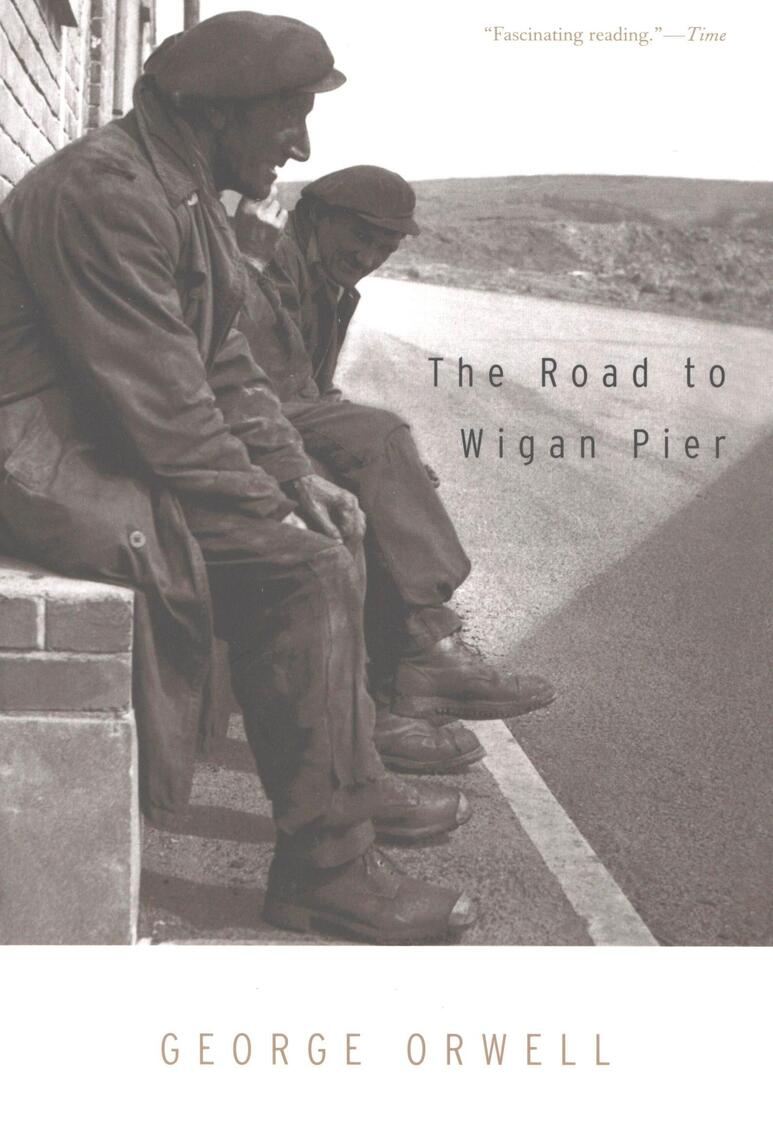
That class is a function more of outlook than income was clear to Orwell, as he explains in his 1937 book The Road to Wigan Pier, which depicts both the privations of working-class life and the British class system as a whole. Orwell describes how the “lower-upper-middle-class” (Orwell’s own), generally professionals in the “Army, Navy, Church, Medicine [or] Law”, understood and aspired to all the many customs of the upper classes (hunting, servants, how to order dinner correctly) despite never being able to afford them. Thus, “To belong to this class when you were [only] at the £400 a year level was a queer business, for it meant that your gentility was almost purely theoretical.” This same dynamic applies today (though the bourgeois values aspired to now are quite different): a poor librarian is far less likely than a wealthy plumber to have voted for causes like Brexit or Trump, which are both populist and, thus, lower-class.
Themselves men of letters, both Orwell and Dalrymple understand that this class distinction is frequently signalled through language. “As for the technical jargon of the Communists,” writes Orwell, “it is as far removed from the common speech as the language of a mathematical textbook.” Such contorted academic prose means little to the ordinary worker, for whom, Orwell argues, Socialism simply means “justice and common decency”. Indeed, Orwell laments that “the worst advertisement for Socialism is its adherents” because of their distance from everyday concerns and inability to speak plainly. Summarising the problem, he quips: “The ordinary man may not flinch from a dictatorship of the proletariat, if you offer it tactfully; offer him a dictatorship of the prigs, and he gets ready to fight”.
A lifelong socialist, Orwell was repeatedly frustrated by the symptoms of this intellectual snobbery — why do the revolutionaries have such disdain for the ordinary punter? Dalrymple, meanwhile, in his essay “How — and How Not — to Love Mankind”, takes aim at its roots. Here, Dalrymple compares the life and work of Marx to his now lesser-known contemporary, Russian novelist and playwright Ivan Turgenev. Though their lives closely resembled one another’s, Dalrymple argues, “They nevertheless came to view human life and suffering in very different, indeed irreconcilable, ways — through different ends of the telescope, as it were. Turgenev saw human beings as individuals always endowed with consciousness, character, feelings, and moral strengths and weaknesses. Marx saw them always as snowflakes in an avalanche, as instances of general forces, as not yet fully human because utterly conditioned by their circumstances.”
[…]
Both writers criticise intellectuals’ pretentious jargon, but it is worth pausing over how each relates his own social position to their subject matter. In a telling passage of Wigan Pier, Orwell describes the working man who has made it into the middle class, perhaps as a Labour MP or trade union official, as “one of the most desolating spectacles the world contains. He has been picked out to fight for his mates, and all it means to him is a soft job and a chance of ‘bettering’ himself. Not merely while but by fighting the bourgeoisie he becomes bourgeois himself.” The scare quotes reflect Orwell’s mixed feelings about social class: does Orwell not believe that a middle-class career — such as his own — is an improvement over the harsh, backbreaking labour of the miners he so vividly documents? He has hit on a deep dilemma, born of a compassionate humanism that points in contradictory directions.
Ostensibly, Orwell chronicles poverty in order to change it, to shock the comfortable hearts of his readers into action. Yet, at the same time, (romanticising the poor against his own advice), he presents the dirt as liberating: squalor and poverty are in some sense more authentic, more real than bourgeois comforts. Thus, as literary critic John Carey argues, Orwell’s “phobia about lower-class dirt collides head-on with his determination to invest dirt with political value, as the price of liberty.”
April 30, 2022
March 30, 2022
QotD: Orwell on political writing
A scrupulous writer, in every sentence that he writes, will ask himself at least four questions, thus: What am I trying to say? What words will express it? What image or idiom will make it clearer? Is this image fresh enough to have an effect? And he will probably ask himself two more: Could I put it more shortly? Have I said anything that is avoidably ugly? But you are not obliged to go to all this trouble. You can shirk it by simply throwing your mind open and letting the ready-made phrases come crowding in. They will construct your sentences for you — even think your thoughts for you, to a certain extent — and at need they will perform the important service of partially concealing your meaning even from yourself.
George Orwell, “Politics and the English Language”, 1946.
March 10, 2022
March 2, 2022
January 29, 2022
QotD: English patriotism
In England patriotism takes different forms in different classes, but it runs like a connecting thread through nearly all of them. Only the Europeanized intelligentsia are really immune to it. As a positive emotion it is stronger in the middle class than in the upper class – the cheap public schools, for instance, are more given to patriotic demonstrations than the expensive ones – but the number of definitely treacherous rich men, the Laval-Quisling type, is probably very small. In the working class patriotism is profound, but it is unconscious. The working man’s heart does not leap when he sees a Union Jack. But the famous “insularity” and “xenophobia” of the English is far stronger in the working class than in the bourgeoisie. In all countries the poor are more national than the rich, but the English working class are outstanding in their abhorrence of foreign habits. Even when they are obliged to live abroad for years they refuse either to accustom themselves to foreign food or to learn foreign languages. Nearly every Englishman of working-class origin considers it effeminate to pronounce a foreign word correctly. During the war of 1914-18 the English working class were in contact with foreigners to an extent that is rarely possible. The sole result was that they brought back a hatred of all Europeans, except the Germans, whose courage they admired. In four years on French soil they did not even acquire a liking for wine. The insularity of the English, their refusal to take foreigners seriously, is a folly that has to be paid for very heavily from time to time. But it plays its part in the English mystique, and the intellectuals who have tried to break it down have generally done more harm than good. At bottom it is the same quality in the English character that repels the tourist and keeps out the invader.
George Orwell, “The Lion And The Unicorn: Socialism and the English Genius”, 1941-02-19.
January 23, 2022
QotD: The British governments of the 1930s
It follows that British democracy is less of a fraud than it sometimes appears. A foreign observer sees only the huge inequality of wealth, the unfair electoral system, the governing-class control over the Press, the radio and education, and concludes that democracy is simply a polite name for dictatorship. But this ignores the considerable agreement that does unfortunately exist between the leaders and the led. However much one may hate to admit it, it is almost certain that between 1931 and 1940 the National Government represented the will of the mass of the people. It tolerated slums, unemployment and a cowardly foreign policy. Yes, but so did public opinion. It was a stagnant period, and its natural leaders were mediocrities.
In spite of the campaigns of a few thousand left-wingers, it is fairly certain that the bulk of the English people were behind Chamberlain’s foreign policy. More, it is fairly certain that the same struggle was going on in Chamberlain’s mind as in the minds of ordinary people. His opponents professed to see in him a dark and wily schemer, plotting to sell England to Hitler, but it is far likelier that he was merely a stupid old man doing his best according to his very dim lights. It is difficult otherwise to explain the contradictions of his policy, his failure to grasp any of the courses that were open to him. Like the mass of the people, he did not want to pay the price either of peace or of war. And public opinion was behind him all the while, in policies that were completely incompatible with one another. It was behind him when he went to Munich, when he tried to come to an understanding with Russia, when he gave the guarantee to Poland, when he honoured it, and when he prosecuted the war half-heartedly. Only when the results of his policy became apparent did it turn against him; which is to say that it turned against its own lethargy of the past seven years. Thereupon the people picked a leader nearer to their mood, Churchill, who was at any rate able to grasp that wars are not won without fighting. Later, perhaps, they will pick another leader who can grasp that only Socialist nations can fight effectively.
George Orwell, “The Lion And The Unicorn: Socialism and the English Genius”, 1941-02-19.
January 17, 2022
January 11, 2022
QotD: The decline of the “Blimp class” in the British empire
The stagnation of the Empire in the between-war years affected everyone in England, but it had an especially direct effect upon two important sub-sections of the middle class. One was the military and imperialist middle class, generally nicknamed the Blimps, and the other the left-wing intelligentsia. These two seemingly hostile types, symbolic opposites – the halfpay colonel with his bull neck and diminutive brain, like a dinosaur, the highbrow with his domed forehead and stalk-like neck – are mentally linked together and constantly interact upon one another; in any case they are born to a considerable extent into the same families.
Thirty years ago the Blimp class was already losing its vitality. The middle-class families celebrated by Kipling, the prolific lowbrow families whose sons officered the army and navy and swarmed over all the waste places of the earth from the Yukon to the Irrawaddy, were dwindling before 1914. The thing that had killed them was the telegraph. In a narrowing world, more and more governed from Whitehall, there was every year less room for individual initiative. Men like Clive, Nelson, Nicholson, Gordon would find no place for themselves in the modern British Empire. By 1920 nearly every inch of the colonial empire was in the grip of Whitehall. Well-meaning, over-civilized men, in dark suits and black felt hats, with neatly rolled umbrellas crooked over the left forearm, were imposing their constipated view of life on Malaya and Nigeria, Mombasa and Mandalay. The one-time empire builders were reduced to the status of clerks, buried deeper and deeper under mounds of paper and red tape. In the early ‘twenties one could see, all over the Empire, the older officials, who had known more spacious days, writhing impotently under the changes that were happening. From that time onwards it has been next door to impossible to induce young men of spirit to take any part in imperial administration. And what was true of the official world was true also of the commercial. The great monopoly companies swallowed up hosts of petty traders. Instead of going out to trade adventurously in the Indies one went to an office stool in Bombay or Singapore. And life in Bombay or Singapore was actually duller and safer than life in London. Imperialist sentiment remained strong in the middle class, chiefly owing to family tradition, but the job of administering the Empire had ceased to appeal. Few able men went east of Suez if there was any way of avoiding it.
George Orwell, “The Lion And The Unicorn: Socialism and the English Genius”, 1941-02-19.
January 7, 2022
QotD: British intelligentsia and imperial decline
… the general weakening of imperialism, and to some extent of the whole British morale, that took place during the nineteen-thirties, was partly the work of the left-wing intelligentsia, itself a kind of growth that had sprouted from the stagnation of the Empire.
It should be noted that there is now no intelligentsia that is not in some sense “Left”. Perhaps the last right-wing intellectual was T.E. Lawrence. Since about 1930 everyone describable as an “intellectual” has lived in a state of chronic discontent with the existing order. Necessarily so, because society as it was constituted had no room for him. In an Empire that was simply stagnant, neither being developed nor falling to pieces, and in an England ruled by people whose chief asset was their stupidity, to be “clever” was to be suspect. If you had the kind of brain that could understand the poems of T.S. Eliot or the theories of Karl Marx, the higher-ups would see to it that you were kept out of any important job. The intellectuals could find a function for themselves only in the literary reviews and the left-wing political parties.
The mentality of the English left-wing intelligentsia can be studied in half a dozen weekly and monthly papers. The immediately striking thing about all these papers is their generally negative, querulous attitude, their complete lack at all times of any constructive suggestion. There is little in them except the irresponsible carping of people who have never been and never expect to be in a position of power. Another marked characteristic is the emotional shallowness of people who live in a world of ideas and have little contact with physical reality. Many intellectuals of the Left were flabbily pacifist up to 1935, shrieked for war against Germany in the years 1935-9, and then promptly cooled off when the war started. It is broadly though not precisely true that the people who were most “anti-Fascist” during the Spanish civil war are most defeatist now. And underlying this is the really important fact about so many of the English intelligentsia – their severance from the common culture of the country.
George Orwell, “The Lion And The Unicorn: Socialism and the English Genius”, 1941-02-19.
December 12, 2021
December 7, 2021
QotD: The decline of class distinctions in Britain
After 1918 there began to appear something that had never existed in England before: people of indeterminate social class. In 1910 every human being in these islands could be “placed” in an instant by his clothes, manners and accent. That is no longer the case. Above all, it is not the case in the new townships that have developed as a result of cheap motor cars and the southward shift of industry. The place to look for the germs of the future England is in the light-industry areas and along the arterial roads. In Slough, Dagenham, Barnet, Letchworth, Hayes – everywhere, indeed, on the outskirts of great towns – the old pattern is gradually changing into something new. In those vast new wildernesses of glass and brick the sharp distinctions of the older kind of town, with its slums and mansions, or of the country, with its manor-houses and squalid cottages, no longer exist. There are wide gradations of income, but it is the same kind of life that is being lived at different levels, in labour-saving flats or council houses, along the concrete roads and in the naked democracy of the swimming-pools. It is a rather restless, cultureless life, centring round tinned food, Picture Post, the radio and the internal combustion engine. It is a civilization in which children grow up with an intimate knowledge of magnetoes and in complete ignorance of the Bible. To that civilization belong the people who are most at home in and most definitely of the modern world, the technicians and the higher-paid skilled workers, the airmen and their mechanics, the radio experts, film producers, popular journalists and industrial chemists. They are the indeterminate stratum at which the older class distinctions are beginning to break down.
This war, unless we are defeated, will wipe out most of the existing class privileges. There are every day fewer people who wish them to continue. Nor need we fear that as the pattern changes life in England will lose its peculiar flavour. The new red cities of Greater London are crude enough, but these things are only the rash that accompanies a change. In whatever shape England emerges from the war it will be deeply tinged with the characteristics that I have spoken of earlier. The intellectuals who hope to see it Russianized or Germanized will be disappointed. The gentleness, the hypocrisy, the thoughtlessness, the reverence for law and the hatred of uniforms will remain, along with the suet puddings and the misty skies. It needs some very great disaster, such as prolonged subjugation by a foreign enemy, to destroy a national culture. The Stock Exchange will be pulled down, the horse plough will give way to the tractor, the country houses will be turned into children’s holiday camps, the Eton and Harrow match will be forgotten, but England will still be England, an everlasting animal stretching into the future and the past, and, like all living things, having the power to change out of recognition and yet remain the same.
George Orwell, “The Lion And The Unicorn: Socialism and the English Genius”, 1941-02-19.
November 29, 2021
QotD: The law
Here one comes upon an all-important English trait: the respect for constitutionalism and legality, the belief in “the law” as something above the State and above the individual, something which is cruel and stupid, of course, but at any rate incorruptible.
It is not that anyone imagines the law to be just. Everyone knows that there is one law for the rich and another for the poor. But no one accepts the implications of this, everyone takes it for granted that the law, such as it is, will be respected, and feels a sense of outrage when it is not. Remarks like “They can’t run me in; I haven’t done anything wrong”, or “They can’t do that; it’s against the law”, are part of the atmosphere of England. The professed enemies of society have this feeling as strongly as anyone else. One sees it in prison-books like Wilfred Macartney’s Walls Have Mouths or Jim Phelan’s Jail Journey, in the solemn idiocies that take place at the trials of Conscientious Objectors, in letters to the papers from eminent Marxist professors, pointing out that this or that is a “miscarriage of British justice”. Everyone believes in his heart that the law can be, ought to be, and, on the whole, will be impartially administered. The totalitarian idea that there is no such thing as law, there is only power, has never taken root. Even the intelligentsia have only accepted it in theory.
George Orwell, “The Lion And The Unicorn: Socialism and the English Genius”, 1941-02-19.
November 26, 2021
QotD: English working class culture
… in all societies the common people must live to some extent against the existing order. The genuinely popular culture of England is something that goes on beneath the surface, unofficially and more or less frowned on by the authorities. One thing one notices if one looks directly at the common people, especially in the big towns, is that they are not puritanical. They are inveterate gamblers, drink as much beer as their wages will permit, are devoted to bawdy jokes, and use probably the foulest language in the world. They have to satisfy these tastes in the face of astonishing, hypocritical laws (licensing laws, lottery acts, etc., etc.) which are designed to interfere with everybody but in practice allow everything to happen. Also, the common people are without definite religious belief, and have been so for centuries. The Anglican Church never had a real hold on them, it was simply a preserve of the landed gentry, and the Nonconformist sects only influenced minorities. And yet they have retained a deep tinge of Christian feeling, while almost forgetting the name of Christ. The power-worship which is the new religion of Europe, and which has infected the English intelligentsia, has never touched the common people. They have never caught up with power politics. The “realism” which is preached in Japanese and Italian newspapers would horrify them. One can learn a good deal about the spirit of England from the comic coloured postcards that you see in the windows of cheap stationers’ shops. These things are a sort of diary upon which the English people have unconsciously recorded themselves. Their old-fashioned outlook, their graded snobberies, their mixture of bawdiness and hypocrisy, their extreme gentleness, their deeply moral attitude to life, are all mirrored there.
The gentleness of the English civilization is perhaps its most marked characteristic. You notice it the instant you set foot on English soil. It is a land where the bus conductors are good-tempered and the policemen carry no revolvers. In no country inhabited by white men is it easier to shove people off the pavement. And with this goes something that is always written off by European observers as “decadence” or hypocrisy, the English hatred of war and militarism. It is rooted deep in history, and it is strong in the lower-middle class as well as the working class. Successive wars have shaken it but not destroyed it. Well within living memory it was common for “the redcoats” to be booed at in the streets and for the landlords of respectable public-houses to refuse to allow soldiers on the premises. In peace-time, even when there are two million unemployed, it is difficult to fill the ranks of the tiny standing army, which is officered by the country gentry and a specialized stratum of the middle class, and manned by farm labourers and slum proletarians. The mass of the people are without military knowledge or tradition, and their attitude towards war is invariably defensive. No politician could rise to power by promising them conquests or military “glory”, no Hymn of Hate has ever made any appeal to them. In the last war the songs which the soldiers made up and sang of their own accord were not vengeful but humorous and mock-defeatist. The only enemy they ever named was the sergeant-major.
George Orwell, “The Lion And The Unicorn: Socialism and the English Genius”, 1941-02-19.