
The transition may also have driven broader cultural shifts. In 1523, Fitzherbert’s Boke of Husbandrie gave a list of a housewife’s jobs (“What warkes a wyfe shulde do in generall”) that included the household’s cooking, cleaning, laundry, and childcare, all of which are typically part of modern housewifery, but also milking cows, taking grain to the miller, malting barley, making butter and cheese, raising pigs and poultry, gardening, growing hemp and flax and then spinning it, weaving, winnowing grain, making hay, cutting grain, selling her produce at market — and, as necessary, helping her husband to fill the dungcart, plow the fields, or load hay. Roles were still highly gendered, but compared to eighteenth and nineteenth century household manuals this is a remarkable amount of time spent out of the house, and the difference holds even when you compare the work hired maids were doing in both periods. Around the time of the advent of coal, though, our descriptions of women’s work increasingly portray it as contained within the walls of the home — or, at most, in the dairy or the poultry yard. Of course social transformations are never monocausal, and the increasing specialization and mechanization that moved some production out of the household probably nudged things along, but Goodman suggests that “the additional demands of running a coal-fired household might have also helped push the idea that a woman’s place is within the home”. After all, if your cleaning takes twice as long, there’s simply less time available for all that agricultural labor and small-scale commerce.
Jane Psmith, “REVIEW: The Domestic Revolution by Ruth Goodman”, Mr. and Mrs. Psmith’s Bookshelf, 2023-05-22.
August 22, 2024
QotD: The changing role of the Medieval housewife in England
August 20, 2024
QotD: The printing press was to the Reformation what social media is in the Current Year
The thing about Luther, then, wasn’t what he said, so much as how he said it.
Martin Luther was the world’s first spin doctor. Though he insisted for a long time that his famous 95 Theses were, and were always intended to be, a scholastic debate between clergymen, Luther mastered the use of printed propaganda. His opponents soon followed, or tried to, in an ever-increasing spiral of printed viciousness. Mutatis mutandis, the exchanges between Luther, Erasmus, Thomas More (to say nothing of a thousand lesser lights) and their opponents all sound shockingly Current Year. They’re snarky and waspish at best, grotesque ad hominem at worst. Modern flame wars have nothing on the way Thomas More and William Tyndale tore into each other, for instance, and More and Tyndale were rank amateurs compared to Luther.
As with the Current Year, where being first on social media is the only criterion that matters, so the printing press injected something very like “hot takes” into the late-Medieval intellectual atmosphere. If you tried to respond to your opponents the old-fashioned way — with closely reasoned, heavily cited arguments, on parchment, hand-copied by monks — you might win the intellectual battle … 500 years later, among historians who thank you for providing such a useful glimpse into late-Medieval mentalités, but in your own time you’d get fired at best, get burned at the stake at worst, if you didn’t respond instantly, in kind.
The printing press, in other words, represented a quantum leap in the velocity of information. Those who grasped its fundamentals prospered, while those who fell behind perished. King Henry VIII, for instance, fatally damaged his cherished intellectual reputation when he deigned to attack to Luther in person. Luther hit back with a tirade that wouldn’t be out of place on Twitter1, and Henry responded in kind, and now the king, who was hip-deep in self-inflicted shit by that point, had to drop the fight. Having been publicly abused by a mere ex-monk, he had to quit the field with his tail between his legs.
Severian, “Velocity of Information”, Rotten Chestnuts, 2021-08-10.
1. Again, mutatis mutandis. Though this sounds to modern ears like an abject apology on Luther’s part (“especially as I am the offscouring of the world, a mere worm who ought only to live in contemptuous neglect”, etc.), in context it’s a vicious attack. For one thing, what’s a great king like Henry doing responding to a “mere worm”? And Henry had to know, since Wolsey did nothing without his master’s orders … except everyone had heard the rumors that Henry was just a dimwitted playboy, and Cardinal Wolsey was really the king in all but name, so maybe he didn’t know. Either way Henry, who prided himself on being an intellectual, was a fool. That’s the kind of thing that would get you executed in the 16th century, and here’s this “mere worm” publishing it, for all the world to see, with no possibility of reprisal from a supposedly puissant monarch.
July 26, 2024
QotD: Comparative advantage
David Ricardo, On the Principles of Political Economy and Taxation (1817), quoted on the Library of Economics and Liberty site.
July 9, 2024
What it was like to visit a Medieval Tavern
Tasting History with Max Miller
Published 27 Mar 2024Medieval stew with meat, spices, and verjuice, and thickened with egg yolks
City/Region: England
Time Period: 15th CenturySome medieval taverns may have had what is called a perpetual stew bubbling away. The idea is basically what it sounds like: as stew was taken out, more ingredients would be added in so that the stew kept on stewing. In southern France, there was a perpetual stew that was served from the 15th century (around when this recipe was written) all the way up until WWII, when they couldn’t get the right ingredients.
I have opted to not make this stew perpetual, but it is delicious. The medieval flavor of super tender meat with spices and saffron is so interesting, especially with the added acidity and sweetness from the verjuice.
A note on thickening with egg yolks: if you need to reheat your stew after adding the egg yolks, like I did, they may scramble a bit. The stew is still delicious, it’s just the texture that changes a little and it won’t be quite as thick.
Vele, Kede, or Henne in bokenade
Take Vele, Kyde, or Henne, an boyle hem in fayre Water, or ellys in freysshe brothe, and smyte hem in pecys, and pyke hem clene; an than draw the same brothe thorwe a straynoure, an caste there-to Percely, Swag, Ysope, Maces, Clowys, an let boyle tyl the flesshe be y-now; than sette it from the fyre, and alye it up with raw yolkys of eyroun, and caste ther-to pouder Gyngere, Veriows, Safroun, and Salt, and thanne serve it forth for a gode mete.
— Harleian Manuscript 279, 15th Century
June 28, 2024
Ruling Medieval France
In Quillette, Charlotte Allen reviews House of Lilies: The Dynasty That Made Medieval France by Justine Firnhaber-Baker, a period of history I know mainly from the English point of view:
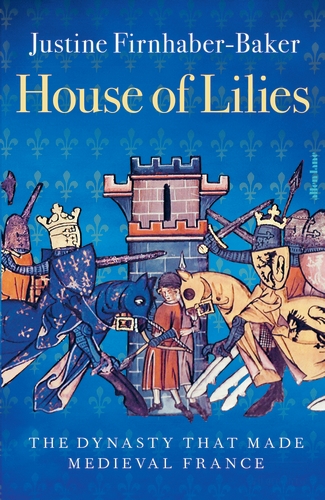
I’m a PhD medievalist, but the history of medieval French royalty was never my specialty, and my ignorance was vast.
I’d assumed, for example, that the French kings of the Middle Ages were mostly fainéants whose writ scarcely ran past the Île-de-France region (encompassing the city of Paris and its environs). The English monarchy across the Channel had been centralised since the days of Alfred the Great (849–899); but the French kings seemed to rule in a more symbolic capacity, being perpetually at the mercy of the powerful dukes and counts of autonomous French regions such as Normandy, Burgundy, Aquitaine, Anjou, Blois, Toulouse, and Languedoc. These regional rulers were technically royal vassals. But, in actuality, they saw themselves as absolute rulers in their own right, and so had no compunction against turning on the crown when they thought it would further their interests.
My impressions had been formed by accounts of the 17-year-old Joan of Arc’s having to personally drag the Dauphin (the future King Charles VII) to Reims for his coronation in 1429, and by Shakespeare’s historical plays, which portrayed the French as fops incapable of defending their territory against the robust and brotherly English during the Hundred Years’ War. Indeed, the whole point of that war (from the English perspective) was that, by dynastic right, large portions of France’s fractured political landscape actually belonged to England.
The one medieval French royal (by marriage) I did know something about, Eleanor of Aquitaine (c. 1122–1204), dumped her French husband, King Louis VII (1120–1180) after he bungled the Second Crusade, a costly and embarrassing adventure on which Eleanor had accompanied him on horseback. (“Never take your wife on a Crusade”, a medievalist friend of mine once sensibly quipped). To top off his disastrous final loss of his Crusader army in 1148 during an ill-considered attack on Damascus — which, although Muslim-ruled, was in fact an ally of Latin-Christian Jerusalem — Louis and Eleanor had failed to produce a son. No sooner was the ink dry on their divorce in 1152 (technically an annulment, since the two were Catholics), than she married Henry Plantagenet, son and heir of the duke of Anjou, who two years later became King Henry II of England. Henry quickly procreated five sons (among fourteen surviving children) with his new bride. Thus began the dynasty that would rule England for more than three centuries.
As everyone who has seen The Lion in Winter knows, Henry II’s relationship with Eleanor was far from tranquil, but two of their sons succeeded him to the English throne: Richard the Lionheart and King John (of Magna Carta fame or infamy, depending on your perspective). Henry was, besides king of England, duke of Normandy and count of Anjou, through his great-grandfather, William the Conqueror, and his mother, Matilda, who’d married Henry’s Anjevin father, Geoffrey, after her first husband, the Holy Roman Emperor Henry V, died in 1125.
Eleanor’s grounds for annulling her marriage to Louis had been that he was her fourth cousin, which violated the Catholic Church’s (selectively applied) consanguinity restrictions. But Henry was even closer kin, being her third cousin. The humiliated and (understandably) rankled Louis demanded that Henry, as his feudal vassal, explain why he’d failed to ask permission to marry (let alone marry his boss’s ex). Henry declined to reply, the feudal equivalent of declaring oneself in rebellion. Louis retaliated by invading Normandy — unsuccessfully — and trying to hold onto Eleanor’s Aquitaine on the claim that he’d become its duke by marriage (Henry II was meanwhile making the same claim) before giving up and remarrying himself in 1154.
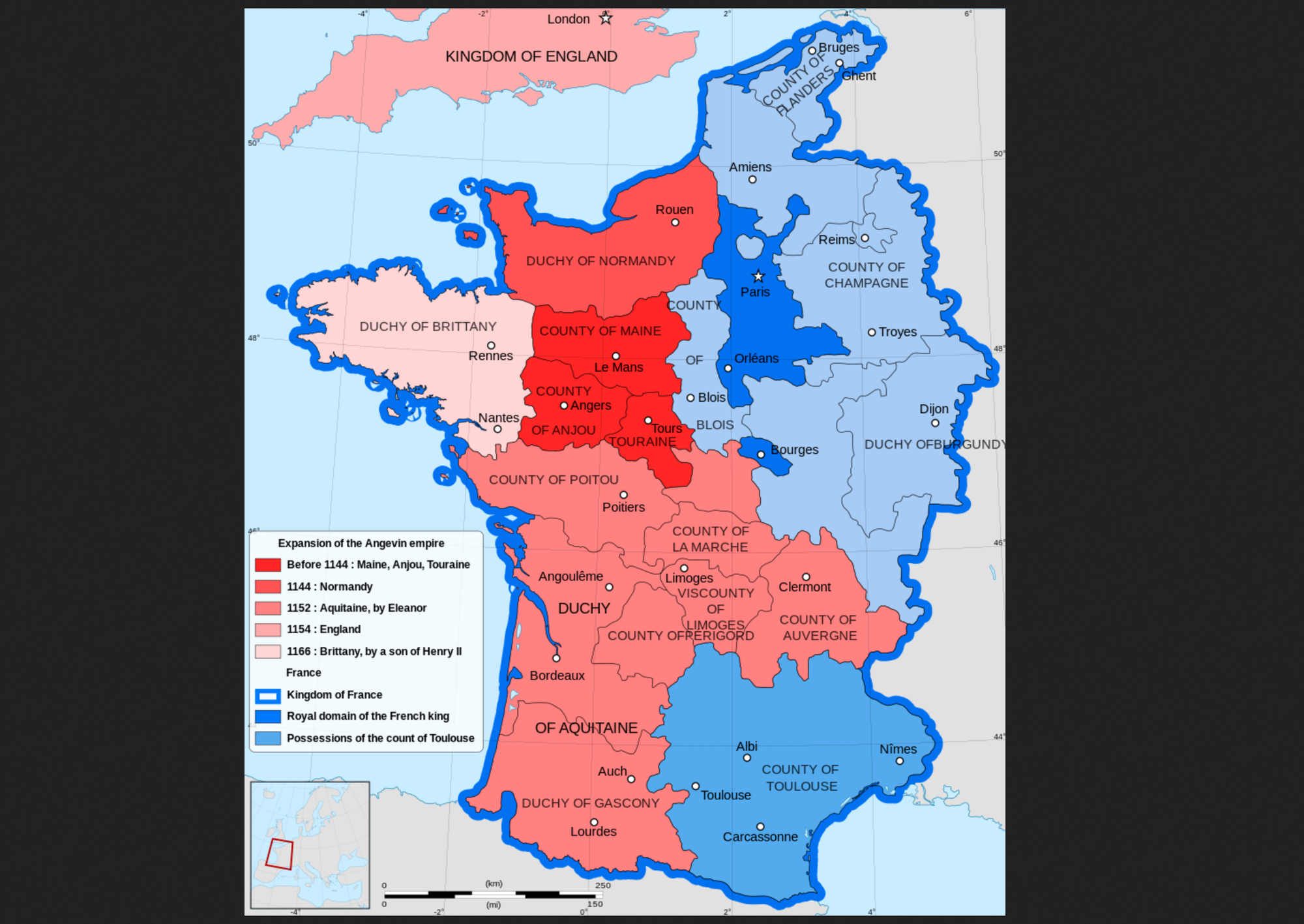
A colour-coded political map of France during the twelfth century, indicating the early expansion of the Angevin Empire — i.e., the territorial possessions of the House of Plantagenet — from the time of Geoffrey V of Anjou (1113–1151). The Plantagenets would rule in England, and parts of France, till the demise of Richard III of England (1452–1485).
I’d assumed that French kings wouldn’t hold much in the way of real royal power until the time of King Louis XIV (1638–1715), who declared (perhaps apocryphally), L’État, c’est moi, and forced French regional nobles to reside in his over-the-top palace at Versailles (where they’d dissipate their incomes via elaborate court ceremonies instead of making trouble from their provincial power bases).
But the scales have now been knocked from my eyes, thanks to Justine Firnhaber-Baker, a professor of French medieval history at the University of St Andrews. The subtitle of her new book, House of Lilies: The Dynasty That Made Medieval France, refers to the Capetian dynasty founded by Hugh Capet (c. 940–996), who took his royal title in 987 A.D. Every French monarch, from Hugh’s reign to the French Revolution and beyond, had Capetian blood running through his veins — including the aforementioned Louis VII, who was a direct descendant of Hugh, and the bookish, dithering King Louis XVI, who was not, but who nevertheless went to the guillotine in 1793 under the derisive sobriquet “Citizen Louis Capet”.
June 25, 2024
QotD: Progress and decline
So progress must have occurred in the intervening time, despite the pessimism that infects those who, like me, are of retrospective temperament and hypersensitive to deterioration. It is not hard to enumerate many things that have improved. They relate principally, but not only, to material conditions. My best friend when I was very young was one of the last children in Britain to suffer from polio, which paralyzed him from the waist down. The quickest form of written communication was then the telegram, and anything other than local telephone calls had to go through an operator. To call across the Atlantic required a reservation and was ferociously expensive; the resultant conversation always seemed to take place during a violent storm. In England, the food was generally disgusting, and meals were to be endured as a regrettable necessity instead of enjoyed (it puzzles me still how people could have cooked so badly). Cars broke down frequently, and every November, pollution produced fogs so thick that you couldn’t see the hand in front of your face (I loved them). Rationing continued for eight years after the war, and disused bomb shelters, present in every park, were where illicit sexual fumbles and smoking took place. Incidentally, for an adult male not to smoke was unusual (75 percent did so); we must have lived in a perpetual fog of foul-smelling tobacco, to judge by the distaste caused by even a single lit cigarette in these virtuous times. Poverty, as raw necessity, still existed. Murderers were sometimes hanged — as well as, more rarely, the innocent. Overt racial prejudice was, if not quite the norm, certainly prevalent.
Yet not everything has improved, though the deterioration has been less tangible than the progress. To give one example: by age 11, I was free to roam London, or at least its better areas, by myself or with a friend of the same age. The sight of an 11-year-old child wandering the city on his own did not suggest to anyone that he was neglected or abused. I remember, too, the evening papers piled up at newsstands; people would throw coins on top of the pile and take their copy. It never occurred to anyone that the money might get stolen; nowadays, it would never occur to anyone that the money would not be stolen. The crime statistics bear out this sea change in national character.
Theodore Dalrymple, “What Seventy Years Have Wrought”, New English Review, 2019-10-26.
June 22, 2024
“We can learn a lot about our betters from looking at each exception to their rules”
Julie Burchill isn’t a soccer fan, but she points out that the “exceptions” to the usual “rules” that the kakistocrats allow during international soccer tournaments tell us a lot about them:

Patriotism is not the only “bad” thing we’re suddenly “allowed” to do in the weeks when the national team plays on the world stage. The BBC in particular reminds men that they can disregard the finger-wagging for a few brief weeks. In EastEnders, male characters cringingly ask their mates to “get the beers in for the game”. Alcohol would generally be condemned as a public-health menace by Auntie, but during “The Game”, one more “cheeky” tipple apparently won’t hurt you.
We can learn a lot about our betters from looking at each exception to their rules. Don’t be racist – except against Jews. Believe all women about sexual assault – unless they’re Israeli. Oh, and be careful not to “culturally appropriate” the slightest thing from any other nationality, even to the point of never wearing a sombrero in a Mexican restaurant – but it’s fine to be a cross-dressing man culturally appropriating my sex. Meanwhile, if you’re a woman, be a good little Transmaid and stand by smiling, even if you call yourself a feminist.
Like most other places in the West in these dog days of civilisation, England feels like a nation devoid of hope and pride. Even so, being allowed to take pride in some overpaid ball-kickers, but not in the fact that this country contributed massively to ending slavery – lest we be called out as White Saviours – is a somewhat surreal situation to find ourselves in, after all those centuries of blood, sweat and struggle.
Flying the flag for the duration of the Euros is like being a eunuch who’s permitted to have his nuts back for a couple of weeks – for old times’ sake – and wear them as earrings. But those who indulge must be sure to tear their St George’s down sharpish once the festivities are over, lest they be fingered as a fascist for liking their own flag more than others. Remember, the only flag that can be flown constantly now is the Pride flag. This must be saluted respectfully wherever it pops up – failure to do so may identify you as an unworthy citizen of Soft Play Pit Nation.
June 21, 2024
From “invention” to “tradition”
At Astral Codex Ten, Scott Alexander considers some “traditions” which were clearly invented much more recently than participants might believe:
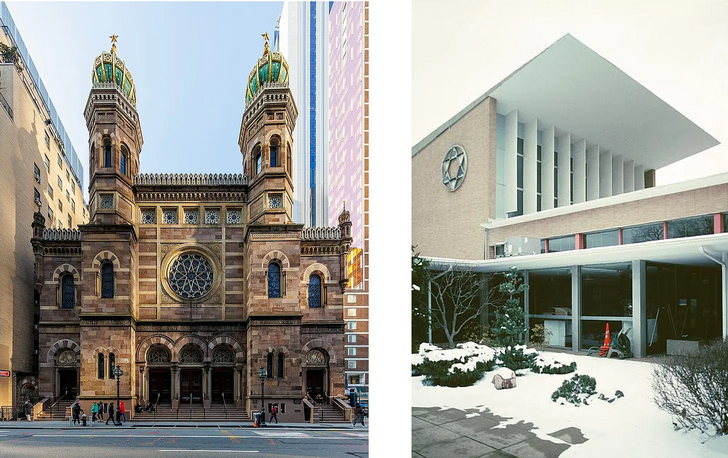
Two NYC synagogues, one in Moorish Revival style and the other is some form of modernism (you can tell it’s not Brutalism because it’s not all decaying concrete). Like Scott, I vastly prefer the one on the left even if it isn’t totally faithful to the Moroccan original design.
A: I like Indian food.
B: Oh, so you like a few bites of flavorless rice daily? Because India is a very poor country, and that’s a more realistic depiction of what the average Indian person eats. And India has poor food safety laws – do you like eating in unsanitary restaurants full of rats? And are you condoning Narendra Modi’s fascist policies?
A: I just like paneer tikka.
This is how most arguments about being “trad” sound to me. Someone points out that they like some feature of the past. Then other people object that this feature is idealized, the past wasn’t universally like that, and the past had many other bad things.
But “of the past” is just meant to be a pointer! “Indian food” is a good pointer to paneer tikka even if it’s an idealized view of how Indians actually eat, even if India has lots of other problems!
In the same way, when people say they like Moorish Revival architecture or the 1950s family structure or whatever, I think of these as pointers. It’s fine if the Moors also had some bad buildings, or not all 1950s families were really like that. Everyone knows what they mean!
But there’s another anti-tradition argument which goes deeper than this. It’s something like “ah, but you’re a hypocrite, because the people of the past weren’t trying to return to some idealized history. They just did what made sense in their present environment.”
There were hints of this in Sam Kriss’ otherwise-excellent article about a fertility festival in Hastings, England. A celebrant dressed up as a green agricultural deity figure, paraded through the street, and then got ritually murdered. Then everyone drank and partied and had a good time.
Most of the people involved assumed it derived from the Druids or something. It was popular not just as a good party, but because it felt like a connection to primeval days of magic and mystery. But actually, the Hastings festival dates from 1983. If you really stretch things, it’s loosely based on similar rituals from the 1790s. There’s no connection to anything older than that.
Kriss wrote:
I don’t think the Jack in the Green is worse because it’s not really an ancient fertility rite, but I do think it’s a little worse because it pretends to be … tradition pretends to be a respect for the past, but it refuses to let the past inhabit its own particular time: it turns the past into eternity. The opposite of tradition is invention.
Tradition is fake, and invention is real. Most of the human activity of the past consists of people just doing stuff … they didn’t need a reason. It didn’t need to be part of anything ancient. They were having fun.
I’ve been thinking a lot about [a seagull float in the Hastings parade] … in the procession, the shape of the seagull became totemic. It had the intensity of a symbol, without needing to symbolise anything in particular. Another word for a symbol that burns through any referent is a god. I wasn’t kidding when I said I felt the faint urge to worship it. I don’t think it would be any more meaningful if someone had dug up some thousand-year-old seagull fetishes from a nearby field. It’s powerful simply because of what it is. Invention, just doing stuff, is the nebula that nurses newborn gods.
I’m nervous to ever disagree with Sam Kriss about ancient history, but this strikes me as totally false.
Modern traditionalists look back fondly on Victorian times. But the Victorians didn’t get their culture by just doing stuff without ever thinking of the past. They were writing pseudo-Arthurian poetry, building neo-Gothic palaces, and painting pre-Raphaelite art hearkening back to the early Renaissance. And the Renaissance itself was based on the idea of a re-naissance of Greco-Roman culture. And the Roman Empire at its peak spent half of its cultural energy obsessing over restoring the virtue of the ancient days of the Roman Republic:
Then none was for a party;
Then all were for the state;
Then the great man helped the poor,
And the poor man loved the great:
Then lands were fairly portioned;
Then spoils were fairly sold:
The Romans were like brothers
In the brave days of old.Now Roman is to Roman
More hateful than a foe,
And the Tribunes beard the high,
And the Fathers grind the low.
As we wax hot in faction,
In battle we wax cold:
Wherefore men fight not as they fought
In the brave days of old.(of course, this isn’t from a real Imperial Roman poem — it’s by a Victorian Brit pretending to be a later Roman yearning for the grand old days of Republican Rome. And it’s still better than any poem of the last fifty years, fight me.)
As for the ancient Roman Republic, they spoke fondly of a Golden Age when they were ruled by the god Saturn. As far as anyone knows, Saturn is a wholly mythical figure. But if he did exist, there are good odds he inspired his people (supposedly the fauns and nymphs) through stories of some even Goldener Age that came before.
June 12, 2024
England “is a parochial country doomed to nostalgia and irrelevance by its unwavering belief in a series of grandiose historical myths”
In The Critic, Fred Skulthorp reviews England: Seven Myths That Changed a Country and How to Set Them Straight by Tom Baldwin and Marc Stears:

Should Keir Starmer find himself in Downing Street after the next election, he will have little to play with in terms of zeitgeist. Unlike Blair, there is no Cool Britannia to tap into. There are few unifying cultural figures and despair seems the only discernible national mood. Starmer has only the recent success of the Lionesses and an oft-quoted anecdote about his dad being a toolmaker to inspire the nation.
But there is one nation-renewing narrative on the centre-left that has emerged since 2016. England, unlike the rest of Europe, is a parochial country doomed to nostalgia and irrelevance by its unwavering belief in a series of grandiose historical myths. The real 21st century England is being held back by people singing “Rule Britannia” at the Last Night of the Proms and the fantasies of Daniel Hannan.
In England: Seven Myths That Changed a Country, Starmer’s biographer Tom Baldwin and former Labour Party speechwriter Mike Stears embark on a journey to set us free from such falsehoods. In Hull we find that William Wilberforce has given the nation an unqualified moral superiority. In Plymouth we discover that Sir Francis Drake is the inspiration for “the aggressively macho nationalist idea” that Brexit can “restore the country’s global reach”. In Runnymede we find that Magna Carta has given rise to the idea of an “Anglo-Saxon birthright sealed with the blood of dead kings”.
Whether anyone actually believes these things is beside the point. These national myths, the authors insist, can account for everything from the popularity of Michael Portillo’s railway documentaries to the 2016 vote to leave the European Union.
Journeys in search of England tend to lend themselves more to projection than discovery. This book presents the worst of that sin. Reading Seven Myths is a bit like being stuck on a very long car journey and regretting having asked the driver: “Whatever happened to the legacy of the London 2012 Olympics?”
Unsurprisingly, much of what follows spouts repackaged Blairite clichés about football, curry and the NHS. Lingering behind their polemic is the tedious psychodrama of the Corbyn years and Labour infighting about how the party should allow itself to feel patriotic. This book is as much about two middle-aged Starmerites trying to work out what it is acceptable to like between their party, the electorate and the limited scope of their inquiry into the England of the 2020s.
And the scope is indeed limited. Reportage and interview, where the book is allowed to breathe away from the grating polemic, is cramped, incomplete and tokenistic. The most memorable soundbite is from Nigel Farage, who tells them — perhaps half-mockingly — that his favourite place in England is London: “It gets faster and more trendy every year that comes”.
Interactions with the public are even more painful. “What do you think of Enoch Powell?” one “brown-skinned man” is asked in Wolverhampton. A refugee from Hong Kong is asked “Does Magna Carta mean anything to you?” Unsurprisingly these conversations don’t return much, but they pave the way for the eye-rollingly mundane conclusion that when it comes to English identity there is “complexity everywhere” (as if anyone’s sense of national identity were ever simple).
Still from the 1964 movie Zulu with Michael Caine as Lieutenant Gonville Bromhead, 24th Regiment of Foot.
For a book that spends nearly 400 pages debunking myths and trying to correct the course of English history, its sources require a lot of reading between the lines. Many can be narrowed down to soundbites from a few politicians and forgotten op-eds in the Telegraph (one quoted is dated as far back as 2004).
All this generates endless false dichotomies, strawmen and reductive statements to account for a grander myth loosely referred to as “English exceptionalism”. At times, attempts to source these myths in the body politic come across as comically desperate. Zulu (1964) becomes a film which kept alive the “British Empire myth” and which “the current generation of politicians would have watched growing up”.
Ironically, the writing itself is laced with the sins of myth-making: boring, trite, incoherent, lazy and unfunny. At times it veers into self-parody. In Runnymede, the “high iron gates” of a housing development near the Magna Carta memorial serve to remind us that national identity myths can “make others feel excluded”. In Plymouth, Greta Thunberg is placed in a pantheon alongside Darwin and Drake who both set sail from the Devon port: “None of these dead Englishmen have as much relevance right now as [the voyage] undertaken from the same city by a Swedish Girl”.

June 1, 2024
QotD: When the chimneys rose in London
In Ruth Goodman’s telling, though, the greatest difference between coal and wood fires is the smoke. Smoke isn’t something we think much about these days: on the rare occasions I’m around a fire at all, I’m either outdoors (where the smoke dissipates rapidly except for a pleasant lingering aroma on my jacket) or in front of a fireplace with a good chimney that draws the smoke up and out of the house. However, a chimney also draws about 70% of the fire’s heat — not a problem if you’re in a centrally-heated modern home and enjoying the fire for ✨ambience✨, but a serious issue if it’s the main thing between your family and the Little Ice Age outdoors. Accordingly, premodern English homes didn’t have chimneys: the fire sat in a central hearth in the middle of the room, radiating heat in all directions, and the smoke slowly dissipated out of the unglazed windows and through the thatch of the roof. Goodman describes practical considerations of living with woodsmoke that never occurred to me:
In the relatively still milieu of an interior space, wood smoke creates a distinct and visible horizon, below which the air is fairly clear and above which asphyxiation is a real possibility. The height of this horizon line is critical to living without a chimney. The exact dynamics vary from building to building and from hour to hour as the weather outside changes. Winds can cause cross-draughts that stir things up; doors and shutters opening and closing can buffet smoke in various directions. … From my experiences managing fires in a multitude of buildings in many different weather conditions, I can attest to the annoyance of a small change in the angle of a propped-open door, the opening of a shutter or the shifting of a piece of furniture that you had placed just so to quiet the air. And as for people standing in doorways, don’t get me started.
One obvious adaptation was to live life low to the ground. On a warm day the smoke horizon might be relatively high, but on a cold damp one (of which, you may be aware, England has quite a lot) smoke hovers low enough that even sitting in a tall chair might well put your head right up into it. Far better to sit on a low stool, or, better yet, a nice soft insulating layer of rushes on the floor.
Chimneys did exist before the transition to coal, but given the cost of masonry and the additional fuel expenses, they were typically found only in the very wealthiest homes. Everyone else lived with a central hearth and if they could afford it added smoke management systems to their homes piecemeal. Among the available solutions were the reredos (a short half-height wall against which the fire was built and which would counteract drafts from doorways), the smoke hood (rather like our modern cooktop vent hood but without the fan, allowing some of the smoke to rise out of the living space without creating a draw on the heat), or the smoke bay (a method of constructing an upstairs room over only part of the downstairs that still allowed smoke to rise and dissipate through the roof). Wood smoke management was mostly a question of avoiding too great a concentration in places you wanted your face to be. The switch to coal changed this, though, because coal smoke is frankly foul stuff. It hangs lower than wood smoke, in part because it cools faster, and it’s full of sulfur compounds that combine with the water in your eyes and lungs to create a mild sulfuric acid; when your eyes water from the irritation, the stinging only gets worse. Burning coal in an unvented central hearth would have been painful and choking. If you already had one of the interim smoke management techniques of the wood-burning period — especially the smoke hood — you would have found adopting coal more appealing, but really, if you burned coal, you wanted a chimney. You probably already wanted a chimney, though; they had been a status symbol for centuries.
And indeed, chimneys went up all over London; their main disadvantage, aside from the cost of a major home renovation, had been the way they drew away the heat along with the smoke, but a coal fire’s greater energy output made that less of an issue. The other downside of the chimney’s draw, though, is the draft it creates at ground level. Again, this isn’t terribly noticeable today because most of us don’t spend a lot of time sitting in front of the fireplace (or indeed, sitting on the floor at all, unless we have small children), but pay attention next time you’re by an indoor wood fire and you will notice a flow of cold air for the first inch or two off the ground. All of a sudden, instead of putting your mattress directly on the drafty floor, you wanted a bedstead to lift it up — and a nice tall chair to sit on, and a table to pull your chair up to as well. There were further practical differences, too: because a chimney has to be built into a wall, it can’t heat as large an area as a central fire. This incentivized smaller rooms, which were further enabled by the fact that a coal fire can burn much longer without tending than a wood fire. A gentleman doesn’t have much use for small study where he can retreat to be alone with his books and papers if a servant is popping in every ten minutes to stir up the fire, but if the coals in the grate will burn for an hour or two untended he can have some real privacy. The premodern wood-burning home was a large open space where many members of the household, both masters and servants, went about their daily tasks; the coal-burning home gradually became a collection of smaller, furniture-filled spaces that individuals or small groups used for specific purposes. Nowhere is this shift more evident than in the word “hall”, which transitions from referring to something like Heorot to being a mere corridor between rooms.
Jane Psmith, “REVIEW: The Domestic Revolution by Ruth Goodman”, Mr. and Mrs. Psmith’s Bookshelf, 2023-05-22.
1. Brief ferrous metallurgy digression: aside from the rare, relatively pure iron found in meteors, all iron found in nature is in the form of ores like haematite, where the iron bound up with oxygen and other impurities like silicon and phosphorus (“slag”). Getting the iron out of the ore requires adding carbon (for the oxygen to bond with) and heat (to fuel the chemical reaction): Fe2O3 + C + slag → Fe + CO2 + slag. Before the adoption of the blast furnace, European iron came from bloomeries: basically a chimney full of fuel hot enough to cause a reduction reaction when ore is added to the top, removing the oxygen from the ore but leaving behind a mass of mixed iron and slag called a bloom. The bloom would then be heated and beaten and heated and beaten — the hot metal sticks together while the slag crumbles and breaks off — to leave behind a lump of nearly pure iron. (If you managed the temperature of your bloomery just right you could incorporate some of the carbon into the iron itself, producing steel, but this was difficult to manage and carbon was usually added to the iron afterwards to make things like armor and swords.) In a blast furnace, by contrast, the fuel and ore were mixed together and powerful blasts of air were forced through as the material moved down the furnace and the molten iron dripped out the bottom. From there it could be poured directly into molds and cast into the desired shape. This is obviously much faster and easier! But cast iron has much more carbon, which makes it very hard, lowers its melting point, and leaves it extremely brittle — you would never want a cast iron sword. (The behavior of various ferrous metals is determined by the way the non-metal atoms, especially carbon, interrupt the crystal structure of the iron. Wrought iron has less than .08% carbon by weight, modern “low carbon” steel between .05% and .3%, “high carbon” steel about 1.7%, and cast iron more than 3%.)
2. The sales of those cooking implements went on to provide the capital for further innovation: Darby’s son and grandson, two more Abrahams, also played important roles in the Industrial Revolution.
May 13, 2024
Archaeological Publishing – the unpalatable truth
Classical and Ancient Civilization
Published May 11, 2024Some anecdotes about publishing archaeological sites
May 8, 2024
QotD: Imperial Spain’s “House of Trade”
And it was something that the English tried, for decades, to emulate. Before they embarked on their first explorations of the icy seas around Russia in the 1550s, they first poached the Casa‘s principal navigator, the Pilot Major, Sebastian Cabot. And later, during the few years that England and Spain were united in matrimony, under Mary I, one English navigator, Stephen Borough, had the chance to visit and glean some of its secrets. He was instrumental in having Spain’s key navigational manual translated in English, and he petitioned Elizabeth I to create an English version of the Casa. That dream never materialised, but the quest to emulate the Casa informed many of the smaller-scale projects — lectures, manuals, globes, and maps — which meant that the English did not sail completely into the unknown.
Anton Howes, “The House of Trade”, Age of Invention, 2019-11-13.
April 22, 2024
QotD: Before England could rely on the “wooden walls” of the Royal Navy
Anton Howes, “The House of Trade”, Age of Invention, 2019-11-13.
April 19, 2024
Breakfast in Jane Austen’s England
Tasting History with Max Miller
Published Jan 16, 2024What you could tell about someone from their breakfast in Jane Austen’s England, and a recipe for Bath buns as she might have eaten them for her first meal of the day.
Caraway buns topped with glaze, sugar, and caraway, served with butter. Perfect for a Jane Austen inspired breakfast with some hot chocolate
City/Region: England
Time Period: 1769It is a truth universally acknowledged that a person who has recently risen from bed must be in want of breakfast. In Jane Austen’s time, breakfast could be around 8:00 or 9:00 in the morning if you were a manual laborer or servant, or it could be as late as 3:00 or 4:00 in the afternoon if you were upper class.
Jane wrote a letter to her sister Cassandra saying that she wanted to join her on her trip to Bath, but didn’t want to inconvenience their hosts, so she would fill up on bath buns for breakfast. I can see why this would have been a sound strategy. The buns are denser than modern versions, but still soft and very good (they would certainly fill you up). The caraway is present but not overpowering, and they’re sweet but not as sweet as a dessert.
Caraway comfits were candy-coated caraway seeds (think M&Ms), but they don’t use caraway to make them anymore. I mimic them as best I can with caraway seeds and sugar.
To make Bath Cakes.
Rub half a pound of butter into a pound of flour, and one spoonful of good barm, warm some cream, and make it into a light paste, set it to the fire to rise, when you make them up, take four ounces of carraway comfits work part of them in, and strew the rest on the top, make them into a round cake, the size of a French roll, bake them on sheet tins, and send them in hot for breakfast.
— The Experienced English Houskeeper by Elizabeth Raffald, 1769
April 7, 2024
How Traditional English Stilton Cheese Is Made At A 100-Year-Old Dairy | Regional Eats
Insider Food
Published Dec 4, 2019Stilton cheese takes its name from the village of Stilton, in the east of England. The earliest reports of cheese made and sold here date to the 17th century. In 1724, English writer Daniel Defoe referred to the town being “famous for cheese”, calling the product the “English Parmesan”. Today, Stilton can only be made in six dairies, which are spread across three counties in England: Nottinghamshire, Leicestershire, and Derbyshire. We visited Colston Bassett Dairy in Nottinghamshire to learn more about the cheese is made.
For more, visit:
https://www.colstonbassettdairy.co.uk/——————————————————
(more…)


