
Food Unwrapped
Published 26 Feb 2022Jimmy heads to Thailand to see how MSG is made and get some expert opinions on if MSG is safe to eat.
(more…)
November 1, 2022
What is actually inside MSG and is it Safe? | Food Unwrapped
Comments Off on What is actually inside MSG and is it Safe? | Food Unwrapped
October 27, 2022
500 Years of Correcting “Historical” Halloween Costumes
Bernadette Banner
Published 26 Oct 2019Ft. my attempts to re-draw them But Better.
[The auction is now concluded.]FOOTNOTES
1. “A literal armful of skirt”: Portrait of Giovanni(?) Arnolfini and his Wife by Jan van Eyck, 1434 http://bit.ly/33ZToHd
2. 16th century split front skirts and square neckline, for comparison: “Portrait of Katherine Parr”, c. 1545 http://bit.ly/2BSUCs5
3. Examples of gowns cut in long panels: from Le Livre des faiz monseigneur saint Loys, composé à la requête du cardinal de Bourbon et de la duchesse de Bourbonnois (p. 195), 1401 – 1500 http://bit.ly/2WcpWLu
4. Exceedingly Extra sleeves: “Saint George Slaying the Dragon” by Jost Haller, c. 1450. Unterlinden Museum. Digital image from Wikimedia Commons. http://bit.ly/2JksLFe
5. Hoods: Le Livre des faiz monseigneur saint Loys, composé à la requête du cardinal de Bourbon et de la duchesse de Bourbonnois (p. 205), 1401 – 1500 http://bit.ly/33Ya7e6
6. Cap? Fillet? from Le Livre des faiz monseigneur saint Loys, composé à la requête du cardinal de Bourbon et de la duchesse de Bourbonnois (p. 211), 1401 – 1500 http://bit.ly/33ZI0Lx
7. French farthingale: “Ballet des fées des forêts de Saint-Germain – Entrée des Esperculates” Daneil Rabel, 1626 http://bit.ly/31M3dal
8. Queen Elizabeth I effigy bodies: “Corset from Elizabeth I’s wax effigy 1603” http://bit.ly/369ezJ5
9. “The Merchant Taylors”, 1749. The British Museum http://bit.ly/2JiYR42
(more…)
Comments Off on 500 Years of Correcting “Historical” Halloween Costumes
October 26, 2022
Four Myths About Construction Debunked
Practical Engineering
Published 21 Jun 2022
Let’s set the record straight for a few construction misconceptions!Errata: The shot at 4:16 is of the Greek Acropolis (not a Roman structure).
Over the past 6 years of reading emails and comments from people who watch Practical Engineering, I know that parts of heavy construction are consistently misunderstood. So, I pulled together a short list of the most common misconceptions. Hope you don’t mind just a little bit of ranting from me 😉
(more…)
Comments Off on Four Myths About Construction Debunked
October 22, 2022
Taking Out the Trash: What We Get Wrong About Recycling
Kite & Key Media
Published 24 May 2022Recycling is essential to protecting the environment, right? Well … it’s complicated. Many of our recycling practices are largely ineffective. And many of the materials it would be most beneficial to reuse barely get recycled at all.
In the 1980s, the recycling movement really took off thanks to the viral story about a trash barge called the Mobro.
In 1987, the Mobro floundered at sea for six months trying to find a port that would accept its load of garbage. The Mobro was rejected by port after port because of unsubstantiated rumors that it was carrying hazardous medical waste.
The Mobro‘s journey put the issue of waste management in the forefront of Americans’ minds. We were told recycling would solve our waste management woes — reducing trash in landfills and facilitating the reuse of plastics. Turns out, recycling isn’t the panacea we imagined it would be.
For starters, we’re not running out of landfill space. If you took just the land in the country that’s available for grazing — and then used just one-tenth of one percent of it — it could hold all the waste Americans will produce over the next 1,000 years.
As for recycling … well, it’s complicated. Take plastic, for instance. Making new plastic is actually cheaper than recycling old plastic. And the newest, high-tech methods of recycling plastic generate carbon emissions 55 times higher than just putting it in a landfill.
Many localities that used to profit from their recycling programs are losing money. Prince George’s County, Maryland, made $750,000 on its recyclables in 2017. A year later, they lost $2.7 million. Recycling has become so expensive that hundreds of local governments have stopped doing it.
Fortunately, there is one area of recycling that has potential: electronic waste. In recent years, only about 30% of e-waste — the remains of discarded computers, cell phones, TVs, etc. — has been recycled, which doesn’t make much sense. It’s packed with valuable metals and rare earths that we rely on for everything from consumer electronics to military technology.
Adding e-waste to the mix could save recycling as we know it. It could make the practice profitable again. And it could be better for the environment.
(more…)
Comments Off on Taking Out the Trash: What We Get Wrong About Recycling
October 21, 2022
QotD: The real reason for Upton Sinclair writing The Jungle
In 1906, Upton Sinclair came out with his book The Jungle, and it shocked the nation by documenting the horror of the meat-packing industry. People were being boiled in vats and sent to larders. Rat waste was mixed with meat. And so on.
As a result, the Federal Meat Inspection Act passed Congress, and consumers were saved from ghastly diseases. The lesson is that government is essential to stop enterprise from poisoning us with its food.
To some extent, this mythology accounts for the wide support for government’s involvement in stopping disease spread today, including Covid and the catastrophic response.
Not only that, but the story is also the basis for the US Department of Agriculture’s food inspection efforts, the Food and Drug Administration’s regulation of medical drugs, the central plan that governs food production, the Centers for Disease Control and Prevention, and the legions of bureaucrats who inspect and badger us every step of the way. It is the founding template for why government is involved in our food and health at all.
It’s all premised on the implausible idea that people who make and sell us food have no concern as to whether it makes us sick. It only takes a quick second, though, to realize that this idea just isn’t true. So long as there is a functioning, consumer-driven marketplace, customer focus, which presumably includes not killing you, is the best regulator. Producer reputation has been a huge feature of profitability, too. And hygiene was a huge feature of reputation — long before Yelp.
Sinclair’s book was not intended as a factual account. It was a fantasy rendered as an ideological screed. It did drum up support for regulation, but the real reason for the act’s passage was that the large Chicago meat packers realized that regulation would hurt their smaller competitors more than themselves. Meat inspections imposed costs that cartelized the industry.
That’s why the largest players were the law’s biggest promoters. Such laws almost have more to do with benefiting elites than protecting the public. It was not really about safety, the best scholarship shows, but exclusionary regulation to raise competitors’ costs of doing business.
Jeffrey A. Tucker, “Poke and Sniff: A Lesson from 1906”, Brownstone Institute, 2022-06-29.
Comments Off on QotD: The real reason for Upton Sinclair writing The Jungle
October 12, 2022
History’s Real Macbeth
Tasting History with Max Miller
Published 11 Oct 2022
(more…)
Comments Off on History’s Real Macbeth
October 11, 2022
QotD: The debt we owe to the Carolingian Renaissance
Bret Devereaux, “Collections: A Trip Through Dhuoda of Uzès (Carolingian Values)”, A Collection of Unmitigated Pedantry, 2020-03-27.
Comments Off on QotD: The debt we owe to the Carolingian Renaissance
August 20, 2022
The historical tourist attractions of Pisa
In the latest Age of Invention newsletter, Anton Howes talks about a recent trip to Italy, specifically the historically interesting places in Pisa and Lucca:

Galileo Galilei circa 1640.
Detail of an oil portrait by Justus Sustermans (1597-1681) from the National Maritime Museum via Wikimedia Commons.
Some are famous. Galileo Galilei, for example, is said to have used the leaning tower of Pisa to drop two spheres of different masses, to show that they would fall at the same speed — at least, that’s what his disciple Vincenzo Viviani claimed, ten years after Galileo’s death, and many decades after the alleged demonstration. Even if Viviani was being accurate, however, Galileo certainly wasn’t the first to demonstrate the concept. And Viviani mistakenly claimed priority for all sort of other scientific breakthroughs for his master, so like most other historians I’m inclined to doubt the story.
Nonetheless, Pisa was certainly Galileo’s birthplace — though it turns out that there are three different locations in the city to have claimed the honour over the years.
Galileo was initially thought to have been born in or near the fortress (its walls are impressive to look at and contain a pleasant garden). But this location was then refuted on the basis that for Galileo’s father Vincenzo Galilei to have lived in the fortress he would have had to have been a master at arms, which he was not. He was in fact a merchant and lute-maker. So in the nineteenth century a new location emerged: the casa Bocca, on the Stretto Borgo, which Vincenzo rented a few months before Galileo’s birth, and where the Galilei family lived for the next decade. It seemed a secure candidate for a while, except for a weird discrepancy: Galileo’s baptismal certificate assigned his birth to the wrong parish.
It then emerged that Galileo’s mother’s family — the Ammannati — lived in the correct parish, and that the custom of the time was for women to return to their parents’ home for the birth of their first child. Thus, the evidence points to Galileo having been born at the Casa Ammanati on the via Giusti. It’s a neat story of how a tourist destination can jump around based on new research, though there’s unfortunately not much to visit there other than a plaque.
In terms of things to actually see, one of the most impressive things in Pisa is the Museo delle Navi Antiche (Museum of Ancient Ships), which we found to be undeservedly deserted. Housed in the old stables for the city’s cavalry, and once the site of the Medici-era naval arsenal, the museum gives a fantastically thorough overview of the city from its Etruscan beginnings through to Roman subjugation, Ostrogothic invasion, Byzantine reconquest, and Longbeard settlement in the sixth century (although they’re usually called the Lombards, this comes from langobardi — literally, longbeards — so I think calling them that is both more accurate and more fun).
The museum’s highlight, however, is the ancient ships for which it is named, and which are incredibly well-preserved. I was stunned to see a massive actual wooden anchor, not just a reconstruction, of a cargo ship from the second century BC. It’s so well-preserved that you can even make out a decoration, carved into the wood, of a ray fish. The same goes for the rest of the various ships’ timbers. You can see almost all of their original hulls and planking, as well as finer details like rudder-oars, benches for the rowers, and in one case even the ship’s name carved into the wood — the Alkedo, which appears to have been a pleasure boat from the first century. Apparently, during excavation, the archaeologists could even make out the Alkedo‘s original red and white paint, as well as the impression left by an iron sheet that had covered its prow. The ships’ contents are often just as astonishing, with well-preserved baskets, fragments of clothing, and even bits of the rigging like its wooden pulleys and ropes. Well worth a visit.
Comments Off on The historical tourist attractions of Pisa
August 15, 2022
QotD: Sparta – the North Korea of the Classical era
But Sparta was not equal, in fact it was the least equal Greek polis we know of. It was one of the least equal societies in the ancient Mediterranean, and one which treated its underclasses – who made up to within a rounding error of the entire society by the end – terribly. You will occasionally see pat replies that Sparta was no more dependent on slave labor than the rest of Greece, but even a basic demographic look makes it clear this is not true. Moreover our sources are clear that the helots were the worst treated slaves in Greece. Even among the Spartiates, Sparta was not equal and it never was.
And Sparta was not militarily excellent. Its military was profoundly mediocre, depressingly average. Even in battle, the one thing they were supposed to be good at, Sparta lost as much as it won. Judging Sparta as we should – by how well it achieved strategic objects – Sparta’s armies are a comprehensive failure. The Spartan was no super-soldier and Spartan training was not excellent. Indeed, far from making him a super-soldier, the agoge made the Spartans inflexible, arrogant and uncreative, and those flaws led directly to Sparta’s decline in power.
And I want to stress this one last time, because I know there are so many people who would pardon all of Sparta’s ills if it meant that it created superlative soldiers: it did not. Spartan soldiers were average. The horror of the Spartan system, the nastiness of the agoge, the oppression of the helots, the regimentation of daily life, it was all for nothing. Worse yet, it created a Spartan leadership class that seemed incapable of thinking its way around even basic problems. All of that supposedly cool stuff made Sparta weaker, not stronger.
This would be bad enough, but the case for Sparta is worse because it – as a point of pride – provided nothing else. No innovation in law or government came from Sparta (I hope I have shown, if nothing else, that the Spartan social system is unworthy of emulation). After 550[BC], Sparta produced no trade goods or material culture of note. It produced no great art to raise up the human condition, no great literature to inspire. Despite possessing fairly decent farmland, it was economically underdeveloped, underpopulated and unimportant.
Athens produced great literature and innovative political thinking. Corinth was economically essential – a crucial port in the heart of Greece. Thebes gave us Pindar and was in the early fourth century a hotbed of military innovation. All three cities were adorned by magnificent architecture and supplied great art by great artists. But Sparta, Sparta gives us almost nothing.
Sparta was – if you will permit the comparison – an ancient North Korea. An over-militarized, paranoid state which was able only to protect its own systems of internal brutality and which added only oppression to the sum of the human experience. Little more than an extraordinarily effective prison, metastasized to the level of a state. There is nothing of redeeming value here.
Sparta is not something to be emulated. It is a cautionary tale.
Bret Devereaux, “Collections: This. Isn’t. Sparta. Part VII: Spartan Ends”, A Collection of Unmitigated Pedantry, 2019-09-27.
Comments Off on QotD: Sparta – the North Korea of the Classical era
August 13, 2022
QotD: Erich von Manstein
In the Britain of the Sixties, a certain mystique still attached to the generals of the Third Reich. In their stylish uniforms and their gleaming jackboots, they had swaggered. Only two, Keitel and Jodl, were executed at Nuremberg; the rest got away with murder.
Even some of those who were convicted of war crimes had friends in high places. One of the most prominent was Erich von Manstein, the architect of many German victories both in the Battle of France and on the Eastern front. He was also complicit in the genocide of more than a million Jews and others by the Nazi Einsatzgruppen in Ukraine.
Yet Churchill was among those who successfully campaigned to have Manstein’s 18-year sentence reduced to 12, of which he served only four.
Manstein’s memoir Verlorene Siege (translated as Lost Victories) appeared in 1958, a key text in the mythology that depicted the Wehrmacht as “clean” and laid the blame for war crimes on Hitler. Konrad Adenauer, the first chancellor of the postwar Federal Republic, also played his part in the rehabilitation of Manstein, on the grounds that West German rearmament required a sharp distinction between the Nazis and an untainted military tradition as the basis for the new Bundeswehr.
Daniel Johnson, “The moral blindness of Putin’s generals”, The Critic, 2022-05-10.
Comments Off on QotD: Erich von Manstein
August 11, 2022
Nostalgia seen as harmful
In The Critic, Michael Ledger-Lomas reviews a new book that is critical of Britain’s chronic case of nostalgia for “the good old days”:

Indulging in pained regret for lost times might seem a harmless pleasure, but Hannah Rose Woods is here to warn it has become a pathological “fixation”. The Right, she argues, has “weaponised” nostalgia, tapping “inchoate yearnings about fading pride and glory” to fuel hatred against historians who are simply “putting the facts back in” to the national “storybook”.
Apparently, the first cure for this “peculiarly English affliction” involves refuting errors and egregious simplifications in Tory talk about the national past. Woods is an inveterate Tweeter and her Rule, Nostalgia often works like a book-length version of the “Hi, historian here” threads that infest that medium.
The Government exhorted people to get through Covid by showing the Blitz spirit, but historians know German bombing caused as much fear and resentment as pride and resolve. Britons were supposed to Keep Calm and Carry On, “but this was a fantasy”, Woods writes, because the 1940s poster with that motto never entered circulation. The tea towels lied to us.
Woods is more productive when she probes nostalgia as a cluster of emotions, rather than condemning it as a set of errors. For like all emotions, it can be usefully historicised. This insight shapes the basic structure and approach of the book, which is more ironic than irate. Our times seem to be gripped by nostalgia for the days before yesterday, but the sixties, seventies and eighties abounded with yearning for the simplicities of the Second World War.
The thirties and forties were, in turn, full of voices lamenting what one of Orwell’s heroes called the “newness of everything”, pining for the sun-dappled afternoons of Edwardian England. The Edwardians themselves lamented the lost certainties of the high Victorian age and fretted that rural tranquillity was on the wane. And so on. Woods turns the periods of our history into Russian dolls of nostalgia, each nested within the other.
It is an engaging literary device which palls as succeeding chapters ask readers to re-enact their surprise that apparently stable times were consumed with anxiety about losing touch with tradition. Woods says the “calmly elegant Georgian heyday” fretted about whether Britain should go global or remain a tight little island, while it would be a “hard sell” to claim that the age of the Reformation and the Civil War was an “age of contentment and stability”. Well, quite.
The further Woods progresses away from the “rancid Englishness” of the present, the more forgiving she becomes of nostalgia — or at least of wistful absorption in the past, which is not quite the same thing. She rightly sees that nostalgia has generally not been an obstacle to rapid social change — what bolder Victorians would have called “progress” — but has offered psychological compensation for them.
Comments Off on Nostalgia seen as harmful
August 7, 2022
QotD: The post-WW1 experiment in banning chemical weapons
Now, when I was in school – this was a topic I was taught about in high school – the narrative I got was fairly clear: we didn’t use chemical weapons because after World War I the nations of the world got together and decided that chemical weapons were just too horrible and banned them, and that this was a sign of something called “progress“. In essence, the narrative I got was, we had become too moral for chemical weapons and so the “civilized” nations (a term sometimes still used unironically in this context) got together and enforced a moral taboo against chemical (and biological) weapons. And, we were told (this was, I should note, the late 90s and early aughts, long before the Syrian Civil War) that this taboo had mostly held.
Which was important, because in this narrative as it was impressed upon that younger version of me, the ban on chemical weapons showed the path towards banning all sorts of other terrible weapons: landmines, cluster-munitions and of course most of all, nuclear weapons. All we would need to do is for the “civilized” nations of the world to summon the moral courage to abandon such brutal weapons of war. Man, the end of history was nice while it lasted! But the example of the “successful” ban on chemical and biological weapons was offered as proof that the dream of a world without nuclear weapons was possible, if only we showed the same will.
When I was a child, I talked like a child, I thought like a child, I reasoned like a child. When I became a man, I put away childish things. But what was my teacher’s excuse? I guess the end of history was a hell of a drug.
[…] all three of these answers (including my high school answer) actually miss the point, because they all assume something fundamental: that chemical weapons are effective weapons, and so the decision not to use them is fundamentally moral, rather than practical.
Quite frankly, we don’t use chemical weapons for the same reason we don’t use war-zeppelin-bombers: they don’t work, at least within our modern tactical systems.
Bret Devereaux, “Collections: Why Don’t We Use Chemical Weapons Anymore?”, A Collection of Unmitigated Pedantry, 2020-03-20.
Comments Off on QotD: The post-WW1 experiment in banning chemical weapons
August 3, 2022
QotD: Relative wealth among the Spartiates
It is important to begin by noting that the sheer quantity of food the spartiates were to receive from their kleros would make almost any spartiate wealthy by the standards of most Greek poleis – spartiates, after all, lived a live of leisure (Plut. Lyc. 24.2) supported by the labor of slaves (Plut. Lyc. 24.3), where the closest they got to actual productive work was essentially sport hunting (Xen. Lac. 4.7). If the diet of the syssition was not necessarily extravagant, it was also hardly … well, Spartan – every meal seems to have included meat or at least meat-broth (Plut. Lyc. 12.2; Xen. Lac. 5.3), which would have been a fine luxury for most poorer Greeks. So when we are talking about disparities among the spartiates, we really mean disparities between the super-rich and the merely affluent. As we’ll see, even among the spartiates, these distinctions were made to matter sharply and with systematic callousness.
Now, our sources do insist that the Spartan system offered the Spartiates little opportunity for the accumulation or spending of wealth, except […] they also say this about a system they admit no longer functions … and then subsequently describe the behavior of wealthy Spartans in their own day. We’ve already noted Herodotus reporting long-standing wealthy elite spartiates as early as 480 (Hdt. 7.134), so it’s no use arguing they didn’t exist. Which raises the question: what does a rich Spartiate spend their wealth on?
In some ways, much the same as other Greek aristocrats. They might spend it on food: Xenophon notes that rich spartiates in his own day embellished the meals of their syssitia by substituting nice wheat bread in place of the more common (and less tasty) barley bread, as well as contributing more meat and such from hunting (Xen. Lac. 5.3). While the syssitia ought to even this effect out, in practice it seems like rich spartiates sought out the company of other rich spartiates (that certainly seems to be the marriage pattern, note Plut. Lys. 30.5, Agis. 5.1-4). Some spartiates, Xenophon notes, hoarded gold and silver (Xen Lac. 14.3; cf. Plut. Lyc. 30.1 where this is supposedly illegal – perhaps only for the insufficiently politically connected?). Rich spartiates might also travel and even live abroad in luxury (Xen. Lac. 14.4; Cf. Plut. Lyc. 27.3).
Wealthy spartiates also seemed to love their horses (Xen. Ages. 9.6). They competed frequently in the Olympic games, especially in chariot-racing. I should note just how expensive such an effort was. Competing in the Olympics at all was the preserve of the wealthy in Greece, because building up physical fitness required a lot of calories and a lot of protein in a society where meat was quite expensive. But to then add raising horses to the list – that is very expensive indeed (note also spartiate cavalry, Plut. Lyc. 23.1-2). Sparta’s most distinguished Olympic sport was also by far the most expensive one: the four-horse chariot race.
In other ways, however, the spartiates were quite unlike other Greek aristocrats. They do not seem to have patronized artists and craftsmen. The various craft-arts – decorative metalworking, sculpture, etc – largely fade away in Sparta starting around 550 B.C. – it may be that this transition is the correct date for the true beginning of not only “Spartan austerity” but also the Spartan system as we know it. There are a few exceptions – Cartledge (1979) notes black-painted Laconian finewares persist into the fifth century. Nevertheless, the late date for the archaeological indicators of Spartan austerity is striking, as it suggests that the society the spartiates of the early 300s believed to have dated back to Lycurgus in the 820s may well only have dated back to the 550s.
The other thing we see far less of in Sparta is euergitism – the patronage of the polis itself by wealthy families as a way of burnishing their standing in society. While there are notable exceptions (note Pritchard, Public Spending and Democracy in Classical Athens (2015) on the interaction and scale of tribute, taxes and euergitism at Athens), most of the grand buildings and public artwork in Greek cities was either built or maintained by private citizens, either as voluntary acts of public beneficence (euergitism – literally “doing good”) or as obligations set on the wealthy (called liturgies). Sparta had almost none of this public building in the Classical period – Thucydides’ observation that an observer looking only at the foundation of Sparta’s temples and public buildings would be hard-pressed to say the place was anything special is quite accurate (Thuc. 1.10.2). There are a handful of exceptions – the Persian stoa, a few statue groups, some hero reliefs, but far, far less than other Greek cities. In short, while other Greek elites felt the need – or were compelled – to contribute some of their wealth back to the community, the spartiates did not.
Passing judgment on those priorities, to a degree, comes down to taste. It is easy to cast the public building and patronage of the arts that most Greek elites engaged in as crass self-aggrandizement, wasting their money on burnishing their own image, rather than actually helping anyone except by accident. And there is truth to that idea – the Greek imagination has little space for what we today would call a philanthropist. On the other hand – as we’ll see – a handful of spartiates will come to possess a far greater proportion of the wealth and productive capacity of their society. Those wealthy spartiates will do even less to improve the lives of anyone – even their fellow spartiates. Moreover, following the beginning of Spartan austerity in the 550s, Sparta will produce no great artwork, no advances in architecture, no great works of literature – nothing to push the bounds of human achievement, to raise the human spirit.
Bret Devereaux, “Collections: This. Isn’t. Sparta. Part IV: Spartan Wealth”, A Collection of Unmitigated Pedantry, 2019-08-29.
Comments Off on QotD: Relative wealth among the Spartiates
July 27, 2022
When the founder of the SAS was captured by Italian troops in 1943
In The Critic, Saul David describes what happened when Lieutenant Colonel David Stirling was captured during his “most hare-brained scheme” to link up the troops of Britain’s First and Eighth armies in Tunisia:
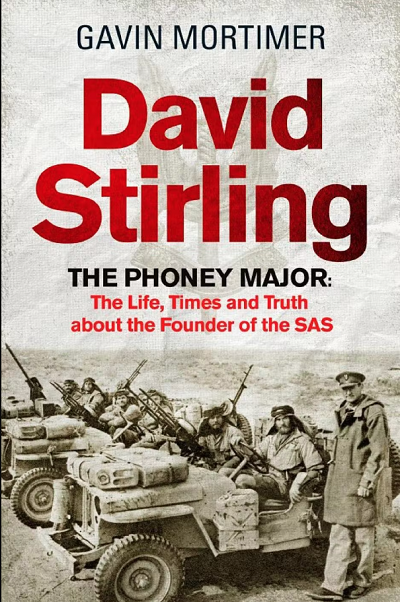
In January 1943 Lieutenant Colonel David Stirling, founder of the SAS, was flown to Rome for interrogation. He had been captured by the Italians on his “most hare-brained scheme yet” — leading a small raiding party deep into enemy territory in Tunisia to attack lines of communication, reconnoitre the terrain and become the first Eighth Army unit to link up with the First Army advancing from the west.
Cautious when speaking to the Italians, he was “vain and voluble” in conversation with a fellow “captive”, Captain John Richards. Unbeknown to Stirling, Richards was an Anglo-Swiss stool pigeon, Theodore Schurch, who had deserted from the British army and was working for fascist intelligence.
Prior to Schurch’s court-martial for treachery in late 1945, Stirling denied he had revealed any sensitive information. If he had, it was inaccurate and “designed to deceive”. This was a lie, told to protect Stirling’s reputation. In fact, as the British authorities knew all too well from intercepted signals, Stirling had told Richards vital details about current SAS operations, including the location of patrols and their orders. He had even given them the name of his probable replacement as SAS commander: Paddy Mayne.
The story of Stirling’s unfortunate encounter with Schurch has been told before, notably by Ben Macintyre in his bestselling SAS: Rogue Heroes. But Macintyre underplays Stirling’s indiscretion and fails to link it to the many other examples of the SAS commander’s recklessness and poor judgement of character. For Gavin Mortimer, on the other hand, both the capture and loose talk were typical of a man who was “imaginative, immature, immoderate and ill-disciplined”. Small wonder that even his own brother Bill thought he would be better off in a prisoner-of-war camp.
The subtitle of Mortimer’s book — a carefully researched and impeccably sourced take-down of the legendary special forces pioneer — is a corrective to the flattering but inaccurate nickname that was first coined for Stirling by British tabloids during the Second World War. “When word reached Cairo of the Phantom Major moniker,” writes Mortimer, “it must have sparked a mix of hilarity and indignation. All the falsehoods and fabrications would have been harmless enough had Stirling not stolen the valour of his comrades.”
Thread by thread, Mortimer unpicks the myth of Stirling’s life and war service that the subject and his fawning admirers had so carefully constructed, both during and after the war. Stirling was not training in North America for an attempt on Mount Everest’s summit when war broke out in 1939, as he later claimed, but rather working as a ranch hand because his exasperated family hoped it might give the feckless youth some focus and direction.
Comments Off on When the founder of the SAS was captured by Italian troops in 1943
July 20, 2022
The Myth of Rosie the Riveter – On the Homefront 016
World War Two
Published 19 Jul 2022With American men going off to fight the war, there are concerns about a labor shortage. Enter Rosie the Riveter. The women who answered the “We Can Do It” call and entered the factories. But did she really exist?
(more…)
Comments Off on The Myth of Rosie the Riveter – On the Homefront 016


