
Forgotten Weapons
Published Jan 29, 2024When Germany capitulated at the end of World War Two, several hundred thousand German soldiers were stuck in Norway (thanks to the efforts of the Norwegian Resistance preventing them from moving south to reinforce against Allied landings in Normandy). These solders’ arms were surrendered to the Norwegians, and they formed the basis of Norwegian Army and Home Guard armaments for many years. With hundreds of thousands of K98k rifles to choose from, the Norwegians were able to pick out plenty in good condition. This included 400 ZF41 DMR/sniper rifles that were kept intact and taken into Norwegian service. Three different branches used the rifles, and they are marked on the chamber with either HAER (Army), FLY (Air Force), or K.ART (Naval Artillery).
In 1950, Norway began to get US military aid in .30-06, and they decided to rebarrel these Mausers to that cartridge. The process began in 1952 and they were all converted by the end of 1956. The new barrels are marked “KAL 7.62”, for 7.62x63mm. There was only a small amount of experimental further conversion to 7.62mm NATO. The ZF-41 models like this one were also given a new serial number tag riveted onto the scope mount with the rifle’s serial number (150001 through 150400).
Converted Mausers served in the Home Guard until the early 1970s, when they were replaced by the AG3 (HK91).
(more…)
May 5, 2024
M98kF1 ZF41: Norway Recycles Germany’s Worst Sniper Rifle
April 26, 2024
The British Army from the start of the Cold War
Dr. Robert Lyman discusses the state of the British Army through the Cold War years down to today, with emphasis on the defence budget tracking against perceived threats to the UK and allies over that period:
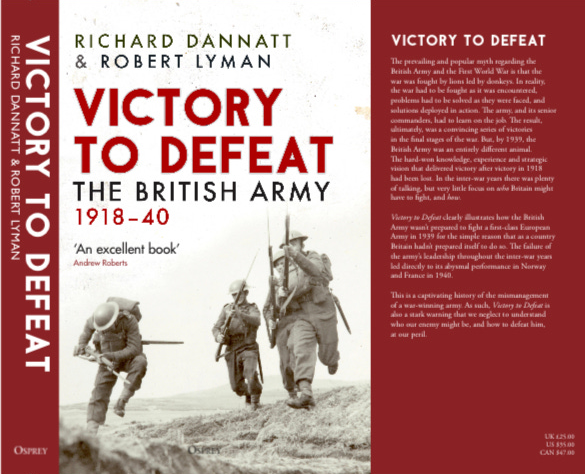
Last year General Lord Dannatt and I published an account of the British Army between 1918 — when it achieved a great victory — and 1940, when it did not. The book was written in part to challenge the UK to think seriously about what happens when our country neglects the requirement for an army able to fight at a high-intensity for a prolonged period against a peer adversary.
Part of our argument was to look at the amount of money the country spends on its defence as a barometer of the seriousness or otherwise of our political masters towards spending money on the primary duty of government, namely the security of its citizens. Our fear is that in the rampant feel-goodery that has plagued the West since 1991 the harsh realities of our unstable world have become forgotten. It has taken Putin’s invasion of Ukraine, and Russia’s subsequent bludgeoning of that benighted country for politicians to gradually wake up to the scale of the threat that this sort of instability offers to the world, not merely Europe or the West.
My fear, like that of many others, is that the wake-up call is taking too long and our country’s defences remain in a parlous state. We haven’t had an army able to deploy at divisional level or above in sustained all-arms manoeuvre for perhaps ten years or more. In other words, our ability to provide what our forefathers would have described as a robust “continental commitment” is almost non-existent.
In the book we trace the origins of the failure to think seriously about the need to have a deployable, expeditionary army, able to fight and operate alongside its allies in NATO on an all-arms battlefield. The reality is that the Cold War forced Britain to retain the ability to fight a general war in Europe, all the while finding the resources to undertake its other commitments across the world. Although worldwide events were dynamic from 1945 to 1989 with further conflicts for the United Kingdom in Malaya, Dhofar, Cyprus, Kenya, Borneo, the Falklands, and the long-running Troubles in Northern Ireland, it was the Cold War in Europe that principally drove the defence agenda and kept the budget at around 5 per cent of GDP. As the major bridge between the United States and Europe, the Royal Navy was heavily committed above and below the surface of the Atlantic Ocean to keep open the sea lines of communication to NATO’s dominant partner, while the British Army retained some 55,000 troops in four armoured divisions as part of NATO’s Northern Army Group and the Royal Air Force was also largely forward-based in West Germany as part of the Second Allied Tactical Air Force. These conventional deployments were all conducted under the nuclear umbrella of Mutual Assured Destruction. By the 1980s, with the West under the leadership of US President Ronald Reagan and British Prime Minister Margaret Thatcher and with increased spending on both conventional armaments and the highly experimental Inter-Continental Ballistic Missile Defence system, the strain of strategic military competition began to show on the political and economic stability of the Soviet Union. Despite the perestroika political movement for reform within the Communist Party of the Soviet Union and the associated openness of glasnost under General Secretary Mikhail Gorbachev, the cracks in the Berlin Wall that opened on 9 November 1989 led inexorably to the collapse of the Soviet Union two years later and the old flag of Russia being raised over the Kremlin on 26 December 1991. The Cold War was over, and an apparent New World Order had begun. The historian Francis Fukuyama declared – somewhat ambitiously – the end of history.
It was at this point that international leaders and their finance ministers in the West began to overlook the cautionary tale that the history of the 20th century might have taught them. With the Soviet Union gone and rump Russia apparently enfeebled, Western states eagerly embarked on military reduction and a peace dividend. In the United Kingdom, the “Options for Change” exercise saw a major slashing of defence capability, beneficially coincidental to help ameliorate a significant economic downturn. The British Army was reduced from 155,000 to 116,000 soldiers, notwithstanding the first Gulf War of 1990–91 which many wishful thinkers regarded as something of an aberration. However, despite that war and the subsequent deployment of large parts of the armed forces to Bosnia from 1992 and then to Kosovo in 1999, the new Labour government of Prime Minister Tony Blair continued with the implementation of its Strategic Defence Review of 1997–98. As a piece of policy work, this was considered an honest review of the United Kingdom’s defence policy and a progressive blueprint for future defence planning and expenditure. Endorsed by Tony Blair and the Chiefs of Staff, this review might have stood the nation in good stead for the future had the Chancellor of the Exchequer, Gordon Brown, fully funded its outcome. For his own reasons, he chose not to do so. The underfunding of the United Kingdom’s defence capability began to show its deficiencies a year after with the second Gulf War of 2003, and the situation was then exacerbated by a protracted campaign in Iraq for the British Army lasting until 2009 and an even more intense one in Afghanistan lasting until 2014.
April 3, 2024
The Flying Saucer Designed To Ram Soviet Bombers | Avro Canada Silver Bug
Rex’s Hangar
Published Dec 29, 2023Today we’re taking a look at a concept “aircraft” developed in the 1950s, the Avro Canada Silver Bug — part of a long line of flying discs drawn up by designer John Frost.
(more…)
April 2, 2024
Gear-Ratio-Accelerated? Yep, It’s a Thing: French MAT 1955 Prototype
Forgotten Weapons
Published Dec 20, 2023EDIT: Shoot, I managed to get the gear ratio backwards. Sorry! The recoil action provides the necessary delay, and then the gear ratio provides acceleration to ensure the bolt can open reliably, akin to the accelerator in a Browning M1917 or 1919 machine gun, or a Lahti L35 pistol. Please excuse the error …
In the search for an improvement to the MAS 1949 rifle for the French military, all the French arsenals proposed new designs. MAS supplied an updated version that was ultimately adopted as the MAS 49/56, but the Tulle Arsenal (MAT) had a wacky idea of its own. In 1955, they presented a short-recoil, tilting bolt, gear-ratio-delayed system. It was an open bolt firing rifle chambered for the 7.5x54mm cartridge, using detachable 20-round magazines. Today we have one of the first models to look at, and there was a second iteration in 1956, which lightened the rifle by replacing some steel parts with aluminum. Neither was successful, much to the relief of the French Army …
Many thanks to the IRCGN (Institut de Recherche Criminelle de la Gendarmerie Nationale) for allowing me access to film this unique rifle for you!
(more…)
March 31, 2024
HMS Unicorn (I72) – Guide 367
Drachinifel
Published Dec 23, 2023The Unicorn, a fleet maintenance carrier of the British Royal Navy, is today’s subject.
(more…)
March 27, 2024
Civil Defence is a real thing in Finland
Paul Wells reports back on his recent trip to Finland, where he got to tour one of the big civil-defence shelters in Helsinki:
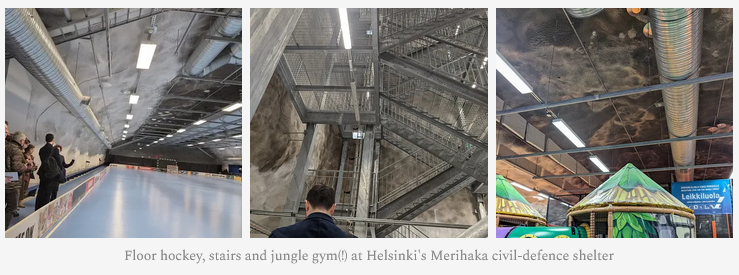
One of the best playgrounds for children in Helsinki is the size of three NFL football fields, dug into bedrock 25 metres below a street-level car park, and built to survive a nuclear bomb.
The air down here is surprisingly fresh. The floor-hockey rinks — there are two, laid end to end — are well maintained. The refreshment stands are stocked with snacks. The steel blast doors are so massive it takes two people to slam one shut.
Finland has been building civil-defence shelters, methodically and without fuss, since the late 1950s. This one under the Merihaka residential district has room for 6,000 people. It’s so impressive that it’s the Finnish capital’s unofficial media shelter, the one visiting reporters are likeliest to be shown. The snack bar and the jungle gym are not for show, however: as a matter of government policy, every shelter must have a second, ordinary-world vocation, to ensure it gets used and, therefore, maintained between crises.
The Merihaka shelter was one of the stops on my visit to Helsinki last week. The first anniversary of Finland’s membership in NATO, the transatlantic defence alliance, is next week, on April 4. Finland’s foreign office invited journalists from several NATO countries to visit Helsinki to update us on Finland’s defence situation. I covered my air travel and hotel. Or rather, paid subscribers to this newsletter did. Your support makes this sort of work possible. I’m always grateful.
The Finnish government used to build most of the shelters. But since 2011, the law has required that new shelters be built at the owners’ expense, by owners of buildings larger than 1,200 square metres and industrial buildings larger than 1,500 square metres.
The city of Helsinki has more shelter space than it has people, including visitors from out of town. Across the country the supply is a little tighter. Altogether today Finland has a total of 50,500 shelters with room for 4.8 million people.
That’s not enough for the 5.5 million people in Finland. But then, if war ever comes, much of the population won’t need shelter, because they’ll be staying groundside to fight.
Conscription is universal for Finnish men between 18 and 60. (Women have been enlisting on a voluntary basis since the 1990s.) The standing armed forces, 24,000, aren’t all that big. But everyone who finishes their compulsory service is in the reserves for decades after, with frequent training to keep up their readiness. In a war the army can surge to 280,000. In a big war, bigger still.
The Soviet Union invaded Finland in 1939, during what was, in most other respects, the “phony war” phase of the Second World War. The Finnish army inflicted perhaps five times as many casualties on the Soviets as they suffered, but the country lost 9% of its territory and has no interest in losing more. Finland’s foreign policy since then has been based on the overriding importance of avoiding a Russian invasion.
March 7, 2024
M60: Cold War Guardian | Tank Chats #175
The Tank Museum
Published Dec 1, 2023The high point of a series of American tank designs that began in WW2, the M60 stood guard in a divided Europe during the Cold War. David Willey gives us a detailed analysis of a tank that served far longer than anyone intended.
(more…)
March 6, 2024
Venezuelan FN49: The First FN49 Contract
Forgotten Weapons
Published Dec 1, 2023Venezuela was the first nation to purchase the FN-49 rifle, before even the Belgian military. In fact, the Venezuelan contract was signed in 1948, before the “FN-49” designation was even in place. Venezuela bought a total of 8,012 rifles in two batches — 4,000 rifles plus 12 cutaway training examples delivered in 1949 and a further 4,000 more rifles delivered in June 1951. All of them included the integral muzzle brake and scope mounting cuts, although no scopes were ever procured. They were all semiautomatic models.
Some of the rifles were issued and used, but some appear to have remained in depots their entire life. Venezuela was also an early adopter of the FAL, and the FN-49 was only used for a short time. In 1966, all of them (or virtually all) were sold as surplus to InterArms, and brought onto the US collector market.
(more…)
March 2, 2024
Brian Mulroney, RIP
In a guest post at Paul Wells’ Substack, Ian Brodie describes former Prime Minister Brian Mulroney’s role in ending the Cold War:
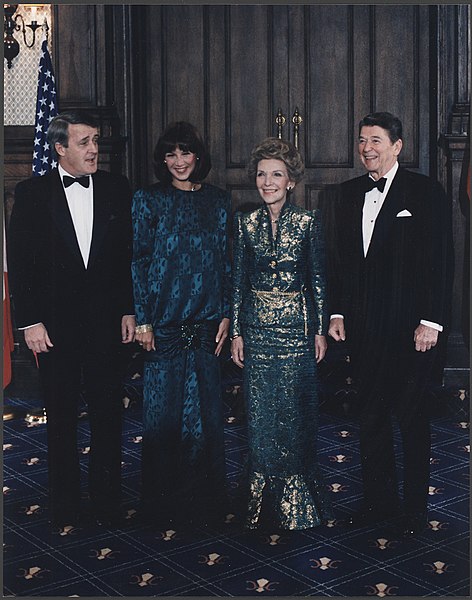
Prime Minister Brian Mulroney, Mila Mulroney, Nancy Reagan, and President Ronald Reagan at the “Shamrock Summit”, 18 March, 1985.
Photo from the Ronald Reagan Presidential Library via Wikimedia Commons.
Mulroney’s role has long been poo-poohed by intellectuals on the Canadian left. He was said to have an unhealthy obsession with pleasing the Americans. As a young boy, his fine voice won him an opportunity to entertain visiting American executives with a song. Amateur psychologists diagnosed a disturbing link between Mulroney’s having grown up in a company town, under the shadow of a US owned mill, and his reinvigoration of St. Laurent’s post-war grand strategy.
Mulroney never automatically fell in with US positions on the global issues of the day. His opposition to the apartheid regime in South Africa ran counter to the positions of both Reagan and Thatcher. But he drove the effort to link the American and Canadian economies through the free trade agreement. He backed our allies in the strategic competition with the Soviet bloc. And in helping to create the International Democratic Union, he helped put the west’s centre-right parties on the side of international political cooperation on the side of democracy, liberty, and the rule of law. The contrast with an earlier prime minister who could not bring himself to condemn the declaration of martial law in Poland a few years earlier was clear.
His personal relationships with a generation of American leaders gave substance to the transactional successes. As the Soviet Union came apart, he secured a spot for Canada as the first NATO country to recognize Ukraine’s independence and bolstered the independence movements of the Baltic republics. When Iraq tried to establish a precedent that, following the Cold War, large, powerful countries could invade their neighbours with impunity, Mulroney backed the US led coalition to liberate Kuwait with all the diplomatic and military power he had on hand.
And along the way, he so closely befriended both Reagan and the first Bush that he was given a privileged platform at two US state funerals, an honour never extended to a Canadian leader before and unlikely to be extended to one again soon.
Mulroney deserves to be remembered along with St. Laurent as Canada’s grand strategist of the 20th century. A trusted confidant of world leaders.
February 21, 2024
Can you make a tank disappear? The Evolution of Tank Camouflage
The Tank Museum
Published Nov 17, 2023It’s not easy to hide a tank. But over the years, military commanders have developed ways to disguise, cover and conceal the presence of their tanks from the enemy. This video is about the “art of deception” – and how, since World War One, through World War Two and into the present day, the science of tank camouflage has evolved to meet the conditions and threats of the contemporary battlefield.
00:00 | Intro
01:38 | WWI
06:26 | WW2
13:42 | Post War
19:40 | Conclusion
(more…)
February 19, 2024
The CIA’s covert operations … as inspired by Vladimir Lenin
Along with most people who’ve been paying attention to history since the start of the Cold War, I hold the CIA in dubious regard. They seem to have been involved in so many underhanded escapades in countries around the world — certainly by reputation, if not in reality — that they stand almost in direct opposition to how most Americans liked to think of their country. Jon Miltimore thinks that among their inspirations was the founder of the Soviet Union himself:

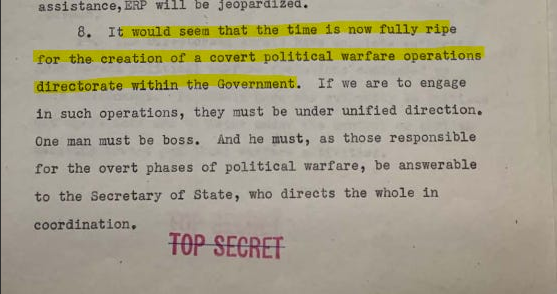
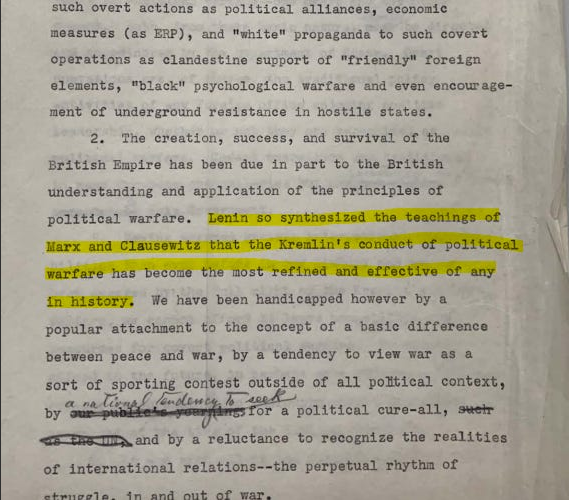
I bring all of this up because I recently came across an old document of some significance that I’d never heard of before titled, “The Inauguration of Organized Political Warfare“.
It was authored by George Kennan, the State Department Policy Planning Director who’d go on to be a successful US diplomat, for the National Security Council (which governed the CIA), and the document explained how the US government had to mobilize national resources “for covert political warfare” to combat the Soviet Union.
Kennan was not, in my opinion, a bad man. He had good instincts and sound motives, at least compared to others in the US intelligence apparatus. He was an early opponent of the Vietnam War and later was one of the first diplomatic leaders to warn against the US policy of expanding NATO up to Russia’s doorstep, something he predicted would be “the most fateful error of American policy in the entire post-cold-war era”.
That said, it’s clear that Kennan was not appalled by the Soviet Union’s use of covert political warfare. He was impressed by it.
“Lenin so synthesized the teachings of Marx and Clausewitz that the Kremlin’s conduct of political warfare has become the most refined and effective of any in history,” Kennan wrote in the document.
We have been handicapped however by a popular attachment to the concept of a basic difference between peace and war, by a tendency to view war as a sort of sporting context outside of all political context, by a national tendency to seek for a political cure-all, and by a reluctance to recognize the realities of international relations — the perpetual rhythm of [struggle, in and out of war].
The document is fascinating because it appears to mark the genesis of the US government’s first formal steps into the world of political warfare — a well-documented history that includes toppling governments, assassinating world leaders, tipping elections, and torturing enemies.
All of these efforts, of course, initially targeted external parties and countries to serve “the national interest”.
This is no longer the case. The CIA, NSA, and other intelligence agencies no longer restrict their covert political warfare to foreign states, and I’m not talking about just Operation Mockingbird and other domestic propaganda efforts.
The CIA is clearly putting its thumb on the scales of US elections in ways that should terrify all Americans.
February 16, 2024
Regional Power: North Korea
Army University Press
Published Feb 13, 2024This film examines the current political and military situation in North Korea. Subject matter experts discuss Korean history, DPRK current affairs, and KPA military doctrine. Topics include the rise of the Kim family to political leadership of the DPRK, its influence in the region, and how the U.S. works in partnership with the Republic of Korea.
February 15, 2024
The Big Picture – NATO: Partners in Peace (1954)
Army University Press
Published Nov 13, 2023NATO: Partners in Peace follows the creation and impact of the North Atlantic Treaty Organization (NATO). Created in April 1949 with twelve founding members, this organization’s goal was to protect the inherent rights of individual states through collective defense. In this episode from The Big Picture series, General Dwight D. Eisenhower offers a speech before he deploys to Europe to become the first Supreme Allied Commander Europe (SACEUR). This is followed with footage of the buildup and training of European forces. Once Eisenhower leaves NATO to campaign for the presidency, General Matthew Ridgway replaces him as NATO commander. One significant problem NATO forces faced was the fact that each nation had its own weapon systems and ammunition, an issue the U.S. wanted to address with the standardization of the 7.62mm cartridge. Perhaps as a deterrent to the Soviet Union, NATO: Partners in Peace depicts new weapons that could be used against a large enemy force such as remote-controlled missiles, napalm bombs, and the massive atomic cannon.
February 6, 2024
5 HEAVY Tanks | Tank Chats
The Tank Museum
Published Nov 10, 2023Enjoy this compilation of classic Tank Chats presented by David Fletcher. We’ve put together David’s chats on TOG 2, FV4005, Conqueror, Conway and the 40 Ton Centurion – representing some of the heaviest tanks in our collection.
(more…)
January 27, 2024
AFN-49: The Forgotten Full-Auto Brother of the FN-49
Forgotten Weapons
Published 20 Oct 20230:00 Introduction and Overview of the AFN 49
1:23 Detailed Insight into the AFN 49’s Global Presence
3:01 Demonstration and Explanation of the AFN’s Unique Features
5:05 Auto Trip Feature: A Deep Dive
7:27 Unique Characteristics of the AFN 49
8:48 The Journey of AFN 49s to the US
10:17 Conversion of Luxembourg AFN 49s: A Historical Perspective
10:43 Conclusion and AcknowledgementsA note to censors: This video is not a tutorial on full auto conversion. It is an explanation of how the system works, and provides no instruction of how to fabricate or modify parts to modify a semiautomatic firearm into a fully automatic one. Doing that would be illegal for most people — although certainly not all; conversion or ownership of machine guns is legal in most places with the appropriate government permission.
The SAFN, aka FN-49, is one of the classic post-war European battle rifles, and was sold to nine different countries in the early 1950s before the FAL became FN’s primary combat rifle offering. What is often forgotten is that despite being limited to a fixed 10-round magazine, nearly half of all FN-49s produced were actually fully automatic AFN-49s. The Belgian Army, Luxembourg Army, Luxembourg Gendarmerie, and Belgian Congo all purchased the automatic pattern. So today, we’re going to take a look at how it differs from the regular SAFN that we are used to seeing.
Interestingly, a batch of the Luxembourg Gendarmerie rifles were imported into the US without anyone realising that they were automatic until they arrived and were being unpacked. InterArms went to the IRS (the NFA was a tax law administered by the Treasury; this was before the formation of the ATF) and proposed removing the selector levers and auto sears, as well as milling off their attachment points on the receivers. The IRS agreed that this would be an acceptable conversion to render the guns legally semiautomatic only, and the changes were made before the rifles were sold. They remain on the US collector market today as an interesting example of legal conditions prior to the adoption of a pointless and punitive decree of “once a machine gun, always a machine gun”.
Many thanks to the Royal Museum of the Armed Forces and Military History in Brussels for access to this very cool piece! Check them out here: https://www.klm-mra.be/en/
(more…)


