
It’s likely that just about everything you know about Joe McCarthy, his life, his political career and his work against the Soviet infiltration of American government is incorrect, the history having been almost without exception written by his staunch enemies, in turn building on the work of McCarthy’s contemporaries to delegitimise and destroy the junior Senator from Wisconsin. Even in the conservative circles, the memory of McCarthy is often treated as a bit of family embarrassment; in part the testament to how successful the left-wing narrative has been but also perhaps the faint memory that half of his own party (the so called liberal wing) despised him at the time and worked hand in hand with the Democrats to destroy him.
Yet McCarthy was right – not just in a general sense of clearly understanding that communism is not merely an alternative path to a brighter future but an evil and inhuman ideology at war with the liberal, democratic and Christian West, but also in focusing on the federal bureaucracy’s strangely ineffectual response to the presence in its ranks of many people, often in very senior and influential positions, suspected of working for the communist cause.
Contrary to the official version, it was never McCarthy’s role to unmask Red agents; a job more appropriately done by investigative agencies. In his legislative role overseeing federal bureaucracies, he made it his mission to inquire why so many individuals, whose loyalty has already been put under the question mark by numerous internal and external investigations, had no problems staying in sensitive jobs for years and moving unhindered from one agency to another. Those named by McCarthy (on the Democrat insistence) were not simply some random individuals with vaguely progressive sympathies; already at the time many of them have been identified as Soviet agents and security risks in the testimony of communist renegades (like Whitaker Chambers and Elizabeth Bentley) or through secret FBI surveillance. Others were suspects on the account of their associations with Eastern European or local communists and causes.
Over the following decades, most have been further incriminated from a variety of sources, including Soviet defectors and the deciphered Venona transcripts of secret Soviet intelligence cables, which mention some 400 individuals in the 1940s and 50s United States as active agents and contacts or abettors and helpers. The problem was not Reds under the beds, but Reds quite literally in positions of access to highly valued classified information or positions of influence over the shape of US policy, from the White House, through the State Department, to a host of other departments and agencies. All this is now beyond any dispute, but these weren’t mere idle speculations at the time either. Lauchlin Currie, Owen Lattimore, Harry Dexter White, Nathan Silvermaster, T.A. Bisson and dozens and dozens of others did conspire in small groups and networks to pass on classified information to the Soviets or steer the American foreign policy into the direction favourable to the communists (particularly in China during and after the war). And yet, despite all having serious question marks over them, they were allowed to work in government for years undisturbed. It was not because of some giant communist conspiracy at the highest levels of government but because of the bureaucratic inertia, old boys’ networks and the organisational reluctance to admit problems – but also because communist agents within protected and promoted each other. Time and time again mistakes got buried instead of rectified. McCarthy dared to shed the public spotlight on the continuing outrage and ask why. It was like a poor country cousin being invited to a formal dinner by his big city relatives and dropping a loud fart between the entree and the main.
But the story of McCarthy goes beyond these well-established historical facts to the campaign of character assassination and falsification of the record that succeeded beyond anyone’s wildest dreams. There is truly nothing new under the sun when the entrenched liberal establishment wants to protect its turf and fend off its enemies and as you read what McCarthy has been subjected to in relatively short period of 1950-54 you will no doubt experience a sense of deja vu from recent history: indiscriminate mud throwing in a hope that something sticks; blatant lies, misrepresentations and misinterpretations of evidence; politicians working hand in hand with public servants to coordinate the attacks; destroying and withholding of information and evidence (for example, the security information about the suspected individuals being physically transferred from the State Department to the Truman White House so that it could not be subpoenaed or otherwise accessed; a practice condemned by the Republicans and then continued by the Eisenhower White House); blackmailing witnesses or preventing them from testifying; biased media running the narrative (fake news is nothing new); whitewashing the accused and discrediting the accusers; incessant lawfare; trumped up charges and defamation. Coincidentally, McCarthy too was compared to Hitler while at the same time being accused of helping Russians. McCarthyism is not what McCarthy has done to his supposed victims; it’s what the left has done to him. It’s what it keeps doing to people who get in the way and threaten to disturb the business as usual.
Arthur Chrenkoff, “Before there was Trump, there was Joe McCarthy”, Daily Chrenk, 2019-09-30.
January 27, 2024
QotD: McCarthy was right
January 24, 2024
France’s Final Battle Rifle Iteration: The MAS 49-56
Forgotten Weapons
Published 24 May 2019While the development of the MAS 49 had given France a very utilitarian rifle that could serve as both for both marksmen and grenadiers, it could still be made better. In large part, the change to the 49-56 pattern was motivated by the move to adopt NATO-compatible 22mm rifle grenades. With the new muzzle hardware, several other changes were made. A gas cutoff was added, to prevent wear and tear on the action from grenade use (something that was found to be a real problem on the MAS 49). The gas port was also moved farther down the barrel, and the hand guard and barrel were both shortened to make the rifle a bit lighter and handier.
Production began in 1957, and about 175,000 of the rifles were made, seeing service as France’s standard front-line infantry rifle until the adoption of the FAMAS in 1979.
(more…)
January 22, 2024
QotD: Mao’s theory of “protracted war” as adapted to Vietnamese conditions by Võ Nguyên Giáp
Giáp was facing a different set of challenges in Vietnam facing either France or the United States which required the framework of protracted war to be modified. First, it must have been immediately apparent that it would never be possible for a Vietnamese-based army to match the conventional military capability of its enemies, pound-for-pound. Mao could imagine that at some point the Red Army would be able to win an all-out, head-on-head fight with the Nationalists, but the gap between French and American capabilities and Vietnamese Communist capabilities was so much wider.
At the same time, trading space for time wasn’t going to be much of an option either. China, of course, is a very large country, with many regions that are both vast, difficult to move in, and sparsely populated. It was thus possible for Mao to have his bases in places where Nationalist armies literally could not reach. That was never going to be possible in Vietnam, a country in which almost the entire landmass is within 200 miles of the coast (most of it is far, far less than that) and which is about 4% the size of China.
So the theory is going to have to be adjusted, but the basic groundwork – protract the war, focus on will rather than firepower, grind your enemy down slowly and proceed in phases – remains.
I’m going to need to simplify here, but Giáp makes several key alterations to Mao’s model of protracted war. First, even more than Mao, the political element in the struggle was emphasized as part of the strategy, raised to equality as a concern with the military side and fused with the military operation; together they were termed dau tranh, roughly “the struggle”. Those political activities were divided into three main components. Action among one’s own people consisted of propaganda and motivation designed to reinforce the will of the populace that supported the effort and to gain recruits. Then, action among the enemy people – here meaning Vietnamese who were under the control of the French colonial government or South Vietnam and not yet recruited into the struggle – a mix of propaganda and violent action to gain converts and create dissension. Finally, action against the enemy military, which consisted of what we might define as terroristic violence used as message-sending to negatively impact enemy morale and to encourage Vietnamese who supported the opposition to stop doing so for their own safety.
Part of the reason the political element of this strategy was so important was that Giáp knew that casualty ratios, especially among guerrilla forces – on which, as we’ll see, Giáp would have to rely more heavily – would be very unfavorable. Thus effective recruitment and strong support among the populace was essential not merely to conceal guerrilla forces but also to replace the expected severe losses that came with fighting at such a dramatic disadvantage in industrial firepower.
That concern in turn shaped force-structure. Giáp theorized an essentially three-tier system of force structure. At the bottom were the “popular troops”, essentially politically agitated peasants. Lightly armed, minimally trained but with a lot of local knowledge about enemy dispositions, who exactly supports the enemy and the local terrain, these troops could both accomplish a lot of the political objectives and provide information as well as functioning as local guerrillas in their own villages. Casualties among popular troops were expected to be high as they were likely to “absorb” reprisals from the enemy for guerrilla actions. Experienced veterans of these popular troops could then be recruited up into the “regional troops”, trained men who could now be deployed away from their home villages as full-time guerrillas, and in larger groups. While popular troops were expected to take heavy casualties, regional troops were carefully husbanded for important operations or used to organize new units of popular troops. Collectively these two groups are what are often known in the United States as the Viet Cong, though historians tend to prefer their own name for themselves, the National Liberation Front (Mặt trận Dân tộc Giải phóng miền Nam Việt Nam, “National Liberation Front for South Vietnam”) or NLF. Finally, once the French were forced to leave and Giáp had a territorial base he could operate from in North Vietnam, there were conventional forces, the regular army – the People’s Army of Vietnam (PAVN) – which would build up and wait for that third-phase transition to conventional warfare.
The greater focus on the structure of courses operating in enemy territory reflected Giáp’s adjustment of how the first phase of the protracted war would be fought. Since he had no mountain bases to fall back to, the first phase relied much more on political operations in territory controlled by the enemy and guerrilla operations, once again using the local supportive population as the cover to allow guerrillas and political agitators (generally the same folks, cadres drawn from the regional troops to organize more popular troops) to move undetected. Guerrilla operations would compel the less-casualty-tolerant enemy to concentrate their forces out of a desire for force preservation, creating the second phase strategic stalemate and also clearing territory in which larger mobile forces could be brought together to engage in mobile warfare, eventually culminating in a shift in the third phase to conventional warfare using the regional and regular troops.
Finally, unlike Mao, who could envision (and achieve) a situation where he pushed the Nationalists out of the territories they used to recruit and supply their armies, the Vietnamese Communists had no hope (or desire) to directly attack France or the United States. Indeed, doing so would have been wildly counter-productive as it likely would have fortified French or American will to continue the conflict.
That limitation would, however, demand substantial flexibility in how the Vietnamese Communists moved through the three phases of protracted war. This was not something realized ahead of time, but something learned through painful lessons. Leadership in the Democratic Republic of Vietnam (DRV = North Vietnam) was a lot more split than among Mao’s post-Long-March Chinese Communist Party; another important figure, Lê Duẩn, who became general secretary in 1960, advocated for a strategy of “general offensive” paired with a “general uprising” – essentially jumping straight to the third phase. The effort to implement that strategy in 1964 nearly overran the South, with ARVN (Army of the Republic of Vietnam – the army of South Vietnam) being defeated by PAVN and NLF forces at the Battles of Bình Giã and Đồng Xoài (Dec. 1964 and June 1965, respectively), but this served to bring the United States more fully into the war – a tactical and operational victory that produced a massive strategic setback.
Lê Duẩn did it again in 1968 with the Tet Offensive, attempting a general uprising which, in an operational sense, mostly served to reveal NLF and PAVN formations, exposing them to US and ARVN firepower and thus to severe casualties, though politically and thus strategically the offensive ended up being a success because it undermined American will to continue the fight. American leaders had told the American public that the DRV and the NLF were largely defeated, broken forces – the sudden show of strength exposed those statements as lies, degrading support at home. Nevertheless, in the immediate term, the Tet Offensive’s failure on the ground nearly destroyed the NLF and forced the DRV to back down the phase-ladder to recover. Lê Duẩn actually did it again in 1972 with the Eastern Offensive when American ground troops were effectively gone, exposing his forces to American airpower and getting smashed up for his troubles.
It is difficult to see Lê Duẩn’s strategic impatience as much more than a series of blunders – but crucially Giáp’s framework allowed for recovery from these sorts of defeats. In each case, the NLF and PAVN forces were compelled to do something Mao’s model hadn’t really envisaged, which was to transition back down the phase system, dropping back to phase II or even phase I in response to failed transitions to phase III. By moving more flexibly between the phases (while retaining a focus on the conditions of eventual strategic victory), the DRV could recover from such blunders. I think Wayne Lee actually puts it quite well that whereas Mao’s plan relied on “many small victories” adding up to a large victory (without the quick decision of a single large victory), Giáp’s more flexible framework could survive many small defeats on the road to an eventual strategic victory when the will of the enemy to continue the conflict was exhausted.
Bret Devereaux, “Collections: How the Weak Can Win – A Primer on Protracted War”, A Collection of Unmitigated Pedantry, 2022-03-03.
January 9, 2024
AMX-13 | Tank Chats #174
The Tank Museum
Published 6 Oct 2023With over 7,700 units built and still in service today, this French light tank stands as a testament to its enduring legacy and historical significance. David Willey gives us an in-depth analysis of the development and history of the AMX-13.
(more…)
January 7, 2024
“Of course, you know that you Eeenglish invented modern people smuggling?”
In The Critic, Peter Caddick-Adams talks about the huge problems faced by European nations in combatting people smuggling:
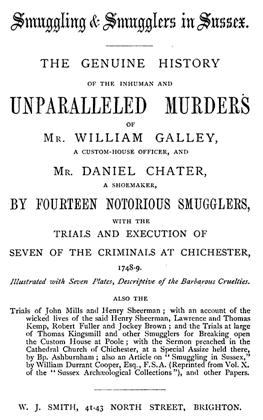
Title page of a book covering the trial of seven smugglers for the murder of two revenue officers. In the preface the author says “I do assure the Public that I took down the facts in writing from the mouths of the witnesses, that I frequently conversed with the prisoners, both before and after condemnation; by which I had an opportunity of procuring those letters which are herein after inserted, and other intelligence of some secret transactions among them, which were never communicated to any other person.”
W.J. Smith, Smuggling and Smugglers in Sussex, 1749, via Wikimedia Commons.
The Prime Minister has nailed his colours to his mast and decided we should “stop the boats”. The slogan is everywhere. What Mr Sunak means is the vessels crossing the Channel laden with bedraggled folk seeking succour on the shores of Albion. I attended a conference recently to see how this was to be done. As the perpetrators are highly organised transnational criminals, the response must be a multi-national one. Delegates were given some historical context. Ours is not a unique era. Since pre-recorded history, mankind has been inclined to see the grass as always greener on the other side of the fence. Hollow out a log to cross a river, invade an island, a coastline, Troy, the Euphrates, the Tigris, the Nile. Anywhere, for trade, for adventure, for sanctuary. Leap the Channel by longship to escape overcrowding, poor crops, for plunder, to claim a crown.
However, we were reminded — for the conference was hosted by several coastal nations studying security and crime — that most of Europe’s maritime problems with criminality and smuggling, be it booze, tobacco, narcotics, fake branded goods, or people, involve rivers, not the open sea. An old friend from the Gendarmerie Maritime observed that the great rivers of the world are not only frontiers, but also highways; earlier versions of today’s motorways, as logistically familiar to the Romans as to our own times. Those long gaggles of barges which still shuffle along the Rhine or Danube are a happenstance of trade we Brits tend to overlook, as our canals and rivers have long been consigned to pleasure-boating.
Based in Messina, the gendarme’s opposite number from the Servizio navale of the Italian Carabinieri, wearing the most resplendent braid-laden uniform of anyone at our gathering, then fixed me with his gimlet eye. “Of course, you know that you Eeenglish invented modern people smuggling?” By this he went on to explain that many of the tricks of shifting people covertly through the Mediterranean, along the Dalmatian coast, by patrol boat about the Baltic, trawler braving the North Sea, MTB across the Channel, caïque over the Aegean, among the Ionian islands, and along the Adriatic, were devised by Britain’s Special Operation’s Executive (SOE) during the Second World War.
My Belgian and French friends observed that such smuggling had honourable roots. From 1789 and post-1917, many nations had aided middle class and aristocratic refugees to flee Revolutionary France and Russia. Subsequently, their descendants helped Jewish families quit the Third Reich. Others aided the British to move vast numbers of manpower by small boat in 1940 from Dunkirk, which emboldened fishermen to repeat the manoeuvre on a smaller scale to confound their German foes. Female Greek, Turkish and Croatian officers chipped in with their knowledge of various rat-lines established during World War Two to support partisans with personnel and weapons, and extract downed airmen, spies and important scientists. Post-war, as a Spanish policeman I knew from my days in Gibraltar observed, the same systems exported Nazi war criminals, and imported drugs and guns.
The modus operandi created in those heady days of derring-do were continued for spies during the Cold War, often by the same families, using the same craft. This applied as much to jaunts and japes up and down the Danube, Rhine, Meuse and Elbe waterways as it did to the open seas. Our Danish representative observed that “boat people” were a distraction. Their numbers were vastly overshadowed by far greater numbers of religious refugees and assorted shady characters, then and now, who used stolen genuine, or expertly forged papers; another legacy from the even more distant times that preceded World War Two. The man from Interpol revealed that today’s Italian and Albanian crime families have such advanced facilities for reproducing many of the world’s passports, ID cards, work permits and driving licences, that they will pass muster even at most European electronic frontier posts and airport controls. Our Albanian colonel shifted uncomfortably.
With the fall of the Iron Curtain, espionage went out of business and, casting about for new business, these latter-day privateers and licenced black marketeers started smuggling industrial quantities of things and people, to replace the nocturnal movement of atomic secrets by night over water. A dinghy full of people in mid-Ocean is merely the tip of a giant iceberg of organisation and logistics that started on 22 July 1940 by direct order of Winston Churchill, but has continued in various legal, semi-legal and illegal forms ever since.
QotD: The US Army between 1945 and 1950
The trouble is, different men live by different myths.
There are men who would have a society pointed wholly to fighting and resistance to Communism, and this would be a very different society from the one Americans now enjoy. It might succeed on the battlefield, but its other failures can be predicted.
But the infantry battlefield also cannot be remade to the order of the prevailing midcentury opinion of American sociologists.
The recommendations of the so-called Doolittle Board of 1945-1946, which destroyed so much of the will — if not the actual power — of the military traditionalists, and left them bitter, and confused as to how to act, was based on experience in World War II. In that war, as in all others, millions of civilians were fitted arbitrarily into a military pattern already centuries old. It had once fitted Western society; it now coincided with American customs and thinking no longer.
What the Doolittle Board tried to do, in small measure, was to bring the professional Army back into the new society. What it could not do, in 1946, was to gauge the future.
By 1947 the United States Army had returned, in large measure, to the pattern it had known prior to 1939. The new teen-agers who now joined it were much the same stripe of men who had joined in the old days. They were not intellectuals, they were not completely fired with patriotism, or motivated by the draft; nor was an aroused public, eager to win a war, breathing down their necks.
A great many of them signed up for three squares and a sack.
Over several thousand years of history, man has found a way to make soldiers out of this kind of man, as he comes, basically unformed, to the colors. It is a way with great stresses and great strains. It cannot be said it is wholly good. Regimentation is not good, completely, for any man.
But no successful army has been able to avoid it. It is an unpleasant necessity, seemingly likely to go on forever, as long as men fight in fields and mud.
One thing should be made clear.
The Army could have fought World War III, just as it could have fought World War II, under the new rules. During 1941-1945 the average age of the United States soldier was in the late twenties, and the ranks were seasoned with maturity from every rank of life, as well as intelligence.
In World War III, or any war with national emotional support, this would have again been true. Soldiers would have brought their motivation with them, firmed by understanding and maturity.
The Army could have fought World War III in 1950, but it could not fight Korea.
T.R. Fehrenbach, This Kind of War: A Study in Unpreparedness, 1963.
December 18, 2023
Battle Taxis | Evolution of the Armoured Personnel Carrier
The Tank Museum
Published 8 Sept 2023Tanks and infantry need to operate together. Tanks provide firepower and protection, the infantry support and protect the tanks. In this video, we look at that vital component of the equation, the Armoured Personnel Carrier and its transition into the modern Infantry Fighting Vehicle.
(more…)
December 13, 2023
How Churchill Started the Cold War in Greece in 1944 – War Against Humanity 121
World War Two
Published 12 Dec 2023You might think that the Cold War starts after this war ends. But already, as the Germans withdraw from Greece, the ideologically opposed Greek resistance groups ELAS and EDES are at each others’ throats. It all culminates in Athens in December 1944; British troops fire some of the first shots of the Cold War as Greece descends into Civil War.
(more…)
December 7, 2023
Carl Gustaf: Recoilless Rifle | Anti-Tank Chats
The Tank Museum
Published 25 Aug 2023From The Falklands to Ukraine; the Carl Gustaf recoilless rifle was introduced in 1948 and is still used by armies around the world today.
(more…)
November 29, 2023
Yugoslav M57: Tito’s Tokarev
Forgotten Weapons
Published 7 Aug 2023Yugoslavia purchased both 1895 Nagant revolvers and TT33 Tokarev from the Soviet Union after World War Two, but this was only a holdover until domestic pistol production could begin. While Yugoslavia was formally communist, Tito was not a puppet of Moscow, and Yugoslavia did their own development to reverse-engineer the Tokarev pistol. In the process, they made a number of improvements to the design, resulting in the M57. Serial production began in 1963 and lasted until 1982, with about 270,000 made in total. It was the standard sidearm for the Yugoslav People’s Army and Yugoslav police forces until 1988.
The changes made from the standard Soviet pattern Tokarev include:
– Longer grip and 9-round magazine capacity
– Captive recoil spring
– Improved front sight
– Stronger firing pin with improved retention system
– Magazine disconnect safety
(more…)
November 28, 2023
Pierre Trudeau and Canada’s choice to become an international featherweight in the 1970s
In The Line, Jen Gerson endures a foreign policy speech from Mélanie Joly that takes her on a weird journey through some of Canada’s earlier foreign policy headscratchers … usually leading back to Justin Trudeau’s late father:
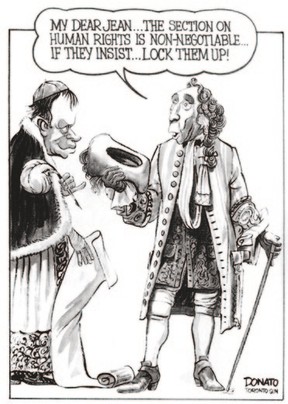
A Toronto Sun editorial cartoon by Andy Donato during Pierre Trudeau’s efforts to pass the Canadian Charter of Rights and Freedoms. You can certainly see where Justin Trudeau learned his approach to human rights.
If I saw a statue of P.E.T. on the roof of a foreign affairs building that looked like it were competing for a 10th place spot in the Eurovision tourney, I don’t know how I’d feel: embarrassed, touched, certainly too polite to say anything honest. I probably wouldn’t be so struck with awe by the sight that I’d be keen to shoehorn the anecdote into a major policy speech in front of the Economic Club.
And yet.
Joly’s speech was striking in that it could be divided into two distinct parts: The first half was a cogent and clear-eyed examination of the state of play of the world, one that acknowledged a fundamental shift in the assumptions that underpin the global order. Nothing one couldn’t glean from the Economist, but grounded nonetheless. The global order is shifting, the stakes have increased, and the world is going to be marked by growing unpredictability.
“Now more than ever, soft and hard power are important,” Joly noted, correctly, ignoring the fact that Canada increasingly has neither, and doesn’t seem to be doing much about that.
And this brings us to the second half of the speech, which was an attempt to spell out the way Canada will navigate this shift, by situating itself as both a Western ally and an honest broker: we are to defend our national interests and our values, while also engaging with entities and countries whose values and interests radically diverge from our own. “We cannot afford to close ourselves off from those with whom we do not agree,” Joly said. “I am a door opener, not a door closer.”
This was clearly intended to be analogous to the elder Trudeau’s historic policy of seeking cooperation with non-aligned countries — countries that declined to join either the Communist or the Western blocs throughout the Cold War.
[…]
If our closest allies treat us like ginger step-children as a result of our own obliviousness and uselessness, our platitude-spewing ruling class is going to seek closer relationships in darker places: in economic ties with China, and in finding international prestige via small and middling regional powers or blocs whose values and interests are, by necessity or choice, far more malleable than our own.
These cute turns of phrase are a matter of domestic salesmanship only. “Pragmatic diplomacy” is a thick lacquer on darker arts.
Which brings us back to Macedonia, again. Or North Macedonia, if you’re a stickler.
Before it declared independence in 1991, Macedonia was a republic within the Socialist Federal Republic of Yugoslavia. During much of Trudeau Sr.’s time, Yugoslavia was led by Josip Tito, a Communist revolutionary who broke with Stalin and spearheaded a movement of non-aligned countries, along with the leaders of India, Egypt, Ghana, and Indonesia. Tito was one of several despotic and authoritarian leaders with whom Trudeau Sr. sought to ingratiate himself to navigate the global order.
P.E.T.’s most ardent supporters maintain a benevolent amnesia about just how radical Trudeau Sr. was relative not only to modern standards, but to world leaders at the time.
During the 1968 election, Trudeau promised to undertake a sweeping review of Canada’s foreign affairs, including taking “a hard look” at NATO, and addressing China’s exclusion from the international community.
In 1969, America elected Richard Nixon a bombastic, controversial, and corrupt president who forced Canada examine the depth of its special relationship with its southern neighbour. At the time, this was termed “Nixon shock.” And it could only have furthered Trudeau Sr.’s skepticism of American hegemony.
It was in this environment of extraordinary uncertainty, and shifting global assumptions and alliances, that Trudeau Sr. called for a new approach to Canadian foreign policy. He wanted a Canada that saw itself as a Pacific power, more aligned to Asia (and China). Trudeau also wanted stronger relationships with Western Europe and Latin America, to serve as countervailing forces to American influence.
November 27, 2023
This Cold War bomber was perfect. Why was it cancelled? | TSR2
Imperial War Museums
Published 9 Aug 2023In 1951, Britain introduced the English Electric Canberra. It would go onto become the RAF’s longest serving aircraft, designed to operate at high level. It was an incredibly efficient aircraft, but by the late 1950s everything changed. The Soviet Union brought into service brand new surface-to-air missiles and suddenly overnight the Canberra was vulnerable.
Now the British government needed a new aircraft, one that could beat this threat and fly under the radar. It was a huge ask for the technology of the time, but had it been successful the aircraft itself would have been a world beater. In this epsiode of Duxford in Depth, Liam Shaw takes a details look at the aircraft that never was, the BAC TSR-2.
(more…)
November 24, 2023
The Man Who Started the Cold War
World War Two
Published 23 Nov 2023What if I told you that a new conflict will sweep the globe in less than a year? It will open not with gunshots but with silent, shadowy espionage. The man who will kick off the Cold War is a quiet Canadian pilot, millionaire, and spymaster. A trusted aide to Churchill and FDR. I bet you haven’t heard this name before: William Stephenson.
(more…)
November 14, 2023
Inside T-72: A Commander’s Perspective | Tank Chats Reloaded
The Tank Museum
Published 21 Jul 2023A fast tank with a low profile and a big gun, the T-72 is a classic Soviet designed Main Battle Tank, in use all over the world. In this video, we talk to Dag Patchett, a former T-72 commander and get his impressions of a tank built in the Cold War era but still very much in service.
(more…)
November 10, 2023
Luftwaffe Drilling and US M6 Survival Rifle
Forgotten Weapons
Published 8 Sept 2014Today we’re looking at a pair of military survival rifles. One is a Luftwaffe M30 drilling — the most finely finished and luxurious survival rifle ever issued by a military force. The other is a US Air Force M6 survival gun — spartan and utilitarian — the polar opposite of the M30.
(more…)


