Quotulatiousness

January 19, 2020

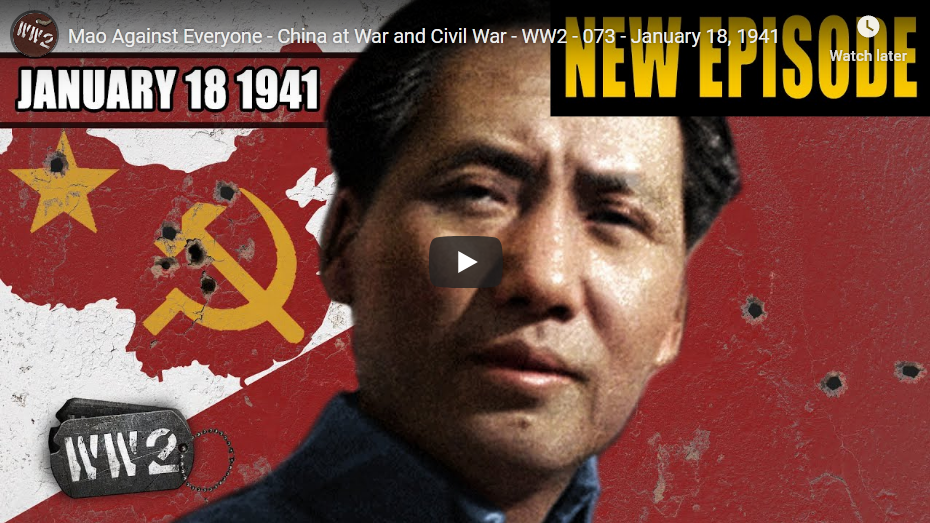
Mao Against Everyone – China at War and Civil War – WW2 – 073 – January 18, 1941

Filed under: Britain, China, France, History, Italy, Military, WW2 — Tags: , , , , , , , — Nicholas @ 04:00

World War Two
Published 18 Jan 2020

The Chinese Communists and Nationalists clash while they’re also both facing Japanese armies in the North. And although the Communists are not the obvious victor this week, the battle has bigger ramifications. Other action takes place in Cambodia and the Mediterranean.

Join us on Patreon: https://www.patreon.com/TimeGhostHistory
Or join The TimeGhost Army directly at: https://timeghost.tv

Follow WW2 day by day on Instagram @World_war_two_realtime https://www.instagram.com/world_war_t…
Join our Discord Server: https://discord.gg/D6D2aYN.
Between 2 Wars: https://www.youtube.com/playlist?list…
Source list: http://bit.ly/WW2sources

Written and Hosted by: Indy Neidell
Produced and Directed by: Spartacus Olsson and Astrid Deinhard
Executive Producers: Bodo Rittenauer, Astrid Deinhard, Indy Neidell, Spartacus Olsson
Creative Producer: Joram Appel
Post-Production Director: Wieke Kapteijns
Research by: Indy Neidell
Edited by: Mikołaj Cackowski
Map animations: Eastory (https://www.youtube.com/c/eastory)

Colorizations by:
– Dememorabilia – https://www.instagram.com/dememorabilia/
– Julius Jääskeläinen – https://www.facebook.com/JJcolorization/

Sources:
Imperial War Museum (E872; E 6600)
Narodowe Archiwum Cyfrowe

Soundtracks from Epidemic Sound:
Phoenix Tail – “At the Front”
Johannes Bornlof – “Death And Glory 2”
Johannes Bornlof – “Last Man Standing 3”
Yi Nantiro – “Watchman”
Johan Hynynen – “Dark Beginning”
Reynard Seidel – “Deflection”
Bonnie Grace – “Imperious”

Archive by Screenocean/Reuters https://www.screenocean.com.

A TimeGhost chronological documentary produced by OnLion Entertainment GmbH.

January 7, 2020

What Made The American Civil War So Deadly? | Animated History

Filed under: Health, History, Military, USA, Weapons — Tags: , , , , — Nicholas @ 06:00

The Armchair Historian
Published 20 Jul 2018

Check out EmperorTigerStar’s video: https://www.youtube.com/watch?v=8j1sJ…

What Made The American Civil War So Deadly?

Sign up for The Armchair Historian website today:
https://www.thearmchairhistorian.com/

Our Twitter: https://twitter.com/ArmchairHist

The Great Courses Plus is currently available to watch through a web browser to almost anyone in the world and optimized for the US, UK and Australian market. The Great Courses Plus is currently working to both optimize the product globally and accept credit card payments globally.

Sources:
Battle Cry of Freedom: The Civil War Era ~ James M. McPherson
The American War: A History of the Civil War Era ~ Gary W. Gallagher
http://www.digitalhistory.uh.edu/disp…
https://blogs.ancestry.com/cm/12-stun…
https://www.battlefields.org/learn/ar…

Wars of the Roses | 3 Minute History

Filed under: Britain, History, Military — Tags: , , , , — Nicholas @ 02:00

Jabzy
Published 23 Jan 2015

Of course there’s a lot I left out.

And when I say “Lancaster”, it sounds out of place because I had to just record over me continuously saying “Lancashire”.

December 14, 2019

The English Civil War Explained

Filed under: Britain, Government, History, Military, Religion — Tags: , , , , , — Nicholas @ 02:00

Royal Armouries
Published 20 Dec 2017

The Royal Armouries’ English Civil War collection boasts an array of infantry and cavalry arms and armour from the 1640s. Delve into this turbulent historical period with our resident Royalist, David.

Where to find us:

⚔Website: https://royalarmouries.org/home
⚔Blog: https://blog.royalarmouries.org/
⚔Twitter: https://twitter.com/Royal_Armouries

The Royal Armouries is the United Kingdom’s national collection of arms and armour. On this channel, discover what goes on behind the scenes at the museum and to see our collection come to life. From combat demonstrations to jousting coverage to behind the scenes tours with our curators, we’ve got it covered.

Have a question about arms and armour? Feel free to leave us a comment and we’ll do our best to answer it.

December 13, 2019

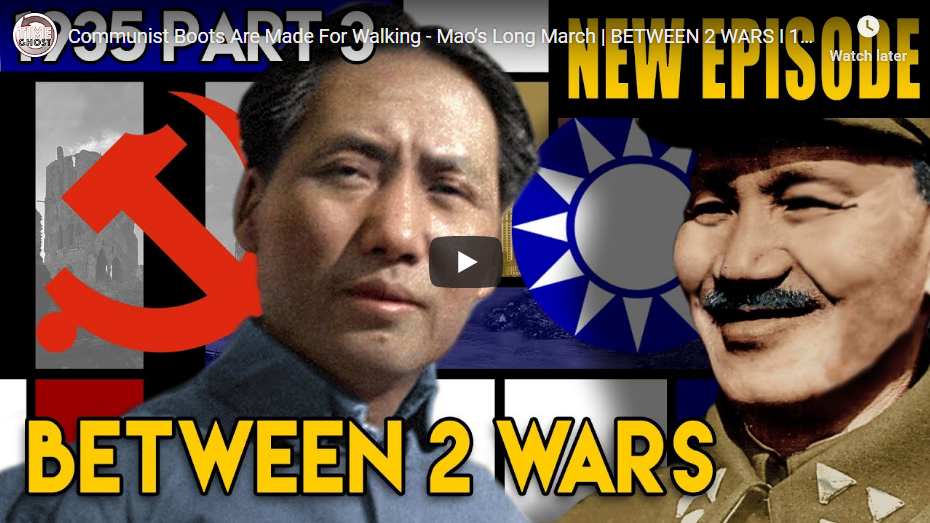
Communist Boots Are Made For Walking – Mao‘s Long March | BETWEEN 2 WARS I 1935 Part 3 of 4

Filed under: China, History, Military — Tags: , , , , , — Nicholas @ 06:00

TimeGhost History
Published 12 Dec 2019

From 1927 to 1934, the Chinese Communists lived in a state within the National Chinese State led by Chiang Kai-Shek. In 1935, the Nationalists strike and the Communists follow their leader Mao Zedong on a Long March Northwards.

Join us on Patreon: https://www.patreon.com/TimeGhostHistory

Hosted by: Indy Neidell
Written by: Joram Appel
Directed by: Spartacus Olsson and Astrid Deinhard
Executive Producers: Bodo Rittenauer, Astrid Deinhard, Indy Neidell, Spartacus Olsson
Creative Producer: Joram Appel
Post-Production Director: Wieke Kapteijns
Research by: Joram Appel
Edited by: Daniel Weiss
Sound design: Marek Kaminski

Colorizations:
– Klimbim – https://klimbim2014.wordpress.com

A TimeGhost chronological documentary produced by OnLion Entertainment GmbH.

December 11, 2019

QotD: Charles I and the Civil War

With the ascension of Charles I to the throne we come at last to the Central Period of English History (not to be confused with the Middle Ages, of course), consisting in the utterly memorable Struggle between the Cavaliers (Wrong but Wromantic) and the Roundheads (Right and Repulsive).

Charles I was a Cavalier King and therefore had a small pointed beard, long flowing curls, a large, flat, flowing hat, and gay attire. The Roundheads, on the other hand, were clean-shaven and wore tall, conical hats, white ties, and sombre garments. Under these circumstances a Civil War was inevitable.

The Roundheads, of course, were so called because Cromwell had all their heads made perfectly round, in order that they should present a uniform appearance when drawn up in line.

Besides this, if any man lost his head in action, it could be used as a cannon-ball by the artillery (which was done at the Siege of Worcester).

For a long time before the Civil War, however, Charles had been quarrelling with the Roundheads about what was right. Charles explained that there was a doctrine called the Divine Right of Kings, which said that:

    (a) He was King, and that was right.

    (b) Kings were divine, and that was right.

    (c) Kings were right, and that was right.

    (d) Everything was all right.

But so determined were the Roundheads that all this was all wrong that they drew up a Petition called the Petition of Right to show in more detail which things were wrong. This Petition said:

    (a) That it was wrong for anyone to be put to death more than once for the same offence.

    (b) Habeas Corpus, which meant that it was wrong if people were put in prison except for some reason, and that people who had been mutilated by the King, such as Prynne, who had often had his ears cut off, should always be allowed to keep their bodies.

    (c) That Charles’s memorable methods of getting money, such as Rummage and Scroungeage, were wrong. But the most important cause of the Civil War was Ship Money

Charles I said that any money which was Ship Money belonged to him; but while the Roundheads declared that Ship Money could be found only in the Cinq Ports, Charles maintained that no one but the King could guess right which was Ship Money and which wasn’t. This was, of course, part of his Divine Right. The climax came when a villager called Hampden (memorable for his dauntless breast) advised the King to divine again. This so upset Charles that he went back to Westminster, and after cinquing several ports burst into the House of Commons and asked in a very royal way for some birds which he said were in there. The Parliament, who were mostly Puritans, were so shocked that they began making solemn Leagues and Countenances. Charles therefore became very angry and complaining that the birds had flown raised his standard at Nottingham and declared war against Hampden and the Roundheads.

The War

At first the King was successful owing to Prince Rupert of Hentzau, his famous cavalry leader, who was very dashing in all directions. After this, many indecisive battles were fought at such places as Newbury, Edgehill, Newbury, Chalgrove Field, Newbury, etc., in all of which the Cavaliers were rather victorious.

The Roundheads therefore made a new plan in order to win the war after all. This was called the SelfDenying Ordnance and said that everyone had to deny everything he had done up to that date, and that nobody was allowed to admit who he was: thus the war could be started again from the beginning. When the Roundheads had done this they were called the New Moral Army and were dressed up as Ironclads and put under the command of Oliver Cromwell, whose Christian name was Oliver and who was therefore affectionately known as `Old Nick’. Cromwell was not only moral and completely round in the head but had a large (round) wart on the nose. He was consequently victorious in all the remaining battles such as Newbury, Marston Moor, Edgehill (change for Chalgrove), Naseby, Newbury, etc.

Blood and Ironclads

When Charles I had been defeated he was brought to trial by the Rump Parliament so-called because it had been sitting for such a long time and was found guilty of being defeated in a war against himself, which was, of course, a form of High Treason. He was therefore ordered by Cromwell to go and have his head cut off (it was, the Roundheads pointed out, the wrong shape, anyway). So romantic was Charles, however, that this made little difference to him and it is very memorable that he walked and talked Half an hour after his Head was cut off.

On seeing this, Cromwell was so angry that he picked up the mace (the new and terrible Instrument of Government which he had invented) and, pointing it at the Head, shouted: “Take away that Marble,” and announced that his policy in future would be just Blood and Ironclads.

W.C. Sellar & R.J. Yeatman, 1066 And All That, 1930.

December 7, 2019

QotD: A “democratic” army

Filed under: Britain, Europe, France, Quotations — Tags: , , , , , , — Nicholas @ 01:00

Orwell’s press card portrait, 1943

It is probable that the nature of modern war has made “democratic army” a contradiction in terms. The French army, for instance, based on universal service, is hardly more democratic than the British. It is just as much dominated by the professional officer and the long-service N.C.O., and the French officer is probably rather more “Prussian” in outlook than his British equivalent. The Spanish Government militias during the first six months of war — the first year, in Catalonia — were a genuinely democratic army, but they were also a very primitive type of army, capable only of defensive actions. In that particular case a defensive strategy, coupled with propaganda, would probably have had a better chance of victory than the methods casually adopted. But if you want military efficiency in the ordinary sense, there is no escaping from the professional soldier, and so long as the professional soldier is in control he will see to it that the army is not democratised. And what is true within the armed forces is true of the nation as a whole; every increase in the strength of the military machine means more power for the forces of reaction. It is possible that some of our more Left-wing jingoes are acting with their eyes open. If they are, they must be aware that the News-Chronicle version of “defence of democracy” leads directly away from democracy, even in the narrow nineteenth-century sense of political liberty, independence of the trade unions and freedom of speech and the press.

George Orwell, “Democracy in the British Army”, Left, 1939-09.

November 29, 2019

Revolts, civil wars, and revolutions

Filed under: Britain, Government, History, Politics — Tags: , , , , , — Nicholas @ 03:00

Severian offers his taxonomy of protest with examples from English history:

King Charles I and Prince Rupert before the Battle of Naseby 14th June 1645 during the English Civil War.
19th century artist unknown, from Wikimedia Commons.

  • A revolt is a large-scale, semi-organized riot. It aims, at best (e.g. Wat Tyler’s Rebellion), at the redress of specific grievances. At worst, it’s violent nihilism (e.g. the Jacquerie).
  • A civil war aims to replace one leader with another, leaving the underlying civil structure intact — e.g. any of the Roman civil wars post-Augustus.
  • A revolution‘s goal is total social transformation. We’re stipulating that it’s violent, because while stuff like the Industrial Revolution is fascinating, we’re not looking at peaceful change here in the Current Year. Revolutions are necessarily, fundamentally ideological.

I realize this can cause some confusion, as events I’d classify as “revolutions” are called civil wars in the history books, and vice versa. But the difference is important, because it sheds light on the development, course, and outcome of events.

The paradigm case is the English Civil War, 1642-51. This was clearly a revolution, as it aimed at — and achieved — the near-total overthrow of existing society. When Charles I took the throne in 1625, his kingdom was very much closer to a Continental-style divine-right monarchy than most Britons would like to admit. While the English had succeeded in clawing some of their liberties back from the crown after Henry VIII’s death, the fact remains that the Stuart state, like the Tudor state, was despotic. But by 1625, the despot was completely out of step with his people, and his times.

By 1642, the first revolutionary prerequisite was in place: No clear alternative. There were lots of revolts against Henry VIII, and one of them, the Pilgrimage of Grace, had the potential to turn into a civil war, or even a revolution. The revolts against Elizabeth I didn’t quite rise to that level, but the Northern Rebellion, and Essex’s Rebellion certainly imperiled her government. See also Wyatt’s Rebellion against Queen Mary, the Prayer Book Rebellion and Kett’s Rebellion against Edward VI, etc. In all of these, the alternative was clear — return to Rome, replacement of one court faction with another, or return to the old ways.

November 9, 2019

Ten Minute English and British History #11 – King John and the Magna Carta

History Matters
Published 1 Jan 2018

Twitter: https://twitter.com/Tenminhistory
Patreon: https://www.patreon.com/user?u=4973164

This episode covers the reign of King John and the problems he had securing the Angevin inheritance and the subsequent issues his barons posed. These problems culminated in the signing of the Magna Carta in 1215 which severely limited the strength of John and his son, Henry III, whose reign was overshadowed by the document.

Ten Minute English and British History is a series of short, ten minute animated narrative documentaries that are designed as revision refreshers or simple introductions to a topic. Please note that these are not meant to be comprehensive and there’s a lot of stuff I couldn’t fit into the episodes that I would have liked to. Thank you for watching, though, it’s always appreciated.

November 8, 2019

Not all Fascists Are Nazis – Civil War in Austria | BETWEEN 2 WARS I 1934 Part 2 of 4

Filed under: Europe, History, Italy — Tags: , , , , — Nicholas @ 06:00

TimeGhost History
Published 7 Nov 2019

Austria is very divided in the 1930s. Austrian Nationalism opposes the idea of a Greater German Reich, which triggers the emergence of Austrofascism. They find themselves in a violet struggle against Nazis, Communists, Democrats and Socialists.

Join us on Patreon: https://www.patreon.com/TimeGhostHistory

Hosted by: Indy Neidell
Written by: Spartacus Olsson, Joram Appel and Francis van Berkel
Directed by: Spartacus Olsson and Astrid Deinhard
Executive Producers: Bodo Rittenauer, Astrid Deinhard, Indy Neidell, Spartacus Olsson
Creative Producer: Joram Appel
Post-Production Director: Wieke Kapteijns
Research by: Naman Habtom, Joram Appel and Francis van Berkel
Edited by: Daniel Weiss
Sound design: Marek Kaminski

Colorized pictures:
– Daniel Weiss,
– Julius Jääskeläinen (https://www.facebook.com/JJcolorization/),
– Dememorabilia (https://instagram.com/dememorabilia)

Sources:
– Image sources: Bundesarchiv, Bundesarchiv, Bild_183-R36187/102-10358/102-00842A/102-00836/102-00840/102-00839/102-09844. Fortepan_28800(FOTOFORTEPAN MZSLOfner Károly)
– Icons from the Noun Project: School by David, college by anbileru adaleru, Law by Delwar Hossain, Parliament by Gerald Wildmoser, Diploma by Alena, guns by Cards Against Humanity, poll by Bastien Ho,

A TimeGhost chronological documentary produced by OnLion Entertainment GmbH.

From the comments:

TimeGhost History
2 days ago (edited)
A lot comes together in this episode. Austria in 1934 is where a lot of political movements, ideologies and methods we saw throughout the ’20s and ’30s in previous episodes go head to head. We explain how Austro-Fascism differs from fascism and how Nazism and Austrofascism engage in a violent clash.

So, this episode covers Communism, Fascism, Austrofascism and Nazism in the context of Austria in 1934. I can predict some of the comments that will appear under this video, so allow me to explain how we interpret and explain the key differences between some of these. In academia, we use a right-left axis to place political movements on based on their ideology, NOT just because of their methods or form of state. Our definition is not politically motivated or does not relate to current day politics. We only apply this definition to the specific historical context of the interwar era and World War Two. In short: totalitarian or authoritarian governments are not all the same. Fascism and Nazism are generally placed on the right because they were driven by state or race superiority, Communism and Socialism are placed on the left as they were driven by class-differences and (theoretical) equality.

Granted, there is a rich scholarly debate surrounding the function and interpretation of the left-right axis. Anyone who is interested to read more about that can read ‘Andrew Heywood, Political Ideologies: An Introduction (2017) 15-17.’ However, there are limits to what is accepted as an academic argument and what is plain propaganda. Socialism and Nazism are not the same by any respectable definition. Communism and Nazism both embracing totalitarian regimes does not make them the same. We love to engage in debates about this, and we will do so with anyone who presents a real argument with real examples and sources. We will not engage with trolls who are politicising this historical debate with a modern-day agenda.

Cheers,
Joram

October 15, 2019

The Tide Is Turning – Russian Civil War Fall 1919 I THE GREAT WAR 1919

Filed under: History, Military, Russia — Tags: , , , , , , — Nicholas @ 04:00

The Great War
Published 14 Oct 2019

Support 16 Days in Berlin: https://realtimehistory.net/indiegogo

The White Russian advance on Moscow comes to a crashing end as the Red Army manages to turn the tide of the Russian Civil War in Fall 1919.

» SUPPORT THE CHANNEL
Patreon: https://www.patreon.com/thegreatwar
Merchandise: https://shop.spreadshirt.de/thegreatwar/

» SOURCES
Figes, Orlando. A People’s Tragedy. The Russian Revolution (London: The Bodley Head, 2017 [1996]).
Mawdsley, Evan. The Russian Civil War (New York: Pegasus Books, 2005).
Smele, Jonathan. The “Russian” Civil Wars 1916-1926 (London: Hurst, 2015).
Sumpf, Alexandre. “Russian Civil War,” in 1914-1918 online. International Encyclopedia of the First World War. https://encyclopedia.1914-1918-online.
Engelstein, Laura. Russia in Flames (Oxford University Press, 2017).

»CREDITS
Presented by: Jesse Alexander
Written by: Jesse Alexander
Director: Toni Steller & Florian Wittig
Director of Photography: Toni Steller
Sound: Toni Steller
Editing: Toni Steller
Mixing, Mastering & Sound Design: http://above-zero.com
Maps: Daniel Kogosov (https://www.patreon.com/Zalezsky)
Research by: Jesse Alexander
Fact checking: Florian Wittig

Channel Design: Alexander Clark
Original Logo: David van Stephold

A Mediakraft Networks Original Channel

Contains licensed material by getty images
All rights reserved – Real Time History GmbH 2019

October 2, 2019

“When the next American Civil War starts…”

Filed under: Military, Politics, USA — Tags: , , , , — Nicholas @ 05:00

David Warren goes all soothsayery and predicts the course and outcome of a potential Red-versus-Blue armed conflict arising from the current Red-versus-Blue verbal conflict:

When the next American Civil War starts, I imagine it will look something like Hong Kong: a big melee spreading through all public spaces (I note that USA is bigger than Hong Kong). But there will be fairly limited casualties, at first, each of which will become the subject of unrestrained media outrage, until the media collapse under physical reprisals. Later, the better and better armed demonstrators, on both sides, will tactically “evolve.” The surveillance state itself will begin to disintegrate, and with it any hope of restoring public order, through agencies such as police, courts, and prisons. Things like border surveillance will be abandoned, with immediate consequences, but as the attraction of going to the States diminishes, no one will mind. More noticeably, the economy will break down. Because the American military was designed chiefly to defend against foreign powers, on a very large scale — and the threat will instead be domestic and scattered — the Army will be (at first) effectively neutralized. Isolated firefights between Democrat and Republican soldiers will escalate to firefights between ships and aeroplanes, but these will end fairly quickly as a Pentagon dictatorship seizes control. Within a year, I expect, though only a small part of their arsenal will prove useful, bullet-enforced curfews will restore relative peace to the streets. I don’t expect the death toll to be more than a few hundred thousand, at least from direct conflict as the guns come out. Interruptions of food supply, and the spread of disease, will cost much more — but possibly less (proportionately) than in the last Civil War, in which both sides were better organized.

That it will have spread to Canada, I cannot doubt, developing from the refugee crisis across “the world’s longest undefended border,” as snowflakes of all descriptions, by their millions, run for their lives, then resume their clashes up here. Mexico would also suffer from this “white flight,” except, the chaos from Mexican cartels’ energetic efforts to reclaim significant parts of Texas, California, and the Southwest, would have the paradoxical effect of ending the outbound refugee traffic there. For the most part, other foreign countries would avoid direct engagement. Instead, Islamist and Socialist regimes around the world would be busy consolidating their own local positions, sparking numerous “little wars” by their attempts at regional expansion. Each would be settled as the larger and more ruthless power won.

Still, I shouldn’t expect the anarchy to continue. Tyranny quickly fills a vacuum of authority (moral as well as material), and answers to the growing demand for safety. Nothing, of course, will be learnt from the adventure, and I should think that within a decade or less, resistance to the new President-for-Life will have all but evaporated.

September 29, 2019

History Summarized: Mexico

Overly Sarcastic Productions
Published 27 Sep 2019

Go to https://NordVPN.com/overlysarcastic and use code OVERLYSARCASTIC to get 70% off a 3-year plan and an extra month for free. Protect yourself online today!

This video is quite serendipitous in timing — by complete coincidence, this is going live on September 27, the day of Mexico’s true political independence under the First Mexican Empire. This is the 11 year sequel to the more traditional Mexican Independence celebrations of September 16th, which marks Miguel Hidalgo’s proclamation of the “Cry of Dolores” and the start of the Mexican War of Independence. No joke, I only realized this when I was partway through researching the video. I do so much ancient history I’m not used to events having dates we can track to the day.

ANYWAY enjoy this look at Mexican History, here broken into three main acts, the Aztec Empire, the Colony of New Spain, and the Independent nation of Mexico.

“Santianna” By The Longest Johns: https://thelongestjohns.bandcamp.com/…

PATREON: https://www.Patreon.com/OSP

DISCORD: https://discord.gg/sS5K4R3

September 16, 2019

The Inca Empire – Andean Apocalypse – Extra History – #4

Filed under: Americas, History, Military — Tags: , , , , , , — Nicholas @ 06:00

Extra Credits
Published on 14 Sep 2019

Join us on Patreon! http://bit.ly/EHPatreon

Disease — likely, smallpox or measles — had arrived in the Inca empire, and it was ruthless. Two of the (now dead) Emperor Huayna Capac’s sons, Atahualpa and Huáscar, decided that a civil war over who should be Sapa Inca was perfect to do right now — nevermind the fact that Francisco Pizarro and his conquistadores had just showed up.

September 14, 2019

QotD: America and its army

Filed under: History, Military, Quotations, USA — Tags: , , — Nicholas @ 01:00

Before 1939 the United States Army was small, but it was professional. Its tiny officers corps was parochial, but true. Its members devoted their time to the study of war, caring little what went on in the larger society around them. They were centurions, and the society around them not their concern.

When so ordered, they went to war. Spreading themselves thinner still, they commanded and trained the civilians who heeded the trumpet’s call. The civilians did the fighting, of course — but they did it the Army’s way.

In 1861 millions of volunteers donned blue or gray. Millions of words have been written on American valor, but few books dwell on the fact that of the sixty important battles, fifty-five were commanded on both sides by West Pointers, and on one side in the remaining five.

In 1917 four million men were mustered in. Few of them liked it, but again they did things the way the professionals wanted them done.

The volunteers came and went, and the Army changed not at all.

But since the Civil War, the Army had neither the esteem nor the favor of public or government. Liberal opinion, whether business-liberal or labor-liberal, dominated the United States after the destruction of the South, and the illiberal Army grew constantly more alienated from its own society.

In a truly liberal society, centurions have no place. For centurions, when they put on the soldier, do not retain the citizen. They are never citizens to begin with.

There was and is no danger of military domination of the nation. The Constitution gave Congress the power of life or death over the military, and they have always accepted the fact. The danger has been the other way around — the liberal society, in its heart, wants not only domination of the military, but acquiesence of the military toward the liberal view of life.

Domination and control society should have. The record of military rule, from the burnished and lazy Praetorians to the juntas of Latin America, to the attempted fiasco of the Légion Étrangére, are pages of history singularly foul in odor.

But acquiesence society may not have, if it wants an army worth a damn. By the very nature of its mission, the military must maintain a hard and illiberal view of life and the world. Society’s purpose is to live; the military’s is to stand ready, if need be, to die.

Soldiers are rarely fit to rule — but they must be fit to fight.

The military is in essence a tool, to be used by its society. If its society is good, it may hope to be used honorably, even if badly. If its society is criminal, it may be, like the Wehrmacht, unleashed upon a helpless world.

But when the Wehrmacht dashed against the world, it was brought to ruin, not by a throng of amateurs, but by well-motivated, well-generaled Allied troops, who had learned their military lessons.

T.R. Fehrenbach, This Kind of War: A Study in Unpreparedness, 1963.

« Newer PostsOlder Posts »

Powered by WordPress