Quotulatiousness

October 20, 2024

Debunking the “Muslims saved the Graeco-Roman legacy” intellectual urban legend

In my weekly set of recommendations from Substack there was a link to A History of Mankind‘s debunking of what is described as an “intellectual urban legend”:

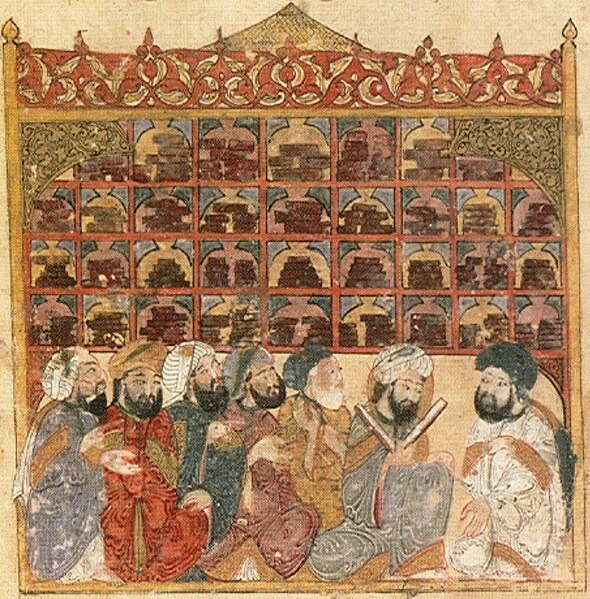
Islamic scholars at an Abbasid library in Baghdad.
Illustration by Yahyá al-Wasiti from 1237 via Wikimedia Commons.

Among the most popular of those legends, there’s one that can be summarized as “Arab scholars and translators saved the books of Graeco-Roman antiquity from being destroyed by the Christians and/or forgotten”. This a surprisingly widespread view. I’ve lived in several countries, and heard versions of this legend, often told in very simple terms over somewhat complicated drinks, from well-educated people often working in academia or the financial sector (which makes more sense than it appears — I’ve worked in the financial sector myself, and people there are highly educated as a rule).

I’ve even heard scholars (normally not Medievalists) express this view, and I’ve read views to this effect in multiple occasions. Just Google “did the arabs save graeco-roman books” and look at the top results, if you don’t believe me. Lots of well-educated people believe this, not to speak of history enthusiasts all over the Internet.

However, the truth is that Arab translators had only a modest impact on the transmission of Graeco-Roman texts to modern times. There are various reasons that explain this, but first let me provide some clarity on why Baghdad’s Medieval “House of Wisdom” — oft-cited, correctly, as the center of the Abbasid-era translation movement inasmuch as there was one — is one of history’s most misunderstood institutions.

The House of Wisdom functioned as a state library with a focus on the transcription and storage of manuscripts, and their translation to the court’s main language, Arabic. Based on a similar library patronized by the Sasanian emperors and staffed with some of its personnel from about the 8th century, the House of Wisdom employed Christian Greek speakers – very few Muslims spoke or read Greek fluently in this era and others, particularly Arabs – as well as Muslim and Zoroastrian Arabic or Syriac speakers who worked to translate and disseminate work.

[…]

Just to give a final touch of class to these absurd claims, Abu Sahl added the detail that the Greeks, dunces as they all are, forgot to actually steal many Iranian books, and simply memorized the contents before they torched them, so the actual Greek copies of Iranian greats are, by necessity, inferior versions diluted by the Greeks’ faulty memory.

Some Muslim scholars later came up with a new wrinkle that Byzantines were poor keepers of their own treasures, and their books were eaten by insects, as the bibliographer Al-Nadim (932-995) wrote in a second- or third-hand anecdote about some guy who visited Constantinople and was sad to see some ancient temple filled with neglected books, later widely quoted, and included in his Index of 987. The same Al-Nadim transmits from someone “trustworthy” that the Byzantines burned fifteen loads of books by Archimedes, which never happened.

Abdullah Ibn-abi-Zayd (922–998), a prolific North African writer on Islamic law, came up with a wrinkle for this wrinkle: that the Byzantine emperor gathered books and hid them in a secret building to prevent heresy among potential readers; and when Yahya, a prominent Bamarkid Persian in the Abbasid court, heard of the repository he asked if he could borrow the texts. The emperor agreed on the condition that they were never returned, so that they would never hurt the delicate Christian feelings of his subjects.

Others with less experience of the Christian West, like the Egyptian Arab Ibn Ridwan (988-1061), claimed that ancient sciences were forgotten there, and only survived in the Ummah because of the supreme wisdom and care displayed by Al-Mamun and their successors. Ridwan’s fable showing just how obscurantist and dumb Christians are proved particularly successful, being often retold with the kind of reverence typically reserved for hadiths:

    The history of medicine begins with a brief account of the development in antiquity from Asclepius to Galen. After Galen, the community of the Christians emerged from and prevailed over the Greeks. The Christians considered it a fault to study intellectual matters and their kings cast away the care for medicine and failed to take care of its students. So its students ceased to commit themselves to the toilsome study of medicine and found reading Hippocrates’ and Galen’s works too tedious; thus, it fell into disorder and its condition worsened. Then came Oribasius, after the Christian kings’ lack of interest in the instruction [of medicine] was firmly rooted … When none of the kings any longer felt the desire to promote the teaching [of medicine] and the people found Hippocrates’ and Galen’s works on it too tedious and tended to compendia and abridgments, the most prominent Alexandrian physicians, afraid that the art would vanish altogether, asked those kings to retain the teaching [of medicine] in Alexandria and [to allow] only twenty books on medicine to be read, sixteen from Galen’s and four from Hippocrates’ works … The teaching stood on shaky ground until al-Ma’mun ‘Abd-Allah ibn-Harun al-Rashid became caliph, who revived and spread it and favored excellent physicians. But for him, medicine and other disciplines of the ancients would have been effaced and obliterated just as medicine is obliterated now from the lands of the Greeks, which had been most distinguished in this field.

I should also mention that it wasn’t just the Graeco-Romans who the Abbasid-era Muslims ripped off in bulk. The fact that Indian numerals came to be known in Europe as “Arabic” numerals, and chess was widely, and wrongly, believed to be an Arabic invention, gives an idea about the impact that Caliphate scholars had as synthesizers and popularizers of scientific knowledge.

Indeed, when the Iranian Al-Khwarizmi (780-850), head of the House of Wisdom from around 820, published the earliest Arabic text on Indian numerals, he chose a title of disarming honesty: “Addition and subtraction according to the Indian calculation”. Such honesty was rarely imitated by Al-Khwarizmi’s successors.

I think you are probably getting the gist of how the story about the Muslim salvage of Graeco-Roman antiquity came about, and was later embraced by every Atheist writer in the West, so that he or she could have nice laughs at the expense of those barbarian fools who never washed themselves, the Christians.

October 19, 2024

QotD: From blackberry picking to Bible verses

Last spring, my oldest daughter and I set out to tame our blackberry thicket. Half a dozen bushes, each with a decade’s worth of dead canes, had come with our house, and we were determined to make them accessible to hungry children. (Do you have any idea how much berries cost at the grocery store, even in the height of summer? Do you have an idea how many hours of peaceful book-reading you can stitch together out of the time your kids are hunting for fruit in their own yard? It’s a win-win.) But after we’d cut down all the dead canes, I explained that we also needed to shorten the living ones, especially the second-year canes that would be bearing fruit later in the summer. At this point, scratched and sweaty from our work, she balked: was Mom trying to deprive the children of their rightful blackberries? But I explained that on blackberries, like most woody plants, the terminal bud suppresses growth from all lower buds; removing it makes them all grow new shoots, each of which will have flowers and eventually fruit. Cutting back the canes in March means more berries in July. At which point I could see a light dawning in her eyes as she exclaimed, “Oh! We’re memorizing the Parable of the True Vine in school but I never knew why Jesus says pruning the vines makes more fruit …”

It’s pretty trite by now to point out that Biblical metaphors that would have made perfect sense for an agricultural society are opaque to a modern audience for whom vineyards are about the tasting room and trimming your wick extends the burn time of your favorite scented candle. There’s probably whole books out there exploring the material culture of first century Judaea to provide context to the New Testament.1 But at least pruning is a “known unknown”: John 15:2 jumps out as confusing, and anyone who does a little gardening can figure out the answer. Plenty of things aren’t like that at all. Even today, few people record the mundane details of their daily lives; in the days before social media and widespread literacy it was even more dramatic, so anyone who wants to know how our ancestors cleaned, or slept, or ate has to go poking through the interstices of the historical record in search of the answers — which means they need to recognize that there’s a question there in the first place. When they don’t, we end up with whole swathes of the past we can’t really understand because we’re unfamiliar with the way their inhabitants interacted with the physical world.

Jane Psmith, “REVIEW: The Domestic Revolution by Ruth Goodman”, Mr. and Mrs. Psmith’s Bookshelf, 2023-05-22.


    1. Are they any good? Should I read them? I’ve mentally plotted out a structure for one of my own, where each chapter is themed around the main image of one of the parables — oil, wine, seeds, fish, sheep, cloth, salt — and explores all the practicalities: the wine chapter would cover viticulture techniques but also land ownership (were the vintners usually tenants? what did their workforce look like?), seeds would cover how grain was planted, harvested, milled, and cooked, etc. The only problem is that I don’t actually know anything about any of this.

October 10, 2024

QotD: Why did ancient China lose its early lead in science and technology?

Why, despite China’s prodigious lead in science, technology, population, and economic activity, did the scientific revolution and then the industrial revolution happen in Europe? Why did they fall so far behind after being so far ahead?

There are all kinds of answers given to this question, from ones based around the concept of “agricultural involution” (which I briefly surveyed in my review of Energy and Civilization), to ones that blame the complexity of the Chinese system of writing and other more outlandish theories. But would you know it, this question is commonly referred to within Sinology as the “Needham puzzle” or the “Needham question”, so what does the man himself think? Needham got the credit for posing the question, not for answering it, but in the final chapter of this book, “Attitudes Towards Time and Change”, he drops some fascinating hints.

A belief common to the great civilizations of the Axial Age was that time itself was somehow unreal. Greek philosophers from the pre-Socratics to the Neo-Platonists all expressed it in very different ways, but all agreed that in some sense the world of mutability and change was an illusion, and that outside of it stood an eternal, absolute reality sufficient in itself, unchanging in its perfection, αἰῶνας τῶν αἰώνων. The Buddhist civilizations include this under the doctrine of maya (illusion), and traditional Hinduism also exhibits time as a dreamlike and incidental quality of the world.

If time is somehow unreal and nothing can ever change, then it’s easy to see the attraction of a cyclic conception of history. And indeed, in the ancient world these cyclic theories predominate. The Babylonians had their Great Year, and Greek thinkers as diverse as Hesiod, Pythagoras, Plato, and Aristotle all speculated about the eternal repetition and recurrence of the ages of the world. In the Mahabharata the great yugas and kalpas, the Days of Brahma, follow one another in an inevitable fourfold cycle of world ages, the profusion of Hindu and Buddhist sects have promulgated a thousand interpretations and variations on this basic pattern. On the other side of the world, the Mayans had their own Great Year, and countless other peoples besides. This cosmology almost feels like a human universal (at least for civilizations at a particular stage of development), and why wouldn’t it be? We open our eyes and all we see are cycles within cycles — the cycle of the day, the cycle of the moon, the cycle of the seasons, the cycle of the generations. As sure as day follows night, why wouldn’t we expect that the universe too, a grand mechanism made by the gods, must eventually return to its starting point.

Various philosophers of science have asserted that this view of history makes scientific progress impossible, because of its fatalism and pessimism. If everything that happens has happened before and will happen again, then why bother trying to change anything? It’ll just get undone in the Kali Yuga anyway. But Needham points out another connection: if time is cyclic, or worse yet somehow unreal, then it makes no sense to stretch it out into an independent coordinate. In this way, the entire metaphysics of cyclical time resists the mathematization of physics. One can imagine the analytic geometry of Descartes being discovered in ancient Alexandria or Tikal or Harappa, but would it have been possible for one of the coordinate axes to represent time? A Descartes was possible, but a Newton or a Bernoulli was inconceivable.

All of this changes with the advent of Christianity, for which the most important fact about the world, the Incarnation, takes place at a particular moment in history, once and for all, κατὰ πάντα καὶ διὰ πάντα. The cosmos is fixed around this central point, and cannot curl back upon itself. Kairos transfigures chronos, and in so doing makes it real, gives it force and meaning. History is not a cycle, but a story of creation, separation, incarnation, and redemption, speeding towards its culmination as assuredly as a stone tracing a parabolic arc through the air. Or as Needham puts it:

    [In the Indo-Hellenic world] space predominates over time, for time is cyclical and eternal, so that the temporal world is much less real than the world of timeless forms, and indeed has no ultimate value … The world eras go down to destruction one after the other, and the most appropriate religion is therefore either polytheism, the deification of particular spaces, or pantheism, the deification of all space … For the Judaeo-Christian, on the other hand, time predominates over space, for its movement is directed and meaningful … True being is immanent in becoming, and salvation is for the community in and through history. The world era is fixed upon a central point which gives meaning to the entire process, overcoming any self-destructive trend and creating something new which cannot be frustrated by cycles of time.

Some historians of science have argued that without this linear conception of time introduced by Christianity, we lack the conceptual vocabulary for various things ranging from analytic methods in physics to the idea of causality itself. So is that the answer? Is the solution to the Needham Puzzle that China progressed as far as it could until, weighed down by the fatalism of cyclic history and the impoverished mathematical vocabulary of timeless metaphysics, it ground to a halt?

Unfortunately, the answer is no. This theory sounds great, but it’s totally wrong.

There’s a bad habit among Western historians and philosophers of engaging in a shallow sort of Orientalism that aggregates all of the exotic East into a single entity.1 But when it comes to attitudes towards time, change, and history; the traditional Chinese attitude is much closer to that of Christendom than it is to the Hindu or Buddhist view. Needham does a good job summarizing the basic Chinese outlook, but includes a lot of details I didn’t know, including that the view of civilizations as ascending through distinct historical stages (e.g. the Stone Age, Bronze Age, Iron Age, etc.) is of Chinese origin! Needham also discusses the veneration, sometimes deification, of great inventors that saturates Chinese folk religion. All in all, the picture is one of China as a progress-obsessed society almost from its earliest moments, and as a society that was steadily progressing right up until it was suddenly and dramatically eclipsed by European science.

John Psmith, “REVIEW: Science in Traditional China, by Joseph Needham”, Mr. and Mrs. Psmith’s Bookshelf, 2023-08-14.


    1. I am infuriated by restaurants that advertise “Asian food”. There’s more culinary diversity inside some regions of China than there is in most of Europe.

October 9, 2024

QotD: The hijacking of the Canadian identity

The anniversary of that first May 27, 2021 unmarked-graves announcement came and went a few weeks ago, with barely a peep from prominent figures in the Canadian progressive firmament. And the same Trudeau who’d recently served up lurid sermons about our status as a blood-stained genocide state has now switched into proto-campaign mode, gushing manically about the Liberal horn of plenty set to deluge this nation with riches. According to the latest Liberal agitprop, in fact, patriotic Trudeauvian boosterism isn’t merely permissible — why, it’s obligatory. So light up those Canada Day backyard barbecues. Canuck Yom Kippur is finally over.

But before we dismiss this three-year interregnum as a dystopian fever dream, it’s worth asking how our collective Canadian identity could be hijacked — even temporarily — in such a radicalized manner. And the truth is that it isn’t just progressive ideologues who bear responsibility; but also their counterparts on all parts of the political spectrum, few of whom exhibited any inclination to offer pushback while these falsehoods took root in the media. Even many writers at this newspaper, generally held to be a right-leaning outlet, greeted the unmarked-graves claims by heaping shame on their country.

In every other comparably advanced society, there exists a natural tension between conservative nationalists who reverentially sentimentalize their history, and the progressive critics who reflexively denounce it. And it is from out of that tension that something approaching the historical truth emerges. Or, at least something close enough to the historical truth that it provides a stable and coherent basis upon which a society can confidently pin its collectively embraced national identity.

What we learned in 2021 is that this necessary tension doesn’t exist in Canada, because traditionalists can no longer describe their nation’s history in a way that gives voice to their emotionally felt patriotism without attracting claims of racism and neocolonialism. As a result, our marketplace of ideas lacks the checks and balances required to inure us against — oh, gee, I don’t know, let’s take a crazy example — apocalyptic medieval fables in which legions of Indigenous children are thrown into furnaces and shallow graves by cackling nuns and diabolical priests.

So yes, shame on Trudeau for lowering the Canadian flag on federal buildings for half a year to honour victims entombed in non-existent mass graves. But shame on the rest of us for staring at our shoes while this blood libel was being signal-boosted. And now that Trudeau seems on his way out — and, with him, the maudlin, tear-soaked, bent-knee political shtick that accompanied this descent into hysteria — we might turn our attention toward developing a national self-identity sufficiently robust that it doesn’t fall to pieces the next time someone claims to have found genocide’s residue under an old tetherball court.

Jonathan Kay, “Don’t let politicians misinform you. Learn about Canada’s true history for yourself”, National Post, 2024-07-01.

August 20, 2024

QotD: The printing press was to the Reformation what social media is in the Current Year

Consider the Reformation. I’m in no way qualified to walk you through all the various doctrinal issues, but in this case a superficial analysis is not only sufficient, it’s actually better. Instead of getting lost in the theological weeds, I want to focus on the process. So let’s stipulate for the sake of argument that nothing Luther said was all that original, theologically — you can find pretty much any tenet of “Lutherism” (as it then was) somewhere in the past, often among the Church Fathers (the “double predestination” that drove Calvinists insane is straight out of St. Augustine, for example). Wyclif, Hus, Nicholas of Cusa, Marsilius of Padua, all those guys were proto-Luthers, at least in part.

The thing about Luther, then, wasn’t what he said, so much as how he said it.

Martin Luther was the world’s first spin doctor. Though he insisted for a long time that his famous 95 Theses were, and were always intended to be, a scholastic debate between clergymen, Luther mastered the use of printed propaganda. His opponents soon followed, or tried to, in an ever-increasing spiral of printed viciousness. Mutatis mutandis, the exchanges between Luther, Erasmus, Thomas More (to say nothing of a thousand lesser lights) and their opponents all sound shockingly Current Year. They’re snarky and waspish at best, grotesque ad hominem at worst. Modern flame wars have nothing on the way Thomas More and William Tyndale tore into each other, for instance, and More and Tyndale were rank amateurs compared to Luther.

As with the Current Year, where being first on social media is the only criterion that matters, so the printing press injected something very like “hot takes” into the late-Medieval intellectual atmosphere. If you tried to respond to your opponents the old-fashioned way — with closely reasoned, heavily cited arguments, on parchment, hand-copied by monks — you might win the intellectual battle … 500 years later, among historians who thank you for providing such a useful glimpse into late-Medieval mentalités, but in your own time you’d get fired at best, get burned at the stake at worst, if you didn’t respond instantly, in kind.

The printing press, in other words, represented a quantum leap in the velocity of information. Those who grasped its fundamentals prospered, while those who fell behind perished. King Henry VIII, for instance, fatally damaged his cherished intellectual reputation when he deigned to attack to Luther in person. Luther hit back with a tirade that wouldn’t be out of place on Twitter1, and Henry responded in kind, and now the king, who was hip-deep in self-inflicted shit by that point, had to drop the fight. Having been publicly abused by a mere ex-monk, he had to quit the field with his tail between his legs.

Severian, “Velocity of Information”, Rotten Chestnuts, 2021-08-10.


    1. Again, mutatis mutandis. Though this sounds to modern ears like an abject apology on Luther’s part (“especially as I am the offscouring of the world, a mere worm who ought only to live in contemptuous neglect”, etc.), in context it’s a vicious attack. For one thing, what’s a great king like Henry doing responding to a “mere worm”? And Henry had to know, since Wolsey did nothing without his master’s orders … except everyone had heard the rumors that Henry was just a dimwitted playboy, and Cardinal Wolsey was really the king in all but name, so maybe he didn’t know. Either way Henry, who prided himself on being an intellectual, was a fool. That’s the kind of thing that would get you executed in the 16th century, and here’s this “mere worm” publishing it, for all the world to see, with no possibility of reprisal from a supposedly puissant monarch.

August 6, 2024

QotD: Malicious idiocy

Filed under: Humour, Quotations, Sports — Tags: , , — Nicholas @ 01:00

God made not men to be malicious idiots. This is something we achieved entirely on our own. It is a living testament to Free Will; and those who attribute malice to the Devil may be too humble. We study his suggestions and run with them. True, he may have started it in scrimmage, but only a human can take it, as we say, “the full nine yards.”

Perhaps we should make it an Olympic event, with male, female, and trans competitions. It would be more fair than the other competitions for running, jumping, lifting weights, &c. No single country would dominate the sport, at least to begin with; some of the smallest nations could excel. Or if they didn’t, malicious idiots could charge the field, accusing judges and timekeepers of racism and hate crimes, adding to the loathely spectacle: Citius! Altius! Fortius!

David Warren, “Off & running”, Essays in Idleness, 2019-11-22.

[NR: This QotD has become much more timely than it was when I scheduled it for today a few months ago.]

August 3, 2024

The Battle of Lepanto, 7 October 1571

Big Serge looks at the decisive battle between the “Holy League” (Spain, Venice, Genoa, Savoy, Tuscany, the Papal States and the Order of St. John) against the Ottoman navy in the Ionian Sea in 1571:

“The Battle of Lepanto”
Oil painting by Juan Luna, 1887. From the Senate of Spain collection via Wikimedia Commons.

Lepanto is a very famous battle, and one which means different things to different people. To a devout Roman Catholic like Chesterton, Lepanto takes on the romanticized and chivalrous form of a crusade — a war by the Holy League against the marauding Turk. At the time it was fought, to be sure, this was the way many in the Christian faction thought of their fight. Chesterton, for his part, writes that “the Pope has cast his arms abroad for agony and loss, and called the kings of Christendom for swords about the Cross”.

For historians, Lepanto is something like a requiem for the Mediterranean. Placed firmly in the early-modern period, fought between the Catholic powers of the inland sea and the Ottomans, then on the crest of their imperial rise, Lepanto marked a climactic ending to the long period of human history where the Mediterranean was the pivot of the western world. The coasts of Italy, Greece, the Levant, and Egypt — which for millennia had been the aquatic stomping grounds of empire — were treated to one more great battle before the Mediterranean world was permanently eclipsed by the rise of the Atlantic powers like the French and English. For those particular devotees of military history, Lepanto is very famous indeed as the last major European battle in which galleys — warships powered primarily by rowers — played the pivotal role.

There is some truth in all of this. The warring navies at Lepanto fought a sort of battle that the Mediterranean had seen many times before — battle lines of rowed warships clashing at close quarters in close proximity to the coast. A Roman, Greek, or Persian admiral may not have understood the swivel guns, arquebusiers, or religious symbols of the fleets, but from a distance they would have found the long lines of vessels frothing the waters with their oars to be intimately familiar. This was the last time that such a grand scene would unfold on the blue waters of the inner sea; afterwards the waters would more and more belong to sailing ships with broadside cannon.

Lepanto was all of these things: a symbolic religious clash, a final reprise of archaic galley combat, and the denouement of the ancient Mediterranean world. Rarely, however, is it fully understood or appreciated in its most innate terms, which is to say as a military engagement which was well planned and well fought by both sides. When Lepanto is discussed for its military qualities, stripped of its religious and historiographic significance, it is often dismissed as a bloody, unimaginative, and primitive affair — a mindless slugfest (the stereotypical “land battle at sea”) using an archaic sort of ship which had been relegated to obsolescence by the rise of sail and cannon.

Here we wish to give Lepanto, and the men who fought it, their proper due. The continued use of galleys well into the 16th century did not reflect some sort of primitiveness among the Mediterranean powers, but was instead an intelligent and sensible response to the particular conditions of war on that sea. While galleys would, of course, be abandoned eventually in favor of sailing ships, at Lepanto they remained potent weapons systems which fit the needs of the combatants. Far from being a mindless orgy of violence, Lepanto was a battle characterized by intelligent battle plans in which both the Turkish and Christian command sought to maximize their own advantages, and it was a close run and well fought affair. Lepanto was indeed a swan song for a very old form of Mediterranean naval combat, but it was a well conceived and well fought one, and Turkish and Christian fleets alike did justice to this venerable and ancient form of battle.

July 29, 2024

“Queering” the Olympics

Filed under: France, Media, Politics, Religion — Tags: , , , — Nicholas @ 04:00

The 2024 Summer Olympic Games in Paris have started, with the traditional “fuck you!” to those the elites most disdain, who in this case are apparently the more than two billion Christians around the globe:

At Spiked, Brendan O’Neill notes that our kakistocratic elites are still not tired of “queering” everything they possibly can, especially if it gets up the noses of those disgusting dirt people in the provinces:

Is anyone else bored of “queering”? Everything’s getting “queered” these days. We’ve had “Queering the Curriculum“. “Queering the Arts“. And my personal favourite: “Queering Palestine“. This entails academics “unpack[ing] the multiple intersections of queer politics and the Palestinian struggle”. Hot tip for these profs: if Hamas ever invites you to discuss your theories, don’t agree to meet them on the high floor of a building. “Queering the Pavement” is the only thing they’re interested in.

Now, with soul-zapping inevitability, we’ve had the “queering” of the Olympic Games. Yesterday’s rain-sodden opening ceremony in Paris was super LGBTQIAzzz. There were drag acts everywhere. A bearded bloke twerked for the world. A bollock-naked man in blue paint was served on a platter of fruit to a gaggle of diet-dodging drag queens. Look, if I wanted to be exposed to the camp debauchery of drag culture, I’d go to a kindergarten.

It really was a naff, dispiriting affair. It was the first opening ceremony to take place, not in a stadium, but in the heart of the hosting city. Boat after boat after boat carried the Games’ athletes along the Seine as 300,000 spectators in soaked plastic macs craned their necks for a glimpse. It seemed to go on forever. It was so bad that even square liberals on X started using the favoured slogan of the right: “STOP THE BOATS”.

The weather didn’t help. The lashing rain hampered the audio, making it hard to hear the ceremony’s star turns, Celine Dion and Lady Gaga (an upside of the downpour, I suppose). What we could hear was just weird. Like when a headless Marie Antoinette sang the opening bars to an ear-splitting heavy-metal ditty. The ceremony organiser, Thomas Jolly, said he wanted his spectacle to be a “celebration of being alive” – here we had a celebration of being dead.

Then there was the “queering”. Just as you can’t switch on the BBC, visit a library or have a quiet pray these days without encountering a drag queen, so you can’t watch the opening ceremony of the Olympics without seeing portly men in moob-hugging outfits voguing and gloating. It was more Eurovision than Olympian. More Ru Paul than Ancient Greece. More “Sashay away” than “Citius, Altius, Fortius“. That’s the original Olympic motto. It means “Faster, higher, stronger”. Because, believe it or not, we were once a species that celebrated the moral beauty of sporting heroism rather than the ability of a middle-aged man to lard himself into a sequined gown.

The part of the ceremony that caused the biggest stink was the camp Last Supper. A bunch of drag acts gathered around a buxom woman adorned in an aureole halo crown in an unmistakable mimicking of da Vinci’s painting of Christ and the apostles at their final meal. Wearing the smug look of all glib performance artists who love nothing more than to piss off “normies” – because they lack the talent for anything else – the drag queens giddily got into their disciple positions and heaped holy adoration on the lady Jesus. You could almost hear their thoughts: “Ooh boy, this is going to piss off old farts – yes!”

July 22, 2024

“Dissident Christianity”

Filed under: Cancon, Europe, Religion, USA — Tags: , , — Nicholas @ 04:00

While I don’t have a god in this fight, I find much to agree with Fortissax here as he responds to another writer’s commentary on modern western Christianity in an essay he titles “Spiteful Mutant Christians“:

Dijon viewed from Saint-Bénigne Cathedral with the Palace of the States of Burgundy, the Notre-Dame and Saint-Michel churches, the Saint-Nicolas tower, the former Saint-Bénigne abbey palace (ENSA), The Lafayette galleries, the old department stores at Le Pauvre Diable and la Ménagère.
Photo by Twibo2 via Wikimedia Commons (caption translated by Google Translate).

Admittedly, I’m not a fan of the majority of Christians on the right, particularly traditionalists on Substack. Before I open a salvo on them, I will say many of them are educated, well-written, and well-spoken. Many of them are respectable, as far as I know, often fathers of many children, who aspire to virtue. This is certainly better than a great many. Many of them have been in this business far longer than I have. Many of them are intelligent and offhand I enjoy many of their general insights. Overall, I wish them no ill will.

However, I’m inclined to believe they’re mostly out-of-touch, often Generation X or elder Millennials who caught the last chopper out of Vietnam and fundamentally don’t understand the socioeconomic or cultural reality of younger Millennials or Generation Z. Who are colourblind by their narrow fraternal environment of American ruralite post-postmodern Christians who seldom interact with people outside of their pseudo-collapsitarian communities. I say “pseudo” because they’re not crazed Libertarian doomsday preppers building bunkers with a hand shovel in the backwoods of Montana, but I’ve observed that the Christian Traditionalist tendency is “Quietism”. From what I understand about Quietism, this is the Christian tendency to be pacifistic, avoid all confrontation, completely abandon North American cities, urban or civil life, and retreat to what is a romanticist fantasy of pastoral agrarian landscape of isolated God-fearing communities, have a pint, and wait for this to all blow over. They’re convinced of the moral, ethical and philosophical superiority of their rural life, an desperately wait for the day they can starve the city boys out.

On that note, the worst and most obnoxious of them are former city slickers or suburbanites who move to the countryside, but that’s an entirely different argument, and I’m getting sidetracked. Perhaps my biggest criticism of the Christians is that they are extremely presumptuous people in “this thing we call” the Dissident Right.

They piggyback off the remnant adherence and nominal identification to Christianity among the irreligious populace who, if they attend church at all, attend churches that are completely captured by the deistic DEI God of Equity. They pretend their super-ultra esoteric Pageau Hermetic Catholicism, Christ-is-King MAGA communist groyper Christian “nationalism”, or “based warrior priest” Eastern European war footage Orthodoxy is the norm. They pretend that the bumbling Christian faithful know or understand half of what they discuss on Telegram, X, or Substack, and this gives them a false sense of security and inevitability. They speak with a false confidence that, to outsiders, would appear that they’re truly in the know, that everyone is in fact Christian, and it’s only a matter of time before everyone else is. This is completely out of touch with reality. If you look at who is Christian and who isn’t, you start to see the brutal picture. For simplicity’s sake, we will focus on North America and Western Europe, with the dividing line being the old NATO boundaries. Let’s break down the facts:

In 2024, the following percentages of national populations identified as Christian

  • Portugal: 84.8%
  • Italy: 83.8%
  • Denmark: 79%
  • Norway: 76.7%
  • United States: 65% (Pew Research Center)
  • Belgium: 65%
  • Canada: 53% (Pew Research Center)
  • Spain: 67%
  • Switzerland: 58.2%
  • United Kingdom: 59%
  • Germany: 57%
  • Netherlands: 43%
  • France: 63% (Pew Research Center)

On its face, you’d be inclined to believe that the majority of the Western world is Christian: God-fearing, church-going, has read and understands the Bible, and partakes in a community, correct? Wrong. The overwhelming majority of people who identify as Christian don’t go to church, and this is explained by baptisms at birth or early life inductions that never lead to anything. The real percentage of practising Christians is as follows, with Portugal hilariously being not even a quarter of what it claims, despite having the highest rate of identification.

In 2024, the following percentages of national populations regularly attending church.

  • Portugal: 19% (Catholic News Agency)
  • Austria: 14% (Catholic News Agency)
  • Spain: 13.4% (Wikipedia)
  • Italy: 20% (Catholic News Agency)
  • Germany: 9% (Catholic News Agency)
  • Netherlands: 7% (Catholic News Agency)
  • Switzerland: 5% (Wikipedia) (BFS Administrations Website)
  • France: 5% (Catholic News Agency)
  • Belgium: 5% (Catholic News Agency)
  • United Kingdom: 5% (Catholic News Agency)
  • Canada: 5% (CareyNieuwhof.com)
  • United States: 24% (weekly attendance) (ChurchTrac) (PRRI)
  • Norway: 3% (Catholic News Agency)
  • Sweden: 3% (Catholic News Agency)
  • Denmark: 3% (Catholic News Agency)

I was technically baptized Catholic, specifically because it was believed that I’d have greater access to educational opportunities, and not out of any genuine piety. I was given a choice at 3 years old to go to my first communion or watch Power Rangers. I’ve never read the Bible, save for two versions of half the book of Romans before putting it down, incredibly unimpressed with Paul failing to sell me on Christianity. My family has been irreligious for four generations. My province of origin, Quebec, is the most secular part of North America, and I’m proud of it. I don’t believe we can sever the influence of Christianity completely, and I don’t think we should. It is an integral part of our heritage, and we need to respect it. You can’t claim to honour your ancestors, or even western history without honouring Christianity. I do however believe that secularism gave the West an opportunity for a clean enough slate to find the definitive, ongoing unraveling of Truth. I chose hero worship. No honest person would say this makes them a Christian.

The purpose of bringing up these statistics is to perform a reality check. Christians are not the majority. Not in the general population, and not in the Dissident Right. Christians do not have a monopoly on morality. Christians do not have a monopoly on Truth. Christians completely lack the social capital and popular consensus to instigate the social policies they want in accordance with their faith on a civilizational scale. I believe that part of the issue is that the discourse is civilization-wide, but most of the Christianity is coming from North America, specifically the United States of America, where it represents a small and dwindling political faction of a broader conservative movement. There is not going to be a Fifth Great Awakening — their latest awakening as Greene himself would admit, is Wokism. A deistic Christian heresy. The public is not going to kneel, convert to disparate, squabbling denominations of Christianity marching in lockstep with Regimevangelicalism.

Blue Checkmark Christianity™ has recently signaled a green light to the millions of Global South Catholic faithful that it’s okay to illegally migrate to and trespass in Europe. The Hierophant has ordered His faithful to abide.

The fact of the matter is that Dissident Christians are a minority of a minority — they’re the equivalent of Sikhs in India. One percent of the population, and yet one loud, obnoxious voice giving all the impression they’re a bigger majority than they are. Christians like Misanthrope are as barely relevant as the degenerate neopagans and their profligate made up religions with zero legitimacy or antiquity. Hiding their views from their pastors, priests and the rest who attend their churches. It is an absolute LARP to speak with the audacity and arrogance that they do to the great secular majority, and or other groups who are attempting to cultivate faith with sincerity. You’d think if their truth was so self-evident, they’d be winning a whole lot more people, and the West would be Christian, but no. They’re going out the same way Zoroastrianism did, and after that, Hellenism, the state religion of the Roman Empire. Weak men, wicked priests, irreligiosity, bureaucratization of the liturgy, heretical reinterpretation of the word. I could go on.

July 18, 2024

QotD: Culture in the late western Roman Empire

This vision of the collapse of Roman political authority in the West may seem a bit strange to readers who grew up on the popular narrative which still imagines the “Fall of Rome” as a great tide of “barbarians” sweeping over the empire destroying everything in their wake. It’s a vision that remains dominant in popular culture (indulged, for instance, in games like Total War: Attila; we’ve already talked about how strategy games in particular tend to embrace this a-historical annihilation-and-replacement model of conquest). But actually culture is one of the areas where the “change and continuity” crowd have their strongest arguments: finding evidence for continuity in late Roman culture into the early Middle Ages is almost trivially easy. The collapse of Roman authority did not mark a clean cultural break from the past, but rather another stage in a process of cultural fusion and assimilation which had been in process for some time.

The first thing to remember, as we’ve already discussed, is that the population of the Roman Empire itself was hardly uniform. Rather the Roman empire as it violently expanded, had absorbed numerous peoples – Celtiberians, Iberians, Greeks, Gauls, Syrians, Egyptians, and on and on. Centuries of subsequent Roman rule had led to a process of cultural fusion, whereby those people began to think of themselves as Romani – Romans – as they both adopted previously Roman cultural elements and their Roman counterparts adopted provincial culture elements (like trousers!).

In particular, by the fifth century, the majority of these self-described Romani, including the overwhelming majority of elites, had already adopted a provincial religion: Christianity, which had in turn become the Roman religion and a core marker of Roman identity by the fifth century. Indeed, the word paganus, increasingly used in this period to refer to the remaining non-Christian population, had a root-meaning of something like “country bumpkin”, reflecting the degree to which for Roman elites and indeed many non-elites, the last fading vestiges of the old Greek and Roman religions were seen as out of touch. Of course Christianity itself came from the fringes of the Empire – a strange mystery cult from the troubled frontier province of Judaea in the Levant which had slowly grown until it had become the dominant religion of the empire, receiving official imperial favor and preference.

The arrival of the “barbarians” didn’t wipe away that fusion culture. With the exception of the Angles, Saxons and Jutes who eventually ended up in England, the new-comers almost uniformly learned the language of the Roman west – Latin – such that their descendants living in those lands, in a sense still speak it, in its modern forms: Spanish, French, Italian, Portuguese, etc. alongside more than a dozen local regional dialects. All are derived from Latin (and not, one might note, from the Germanic languages that the Goths, Vandals, Franks and so on would have been speaking when they crossed the Roman frontier).

They also adopted the Roman religion, Christianity. I suspect sometimes the popular imagination – especially the one that comes with those extraordinarily dumb “Christian dark age” graphs – is that when the “barbarians invade” the Romans were still chilling in their Greco-Roman temples, which the “barbarians” burned down. But quite to the contrary – the Romans were the ones shutting down the old pagan temples at the behest of the now Christian Roman emperors, who busied themselves building beautiful and marvelous churches (a point The Bright Ages makes very well in its first chapter).

The “barbarians” didn’t tear down those churches – they built more of them. There was some conflict here – many of the Germanic peoples who moved into the Roman Empire had been converted to Christianity before they did so (again, the Angles and Saxons are the exception here, converting after arrival), but many of them had been converted through a bishop, Ulfilias, from Constantinople who held to a branch of Christian belief called “Arianism” which was regarded as heretical by the Roman authorities. The “barbarians” were thus, at least initially, the wrong sort of Christian and this did cause friction in the fifth century, but by the end of the sixth century nearly all of these new kingdoms created in the wake of the collapse of Roman authority were not only Christian, but had converted to the officially accepted Roman “Chalcedonian” Christianity. We’ll come back later to the idea of the Church as an institution, but for now as a cultural marker, it was adopted by the “barbarians” with aplomb.

Artwork also sees the clear impact of cultural fusion. Often this transition is, I think, misunderstood by students whose knowledge of artwork essentially “skips” Late Antiquity, instead jumping directly from the veristic Roman artwork of the late republic and the idealizing artwork of the early empire directly to the heavily stylized artwork of Carolingian period and leads some to conclude that the fall of Rome made the artists “bad”. There are two problems: the decline here isn’t in quality and moreover the change didn’t happen with the fall of the Roman Empire but quite a bit earlier. […]

Late Roman artwork shows a clear shift into stylization, the representation of objects in a simplified, conventional way. You are likely familiar with many modern, highly developed stylized art forms; the example I use with my students is anime. Anime makes no effort at direct realism – the lines and shading of characters are intentionally simplified, but also bodies are intentionally drawn at the wrong proportions, with oversized faces and eyes and sometimes exaggerated facial expressions. That doesn’t mean it is bad art – all of that stylization is purposeful and requires considerable skill – the large faces, simple lines and big expressions allow animated characters to convey more emotion (at a minimum of animation budget).

Late Roman artwork moves the same way, shifting from efforts to portray individuals as real-to-life as possible (to the point where one can recognize early emperors by their facial features in sculpture, a task I had to be able to perform in some of my art-and-archaeology graduate courses) to efforts to portray an idealized version of a figure. No longer a specific emperor – though some identifying features might remain – but the idea of an emperor. Imperial bearing rendered into a person. That trend towards stylization continues into religious art in the early Middle Ages for the same reason: the figures – Jesus, Mary, saints, and so on – represent ideas as much as they do actual people and so they are drawn in a stylized way to serve as the pure expressions of their idealized nature. Not a person, but holiness, sainthood, charity, and so on.

And it really only takes a casual glance at the artwork I’ve been sprinkling through this section to see how early medieval artwork, even out through the Carolingians (c. 800 AD) owes a lot to late Roman artwork, but also builds on that artwork, particularly by bringing in artistic themes that seem to come from the new arrivals – the decorative twisting patterns and scroll-work which often display the considerable technical skill of an artist (seriously, try drawing some of that free-hand and you suddenly realize that graceful flowing lines in clear symmetrical patterns are actually really hard to render well).

All of the cultural fusion was effectively unavoidable. While we can’t know their population with any certainty, the “barbarians” migrating into the faltering western Empire who would eventually make up the ruling class of the new kingdoms emerging from its collapse seem fairly clearly to have been minorities in the lands they settled into (with the notable exception, again, of the Angles, Saxons and Jutes – as we’re going to see this pattern again and again, Britain has an unusual and rather more traumatic path through this period than much of the rest of Roman Europe). They were, to a significant degree, as Guy Halsall (op. cit.) notes, melting into a sea of Gallo-Romans, or Italo-Romans, or Ibero-Romans.

Even Bryan Ward-Perkins, one of the most vociferous members of the decline-and-fall camp, in his explosively titled The Fall of Rome and the End of Civilization (2005) – this is a book whose arguments we will come back to in some detail – is forced to concede that “even in Britain the incomers [sic] had not dispossessed everyone” of their land, but rather “the invaders entered the empire in groups that were small enough to leave plenty to share with the locals” (66-7). No vast replacement wave this, instead the new and old ended up side by side. Indeed, Odoacer, seizing control of Italy in 476, we are told, redistributed a third of the land; it’s unclear if this meant the land itself or the tax revenue on it, but in either case clearly the majority of the land remained in the hands of the locals which, by this point in the development of the Roman countryside, will have mostly meant in the hands of the local aristocracy.

Instead, as Ralph Mathisen documents in Roman aristocrats in barbarian Gaul: strategies for survival in an age of transition (1993), most of the old Roman aristocracy seems to have adapted to their changing rulers. As we’ll discuss next week, the vibrant local government of the early Roman empire had already substantially atrophied before the “barbarians” had even arrived, so for local notables who were rich but nevertheless lived below the sort of mega-wealth that could make one a player on the imperial stage, little real voice in government was lost when they traded a distant, unaccountable imperial government for a close-by, unaccountable “barbarian” one. Instead, as Mathisen notes, some of the Gallo-Roman elite retreat into their books and estates, while more are co-opted into the administration of these new breakaway kingdoms, who after all need literate administrators beyond what the “barbarians” can provide. Mathisen notes that in other cases, Gallo-Roman aristocrats with ambitions simply transferred those ambitions from the older imperial hierarchy to the newer ecclesiastical one; we’ll talk more about the church as an institution next week. Distinct in the fifth century, by the end of the sixth century in Gaul, the two aristocracies: the barbarian warrior-aristocracy and the Gallo-Roman civic aristocracy had melded into one, intermarried and sharing the same religion, values and culture.

In this sense there really is a very strong argument to be made that the “Romans” and indeed Roman culture never left Rome’s lost western provinces – the collapse of the political order did not bring with it the collapse of the Roman linguistic or cultural sphere, even if it did fragment it.

Bret Devereaux, “Collections: Rome: Decline and Fall? Part I: Words”, A Collection of Unmitigated Pedantry, 2022-01-14.

July 9, 2024

What it was like to visit a Medieval Tavern

Filed under: Britain, Food, France, History, Religion, Wine — Tags: , , , , , — Nicholas @ 02:00

Tasting History with Max Miller
Published 27 Mar 2024

Medieval stew with meat, spices, and verjuice, and thickened with egg yolks

City/Region: England
Time Period: 15th Century

Some medieval taverns may have had what is called a perpetual stew bubbling away. The idea is basically what it sounds like: as stew was taken out, more ingredients would be added in so that the stew kept on stewing. In southern France, there was a perpetual stew that was served from the 15th century (around when this recipe was written) all the way up until WWII, when they couldn’t get the right ingredients.

I have opted to not make this stew perpetual, but it is delicious. The medieval flavor of super tender meat with spices and saffron is so interesting, especially with the added acidity and sweetness from the verjuice.

A note on thickening with egg yolks: if you need to reheat your stew after adding the egg yolks, like I did, they may scramble a bit. The stew is still delicious, it’s just the texture that changes a little and it won’t be quite as thick.

    Vele, Kede, or Henne in bokenade
    Take Vele, Kyde, or Henne, an boyle hem in fayre Water, or ellys in freysshe brothe, and smyte hem in pecys, and pyke hem clene; an than draw the same brothe thorwe a straynoure, an caste there-to Percely, Swag, Ysope, Maces, Clowys, an let boyle tyl the flesshe be y-now; than sette it from the fyre, and alye it up with raw yolkys of eyroun, and caste ther-to pouder Gyngere, Veriows, Safroun, and Salt, and thanne serve it forth for a gode mete.
    — Harleian Manuscript 279, 15th Century

(more…)

May 18, 2024

The plight of Greek refugees after the Greco-Turkish War

As part of a larger look at population transfers in the Middle East, Ed West briefly explains the tragic situation after the Turkish defeat of the Greek invasion into the former Ottoman homeland in Anatolia:

“Greek dialects of Asia Minor prior to the 1923 population exchange between Greece and Turkey. Evolution of Greek dialects from the late Byzantine Empire through to the early 20th century leading to Demotic in yellow, Pontic in orange, and Cappadocian in green. Green dots indicate Cappadocian Greek speaking villages in 1910.”
Map created by Ivanchay via Wikimedia Commons.

While I understand why people are upset by the Nakba, and by the conditions of Palestinians since 1948, or particular Israeli acts of violence, I find it harder to understand why people frame it as one of colonial settlement. The counter is not so much that Palestine was 2,000 years ago the historic Jewish homeland – which is, to put it mildly, a weak argument – but that the exodus of Arabs from the Holy Land was matched by a similar number of Jews from neighbouring Arab countries. This completely ignored aspect of the story complicates things in a way in which some westerners, well-trained in particular schools of thought, find almost incomprehensible.

The 20th century was a period of mass exodus, most of it non-voluntary. Across the former Austro-Hungarian, Russian and Ottoman empires the growth in national consciousness and the demands for self-determination resulted in enormous and traumatic population transfers, which in Europe reached its climax at the end of the Second World War.

Although the bulk of this was directed at Germans, the aggressors in the conflict, they were not the only victims – huge numbers of Poles were forcibly moved out of the east of the country to be resettled in what had previously been Germany. The entire Polish community in Lwów, as they called it, was moved to Wrocław, formerly Breslau.

Maps of central and eastern Europe in the 19th century would have shown a confusing array of villages speaking a variety of languages and following different religions, many of whom wouldn’t have been aware of themselves as Poles, Romanians, Serbs or whatever. These communities had uneasily co-existed under imperial rulers until the spread of newspapers and telegraph poles began to form a new national consciousness, usually driven by urban intellectuals LARPing in peasant fantasies.

This lack of national consciousness was especially true of the people who came to be known as Turks; the Balkans in the late 19th century had a huge Muslim population, most of whom were subsequently driven out by nationalists of various kinds. Many not only did not see themselves as Turks but didn’t even speak Turkish; their ancestors had simply been Greeks or Bulgarians who had adopted the religion of the ruling power, as many people do. Crete had been one-third Muslim before they were pushed out by Greek nationalists and came to settle in the Ottoman Empire, which is why there is still today a Greek-speaking Muslim town in Syria.

This population transfer went both ways, and when that long-simmering hatred reached its climax after the First World War, the Greeks came off much worse. Half a million “Turks” moved east, but one million Greek speakers were forced to settle in Greece, causing a huge humanitarian crisis at the time, with many dying of disease or hunger.

That population transfer was skewed simply because Atatürk’s army won the Greco-Turkish War, and Britain was too tired to help its traditional allies and have another crack at Johnny Turk, who – as it turned out at Gallipoli – were pretty good at fighting.

The Greeks who settled in their new country were quite distinctive to those already living there. The Pontic Greeks of eastern Anatolia, who had inhabited the region since the early first millennium BC, had a distinct culture and dialect, as did the Cappadocian Greeks. Anthropologically, one might even have seen them as distinctive ethnic groups altogether, yet they had no choice but to resettle in their new homeland and lose their identity and traditions. The largest number settled in Macedonia, where they formed a slight majority of that region, with many also moving to Athens.

The loss of their ancient homelands was a bitter blow to the Greek psyche, perhaps none more so than the permanent loss of the Queen of Cities itself, Constantinople. This great metropolis, despite four and a half centuries of Ottoman rule, still had a Greek majority until the start of the 20th century but would become ethnically cleansed in the decades following, the last exodus occurring in the 1950s with the Istanbul pogroms. Once a mightily cosmopolitan city, Istanbul today is one of the least diverse major centres in Europe, part of a pattern of growing homogeneity that has been repeated across the Middle East.

But the Greek experience is not unique. Imperial Constantinople was also home to a large Jewish community, many of whom had arrived in the Ottoman Empire following persecution in Spain and other western countries. Many spoke Ladino, or Judeo-Spanish, a Latinate language native to Iberia. Like the Greeks and Armenians, the Jews prospered under the Ottomans and became what Amy Chua called a “market-dominant minority”, the groups who often flourish within empires but who become most vulnerable with the rise of nationalism.

And with the growing Turkish national consciousness and the creation of a Turkish republic from 1923, things got worse for them. Turkish nationalists and their allies murdered vast numbers of Armenians, Greeks and Assyrian Christians in the 1910s, and the atmosphere for Jews became increasingly tense too, with more frequent outbursts of communal violence. After the First World War, many began emigrating to Palestine, now under British control and similarly spiralling towards violence caused by demographic instability.

April 13, 2024

“One of the banes of the traditionalist and neoreactionary is ideology”

Filed under: History, Liberty, Politics, USA — Tags: , , , , , — Nicholas @ 03:00

Theophilus Chilton urges conservatives to rebuild the crucial social structures that modern life has so signally undermined: churches, the männerbund, and militias (and no, I’d never heard of männerbund either).

One of the banes of the traditionalist and neoreactionary is ideology. Now, any thinking person has a worldview, a comprehensive picture of how they view the world and interpret what they see around them that is based on their experiences, education, and background. However, this is not what is meant with the term “ideology.” Instead, an ideology is a set of beliefs – often unsubstantiated – which are held in a doctrinaire fashion, even in the face of any and all evidences that the beliefs are wrong. Moreover, ideologues will demand adherence to these beliefs, and will actively seek to ridicule and punish those who do not sufficiently fill out the list of checkboxes demanded by the ideology. In short, an ideology is a way for people to avoid having to think for themselves, to resist bringing their worldview into line with reality as it is manifested around them. The key to the concept here is not that of having a cohesive worldview, but the fact that this worldview is held in spite of any countervailing evidence. The ideologue refuses to consider any evidences or objections to his belief system, and will try to find ways (accusing his opponent of being racist, sexist, etc.) to get around having to deal with them.

One such ideology is modern American conservatism, along with its close relative by cousin marriage libertarianism. Just as much as modern neoliberalism demands a blind adherence to a rigidly held set of ideological positions which are increasingly out of step with human nature and reality, so also does modern conservatism. One of the most obvious examples of this is the conservative/libertarian idolisation of “rugged individualism” and “the sovereign individual”. Indeed, these folks have created an elaborate mythology which places the “rugged individual” at the centre of the American experience throughout our history. Like most beliefs built on a purely ideological foundation, this mythology is deeply held while being deeply out of touch with actual history and reality.

If I were to make this criticism on a typical conservative site such as Free Republic, it would be roundly met with automatic and unreasoning condemnation. How dare I suggest that Americans should be anything less than atomised individuals with no connexions or associations of community to each other! I must be the reincarnation of Josef By-George Stalin!

And yet, the whole history of America has been one of traditional communities acting in concert. The Revolution was driven by citizen associations formed in churches and taverns, who then fought as community militias. The settling of the West was not done by individuals, by and large, but by groups who traveled by wagon train for mutual support and self-defence. Even today, most local community matters are handled by citizens acting together. While the individuals in American history may have been rugged, they were not alone. America, like most other traditional Western societies from the classical period forward, was communitarian and group oriented.

In other words, there is ample evidence which suggests that our choices don’t have to be either Ayn Rand or Bernie Sanders. There is a third option, which is to recognise the organic bonds of community, society, and nation which bind men together.

This is important for us to keep in mind today because there are any number of influences due to the modernism of our world today which act to draw people away from community and the positive associative bonds we used to have with each other. One of these which I’ve discussed previously is the set of social phenomena surrounding the creation of suburbia after World War II. Our forms of popular entertainment work toward this end as well – instead of towns and villages coming together to celebrate births, marriages, and deaths with song, dance, and competitions, modern American man sits alone in front of his television or in a darkened movie theatre where he’s not allowed to talk to those sitting next to him. Modern American religion plays into this as well, with its selfish emphasis on “what church can do for me”, rather than the other way around, and where Americans “church hop” from assembly to assembly, never integrating into a body of believers, but always flitting about looking for the next new program for their kids.

I say that we ought to reject this modernism as inferior to what we once had. In place of the atomised individual of conservative and libertarian phantasies, those of us in tradition and neoreaction ought to seek to restore and then strengthen traditional social bonding institutions.

The three institutions which I’d like to discuss in particular here are churches, the männerbund, and militias. Each of these institutions play different, yet complementary, roles in communitarian society. Each also, I believe, appeals particularly to one of the three complementary and interdependent tripartite divisions (spirit, soul, and body) of the holistic makeup of man.

March 31, 2024

QotD: Sins and “sins”

Filed under: Quotations, Religion — Tags: , , — Nicholas @ 01:00

While true of the puritanical organic lobby, a Supersized ethical position is also advanced by all too many Christians. Indeed, this is where the green-thinkers derive their theology in the first place. Gluttonous McDonald’s visits are on a long list that includes some items mentioned once or twice in scripture such as gay sex, polycotton and women letting their hair down in church and plenty of things from cocaine to coffee which are nowhere to be found in the Bible. The notion is that some things, while pleasurable, will prevent your immortal soul from making it to heaven and that for your own good you must be prevented from enjoying them. That this makes a nonsense of free will, shows precious little faith in the free gift of Grace and that some “sins” are singled out for hysterical attention while most are ignored entirely does not bother puritans historical or contemporary. And the fact most people worship at a different altar altogether does not cross their minds at all.

Ghost of a Flea, “Religion in general”, Ghost of a Flea, 2005-04-13.

March 12, 2024

QotD: Isaiah Berlin on Niccolò Machiavelli

When asked about Machiavelli’s reputation, people use terms like “amoral”, “cynical”, “unethical”, or “unprincipled”. But this is incorrect. Machiavelli did believe in moral virtues, just not Christian or Humanistic ones.

What did he actually believe?

In 1953, the British philosopher Isaiah Berlin delivered a lecture titled “The Originality of Machiavelli”.

Berlin began by posing a simple question: Why has Machiavelli unsettled so many people over the years?

Machiavelli believed that the Italy of his day was both materially and morally weak. He saw vice, corruption, weakness, and, as Berlin says, “lives unworthy of human beings”. It’s worth noting here that around the time that Machiavelli died in 1527, the Age of Exploration was just kicking off, and adventurers from Italy and elsewhere in Europe were in the process of transforming the world. Even the shrewdest individuals aren’t always the best judges of their own time.

So what did Machiavelli want? He wanted a strong and glorious society. Something akin to Athens at its height, or Sparta, or the kingdoms of David and Solomon. But really, Machiavelli’s ideal was the Roman Republic.

To build a good state, a well-governed state, men require “inner moral strength, magnanimity, vigour, vitality, generosity, loyalty, above all public spirit, civic sense, dedication to security, power, glory”.

According to Machiavelli, these are the Roman virtues.

In contrast, the ideals of Christianity are “charity, mercy, sacrifice, love of God, forgiveness of enemies, contempt for the goods of this world, faith in the hereafter”.

Machiavelli wrote that one must choose between Roman and Christian virtues. If you choose Christianity, you are selecting a moral framework that is not favorable to building and preserving a strong state.

Machiavelli does not say that humility, compassion, and kindness are bad or unimportant. He actually agrees that they are, in fact, good and righteous virtues. He simply says that if you adhere to them, then you will be overrun by more unscrupulous men.

In some instances, Machiavelli would say, rulers may have to commit war crimes in order to ensure the survival of their state. As one Machiavelli translator has put it: “Men cannot afford justice in any sense that transcends their own preservation”.

From Berlin’s lecture:

    If you object to the political methods recommended because they seem to you morally detestable … Machiavelli has no answer, no argument … But you must not make yourself responsible for the lives of others or expect good fortune; you must expect to be ignored or destroyed.

In a famous passage, Machiavelli writes that Christianity has made men “weak”, easy prey to “wicked men”, since they “think more about enduring their injuries than about avenging them”. He compares Christianity (or Humanism) unfavorably with Paganism, which made men more “ferocious”.

“One can save one’s soul,” writes Berlin, “or one can found or maintain or service a great and glorious state; but not always both at once.”

Again, Machiavelli’s tone is descriptive. He is not making claims about how things should be, but rather how things are. Although it is clear what his preference is.

He writes that Christian virtues are “praiseworthy”. And that it is right to praise them. But he says they are dead ends when it comes to statecraft.

Machiavelli wrote:

    Any man who under all conditions insists on making it his business to be good, will surely be destroyed among so many who are not good. Hence a prince … must acquire the power to be not good, and understand when to use it and when not to use it, in accord with necessity.

To create a strong state, one cannot hold delusions about human nature:

    Everything that occurs in the world, in every epoch, has something that corresponds to it in the ancient times. The reason is that these things were done by men, who have and have always had the same passions.

Rob Henderson, “The Machiavellian Maze”, Rob Henderson’s Newsletter, 2023-12-09.

« Newer PostsOlder Posts »

Powered by WordPress