
Careful examination of the background, and also of the foreground of the Scriptures, has led me to the conclusion that they are authoritative, if often misunderstood. I note that Our Lord was personally guilty of founding one of these “organized religions,” and of appointing the deeply flawed Saint Peter as its first CEO. And that, whatever can be said against it, the organization is still around, with the same sales message never yet updated, and in as much of a mess as ever before.
Verily, the more I read of history, the better persuaded I am that Catholic Church, TM, has been on the brink of collapse, continuously, these last two thousand years. As Hilaire Belloc put it, and I do love to quote this:
“The Catholic Church is an institution I am bound to hold divine — but for unbelievers a proof of its divinity might be found in the fact that no merely human institution conducted with such knavish imbecility would have lasted a fortnight.”
By comparison, I suppose, the Prophet of Submission could be accounted wiser, to have taken arms against his sea of troubles. His outfit would descend from the unattended dunes upon complacent strangers, in hours when they were unaware. (The whole process arguably in anticipation of the Welsh art of Llap-goch.)
For our “Christian” part, even in the colonies, it was the piratical State that arrived this way — with a disorganized gaggle of proselytizing priests, seldom in their baggage, under the impression they must save men’s souls, wherever the ships sailed — unarmed, and frequently alone, in circumstances perfectly unpredictable, except for the reasonable expectation of a grisly end. They were, in the Americas as elsewhere, more likely to be pleading on behalf of the beleaguered natives against the State, than exacting tributes to the State’s command.
There is a real contrast here in marketing strategies.
David Warren, “Organized religion”, Essays in Idleness, 2016-08-08.
April 7, 2018
QotD: Organized religion
March 31, 2018
More on “Hellgate”
Ann Althouse is still puzzled by the recent accidental-on-purpose revelation by the Pope that there is no hell:
I’m reading “Does Hell Exist? And Did the Pope Give an Answer?” (NYT). I’ve been writing about the reported news that the Pope said Hell does not exist, and I keep hearing that the Vatican has attempted to squelch the news, but I continue to believe the Pope said it. One reason I believe it is that Hell is such an implausible notion that I think an intelligent person, such as Pope Francis, is unlikely to believe it, though he might choose to keep quiet on the subject and not rock the boat the Vatican seems not to want rocked. Upon this not rocking of the boat, I will build my church. And the gates of hell shall not prevail against it, because there is no hell, but let’s tell them there is, because it will scare the wits out of them.
I don’t give a damn (not that there’s any such thing) what “The Vatican” thinks, but I do care what Pope Francis said in his conversation with his friend, the 93-year-old Eugenio Scalfari. Scalfari is — as the NYT puts it — “an atheist, left-wing and anticlerical giant of Italian journalism.” Scalfari has no audio recording or even jotted-down notes to back up his statement that Francis said, “A hell doesn’t exist.”
[…]
The Pope is deliberately choosing and using Eugenio Scalfari. There’s something complex happening there, and a flat denial that the Pope said there is no Hell is at least as much of a simplification as the Scalfari report that he said it. So you can believe what you want.
I think the Pope likes talking with Scalfari so he can get some good back and forth and so he can get his ideas out to the world filtered through this slightly but not completely unreliable narrator. There is deniability, and there is also the leakage of the good news (that there is no hell).
But it’s hard to admit that the Church has propounded a frightening, painful lie for so long, harder than apologizing for the 150,000 indigenous children who “were separated from their families and forced to attend the schools between the 1880s and the final closure in 1996, often suffering physical, sexual and psychological abuse.”
Pope Francis won’t do that. He has a different approach — he talks to the atheist, left-wing and anticlerical giant of Italian journalism who doesn’t take notes but spins out the story in that impressionistic Italian style that sophisticated readers understand.
March 30, 2018
Having served its purpose for two thousand years, the Pope now says there is no Hell
Who said that Holy Week was a slow news week? Michael W. Chapman (via Ann Althouse) reports on the latest revelation from the head of the Catholic Church:
In another interview with his longtime atheist friend, Eugenio Scalfari, Pope Francis claims that Hell does not exist and that condemned souls just “disappear.” This is a denial of the 2,000-year-old teaching of the Catholic Church about the reality of Hell and the eternal existence of the soul.
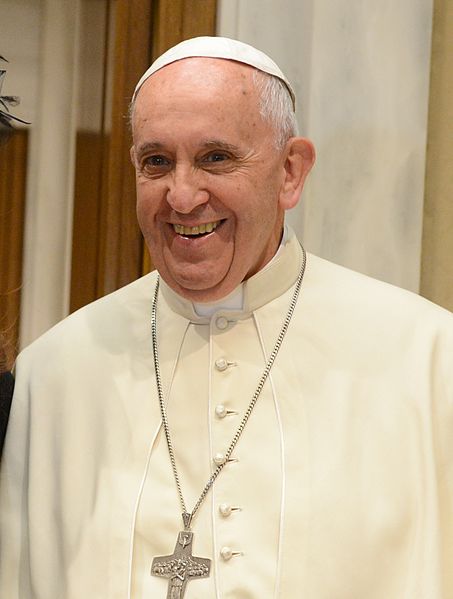
The interview between Scalfari and the Pope was published March 28, 2018 in La Repubblica. The relevant section on Hell was translated by the highly respected web log, Rorate Caeli.Pope Francis in a meeting with President Christina Fernandez de Kirchner of Argentina in the Casa Rosada.
Attribution: Casa Rosada (Argentina Presidency of the Nation), via Wikimedia CommonsThe interview is headlined, “The Pope: It is an honor to be called revolutionary.” (Il Papa: “È un onore essere chiamato rivoluzionario.”)
Scalfari says to the Pope, “Your Holiness, in our previous meeting you told me that our species will disappear in a certain moment and that God, still out of his creative force, will create new species. You have never spoken to me about the souls who died in sin and will go to hell to suffer it for eternity. You have however spoken to me of good souls, admitted to the contemplation of God. But what about bad souls? Where are they punished?”
Pope Francis says, “They are not punished, those who repent obtain the forgiveness of God and enter the rank of souls who contemplate him, but those who do not repent and cannot therefore be forgiven disappear. There is no hell, there is the disappearance of sinful souls.”
The post was later updated with a note from the Vatican:
“The Holy Father Francis recently received the founder of the newspaper La Repubblica in a private meeting on the occasion of Easter, without however giving him any interviews. What is reported by the author in today’s article [in La Repubblica] is the result of his reconstruction, in which the textual words pronounced by the Pope are not quoted. No quotation of the aforementioned article must therefore be considered as a faithful transcription of the words of the Holy Father.”
So either Scalfari misunderstood what his old friend was saying, or he’s just been thrown under a holy bus. I have no god in this fight, but it’s interesting either way.
March 26, 2018
Rick McGinnis on Jordan Peterson’s 12 Rules For Life: An Antidote to Chaos
Peterson’s book and lecture series has been much in the news lately, so Rick McGinnis shares his thoughts, particularly about the message and intended audience for 12 Rules for Life:
It was probably inevitable that this sudden notoriety would create a demand for a book-length statement of principles from Peterson, and he obliged earlier this year with 12 Rules For Life: An Antidote to Chaos. Deceptively packaged as a self-help tome, the book expands on a series of postings Peterson made on Quora, a crowdsourcing website that, instead of asking for money, invites its readers to contribute answers to questions posed by other readers.
The book’s structure is straightforward; after sketching in the origin of the dozen precepts, he states them at the outset of each chapter, explains them in varying degrees of complexity with examples from his practice as a clinical psychologist, anecdotes from his own life or – and this is proving to be most tantalizing – ruminations on quotes from history, philosophy, mythology or (most often of all) the Bible.
On the surface, Peterson’s edicts for a good life are self-evident: Stand straight; Obey the Golden Rule; Choose your friends wisely; Set yourself reasonable expectations; Raise your children well; Don’t be a hypocrite; Cherish meaning; Don’t lie; Listen before you speak; Choose your words carefully; Let children fail so they learn to succeed; Be kind to animals.
But lest you think that short paragraph should save anyone the price of the book, it has to be understood that we are at least a generation, perhaps several, from the point where these commonsensical statements were known, understood or accepted by any sane adult. We are, at the end of a century of phenomenal technological advances and cataclysmic history, sorely in need of a book-length exposition on phrases that you’d once expect to find on needlework samplers.
Early on and quite often, Peterson comes across with butt-clenching dread as the smartest-man-in-the-room, laying out the stories behind the facts, culled from his years of reading and research, with the force and volume of a firehose. He relies heavily on evolutionary biology to explain our hardwired need to create and find our place in hierarchies, with examples that distill our endlessly troubling social responses to bluff, authority, and even violence down to chemical and neurological mechanisms set in place way back in time with far less complex creatures (a scenario that’s easily satirized as “we are all lobsters”).
It’s been observed – and confirmed by Peterson – that the ideal audience for his book is young people in general and young men in particular. As a former young man, I can attest that being told by a wise older man, clearly on your side but unwilling to sugar coat the facts, that the bully and the big-man-on-campus are better armed than you are to jockey for status and fulfillment – the alpha lobsters, waving their claws around to appreciable effect – is very much less than comforting. Peterson’s ideal audience will have to endure the climb up a very steep hill of biological determinism to reach the far more hospitable plateau beyond.
I’m not saying Peterson is wrong. From the perspective of an older man, I’ve seen this lobster battle played out too many times to deny its plausibility. But I’d be remiss if I didn’t suggest that the ideologies that he decries, imagining that there is no biological determinism – not even the binary division of gender – or even a landscape governed by measurable standards or objective truth, is far more appealing to young people raised to believe in an ever-expanding entitlement of “rights” and a pursuit of “justice” that needs to triumph above history or biology.
It’s when Peterson tries to explain the philosophical and even theological roots of our cultural systems that things might be rewarding, for both young and older readers. He has a core group of texts that he relies upon, with particular emphasis on Dostoyevsky and Solzhenitsyn on the modern side, and while he will evoke ancient mythology – the gods of Egypt make several appearances, though even he can’t overcome the essential strangeness of their myths – he reaps more rewardingly from the Bible, especially in one passage where he analyzes the difference between the Old and New Testament God.
March 17, 2018
QotD: Translation error?
Here are two more facts known to many educated people:
1. The Christians did not begin to arrive at a settlement of the question of the divinity of Jesus until surprisingly late – the council of Nicaea in AD 325, and important controversies remained live until the Third Council of Constantinople in 680.
2. The original Aramaic-speaking Christians of Palestine having been effectively wiped out in the aftermath of the Bar Kokba revolt in AD 70, Christianity was re-founded by Paul of Tarsus among speakers of Koine Greek. The entire New Testament is written in Koine Greek.
Now here are two facts generally known only among a handful of specialist scholars. I picked them up through omnivorous reading and did not fully realize their significance for a long time.
3. In other Aramaic sources roughly contemporary with the New Testament, the phrase “Son of God” occurs as an idiom for “guru” or “holy man”. Thus, if Jesus refers to himself as “the son of God”, the Aramaic sense is arguably “the boss holy man”.
4. The Koine Greek of the period, on the other hand, did not have this idiom.
Now, imagine a Koine speaker reading the lost Aramaic source documents of which the Gospels are redactions, with only an indifferent command of the latter language He does not know that “Son of God” is an idiom…
Yes, that’s right. I’m suggesting that Jesus got deified by a translation error!
(Correction: The Bar Kokba revolt was AD 132; I was confusing it with the revolt of AD 70 in which the Temple at Jerusalem was destroyed.)
Eric S. Raymond, “Translation Errors”, Armed and Dangerous, 2009-02-12.
February 22, 2018
Curse of the FRIDAY THE 13TH I IT’S HISTORY
IT’S HISTORY
Published on 21 Feb 2018On today’s episode we are going to talk about the end of the Templar Order and the famous curse of Jacques de Molay.
February 18, 2018
Nitay Arbel on Jordan Peterson’s 12 Rules for Life
A guest post at According to Hoyt:
Those looking for an ‘alt-right’ manifesto will be sorely disappointed. Peterson actually says explicitly that on some economic issues (e.g., income disparity) he leans somewhat left, and elsewhere in the book laments that the cultural demonization of anything masculine is (as he describes it) causing a backlash, in terms of a resurgence in popularity of European parties he calls ‘far right’ or even ‘fascist’. (For Trump, to be clear, he uses the term ‘populist’, which undeniably fits.)
Nor will you find a camouflaged Christian revivalist tract here, as some claim. To be sure, Peterson heavily draws on the Bible and particularly on the Christian New Testament for quotes, but there are plenty of references to Eastern religious philosophies as well, particularly Taoism (‘yang vs. yin’, which here becomes ‘order vs. chaos’) and classical Buddhism (the concept that life is suffering). Among Christian theologians, Kierkegaard’s “act of faith” comes up repeatedly. During an interview, he was asked point-blank “Are you a Christian, and do you believe in G-d?” His intriguing answer: “I think the proper response to that is No, but I’m afraid He might exist.”
Nor is it some sort of “EST”-type (quasi-)cult manual, with Peterson setting himself up as a guru.
Moreover, it does not purport to be a reasoned scholarly tome of conservative philosophy. This is where Peter Hitchens (brother of the late Christopher) gets a little dyspeptic in his review in The Spectator, as he found it wanting there. http://archive.is/4eQIE (h/t: masgramondou)
David Solway, in his much more sympathetic article on PJMedia, hits the nail on the head, I believe. https://pjmedia.com/trending/jordan-peterson-phenomenon/ Like Solway, I find it hard to identify a single new idea in the book — pretty much everything Peterson says would be familiar to those of us who have been reared on Scripture and the Great Books.
But we have reached the level of intellectual corruption where, as George Orwell put it, the first duty of any thinking person is the restatement of the obvious. And that, Peterson does very well indeed. The book is a coherent whole, an engaging read, yea even a compelling ‘recap’ to the well-read. Peterson makes his discourse more engaging through extensive illustrations from psychological research, his own clinical practice, neuroscience, and his own life experience. Most importantly, it will bring wisdom of the ages (and of rational-empirical thinking) to a millennial generation drowning in derp and denial of objective reality. To those who, if you will pardon me the phrase, “know not the gods of the copybook headings”.
I just finished reading the book myself, and I largely agree with this summary.
February 4, 2018
Sword Bayonets – German Casualties – Jerusalem Occupation I OUT OF THE TRENCHES
The Great War
Published on 3 Feb 2018Check our Podcast: http://bit.ly/MedievalismWW1Podcast
Chair of Wisdom Time! This week we talk about possibly fabricated German casualty numbers, the unwieldy WW1 bayonets and the reaction to the occupation of Jerusalem.
February 3, 2018
Saladin – the Sword of Islam – IT’S HISTORY
IT’S HISTORY
Published on 2 Feb 2018Saladin was the famous Muslim leader during the time of the Crusades.
January 22, 2018
Khosrau Anushirawan: On Top of the World – Extra History – #5
Extra Credits
Published on 20 Jan 2018Plague had brought an end to Khosrau’s war against Justinian, but Justinian’s nephew soon reignited the rivalry. Khosrau was at the peak of his political power and eager to crush this young upstart personally… but old age had also crept up on him.
December 30, 2017
The Dark Ages of Sex – All Pleasure is Sin! l THE HISTORY OF SEX
IT’S HISTORY
Published on 21 Sep 2015Sex became a sin in the Middle Ages. Following the promiscuous Ancient Rome and Greece, the Western World was indoctrinated with Medieval concepts of guilt and immorality. Adultery and sex for pleasure became unthinkable. Churches implemented strict rules, breaking them could result in public shaming. The severity of punishments would only increase after the Reformation.
December 26, 2017
Midwinter celebrations, historically speaking
In the most recent Libertarian Enterprise, L. Neil Smith tries to track down where our traditional Christmas celebrations originated:
Each and every one of those cultures has had a different way, of course, of dignifying what is essentially a middle finger in the face of nature. The earliest such I could find was Zagmuk, the ancient Mesopotamian celebration of the triumph of Marduk over the forces of Chaos.
Or whatever. I suspect the Mesopotamians would have decreed a celebration if it had been Chaos that had won in the second, by a knock-out. Nearby cultures picked the idea up and celebrated their own versions.
All this happened about 4000 years ago.
The Romans had a midwinter holiday, Saturnalia, which involved feasting and giving gifts. Later on, the word became a synonym for abandon and debauchery, but the Romans, by and large, were a pretty puritanical bunch, given to grim tales such as that of Lucius Junius Brutus who had his own sons executed because they sold out to the Etruscans, and Mucius Scaevola who burned his own hand off to prove that Romans… well, would burn their own hands off given half a chance. Nobody ever needed a festive midwinter holiday worse than they did.
Saturnalia started around the eighth century, B.C.
Hanukkah is interesting. I learned about it when I wrote The Mitzvah with Aaron Zelman. These days a lot is made of the “Festival of Lights” and the miracle that occurred when the Jews retook their Temple from a pack of Hellenized Syrians who had left only enough lamp oil behind for a single day. The oil miraculously burned eight days, instead, and that’s what all that ceremony with the Menorah is all about.
There’s another Hanukkah story, of a victory of the Maccabees (a nickname, meaning “hammer” — see Charles Martel) over those same Hellenized Syrians, which is how the Jews got their Temple back. Jews argue over which story is more significant, but it’s pretty obvious to me. It’s equally obvious that they’d find something else to celebrate in the middle of the winter, even if they’d never gotten their Temple back.
Which happened in 165 B.C.
Christmas probably wasn’t celebrated, as such, for a couple of hundred years after the presumed birth of Christ. I say “presumed”, because the whole story — no room in the inn, born in a manger with animals on the watch, shepherds coming to worship, a star shining overhead — was shoplifted, directly from another religion popular in Rome at the time of the early Christians, worship of the warrior-god Mithras.
Speaking of sticky fingers, holidaywise, the Yule log and the Christmas tree were “borrowed” from the norsemen, who were accustomed to hanging dead male animals and male slaves from a tree to decorate it.
Yuck.
There is a midwinter holiday that has come along more recently than Christmas. I have to confess that, to me, Kwanzaa (Est. 1966) represents one of the lamest, most transparent inventions a con-man ever foisted on any segment of the public. It’s basically a holiday for black people who don’t want to celebrate the white peoples’ holiday. On the other hand it’s no lamer than any other excuse for a holiday.
December 24, 2017
Repost – Atheist’s seasonal dilemmas
David Harsanyi looks at the plight of the non-believer during the Christmas season:
Unlike many of my fellow atheists, however, I’m not a fundamentalist on the issue of nonbelief. Though my rock-ribbed skepticism is, I hope, driven by reason, my unwavering desire to avoid saying “amen” in a group setting is a real driver, as well.
“Aren’t we forgetting the true meaning of Christmas?” Homer Simpson once asked. “You know, the birth of Santa.”
Like Homer, I enjoy the birthday of Jesus — or Santa. So it pains me to witness fellow atheists acting like a bunch of irritating ’80s televangelists and defeating the entire purpose of unbelief by organizing, grousing, wagging their fingers and, worst of all, proselytizing.
Take the billboards popping up in Las Vegas this year that read “Reason’s Greetings” and “Heathen’s Greetings.”
The man behind the billboards claims to only want to make people think — because only atheists can really think, after all. “People that drive by who have an open mind may think to themselves, ‘Maybe I should question some of my dogmatic beliefs,’ ” Richard Hermsen, a local atheist activist, explained.
Granted, atheists have some reason to be annoyed by the general public. A USA Today/Gallup Poll in 2007, for instance, found that more than half of Americans would, under no circumstances whatsoever, vote for an atheist.
No group fared lower than heathens. Not Mormons. Or even the Jews — and we probably killed Christ.
December 23, 2017
Repost – “Merry Christmas” versus “Happy Holidays” versus “Happy Midwinter Break”
L. Neil Smith on the joy-sucking use of terms like “Happy Midwinter Break” to avoid antagonizing the non-religious among us at this time of year:
Conservatives have long whimpered about corporate and government policies forbidding employees who make contact with the public to wish said members “Merry Christmas!” at the appropriate time of the year, out of a moronic and purely irrational fear of offending members of the public who don’t happen to be Christian, but are Jewish, Muslim, Hindu, Buddhist, Sikh, Jain, Rastafarian, Ba’hai, Cthuluites, Wiccans, worshippers of the Flying Spaghetti Monster, or None of the Above. The politically correct benediction, these employees are instructed, is “Happy Holidays”.
Feh.
As a lifelong atheist, I never take “Merry Christmas” as anything but a cheerful and sincere desire to share the spirit of the happiest time of the year. I enjoy Christmas as the ultimate capitalist celebration. It’s a multiple-usage occasion and has been so since the dawn of history. I wish them “Merry Christmas” right back, and I mean it.
Unless I wish them a “Happy Zagmuk”, sharing the oldest midwinter festival in our culture I can find any trace of. It’s Babylonian, and celebrates the victory of the god-king Marduk over the forces of Chaos.
But as anybody with the merest understanding of history and human nature could have predicted, if you give the Political Correctness Zombies (Good King Marduk needs to get back to work again) an Angstrom unit, they’ll demand a parsec. It now appears that for the past couple of years, as soon as the Merry Christmases and Happy Holidayses start getting slung around, a certain professor (not of Liberal Arts, so he should know better) at a nearby university (to remain unnamed) sends out what he hopes are intimidating e-mails, scolding careless well-wishers, and asserting that these are not holidays (“holy days”) to everyone, and that the only politically acceptable greeting is “Happy Midwinter Break”. He signs this exercise in stupidity “A Jewish Faculty Member”.
Double feh.
Two responses come immediately to mind, both of them derived from good, basic Anglo-Saxon, which is not originally a Christian language. As soon as the almost overwhelming temptation to use them has been successfully resisted, there are some other matters for profound consideration…
December 20, 2017
QotD: Heaven
I suspect that if people were asked to describe a heaven, they would come up with something very like an eternal cruise on one of those dreadful ships that ruin the appearance and atmosphere of everywhere they dock: five meals a day, a casino, cinema, sauna, swimming pool, dinner at the captain’s table. But such a life would soon pall. Before long there would be quarrels, divisions into factions, and possibly even a murder or two, just for variation. Man is not so much a problem-solving creature as a problem-creating one; and as for his state of mind, he likes change for its own state, even if it be change for the worse. Man will never be entirely sensible.
Theodore Dalrymple, “Dissatisfaction Guaranteed”, Taki’s Magazine, 2016-11-26.


