
Extra Credits
Published on 3 Nov 2018Rollo the Walker led the Great Heathen Army and had his sights set on sacking Paris, in a time when relations between the Vikings and the Franks had become, essentially, getting paid to raid. Eventually his sights would turn to stability — and he became the founder of Normandy.
Join us on Patreon! http://bit.ly/EHPatreon
November 6, 2018
Viking Expansion – Rollo the Walker – Extra History – #2
Comments Off on Viking Expansion – Rollo the Walker – Extra History – #2
November 5, 2018
Who Was Guy Fawkes? – Anglophenia Ep 18
Anglophenia
Published on 5 Nov 2014Remember, remember the 5th of November: Guy Fawkes is one of Britain’s most infamous figures. Who’s the man behind the mask made famous by V For Vendetta and the protest group Anonymous? Siobhan Thompson explains.
Comments Off on Who Was Guy Fawkes? – Anglophenia Ep 18
November 4, 2018
QotD: LEED indulgences
I am not religious but am fascinated by the comparisons at times between religion and environmentalism. Here is the LEED process applied to religion:
- 1 point: Buy indulgence for $25
- 1 point: Say 10 Our Fathers
- 1 point: Light candle in church
- 3 points: Behave well all the time, act charitably, never lie, etc.
It takes 3 points to get to heaven. Which path do you chose?
Warren Meyer, “When Sustainability is not Sustainable”, Coyote Blog, 2013-07-30.
Comments Off on QotD: LEED indulgences
September 23, 2018
30 Years War | 3 Minute History
Jabzy
Published on 28 Oct 2015Thanks to Xios, Alan Haskayne, Lachlan Lindenmayer, William Crabb, Derpvic, Seth Reeves and all my other Patrons. If you want to help out – https://www.patreon.com/Jabzy?ty=h
Comments Off on 30 Years War | 3 Minute History
September 13, 2018
QotD: “God is dead”
The life and work of the maverick German philosopher Friedrich Nietzsche (1844-1900) is associated with five interlinking ideas: the death of God; nihilism and the crisis in morality; the Superman; the will to power; and the eternal recurrence.
Nietzsche first announced that ‘God is dead’ in his 1883 work The Joyful Science. As with much that he wrote, this phrase of Nietzsche’s has subsequently been often misunderstood. Taken literally, it is obviously a nonsensical declaration, for either a Christian god is real and eternal, or else he never existed in the first place. What Nietzsche meant by the death of God was that European civilisation had lost its faith in Christianity, but was still living by values and a morality system based on it. For this reason he believed European civilisation was facing a crisis resulting from the approaching collapse in its morality system, and the dawn of the age of nihilism – hence the title of his 1886 work, Beyond Good and Evil, which was not the libertine manifesto it sounds like, but a contention that Christian values of good and evil have become redundant.
In this respect, Nietzsche was not a nihilist, another common misconception. He viewed the coming age of nihilism with much trepidation, fearing (rightly) that the result would be great wars in the 20th century. He believed that it was imperative that humanity create a new morality system for the coming post-Christian age. The solution, he believed, was a new individualistic morality system in which the strongest, bravest men would become their own masters and creators, and in turn would become philosopher kings and oligarchs of the spirit. This new man was to be embodied in his infamous, hypothetical Übermensch, or Superman (as Über means above and beyond in German, Nietzsche’s word used to be also translated as the Beyond-Man or Overman, but today is usually not translated at all. The Übermensch goes above and beyond.)
Patrick West, “Nietzsche and the struggle against nihilism”, Spiked, 2018-08-03.
Comments Off on QotD: “God is dead”
September 9, 2018
Holy Roman Empire Explained
WonderWhy
Published on 9 Aug 2018Looking at the origins and history of the Holy Roman Empire, assessing the claim by Voltaire that it was not holy, nor Roman, nor an empire, and finally looking at the complex hierarchical political structure of the empire.
Have you ever wondered what the world would be like if the Holy Roman Empire existed today? This video is a collaboration was RealLifeLore, who looked at that very question. Link here: https://www.youtube.com/watch?v=SIwNR…
Comments Off on Holy Roman Empire Explained
August 13, 2018
Blasphemy in modern Britain
Once upon a time, blasphemy was prosecuted by the Crown as an attack on the very basis of English law: “[blasphemy] law is needed to uphold the national law, which is based on Christianity. Thus, targeting Christianity is targeting the very foundation of England.” The last successful prosecution was in 1977. Modern prosecutions for blasphemy do not get filed under the old law, but the mechanism of the police, the courts, and the media are directed against those who dare to insult one particular faith:

Religious freedom is one of the core principles of any modern liberal society. As a secularist, I defend the right of religious people to send their children to faith schools, have their children circumcised, or wear the burqa. This does not mean I approve of any of these practices; they should be permissible but not protected from criticism. We should be free to ridicule, lampoon, chastise, critique, etc. every aspect of religious belief that we tolerate.
This is, more or less, what the U.K.’s former Conservative Foreign Secretary Boris Johnson wrote in his now infamous newspaper column in the Telegraph last week. Yet all hell has broken loose. It was greeted by near-hysterical outrage and shrill denunciations of Johnson’s alleged dog whistle racism; reports of civil war in the Tory Party over the matter; the now ubiquitous demands for an apology for causing offence (or else), which was backed in this instance by the Prime Minister. Boris’s is now the subject of an internal Party inquiry. It’s worth untangling this sorry tale as a snap-shot of today’s offence culture and how chilling it can be to a free society.
Johnson has been ‘called out’ as Islamophobic for arguing against – yes against – a ban on the burqa and for defending – yes defending – the right of any “free-born adult woman” to wear what she wants “in a public place, when she is simply minding her own business”. His column is predominantly an excoriating critique of Denmark’s betrayal of its own “spirit of liberty” and “the spirit of Viking individualism” by its decision to impose a state ban on the burqa or niqab (although he is not being indicted for caricaturing Danish culture). He rightly notes that being opposed to a ban should not be interpreted as approval and goes on to say – albeit in a somewhat crass manner – that “Muslim head-gear that obscures the female face… looking like letterboxes… like a bank robber…is absolutely ridiculous”.
As similes go, no doubt Boris could have been more tactful. I am no fan of BoJo-style private school wit. Indeed, I can understand that veil-wearing Muslim women – whom myriad journalists throughout the country have stopped on streets to ask if they like being compared to criminals or inanimate objects – would find the analogy offensive. But should all political comment on religion have to pass an offense test to be allowed? I am pretty sure that my two aunts – who are Catholic nuns – would be pretty offended if they heard my atheist mates’ denouncing as backward mumbo-jumbo a religion that believes the host and wine is literally the body and blood of Christ. But that’s the deal – a free society affords religious tolerance for nuns, imams, rabbis; and conversely liberty for others to stick the metaphorical boot into their beliefs.
Are Boris’s critics demanding respect for all religious practices regardless of whether they consider them backward, wrong-headed, or oppressive? Should we bite our lip in case we offend? We seem to have forgotten that we once all declared #JeSuisCharlie – a brief but inspiringly unapologetic defense of free speech after cartoonists for the satirical magazine Charlie Hebdo were brutally butchered in Paris for daring to publish cartoons deemed offensive to Islam. Should they have shut up until they learned to become more tactful?
Naturally, cheap sectarian Tory-bashing has driven some of the outrage. Supporters of the Labour Party, recently afflicted by an anti-Semitism scandal that is still rumbling on, were quick to denounce the “gross Islamophobia” in the article, even though criticism of the burqa has been commonplace in Labour and feminist ranks over the years. Emily Thornberry, Labour’s Shadow Secretary of State for Foreign and Commonwealth Affairs (and Boris’s shadow until his recent resignation), declared on BBC’s Question Time in 2013 that “I wouldn’t want my four-year-old looked after by somebody wearing a burka. I wouldn’t want my elderly mum looked after by somebody wearing a burka. They need to be able to show their face. I wouldn’t mind if they worked in records in the hospital.”
Comments Off on Blasphemy in modern Britain
August 7, 2018
QotD: Sailing past Byzantium
To those who know nothing about the mediaeval, “byzantine” East of Christendom (and what do I know about anything?) a book by the respectable Oxford scholar, Averil Cameron, is worth mentioning. It is a short survey of developments in her academic field, entitled, Byzantine Matters (2014). It poses five basic questions on which our common assumptions are mostly wrong, and provides succinct directions for thinking again.
Mediaeval Greece, the Byzantine dynasties, and Orthodox Christianity: these are far from interchangeable concepts. Moreover, “Byzantine art” — the focus of enthusiasm in the anglosphere through the last century or so — is misunderstood. The term “Byzantine” itself — conceived from late antiquity as a deprecation — persists in the academy as an intelligence neutralizer. The vanity of “the West” gets in the way of appreciating a parallel Christian realm, which flourished for more than a thousand years, and never succumbed to the Arabs. (It finally succumbed to the Turks.) We disdain what amounts to an alternative universe of Christian witness and high culture, of great variety and depth, even more obtusely than we disdain our own Middle Ages.
We are narrowed and prejudiced by the attitudinizing of Edward Gibbon, and the inheritance (or disinheritance) of our Western “Enlightenment,” to view as backward a civilization in most ways superior to our “modern” own, from pride in the tinsel of technology. From AD 330 (the founding of Constantine’s capital) to 1453 (when it fell into Ottoman hands), we see only a continuous story of “decline.” But there were many declines over this vast period, and in the intervals between them, many recoveries.
David Warren, “Sailing past Byzantium”, Essays in Idleness, 2016-11-07.
Comments Off on QotD: Sailing past Byzantium
August 3, 2018
QotD: The lost kingdom of Pontus
Pontus is that country, within modern Turkey, that follows the south-east Black Sea shore, and inland is enclosed as by an amphitheatre of mountains. It is the more interesting, archaeologically, for having been often by-passed, in the movements of conquering nomads and armies, from Hittites and Hurrians to Arabs and Turks. The Greeks took it, because they came by sea. They kept it, till late in the day; so that even after Constantinople fell to our short-sighted Franks (in 1204), the Empire of Trebizond immediately formed, and Byzantium persisted in Pontus, as in Crimea and elsewhere, until it could be restored at its centre.
David Warren, “A wonderworker”, Essays in Idleness, 2016-11-17.
Comments Off on QotD: The lost kingdom of Pontus
July 9, 2018
Nominating Amy Barrett “would be a tactical masterpiece on the level of Napoleon’s conduct of the Battle of Austerlitz, or Hannibal at Cannae”
I have no idea who President Trump will announce later today as his nominee for the vacancy on the US Supreme Court, but Conrad Black is plumping for one particular candidate:
The desperation of the Democrats to stop the apparently inexorable rise of a president they so completely discounted and despised, and assumed they could remove or emasculate just by turning up the volume and activity of their media organ monkeys, may drive them to accidental suicide over the latest Supreme Court vacancy. I have no standing at all to intuit whom the president may nominate. But if, as I suspect, it is Judge Amy Barrett, it would be a tactical masterpiece on the level of Napoleon’s conduct of the Battle of Austerlitz, or Hannibal at Cannae.
The U.S. Senate confirmed Barrett to the Seventh U.S. Circuit Court of Appeals on October 31, by a 55-43 vote. Three Democrats voted for her and two did not vote. It would not be easy to justify changing their votes now, as she has served unexceptionably. At her confirmation hearings, Senator Dianne Feinstein, the Judiciary Committee’s aged ranking Democrat, asked Barrett about her religious views, and the nominee responded that no judge should allow personal views, whether based on faith or anything else, to influence the imposition of the law. “The dogma lives loudly within you, and that is a concern,” Feinstein said infamously. This was an outrageous comment; Feinstein doesn’t know anything about the dogma of the Roman Catholic Church, and she has no idea what privately motivates Judge Barrett.
The fury and haste of the Democrats once the starting gun went off with the announcement of the retirement of Justice Anthony Kennedy from the Supreme Court, expressed their blind panic that their entire protracted regime of encroachments and embellishments on the Constitution — buttressing their centralized and authoritarian notion of administrative juridical governance with pretense to defending the rights of women, affirmative action, and the legislative role of the judiciary generally — was now under mortal assault.
[…]
I believe the president will nominate Barrett, that the Democrats will take definitive leave of their depleted senses, apostrophize the judge as a Trojan Horse of female submission, that she will clear her hearings with flying colors while the president’s formidable battery of social media and talk show supporters roast the Democrats for attacking an exemplary female achiever and a fine jurist whose only offense is to be a member of the Roman Catholic Church, by far the largest in the country with more than 70 million adherents. Remember, too, the Supreme Court in the final days of its term ruled that crisis pregnancy centers need not advertise the virtues of abortion with Planned Parenthood, and in 2016 said the Little Sisters of the Poor could not be compelled to pay for birth control and sterilization.
As at Cannae and at Austerlitz, the center of the defending force (Democrats), will crumble and President Trump will sweep the field. The Democratic playbook of endless ear-splitting allegations of serial outrages by the president, will not, finally, bring him down. On this issue, of mobilizing unfounded sexist paranoia against a flawless nominee, thereby insulting tens of millions of American women and U.S. Roman Catholics, before raising the objections of fair-minded non-Catholic men, at least another 20 percent of the population, the Democrats will immolate themselves in an unprecedentedly spectacular launch of their midterm election campaign.
Of course, no matter who is put forward, that person will immediately become the target of a supersized version of the “two-minute hate” that will literally last for months, or until the nominee is driven to decline the nomination, at which point the hate will be directed at the next nominee. Pedantically, however, Black’s use of Cannae and Austerlitz is only metaphorical: at Austerlitz, the allied centre did crumble, but at Cannae, it was the Roman cavalry on the flanks that crumbled, allowing the Carthaginians to envelop the rear of the main Roman army. Two very different battles.
Comments Off on Nominating Amy Barrett “would be a tactical masterpiece on the level of Napoleon’s conduct of the Battle of Austerlitz, or Hannibal at Cannae”
June 11, 2018
Feature History – Thirty Years’ War
Feature History
Published on 12 Nov 2016Hello and welcome to Feature History, featuring religious conflict, tragic war, and a really nifty collaboration with Jabzy.
3 Minute History – German Peasant’s War
https://www.youtube.com/watch?v=zeQVAUmyLksInvolvement Chart
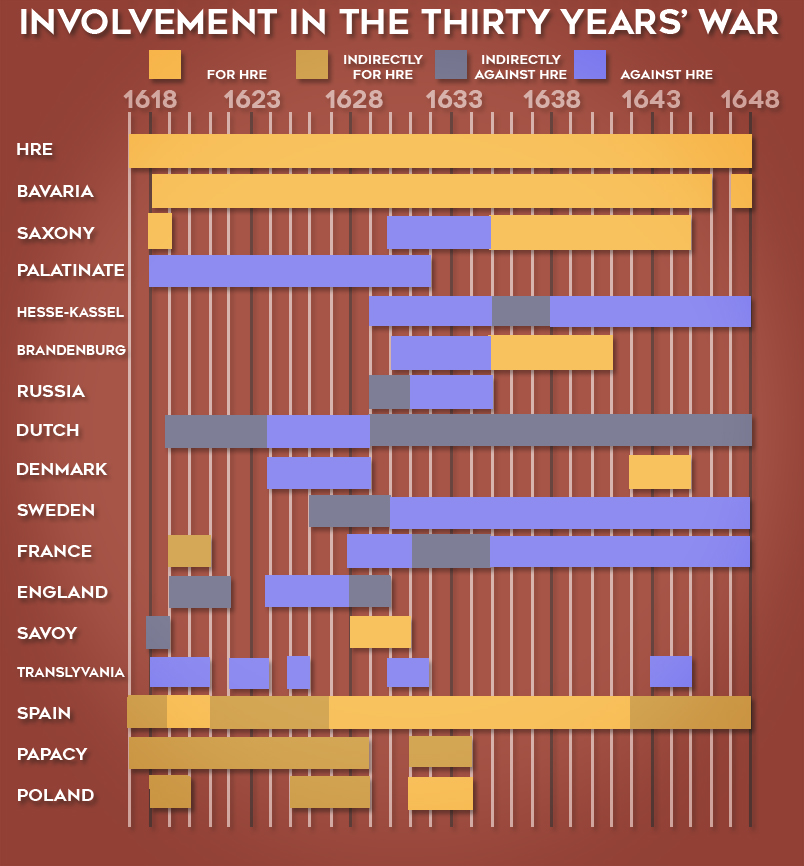
Comments Off on Feature History – Thirty Years’ War
June 4, 2018
QotD: Pushing the Confederacy down the memory hole
Lately, I have been mightily irritated by the politically-correct campaign to permanently banish the old Confederate flag, and all music associated with the Southern cause, or any symbol that it once existed, before it was comprehensively defeated a century-and-a-half ago. Memorials of Robert E. Lee are being treated as memorials of Adolf Q. Hitler.
It strikes me that even under the old lamentable cotton-plantation slave system of the South, people mixed and got to smell one another — rich and poor, black and white, genteel and grotesque. That, the most forgotten slogan of the Dixie Land was her war cry: “Down with the Eagle, and up with the Cross!” That, it is the Cross of Saint Andrew astride the old Confederate flag that is most galling to the hyper-secular, liberal mind. That, the greatest triumph of the Union propaganda was to tar all those flag-bearers in the way our contemporary media demean all dissenters from the current party line as “racists,” “sexists,” “phobes,” and nothing more. That, the principal crime of the South was to stand by the wording of the U.S. Constitution, and from the beginning, to get in the way of a grand national scheme for social engineering, which triumphed with Lincoln (though hardly a liberal by the standards of today). That, in the Southern view, the eagle swooped down on them, with claws.
Something similar is now happening in the division of “Red States” and “Blue”: in an America from which the Christian conception of the “common man” is being systematically expunged. All who resist the categories to which they have been assigned are instinctively rebelling; “victim” and “oppressor” alike. This is what “common men” will do, when tarred and pressed, often without fully understanding why they rebel. They remember, however obliquely, whose sons and daughters they are. That, no matter how low in social station, they are Christ’s, and not the segregated chattels of some malicious and incompetent — and intentionally divisive — Washington Nanny.
The recovery of USA, and more largely, the recovery of Christendom, turns on the recovery of this conception of the “common man” — as Man, not as member of a client group. This has nought to do with “equality,” for it is none of a government’s business to help one group get even with another. Rather it is to serve man as man. This is a matter that goes deeper even than slavery, as Saint Paul explained. It is an unarguable, even mystical point. Where that conception survives, of the common in man, Christendom persists, and can potentially flourish.
David Warren, “The common man”, Essays in Idleness, 2016-08-29.
May 27, 2018
Woke-ism, the new religion of progressives
John McWhorter notes the strong parallels between Christianity and woke-ness:
Over the past several years, for instance, whites across the country have been taught that it isn’t enough to understand that racism exists. Rather, the good white person views themselves as the bearer of an unearned “privilege” because of their color. Not long ago, I attended an event where a black man spoke of him and his black colleagues dressing in suits at work even on Casual Fridays, out of a sense that whites would look down on black men dressed down. The mostly white audience laughed and applauded warmly—at a story accusing people precisely like them of being racists.
This brand of self-flagellation has become the new form of enlightenment on race issues. It qualifies as a kind of worship; the parallels with Christianity are almost uncannily rich. White privilege is the secular white person’s Original Sin, present at birth and ultimately ineradicable. One does one’s penance by endlessly attesting to this privilege in hope of some kind of forgiveness. After the black man I mentioned above spoke, the next speaker was a middle-aged white man who spoke of having a coach come to his office each week to talk to him about his white privilege. The audience, of course, applauded warmly at this man’s description of having what an anthropologist observer would recognize not as a “coach” but as a pastor.
I have seen whites owning up to their white privilege using the hand-in-the-air-palm-out gesture typically associated with testifying in church. After the event I have been describing, all concerned deemed it “wonderful” even though nothing new had been learned. The purpose of the event was to remind the parishioners of the prevalence of the racist sin and its reflection in themselves, and to offer a kind of forgiveness, this latter being essentially the function of the black people on the panel and in the audience. Amen.
[…]
The self-affirming part is the rub. This new cult of atonement is less about black people than white people. Fifty years ago, a white person learning about the race problem came away asking “How can I help?” Today the same person too often comes away asking, “How can I show that I’m a moral person?” That isn’t what the Civil Rights revolution was about; it is the product of decades of mission creep aided by the emergence of social media.
What gets lost is that all of this awareness was supposed to be about helping black people, especially poor ones. We are too often distracted from this by a race awareness that has come to be largely about white people seeking grace. For example, one reads often of studies showing that black boys are punished and suspended in school more often than other kids. But then one reads equally often that poverty makes boys, in particular, more likely to be aggressive and have a harder time concentrating. We are taught to assume that the punishments and suspensions are due to racism, and to somehow ignore the data showing that the conditions too many black boys grow up in unfortunately makes them indeed more likely to act up in school. Might the poverty be the key problem to address? But, try this purely logical reasoning in polite company only at the risk of being treated as a moral reprobate. Our conversation is to be solely about racism, not solutions — other than looking to a vaguely defined future time when racism somehow disappears, America having “come to terms” with it: i.e. Judgment Day. As to what exactly this coming to terms would consist of, I suppose only our Pastor of White Privilege knows.
Comments Off on Woke-ism, the new religion of progressives
April 18, 2018
Stossel: Jordan Peterson on Finding Meaning in Responsibility
ReasonTV
Published on 17 Apr 2018Jordan Peterson is an unlikely YouTube celebrity. The Canadian psychologist lectures about things like responsibility. Yet millions of young people watch his videos, line up to hear his speeches, and buy his book 12 Rules for Life. It was number one on the Amazon bestseller list for a month.
———
John Stossel asks: What could make a book about responsibility take off?
“People have been fed this diet of pabulum, rights, and impulsive freedom,” Peterson tells Stossel. “There’s just an absolute starvation for the other side of the story.”
The other side of the story, according to Peterson, is that “it’s in responsibility that most people find the meaning that sustains them through life. It’s not in happiness. It’s not in impulsive pleasure.”
Peterson instead advises: “Adopt responsibility for your own well-being, try to put your family together, try to serve your community, try to seek for eternal truth….That’s the sort of thing that can ground you in your life, enough so that you can withstand the difficulty of life.”
Many leftists hate Peterson. They attack him for saying people should be “dangerous.” Peterson explains to Stossel that he means people should have the capacity to be dangerous, but control it.
“People who teach martial arts know this full well,” Peterson says. “If you learn a martial art you learn to be dangerous, but simultaneously you learn to control it.”
Advice about that, and responsibility, bring Peterson big audiences.
—–
The views expressed in this video are solely those of John Stossel; his independent production company, Stossel Productions; and the people he interviews. The claims and opinions set forth in the video and accompanying text are not necessarily those of Reason.
Comments Off on Stossel: Jordan Peterson on Finding Meaning in Responsibility
April 14, 2018
The Danelaw – The Fall of Eric Bloodaxe – Extra History – #2
Extra Credits
Published on 12 Apr 2018After peace was made between King Alfred and Guthrum, the Danelaw was born — a geographic area in England controlled by the Danes, but also extremely reliant on the cooperation by the Anglo-Saxons and the local Christian population.
Sponsored by Total War Saga: Thrones of Britannia!
Comments Off on The Danelaw – The Fall of Eric Bloodaxe – Extra History – #2


