Megan T
Published on 26 Apr 2015
June 15, 2018
JM’s Toy Stories – Legoland Vault
June 14, 2018
QotD: The gender-neutral child
The media is full of excited stories heralding the revolution in children’s play. This recent headline in Time is typical: “The Next Generation of Kids Will Play With Gender Neutral Toys.” But children are not gender-neutral, and they famously resist efforts to make them so. If 40 percent of millennials think otherwise, that’s probably because they haven’t had kids yet.
Parents and teachers should certainly expose their kids to a wide range of toys and play, and teach them to accept kids who enjoy gender non-conforming toys. When toy companies rigidly classify certain toys as girl-only or boy-only, that may create a stigma against those who cross the line. Overt signage is superfluous anyway. So let’s hope other retailers follow Target’s example.
But the crusade promoted by the White House is not about tolerance for non-conformers. Its goal is to re-socialize the majority of gender-typical children toward gender neutrality. Jarret is right that it won’t be easy. With few exceptions, children are powerfully drawn to sex-stereotyped play.
Parents who read too much Judith Butler in college and view gender as fluid and malleable may be startled by the counterevidence their three-year-olds provide. The usually eloquent Julia Turner, editor of Slate, became tongue-tied a few weeks ago when she tried to explain a mysterious development at home: Her little twin sons were obsessed with wheeled objects — particularly cement mixers. Parenthood, she confessed, had “complicated” her worldview. Turner kept affirming her loyalty to the gender-is-a-social-construct school. But then, referring to her sons’ insistent boyishness, she uttered four heretical words: “There’s a there there…”
Indeed there is. And it takes a liberal arts degree not to see it. A 2012 cross-cultural study on sex differences confirmed what most of us see: despite some exceptions, females tend to be more sensitive, esthetic, sentimental, intuitive, and tender-minded, while males tend to be more utilitarian, objective, unsentimental, and tough-minded.
The female penchant for nurturing play and the male propensity for rough-and-tumble hold cross-culturally and even cross-species. Among our close relatives such as rhesus and vervet monkeys, researchers have found that females play with dolls far more than do their brothers, who prefer balls and toy cars. It seems unlikely the monkeys are acting out a culturally manufactured gender binary. Something else is going on. Most scientists attribute typical male/female differences to some yet-to-be understood combination of biology and culture.
Christina Hoff Sommers, “Those Who Push For Toy Neutrality Don’t Get Little Girls At All”, The Federalist, 2016-09-11.
May 30, 2018
May 26, 2018
QotD: Child labour
In response to something I’d written about labor unions, a critic started badgering me about child labor.
What a terrible feature of capitalism, he said.
No, it was a terrible feature of all of world history, I replied.
Thank goodness for people who passed laws against it, he said.
No, I said, thank goodness for capitalism, which created enough wealth that families didn’t have to send their kids to work anymore just to avoid starvation.
Then I was asked: do I really believe my kids would be better off in a factory (than in school, presumably)?
As if the choice we’re talking about is between factory work and school! The actual choice faced by these families is between factory work and starvation.
The British charity Oxfam found that in Bangladesh, where the government caved in to Western demands to suppress child labor, the children — you’ll never guess — didn’t wind up in school! How about that.
Where did they wind up? In prostitution, or dead.
Nice going, geniuses.
Yes, there were laws passed against child labor, but those came when child labor was already practically a thing of the past.
No law is going to keep families from avoiding starvation — and even the left-wing International Labor Organization admits that this is the real reason for child labor. Only capital accumulation makes it possible to end child labor humanely.
My opponent probably isn’t a bad guy. He’s just absorbed the conventional wisdom on pretty much everything.
It’s very easy to blame “capitalism” for child labor. Where is the average person going to hear any other explanation?
Tom Woods, “SJWs Really Mean Well, But Accidentally Starve Some Children”, The Tom Woods Show, 2016-09-13.
May 4, 2018
Jordan Peterson – Winston Churchill predicted the Death of our Civilization
Dose of Truth
Published on 9 Apr 2018Without tradition or culture and the diligence to keep it alive our value systems and lessons learned by our ancestors will be soon forgotten and Western civilization will descend in to chaos as a result of the forgotten history and disregard for its tradition and value structure. Jordan Peterson sits down with former Deputy Prime Minister John Anderson and they discuss this topic and Jordan Peterson provides us with an education on concepts in psychology like memory and its function. John Anderson starts off with words of Churchill, as Jordan Peterson unpacks the statement made.
April 17, 2018
QotD: Named Laws
A good rule of thumb in reviewing contemporary legislation is that if the bill in question is named after a child it is bound to be a bad one. It will be based on pure emotion, rather than reason and any principled opposition to the bill will be stifled at the risk of appearing callous or insensitive to the personal suffering of the bill’s proponents.
Jay Jardine, “A Dumb Law, By Any Other Name”, The Freeway to Serfdom, 2005-01-24.
April 1, 2018
Boarding Schools – what are they like?
Lindybeige
Published on 15 Oct 2016For two years, I went to a British public boarding school, and recently, I attended a reunion. I talk about them.
Support me on Patreon: https://www.patreon.com/LindybeigeIt was difficult in the edit to achieve the balance I wanted, but this can be redressed in later videos. I recorded a few more pieces to camera and took more shots of the school. I don’t feature the people there because this was a personal project, and it would be unfair to involve them in something they may find expresses opinions and ideas with which they disagree. Besides, I wanted to talk to old friends, not poke a camera in their faces.
Lindybeige: a channel of archaeology, ancient and medieval warfare, rants, swing dance, travelogues, evolution, and whatever else occurs to me to make.
March 29, 2018
British Schools Explained – Anglophenia Ep 25
Anglophenia
Published on 5 Mar 2015How much do you know about the U.K.’s education system? Siobhan Thompson teaches you the basics. Study up!
March 17, 2018
Toys ‘R’ Us did for toys what Borders and Barnes & Noble did for books
We have lived through the golden age of the big box store, and the less-fit are now going to the wall. Virginia Postrel looks at the history of Toys’R’ Us and how it changed the toy market:
I wasn’t a Toys ‘R’ Us kid.
By the time the big box wonderland arrived in my hometown, I was a 25-year-old business reporter living 900 miles away. So instead of conjuring up memories of dolls, bikes and video games, the chain’s imminent demise reminds me of what the world was like before it arrived: Most toys were available only around Christmas and even then the choices were limited unless you lived in a big city. We got my doll house in Atlanta.
Toys ‘R’ Us changed that. “They got a million toys at Toys ‘R’ Us that I can play with,” boasted its famous jingle. “The selection — more than 18,000 different toys in every store — is almost inconceivably vast,” wrote David Owen in a 1986 Atlantic article on the toy business. “There’s an enormous opportunity in America if you’re willing to make a commitment to inventory,” founder Charles Lazarus told him.
Indeed there was.
What Toys ‘R’ Us did for toys, Home Depot and Lowe’s did for hardware; Best Buy and Circuit City for electronics and music; Borders and Barnes & Noble for books; Bed, Bath and Beyond and Linens n’ Things for home goods; and Staples, Office Depot and Office Max for office supplies. The rise of category killers in the 1980s accustomed consumers of all ages to unprecedented variety and choice—in any season and just about any locale. In less populated areas, Walmart filled in the gaps.
By internet standards, the selection Owen termed “inconceivably vast” now looks paltry. “I stopped by my local Best Buy to do research, and found they stock something like 30,000 different titles,” I wrote in 1999. Looking at that text today I wondered if the number was a typo. A mere 30,000? Surely there was a missing zero. Or two.
March 12, 2018
The pesky and persistent gap between what men earn and what women earn
Tim Worstall responds to yet another Guardian article decrying the difference in earnings for men and women:
There is a gender earnings gap in British – as with all others – society. The interesting question is what is causing it, the important one what we do about it. The answers being, in turn, children and nothing.
This is not, you will note, the general direction of the political conversation. It does have the merit of being true on both counts.
Take this finding that there are lots more highly paid men out there:
There are almost four times more men than women in Britain’s highest-paid posts, according to “scandalous” figures that show the extent of the glass ceiling blocking women from top jobs.
Government data reveals the huge disparity in the number of men and women with a six-figure income, fuelling concerns over the gender pay gap in the City and other professions.
There were 681,000 men earning £100,000 or more in 2015-16, according to new HMRC data. It compares with only 179,000 women. The latest figures show that 17,000 men earned £1m in 2015-16, while only 2,000 women did so.
Those numbers are true. There are more men earning higher incomes than there are women. This is the entire and whole driver of that gender pay gap – or what it actually is, a gender earnings gap. And what is the cause of this? As the TUC has pointed out [PDF]:
There is an overall gender pay gap of 34 per cent for this cohort of full-time workers who were born in 1970. This gap is largely due to the impact of parenthood on earnings – the women earning less and the men earning more after having children.
That really is just about all there is to it. It’s illegal, and has been for decades, to pay people differently based solely upon their gender. People doing the same job get the same pay by gender – there’re fortunes to be made dobbing in employers where this isn’t the case and we don’t see such dobbing in happening.
[…]
We can also point out that the true answer here is entirely in womens’ hands. Granny knew how to manage G-Pops, Lysistrata shows the Ancient Greeks got the point. If the only way men got nookie and or children was by being house husbands then there wouldn’t be a gender earnings gap, or it would run the other way. That women don’t strike for this – perhaps that not enough do – shows that this might well not be what women actually want.
OK, maybe not in womens’ hands but certainly in their control….
February 20, 2018
QotD: Kindness
Be kind. Mean is easy; kind is hard. Somewhere in eighth grade, many of us acquired the idea that the nasty putdown, the superior smile, the clever one liner, are the signs of intelligence and great personal strength. But this kind of wit is, to borrow from the great John Scalzi, “playing the game on easy mode.” Making yourself feel bigger by making someone else feel small takes so little skill that 12-year-olds can do it. Those with greater ambitions should leave casual cruelty behind them.
Megan McArdle, “After 45 Birthdays, Here Are ’12 Rules for Life'”, Bloomberg View, 2018-01-30.
January 23, 2018
The unintended consequences of Ontario’s steep minimum wage hike
Colby Cosh on the unpredictable outcomes of Ontario’s recent minimum wage increase:
In Thursday’s edition of this paper, Marni Soupcoff wrote an entertaining column about how Ontario’s fairly aggressive minimum wage increase had suddenly raised the costs of labour-intensive goods and services for consumers — the ones, that is, who don’t benefit themselves from a minimum wage increase. Child care, which is a very pure purchase of labour, is the example that is being exasperatedly discussed this week. The headline did not have “duh” in it, but that was the spirit of the thing.
Soupcoff pointed out that this not only could have been foreseen; an explicit warning of it was given in the pages of the Toronto Star, by the paper’s social justice reporter Laurie Monsebraaten. Our Financial Post section could perhaps easily be called the Social Injustice Gazette, but anyone at FP who got such an early jump on an economics story would be rightly pleased with himself.
Soupcoff’s major point was that the broad-sense law of supply and demand is not some plutocratic swindle devised by the Monopoly Man and his fatcat pals; even believers in “social justice” have to take it into account, as they take gravity into account when they are moving an old couch to a charity shop or sending cosmonauts into orbit. This is obviously right as far as it goes, but the words “supply and demand” are not enough, on their own, to predict the precise market response to a change in a price control — which is what the minimum wage is.
That, perhaps, is the true key point amidst all the various ideological struggles currently in progress over minimum wage levels, which are being yoinked upward in Alberta as well as in Ontario. A minimum wage is a price control. The minimum wage is not really so much a labour standard as it is the abolition of labour bargains that feature a nominal wage below the minimum. And price controls are a blunt instrument. Most economists, whatever their political orientation, instinctively resist them.
The incidence of a price control — the precise place upon which the economic burden of it falls — is not, in fact, foreseeable without other information. In the market for hired child care, for example, it could turn out, with time, that the real effect of increasing a minimum wage is that some parents drop out of the labour market and tend to their own children. It’s just not what one would actually predict, because the need for professional child care is something that a family tends to plan for well in advance, with a longer time horizon than any government’s. (Also, we haven’t invented dependable babysitting robots yet.)
Women, in particular, organize lives and careers around whether they expect their own labour force participation to be able to cover care expenses. Indeed, couples adjust family size for these expectations. We can even imagine circumstances in which a province’s extreme, credible commitment to a very high future minimum wage influenced birth rates.
January 17, 2018
QotD: The true purpose of public education
The most erroneous assumption is to the effect that the aim of public education is to fill the young of the species with knowledge and awaken their intelligence, and so make them fit to discharge the duties of citizenship in an enlightened and independent manner. Nothing could be further from the truth. The aim of public education is not to spread enlightenment at all; it is simply to reduce as many individuals as possible to the same safe level, to breed and train a standardized citizenry, to put down dissent and originality. That is its aim in the United States, whatever the pretensions of politicians, pedagogues and other such mountebanks, and that is its aim everywhere else
H.L Mencken, The American Mercury, 1924-02.
December 24, 2017
The Dangerous Toys of Christmas: Debunked!
ReasonTV
Published on 22 Dec 2017Author Lenore Skenazy says today’s holiday toys are so risk averse that there’s almost nothing left to warn about. But still, the warnings come every year from consumer groups.
——–
Are you sick of being warned about anything and everything when it comes to the holiday season?
Me too. That’s why I’m ready to throw an icicle at a group called World Against Toys Causing Harm (WATCH). Every year since 1973, they’ve published a paranoid list of the “10 Worst Toys” at Christmastime.
These warnings may have been necessary back in 1973 when companies were still selling toy ovens that could smelt ore and chemistry sets that could actually blow things up.
In fact, the toy world was littered with bad ideas — from the Cabbage Patch Kid dolls with mechanical jaws that chewed everything — including chunks of hair from kids’ heads — to lawn darts — sharp metal things you’d toss at your friends’ toes that caused over six thousand injuries.
The Consumer Product Safety Commission eventually banned those items — and it’s hard to disagree with them — but today’s toys are so risk averse, so super safe, that there’s almost nothing left to warn about. But still the warnings fall like cookie crumbs onto Santa’s beard.
It is this zero tolerance for “risk” that WATCH and other consumer groups exploit every Christmas. Among its top 10 dangers this year are the popular fidget spinners.
Also on this year’s list is the Wonder Woman Battle Action Sword, which, the WATCH team says, encourages young children “to bear arms” — as if you get a Wonder Woman toy and immediately deploy to Yemen. They also say that the “rigid plastic sword blade has the potential to cause facial or other impact injuries.” Yeah … and so does a fork. In fact, so does a candy cane, if you suck it to a sharp point.
Even an innocent looking Disney-themed plush toy did not escape WATCH’s nannying notice. The group warns that the toy could be dangerous due to “fabric hats and bows that can detach, posing a choking hazard.”
That’s a lot of coulds, especially considering the Consumer Product Safety Commission notes on its website that it has had ZERO reports of injuries.
The Toy Association, which is an industry trade group, says WATCH’s dangerous toys list is “full of false claims that needlessly frighten parents and caregivers.”
It’s obvious that toys that explode and toys that are just plain dumb — a boomerang made out of razor blades — are bad. But if they only worked a little harder, I’ll bet WATCH could stop kids from playing with toys. Any toys. Ever.
You want a really great gift for the kids? How about they wake up Christmas morning, unwrap the giant package under the tree to find their very own product liability lawyer? Wind him up and watch him sue all the other toys. Hours of fun!
And when the kids get bored, they lock him in the toy chest, and go play with a great toy. A stick.
Written by Lenore Skenazy. Produced by Alexis Garcia and Paul Detrick. Camera by Jim Epstein, Alex Manning, and Paul Detrick.
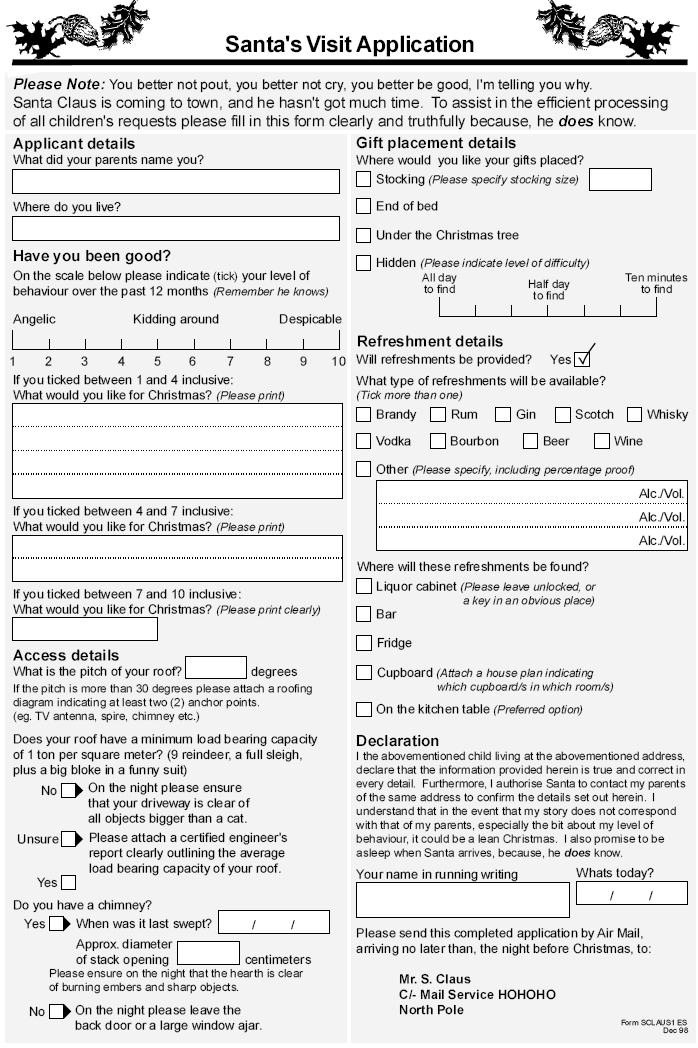
Repost – Hey Kids! Did you get your paperwork in on time?
If you hurry, you can just get your Santa’s Visit Application in before the deadline tonight!