Quotulatiousness

March 22, 2022

West Germany’s Wirtschaftwunder — the staggering economic postwar recovery

Christian Monson debunks the common tale taught in western schools of reason for the amazing recovery of West Germany’s economy after World War Two:

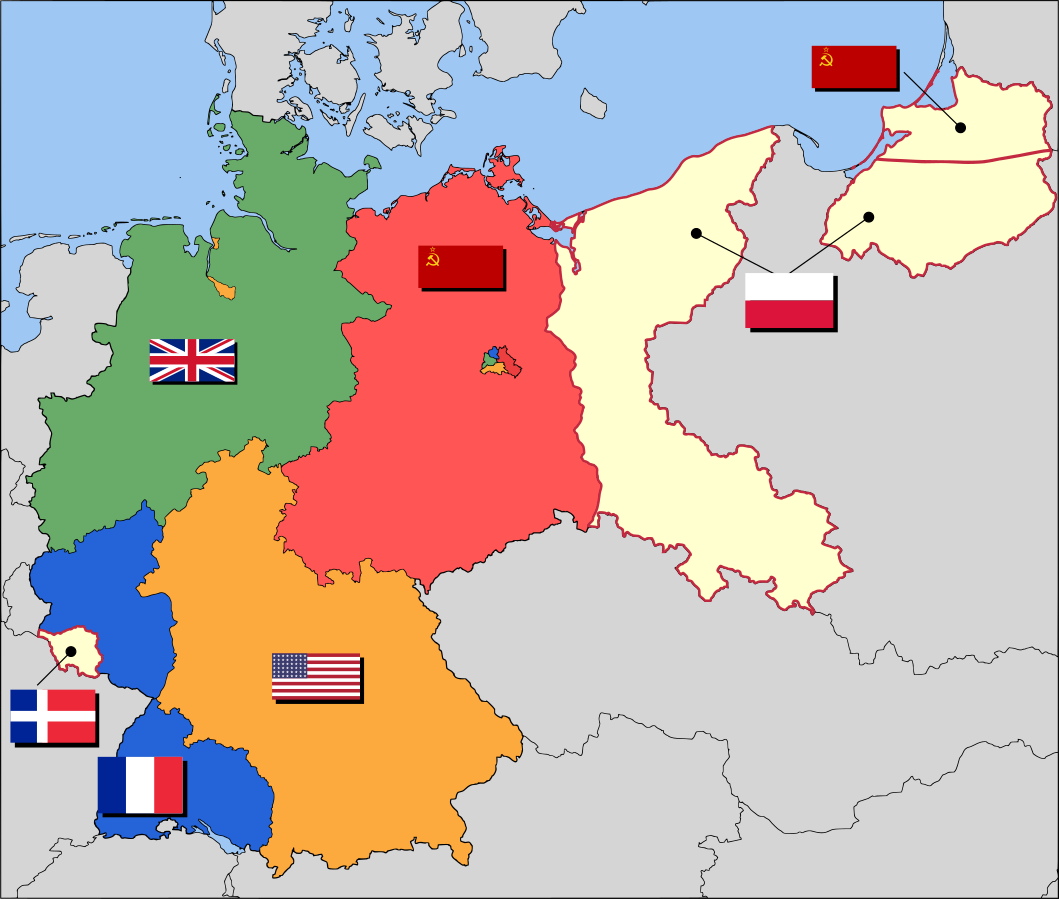
Occupation zone borders in Germany, 1947. The territories east of the Oder-Neisse line, under Polish and Soviet administration/annexation, are shown as cream as is the likewise detached Saar protectorate. Berlin is the multinational area within the Soviet zone.

Image based on map data of the IEG-Maps project (Andreas Kunz, B. Johnen, and Joachim Robert Moeschl of the University of Mainz) — www.ieg-maps.uni-mainz.de, via Wikimedia Commons.

This “economic miracle” is commonly referred to as die Wirtschaftswunder. But how did Germany go from rubble to riches in just a decade while neutral countries like Spain merely treaded economic water? If you ask your average American history student, they will say the Marshall Plan, of course!

Unfortunately, the ubiquity of the myth that the Marshall Plan rebuilt Germany is proof that state-controlled education favors propaganda over economic literacy. Despite the fact that most modern historians don’t give the Marshall Plan much credit at all for rebuilding Germany and attribute to it less than 5 percent of Germany’s national income during its implementation, standard history textbooks still place it at the forefront of the discussion about post-war reconstruction.

Consider this section from McDougal Littell’s World History (p. 968), the textbook I was given in high school:

    This assistance program, called the Marshall Plan, would provide food, machinery, and other materials to rebuild Western Europe. As Congress debated the $12.5 billion program in 1948, the Communists seized power in Czechoslovakia. Congress immediately voted approval. The plan was a spectacular success.

Of course, the textbook makes no mention of the actual cause of the Wirtschaftwunder: sound economic policy. That’s because, for the state, the Marshall Plan makes great statist mythology.

Not only is it frequently brought up to justify the United States getting involved in foreign conflicts, but it simply gives support for central planning. Just look at the economic miracle the government was able to create with easy credit, they say.

And of course, admitting that the billions of dollars pumped into Germany after WWII accomplished next to nothing, especially when compared to something as simple as sound money, would be tantamount to admitting that the government spends most of its time making itself needed when it isn’t and thereby doing little besides getting in the way.

Credit for the turnaround should be accorded to Ludwig Erhard, according to Alasdair Macleod at the Cobden Centre:

Anyone who favours regulation needs to explain away Germany’s post-war success. Her economy had been destroyed, firstly by the Nazi war machine, and then by Allied bombing. We easily forget the state of ruin the country was in, with people in the towns and cities actually starving in the post-war aftermath. The joint British and American military solution was to extend and intensify war-time rationing and throw Marshall aid at the problem.

Then a man called Ludwig Erhard was appointed director of economics by the Bizonal Economic Council, in effect he became finance minister. He decided, against British and American misgivings, as well as opposition from the newly-recreated Social Democrats, to do away with price controls and rationing, which he did in 1948. These moves followed his currency reform that June, which contracted the money supply by about 90%. He also slashed income tax from 85% to 18% on annual incomes over Dm2,500 (US$595 equivalent).

Economists of the Austrian school would comprehend and recommend this strategy, but it goes wholly against the bureaucratic grain. General Lucius Clay, who was the military governor of the US Zone, and to whom Erhard reported, is said to have asked him, “Herr Erhard, my advisers tell me what you have done is a terrible mistake. What do you say to that?”

Erhard replied, “Herr General, pay no attention to them! My advisers tell me the same thing.”

About the same time, a US Colonel confronted Erhard: “How dare you relax our rationing system, when there is a widespread food shortage?”

Erhard replied, “I have not relaxed rationing, I have abolished it. Henceforth the only rationing ticket the people will need will be the deutschemarks. And they will work hard to get those deutschemarks, just wait and see.”

The US Colonel did not have to wait long. According to contemporary accounts, within days of Erhard’s currency reform, shops filled with goods as people realised the money they sold them for would retain its value. People no longer needed to forage for the basics in life, so absenteeism from work halved, and industrial output rose more than 50% in the second half of 1948 alone.

March 10, 2022

QotD: Orwell on Capitalism, Socialism, and Fascism

Filed under: Economics, Germany, History, Politics, Quotations, WW2 — Tags: , , , , — Nicholas @ 01:00

Socialism is usually defined as “common ownership of the means of production”. Crudely: the State, representing the whole nation, owns everything, and everyone is a State employee. This does not mean that people are stripped of private possessions such as clothes and furniture, but it does mean that all productive goods, such as land, mines, ships and machinery, are the property of the State. The State is the sole large-scale producer. It is not certain that Socialism is in all ways superior to capitalism, but it is certain that, unlike capitalism, it can solve the problems of production and consumption. At normal times a capitalist economy can never consume all that it produces, so that there is always a wasted surplus (wheat burned in furnaces, herrings dumped back into the sea, etc., etc.) and always unemployment. In time of war, on the other hand, it has difficulty in producing all that it needs, because nothing is produced unless someone sees his way to making a profit out of it. In a Socialist economy these problems do not exist. The State simply calculates what goods will be needed and does its best to produce them. Production is only limited by the amount of labour and raw materials. Money, for internal purposes, ceases to be a mysterious all-powerful thing and becomes a sort of coupon or ration-ticket, issued in sufficient quantities to buy up such consumption goods as may be available at the moment.

However, it has become clear in the last few years that “common ownership of the means of production” is not in itself a sufficient definition of Socialism. One must also add the following: approximate equality of incomes (it need be no more than approximate), political democracy, and abolition of all hereditary privilege, especially in education. These are simply the necessary safeguards against the reappearance of a class-system. Centralized ownership has very little meaning unless the mass of the people are living roughly upon an equal level, and have some kind of control over the government. “The State” may come to mean no more than a self-elected political party, and oligarchy and privilege can return, based on power rather than on money.

But what then is Fascism?

Fascism, at any rate the German version, is a form of capitalism that borrows from Socialism just such features as will make it efficient for war purposes. Internally, Germany has a good deal in common with a Socialist state. Ownership has never been abolished, there are still capitalists and workers, and – this is the important point, and the real reason why rich men all over the world tend to sympathize with Fascism – generally speaking the same people are capitalists and the same people workers as before the Nazi revolution. But at the same time the State, which is simply the Nazi Party, is in control of everything. It controls investment, raw materials, rates of interest, working hours, wages. The factory owner still owns his factory, but he is for practical purposes reduced to the status of a manager. Everyone is in effect a State employee, though the salaries vary very greatly. The mere efficiency of such a system, the elimination of waste and obstruction, is obvious. In seven years it has built up the most powerful war machine the world has ever seen.

But the idea underlying Fascism is irreconcilably different from that which underlies Socialism. Socialism aims, ultimately, at a world-state of free and equal human beings. It takes the equality of human rights for granted. Nazism assumes just the opposite. The driving force behind the Nazi movement is the belief in human inequality, the superiority of Germans to all other races, the right of Germany to rule the world. Outside the German Reich it does not recognize any obligations. Eminent Nazi professors have “proved” over and over again that only Nordic man is fully human, have even mooted the idea that non-Nordic peoples (such as ourselves) can interbreed with gorillas! Therefore, while a species of war-Socialism exists within the German state, its attitude towards conquered nations is frankly that of an exploiter. The function of the Czechs, Poles, French, etc., is simply to produce such goods as Germany may need, and get in return just as little as will keep them from open rebellion. If we are conquered, our job will probably be to manufacture weapons for Hitler’s forthcoming wars with Russia and America. The Nazis aim, in effect, at setting up a kind of caste system, with four main castes corresponding rather closely to those of the Hindu religion. At the top comes the Nazi party, second come the mass of the German people, third come the conquered European populations. Fourth and last are to come the coloured peoples, the “semi-apes” as Hitler calls them, who are to be reduced quite openly to slavery.

However horrible this system may seem to us, it works. It works because it is a planned system geared to a definite purpose, world-conquest, and not allowing any private interest, either of capitalist or worker, to stand in its way. British capitalism does not work, because it is a competitive system in which private profit is and must be the main objective. It is a system in which all the forces are pulling in opposite directions and the interests of the individual are as often as not totally opposed to those of the State.

George Orwell, “The Lion And The Unicorn: Socialism and the English Genius”, 1941-02-19.

March 2, 2022

QotD: George Orwell was a dedicated socialist

Filed under: Britain, Economics, History, Quotations, WW2 — Tags: , , — Nicholas @ 01:00

I began this book to the tune of German bombs, and I begin this second chapter in the added racket of the barrage. The yellow gun-flashes are lighting the sky, the splinters are rattling on the house-tops, and London Bridge is falling down, falling down, falling down. Anyone able to read a map knows that we are in deadly danger. I do not mean that we are beaten or need be beaten. Almost certainly the outcome depends on our own will. But at this moment we are in the soup, full fathom five, and we have been brought there by follies which we are still committing and which will drown us altogether if we do not mend our ways quickly.

What this war has demonstrated is that private capitalism – that is, an economic system in which land, factories, mines and transport are owned privately and operated solely for profit – does not work. It cannot deliver the goods. This fact had been known to millions of people for years past, but nothing ever came of it, because there was no real urge from below to alter the system, and those at the top had trained themselves to be impenetrably stupid on just this point. Argument and propaganda got one nowhere. The lords of property simply sat on their bottoms and proclaimed that all was for the best. Hitler’s conquest of Europe, however, was a physical debunking of capitalism. War, for all its evil, is at any rate an unanswerable test of strength, like a try-your-grip machine. Great strength returns the penny, and there is no way of faking the result.

When the nautical screw was first invented, there was a controversy that lasted for years as to whether screw-steamers or paddle-steamers were better. The paddle-steamers, like all obsolete things, had their champions, who supported them by ingenious arguments. Finally, however, a distinguished admiral tied a screw-steamer and a paddle-steamer of equal horsepower stern to stern and set their engines running. That settled the question once and for all. And it was something similar that happened on the fields of Norway and of Flanders. Once and for all it was proved that a planned economy is stronger than a planless one.

George Orwell, “The Lion And The Unicorn: Socialism and the English Genius”, 1941-02-19.

February 9, 2022

QotD: Paper or plastic?

In his Nobel Lecture, The Pretence of Knowledge, Friedrich Hayek told us that it was never going to be possible to centrally plan an economy for economies are big, complex, even chaotic, things. That centre can never gain enough information in real time to be able to make decisions which bear much relation to reality. We can also run his logic backwards, if we do insist upon planning then we can only have a simple economy – all the knowledge we have allows us to plan – and simple economies are poor ones with poor people in them. Planning and poverty or market chaos and wealth: take your pick.

This point is illustrated in microcosm by those trying to get rid of single use plastic bags. The 5p charge for plastic bags has meant the sale of billions of so-called bags for life, which use twice as much plastic as the cheaper alternative. All those bags for life mean we use more plastic than we started with and even, possibly, more bags themselves. This was something that was warned about before the plastic bag charge was introduced, with some observing that even “single use” bags did tend to get used more than once.

So far, then, we have learnt that the planning deployed to reduce plastic has had the opposite effect. That, however, has not stopped the central planners from redoubling their efforts. The necessary charge for a bag is to double, the system is to be expanded to the tens of thousands of small shops that don’t currently have to charge. “It doesn’t work, let’s have more of it”, the cry of bureaucracies through the ages.

But this is the blending of government planning with the fashionable nostrums of our day so of course it gets worse. It’s not even true that the bags for life – and especially not the cotton ones, even less so the organic cotton – are more environmentally friendly than the single use ones. Even recycled ones use more resources than single-use ones – for yes, recycling is an industrial activity using energy and other resources.

We can even construct a little spectrum here. How many times do we need to reuse a bag for it to have as little resource use – and thus environmental effect – as just the one use of those thin single use plastic ones? Obviously enough, the single use that we’re told not to use has a value of one here. The bag for life must be reused 35 times. A bag for life from recycled plastic 84 times. A paper bag must be reused 43 times – yes, paper. A cotton bag 7,100 times and an organic cotton? 20,000.

Which is the environmentally friendly option here? Clearly and obviously the one that everyone insists we must not use. So much for fashionable nostrums then.

Tim Worstall, “Plastic bags and the problem with central planning”, CapX, 2019-01-02.

January 25, 2022

The fantasy of a modern economy without money

Filed under: Economics — Tags: , , , , — Nicholas @ 03:00

Jon Hersey and Thomas Walker-Werth consider the claim that we’d all be better off without money in a truly modern, egalitarian society:

Capitalism, to the extent it has existed, has been incredibly successful at lifting most of humanity out of poverty, incentivizing the creation of incredible, life-enhancing technologies, such as those Maezawa used to make his fortune — not to mention, travel to space. But it’s long had its critics, and he is far from the first to propose a sort of Garden-of-Eden world where everything is plentiful and free. Karl Marx envisioned a similar utopia. Communism, he said, ultimately would bring about a world without money:

    In the case of socialised production the money-capital is eliminated. Society distributes labour-power and means of production to the different branches of production. The producers may, for all it matters, receive paper vouchers entitling them to withdraw from the social supplies of consumer goods a quantity corresponding to their labour-time. These vouchers are not money. They do not circulate.

And although “society distributes labour-power” — meaning government planners tell people what to do to ensure that things (such as “free” Ferraris) get made — workers could also all pursue whatever hobbies or occupations strike their fancy. “[I]n communist society,” Marx explained,

    where nobody has one exclusive sphere of activity but each can become accomplished in any branch he wishes, society regulates the general production and thus makes it possible for me to do one thing today and another tomorrow, to hunt in the morning, to fish in the afternoon, rear cattle in the evening, criticize after dinner, just as I have in mind, without ever becoming hunter, fisherman, shepherd or critic.

[…]

Although Marx considered himself a social scientist and economist — and although his ideas are still some of the most widely taught — they aren’t much taught in social science or economics departments, except as foils. That’s because virtually all of Marx’s hypotheses have been debunked. For one, who’s going to build the free Ferraris that Maezawa has dreamed up, never mind tackle more mundane tasks, with no incentive? But for those who don’t find such commonsense thought experiments convincing — or who think, as Marx did, that human nature will somehow mysteriously change — the impracticality of Marx’s moneyless state was demonstrated by what Austrian economists have come to call the calculation problem. Ludwig von Mises once explained the problem as follows:

    If a hydroelectric power station is to be built, one must know whether or not this is the most economical way to produce the energy needed. How can he know this if he cannot calculate costs and output?

    We may admit that in its initial period a socialist regime could to some extent rely upon the experience of the preceding age of capitalism. But what is to be done later, as conditions change more and more? Of what use could the prices of 1900 be for the director in 1949? And what use can the director in 1980 derive from the knowledge of the prices of 1949?

    The paradox of “planning” is that it cannot plan, because of the absence of economic calculation. What is called a planned economy is no economy at all. It is just a system of groping about in the dark.

In short, without prices, people have no relatable, quantifiable means of comparing and contrasting options about how to spend time and capital, which is vital for determining how best to use these naturally scarce resources. “New Scientist magazine reported that in the future, cars could be powered by hazelnuts,” said comedian Jimmy Fallon, in a skit that captures this point hilariously. “That’s encouraging, considering an eight-ounce jar of hazelnuts costs about nine dollars. Yeah, I’ve got an idea for a car that runs on bald eagle heads and Fabergé eggs.”

December 28, 2021

“After the Second World War, the architecture-industrial complex … began a massive rebuilding of major cities”

Filed under: Architecture, Britain, Europe, History — Tags: , , , , — Nicholas @ 03:00

In The Critic, Nikos A. Salingaros decries “architectural urbanicide”:

Cumbernauld Shopping Centre, voted as Britain’s most hated building.
Photo by Ed Webster via Wikimedia Commons.

Biological life transforms energy from the sun into complexes of organic materials that either metabolize while remaining relatively fixed, or move about and eat each other. Human energy creates the analogous case of artifacts and buildings, which give us a healing effect akin to the feedback experienced from our interaction with biological organisms. This positive emotion corresponds to the mechanism of “biophilia”.

Women grow and nurture the human baby. They are predisposed to appreciate the created life form through an intense bond of love through beauty. Most people — though not all, a notable exception being the architect Le Corbusier — love babies and have a built-in reflex of smiling at the sight of one, even if it’s not their own. Beauty is inseparable from creation and life.

Established architecture in our times, and for a century before now, has been an almost exclusively male domain, dominated by sheer power. The profession has aligned itself with ideology and extractive money interests. A design movement that ignores living structure took dominance after World War II. It thrives through global consumption. Mathematical analysis can measure very precise living qualities embedded in design and materials, such as fractal scaling, multiple nested symmetries, color harmonization, organized details, vertical axis, etc. Recent experimental tools of eye-tracking and artificial intelligence using Visual Attention Software determine which designs attract the eye unconsciously, and which remain uninteresting to our sophisticated brain evolved for survival.

[…]

After the Second World War, the architecture-industrial complex of building and real estate industries began a massive rebuilding of major cities. This freed up real estate for new construction, an activity that enriched a certain section of society. Working with politicians at all levels, architectural review boards did not value traditional buildings, nor those in any of several new but non-modernist form languages. Any qualms about the irreversible destruction of the life of cities were offset by the media convincing the population that this was an inexorable and much desired move towards progress. Anybody opposing this program of architectural substitution — replacing living by dead structure — was labeled an obscurantist reactionary. The promised utopia seduced academia to join this campaign. People failed to realize that an ideology ostensibly linked to Marxist beliefs was driven by ruthless industry manipulation.

Nevertheless, architects don’t tear down buildings: it is real estate speculators who do. Those corporate entities are amoral, willing to do anything for profit. It’s not their responsibility to save valuable older buildings; that task falls upon society, which has failed miserably in this duty. The various mechanisms that are supposed to protect a perfectly sound and health-inducing building become a cruel joke when such a building is demolished. A decision is taken outside the light of public scrutiny, while implementing the strategy of the fait accompli — after the bulldozers and wreckers, it’s too late to do anything.

The story of the systematic destruction of the UK’s architectural heritage is long and ugly. To mention just one example, the corrupt Newcastle City Council Member Thomas Daniel Smith managed to erase large swaths of central city districts and replace them with cheaply-built glass-and-steel monstrosities before he was jailed in 1974. Smith worked closely with dishonest — and extremely successful — architect John Poulson, who was also jailed in 1974. He appealed directly to democratic and liberal sentiments to further his ambitions, and the political class at the time fell for his manipulations. This sordid story repeats, with only minor variations, except that the other urbanicides were never prosecuted.

November 29, 2021

Giovanni Gentile, “the ideological father of Fascism”

Filed under: Europe, History, Italy, Politics — Tags: , , , , — Nicholas @ 03:00

Emmanuel Rincón on the Italian philosopher who created the ideological underpinnings of Benito Mussolini’s Fascist movement:

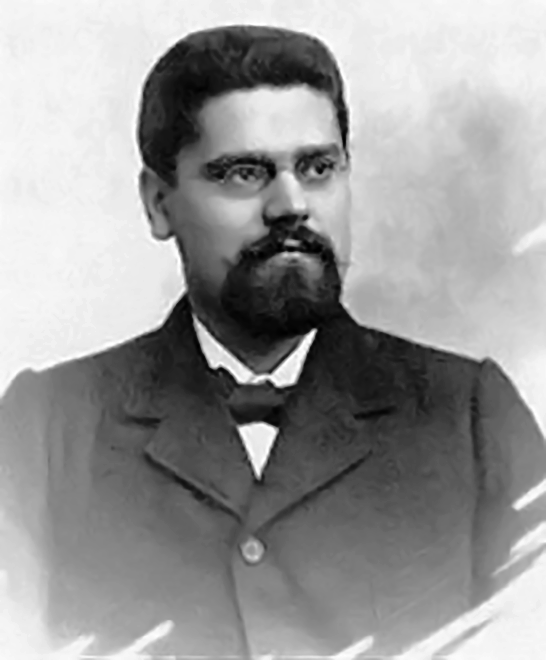
Giovanni Gentile
Undated photograph probably before 1930 via Wikimedia Commons.

Giovanni Gentile, a neo-Hegelian philosopher, was the intellectual author of the “doctrine of fascism”, which he wrote in conjunction with Benito Mussolini. Gentile’s sources of inspiration were thinkers such as Hegel, Nietzsche, and also Karl Marx.

Gentile went so far as to declare “Fascism is a form of socialism, in fact, it is its most viable form.” One of the most common reflections on this is that fascism is itself socialism based on national identity.

Gentile believed that all private action should be oriented to serve society. He was against individualism, for him there was no distinction between private and public interest. In his economic postulates, he defended compulsory state corporatism, wanting to impose an autarkic state (basically the same recipe that Hitler would use years later).

A basic aspect of Gentile’s logic is that liberal democracy was harmful because it was focused on the individual which led to selfishness. He defended “true democracy” in which the individual should be subordinated to the State. In that sense, he promoted planned economies in which it was the government that determined what, how much, and how to produce.

Gentile and another group of philosophers created the myth of socialist nationalism, in which a country well directed by a superior group could subsist without international trade, as long as all individuals submitted to the designs of the government. The aim was to create a corporate state. It must be remembered that Mussolini came from the traditional Italian Socialist Party, but due to the rupture with this traditional Marxist movement, and due to the strong nationalist sentiment that prevailed at the time, the bases for creating the new “nationalist socialism”, which they called fascism, were overturned.

Fascism nationalized the arms industry, however, unlike traditional socialism, it did not consider that the state should own all the means of production, but more that it should dominate them. The owners of industries could “keep” their businesses, as long as they served the directives of the state. These business owners were supervised by public officials and paid high taxes. Essentially, “private property” was no longer a thing. It also established the tax on capital, the confiscation of goods of religious congregations and the abolition of episcopal rents. Statism was the key to everything, thanks to the nationalist and collectivist discourse, all the efforts of the citizens had to be in favor of the State.

November 7, 2021

QotD: Shoe manufacturing in the Soviet Union

The Commies weren’t big on consumer goods for obvious reasons, but even the proles need shoes. If you’re a Communist (or a teenager), it seems simple enough: send your flunkies out into a region, have them write down everyone’s shoe sizes, and then make those. Which would work, I guess, if not for the fact that industry doesn’t operate that way. Industries are only efficient through economies of scale. “A shoe factory” only beats “a cordwainer” because the factory can crank out 10,000 pairs of shoes in the time it takes the cordwainer to produce one pair. Worse, factories are massive resource sinks if they’re not running at full blast at all times …

After trying several workarounds, GOSPLAN, the state production ministry, decided to use “Gross Output Targets” to produce goods. Which probably worked ok for stuff like rebar, if you don’t care about quality (see Mao’s DIY backyard blast furnaces), but is terrible for stuff like shoes. So let’s say GOSPLAN decides that 100,000 lucky proles of Irkutsk Oblast shall receive one pair of shoes apiece. Since all materials had to be requisitioned in advance from GOSSNAB (I confess: I love Soviet acronyms), and since the production line would need to be re-tooled for each individual size and style of shoe, the factory managers — who had to hit the Gross Output Target, or go tour Siberia — did the only logical thing: They cranked out 100,000 baby shoes, all left feet. (Baby shoes use less leather; the excess can be sold or traded, see below).

Again, Commies couldn’t care less about consumer complaints, but eventually some up and comer in the Party will notice that everyone is wandering barefoot around a big pile of baby shoes. That might make him look bad, so he sends a report, and, after a long and convoluted bureaucratic process, GOSPLAN revises their order: 100,000 pairs of shoes, but in different sizes and styles, for men and women. In response to which, the factory manager does the only logical thing: 99,999 pairs of baby shoes, all left feet, plus one pump and one wingtip.

Lather, rinse, repeat. The factory manager isn’t a bad guy — in fact, let’s say he’s Wyatt. He’s just operating on an entirely different incentive structure than even his immediate boss, to say nothing of the faceless apparatchiks at GOSPLAN. Hitting any Gross Output Target is a real task, given that his workforce is a bunch of illiterate peasants who hate him and are constantly drunk. What probably seems like spectacularly inventive cruelty to the proles of Irkutsk Oblast is just Wyatt doing everything he can to keep his family out of the Gulag. And since Wyatt’s a smart guy, he can get around any target GOSPLAN sets. If they tell him to produce 100,000 pounds of shoes, his factory cranks out one enormous pair of concrete sneakers.

That’s one of Wyatt’s two overriding priorities: Staying out of the Gulag. The other one is: Using whatever he can scrimp, save, or scrounge from GOSSNAB as trade goods in the black market.

Here again, Wyatt’s not a bad guy. He’s not doing this to feather his own nest (though of course he lives a little better than others; he’s only human). In the words of the immortal Mike Tyson, everyone has a plan until he gets punched in the mouth, and even the most meticulously “scientific” management gets punched in the mouth all the time. As we’ve seen, GOSPLAN can’t even get it right with something as low-tech, as easy to mass-produce as shoes, so imagine how they do with more complex bits of equipment. The factory managers, who have to hit the Gross Output Targets, no matter what, quickly figure out that they’ll be waiting until doomsday if they try requisitioning what they need from GOSSNAB, so they form a kind of black market between themselves. Indeed there’s an entire class of quasi-criminals, whose name I forget, that exists only to facilitate such transactions.

Extend that paradigm to everything, and you’ve got life in the USSR. There’s the “official” economy, which is pure fantasy. There’s the black market economy at the factory level, where bulk materials change hands (since the official economy is pure fantasy, nobody blinks an eye when, say, 100,000 metric tons of concrete disappears off a manifest somewhere and reappears, un-manifested (as it were), somewhere else). There’s the black market at the consumer level, since of course the poor proles of Irkutsk Oblast have to have shoes and there’s no way they’re getting them from Wyatt’s factory. And finally, there’s the black market at the service level — those go-betweens arranging for 100,000 metric tons of concrete to fall off a truck in Vladivostok and appear, like magic, in Kiev (and their consumer-level equivalents — think pimps, but for everything).

Severian, “Darker Shade of Black IV: Black Market”, Rotten Chestnuts, 2021-04-02.

October 21, 2021

If Quebec is the model for universal childcare services, then voters will be waiting a long, long time for that promise to be fulfilled

Filed under: Business, Cancon, Government — Tags: , , , , — Nicholas @ 03:00

In The Line, Andrea Mrozek talks about the promises (mostly still unfulfilled) of Quebec’s “universal” childcare service model:

Since last month’s election, many have been asking which promises the Liberals made will prove the most difficult to keep. Put child care at the top of the list: The federal government’s five-year, $30 billion Canada-wide child-care plan is rife with complicating factors. When government officials point to Quebec as the model for the rest of Canada, what that means is a system plagued by lack of access, inequality and poor quality.

When Quebec introduced its low-user fee “universal” system in 1997, the goal was to create a centre-based, publicly-funded system for all children. Fees started at $5 a day, briefly shifting to a fee structure based on income, before settling in at the current daily rate of $8.50.

The rapid reduction in fees in only one part of the child-care sector disrupted the care options parents were using in Quebec. Private providers, who were not to be included in Quebec’s system, “understandably crumbled” after the system began. Unfortunately, the public system never picked up the slack. So the Quebec government then coaxed them back into the business of child-care provision through a system of tax credits.

Consider this: We are told publicly funded child care offered at a fixed low price for parents is the way to go across Canada. Consider further that we are told Quebec is the model for said child-care system. Then consider that between 2003 and 2021, in Quebec, public (“Centres de la petite enfance” or CPE spaces) increased by about 55 per cent, or 35,000 spaces. In the same time period, private, unsubsidized spaces increased by about 4,200 per cent or 68,500 spaces. This growth in private provision is not at all what architects of public child-care provision desire. It has, however, proved unavoidable in Quebec, precisely because provision of public spaces has been so slow. Whether it’s lack of funds, political will or some other combination of factors, Quebec has been unable over two decades to build the system of CPE’s envisioned in the mid 1990s.

None of this is a secret: The Quebec auditor general reported last fall there are “not enough spaces available in subsidized child care to meet the needs of families in Quebec.” There are 98,014 spaces in CPEs but 46,000 on a waiting list for a CPE space, as per the auditor general. Does this sound like a policy success?

Further, the waitlists are now themselves a source of inequity. The same auditor-general report highlights that in Montreal in particular, “the children of low-income families are underrepresented in (CPEs).” Previous studies showed this to be a problem across Quebec. Sociologist Rod Beaujot wrote this in a 2013 paper: “In Quebec, day care is used less by children in vulnerable environments, and the services they use are of lower quality (Giguère and Desrosiers 2011). In contrast, the higher the mother’s education, and the higher the family income, the greater the usage of child-care in the Quebec program (Audet and Gingras 2011.) While the program has provisions for disadvantaged families, it would appear that other provinces are more successful in tailoring programs to families with lower incomes.”

So, it’s another “universal” program that disproportionally benefits the wealthy and well-connected (who tend to be Liberal Party supporters and voters)? Tabarnak! Who could ever have possibly seen this coming? Oh, and the Quebec model the rest of the country is supposedly eager to adopt has literally the worst ratios of adult caregivers to children, and 81% of Quebec parents say “Finding quality child care is a way bigger hassle than it should be for parents today”, which is a higher percentage than it is in any other province.

October 13, 2021

Elitist scorn for “dollar” stores

Filed under: Business, Government, USA — Tags: , , , — Nicholas @ 03:00

Laura Williams uses the often-debunked tale of Marie Antoinette telling the poor of Paris to eat cake to illustrate a very real present-day issue of local governments trying to limit or even eliminate low-cost retail options in poor areas of their municipalities:

“Family Dollar Store” by JeepersMedia is licensed under CC BY 2.0

Sixty-two percent of adults surveyed by brand intelligence firm Morning Consult say Dollar Tree “has a positive effect on my community” (compared to 51 percent for Starbucks and 59 percent for Target).

People who can afford more choices — driving out to a big-box store, buying in bulk, ordering online, patronizing a farmer’s market — simply can’t see the perspective of someone for whom the dollar store is the most practical option.

[…]

Opponents of dollar stores often contradict each other or even themselves.

Critics objected when suburban growth sent stores running for whiter, more affluent suburbs. But dollar stores’ explicit attempts to reverse this trend — to set up affordable retail options in poorer, underserved neighborhoods — are somehow also the target of scorn.

You’ll also hear critics claim dollar stores engage in “predatory” behavior by offering prices that are simultaneously too low (undercutting potential competitors) and also too high (as compared to a per-unit cost at the Costco 15 miles away).

Haters complain retail jobs offered by dollar stores are “low quality and low-wage” but also that dollar stores don’t create enough of these low-quality, undesirable jobs. One is reminded of the Woody Allen line complaining about a restaurant’s “terrible food … and such small portions!”

A Tulsa councilwoman begrudgingly confirmed that dollar retailers offer essentials like toothpaste and school supplies, bread and eggs, in areas where supermarkets “have consistently failed”. Why this is condemnable, rather than laudable, she does not explain.

With backward economic thinking, CNN claimed dollar stores “limit poor communities’ access to healthy food,” blaming low-cost retailers for the gaps they try to fill.

Bans on walkable, ultra-affordable stores do nothing to increase the availability of fresh food; they merely stamp out the only existing option.

September 16, 2021

QotD: The youthful Utopian

Filed under: Quotations, Space, Technology — Tags: , , — Nicholas @ 01:00

More than half a century ago, I had a friend in junior high school I could never figure out or drum much common sense into. He was quite the dreamer. He loved science fiction. His nickname was “Angus” — derived from the fact that he was rather rotund, and our school was surrounded by farm fields. When we grazed at the same lunch table, he would speculate endlessly about what life on other planets might be like. He was very earnest, and very entertaining.

One day I suggested facetiously that Angus stop speculating and go find out for himself. “Build a spaceship someday and fly to the planet of your choice,” I recommended. To my surprise, he took me seriously.

Some days later, Angus excitedly told me he had it all worked out. He had designed the spaceship and even brought the plans to show me. Then he unfolded a large sheet of brown wrapping paper. There it was — the entire cockpit control panel of the craft that would take Angus to the cosmos. There was a button for everything.

“This is not a plan!” I declared with a laugh. “It’s just a bunch of buttons with labels on them.”

“But it’s all here,” Angus insisted. “I’ve thought of everything — Start, Stop, Land, Take-off, Dodge Asteroids, you name it, everything you need to know.” He even had an all-purpose button to take care of anything unexpected, which he thought was a genius innovation.

What I remember most vividly about this experience was not the fine detail of my friend’s sketch. It was my frustrating inability to convince him he was delusional, that his plan was no plan at all, that as a 14-year-old he wasn’t yet ready for a senior position at NASA. He was what philosopher Eric Hoffer might call a “true believer” — convinced beyond any hope of convincing otherwise that his plan was thorough, perfect, and sure to work.

I lost track of Angus after graduation, but I am quite certain his spaceship never left the ground.

Lawrence W. Reed, “The Dark Side of Paradise: A Brief History of America’s Utopian Experiments in Communal Living”, Foundation for Economic Education, 2021-06-13.

September 9, 2021

When you mess around in a software testing environment … make sure it actually is a test

A British local government found out the hard way that they need to isolate their software testing from their live server:

A borough council in the English county of Kent is fuming after a software test on the council’s website led to five nonsensical dummy planning application documents being mistakenly published as legally binding decisions.

According to a statement from Swale Borough Council, staff from the Mid Kent Planning Support Team had been testing the software when “a junior officer with no knowledge of any of the applications” accidentally pressed the button on five randomly selected Swale documents, causing them to go live on the Swale website.

After learning what had happened, the council moved to remove the erroneous decisions from public display, but according to the statement: “Legal advice has subsequently confirmed they are legally binding and must be overturned before the correct decisions are made.”

Publishing randomly generated planning decisions is obviously bad enough, but the problems got worse for Swale when it was discovered that the “junior officer” who made the mistake had also added their own comments to the notices in the manner of somebody “who believed they were working solely in a test environment and that the comments would never be published,” as the council diplomatically described it.

So it was that despite scores of supportive messages from residents, the splendidly named Happy Pants Ranch animal sanctuary had its retrospective application for a change of land use controversially refused, on the grounds that “Your proposal is whack. No mate, proper whack,” while an application to change the use of a building in Chaucer Road, Sittingbourne, from a butchers to a fast-food takeaway was similarly denied with the warning: “Just don’t. No.”

The blissfully unaware office junior continued their cheerful subversion of Kent’s planning bureaucracy by approving an application to change the use of a barn in the village of Tunstall, but only on condition of the numbers 1 to 20 in ascending order. They also approved the partial demolition of the Wheatsheaf pub in Sittingbourne and the construction of a number of new flats on the site, but only as long as the project is completed within three years and “Incy Wincy Spider.”

Finally, Mid Kent’s anonymous planning hero granted permission for the demolition of the Old House at Home pub in Sheerness, but in doing so paused to ponder the enormous responsibility which had unexpectedly been heaped upon them, commenting: “Why am I doing this? Am I the chosen one?”

For their part, Swale Borough Council’s elected representatives were less than impressed by the work of their colleagues at the Mid Kent Planning Support Team and wasted no time in resolutely throwing them under the bus.

“These errors will have to be rectified but this will cause totally unnecessary concern to applicants,” thundered Swale councillors Roger Truelove, Leader and Cabinet Member for Finance, and Mike Baldock, Deputy Leader and Cabinet Member for Planning in a shared statement. “This is not the first serious problem following the transfer of our planning administration to Mid Kent shared services. We will wait for the outcome of a proper investigation and then consider our appropriate response as a council.”

August 25, 2021

Louisa May Alcott’s childhood experiences in a utopian socialist commune

Filed under: Economics, History, USA — Tags: , , , — Nicholas @ 03:00

At the Foundation for Economic Education, Lawrence W. Reed recounts the author’s family’s time in one of the many utopian settlements of the early United States:

The original farm house of Fruitlands farm community in Harvard, Massachusetts, founded by Bronson Alcott and Charles Lane in 1843. Now a museum to the experiment.
Photo by Midnightdreary via Wikimedia Commons.

Alcott was just 11 when her father moved the family to the experimental village of Fruitlands in Massachusetts. It was not a promising place. Elizabeth Dunn at History.com writes,

    Fruitlands was founded in Harvard, Massachusetts, as a self-sufficient farming community by Charles Lane and Bronson Alcott, two men with no practical experience in either farming or self-sufficiency … Settlers were forbidden to eat meat, consume stimulants, use any form of animal labor, create artificial light, enjoy hot baths or drink anything but water. Lane’s ideas later evolved to include celibacy within marriage, which caused no small amount of friction between him and his most loyal disciple, Bronson Alcott, who had relocated his wife and four daughters [Louisa being one of them] to Fruitlands in a characteristic fit of enthusiasm.

At least 119 utopian, communal or socialist settlements were founded in the early 1800s in America. As most of the country reveled in newly won freedoms and a market economy that allowed the enterprising to create wealth, a few malcontents sought a different life. They spurned private property in favor of sharing material things in common. They preferred a “planned” community over the supposed “chaos” of the market’s spontaneous order. They thought if they just worked out on paper what their preferred society would look like, everything and everybody would just fall into place.

Like many idealists, Alcott’s father and many others believed that it was possible to “plan” everything successfully so that nothing was wasted and there was no economic inequality. Like many others since then, they quickly discovered that human nature does not work that way:

Lofty pledges of equality that fell far short of reality. Women, for instance, were promised they would have to work no harder or longer than men, but the Alcott girls were among the Fruitlands women who were stuck with most of the labor.

Goofy, fringe notions about life. At Fruitlands, these notions included a general abstinence not only from sex but from most of what its architects regarded as “worldly activities” — like most commerce and trade, the raising of livestock, and the planting of vegetables that grow down (like turnips and carrots) instead of up (like lettuce and tomatoes).

A weird disdain for private property. The mere desire to acquire property for oneself (even by serving others as customers) was regarded as repugnant. Lane and Alcott once visited a nearby settlement of Shakers and while admiring the Shakers’ practice of property held “in common”, they condemned them for engaging in commerce by selling their homemade furniture.

May 18, 2021

QotD: The imaginary problem of having “too much” choice

Filed under: Economics, Liberty, Quotations, USA — Tags: , , , — Nicholas @ 01:00

In the early 20th century critics attacked product variety as being wasteful — a sign that markets were less efficient than central planning. Hence, the Chinese wore Mao suits, Americans got uniformly round automobile headlights and British authorities “rationalized” furniture designs.

A famous scene in the film Moscow on the Hudson has Robin Williams as a Soviet immigrant collapsing at the sight of an American coffee aisle, circa 1984. Imagine what would happen in Starbucks.

A free economy multiplies variety, the better to serve buyers with different tastes and different needs and to give people the chance to experience different goods at different times. Arguing that this plenitude is inefficient went out decades ago. The problem with markets, the detractors now say, is that all these choices make us unhappy.

Virginia Postrel, “I’m Pro-Choice”, Forbes, 2005-03-28.

April 15, 2021

QotD: The “evil” of profits

Filed under: Business, Economics, Germany, Government, Quotations, Russia, USA — Tags: , , , , — Nicholas @ 01:00

The slogan into which the Nazis condensed their economic philosophy, viz., Gemeinnutz geht vor Eigennutz (i.e., the commonweal ranks above private profit), is likewise the idea underlying the American New Deal and the Soviet management of economic affairs. It implies that profit-seeking business harms the vital interests of the immense majority, and that it is the sacred duty of popular government to prevent the emergence of profits by public control of production and distribution.

Ludwig von Mises, Planned Chaos, 1947.

« Newer PostsOlder Posts »

Powered by WordPress