More than half a century ago, I had a friend in junior high school I could never figure out or drum much common sense into. He was quite the dreamer. He loved science fiction. His nickname was “Angus” — derived from the fact that he was rather rotund, and our school was surrounded by farm fields. When we grazed at the same lunch table, he would speculate endlessly about what life on other planets might be like. He was very earnest, and very entertaining.
One day I suggested facetiously that Angus stop speculating and go find out for himself. “Build a spaceship someday and fly to the planet of your choice,” I recommended. To my surprise, he took me seriously.
Some days later, Angus excitedly told me he had it all worked out. He had designed the spaceship and even brought the plans to show me. Then he unfolded a large sheet of brown wrapping paper. There it was — the entire cockpit control panel of the craft that would take Angus to the cosmos. There was a button for everything.
“This is not a plan!” I declared with a laugh. “It’s just a bunch of buttons with labels on them.”
“But it’s all here,” Angus insisted. “I’ve thought of everything — Start, Stop, Land, Take-off, Dodge Asteroids, you name it, everything you need to know.” He even had an all-purpose button to take care of anything unexpected, which he thought was a genius innovation.
What I remember most vividly about this experience was not the fine detail of my friend’s sketch. It was my frustrating inability to convince him he was delusional, that his plan was no plan at all, that as a 14-year-old he wasn’t yet ready for a senior position at NASA. He was what philosopher Eric Hoffer might call a “true believer” — convinced beyond any hope of convincing otherwise that his plan was thorough, perfect, and sure to work.
I lost track of Angus after graduation, but I am quite certain his spaceship never left the ground.
Lawrence W. Reed, “The Dark Side of Paradise: A Brief History of America’s Utopian Experiments in Communal Living”, Foundation for Economic Education, 2021-06-13.
September 16, 2021
QotD: The youthful Utopian
September 9, 2021
When you mess around in a software testing environment … make sure it actually is a test
A British local government found out the hard way that they need to isolate their software testing from their live server:
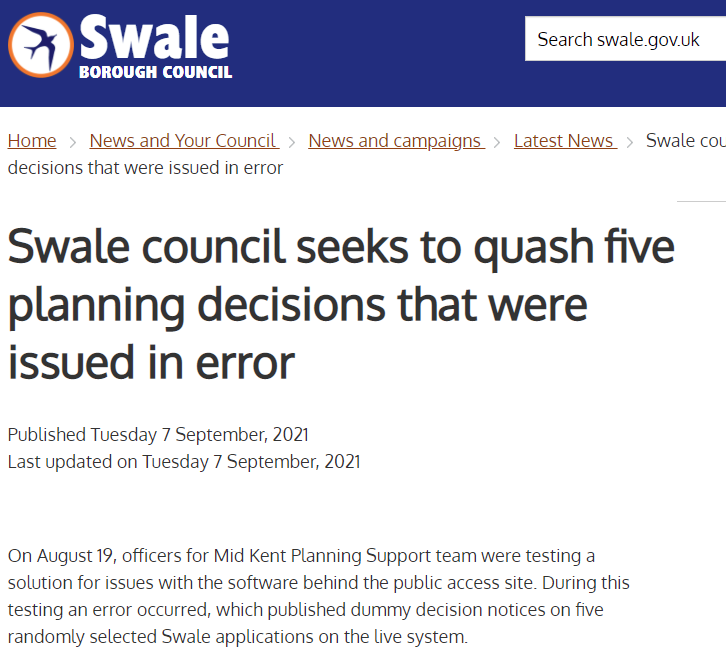
A borough council in the English county of Kent is fuming after a software test on the council’s website led to five nonsensical dummy planning application documents being mistakenly published as legally binding decisions.
According to a statement from Swale Borough Council, staff from the Mid Kent Planning Support Team had been testing the software when “a junior officer with no knowledge of any of the applications” accidentally pressed the button on five randomly selected Swale documents, causing them to go live on the Swale website.
After learning what had happened, the council moved to remove the erroneous decisions from public display, but according to the statement: “Legal advice has subsequently confirmed they are legally binding and must be overturned before the correct decisions are made.”
Publishing randomly generated planning decisions is obviously bad enough, but the problems got worse for Swale when it was discovered that the “junior officer” who made the mistake had also added their own comments to the notices in the manner of somebody “who believed they were working solely in a test environment and that the comments would never be published,” as the council diplomatically described it.
So it was that despite scores of supportive messages from residents, the splendidly named Happy Pants Ranch animal sanctuary had its retrospective application for a change of land use controversially refused, on the grounds that “Your proposal is whack. No mate, proper whack,” while an application to change the use of a building in Chaucer Road, Sittingbourne, from a butchers to a fast-food takeaway was similarly denied with the warning: “Just don’t. No.”
The blissfully unaware office junior continued their cheerful subversion of Kent’s planning bureaucracy by approving an application to change the use of a barn in the village of Tunstall, but only on condition of the numbers 1 to 20 in ascending order. They also approved the partial demolition of the Wheatsheaf pub in Sittingbourne and the construction of a number of new flats on the site, but only as long as the project is completed within three years and “Incy Wincy Spider.”
Finally, Mid Kent’s anonymous planning hero granted permission for the demolition of the Old House at Home pub in Sheerness, but in doing so paused to ponder the enormous responsibility which had unexpectedly been heaped upon them, commenting: “Why am I doing this? Am I the chosen one?”
For their part, Swale Borough Council’s elected representatives were less than impressed by the work of their colleagues at the Mid Kent Planning Support Team and wasted no time in resolutely throwing them under the bus.
“These errors will have to be rectified but this will cause totally unnecessary concern to applicants,” thundered Swale councillors Roger Truelove, Leader and Cabinet Member for Finance, and Mike Baldock, Deputy Leader and Cabinet Member for Planning in a shared statement. “This is not the first serious problem following the transfer of our planning administration to Mid Kent shared services. We will wait for the outcome of a proper investigation and then consider our appropriate response as a council.”
August 25, 2021
Louisa May Alcott’s childhood experiences in a utopian socialist commune
At the Foundation for Economic Education, Lawrence W. Reed recounts the author’s family’s time in one of the many utopian settlements of the early United States:
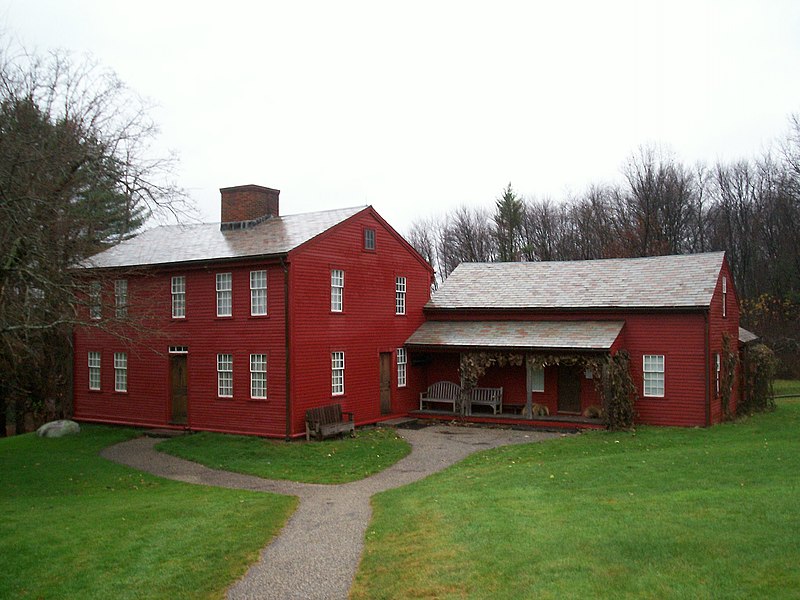
The original farm house of Fruitlands farm community in Harvard, Massachusetts, founded by Bronson Alcott and Charles Lane in 1843. Now a museum to the experiment.
Photo by Midnightdreary via Wikimedia Commons.
Alcott was just 11 when her father moved the family to the experimental village of Fruitlands in Massachusetts. It was not a promising place. Elizabeth Dunn at History.com writes,
Fruitlands was founded in Harvard, Massachusetts, as a self-sufficient farming community by Charles Lane and Bronson Alcott, two men with no practical experience in either farming or self-sufficiency … Settlers were forbidden to eat meat, consume stimulants, use any form of animal labor, create artificial light, enjoy hot baths or drink anything but water. Lane’s ideas later evolved to include celibacy within marriage, which caused no small amount of friction between him and his most loyal disciple, Bronson Alcott, who had relocated his wife and four daughters [Louisa being one of them] to Fruitlands in a characteristic fit of enthusiasm.
At least 119 utopian, communal or socialist settlements were founded in the early 1800s in America. As most of the country reveled in newly won freedoms and a market economy that allowed the enterprising to create wealth, a few malcontents sought a different life. They spurned private property in favor of sharing material things in common. They preferred a “planned” community over the supposed “chaos” of the market’s spontaneous order. They thought if they just worked out on paper what their preferred society would look like, everything and everybody would just fall into place.
Like many idealists, Alcott’s father and many others believed that it was possible to “plan” everything successfully so that nothing was wasted and there was no economic inequality. Like many others since then, they quickly discovered that human nature does not work that way:
Lofty pledges of equality that fell far short of reality. Women, for instance, were promised they would have to work no harder or longer than men, but the Alcott girls were among the Fruitlands women who were stuck with most of the labor.
Goofy, fringe notions about life. At Fruitlands, these notions included a general abstinence not only from sex but from most of what its architects regarded as “worldly activities” — like most commerce and trade, the raising of livestock, and the planting of vegetables that grow down (like turnips and carrots) instead of up (like lettuce and tomatoes).
A weird disdain for private property. The mere desire to acquire property for oneself (even by serving others as customers) was regarded as repugnant. Lane and Alcott once visited a nearby settlement of Shakers and while admiring the Shakers’ practice of property held “in common”, they condemned them for engaging in commerce by selling their homemade furniture.
May 18, 2021
QotD: The imaginary problem of having “too much” choice
A famous scene in the film Moscow on the Hudson has Robin Williams as a Soviet immigrant collapsing at the sight of an American coffee aisle, circa 1984. Imagine what would happen in Starbucks.
A free economy multiplies variety, the better to serve buyers with different tastes and different needs and to give people the chance to experience different goods at different times. Arguing that this plenitude is inefficient went out decades ago. The problem with markets, the detractors now say, is that all these choices make us unhappy.
Virginia Postrel, “I’m Pro-Choice”, Forbes, 2005-03-28.
April 15, 2021
QotD: The “evil” of profits
Ludwig von Mises, Planned Chaos, 1947.
March 17, 2021
QotD: Technocracy’s failure mode
That engineering mindset is one of order, of processes, of structures. Free form and flowing is not generally described as desirable among engineers.
To change examples, Major Douglas came up with the idea of Social Credit. Calculate the profits in an economy and then distribute them to the people. This makes sense to an engineer. The shoot down that we never can calculate such profits in anything like real time just does not compute.
To engineers, if we’ve a process, a structure, then we can handle these things. Yet human life and society is simply too complex to be handled in such a manner. Sure, Hayek never was talking about sexual harassment but the point does still stand.
No, this is not really specifically about Google nor sexual harassment. Rather, it’s about technocracy and the undesirability of it as a ruling method. Here we’ve got just great engineers stepping off their comfort zone and into social relationships. The nerds that is, the very ones we’ve been deriding for centuries as not quite getting it about those social relationships, trying to define and encode those things we’re suspicious they don’t quite understand in the first place.
That is, rule by experts doesn’t work simply because experts always do try to step out of their areas of expertise. Where they’re just as bad and dumb as the rest of us. Possibly, even worse, given the attributes that led them to their areas of expertise in the first place.
Tim Worstall, “Google’s Sexual Harassment Policies – Why We Don’t Let The Technocrats Run The World”, Continental Telegraph, 2018-11-08.
March 16, 2021
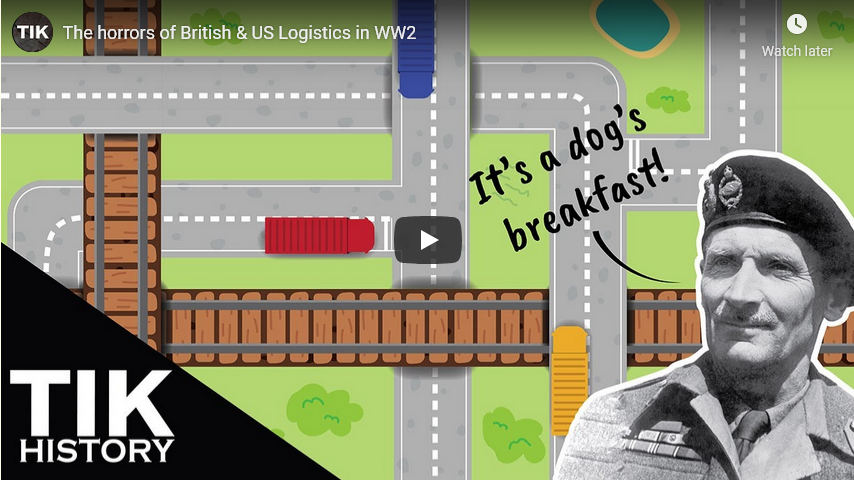
The horrors of British & US Logistics in WW2
TIK
Published 15 Mar 2021The Allies may have had a lot of resources, manpower and industry, but that didn’t mean that their logistics weren’t inefficient or a disorganized mess. Today, we’re going to look at how the British railways were disaster during WW2, how the Americans ran out of fuel on the way to Germany, and why Montgomery called the planning for the invasion of Sicily a “dog’s breakfast”.
⏲️ Videos EVERY Monday at 5pm GMT (depending on season, check for British Summer Time).
The thumbnail for this video was created by Terri Young. Need graphics? Check out her website here https://www.terriyoungdesigns.co.uk/
– – – – –
📚 BIBLIOGRAPHY / SOURCES 📚
Dunn, W. The Soviet Economy and the Red Army, 1930-1945. Praeger Publishers, 1995.
Garvey, J. Operation Husky: The Untold Story of the logistics of the Sicily Invasion. Farm Publications, Kindle 2019.
Hazlitt, H. Economics in One Lesson: The Shortest & Surest Way to Understand Basic Economics. Three Rivers Press, 1979.
MacDonald, J. Supplying the British Army in the Second World War. Pen & Sword Military, Kindle 2020.
Molony, C. The Mediterranean and Middle East, Volume V, The Campaign in Sicily 1943 and The Campaign in Italy 3rd September 1943 to 31st March 1944. The Naval & Military Press LTD 2004, first published in 1973.
Wolmar, C. Fire & Steam: How the Railways Transformed Britain. Atlantic Books, Kindle 2007.British Government, Railways Act 1921, https://www.legislation.gov.uk/ukpga/…
Full list of all my sources https://docs.google.com/spreadsheets/…
– – – – –
⭐ SUPPORT TIK ⭐
This video isn’t sponsored. My income comes purely from my Patreons and SubscribeStars, and from YouTube ad revenue. So, if you’d like to support this channel and make these videos possible, please consider becoming a Patreon or SubscribeStar. All supporters who pledge $1 or more will have their names listed in the videos. For $5 or more you can ask questions which I will answer in future Q&A videos (note: I’m behind with the Q&A’s right now, and have a lot of research to do to catch up, so there will be a delay in answering questions). There are higher tiers too with additional perks, so check out the links below for more details.
https://www.patreon.com/TIKhistory
https://www.subscribestar.com/tikhistoryThank you to my current supporters! You’re AWESOME!
– – – – –
ABOUT TIK 📝
History isn’t as boring as some people think, and my goal is to get people talking about it. I also want to dispel the myths and distortions that ruin our perception of the past by asking a simple question – “But is this really the case?”. I have a 2:1 Degree in History and a passion for early 20th Century conflicts (mainly WW2). I’m therefore approaching this like I would an academic essay. Lots of sources, quotes, references and so on. Only the truth will do.
This video is discussing events or concepts that are academic, educational and historical in nature. This video is for informational purposes and was created so we may better understand the past and learn from the mistakes others have made.
January 13, 2021
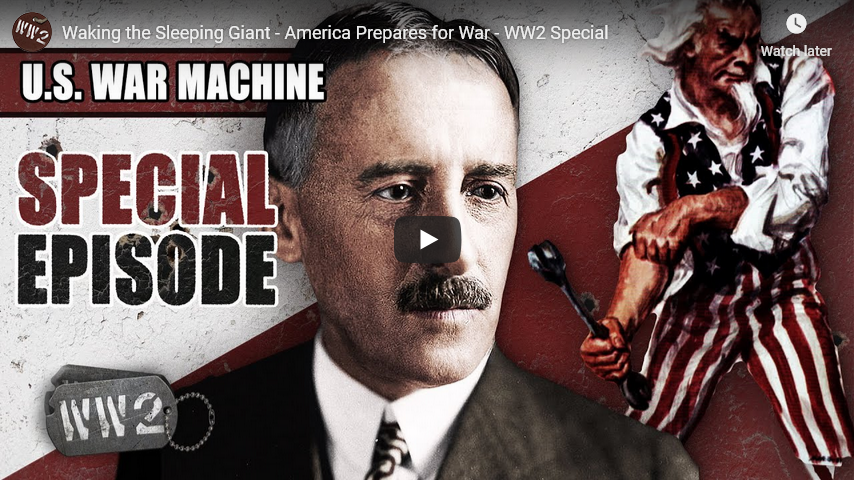
Waking the Sleeping Giant – America Prepares for War – WW2 Special
World War Two
Published 12 Jan 2021As the United States enters World War Two, a huge industrial giant awakens from hibernation. This episode covers industrial mobilization plans, their execution, and their potential.
Join us on Patreon: https://www.patreon.com/TimeGhostHistory
Or join The TimeGhost Army directly at: https://timeghost.tvFollow WW2 day by day on Instagram @ww2_day_by_day – https://www.instagram.com/ww2_day_by_day
Between 2 Wars: https://www.youtube.com/playlist?list…
Source list: http://bit.ly/WW2sourcesHosted by: Indy Neidell
Written by: Joram Appel
Director: Astrid Deinhard
Producers: Astrid Deinhard and Spartacus Olsson
Executive Producers: Astrid Deinhard, Indy Neidell, Spartacus Olsson, Bodo Rittenauer
Creative Producer: Maria Kyhle
Post-Production Director: Wieke Kapteijns
Research by: Joram Appel
Edited by: Karolina Dołęga
Sound design: Marek Kamiński
Map animations: Eastory (https://www.youtube.com/c/eastory)Colorizations by:
Dememorabilia – https://www.instagram.com/dememorabilia/
Norman Stewart – https://oldtimesincolor.blogspot.com/Sources:
– Library of Congress
– National Archives NARA
– Picture of the first class of the Army Industrial College from National Defense University
– FDR Presidential Library & Museum
– Icons from the Noun Project: Artillery by Creative Mania, Douglas SBD Dauntless by Lluisa Iborra, Man by Milinda Courey, Factory Workers by Gan Khoon Lay, Soldier by Wonmo Kang, Old Car by Andri Graphic, progress 20% & 40% by Roberto Chiaveri.Soundtracks from Epidemic Sound:
– “The Inspector 4” – Johannes Bornlöf
– “London” – Howard Harper-Barnes
– “Break Free” – Fabien Tell
– “Last Point of Safe Return” – Fabien Tell
– “Force Matrix” – Jon BjorkArchive by Screenocean/Reuters https://www.screenocean.com.
A TimeGhost chronological documentary produced by OnLion Entertainment GmbH.
QotD: Bureaucracy as a filter
But imagine it takes the doctor an hour of painful phone calls to even get the right person from the insurance company on the line. Now there’s a cost involved. If your patient is going to die without the medication, you’ll probably groan and start making the phone calls. But if your patient doesn’t really need it, and you just wanted to approve it in order to be nice, now you might start having a heartfelt talk with your patient about the importance of trying less expensive medications before jumping right to the $10,000 one.
Organizations have a legal incentive not to deny people things, because the people involved can sue them. But they have an economic incentive not to say yes to every request they get. Seeing how much time and exasperation people are willing to put up with in order to get what they want is an elegant way of separating out the needy from the greedy if every other option is closed to you.
This story makes sense and would help explain why bureaucracy gets so bad, but I’m not sure it really fits the evidence. People complain a lot about bureaucracy in places like the Department of Motor Vehicles, but the DMV doesn’t lose anything by giving you a drivers license and isn’t interested in separating out people who really want licenses from people who only want them a little. If the DMV can be as bureaucratic as it is without any conspiratorial explanation, maybe everything is as bureaucratic as it is without any conspiratorial explanation.
Scott Alexander, “Bureaucracy as Active Ingredient”, Slate Star Codex, 2018-08-31.
December 14, 2020
QotD: Goodhart’s law
Any observed statistical regularity will tend to collapse once pressure is placed upon it for control purposes.
Or as it has been reformulated:
Goodhart’s law is an adage named after economist Charles Goodhart, which has been phrased by Marilyn Strathern as: “When a measure becomes a target, it ceases to be a good measure.” One way in which this can occur is individuals trying to anticipate the effect of a policy and then taking actions which alter its outcome.
Set a target for tonnes of shoes and you get one tonne shoes. Set a target for 100 shoes and you get 100 left feet. Set a target for being on time and people fiddle their definition of time.
It is, by the way, entirely fine to insist that airlines play fair with telling us how long a flight will take. You said it will take 4 hours, then 4 hours should be about the time it takes. Yes, sure, we understand, airports, crowded places. Idiot passengers forget to board, luggage must be taken off. Winds vary, thunderstorms happen, French air traffic controllers actually turn up to work today, their one day in seven. Sure, there’re lots of variables. But if you say it’s about four hours then it should be about four hours. Great.
But to complain that they pad their number a bit is ludicrous. We’re holding their feet to the fire, insisting that an underestimate will lead to financial costs. Thus, obviously, they will overestimate. That’s not really even Goodhart’s Law, that’s just human beings. But then, as we know, those who would plan everything don’t deal well with the existence of people, do they?
Tim Worstall, “Goodhart’s Law Applies To Economies, To Everything – Why Not Scheduled Airline Flight Times?”, Continental Telegraph, 2018-08-27.
November 12, 2020
QotD: It’s impossible to plan the economy
Government is so ill-equipped to judge the future that it sold €6 billion’s worth of property off for £1.6 billion – that’s what we need to be true for that £4.5 billion loss, no? This is not a world in which we can trust government to plan our economy, is it?
And which government exists in reality? Well, the complaint is that second. And the people complaining are largely those who insist that we should act as if we’ve government of the first type. No, they don’t note the discord in that logic either. Governments aren’t very good at economic decisions therefore governments must make more economic decisions for us all. If you can manage to believe that you too can join the Labour Party.
Tim Worstall, “That Ministry Of Defence Housing Deal Proves It’s Impossible To Plan The Economy”, Continental Telegraph, 2018-07-13.
October 7, 2020
QotD: The gullible generation
For Americans, it meant looking for protection by a political regime so grossly and criminally corrupt that future historians will shake their heads, wondering how an entire people could be such suckers. “The Greatest Generation”, that miserable collectivist mouthpiece Tom Brokaw has called them. Looking back over what my father told me of his life, how his family suffered in the government-caused Great Depression, how he and his comrades risked unspeakable danger in the war, and how he became a prisoner in Germany — all to aggrandize the virtual godhood of Franklin Delano Roosevelt — I call them “The Gullible Generation”.
On the other hand, people loved the Roosevelt Administration so much that they passed a Constitutional amendment to make sure that no sonofabitch could ever be elected to more than two Presidential terms again.
World War II gave government complete, dictatorial control of American society, control of industry, control of communications, control of the economy, control that Roosevelt had desperately lusted after before the war, but failed to achieve. If anyone objected, or insisted on his rights under the Constitution, all the other side had to say was, “Don’t you know there’s a war on?”
The government enjoyed that level of control. Once the war was won, and people looked forward to a period of peace, the government plunged us into the Korean War, Vietnam, and an increasing number of undeclared and stupid conflicts in order to retain its power. “Don’t you know there’s a war on?” never worked quite as well as it had to shut dissenters up, but it’s clear that this scam will go on and on and on until something drastic is done to stop it.
L. Neil Smith, “The Deep State”, Libertarian Enterprise, 2019-04-14.
August 10, 2020
FDR’s “New Deal” and the Great Depression
The Great Depression began with the collapse of the stock market in 1929 and was made worse by the frantic attempts of President Hoover to fix the problem. Despite the commonly asserted gibe that Hoover tried laissez faire methods to address the economic crisis, he was a dyed-in-the-wool progressive and a life-long control freak (the Smoot-Hawley Tariff Act which devasted world trade was passed in 1930). Franklin D. Roosevelt won the 1932 election by promising to undo Hoover’s economic interventions, yet once in office he turned out to be even more of a control freak than Hoover. His economic and political plans made Hoover’s efforts seem merely a pale shadow.
For newcomers to this issue, “New Deal” is the term used to describe the various policies to expand the size and scope of the federal government adopted by President Franklin Delano Roosevelt (a.k.a., FDR) during the 1930s.
And I’ve previously cited many experts to show that his policies undermined prosperity. Indeed, one of my main complaints is that he doubled down on many of the bad policies adopted by his predecessor, Herbert Hoover.
Let’s revisit the issue today by seeing what some other scholars have written about the New Deal. Let’s start with some analysis from Robert Higgs, a highly regarded economic historian.
… as many observers claimed at the time, the New Deal did prolong the depression. … FDR and Congress, especially during the congressional sessions of 1933 and 1935, embraced interventionist policies on a wide front. With its bewildering, incoherent mass of new expenditures, taxes, subsidies, regulations, and direct government participation in productive activities, the New Deal created so much confusion, fear, uncertainty, and hostility among businessmen and investors that private investment, and hence overall private economic activity, never recovered enough to restore the high levels of production and employment enjoyed in the 1920s. … the American economy between 1930 and 1940 failed to add anything to its capital stock: net private investment for that eleven-year period totaled minus $3.1 billion. Without capital accumulation, no economy can grow. … If demagoguery were a powerful means of creating prosperity, then FDR might have lifted the country out of the depression in short order. But in 1939, ten years after its onset and six years after the commencement of the New Deal, 9.5 million persons, or 17.2 percent of the labor force, remained officially unemployed.
Writing for the American Institute for Economic Research, Professor Vincent Geloso also finds that FDR’s New Deal hurt rather than helped.
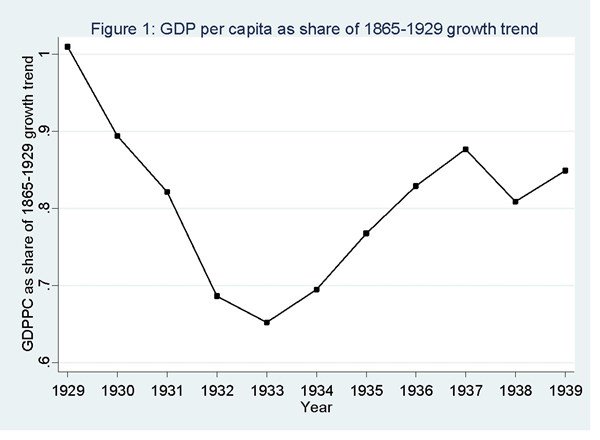
… let us state clearly what is at stake: did the New Deal halt the slump or did it prolong the Great Depression? … The issue that macroeconomists tend to consider is whether the rebound was fast enough to return to the trendline. … The … figure below shows the observed GDP per capita between 1929 and 1939 expressed as the ratio of what GDP per capita would have been like had it continued at the trend of growth between 1865 and 1929. On that graph, a ratio of 1 implies that actual GDP is equal to what the trend line predicts. … As can be seen, by 1939, the United States was nowhere near the trendline. … Most of the economic historians who have written on the topic agree that the recovery was weak by all standards and paled in comparison with what was observed elsewhere. … there is also a wide level of agreement that other policies lengthened the depression. The one to receive the most flak from economic historians is the National Industrial Recovery Act (NIRA). … In essence, it constituted a piece of legislation that encouraged cartelization. By definition, this would reduce output and increase prices. As such, it is often accused of having delayed recovery. … other sets of policies (such as the Agricultural Adjustment Act, the National Labor Relations Act and the National Industrial Recovery Act) … were very probably counterproductive.
Here’s one of the charts from his article, which shows that the economy never recovered lost output during the 1930s.
August 6, 2020
Congress legislating on high tech is like your Grampa telling you how to play your favourite online game
Brad Polumbo on the notion that the politicians in Washington (or Ottawa, or London, or Canberra, …) are in any way capable of sensibly regulating the high tech sector:

While many principled small-government conservatives, such as Sen. Rand Paul, still back a free-market approach to tech policy issues, Hawley is not an outlier by any means.
Indeed, President Trump has also backed the regulation of social media companies to combat perceived anti-conservative bias. And the most popular conservative media personality in the country, Fox News host Tucker Carlson, regularly rails against Big Tech — even agreeing with progressive proposals to use the heavy hand of government antitrust regulation to break up companies such as Facebook and Google.
So, if major figures from both parties can agree on regulating Big Tech, it must be a good idea, right? Not so fast.
From left to right, the intentions behind these regulatory proposals are often good. After all, most reasonable people would likely share Democrats’ desire to see Big Tech better handle misinformation, “fake news,” and foreign election interference, while conservative Republicans’ calls for political neutrality online are no doubt appealing in the abstract.
Unfortunately, in their haphazard rush to score political points through government action, would-be regulators from both parties are forgetting the inevitable “knowledge problem” that plagues any central planners who try to dictate the minutiae of complicated industries from the halls of Washington, DC.
Economic philosopher Friedrich A. Hayek diagnosed this fatal flaw of government control in his seminal work “The Use of Knowledge in Society.”
“If we can agree that the economic problem of society is mainly one of rapid adaptation to changes in the particular circumstances of time and place,” Hayek wrote. “It would seem to follow that the ultimate decisions must be left to the people who are familiar with these circumstances, who know directly of the relevant changes and of the resources immediately available to meet them.”
“We cannot expect that this problem will be solved by first communicating all this knowledge to a central board which, after integrating all knowledge, issues its orders,” he continued. “We must solve it by some form of decentralization. But this answers only part of our problem. We need decentralization because only thus can we insure that the knowledge of the particular circumstances of time and place will be promptly used.“
August 4, 2020
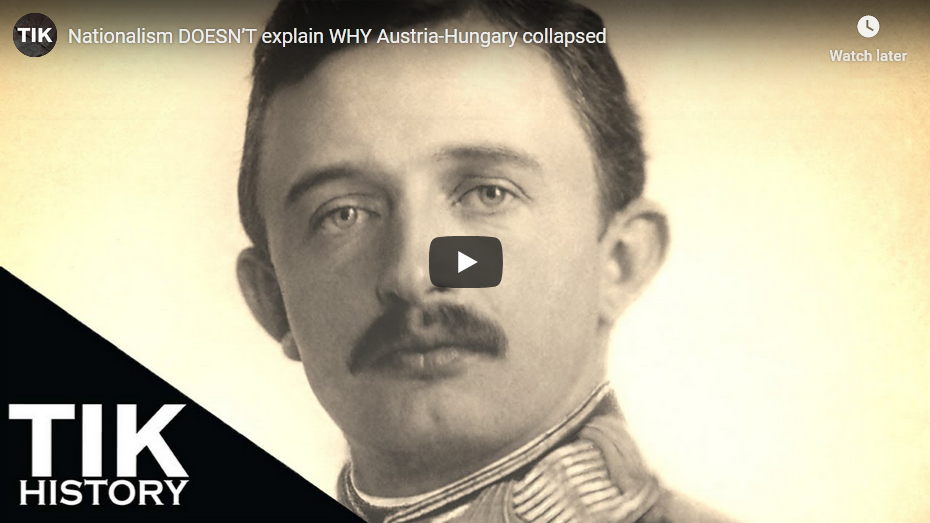
Nationalism DOESN’T explain WHY Austria-Hungary collapsed
TIK
Published 3 Aug 2020The go-to answer is that national or ethnic divisions caused the collapse of the Austro-Hungarian Empire. But is this really the case? Using multiple sources, it’s time to provide YouTube with a narrative which doesn’t confirm nationalist beliefs. The Habsburgs survived the collapse, with Emperor Karl / Charles trying to reclaim his throne later on before being exiled. However, by about mid-November 1918, he had lost all power. The fact that there is no specific date when Austria-Hungary collapsed, and the fact that the “national revolutions” were met with relatively little opposition, speaks volumes. As does the fact that the new states were all multinational, which undermines the narrative that nationalism was the reason why Austria-Hungary collapsed. Leave your thoughts in the comments below.
⏲️ Videos EVERY Monday at 5pm GMT (depending on season, check for British Summer Time).
– – – – –
📚 BIBLIOGRAPHY / SOURCES 📚
Judson, P. The Habsburg Empire: A New History. Belknap Press, Kindle 2016.
Kiste, J. The End of the Habsburgs: The Decline and Fall of the Austrian Monarchy. Kindle 2019.
Macgregor, J. & Docherty, G. Prolonging the Agony: How the Anglo-American Establishment Deliberately Extended WW1 by Three-and-a-Half Years. Trine Day LLC, 2018.
Marx, K. Capital: A Critique of Political Economy: Volume III. PDF, English edition, 2010. (Originally written 1894)
Mises, L. Socialism: An Economic and Sociological Analysis. Liberty Fund, 1981. 1969 edition (roots back to 1922).
Oxford Dictionary of English, Oxford University Press, Third Edition 2010.
Rady, M. The Habsburgs: The Rise and Fall of a World Power. Perseus Books, Kindle 2020.
Watson, A. Ring of Steel: Germany and Austria-Hungary at War, 1914-1918. Penguin Books, 2015.Cornwall, M. “Propaganda at Home (Austria-Hungary).” 1919. https://encyclopedia.1914-1918-online….
Online Latin-Dictionary http://www.latin-dictionary.net/defin…
Online Etymology Dictionary https://www.etymonline.com/word/publicFull list of all my sources – https://docs.google.com/spreadsheets/…
– – – – –
⭐ SUPPORT TIK ⭐
Want to ask a question? Please consider supporting me on either Patreon or SubscribeStar and help make more videos like this possible. For $5 or more you can ask questions which I will answer in future Q&A videos. Thank you to my current Patrons! You’re AWESOME! https://www.patreon.com/TIKhistory or https://www.subscribestar.com/tikhistory
– – – – –
ABOUT TIK 📝
History isn’t as boring as some people think, and my goal is to get people talking about it. I also want to dispel the myths and distortions that ruin our perception of the past by asking a simple question – “But is this really the case?” I have a 2:1 Degree in History and a passion for early 20th Century conflicts (mainly WW2). I’m therefore approaching this like I would an academic essay. Lots of sources, quotes, references and so on. Only the truth will do.
This video is discussing events or concepts that are academic, educational and historical in nature. This video is for informational purposes and was created so we may better understand the past and learn from the mistakes others have made.