Quotulatiousness

November 25, 2021

Are there any actual First Nations people on government commissions, or are they all Pretendians?

Filed under: Books, Cancon — Tags: , , , , , — Nicholas @ 03:00

There are few enough opportunities for First Nations people in Canada to be heard and for their efforts to matter on issues of concern to all First Nations people … so why do so many of those positions seem to be held by people who lie about their First Nations ancestry? (The original CBC story is from back in September, but I only found out about it today, with my usual great sense of timing.)

“Book burning” by pcorreia is licensed under CC BY 2.0

Suzy Kies, the co-chair of the Indigenous peoples’ commission of the Liberal Party, has resigned from the position after her claim to Indigenous ancestry was called into question.

Radio-Canada reported on Wednesday that it could not confirm Kies’s claims to Indigenous ancestry. Kies told Radio-Canada in an interview that her father is of European descent and her mother is of Indigenous descent.

“My mother’s family is from several communities,” she told Radio-Canada in an interview in French. “On my grandfather’s side, it’s the Maliseet, from St. Mary’s, New Brunswick, there are also the Laporte who are Innu. And my grandmother was Abenaki from Odanak.”

In Radio-Canada’s reporting, they consulted civil status records and the Abenaki Council of Odanak, who did not find Kies on the band list.

The story came following controversy over a book-burning project at a francophone Ontario school board in which Kies was involved. The event, which was carried out by the Conseil scolaire catholique Providence in 2019, has resurfaced during the election campaign and has attracted condemnation by federal leaders.

The event was meant to promote reconciliation by burning and disposing of books the school board deemed to contain outdated and inappropriate depictions of Indigenous people. The books included novels, comic books and encyclopedias, according to a documentary obtained by Radio-Canada. Nearly 5,000 books were disposed of, but only around 30 were burned.

H/T to halls of macadamia for the link.

Update: A disturbing number of white American college applicants are lying about their racial ancestry to (significantly) improve their chances of being accepted, so I guess Canadian Pretendians are just slightly ahead of the curve:

The survey of 1,250 white college applicants ages 16 and older found that the most popular racial claim was Native American. Out of the 34 percent of white college applicants who lied about their race, 77 percent were accepted.

“It’s the easiest lie to tell because you can’t get caught in it,” said Vijay Jojo Chokal-Ingam, an admissions consultant at SOSAdmissions.com and author of Almost Black: The True Story of How I Got Into Medical School By Pretending to Be Black.

“A lot of people, based on very flimsy reasons, claim to be either African-American, Hispanic or Native American because they know it’s going to improve their chances,” Chokal-Ingam said in an interview with The College Fix.

Though lying on college applications is frowned upon, universities typically do not push back on students about their race. Instead, they accept it regardless of what they look like, he said.

“It’s become a joke,” Chokal-Ingam said.

He cited Senator Elizabeth Warren, who famously “lied about her race to get a faculty position at Harvard.”

“If there was a degree to which people felt guilt about doing that, it died with Warren because the Boston Globe, the New York Times, the Washington Post — they all ran to her defense,” he said. “This prompted an ‘if she can do it, I can do it too’ ideology.”

“When President Trump called Senator Elizabeth Warren ‘Pocahontas’, [the media] called him a racist. They said it was a racist thing. On the contrary, I think that he was bringing to attention a very important issue in the field of racial-race relations,” Chokal-Ingam said. “He was making people aware of the fact that people routinely, on a massive scale, lie about their race.”

H/T to Glenn “Instapundit” Reynolds, who pointed out, “If white supremacy were actually a thing, this wouldn’t be happening”.

QotD: Corporate coercion can be just as dangerous as state coercion

So many libertarians […] have a simplistic, dare I say dualistic notion about bad-things-done-by-private-business and bad-things-done-by-the-state. One is met with “so start up a rival company” the other with “an outrageous example of state overreach that must be opposed politically.”

And in an ideal world, yes, that makes sense. We do not live in anything resembling an ideal world.

In an era when three (two really) credit card companies and a handful of payment processors have an off-switch for pretty much any on-line business they take a dislike to (unless they are called Apple or Amazon), as more and more of the economy goes virtual, what we have is turn-key tyranny for sale to the highest bidder, and the highest bidder is always going to be a state. I am uncertain what the solution is, but as we do not live in a “free market”, not convinced “so go set up your own global credit card and payment processing network” adds anything meaningful to the discussion. It is a bit like saying when the local electric provider turns off the power in your office (or home) because they disapprove of what you are doing “so go set up your own electric supply company”, as if that would be allowed to happen.

Perry de Havilland, “This is what so many libertarians cannot understand …”, Samizdata, 2021-08-22.

November 15, 2021

QotD: Britain at war

England is the most class-ridden country under the sun. It is a land of snobbery and privilege, ruled largely by the old and silly. But in any calculation about it one has got to take into account its emotional unity, the tendency of nearly all its inhabitants to feel alike and act together in moments of supreme crisis. It is the only great country in Europe that is not obliged to drive hundreds of thousands of its nationals into exile or the concentration camp. At this moment, after a year of war, newspapers and pamphlets abusing the Government, praising the enemy and clamouring for surrender are being sold on the streets, almost without interference. And this is less from a respect for freedom of speech than from a simple perception that these things don’t matter. It is safe to let a paper like Peace News be sold, because it is certain that ninety-five per cent of the population will never want to read it. The nation is bound together by an invisible chain. At any normal time the ruling class will rob, mismanage, sabotage, lead us into the muck; but let popular opinion really make itself heard, let them get a tug from below that they cannot avoid feeling, and it is difficult for them not to respond. The left-wing writers who denounce the whole of the ruling class as “pro-Fascist” are grossly over-simplifying. Even among the inner clique of politicians who brought us to our present pass, it is doubtful whether there were any conscious traitors. The corruption that happens in England is seldom of that kind. Nearly always it is more in the nature of self-deception, of the right hand not knowing what the left hand doeth. And being unconscious, it is limited. One sees this at its most obvious in the English Press. Is the English press honest or dishonest? At normal times it is deeply dishonest. All the papers that matter live off their advertisements, and the advertisers exercise an indirect censorship over news. Yet I do not suppose there is one paper in England that can be straightforwardly bribed with hard cash. In the France of the Third Republic all but a very few of the newspapers could notoriously be bought over the counter like so many pounds of cheese. Public life in England has never been openly scandalous. It has not reached the pitch of disintegration at which humbug can be dropped.

George Orwell, “The Lion And The Unicorn: Socialism and the English Genius”, 1941-02-19.

October 5, 2021

Chris Alexander – “The truth is that ‘normal’ in the People’s Republic of China, at least since 1959, has never included the rule of law”

Filed under: Cancon, China, Government — Tags: , , , , , , — Nicholas @ 05:00

Writing in The Line, Chris Alexander (former Minister of Citizenship and Immigration) explains why attempts to “return to normal” in Canada’s relationship with mainland China are foredoomed to failure:

Yuen Pau Woo was joined in these arguments by senators Peter Boehm and Peter Harder, both seasoned diplomats, who also urged Canada to suspend its judgement with regard to China’s persecution of the Uighurs. This includes the use of concentration camps and forced labour, as well as the repression of language, culture and religion. These are all blatant acts committed with the “intent to destroy, in whole or in part, a national, ethnical, racial or religious group”, as the 1951 Genocide Convention defines this “odious scourge”.

Throughout this unfortunate saga, Beijing has had a Greek chorus of supporters across Canada — mostly from people with well-remunerated corporate or political backgrounds — for the preposterous notion of a “prisoner exchange” that would get relations with China back to “normal”.

In the end, the Senate’s genocide motion failed by a vote of 29 in favour to 33 opposed, with 13 abstentions. China’s Foreign Ministry praised Woo, Boehm and Harder as “people of vision” who had seen through the “despicable schemes of a few anti-China forces”. The “clumsy trick of attacking China for selfish political gains” and “the hype of ‘genocide’ in Xinjiang is unpopular and doomed to fail”, the Foreign Ministry spokesperson crowed.

Had Woo, a former president and CEO of the Asia Pacific Foundation of Canada, and the “two Peters”, both former deputy ministers of foreign affairs, voted in favour, the Senate’s genocide motion would have passed. Instead all three chose, on an issue directly threatening the identity and lives of millions, to take the position of the Communist Party of China over one unanimously endorsed by Canada’s elected House of Commons — all in the empty hope of getting back to “normal” with Beijing.

The truth is that “normal” in the People’s Republic of China, at least since 1959, has never included the rule of law. From China’s ferocious and brutal invasion of Tibet that same year, through the murderous Great Leap Forward ending in 1962, to the decade-long Cultural Revolution up to Mao’s death in 1976 (and beyond), China has been a legal void. Serious judicial reforms never featured in Deng Xiaoping’s economic relaunch. On the contrary, basic rights were decimated, as Tibetan, Mongolian, Uighur and other refugees attest.

According to Freedom House, the current General Secretary of the Chinese Communist Party Xi Jinping’s relentless push for all-encompassing surveillance and censorship has made China the worst environment in the world for internet freedom for the seventh year running. Compliance with such global gag orders is enforced by the CCP’s Orwellian digital panopticon, the notorious United Front Work Department, which seeks to browbeat, buy, corrupt, blackmail, extort or otherwise leverage people and firms with connections to China in support of Xi’s agenda.

Thanks to United Front subterfuge, some prominent Canadians still take China’s side, even as Beijing’s favourability score in Canadian public opinion plummeted to 14 per cent, mirroring a worldwide nosedive for China’s image driven by the two Michaels’ ordeal and Beijing’s “wolf warrior” belligerence.

August 9, 2021

The modern-day threat of being made an “unperson” is real and very dangerous

Sean Gabb explains why even libertarians need to consider the non-state power in the hands of corporations that can — and does — force people out of their jobs, their homes, and even deprive them of the ability to communicate or to access financial services merely for expressing unpopular opinions. As I said in a different venue, it’s a short step from “no fly lists” to “no eat lists”, especially when the enforcing entity is a nominally private organization:

John Stuart Mill (1806-1873)

The old pressures to conform were wrong. So are the new. And they are wrong simply because they are pressures to conform. I find myself at last appreciating a part of Mill’s essay On Liberty for which I never used to have much time. Until recently, I would insist that the only real oppression was by the State: all else was the working of private choice. If the authorities fined a man £5 for having sex with another man, that was outrageous tyranny. If his tastes became public knowledge, and he was unable to find work, that was merely unfortunate. This is, I still believe, essentially true. Indeed, I could argue that, without a State having centralised and corporatised powers of discrimination that ought to be widely distributed, there would be no problem — or there would be a problem that was bearable. But these powers were centralised and corporatised a long time ago. They are now being used to achieve a uniformity of opinion outside the home in which the formal organs of compulsion have no obvious part. This is not the “tyranny of the majority” that worried Mill. I find it inconceivable that anything close to a majority could believe the insane drivel pouring from the regime media. Neither, though, is it the kind of oppression against which liberal bills of rights have traditionally been written. Because of this —

    when society is itself the tyrant …, its means of tyrannising are not restricted to the acts which it may do by the hands of its political functionaries. Society can and does execute its own mandates: and if it issues wrong mandates instead of right, or any mandates at all in things with which it ought not to meddle, it practises a social tyranny more formidable than many kinds of political oppression, since, though not usually upheld by such extreme penalties, it leaves fewer means of escape, penetrating much more deeply into the details of life, and enslaving the soul itself. Protection, therefore, against the tyranny of the magistrate is not enough: there needs protection also against the tyranny of the prevailing opinion and feeling; against the tendency of society to impose, by other means than civil penalties, its own ideas and practices as rules of conduct on those who dissent from them …

    (J.S. Mill On Liberty, 1859, “Introductory“)

We need protection indeed. But the protection we need is not yet another law telling the police to leave dissidents alone. We already have a stack of these, and they are protections against a threat that largely does not exist. The answer, I suggest, is an amendment to the anti-discrimination laws to outlaw discrimination on the grounds of what may be loosely called political opinion.

I say hardly anyone read my original essay. Sadly, most of those who did read it stand in the more wooden reaches of the libertarian movement, and these set up a cry that I had become a Communist. I was suggesting that private organisations should be coerced in their choices of whom and whom not to employ, and even in their choices of customer and supplier. I had abandoned the non-aggression principle. Here, briefly expressed, is my answer to these claims.

I run the Centre for Ancient Studies. This provides a range of tuition services in Greek and Latin. It is a sole tradership. As such, I reserve the unconditional right to decide what services I offer and to whom. If I dislike the colour of your face, or the status of your foreskin, or your tastes in love, or anything else that I may think relevant, it should be my right not to do business with you. It may be that only a fool turns away customers with money to spend, and I am not that sort of a fool. Even so, I do claim at least the theoretical right, and I ground it on my right to do as I please with my own. But I claim these rights as a human individual. A limited company is not a human individual. Whatever entrepreneurship may exist in them, these companies are artificial persons and creatures of the State. Their owners have the privilege of limited liability. That is, they have the right, in the event of insolvency, not to pay the debts of a company if these are greater than the assets of the company. If this were not a valuable right, there would not be so many limited companies. There are almost no large companies, and none lasting more than a single generation, that do not have limited liability.

This being so, limited companies benefit from a grant of privilege from the State, and are legitimate subjects of regulation by the State for as long as they are receipt of this privilege. No doubt, some forms of state regulation are bad in their objects, or bad as regards the means to their objects. But regulation is not in itself an aggression by the State. It follows that, whether or not we can get it, libertarians should not feel barred from demanding laws to prevent limited companies from discriminating against their employees on the grounds of political opinion, and to require them to do business with customers and suppliers regardless of political opinion.

I appreciate that I am asking for more than the regulation of limited companies. The anti-discrimination laws we have make no distinction between incorporated and unincorporated associations. Even so, the extension of these laws to cover political opinion would mainly affect only the larger limited companies. At the same time, there is an obvious and overriding public interest in the protection of political opinion. People are now scared to speak their minds. Whether intended or just revealed, this is part of the strategy. The reason why the collapse of both freedom and tradition is gathering pace is because no one dares stand up and protest. In the absence of protest, everything will carry on as it is. Given a restored right of protest, there is a chance of stopping the collapse. The only way to lift the blanket of fear that now lies over all but approved opinion is somehow or other to get a law making it clear that no one who speaks his mind can be loaded with shadow punishments.

“Somehow or other!” In a sense, I am making a fool of myself. I am asking the politicians to make a law against what they themselves may not be doing, but that has no effect on their main reason for being in politics, which is to fill their pockets. I am asking them to take on the entire mass of the non-elected Establishment. I am asking a lot of these people. On the other hand, the politicians still need to be elected, and that was the weak point in the Establishment’s plan to stay in the European Union. We had to spend four years voting and revoting, but we did eventually get what we wanted. It is conceivable that, if enough of us call loudly enough for protection, some kind of protection will be granted.

Short of that, we are lost.

July 25, 2021

The plight of the Uyghurs in China

Filed under: China, Government, Religion — Tags: , , , , — Nicholas @ 03:00

In this week’s excerpt from his full Weekly Dish, Andrew Sullivan considers the Chinese government’s ongoing suppression of the Uyghur minority:

There’s a story in a recent Atlantic memoir by a Uyghur refugee that lingers in the mind. The Chinese authorities in Xinjiang Province now regard the possession of any religious literature, including the Koran, as prima facie evidence of terroristic activities. Terrified Uyghurs in Urumqi, the regional capital, have learned these past few years to quickly dispose of any such items — some throwing out books into the streets overnight so they could not be traced to their households. But one old man in his seventies forgot about a Koran he had possessed, and, coming upon it late, was too scared to hand it over, so threw it into a river. Alas,

    the authorities had installed wire mesh under all bridges, and when the mesh was cleaned, the Quran was found and turned over to the police. When officers opened it, they found a copy of the old man’s ID card: In Xinjiang, the elderly have a habit of keeping important documents in frequently read books, so that they are easily found when needed. The police tracked down the old man and detained him on charges of engaging in illegal religious activities. He was sentenced to seven years in prison.

The “prisons” this elderly, devout Muslim was shipped off to now have a capacity of around one million people. They have been built at breakneck speed. Buzzfeed News has found “more than 260 structures built since 2017 and bearing the hallmarks of fortified detention compounds.” The more recent building suggests they are going to become permanent parts of a bid to wipe Uyghur culture from the face of the earth.

The Atlantic story helps you understand how eerily reminiscent this campaign is to the early Nazi-era treatment of Jews, all the way down to the initial disbelief that the genocidal campaign was beginning, to the slow creeping oppression, the sudden new checkpoints and security procedures, the separation of Han and Uyghurs, knocks on the door at night, the attempts of some to escape without detection, and the sudden disappearances of friends, relatives, co-workers — never to be heard of again.

We cannot know for sure what happens inside the camps, but reports from survivors include torture, starvation, force-feeding, solitary confinement, and brainwashing. And in some ways, the entire region is now an open-air prison: security cameras are everywhere, the imprisoned are pressured to incriminate others, police go house to house searching for illicit materials, mosques and neighborhoods are razed, Uyghur language is banned, phones monitored, face recognition technology is ubiquitous. Family members, waiting for their turn to be arrested, leave notes like this one from a husband to his wife:

    If they arrest me, don’t lose yourself. Don’t make inquiries about me, don’t go looking for help, don’t spend money trying to get me out. This time isn’t like any time before. They are planning something dark. There is no notifying families or inquiring at police stations this time … I’m not afraid of prison. I am afraid of you and the girls struggling and hurting when I’m gone. So I want you to remember what I’m saying.

It’s important to note that the concentration camps for Muslims in China are not extermination camps. (At least not yet. “They are planning something dark” is not a sentence one ever wants to read.) But it is the greatest, systematic detention of a religious minority since the Second World War, championed by a newly emerged dictator-for-life, Chinese President Xi. And it is not going to stop any time soon.

July 23, 2021

Panic is infectious, and the dying media are a primary vector

In City Journal, John Tierney looks at the two lethal waves of contagion the world has suffered since 2019, the Wuhan Coronavirus itself and the media-driven panic that almost certainly resulted in far more deaths than the disease that triggered it:

Wuhan Institute of Virology.
Wikimedia Commons.

Instead of keeping calm and carrying on, the American elite flouted the norms of governance, journalism, academic freedom — and, worst of all, science. They misled the public about the origins of the virus and the true risk that it posed. Ignoring their own carefully prepared plans for a pandemic, they claimed unprecedented powers to impose untested strategies, with terrible collateral damage. As evidence of their mistakes mounted, they stifled debate by vilifying dissenters, censoring criticism, and suppressing scientific research.

If, as seems increasingly plausible, the coronavirus that causes Covid-19 leaked out of a laboratory in Wuhan, it is the costliest blunder ever committed by scientists. Whatever the pandemic’s origin, the response to it is the worst mistake in the history of the public-health profession. We still have no convincing evidence that the lockdowns saved lives, but lots of evidence that they have already cost lives and will prove deadlier in the long run than the virus itself.

One in three people worldwide lost a job or a business during the lockdowns, and half saw their earnings drop, according to a Gallup poll. Children, never at risk from the virus, in many places essentially lost a year of school. The economic and health consequences were felt most acutely among the less affluent in America and in the rest of the world, where the World Bank estimates that more than 100 million have been pushed into extreme poverty.

The leaders responsible for these disasters continue to pretend that their policies worked and assume that they can keep fooling the public. They’ve promised to deploy these strategies again in the future, and they might even succeed in doing so — unless we begin to understand what went wrong.

The panic was started, as usual, by journalists. As the virus spread early last year, they highlighted the most alarming statistics and the scariest images: the estimates of a fatality rate ten to 50 times higher than the flu, the chaotic scenes at hospitals in Italy and New York City, the predictions that national health-care systems were about to collapse. The full-scale panic was set off by the release in March 2020 of a computer model at the Imperial College in London, which projected that — unless drastic measures were taken — intensive-care units would have 30 Covid patients for every available bed and that America would see 2.2 million deaths by the end of the summer. The British researchers announced that the “only viable strategy” was to impose draconian restrictions on businesses, schools, and social gatherings until a vaccine arrived.

This extraordinary project was swiftly declared the “consensus” among public-health officials, politicians, journalists, and academics. Anthony Fauci, director of the National Institute of Allergy and Infectious Diseases, endorsed it and became the unassailable authority for those purporting to “follow the science”. What had originally been a limited lockdown — “15 days to slow the spread” — became long-term policy across much of the United States and the world. A few scientists and public-health experts objected, noting that an extended lockdown was a novel strategy of unknown effectiveness that had been rejected in previous plans for a pandemic. It was a dangerous experiment being conducted without knowing the answer to the most basic question: Just how lethal is this virus?

The most prominent early critic was John Ioannidis, an epidemiologist at Stanford, who published an essay for STAT headlined “A Fiasco in the Making? As the Coronavirus Pandemic Takes Hold, We Are Making Decisions Without Reliable Data.” While a short-term lockdown made sense, he argued, an extended lockdown could prove worse than the disease, and scientists needed to do more intensive testing to determine the risk. The article offered common-sense advice from one of the world’s most frequently cited authorities on the credibility of medical research, but it provoked a furious backlash on Twitter from scientists and journalists.

July 22, 2021

Conservative cancel culture?

Filed under: Media, Politics, USA — Tags: , , , , , , — Nicholas @ 05:00

Kurt Schlichter addresses the notion that “cancel culture” is alive and well among conservatives as much as it is among progressives:

“A little Black Rifle Coffee pour over this morning.” by jonmrogers is licensed under CC BY 2.0

Is there a conservative cancel culture? No. What there is now is a consensus among conservatives that we will refuse to subsidize institutions and entities that hate us. “Cancel culture,” properly understood – in this time of words meaning whatever they need to mean at any given moment, I’m going to have to insist on fixed definitions – is the attempt to use formal and informal sanctions to stop people from expressing dissenting views. But conservatives don’t care what the conservatives who cry about it when they are caught shafting us – hi Kristi! – think; conservatives care about what these people do or don’t do. Labeling our rejection of squishes and RINOs as “cancel culture” is a cheesy attempt to stop us from insisting that conservatives actually conserve. If the left, and the GOPuffballs, want to call this act of self-preservation “cancel culture” and shame us into unilateral disarmament in the name of some sort of pseudo-consistency, let them try. We’re not tying ourselves up with alleged “principles” anymore; ideological bondage is not our scene.

[…]

There was a certain coffee company created by vets that embraced a kind of vet-bro/gun vibe and it worked hard to cultivate a following in the conservative community. And then they stamped their combat boots hard on their own tender beans. Black Rifle Coffee Company’s problem provides an important lesson not just for companies seeking to operate on the conservative tip, but for GOP politicians as well.

What happened? BRCC gave an interview to The New York Times that many cons saw as taking sides against us conservatives. Did it or didn’t it take sides against us? The company denies it and is trying to repair the damage, but the facts of the case are not the point we are discussing here – the point is how conservatives, the cheated-on wives of American politics, reacted when they felt, rightly or wrongly, betrayed.

The conservatives went nuclear. Here’s the thing a lot of people seem to not understand. No faction has been screwed over by its own side more than conservatives. How many politicians, when they had the power to do the conservative things they ran on, opted for favorable WaPo coverage over keeping their promises? The incentives to cooperate are huge … like coverage in the DC paper of record explaining how one has “grown”. But we’re done with the bait-and-switch. We’re super-sensitive and super-suspicious, because we’ve been burned before.

So, conservatives have a hair trigger for perceived betrayal – if they even suspect it, they go off. Those seeking our support should act accordingly, as cons have been serially betrayed for decades. Take W, please, back to his ranch to paint his paintings. But before you do, remember what he did to all of us who defended him when he refused to defend himself – he talked smack about us as he partied with his new pals the Clintons and Obamas.

The Ahoy Crew used to at least pretend to be with us – Cap’n Bill Kristol, David Aptly-Named French, Jonah Heavy G Goldberg, and the rest turned on us the second they perceived their sinecures were in peril due to our swelling demand for actual victory.

Them or us. Pick one. But you can’t choose both, or neither.

Update: The CEO of the company is either in desperate damage control mode or genuinely upset at the misrepresentation of his views by the New York Times:

Let’s get the air cleared right away. Black Rifle Coffee’s founder and CEO has spoken out and is disputing how his comments were presented by the New York Times and represented by those reacting to the article, who were led to believe that Black Rifle Coffee bashed conservatives.

Evan Hafer decided to set the record straight regarding the “significant amount of misinformation being put out on the internet” about Black Rifle Coffee and about statements that he has made.

Hafer quickly debunked the notion that he made derogatory remarks about BRCC’s customers or conservatives and then proceeded to explain how the New York Times deliberately twisted his words and took them out of context. According to Hafer, his conversation with the NYT Magazine reporter was in the context of racism and anti-Semitism in America in light of Hafer being the target of an organized attack last year because of “my last name and my heritage.”

“We were purely discussing that,” Hafer says, and he was not conflating those groups with conservatives.

“The New York Times, as we know, the chances of them being objective were fairly slim, but we gave them the opportunity,” he added. He went on to mention veterans issues he hoped to bring attention to. But, unfortunately, the New York Times chose to go with “the salacious headline” about the company instead.

Hafer reiterated that racists and anti-Semites have no place in his company.

July 20, 2021

Kurt Westergaard, RIP

Filed under: Europe, Liberty, Media, Religion — Tags: , , , , , , — Nicholas @ 05:00

Mark Steyn on the life and work of cartoonist Kurt Westergaard:

Kurt Westergaard and I were successive winners of the Danish Free Press Society’s Sappho Award. I was very flattered to find myself in his company, but couldn’t honestly say I deserved to be. Kurt was one of the bravest men of our time – not because he was inclined to bravery, but simply because, when it was required, he met the challenge and never backed down.

Sixteen years ago Flemming Rose of the Danish newspaper Jyllands-Posten decided to conduct a thought experiment in public after an author casually revealed that he couldn’t find any Danish artist willing to illustrate his book about “the Prophet Mohammed” (as the BBC now routinely styles him). So Flemming called twelve cartoonists and invited them to depict the late Prophet. Kurt Westergaard’s cartoon was the memorable one, and the one you recall as the years roll by. It was a pithy visual jest: Mohammed’s turban as a bomb with a lit fuse. See picture at top right.

“I attempted to show that terrorists get their spiritual ammunition from parts of Islam, and with this spiritual ammunition, and with dynamite and other explosives, they kill people,” Kurt told my old newspaper The National Post a few years back. “I showed this in a cartoon and what happened? They want to kill me, so I think I was right.”

An otherwise courtly, cultured Dane, Kurt Westergaard had a somewhat arresting dress code, preferring le rouge et le noir, the colors of anarchists, although, as a practical matter, it’s hard for a man of advanced years to carry off red trousers, whatever his motivation. He would qualify his pantaloons by explaining that he was not a political anarchist but a cultural one. Still, one can gather from the garb alone that Westergaard was no “right-winger”. Like most of the men and women I have shared a stage with in Europe this century, he was an old Sixties radical sufficiently principled to think the same kind of jokes he’d applied to church, monarchy, parliament and every other societal institution should also be applied to Islam. He never wanted to be a “free speech hero”, but gamely bore the burthen once it had been dropped on him. He certainly never wanted to be world-famous, albeit more so in Mogadishu than Manhattan and Lahore than Los Angeles. It cost him a comfortable retirement, weakened his health, and an ever more craven culture denied him the consolations of monetary exploitation. When I expressed sympathy, he laughed and said he’d do the same cartoon all over again even knowing what he was in for.

The blood lust began with a trio of imams on the make shopping the twelve cartoons (plus three cruder fakes) round the Muslim world, and leaving it to the usual Islamonutters to take it from there: In nothing flat, over two hundred people were dead – which meant that CNN & Co were obliged to cover the story. They did so by modifying Westergaard’s cartoon, with Mohammed’s face pixilated, as if he’d entered the witness protection programme. If only. In reality, it was that dwindling band of people who believe in free speech – and, indeed, free speech itself – that found itself in the witness protection programme.

Does Facebook have a war on history?

Filed under: History, Media, Politics, USA — Tags: , , , — Nicholas @ 04:00

Study of Antiquity and the Middle Ages
Published 19 Jul 2021

Does Facebook have a war on history? The answer is a simple no but the story is complicated.

In this episode I am joined by author and reporter Peter Suciu on his article “On Facebook, History Can Violate Community Standards”.

To quote the article * One thing that is often taught to students of history is that “history” didn’t happen. Events happened in the past, but history is just our way of chronicling those events. There is also a saying that history is written by the winners, but that too isn’t entirely accurate – if history were only written by the winners we’d never hear of the setbacks, mistakes made by generals or losses incurred by said winners. History, to put it bluntly, is written by historians and those with knowledge of past events.

On Facebook it now seems that merely writing about – and then sharing those writings – could violate community standards. Even in this era of “fake news” it isn’t so easy to understand why the social network has taken this stance – end quote.

Recently an incident on Facebook lead me to create this video … while scrolling through my Roman themed history groups I noticed a post by a member showing that their history post had been taken down by Facebook for violating community standards. The post was a picture of the Roman Eagle with SPQR under its feet. This particular illustration was actually from the Rome Total War Gaming Franchise and that lead me to wonder more about how and why Facebook targets certain posts?

Is there confusion among Facebook employees and its algorithms involving not just Ancient History but specifically Roman History?

Why are Third Reich posts and photos censored? And why are they censored even if there are no violent images or symbols of hate shown?

Why are militaria groups coming under fire for trading, buying and selling Third Reich memorabilia when other memorabilia such as relating to the USSR or the CCP are deemed acceptable?

Why is Facebook warning me that the history groups I’m in may be exposing me to extremist content?

These are questions that I pondered while making this episode and so I hosted a fellow history buff and militaria collector on whether or not history can violate Facebooks Community Standards?

Support our great guest at all these links below!

On Facebook, History Can Violate Community Standards
https://www.forbes.com/sites/petersuc…

Twitter: https://twitter.com/PeterSuciu

Forbes: https://www.forbes.com/sites/petersuc…

National Interest: https://nationalinterest.org/profile/…

His awesome history store: https://www.plundererpete.com/

Reference Links Below!

Facebook warns users they may have been exposed to ‘harmful’ extremists.
https://www.foxnews.com/media/faceboo…

Facebook bans historical St. Augustine groups, pages: Is the word ‘militia’ to blame?
https://www.firstcoastnews.com/articl…

History-themed Facebook groups have become a magnet for racist content.
https://www.newstatesman.com/science-…

An article involving Channel host Nick Barksdale and Facebook.
https://news.law.fordham.edu/blog/202…

Inside “Facebook Jail”: The Secret Rules That Put Users in the Doghouse.
https://www.wsj.com/articles/inside-f…

June 23, 2021

Bad legislation rammed through in the small hours of the morning

Filed under: Cancon, Government, Law, Liberty, Technology — Tags: , , , , , , — Nicholas @ 03:00

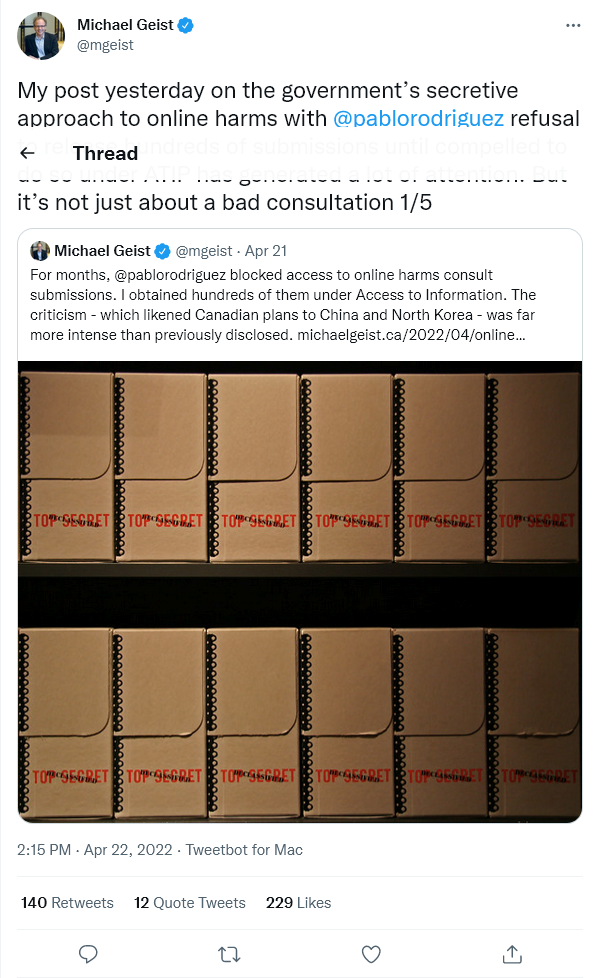
Michael Geist on how one of the worst pieces of legislation to get extruded from the bowels of the Liberal minority government got pinched off by main force and now sits, steaming, on the docket for the Senate to … well, “rubber stamp” isn’t quite the right phrase but it’s pretty rare for our unelected senators to do anything to benefit ordinary Canadians, so we’re depending on them somehow managing to display an almost supernatural effort to slow down this shitty bill until the end of the session:

Canadian Heritage Minister Steven Guilbeault, 3 February 2020.
Screencapture from CPAC video.

The Liberal government strategy of multiple gag orders and a “super motion” to limit debate bore fruit last night as Bill C-10 received House of Commons approval at 1:30 am. The Parliamentary process took hours as the government passed multiple motions to cut short debate, re-inserted amendments that had been previously ruled null and void, and rejected a last-ditch attempt to restore the Section 4.1 safeguards for user generated content. The debate included obvious errors from Liberal MPs who were presumably chosen to defend the bill. For example, Julie Dabrusin, the Parliamentary Secretary to the Minister of Canadian Heritage, said that Section 2.1 in Bill C-10 “specifically excludes content uploaded by users.” Only it doesn’t as Dabrusin should know given that 2.1 covers users not content and she was the MP who introduced the amendment at committee to remove Section 4.1, which was the provision that excluded content uploaded by users.

Given the public support from the Bloc for cutting short debate, the outcome last night was never really in doubt. Perhaps the most interesting vote of the night came with a motion from Conservative MP Alain Rayes, which once again called for the re-insertion of Section 4.1. While the motion was defeated with the support of Liberal, NDP, and Bloc MPs, there were several notable exceptions. Liberal MPs Nate-Erskine Smith and Wayne Long both abstained and former Justice Minister (and now independent MP) Jody Wilson-Raybould voted in favour of the motion. The report stage was limited to one hour of debate, which meant that the 23 amendments were again subject to no real debate or discussion. Once the bill passed the report stage, it was on to third and final reading, which was limited to 15 minutes of debate per party. The vote followed just before 1:30 am with the Liberals, NDP, and Bloc once again supporting Bill C-10. Wilson-Raybould joined with the Conservatives in voting against it.

A rational government would comprehend that their pitch that the real purpose of the bill is to “make the web giants pay” is completely undermined by the obvious and deliberate attempt to introduce government censorship of what ordinary Canadians watch on the internet and share through social media. It’s all about the control, not about any imaginary financial windfall from shaking down tech companies for spare change. Why the rush to get it rammed through parliament right now, with so many other rather more pressing concerns at hand?

June 17, 2021

QotD: Declaring war on the Upper-Class Media

Filed under: Media, Politics, Quotations, USA — Tags: , , , , , , , , — Nicholas @ 01:00

This is your new term for “mainstream media”. Being against the “mainstream media” sounds kind of conspiratorial. Instead, you’re against the upper-class media, which gains its status by systematically excluding lower-class voices, and which exists mostly as a tool of the upper classes to mock and humiliate the lower class. You are not against journalism, you’re not against being well-informed, you’re against a system that exists to marginalize people like you. Tell the upper-class media that if they want your respect, they need to stop class discrimination.

67% of US families watch the Super Bowl — what percent of New York Times editors and reporters do? 20% of Americans go to religious services weekly — how many of those work for the New York Times? How come 96% of political donations from journalists go to Democrats? Your job is to take a page from the Democratic playbook and insist there is no reason any of this could be true except systemic classism, that any other explanation is offensive, and it’s the upper-class media’s moral duty to do something about this immediately. Until they do so you are absolutely justified in ignoring them and trusting less bigoted and exclusionary sources (I hear Substack is pretty good!)

Insist that working-class people have the right to communicate with each other without interference from upper-class gatekeepers. Make sure people know every single fact about @Jack and what a completely ridiculous person he is, and point out that somehow this is the guy who decides what you’re allowed to communicate with your Twitter friends. Every time tech companies censor social media, even if they’re censoring left-wing views, call their CEOs in for long and annoying Congressional hearings where you use the words “Silicon Valley elites” a lot.

Scott Alexander, “A Modest Proposal For Republicans: Use The Word ‘Class'”, Astral Codex Ten, 2021-02-26.

June 10, 2021

QotD: “Defending” democracy using totalitarian methods

Filed under: Britain, History, Liberty, Media, Quotations, WW2 — Tags: , , , , — Nicholas @ 01:00

One of the peculiar phenomena of our time is the renegade Liberal. Over and above the familiar Marxist claim that “bourgeois liberty” is an illusion, there is now a widespread tendency to argue that one can only defend democracy by totalitarian methods. If one loves democracy, the argument runs, one must crush its enemies by no matter what means. And who are its enemies? It always appears that they are not only those who attack it openly and consciously, but those who “objectively” endanger it by spreading mistaken doctrines. In other words, defending democracy involves destroying all independence of thought. This argument was used, for instance, to justify the Russian purges. The most ardent Russophile hardly believed that all of the victims were guilty of all the things they were accused of: but by holding heretical opinions they “objectively” harmed the régime, and therefore it was quite right not only to massacre them but to discredit them by false accusations. The same argument was used to justify the quite conscious lying that went on in the leftwing press about the Trotskyists and other Republican minorities in the Spanish civil war. And it was used again as a reason for yelping against habeas corpus when Mosley was released in 1943.

These people don’t see that if you encourage totalitarian methods, the time may come when they will be used against you instead of for you. Make a habit of imprisoning Fascists without trial, and perhaps the process won’t stop at Fascists. Soon after the suppressed Daily Worker had been reinstated, I was lecturing to a workingmen’s college in South London. The audience were working-class and lower-middle class intellectuals — the same sort of audience that one used to meet at Left Book Club branches. The lecture had touched on the freedom of the press, and at the end, to my astonishment, several questioners stood up and asked me: Did I not think that the lifting of the ban on the Daily Worker was a great mistake? When asked why, they said that it was a paper of doubtful loyalty and ought not to be tolerated in war time. I found myself defending the Daily Worker, which has gone out of its way to libel me more than once. But where had these people learned this essentially totalitarian outlook? Pretty certainly they had learned it from the Communists themselves! Tolerance and decency are deeply rooted in England, but they are not indestructible, and they have to be kept alive partly by conscious effort. The result of preaching totalitarian doctrines is to weaken the instinct by means of which free peoples know what is or is not dangerous. The case of Mosley illustrates this. In 1940 it was perfectly right to intern Mosley, whether or not he had committed any technical crime. We were fighting for our lives and could not allow a possible quisling to go free. To keep him shut up, without trial, in 1943 was an outrage. The general failure to see this was a bad symptom, though it is true that the agitation against Mosley’s release was partly factitious and partly a rationalisation of other discontents. But how much of the present slide towards Fascist ways of thought is traceable to the “anti-Fascism” of the past ten years and the unscrupulousness it has entailed?

George Orwell, Unpublished Preface to Animal Farm, 1945.

June 9, 2021

Bill C-10 – “… what occurred yesterday was far worse than a blunder. It was a betrayal.”

In another country it might be a fascinating and amusing thing to watch Steven Guilbeault faff about pretending to understand what his own bill says and how it will cause havoc for ordinary Canadians, but being in Canada the humour is lacking as Michael Geist shows:

Canadian Heritage Minister Steven Guilbeault, 3 February 2020.
Screencapure from CPAC video.

Several weeks after Canadian Heritage Minister Steven Guilbeault introduced Bill C-10, I started a 20 part blog post series called the Broadcasting Act Blunder (podcast edition here). The series examined many of concerns with the bill, including issues such as over-broad regulation and discoverability requirements that would only garner public attention many months later. I thought about that series yesterday as I watched Guilbeault try in the House of Commons to defend the indefensible: a gag order on committee review of the bill, the first such order in two decades. While the bill is in dire need of fixing, what occurred yesterday was far worse than a blunder. It was a betrayal. A betrayal of the government’s commitment to “strengthen Parliamentary committees so that they can better scrutinize legislation.” A betrayal of the promise to do things differently from previous governments. A betrayal of Canada’s values as a Parliamentary democracy.

The 23 minute and 30 second question and comment period – the House Speaker ruled there could be no debate and that the period could not extend beyond 23 minutes and 30 seconds – notably featured NDP MP Peter Julian and Green MP Elizabeth May, two of the longer serving MPs in the House as among the first to speak. Julian was first elected in 2004, when Guilbeault was only a few years removed from activist stunts such as climbing the CN Tower. Meanwhile, May became the founding Executive Director of the Sierra Club in 1989, the same year Guilbeault started as a university student. It seemed to me that both had a message for an inexperienced cabinet minister elected less than two years ago, namely that some things are bigger than single bill. Bills come and go, but principles – or betrayal of those principles – endures.

Guilbeault clearly did not get it, wondering how the NDP could possibly reject the gag order and effectively support potential delays to his bill. Both the NDP and the Greens may ultimately vote for Bill C-10, but both understand that defending democracy and the freedom of expression of MPs (much less the freedom of expression of all Canadians) is far more important than a delay to any single bill. As May noted, the gag order will do real long term damage. One day it will be a different government on a different issue seeking to use the same procedure to cut short committee study. And the Liberals will have no credible response with no one to blame but themselves.

But we don’t need to look far into the future to see the consequences of the Guilbeault gag order. This past weekend, the Canadian government joined with other countries to criticize the Nigerian government for blocking Twitter and establishing registration requirements for social media. Yet calls for respecting freedom of expression rings hollow when you are shutting down Parliamentary debate on a bill with profound implications for freedom of expression. Indeed, Canada’s lost moral authority on Internet freedoms is an undeniable consequence of Bill C-10 and the Guilbeault gag order.

June 8, 2021

The utter failure of political leadership in most countries during the pandemic

Jay Currie runs through some of the many reasons our political leadership and their “expert class” advisors in most western countries were utter shit almost from the starting gun of the Wuhan Coronavirus pandemic:

“Covid 19 Masks” by baldeaglebluff is licensed under CC BY-SA 2.0

The first response of most of our political class was to doggedly claim to be following the science, turn day to day decision making over to “public health experts”, follow the guidance of the WHO and the CDC – guidance which was, to be charitable, inconsistent – and to largely avoid questioning the experts. (Trump seemed to make some attempt to raise questions but made little headway in the face of his own public health bureaucracy.)

“Wipe everything” (which the CDC now concedes is pointless because the virus is rarely, if ever, transmitted by contact, “wash your hands” (good advice at any time), “social distance” (hilarious when in effect outdoors where there is next to no transmission), “walk this way” in the essential grocery and liquor stores, “wear a mask”, “wear two masks”, “stay home” (logical for two weeks, insane for six months), “curfew” (no known benefit, Quebec ended up being under curfew for five months), “no indoor dining” (despite next to no evidence that restaurants were significant sources of infection), “don’t travel” (with a vast list of exceptions), “don’t gather outdoors (unless BLM protest)” (ignoring entirely that the virus rarely spreads outdoors): it was all COVID theatre and, to paraphrase Dr. Bonnie Henry, “There’s no science to it.”

What the politicians did was simply to panic. They abdicated their responsibility to lead to “experts” who seemed to all be reading from the same “mass lockdown, masks everywhere, hang on for the vaccine, there is no treatment” script.

The key political failure was the acceptance of the “there is no treatment” story. Back in February/March 2020 there were suggestions that there might well be treatments of some sort. HCQ was trotted out and, partially because Trump mentioned it and partially because of very badly designed studies, dismissed. The very idea of a COVID treatment regime was, essentially, made illegal in Canada and much of the United States.

The idea of boosting immunity with things like Vitamin D and C and a good long walk every day did not come up at most of the Public Health Officer’s briefings across Canada. And, again, not very well done studies were cited showing that “Vitamin D does not cure COVID”. A claim which was not being made. A healthy immune system, to which Vitamin D can contribute, most certainly does cure COVID in the vast majority of cases.

Citing privacy concerns, public health officials were unwilling to give many details as to who was dying of or with COVID. Age, co-morbidities, race, and the socio-economic status of the dying were disclosed reluctantly and long after the fact.

I don’t think most of this can be blamed on the public health officials. They had their jobs to do and, to a greater or lesser degree, managed to do them. They are hired to apply current best practices – often mandated on a world wide basis by the WHO – to the situation before them. Public Health officials are not expected to be imaginative nor innovative.

Imagination, leadership, thinking outside the proverbial box is what we elect politicians for.

But, hey! Doesn’t Justin wear cool socks? Totally worth flushing decades of economic growth down the toilet for those nice socks! Canada’s back! (Back to 1974, approximately.)

« Newer PostsOlder Posts »

Powered by WordPress