Quotulatiousness

December 7, 2021

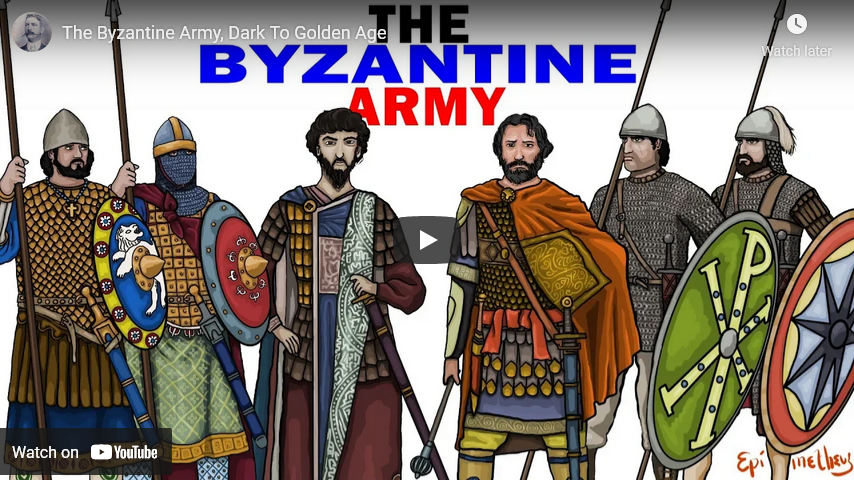
The Byzantine Army, Dark To Golden Age

Filed under: Europe, History, Middle East, Military, Religion — Tags: , , , , , , , — Nicholas @ 04:00

Epimetheus
Published 22 Mar 2019

The Byzantine army, Dark to Golden age

This video was sponsored by Skillshare

Sources
Romano-Byzantine armies 4th-9th Centuries (David Nicolle)
Larousse Encyclopedia of Ancient and Medieval History (Marcel Dunan)
The Late Roman Infantryman (Simon MacDowall)
Byzantium Beyond the Golden Gate
Fall of the West (John Lambshead)
The Late Roman Cavalryman (Simon MacDowall)

Tags:
Byzantine history, Byzantine, Byzantine documentary, Eastern Roman, Byzantine army, ancient history, Byzantine Cataphract, Byzantine Roman, history, Bulgaria Byzantium, Byzantine military, Byzantine legion, Byzantine empire, fall Byzantine, ancient, Rome, Constantinople, Byzantine empire documentary, crash course Byzantine empire, Byzantium, Byzantine army structure, Byzantine vs Roman, theme system, theme Byzantine, Roman tactics, Byzantine tactics, eastern Roman empire

From the comments:

Epimetheus
2 years ago (edited)
Notes/additional info:

1. Should the empire be called Byzantine, Roman or Greek? I see people arguing for each of these in the comments and there is merit to each of these; but it is important to note that they called themselves Roman, they were majority Greek in population and language spoken, and the term Byzantine is useful in differentiating the time period and has been colloquially used for a long time (although not during the empire) Being a reference to the earlier name of Byzantium for the city of Constantinople.

2. When I refer to “native troops” this includes many other ethnic groups living within the empire, notably the Armenians who lived in Anatolia for hundreds of years and had assimilated in many ways but maintained different views on aspects of the Christian faith which was the most striking differentiating factor between them and the rest of the population of the empire.

3. The Strategos and Domestikos label should be switched on the captions at 6 mins 17 secs in. A Strategos led a Thema(ta) and a Domestikos led a Tagma(ta). Unfortunately I switched those by accident and stared at the screen for a while and did not notice that … sorry guys ;(

4. The Varangian Guard was a personal bodyguard unit to the emperor which are pretty cool, they were mostly comprised of Norsemen (Scandinavians), Rus and Saxons. They are the unit I refer to when I mention a Scandinavian unit.

5. The coolest unit (in my opinion) that I did not mention was the Akritai which were kinda like the Cossacks in that they were a loosely controlled border guard on the eastern side of the empire; and were the subject of much folklore and poems and such.
November 6, 2021

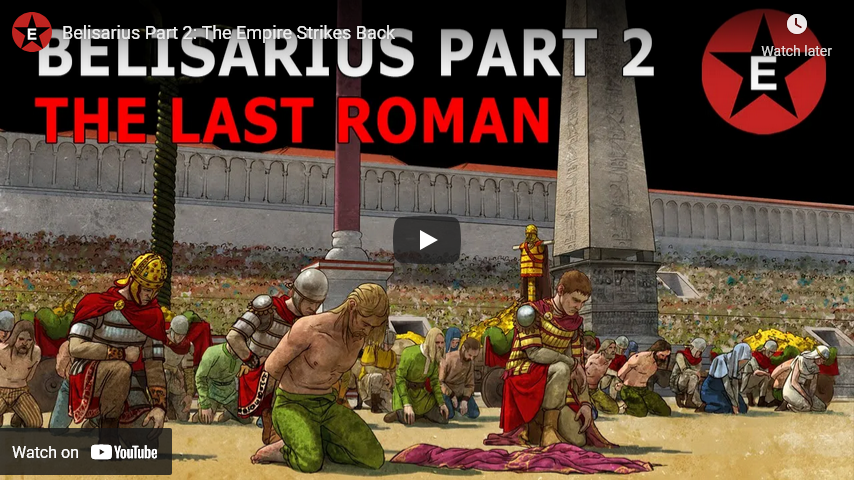
Belisarius Part 2: The Empire Strikes Back

Epic History TV
Published 5 Nov 2021

Play Epic War: Thrones and enjoy the real war game experience!
Download here: http://bitly.ws/j86c
Use Gift Code ‘WAR777‘ to receive 200 beads and 200 skill points.
Real War, Real Epic

Big thanks to Legendarian for Total War: Attila gameplay footage, check out his YouTube channel here: https://www.youtube.com/channel/UCOI2…

Thanks also to our Series Consultant Professor David Parnell of Indiana University Northwest, who you can follow on Twitter here: https://twitter.com/byzantineprof

Total War: Attila gameplay footage used with kind permission of Creative Assembly — buy the game here: https://geni.us/qDreR

Thanks also to the Vandalic War mod crew for modding support, find out more about their mod here: https://steamcommunity.com/sharedfile…

🎨 Original artwork by Miłek Jakubiec https://www.artstation.com/milek

📚Recommended reading (as an Amazon Associate I earn from qualifying purchases):
📖 Procopius, History of the Wars https://geni.us/L3Pgc
📖 The Wars of Justinian by Michael Whitby https://geni.us/Xxrd3
📖 Rome Resurgent by Peter Heather https://geni.us/ZFoU1
📖 The Armies of Ancient Persia: the Sassanians by Kaveh Farrokh https://geni.us/jMQo3z
📖 Late Roman Cavalryman AD 236–565 (Osprey) by Simon MacDowall https://geni.us/XMGl

Support Epic History TV on Patreon from $1 per video, and get perks including ad-free early access & votes on future topics https://www.patreon.com/EpicHistoryTV

👕 Buy EHTV t-shirts, hoodies, mugs and stickers here! teespring.com/en-GB/stores/epic-histo…

🎶Music from Filmstro: https://filmstro.com/?ref=7765
Get 20% off an annual license with this exclusive code: EPICHISTORYTV_ANN

#EpicHistoryTV #RomanEmpire #EasternRomanEmpire #Justinian #Belisarius #ByzantineEmpire

#EpicWar:Thrones #Strategy #ThreeKingdoms #WarGame #RealCivilizationWar

October 18, 2021

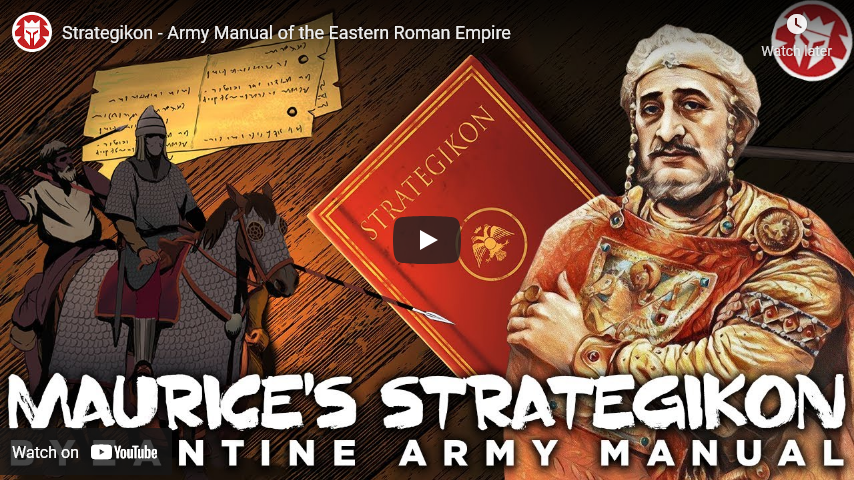
Strategikon – Army Manual of the Eastern Roman Empire

Filed under: Books, History, Middle East, Military — Tags: , , , , — Nicholas @ 04:00

Kings and Generals
Published 30 Mar 2021

The Kings and Generals animated historical documentary series on the evolution of the Roman Army continues with the second episode of the series on the Army of the Eastern Roman Empire – the Byzantine Empire. In this episode, we’ll focus on Strategikon of Maurice – the army manual that defined the structure, training and tactics of the Byzantine army.

Support us on Patreon: http://www.patreon.com/KingsandGenerals or Paypal: http://paypal.me/kingsandgeneral

We are grateful to our patrons and sponsors, who made this video possible: https://docs.google.com/document/d/1o…

The video was made by Arb Paninken http://bit.ly/2Ow3oC8, while the script was developed by Matt Hollis. This video was narrated by Officially Devin (https://www.youtube.com/user/OfficiallyDevin)

✔ Merch store â–º https://teespring.com/stores/kingsand…
✔ Patreon ► https://www.patreon.com/KingsandGenerals
✔ Podcast ► Google Play: http://bit.ly/2QDF7y0 iTunes: https://apple.co/2QTuMNG
✔ PayPal ► http://paypal.me/kingsandgenerals
✔ Twitter ► https://twitter.com/KingsGenerals
✔ Instagram ► http://www.instagram.com/Kings_Generals

Production Music courtesy of Epidemic Sound: http://www.epidemicsound.com

#Documentary #Byzantines #Romans

Look at Life — The Rocket Age Lancers (1961)

Filed under: Britain, History, Military — Tags: , , , , — Nicholas @ 02:00

PauliosVids
Published 20 Nov 2018

Looking to the future with the 9th Queen’s Royal Lancers.

September 1, 2021

1893 Lee-Metford Trials Carbine (One of Only 100 Made)

Filed under: Britain, History, Military, Weapons — Tags: , , , — Nicholas @ 02:00

Forgotten Weapons
Published 17 May 2021

http://www.patreon.com/ForgottenWeapons

https://www.floatplane.com/channel/Fo…

Cool Forgotten Weapons merch! http://shop.forgottenweapons.com

Once Lee-Metford rifle production was in place, the British began working on a carbine version of the same action for their cavalry. In 1893 a trial run of 100 carbines were made, and today we are looking at serial number 32 of that batch. These carbines are different in several ways from the ultimately adopted pattern. They had exposed muzzles like the Martini carbines, instead of the heavy snub-nose muzzle that would be adopted (similar to the muzzle of most early Mauser carbines). These trials carbines also had no safety, no sling attachments, and no barrel band. The did have the bent bolt handle of the final pattern (albeit not flattened down) and the short 6-round magazine.

Contact:
Forgotten Weapons
6281 N. Oracle 36270
Tucson, AZ 85740

August 25, 2021

Carica! – The Cavalry Charges of World War Two – WW2 Special

Filed under: Europe, Germany, History, Italy, Military, Russia, WW2 — Tags: , , , , — Nicholas @ 04:00

World War Two
Published 24 Aug 2021

The Eastern Front is a battleground of Blitzkrieg and Deep Battle; Panzers vs. T-34s; Nazism and Communism. You’d think that there would be no place for cavalry tactics here. But the Wehrmacht, Red Army, and Regio Esercito do still use centuries-old cavalry tactics in their waging of war.
(more…)

August 24, 2021

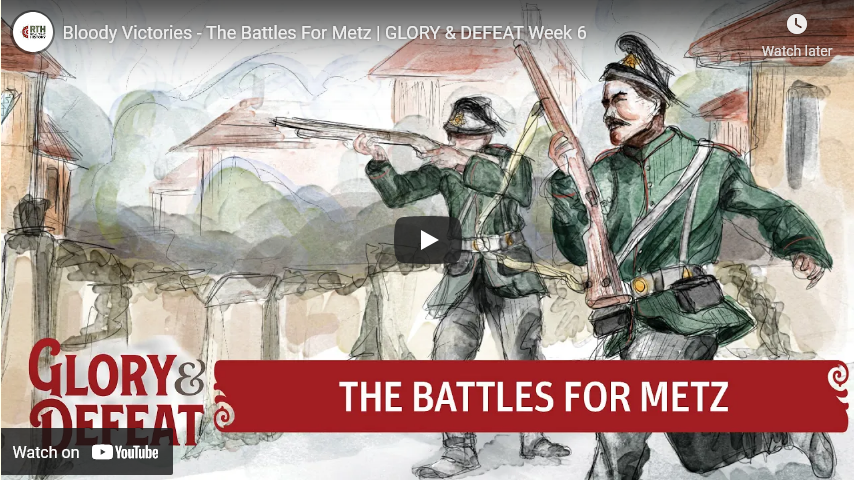
Bloody Victories – The Battles For Metz | GLORY & DEFEAT Week 6

Filed under: France, Germany, History, Military — Tags: , , , — Nicholas @ 04:00

realtimehistory
Published 19 Aug 2021

Support Glory & Defeat by sponsoring an illustration: https://realtimehistory.net/adoptanar…

The French Army of Marshal Bazaine was hoping to reach Verdun or even Paris after the first engagements around Metz. But the French troops were exhausted which allowed the Germans to catch up. With the Battle of Gravelotte and the Battle of Mars-la-Tour, the fate of the French Rhine Army is sealed; they are trapped in Metz.

» THANK YOU TO OUR CO-PRODUCERS
John Ozment
James Darcangelo
Jacob Carter Landt
Thomas Brendan

» OUR PODCAST
https://realtimehistory.net/podcast – interviews with historians and background info for the show.

» LITERATURE
Arand, Tobias: 1870/71. Die Geschichte des Deutsch-Französischen Krieges erzählt in Einzelschicksalen. Hamburg 2018
Bourguinat, Nicolas/Vogt, Gilles: La Guerre franco-allemande de 1870. Une histoire globale. Paris 2020
Buk-Swienty, Tom: Feuer und Blut. Hauptmann Dinesen. Hamburg 2014
Roux, Georges: La Guerre de 1870. Paris 1966

» SOURCES
Braun, Lily (Hrsg.): Kriegsbriefe aus den Jahren 1870/1 von Hans von Kretschman. Berlin 1911
Engels, Friedrich: Der Deutsch-Französische Krieg. Sechzig Artikel aus der “Pall Mall Gazette”. Berlin (Ost) 1957
Fontane, Theodor: Der Krieg gegen Frankreich. Bd. 1. Berlin 1873
Geschichte des Krieges 1870–1871, Union Deutsche Verlagsanstalt, Stuttgart 1895
N. N. (Hrsg.): Bismarcks Briefe an seine Gattin aus dem Kriege 1870/71. Stuttgart, Berlin 1903
Seigneur, Daniel: Carnets d’un infirmier d’une guerre oublié. Bière 2014

» OUR STORE
Website: https://realtimehistory.net

»CREDITS
Presented by: Jesse Alexander
Written by: Cathérine Pfauth, Prof. Dr. Tobias Arand, Jesse Alexander
Director: Toni Steller & Florian Wittig
Director of Photography: Toni Steller
Sound: Above Zero
Editing: Toni Steller
Motion Design: Philipp Appelt
Mixing, Mastering & Sound Design: http://above-zero.com
Maps: Battlefield Design
Research by: Cathérine Pfauth, Prof. Dr. Tobias Arand
Fact checking: Cathérine Pfauth, Prof. Dr. Tobias Arand

Channel Design: Battlefield Design

Contains licensed material by getty images
All rights reserved – Real Time History GmbH 2021

August 10, 2021

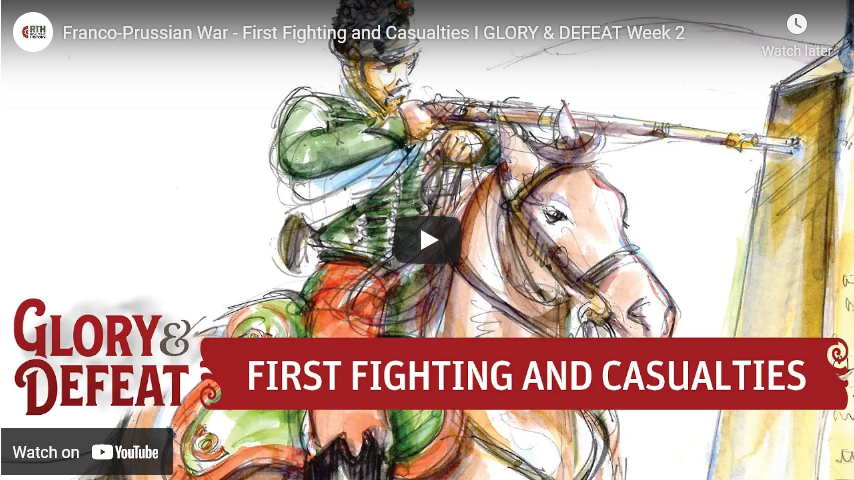
Franco-Prussian War – First Fighting and Casualties I GLORY & DEFEAT Week 2

Filed under: France, Germany, History, Military — Tags: , , , , , — Nicholas @ 04:00

realtimehistory
Published 22 Jul 2021

Support Glory & Defeat: https://realtimehistory.net/gloryandd…

With the official declaration of war from France, Prussia mobilizes and calls in the defensive alliances with the other German states within the North German Confederation but also with Bavaria, Württemberg and Baden. And while the bigger armies still assemble, the first skirmishes happen near the French border.

» OUR PODCAST
https://realtimehistory.net/podcast – interviews with historians and background info for the show.

» LITERATURE
Arand, Tobias: 1870/71. Der Deutsch-Französische Krieg erzählt in Einzelschicksalen. Hamburg 2018

Arand, Tobias / Bunnenberg, Christian (Hrsg.): Karl Klein. Fröschweiler Chronik. Kriegs- und Friedensbilder aus dem Krieg 1870. Kommentierte Edition. Hamburg 2021

Bourguinat, Nicolas / Vogt, Gilles: La guerre franco-allemande de 1870. Une histoire globale. Paris 2020

Howard, Michael: The Franco-Prussian War. London 1961

Milza, Pierre: L’année terrible. La guerre franco-prussienne septembre 1870 – mars 1871. Paris 2009

» SOURCES

Becker, Josef (Hrsg.): Bismarcks spanische «Diversion« 1870 und der preußisch-deutsche Reichsgründungskrieg. Bd. III. Paderborn, München, Wien, Zürich 2003

Bebel, August / Bernstein, Eduard (Hrsg.): Der Briefwechsel zwischen Friedrich Engels und Karl Marx. Bd. IV. Stuttgart 1921

Fontane, Theodor: Krieg gegen Frankreich, Bd. 1. Berlin 1873

Napoléon III: Proclamation de l’Empereur. Paris, 23. Juillet 1870

» OUR STORE
Website: https://realtimehistory.net

»CREDITS
Presented by: Jesse Alexander
Written by: Cathérine Pfauth, Prof. Dr. Tobias Arand, Jesse Alexander
Director: Toni Steller & Florian Wittig
Director of Photography: Toni Steller
Sound: Above Zero
Editing: Toni Steller
Motion Design: Philipp Appelt
Mixing, Mastering & Sound Design: http://above-zero.com
Maps: Battlefield Design
Research by: Cathérine Pfauth, Prof. Dr. Tobias Arand
Fact checking: Cathérine Pfauth, Prof. Dr. Tobias Arand

Channel Design: Battlefield Design

Contains licensed material by getty images
All rights reserved – Real Time History GmbH 2021

July 13, 2021

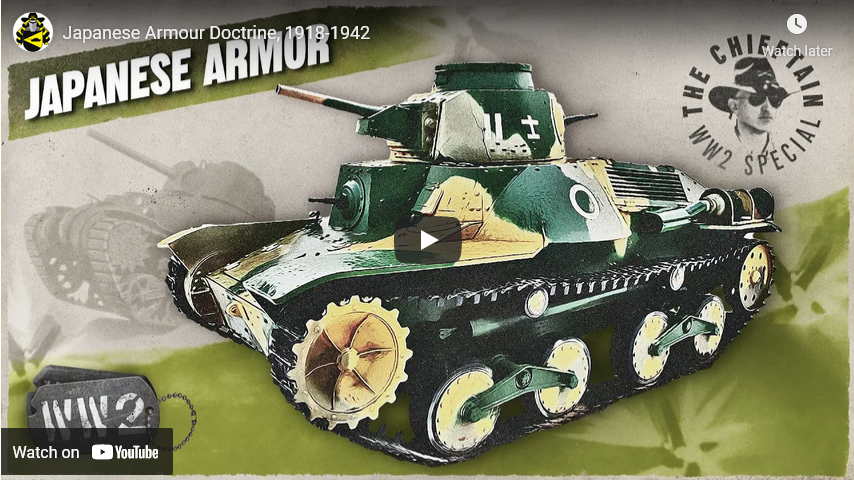
Japanese Armour Doctrine, 1918-1942

Filed under: China, History, Japan, Military, Russia, USA, Weapons, WW2 — Tags: , , , , , — Nicholas @ 04:00

The_Chieftain
Published 11 Jul 2021

Sources include:
Japanese tanks and armoured Warfare 1932-45, David McCormack
WW2 Japanese Tank Tactics, Gordon Rottmen, Akira Takizawa
Japanese Tanks, Tactics and anti-tank weapons, Donald McLean
Type 89 and Tankette books, Kazunori Yoshikawa

Continuing on this series of videos supporting the WW2 Channel, I look at what I can find about how the Japanese thought of tanks and their usage, tempered by quite a bit of combat experience.

Improved-Computer-And-Scout Car Fund:
Patreon: https://www.patreon.com/The_Chieftain
Direct Paypal https://paypal.me/thechieftainshat

May 4, 2021

What was the first professional army in History?

Filed under: History, Middle East, Military — Tags: , , , — Nicholas @ 04:00

Epimetheus
Published 3 Aug 2019

The First Professional Army in History, The Ancient Assyrian Army

Sources:
The Ancient Assyrians by Mark Healy
Warfare in the Ancient World by John Hackett
A History of the Ancient Near East by Marc Van Der Mieroop

Video on History of the Assyrian Empire From the Old Empire to the Neo-Assyrian Empire
https://youtu.be/aT57dnlo-Tw​

This video is sponsored by my Patrons over on Patreon
https://www.patreon.com/Epimetheus1776

March 30, 2021

Caesar in Britain II: There and Back Again (54 B.C.E.)

Historia Civilis
Published 21 Mar 2017

Patreon | http://historiacivilis.com/patreon​
Donate | http://historiacivilis.com/donate​
Merch | http://historiacivilis.com/merch​
Mailing List | http://historiacivilis.com/mailinglist​
Twitter | http://historiacivilis.com/twitter​
Website | http://historiacivilis.com​

Music is:
“Day Bird,” by Broke For Free
“Drums of the Deep,” by Kevin MacLeod
“Flood,” by Jahzzar

March 4, 2021

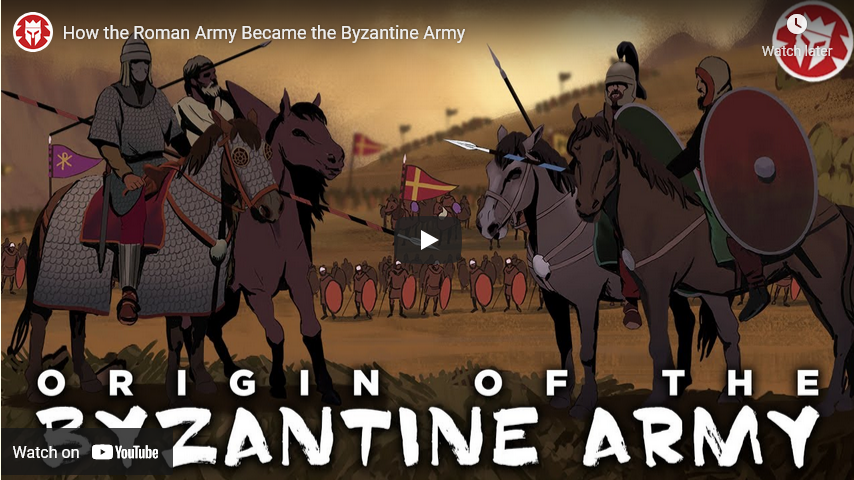
How the Roman Army Became the Byzantine Army

Kings and Generals
Published 2 Mar 2021

Video is Sponsored by Ridge Wallet: https://www.ridge.com/KINGSANDGENERALS​ Use Code “KINGSANDGENERALS” for 10% off your order!

The Kings and Generals animated historical documentary series on the evolution of the Roman Army continues with the first episode of the series on the Army of the Eastern Roman Empire — the Byzantine Empire. In this episode, we’ll mainly focus on how the Roman army was transformed into the Byzantine army and talk about the armies of Justinian and Belisarius described by Procopius.

Support us on Patreon: http://www.patreon.com/KingsandGenerals​ or Paypal: http://paypal.me/kingsandgenerals​.​ We are grateful to our patrons and sponsors, who made this video possible: https://docs.google.com/document/d/1o…​

The video was made by our Arb Paninken http://bit.ly/2Ow3oC8​, while the script was developed by Leo Stone. This video was narrated by Officially Devin (https://www.youtube.com/user/OfficiallyDevin​)

✔ Merch store ► teespring.com/stores/kingsandgenerals​
✔ Podcast ► Google Play: http://bit.ly/2QDF7y0​ iTunes: https://apple.co/2QTuMNG​
✔ Twitter ► https://twitter.com/KingsGenerals​
✔ Instagram ► http://www.instagram.com/Kings_Generals​

Production Music courtesy of Epidemic Sound: http://www.epidemicsound.com​

#Documentary​ #Byzantines​ #Romans

March 2, 2021

The Evolution of Shock Cavalry – From Antiquity to the Middle Ages

Invicta
Published 1 Mar 2021

Learn about the evolution of shock cavalry from antiquity before the use of saddles and stirrups! Check out The Great Courses Plus to learn about shock cavalry in the campaigns of Alexander the Great: http://ow.ly/osex30rvhjf​

In this history documentary we explore the topic of ancient cavalry. The basic idea is that these units often get depicted in media as performing glorious massed charges headlong into the enemy ranks as seen in such scenes as the Charge of the Rohirrim from the Battle of Pelenor Fields. In reality this would have been a very dangerous situation for cavalrymen even under the best circumstances. But to make matters worse, riders from antiquity fought without the use of either saddles or stirrups. So how on earth did they manage to dominate the battlefield with these handicaps. Let’s find out.

We begin by covering the history of cavalry with the first domestication of the horse and its introduction to warfare first as member of the baggage train and soon after as a part of chariot crews rather than as actual mounted forces. This was in large part due to the lack of riding experience and technology on behalf of the rider. Soon after the Bronze Age Collapse however cavalry began to rise to prominence across the armies of the Mediterranean. We speak about the various forms of equine practices which ranged from riding bareback into combat as with the Numidian Cavalry to the use of simple bridles and cloth seats as with Greek Cavalry and Persian Cavalry.

We then cover the techniques used by these cavalrymen to mount, ride, and fight. As a part of this discussion, we rely heavily on Xenophon’s Manual on Horsemanship which provides excellent first hand details from the period. We also show how these techniques were successfully used by shock cavalry of antiquity such as the Macedonian Companion Cavalry, the Saka Steppe Lancers, and the Persian Cataphracts to great effect even without the use of saddles and stirrups.

Finally we do pose the question of why they didn’t use the saddle and stirrup given its seemingly obvious advantages. To answer this question we look at the history of its development from late antiquity to the early Middle Ages.

Bibliography and Suggested Reading
On Horsemanship, by Xenophon
Adrian Goldsworthy, The Complete Roman Army
Adrian Goldsworthy, Roman Warfare
J.C. Coulston, Cavalry Equipment of the Roman Army in the First Century A.D.
George T. Dennis, Maurice’s Strategikon, p. 38.
Julius Caesar, Commentarii de Bello Civili
Russel H. Beaty, Saddles

#History​
#Documentary​
#ShockCavalry

From the comments:

Invicta
13 hours ago
I was inspired by comments on our latest Units of History episode covering the Companion Cavalry which asked about how shock tactics worked in an age before the stirrup and saddle. I went down the rabbit hole finding answers and present to you my findings in this video! One awesome source we used was the Manual on Horsemanship by Xenophon which you can read for yourself here: http://www.gutenberg.org/files/1176/1176-h/1176-h.htm

February 26, 2021

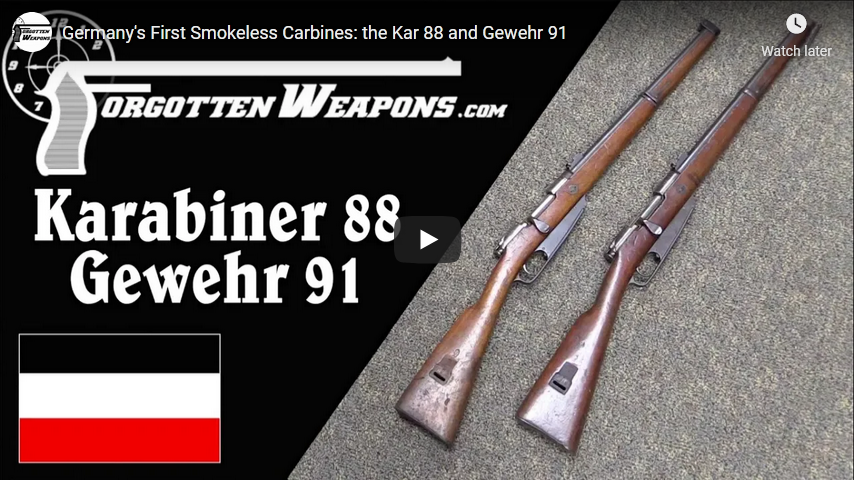
Germany’s First Smokeless Carbines: the Kar 88 and Gewehr 91

Filed under: Germany, History, Military, Weapons — Tags: , , — Nicholas @ 02:00

Forgotten Weapons
Published 27 May 2018

http://www.forgottenweapons.com/germa…

http://www.patreon.com/ForgottenWeapons

Cool Forgotten Weapons merch! http://shop.bbtv.com/collections/forg…

With the development of the smokeless Gewehr 88 “Commission Rifle”, the German Army finally made a serious effort to bring their cavalry units up to a modern standard. There had never been a carbine variant of the Mauser 71/84 produced, and even by the late 1880s many German cavalrymen were still carrying single shot Mauser 71 carbines — or worse, converted captured Chassepots from the Franco-Prussian War. While the Karabiner 88 wasn’t in production quite as quickly as they would have liked, guns were coming off the factory line in quantity by the summer of 1890. The factories tasked with this production were not actually the major state arsenals, but rather two private companies in Suhl — CG Haenel and VC Schilling (although the Erfurt Arsenal would step in in 1891 to make a batch of 25,000 carbines).

The Kar 88 was remarkable light and handy, and designed for use in a cavalry scabbard, meaning that it had a nice slick profile. This became a problem when the Army wanted to issue the carbines for foot artillery crews as well, because it gave them no way to stack the rifles while tending to their artillery pieces. The result was the Gewehr 91, which was identical to the Kar 88 in every way except for the addition of a stacking rod under the muzzle.

Both the Kar 88 and Get 91 were already being slowly taken out of service before World War One, as the new Mauser 98 pattern carbines introduced in 1909 or 1910 were taking their place. This would change with the outbreak of war, of course, and every one of the 88 pattern carbines in German inventory would be issued out during the Great War. Their size and weight made them ideal for the troops who needed a personal weapon but were unlikely to actually have to fight with it (artillery crews, cyclists, supply drivers, balloon crews, etc). After the war, they all disappeared from military service, though. The arms limitations of the Treaty of Versailles gave Germany no reason to keep obsolescent arms, and they were discarded in favor of keeping Mauser 98 pattern rifles and carbines.

Contact:
Forgotten Weapons
6281 N Oracle #36270
Tucson, AZ 85704

February 22, 2021

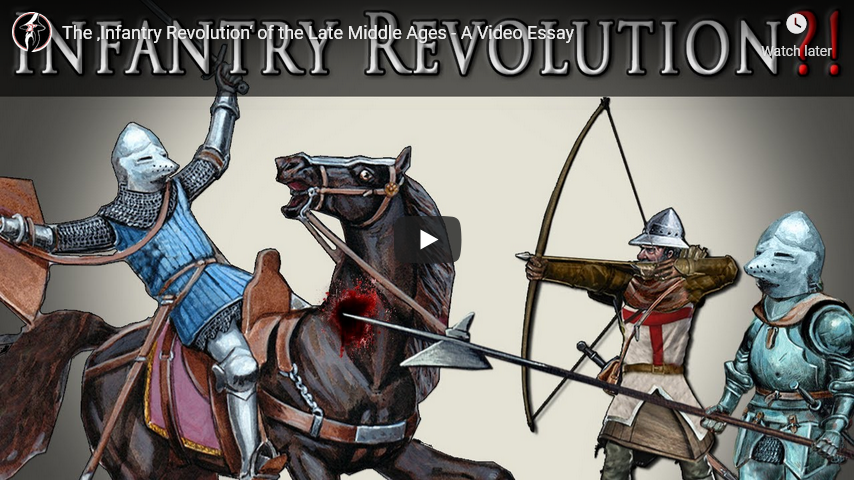
The “Infantry Revolution” of the Late Middle Ages

Filed under: Europe, History, Military, Weapons — Tags: , , , , — Nicholas @ 04:00

SandRhoman History
Published 21 Feb 2021

CuriosityStream link: https://curiositystream.com/sandrhoman​

The “Infantry Revolution” of the late Middle Ages is kind of a hot topic among armchair historians and academics alike. This is how the argument goes: In the late Middle Ages, infantry grew in importance to the detriment of heavy cavalry; by then battles were increasingly won with pikes, longbows and arquebuses instead of mounted knights with lances, the argument continues, and as a result of that, the socio-political make-up and development of European polities changed lastingly. So, this Infantry Revolution supposedly had an incredible impact on European state building processes AND, the argument finally concludes, it laid the foundation to Europe’s conquest and colonization of many parts of the world. However, in public spaces such as YouTube this whole debate is more discussed in regards to tactics and fighting techniques than economics and politics. Consequently, much of the public discussion is about how and if the importance of knights changed after the High Middle Ages. Likewise, topics such as the efficacy of the English longbow or the impact of pikes in the late Middle Ages are frequently the subject of discussions. All of that is controversial to say the least but it gets worse: these changes must be viewed in the broader military changes such as the rise of gunpowder artillery between 1420 and 1530 — called an artillery revolution — the decline of sieges between the 1420s and the 1530s which, among many things, led to the resurgence of heavy cavalry in the later late Middle Ages. Lastly, all of these revolutions belong to a notion called “military revolution”. This video is not intended to argue one side or the other of the “infantry revolution” but to provide a broad overview over both the debate and the military changes during the 14th and 15th centuries. It explains how contemporary historiography quarrels over the infantry revolution.

Patreon: https://www.patreon.com/sandrhomanhis…​

Twitter: https://twitter.com/SandrhomanBibliog…​

Bibliography:
Bane, M., English Longbow Testing against various armor circa 1400, 2006.
Ayton, A., / Price, J. L., (Hrsg.), The Medieval Military Revolution. State, Society and Military Change in Medieval and Early Modern Europe, 199J.
Black, A Military Revolution? Military Change and European Society 1550–1800, 1991.
Devries, K., Medieval Military Technology, 1994.
Dierk, W., s.v. “Heeresreform”, in: Enzyklopädie der Neuzeit
Ortenburg, G., “Waffe und Waffengebrauch im Zeitalter der Landsknechte” (Heerwesen der Neuzeit, Abt. 1, Bd. 1) Koblenz 1984.
Magier, Mariusz; Nowak, Adrian; et al., “Numerical Analysis of English Bows used in Battle of Crécy”. Problemy Techniki Uzbrojenia. 142 (2), 2017, 69–85.
Meumann, M., s.v. “Military Revolution”, in: Enzyklopädie der Neuzeit.
Parker G., “The ‘Military Revolution’, 1560–1660 – a Myth?”, in: Journal of Modern History 48.2, 1976, 196–214
Parker, G., Die militärische Revolution. Die Kriegskunst und der Aufstieg des Westens 1500–1800, 1990 (Engl. 1988)
Roberts, M.: “The military revolution, 1560–1660”. In: Clifford J. Rogers: The military revolution debate. Readings on the military transformation of early modern Europe. Westview Press, Boulder, Colo. 1995, S. 13–35.
Rogers, C.J. / Tallet F. (editors), European Warfare, 1350–1750, 2010.
Rogers, C.J., The Efficacy of the English Longbow, 1998.
Schmidtchen, Volker, Kriegswesen im späten Mittelalter. Technik, Taktik, Theorie, Weinheim 1990.
Soar, H., Gibbs, J., Jury, C., Stretton, M., Secrets of the English War Bow. Westholme, 2010, pp. 127–151.

« Newer PostsOlder Posts »

Powered by WordPress