
The pike and the musket shifted the center of warfare away from aristocrats on horses towards aristocrats commanding large bodies of non-aristocratic infantry. But, as comes out quite clearly in their writing, those aristocrats were quite confident that the up-jumped peasants in their infantry lacked any in-born courage at all. Instead, they assumed (in their prejudice) that such soldiers would require relentless synchronized drilling in order to render the complex sequence of actions to reload a musket absolutely mechanical. As Lee points out [in Waging War], this training approach wasn’t necessary – other contemporary societies adapted to gunpowder just fine without it – but was a product of the values and prejudices of the European aristocracy of the 1500 and 1600s.
Such soldiers were, in their ideal, to quickly but mechanically reload their weapons, respond to orders and shift formation more or less oblivious to the battle around them. Indeed, uniforms for these soldiers came to favor high, starched collars precisely to limit their field of vision. This is not the man who, in Tyrtaeus’ words (elsewhere in his corpus), “bites on his lip and stands against the foe” but rather a human who, in the perfect form, was so mechanical in motions and habits that their courage or lack thereof, their awareness of the battlefield or lack thereof, didn’t matter at all. But at least, the [Classical] Greek might think, at least such men still ought not quail under fire but instead stood tall in the face of it.
After all, as late as the Second World War, it was thought that good British officers ought not duck or take cover under fire, in order to demonstrate and model good coolness under fire for their soldiers. The impression I get from talking to recent combat veterans (admittedly, American ones rather than British, since I live in the United States) is that an officer who behaved in that same way on today’s battlefield would be thought reckless (or stupid), not brave. Instead, the modern image of courage under fire is the soldier moving fast, staying low, moving to and through cover whenever possible – recklessness is discouraged precisely because it might put a comrade in danger.
Instead, the courage that is valued in many of today’s armies is the courage to stay calm and make cool, rational decisions. It is, to borrow the first line in Rudyard Kipling’s “If-“, “If you can keep your head when all about you/Are losing theirs and blaming it on you.” Which is not at all what was expected of the 17th century infantryman, whose officers trusted him to make nearly no decisions at all! But, as we’ve discussed, the modern system of combat demands that lots of decisions be devolved down further and further in the command hierarchy, with senior officers giving subordinates (often down to NCOs) the freedom to alter plans on the fly at the local level so long as they are following the general mission instructions (a system often referred to by its German term, auftragstaktik).
Bret Devereaux, “Collections: The Universal Warrior, Part IIa: The Many Faces of Battle”, A Collection of Unmitigated Pedantry, 2021-02-05.
November 16, 2023
QotD: Infantry soldiers in the age of pike and shot
November 14, 2023
“Like all Luttwak stories, this is probably false but totally believable”
In the latest book review from Mr. and Mrs. Psmith’s Bookshelf, John Psmith considers Edward Luttwak’s fascinating and controversial The Grand Strategy of the Roman Empire, a book I quite enjoyed reading although I think his much later The Grand Strategy of the Byzantine Empire one of his best books.
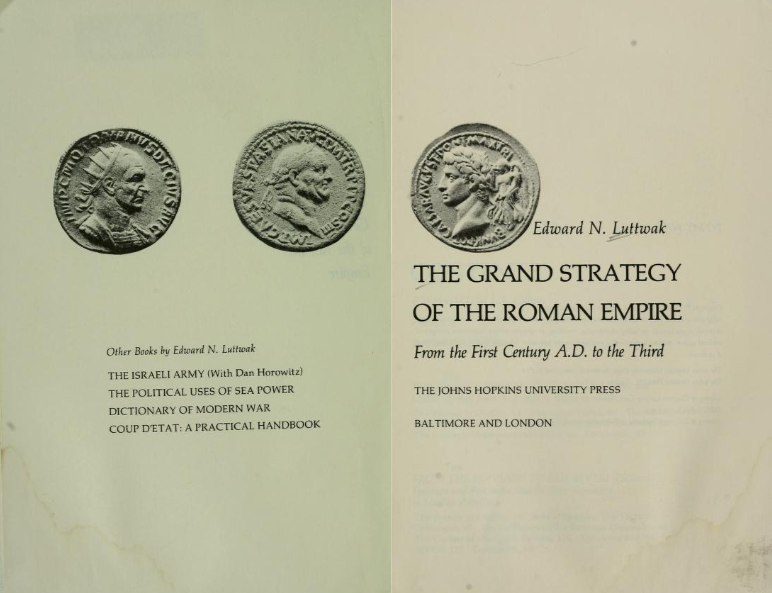
In one of the dozens of notorious interviews of Edward Luttwak that float around the internet, he’s asked how he chose the topic for his PhD dissertation. His answer is that one day at university he had a humiliating social encounter. Immediately afterwards, somebody pounced on him and asked what his dissertation was about anyway. He hadn’t even started thinking about what his topic would be, but he obviously couldn’t say that, and so instead he puffed himself up and made something up on the spot, and he did so by saying the most grandiloquent series of words one at a time like a large language model feverishly choosing the next token to maximize self importance: “The … GRAND … Strategy … … OF THE ROMAN EMPIRE!!” His interlocutor was sufficiently awed and impressed, but then he had to write the damn thing. Like all Luttwak stories, this is probably false but totally believable.1
But I’m very glad he wrote that thesis, because it was later turned into the wonderful book I’m reviewing. Now, one of the ways that the Psmiths subvert traditional gender roles is that it’s Jane, not I, who thinks about the Roman Empire every day. But this is only pretending to be a book about the Roman Empire. It’s really a book about “grand strategy” — how states can efficiently allocate scarce military, diplomatic, and financial resources to counter a variety of internal and external threats. It’s true that the examples are mainly drawn from four centuries of Roman history — starting with the Julio-Claudian dynasty and ending with the Empire losing control of Italy and Western Europe — but the analysis, and the lessons, are abstract enough that they transcend that particular context.
Luttwak believes that the state is a kind of machine for turning arable land into military power via taxation and conscription. A state that wants to maximize its survival odds can do so in three ways: (1) it can increase its “inputs”, by bringing a larger quantity of arable land under its control (so long as it avoids a commensurate increase in the threats it faces); (2) It can increase the efficiency of the machine, by extracting more grain and more labor from the people it rules, or by undertaking internal reforms to reduce the amount of potential that’s bled away by corruption and decadence; or (3) It can use its military as effectively as possible, doing more with less, killing many birds with one stone or setting up situations where a small allocation of force can tie down much larger opponents.
This third option is more or less what Luttwak means by “grand strategy,” and I think it may be the key that ties together all of Luttwak’s writing and thought. What do a book about the ancient world and a book about Cold War era coups have in common? They’re both about doing more with less, economizing force by wielding it with overwhelming brutality and efficiency. Luttwak’s coldly arithmetic view of the state is reminiscent of nothing so much as James C. Scott’s view of the world,2 but Luttwak is on the opposite team. Scott is an anarchist, Luttwak is a hard-boiled realist, and moreover he’s one with a deep aesthetic appreciation for power and violence, especially when used elegantly, like a scalpel, such that they have effects far out of proportion with their quantity.3
The history of Rome that Luttwak wants to tell is not the history of its cultural or civilizational achievements, but rather the history of how these people were so incredibly good at economizing on violence that they were able to waste a huge portion of their military and economic potential on civil wars, but still keep the lights on and the barbarians at bay. “Grand strategy” is how they accomplished that, but the strategy changed as the threats evolved and as the internal condition of the empire deteriorated. Luttwak delineates three distinct epochs — the founding of the empire under the Julio-Claudian dynasty, the rationalization of frontiers under the Antonine emperors, and the Crisis of the Third Century — and argues that each of the three featured a fundamentally different overall strategic posture on the part of Rome.
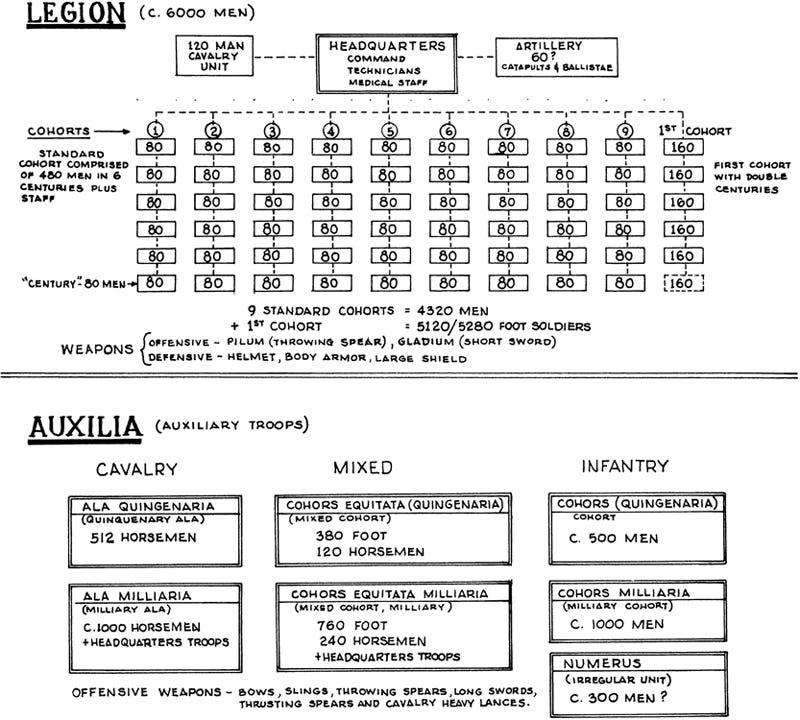
But before we get into all of that, I suppose we ought to talk about the legions. When people think of Roman military power, they usually think of the heavily-armed guys with red cloaks and horsehair plumes on their helmets. But of course they only made up a small fraction of the Roman military. We know that this has to be true because ancient armies, as much as modern armies, relied on combined-arms for their success. A legionary was a very scary kind of soldier, combining the roles of heavy infantry and combat engineer, but an army made up entirely of heavy infantry would be shredded by an opposing force of horse archers, for instance. So the Romans brought many other kinds of troops to bear: skirmishers, slingers, archers, light infantry, cavalry of their own (including mounted archers, light cavalry, and lancers with primitive barding that are a clear precursor of Medieval knights). And … almost to a man, all of these other forces were non-Roman.4 They were either mercenaries, or allied barbarians, or auxiliaries. As a kid in ancient history class I just accepted this as a fact, but reflect on it for a second and it seems very weird. This whole arrangement caused the Romans no end of trouble, so why did they do it that way?
Take the Luttwak pill and it all becomes clear: the Romans went all-in on legionaries as a way of economizing on force. The only people Rome could absolutely rely on were her citizens. The definition of a “real” Roman changed over time — at first it was only inhabitants of the city of Rome itself, later it was expanded to the surrounding countryside, and finally to all of Italy. But at every point it was a tiny fraction of the total population of the empire. Of that tiny fraction, some even smaller fraction are available to be trained as soldiers and to bear arms. What do you want those guys to be doing? The Roman answer is that you want them to be legionaries, because legionaries are not general-purpose soldiers, they’re specialists, and their specialties are: (1) besieging enemy cities, and (2) battles of attrition and annihilation.
1. Evidence that it’s false, he tells a completely different story in a different interview!
“I chose the subject because no theme in contemporary strategy was anywhere as interesting as the simple question of how Rome defended its territories (and added to them, now and then). Also, I did not want to waste my days reading the stultified & chaotically duplicative literature of ‘political science’ in which Strategy is imprisoned, when I could read instead in the often elegant, multi-lingual literature of Roman imperial studies.”
2. The zoomed-out, autistic alien robot anthropologist nature of this analysis also reminds me a bit of Vaclav Smil.
3. Wouldn’t the most elegant use of power be its deployment in such a way that it doesn’t really have to be used at all? In fact this is the main theme of Luttwak’s most recent book, The Grand Strategy of the Byzantine Empire, a sort of sequel to this one. In the same interview as in the first footnote, Luttwak summarizes the argument of that book: Byzantine strategy was based on:
“a single, paradoxical, principle: do everything possible to raise, equip and train the best possible army and navy, and then … do everything possible to use them as little as possible … every alternative was to be tried to avoid, or at least minimize the destructive ‘attrition’ combat of main forces. Instead, potential enemies were to be dissuaded, bribed, subverted, weakened by getting others to attack them, sidetracked into other ventures; if enemy forces attacked nonetheless, they were to be contained and delayed by skirmishing, feints and demonstrations while the search went on for other powers near or far willing to attack or at least threaten the enemy power; if enemy attacks persisted nonetheless, they were to be met by countering maneuvers designed to exhaust them rather than the destructive combat of main forces, the very last resort. It was not only the precious trained manpower of the empire that this strategy wanted to conserve, but also the enemy’s … because today’s enemy could become tomorrow’s ally.
4. This isn’t quite true in every period. For instance during the Punic Wars, the Romans fielded “equites“, native Roman cavalry of their own, but it fell out of fashion pretty quickly thereafter.
November 11, 2023
In memoriam
A simple recognition of some of our family members who served in the First and Second World Wars:
The Great War
 Private William Penman, Scots Guards, died 16 May, 1915 at Le Touret, age 25
(Elizabeth’s great uncle)- Private Archibald Turner Mulholland, Argyll & Sutherland Highlanders, mortally wounded 25 September, 1915 at Loos, age 27
(Elizabeth’s great uncle) - Private David Buller, Highland Light Infantry, died 21 October, 1915 at Loos, age 35
(Elizabeth’s great grandfather) - Private Harold Edgar Brand, East Yorkshire Regiment. died 4 June, 1917 at Tournai.
(My first cousin, three times removed) - Private Walter Porteous, Durham Light Infantry, died 4 October, 1917 at Passchendaele, age 18
(my great uncle, who had married the day before he left for the front and never returned) - Corporal John Mulholland, Argyll & Sutherland Highlanders, wounded 2 September, 1914 (shortly before the First Battle of the Aisne), wounded again 29 June, 1918, lived through the war.
(Elizabeth’s great uncle)
The Second World War
- Flying Officer Richard Porteous, Royal Air Force, survived the defeat in Malaya, was evacuated to India and lived through the war
(my great uncle) - Able Seaman John Penman, Royal Navy, served in the Defensively Equipped Merchant fleet on the Atlantic convoys, the Murmansk Run (he may have been on a ship in convoy PQ-17, as we know he spent a winter in Russia) and other convoy routes, was involved in firefighting and rescue efforts during the Bombay Docks explosion in 1944, lived through the war
(Elizabeth’s father) - Private Archie Black (commissioned after the war and retired as a Major), Gordon Highlanders, captured during the fall of Singapore (aged 15) and survived a Japanese POW camp (he had begun to write an autobiography shortly before he died)
(Elizabeth’s uncle) - Elizabeth Buller, “Lumberjill” in the Women’s Timber Corps, an offshoot of the Women’s Land Army in Scotland through the war.
(Elizabeth’s mother) - Trooper Leslie Taplan Russon, 3rd Royal Tank Regiment, died at Tobruk, 19 December, 1942 (aged 23).
Leslie was my father’s first cousin, once removed (and therefore my first cousin, twice removed).
My maternal grandfather, Matthew Kendrew Thornton, was in a reserved occupation during the war as a plater working at Smith’s Docks in Middlesbrough. The original design for the famous Flower-class corvettes came from Smith’s Docks and 16 of the 196 built in the UK during the war (more were built in Canada). My great-grandmother was an enthusiastic ARP warden through the war (she reportedly enjoyed enforcing blackout compliance in the neighbourhood using the rattle and whistle that came with the job).
For the curious, the Commonwealth War Graves Commission the Royal British Legion, and the Library and Archives Canada WW1 and WW2 records site provide search engines you can use to look up your family name. The RBL’s Every One Remembered site shows you everyone who died in the Great War in British or Empire service (Canadians, Australians, New Zealanders, South Africans and other Imperial countries). The CWGC site also includes those who died in the Second World War. Library and Archives Canada allows searches of the Canadian Expeditionary Force and the Royal Newfoundland Regiment for all who served during WW1, and including those who volunteered for the CEF but were not accepted.
In Flanders fields the poppies blow
Between the crosses row on row,
That mark our place; and in the sky
The larks, still bravely singing, fly
Scarce heard amid the guns below.We are the Dead. Short days ago
We lived, felt dawn, saw sunset glow,
Loved and were loved, and now we lie
In Flanders fields.Take up our quarrel with the foe:
To you from failing hands we throw
The torch; be yours to hold it high.
If ye break faith with us who die
We shall not sleep, though poppies grow
In Flanders fields.Lieutenant Colonel John McCrae, MD Canadian Army Medical Corps (1872-1918)
Here is Mark Knopfler’s wonderful song “Remembrance Day” from his Get Lucky album, set to a slideshow of British and Canadian images from World War I through to more recent conflicts put together by Bob Oldfield:
November 9, 2023
Defending a stateless society: the Estonian way
David Friedman responded to a criticism of his views from Brad DeLong. Unfortunately, the criticism was written about a decade before David saw it, so he posted his response on his own Substack instead:

English version of the Estonian Defence League’s home page as of 2023-11-08.
https://www.kaitseliit.ee/en
Back in 2013 I came across a piece by Brad DeLong critical of my views. It argued that there were good reasons why anarcho-capitalist ideas did not appear until the nineteenth century, reasons illustrated by how badly a stateless society had worked in the Highlands of Scotland in the 17th century. I wrote a response and posted it to his blog, then waited for it to appear.
I eventually discovered what I should have realized earlier — that his post had been made nine years earlier. It is not surprising that my comment did not appear. The issues are no less interesting now than they were then, so here is my response:
Your argument rejecting a stateless order on the evidence of the Scottish Highlands is no more convincing than would be a similar argument claiming that Nazi Germany or Pol Pot’s Cambodia shows how bad a society where law is enforced by the state must be. The existence of societies without state law enforcement that work badly — I do not know enough about the Scottish Highlands to judge how accurate your account is — is no more evidence against anarchy than the existence of societies with state law enforcement that work badly is against the alternative to anarchy.
To make your case, you have to show that societies without state law enforcement have consistently worked worse than otherwise similar societies with it. For a little evidence against that claim I offer the contrast between Iceland and Norway in the tenth and eleventh centuries or northern Somalia pre-1960 when, despite some intervention by the British, it was in essence a stateless society, and the situation in the same areas after the British and Italians set up the nation of Somalia, imposing a nation state on a stateless society. You can find short accounts of both those cases, as well as references and a more general discussion of historical feud societies, in my Legal Systems Very Different From Ours. A late draft is webbed.
So far as the claim that the idea of societies where law enforcement is private is a recent invention, that is almost the opposite of the truth. The nation state as we know it today is a relatively recent development. For historical evidence, I recommend Seeing Like a State by James Scott, who offers a perceptive account of the ways in which societies had to be changed in order that states could rule them.
As best I can tell, most existing legal systems developed out of systems where law enforcement was private — whether, as you would presumably argue, improving on those systems or not is hard to tell. That is clearly true of, at least, Anglo-American common law, Jewish law and Islamic law, and I think Roman law as well. For details again see my book.
In which context, I am curious as to whether you regard yourself as a believer in the Whig theory of history, which views it as a story of continual progress, implying that “institutions A were replaced by institutions B” can be taken as clear evidence of the superiority of the latter.
And From the Real World
In chapter 56 of the third edition of The Machinery of Freedom I discussed how a stateless society might defend against an aggressive state, which I regard as the hardest problem for such a society. One of the possibilities I raise is having people voluntarily train and equip themselves for warfare for the fun (and patriotism) of it, as people now engage in paintball, medieval combat in the Society for Creative Anachronism, and various other military hobbies.
A correspondent sent me a real world example of that approach — the Estonian Defense League, civilian volunteers trained in the skills of insurgency. They refer to it as “military sport”. Competitions almost every week.
Estonia’s army of 6000 would not have much chance against a Russian invasion but the Estonians believe, with the examples of Iraq and Afghanistan in mind, that a large number of trained and armed insurgents could make an invasion expensive. The underlying principle, reflected in a Poul Anderson science fiction story1 and one of my small collection of economics jokes,2 is that to stop someone from doing something you do not have to make it impossible, just unprofitable. You can leverage his rationality.
Estonia has a population of 1.3 million. The league has 16,000 volunteers. Scale the number up to the population of the U.S. and you get a militia of about four million, roughly twice the manpower of the U.S. armed forces, active and reserve combined. The League is considered within the area of government of the Ministry of Defense, which presumably provides its weaponry; in an anarchist equivalent the volunteers would have to provide their own or get them by voluntary donation. But the largest cost, the labor, would be free.
Switzerland has a much larger military, staffed by universal compulsory service, but there are also private military associations that conduct voluntary training in between required military drills. Members pay a small fee that helps fund the association and use their issued arms and equipment for the drills.
1. The story is “Margin of Profit“. I discuss it in an essay for a work in progress, a book or web page containing works of short literature with interesting economics in them.
2. Two men encountered a hungry bear. One turned to run. “It’s hopeless,” the other told him, “you can’t outrun a bear.” “No,” he replied, “But I might be able to outrun you.”
QotD: The end of the “spoils system” and the professionalization of the bureaucracy
I know, that seems weird, but unless you’ve really studied this stuff — it’s not taught in most high school or even college classes, for some mysterious reason — you probably don’t know that the civil service used to be entirely patronage-based. Our two most famous literary customs inspectors, for instance (Hawthorne and Melville), got their jobs through political connections, and that’s the way it worked for everyone — every time the other party won an election, most of the bureaucrats got turfed out, to be replaced by loyal party men. Trust me: very few of the names on this list would ring much of a bell even to field specialists, but they were big political cheeses in their day; Postmaster General was a plum federal post that was often handed to loyal Party men as a reward for a lifetime of faithful service. And so on down the line, including your local postmaster.
It took until 1883 to finally kill of this last vestige of federalism, but the Pendleton Act did it. Here again, this isn’t taught in school for some mysterious reason, but the political class took a very different lesson from the Civil War than the hoi polloi. While for the proles the Civil War was presented as a triumph of the common man, the elite understood that it was training, logistics, bureaucratization, professionalism that won the war for the Union. The Republicans made a big show of putting up U.S. Grant as “the Galena Tanner” in their campaign rhetoric but Grant had been a bankrupt tanner, and indeed a conspicuous failure at everything except war … and even there, his record was carefully doctored to present an image of a bumbling amateur suddenly being struck by inspiration, when in fact Grant was a West Pointer with an impressive combat record in the Mexican War. Now is not the time or place to discuss the merits, or not, of various Civil War figures, so just go with me on this: Pretty much all the big name generals on both sides of the war were presented to the public as talented gentleman amateurs, and it was heavily insinuated that the ones they couldn’t so portray — McClellan, and especially Robert E. Lee — lost because they were too hidebound, too “professional”.
The reality is almost the complete opposite — yeah, Stonewall Jackson ended the Mexican War as a mere captain (no mean feat in The Old Army, but whatever), but he had a tremendous combat record, and was so much of a military professional that he actually taught at a military academy. This is not to say there weren’t naive geniuses in the Civil War — see e.g. Nathan Bedford Forrest — but the Civil War, like all wars since the invention of the arquebus, was won by hardcore, long-service, well-trained professionals. A naive genius like Forrest might’ve been a better tactician, mano-a-mano and in a vacuum, than a West Point professional like Custer — then again, maybe not — but wars aren’t fought in vacuums. They’re fought on battlefields, and they’re won by supply weenies and staff pogues.
[…]
They took that experience with them into politics, and so it’s no surprise that the Federal government of the Gilded Age, though tiny by our standards, grew into such a leviathan in so short a time. Again, I’m just going to have to ask you to trust me on this, since for some reason it never gets covered in school, but back in the later 19th century words like “efficiency” really meant something to the political class. All those politician-generals (and politician-colonels and politician-majors and all the rest down at the local level) expected the State to function like the Army — that is to say, as a self-enclosed world where efficiency not only counts, but triumphs. An amateur civil service can’t do that, and so the days of the political sinecure had to end.
Severian, “Real Federalism Has Never Been Tried”, Rotten Chestnuts, 2021-05-03.
November 5, 2023
Military “institutional racism” and the Expert Infantry Badge
Chris Bray on a recent article in which a USAF Colonel lectures other “white colonels” about institutional racism in America’s military services:
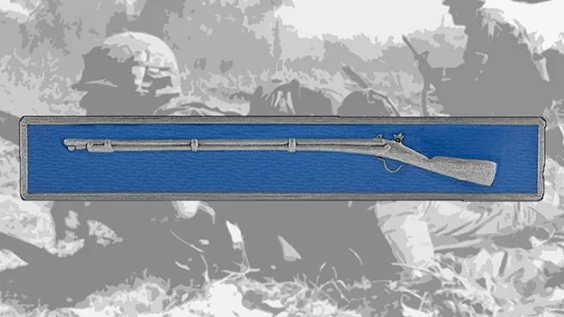
US Army Expert Infantry Badge
Image from armyfacts.com
Thoughts about the Air Force colonel who delivers sanctimonious lectures about institutional racism to his fellow “white colonels”.
In you’re an infantry soldier in the US Army, you can distinguish yourself by earning an Expert Infantry Badge. To do that, you have to qualify as an expert with the rifle, then complete a series of skills tests like “set headspace and timing on a caliber .50 machine gun” and “operate as a station in a radio net with SINCGARS radio single channel”. Then, finally, you have to complete a 12-mile road march. You can read the standards for that event here: carry a rifle and magazines, wear a helmet at all times, carry a rucksack weighing at least 35 pounds, and so on. When the person with the stopwatch says that three hours have elapsed, you’re either standing behind the finish line or in front of it; you either earn the EIB or you don’t.
The test isn’t subjective — the judges don’t award you style points. If you crawl across the finish line in a pool of blood and urine, sobbing for mommy, but you do it in less than three hours, and you still have your rucksack and your rifle and everything else at the end, you get the EIB.
Nor is it weighted. If you’re a fourth-generation VMI graduate with a fine old family name that can be found on the rolls of the Mayflower Society, you get the EIB if you cross the finish line on time. If you’re an E-2 who grew up in a trailer park and barely made it out of high school and doesn’t remember the names of all your so-called stepdads, you get the EIB if you cross the finish line on time. Officers and enlisted work to exactly the same standard. The credential comes from the task, full stop. This fact is the core of every credential you can earn in the military: If you’re authorized to wear the Parachutist Badge, you went to Fort Benning, or whatever they call it now, and jumped out of the plane five times without missing the ground. You did the thing. Doing the thing is who you are, in a growing list of things.
As a set of organizations built on task competence, for plainly measurable tasks that can’t be faked or fudged, the armed forces have been America’s first meritocracy. The first black West Point graduate was commissioned in 1877; the first black Medal of Honor recipient was born into slavery. Even in the segregated military, credentials obtained through task competence bore weight, as the court-martial of Jackie Robinson suggests with its outcome: In 1944, in Texas, a black officer was correct to harshly demand respect from a white enlisted soldier.
If you’ve served in the military, you’ve seen this. In my first posting as an infantryman, my company commander, first sergeant, platoon sergeant, and squad leader were black, a fact that I never heard anyone even mention. Rank, profession, and authority come from doing, without socioeconomic or racial chutes or ladders: If you can fly the plane, you’re a pilot. Up to the boundaries of the flag ranks, politics and identity don’t matter. (Regarding those flag ranks, see the late David Hackworth’s discussion of “perfumed princes”.)
And so the descent of the American military into the performative politics of DEI and equity and Robin DiAngelo books just blindly shits on the core value of the American military, which is that you get the rank and the status for what you do, full stop.
QotD: The Auftragstaktik principle of the Third Reich
Obviously civilian life isn’t as goal-directed as the military in wartime, but a similar principle applied — given a vague set of generalized objectives from the top (Kershaw’s famous “working towards the Führer” thesis), everyone at every level was encouraged to move the ball downfield as he saw fit … with the added twist that, in the absence of a clearly defined, military-style chain of command, the various “subordinates” would ruthlessly battle it out with each other, Darwin-style, for bureaucratic supremacy.
Thus the Nazis’ infamous plate-of-spaghetti org charts. I’m not an expert, but I’m pretty sure there were more than a few guys who held wildly different ranks in various different organizations simultaneously. He might be a mere patrolman in the Order Police, but an officer in the SS, a noncom in the SA (you could be in both, at least in the early days), and so forth. I wouldn’t be surprised if there was more than one guy who technically reported to himself, somewhere deep in the bowels of the RHSA [Reich Security Main Office]. You could spend a lifetime trying to sort this stuff out …
Severian, “The Crisis of the Third Decade”, Rotten Chestnuts, 2021-03-18.
October 28, 2023
Smith versus Smith: US Army/Marine relations in 1944
World War Two
Published 27 Oct 2023When Marine Corps General Holland “Howling Mad” Smith removed Infantry General Ralph Smith from command in 1944 during the Battle of Saipan, it began a controversy that soon snowballed, threatening to sabotage Army-Marine relations at a time when cooperation was the key to victory.
(more…)
October 23, 2023
Icon of Canadian Search and Rescue For 40 years; the story of the CH-113 Labrador
Polyus
Published 3 Sept 2021The Boeing-Vertol CH-113 Labrador was an icon of Canadian search and rescue for 40 years. It served on both the right and left coast and undertook many life saving rescues in its day. Originally ordered as two models, an army transport version and a search and rescue version, they were all converted to a common standard when the army took possession of their Chinook helicopters. As a dedicated search and rescue helicopter it excelled at its role. Its replacement is a long story for another time but involves several facepalm moments thanks to short sighted decision making. As a result it was kept in service longer than anticipated but still did the job well.
0:00 Introduction
0:27 Previous generation of search and rescue
1:18 Acquisition of the CH-46 Sea Knight
4:10 Definitive CH-113 Labrador model
5:53 Replacement and retirement
6:38 Conclusion
(more…)
October 22, 2023
QotD: The changes in Roman legionary equipment attributed to the “Marian reforms”
For the pilum, Plutarch says that Marius designed it to incorporate a wooden rivet where the long metal shank met the heavy wooden shaft, replacing one of the two iron nails with a wooden rivet that would break on impact, in order to better disable the shield. The problem is that the pilum is actually archaeologically one of the best attested Roman weapons with the result that we can follow its development fairly closely. And the late, great Peter Connolly did exactly that in a series of articles in the Journal of Roman Military Equipment Studies1 and while the design of the pilum does develop over time, there’s simply no evidence for what Plutarch describes. The “broad tanged” pilum type could have been modified this way, but we’ve never found one actually so modified; instead the pila of this type we find all have rivets (two of them) in place (where rivets are preserved at all). Moreoever, most pila of that “broad tanged” type, both before and after Marius, have the edges of that broad tang bent over at the sides, which would prevent the sort of sliding action Plutarch describes even if one of the rivets broke. Meanwhile, by the first century there are three types of pila around (socketed, broad-tanged and spike-tanged) only one of which could be modified in this way (the broad-tanged type), and that type doesn’t dominate during the first century when one might expect Marius’ new-style pila to be in use. In practice then the conclusion seems to be that Plutarch made up or misunderstood this “innovation” in the pilum or, at best, the design was adopted briefly and then abandoned.
On to the aquila. Now, it is absolutely true that the aquila, the legionary eagle, became a key standard for the Roman legions. Pliny the Elder notes that before Marius it was merely the foremost of five standards, the others being the wolf, minotaur, horse and boar (Plin. HN 10.16). But even a brief glance as legionary standards into the early empire (see Keppie (1984), 205-213 for an incomplete and somewhat dated list) shows that bulls, boars and wolves remained pretty common legionary emblems (alongside the eagle) into the empire. The eagle seems to have been something of a personal totem for Marius (e.g. Plut. Mar. 36.5-6) so it is hardly surprising he’d have emphasized it, the same way that legions founded by Caesar – or which wanted to be seen as founded by Caesar – adopted the bull emblem, quite a lot. But this is a weak accomplishment, since Pliny already notes that the eagle was, even before Marius, already prima cum quattuor aliis (“first among four others”), and so it remained: first among a range of other emblems and standards. Though of all of the things we may credit Marius with instituting, this perhaps gets the closest, if we believe Pliny that Marius further elevated the eagle into its particular position.
Then there is the institution of the Roman marching pack and the furca to carry it, such that Marius’ soldiers became known as “Marius’ mules” because he made them carry all of their own kit rather than, as previous legions had supposedly done, carrying it all on mules. Surely this extremely famous element of the narrative cannot be flawed? And Plutarch sort of says this, he notes that, “Setting out on the expedition, he laboured to perfect his army as it went along, practicing the men in all kinds of running and in long marches, and compelling them to carry their own baggage and to prepare their own food. Hence, in after times, men who were fond of toil and did whatever was enjoined upon them contentedly and without a murmur, were called Marian mules” (Plut. 13.1; trans. B. Perrin). Except that doesn’t say anything about instituting the classic Roman pack that we see, for instance, depicted on Trajan’s column, does it? It just says Marius made his men carry their baggage and prepare their own food, leading to the nickname for men who did toil without complaint.
The problem is that those two things – making soldiers carry their baggage and cook their own food (along with kicking out camp followers) – are ubiquitous commonplaces of good generalship with instances that pre-date Marius. P. Cornelius Scipio Aemilianus does exactly this – getting rid of camp servants, wagons and pack animals, making soldiers cook their own food and kicking out the camp followers – according to Appian in 134 when he besieged Numantia (which fell in 133, App. Hisp. 85). And then Q. Caecilius Metellus, Marius’ own former commander, does the exact same thing in 109 when he takes command against Jugurtha in North Africa, kicking the sutlers out of the camp, getting rid of pack animals and private servants, making soldiers cook their own food, carry their own rations and their own weapons (Sall. Iug. 42.2; note that Sallust dies in in the 30s BC, 80-odd years before Plutarch is born, so Plutarch may well be getting this trope from Sallust and then attributing it to the wrong Roman). Critiques of generals who issued rations rather than making their soldiers cook or praise for generals who didn’t remained standard into the empire (e.g. Tac. Hist. 2.88; Hdn. 4.7.4-6; Dio Cass. 62.5.5). In short this trope was not new to Marius nor was it new to Plutarch’s version of Marius; it was a standard trope of generals restoring good discipline to their soldiers. Plutarch even hedges noting another story that the term “Marius’ mules” might actually have come how well Marius as a junior officer got along with animals (Plut. Mar. 13.2)!
Well, fine enough, but what about the idea that state-issued equipment is emerging in this period? Well, it might be but our evidence is not great. As noted when we discussed the dilectus, Polybius implies – and his schematic for conscription makes little sense otherwise – that the Romans are in that period buying their own equipment. He also notes that the quaestors deduct from a soldier’s pay the price of their rations (if they are Romans; socii eat for free), their clothing and any additional equipment they need (Polyb. 6.39.14). It makes sense; if a fellow forgot a sword or his breaks, you need to get that replaced, so you fine him the value of it and then issue him one from the common store.
Now Keppie (1984) assumes this system changes during the tribunate(s) of Gaius Gracchus (123-2) and you can see the temptation in this idea. If Gaius Gracchus shifts equipment to being issued at state expense, then suddenly there’s no reason not to recruit the landless proletarii (discussed below) opening the door for Marius to do so (discussed below) and fundamentally transforming the Roman army into the longer-service, professional form we see in the empire. The problem is that, well, it didn’t happen. First, we have no evidence at all that Gaius Gracchus did anything related to soldier’s arms and armor; what we have is a single line from Plutarch that soldiers should be issued clothing at state expense with nothing deducted from their pay to meet this cost (Plut. C. Gracch. 5.1). The assumption here is that this also covered arms and armor, but Plutarch doesn’t say that at all. The more fatal flaw is that we can be very, extremely sure this reform didn’t stick, because we have a bunch of Roman “pay stubs” from the imperial period (from Egypt, naturally) and regular deductions vestimentis, “for clothing” show up as standard.2 Indeed, they show up alongside deductions for food and replacement socks, boots and so on, exactly as Polybius would have us expect. Apart from the fact that this is presumably being done by a procurator instead of a quaestor (a change in the structure of administration in the provinces run directly by the emperor), this is the same system.
Now there are reasons to think that at least some equipment was state supplied or contracted (even if it may have been billed to the accounts of the soldiers who got it). Scipio creates a public armaments production center in Carthago Nova in 210, but this may be a one off. Seemingly more centralized production of arms under contract are more common in the late Republic and by the imperial period we start to see evidence of fabricae which seem to be central production sites for military equipment.3 But we have no hint in the sources of any sudden reform to this system. It may well be a gradual change as the “mix” of personal and state-ordered equipment slowly tilts in favor of the latter; the system Polybius describes could accommodate both situations, so there’s no need for a sudden big shift. Alternately, the preponderance of state-produced equipment might well be connected to the formalization of a long-service professional army under Augustus. Even then, we still find pieces of equipment in Roman imperial sites which were clearly personal; soldiers could still go and get a fancy version of standard kit, stamp their name in it and call it theirs. All I think we can say with any degree of confidence is that self-purchased equipment seems to be the norm in Polybius’ day whereas state-issued equipment seems to be the norm by the end of the first century. But Marius has nothing to do with it, as far as we can tell and no ancient source claims that he did.
Oh and by the by, if you are picking up from all of this (and our discussion of Lycurgus) that Plutarch is a difficult source that needs to be treated with a lot of caution because he never lets the facts get in the way of a good story … well, that’s true.
Bret Devereaux, “Collections: The Marian Reforms Weren’t a Thing”, A Collection of Unmitigated Pedantry, 2023-06-30.
1. “Pilum, Gladius and Pugio in the Late Republic”, JRMES 5 (1997), then “The Reconstruction and Use of Roman Weaponry in the Second Century BC”, JRMES 11 (2000) and then “The pilum from Marius to Nero – a reconsideration of its development and function”, JRMES 12/13 (2001/2).
2. On this, see R.O. Fink, Roman Military Records on Papyrus (1971).
3. On all this, see Bishop and Coulston, Roman Military Equipment (2006), 233-240.
October 21, 2023
QotD: The US Army’s Korean War blooding
For his own sake and for that of those around him, a man must be prepared for the awful, shrieking moment of truth when he realizes he is all alone on a hill ten thousand miles from home, and that he may be killed in the next second.
The young men of America, from whatever strata, are raised in a permissive society. The increasing alienation of their education from the harsher realities of life makes their reorientation, once enlisted, doubly important.
Prior to 1950 they got no reorientation. They put on the uniform, but continued to get by, doing things rather more or less. They had no time for sergeants.
As discipline deteriorated, the generals themselves were hardly affected. They still had their position, their pomp and ceremonies. Surrounded by professionals of the old school, largely field rank, they still thought their rod was iron, for, seemingly, their own orders were obeyed.
But ground battle is a series of platoon actions. No longer can a field commander stand on a hill, like Lee or Grant, and oversee his formations. Orders in combat — the orders that kill men or get them killed, are not given by generals, or even by majors. They are given by lieutenants and sergeants, and sometimes by PFC’s.
When a sergeant gives a soldier an order in battle, it must have the same weight as that of a four-star general.
Such orders cannot be given by men who are some of the boys. Men willingly take orders to die only from those they are trained to regard as superior beings.
It was not until the summer of 1950, when the legions went forth, that the generals realized what they had agreed to, and what they had wrought.
The Old Army, outcast and alien and remote from the warm bosom of society, officer and man alike, ordered into Korea, would have gone without questioning. It would have died without counting. As on Bataan, it would not have listened for the angel’s trumpet or the clarion call. It would have heard the hard sound of its own bugles, and hard-bitten, cynical, wise in bitter ways, it would have kept its eyes on its sergeants.
It would have died. It would have retreated, or surrendered, only in the last extremity. In the enemy prison camps, exhausted, sick, it would have spat upon its captors, despising them to the last.
It would have died, but it might have held.
T.R. Fehrenbach, This Kind of War: A Study in Unpreparedness, 1963.
October 20, 2023
Zulu Kingdom’s Last Stand – The Anglo-Zulu War 1879
Real Time History
Published 18 Oct 2023The Anglo-Zulu War in 1879 is one of the most well known colonial wars of the British Empire. And while the British ultimately won and annexed the Zulu Kingdom, at the Battle of Isandlwana they suffered one of their worst defeats.
(more…)
October 14, 2023
A Jacobite spy for Bonnie Prince Charlie
In the latest Age of Invention newsletter, Anton Howes talks about the career of John Holker of Manchester, cloth manufacturer, who joined the army of Prince Charles Edward Stewart in 1745, and eventually became an expert in industrial espionage:
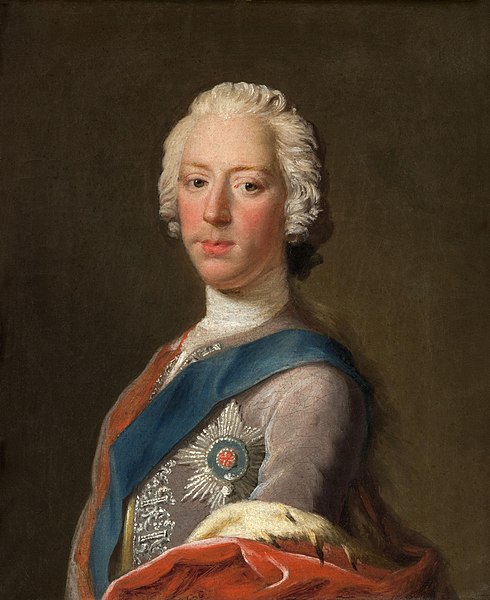
Prince Charles Edward Stuart, 1720 – 1788. Eldest Son of Prince James Francis Edward Stuart.
Portrait by Allan Ramsay, National Galleries Scotland via Wikimedia Commons.
I’ve lately been reading about one of history’s greatest spies — not a James Bond-like agent with licence to kill, but a master of industrial espionage, John Holker.1
Holker was originally from Manchester, in Lancashire, where he was a skilled cloth manufacturer in the early eighteenth century, his specialty being calendering — a finishing process to give cloth a kind of sheen or glazed effect. But Holker was also a Catholic and a Jacobite — a believer in the claim of the Catholic descendants of the deposed king James II to be the rightful rulers of Great Britain, instead of the Hanoverian George I and George II who had only succeeded to the throne because they were Protestants. In 1745 James II’s grandson Charles, also known as Bonnie Prince Charlie — likely the “Bonnie” who lies over the ocean in the famous song — landed in the Scottish Highlands and raised the royal standard. Charles’s uprising defeated the British troops stationed in Scotland, captured Edinburgh, and then marched down the west coast of England, capturing Carlisle and entering Lancashire.
To Holker, who had been born in the same year as the last Jacobite rebellion in 1719, the arrival of Charles in Manchester must have seemed like a once-in-a-generation opportunity. He and his business partner instantly joined Charles’s troops and he was appointed a lieutenant. But Manchester was the last place to provide many eager volunteers for the uprising, and when Charles reached Derby he lost heart and turned around. Holker and his business partner ended up being left to garrison Carlisle as Charles and his force retreated into Scotland to hunker down, and they were soon captured by the British troops sent to quash the uprising. They were then, as officers, sent to Newgate prison in London to sit with their legs bound in irons and await trial and certain execution.
But they never made it to trial. In the first demonstration of Holker’s extraordinary talent for espionage, they escaped. Holker had been allowed visitors in prison, so had drawn on London’s crypto-Jacobite circle to smuggle in files, ropes, and information about the prison and its surroundings. They managed to file through the leg-irons and window bars, climbed up the gutters onto the prison roof, and then used planks from the cell’s tabletop to cross onto the roof of a nearby house. In the event, they disturbed a dog guarding the house, and so Holker hid in a water-butt and became separated from the others. He eventually found refuge at a crypto-Jacobite’s house, then escaped into the countryside before managing to make his way to France.
In France, Holker joined his fellow veterans of the failed uprising of ‘45, becoming a lieutenant in a Jacobite regiment of the French army. He fought for the French in the Austrian Netherlands — present-day Belgium — against the Hapsburgs, the Hanoverians, the Dutch, and the British. Even more extraordinary, however, was that when Bonnie Prince Charlie wanted to go in secret to England in 1750, it was Holker who went with him as his sole companion and guide. Although Charles failed to persuade his supporters in England to rise up in rebellion on their own, Holker managed to get the prince secretly and safely to London and back.
By the time Holker reached his early thirties he had been an industrialist, rebel, prisoner, fugitive, soldier, undercover agent, and even spy-catcher: he successfully identified a spy for the British in Charles’s circle, even if Charles failed to heed his warning. But in 1751 Holker’s career took yet another turn when he was recruited by the French government as an industrial spymaster.
Holker’s chief task was to steal British textile technologies.
1. Unless otherwise stated, I’ve drawn much of my information on Holker and the industries that the French attempted to copy from John R. Harris, Industrial Espionage and Technology Transfer: Britain and France in the 18th Century (Taylor & Francis, 2017), particularly chapter 3.
October 12, 2023
Considering Israel’s potential courses of action in Gaza
CDR Salamander puts on his Operational Planning hat and sifts through what Israel may decide to do in light of open source information from Israeli and other sources:

This isn’t going to make anyone happy. It doesn’t matter if you are on the “cease fire and de-escalate” left or the “Linebacker III” right — none of my COAs will be quite what you are looking for … though the Linebacker III crowd might be OK with COA-B and COA-C … but I’m getting ahead of myself.
Cut this ‘ole Operational Planner some slack, and a few caveats:
- I’ve had to rewrite 85% of this from its first draft over the weekend as we now have Commander’s Intent (CI) and higher Direction and Guidance (D&G). That had me discard two of my three Courses of Action (COA).
- I am quite sure the Israeli Defense Forces had appropriate draft Operational Plans (OPLANS) on the shelf with all sorts of Branch Plans and Sequels waiting to be updated and providing enough once dusted off to get things in to Phase I.
- I don’t have a Planning Staff or even a Core Planning Group, intel support, or even some Italian colleagues to remind me to take my 10:00 and 15:00 coffee breaks, but I’ll do my best anyway. As anyone in crisis response planning can tell you — as opposed to advanced plans types — you have to be comfortable enough to accept that you don’t have enough time, staff, or information to produce a great OPLAN, but you’ll come up with a good enough plan anyway. You’re happy to be wrong about a detail or two, and are open-minded enough, secure in your ego, and content to change what you thought was perfect — some or all of your plan — the moment you get better information, changes in CI or D&G, or the situation develops in unexpected ways … as they do.
- If you are looking for a detailed Tactical OPLAN or a sweeping Strategic OPLAN, you’re at the wrong substack. I’m an Operational Planner and what I am about to do is an “elevator speech” level Preliminary COA Decision Brief with the principals (J2, J3, J4, J5, and the Chief of Staff) where they get to weigh in and refine what the Planning Group I am the Chair of has produced (OK, I’m a Planning Group of one and I made myself Chair … I don’t care, it’s going on my FITREP anyway). Following the Principals’ input — especially from the Chief of Staff who has had better one on one time with the Commander and as such has the nuance no one else does — I’ll beg for a day and will be told I have two hours to make changes and then well brief the Commander.
Working from open-source information, we have CI and D&G from the Prime Minister and the Minister for Defense.
If you go to YouTube you can get the script, but we’ll use this statement from the weekend as a close approximation of POLMIL-level guidance from Prime Minister Netanyahu;
As a Planning Staff, what do I need to take away from this?
- Israel is at war.
- Israel will finish it.
- We will exact a price that will be remembered by them (Hamas) and Israel’s other enemies for decades to come.
From Defense Minister Yoav Gallant we have:
- Gaza won’t return to what it was before.
- We started the offensive from the air, later will also from the ground, and that’s how it will end.
- Gaza will never return to what it was.
Like I said … that had me ditch two of the my three COA from this weekend. If you wanted to know how it shifted, my most dovish COA is gone, and my most harsh COA is now the center of my Overton Window. A planner must try to align with CI and D&G as it is understood — not how he wishes it to be.


October 11, 2023
QotD: A rational army would run away …
If all of us plant our spears and hold them steady, with luck we can break their charge; some of us will die but most of us will live. If we run, horses run faster than we do. I should stand.
Oops.
I made a mistake; I said “we”. I don’t control the other men. If everybody else stands and I run, I will not be the one of the ones who gets killed; with 10,000 men in the line, whether I run has very little effect on whether we stop their charge. If everybody else runs I had better run too, since otherwise I’m dead.
Everybody makes the same calculation. We all run, most of us die.
Welcome to the dark side of rationality.
This is one example of what economists call market failure — a situation where individual rationality does not lead to group rationality. Each person correctly calculates how it is in his interest to act and everyone is worse off as a result.
David D. Friedman, “Making Economics Fun: Part I”, David Friedman’s Substack, 2023-04-02.


