
First off we need to establish what changes are generally understood to fall under the heading of the “Marian Reforms”, before we then try to actually locate those changes in our evidence (and then marvel at our general inability to do so). Understood broadly the Marian reforms are supposed to be a combination tactical, organizational and equipment reforms associated with Gaius Marius in the last decade of the 100s. As it turns out, Marius initiated almost none of these reforms, some of these supposed reforms didn’t happen at all at any point and some of them happened outside the time period in question.
In short, the things that are supposed to have happened here are:
- (Tactical-Organizational) A shift in battle tactics from the two-century maniple (c. 120 men) to the six-century cohort (c. 480 men) as the primary tactical unit on the battlefield,1 as well as the primary organizational unit of the Roman army. Elements of the older Polybian legion persist in names and titles.
- (Organizational) A shift from poorly paid conscript soldiers drawn from Rome’s propertied class (the assidui) drawn up through the dilectus to the use of volunteers drawn from Rome’s property-less poor (the proletarii or capite censi) who served as effectively professional soldiers, lacking any other means of subsistence.
- (Organizational) The practice of granting land and/or citizenship to Roman soldiers on discharge as a regular feature of Roman service.
- (Organizational) The end of the light infantry velites and Roman citizen cavalry (the equites) as part of the legion, as a product of the next point making such wealth distinctions unimportant.
- (Logistical) The introduction of state-supplied equipment (in place of self-supplied equipment) which enabled the mass-recruitment of the proletarii, as they no longer needed to be able to afford their own equipment, as part of a reform ascribed by some scholars to Gaius Gracchus (trib. 123-2).
- (Equipment) The introduction of a new design of pilum with a wooden rivet designed to break on impact with enemy shields (Plut. Mar. 25).
- (Equipment) The prioritization of the aquila, the eagle standard, over other standards in the legion (Plin. NH 10.16), often framed as the aquila fully replacing these other standards.
- (Equipment) The introduction of the furca, a Y-shaped pole for carrying the soldier’s pack (the sarcina), leading to better legionary logistics.
As we’re going to discuss, some of these things happened – but not because of Marius – and some of them didn’t happen at all. So how on earth did this idea of a big “Marian Reform” end up so pervasive in how we (used to) understand the Roman army of this period? The answer really has a lot to do with gaps (lacunae) in our sources. For the early second century, we have two really quite good sources on Roman military activity, Livy and Polybius. But both give out by mid-century,2 leaving us relatively blind until Julius Caesar‘s comentarii (de Bello Gallico and de Bello Civili) suddenly give us a massive infusion of information as we can see Caesar’s army functioning often in quite minute detail.
And we see what seem to be quite different armies! Caesar is using cohorts as tactical and operational units, rather than maniples. His armies don’t seem to have any citizen cavalry in them and they seem to be very loyal to him; he’s using a lot of non-citizens in auxiliary roles in a way that we know will become very standard in the imperial period (eventually making up half the army by Tiberius‘ reign). And indeed, moving forward, the legions of the early empire end up a lot more visible to us, both because of the literary evidence (Tacitus!) and also because, as they become more stationary on fixed frontiers, they leave forts and inscriptions and other evidence we can see far more clearly than the ever-moving armies of the Roman Republic.
And then into that there is Gaius Marius. Remember that our sources in this period are a bit patchier, without a strong continuous narrative (but with a lot of sources so we generally have someone for most of it). But Marius gets a lot of focus because of his roles in the civil wars and his spectacular seven consulships, and the one thing we are told quite clearly about him is that in 107 when he raised his first consular army he broke tradition by accepting volunteers from the proletarii (Sall. Iug. 86.1; Plut. Mar. 9.1). The temptation then to see that substantial change (which, to be clear, our sources are exaggerating for reasons I’ll discuss in a moment) as connected to all the other changes from the “Polybian” legion to the “Caesarian” legion and thus to assume that Marius is doing all of them, reading far too deeply into a few lines of Sallust and Plutarch (the latter not generally a particularly good guide on military affairs).
And I should note finally at the outset that this all also plays into a tendency in our sources generally: ancient authors really like narratives where one particular aristocrat can be credited with making major reforms or innovations as an expression of their particular virtue. We’ve talked about this with Lycurgus, but it shows up consistently with rulers supposedly introducing new weapons and new practices as big, top-down reforms that, on closer inspection, turn out to be gradual changes we can see signs of happening over quite some time. It’s an understandable if irritating bias of habit for authors whose purpose in writing is the education of aristocrats on how to be leaders – every big change has to be a product of the character and leadership of aristocrats (even when it wasn’t). Plutarch, especially, of all ancient authors, loves these sorts of just-so stories and guess who we are heavily reliant on for the life of Gaius Marius? But until relatively recently, historians were often far more willing to accept these sorts of just-so stories than they should have been (in part because late 19th and early 20th century historians shared some of those same assumptions about elite leadership and in part because singular reforms make for compelling stories).
Bret Devereaux, “Collections: The Marian Reforms Weren’t a Thing”, A Collection of Unmitigated Pedantry, 2023-06-30.
1. Note that the size of the century has changed, from 60 to 80 as well.
2. Polybius’ history, already incomplete as we have it, ends, while Livy’s continuous narrative which originally went through the first century cuts out almost completely in 167, leaving us with just summaries of his work.
October 6, 2023
QotD: The “Marian Reforms” to Roman legions
October 2, 2023
The fall and rise of siege warfare
Sieges are probably about a year or so younger than the first fortified village — as soon as someone came up with the bright idea of throwing a wall around it for protection, some equally bright spark likely started coming up with ways to get inside that wall. In The Critic, Peter Caddick-Adams considers the eclipse and return of siege warfare in Europe in reviewing Iain MacGregor’s The Lighthouse of Stalingrad and Prit Buttar’s To Besiege a City: Leningrad 1941-42:
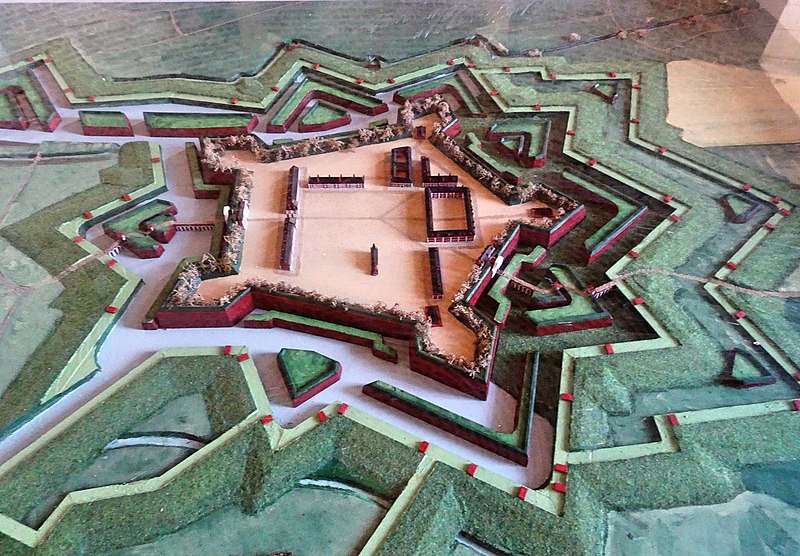
A model of the Vauban fortress at Arras in northern France. Arras is one of the Fortifications of Vauban, a UNESCO World Heritage Site.
Image via Wikimedia Commons.
The history of war is never far removed from battles for cities. Many of us, of whatever creed, were brought up on the story of the walls of Jericho tumbling after the Israelites marched around the stronghold once a day for six days, seven times on the seventh day, and then blew their trumpets. Though no archaeological evidence at Tell es-Sultan, in modern Palestine, corroborates the arresting visual image related in Joshua, Chapter 6, diggers have uncovered a range of defensive stone and brick walls dating back to 8,000 BC. It indicates that even 10,000 years ago, the ancients indulged in the odd siege when the mood took them. The biblical story also introduces us to the concept of intimidation, today fashionably called “psychological warfare”.
The much younger fortress of Troy provides insights into another city-focussed era of battles. Beneath today’s Hisarlik in northern Turkey are nine archaeological layers. Troy VIII was the alluring city of Classical and Hellenistic times, as portrayed in the Iliad, Homer’s Odyssey and Virgil’s Aeneid. The Romans took the lessons of Homeric Troy seriously and clad all their major settlements with defensive walls, as any exploration of Canterbury, Chester or York will confirm. These acted as magnets for opponents, as in Boudicca’s revolt of AD 60–61. Cities such as Colchester, London and St Albans were sacked, as much for what they represented as for their physical presence.
When the Normans arrived in their longships, they imported the concept of stone castles to control the newly conquered English. Their walled cities would be ungraded and contested scores of times over the succeeding six centuries. Henry V’s siege of Harfleur (modern Le Havre) in 1415, the beginning of the Agincourt campaign famously depicted in Shakespeare’s play, underlined the drawback of traditional sieges. They took longer and were usually far costlier than expected. Several thousand men camped in a small area with no knowledge of hygiene inevitably resulted in a high mortality rate amongst the attackers before a shot was fired.
Harfleur was also the first time an English army made use of gunpowder artillery in a siege, a technology that had trickled its way across the world from China. Powder and fuse heralded events 38 years later, when an Ottoman army shook the Christian world to its core by breaching the massive walls of Constantinople (Istanbul) after a 53-day bombardment using cannons. On Tuesday, 29 May 1453, stone finally gave way to bronze and iron, finishing the last remnant of the Roman Empire. Europe was never quite the same again. Fortress architecture started to employ breadth, using earthen ramparts and ditches, rather than height.
Strategy for urban warfare intensified during the lifetime of the French fortress engineer Vauban (1633–1707), who used landscaped terrain as well as geometrically designed defensive walls to deter would-be besiegers. When viewed from above, his fortification designs resemble starfish. So successful were his tactics that sieges, always costly and time-consuming, lessened in importance. His contemporary Marlborough recognised that on any cost-benefit analysis, Vauban had rendered sieges militarily unprofitable, restoring manoeuvre to campaigns.
Subsequent wars fought in the Napoleonic era, the Crimea, between the American North and South, and by Prussia generally reflected this return to mobility. There was the odd attritional discrepancy with the 1854–55 siege of Sevastopol, that of Petersburg in 1864–65 and Paris in 1870–71. Cities were still fought for, but usually contests were removed away from the walls, where forces could conduct wide sweeping manoeuvres, such as Leipzig in 1813 or Ypres in the Great War. As weapons grew more accurate and their munitions heavier, fortifications broadened and sank into the ground, culminating in the trenches of 1914–18. In this era, dominance of terrain became the hallmark, and it was virtually siege-free.
It was remarkable that urban warfare returned on an industrial scale during the Second World War, a time usually associated with blitzkrieg and rapid tank thrusts. This happened at Leningrad, Sevastopol and Stalingrad in the East; at Ortona and Cassino in Italy, Caen; Carentan and St Lo in Normandy; in Aachen and later assaults on Aschaffenburg and Cologne, Magdeburg, Leipzig and Berlin in 1945. Subsequent NATO doctrine for the defence of central Europe focussed on the threat of more attrition. Plans were devised to defend quite small localities, putting grit in the Soviet steamroller and making the cost of attacking Western towns and cities prohibitive.
Update: Broken URL corrected.
September 27, 2023
The British army between 1918 and 1940
Richard Dannatt and Robert Lyman recently published Victory to Defeat, which chronicles the decline of the British army’s fighting capabilities in the interwar years. Robert Lyman posted a longer version of Gordon Corrigan’s review for Aspects of History (with permission):
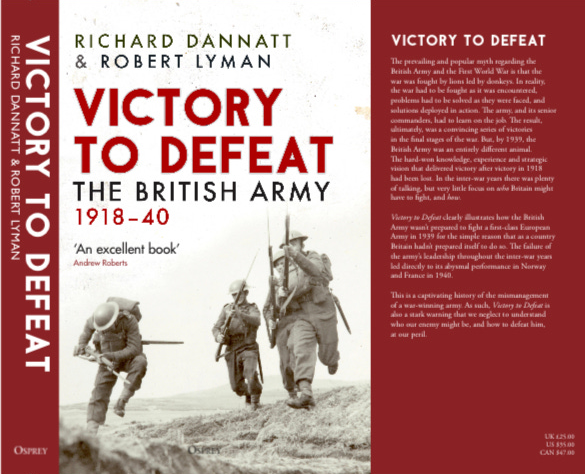
The British Army ended the First World War well trained, well led, well equipped and capable of engaging in all arms intensive warfare. Of all the players, on both sides, this army was unquestionably the most capable of deployment against a first class enemy anywhere in the world. Twenty years later it found itself with very much the same equipment, but with very much less of it, and devoid of either the ability or the means to fight a war in Europe against an enemy which had absorbed the lessons of 1918 but which the British had forgotten. It was the British Army that had invented blitzkrieg (although of course they did not call it that, a term coined by the French press very much later) and used it during the Battle of Amiens and on into the “Hundred Days” that saw the defeat of the German Army on the battlefield, and whatever German myth later averred, it was the British Army that forced that victory on the Western Front, not the French and not the Americans. And yet, in 1939 and 1940 the British were roundly defeated in France and Belgium, in Greece, in Crete and in North Africa. In this important – and to this reviewer almost heart rending – book the authors describe how and why the victors of 1918 were allowed to become incapable of fighting intensive warfare a mere two decades later.
In the first part of the book the authors describe the build up to the First War, and their explanation of the so called “Curragh Mutiny” is much more accurate than many accounts by others (although the officers did not threaten to disobey orders, only to resign, and while Carson’s Ulster Volunteers were indeed incorporated into the British Army as the 36th Ulster Division, so were Redmond’s National Volunteers, into the 16th Irish Division). The authors then go on to show how the British government had, albeit reluctantly, accepted a continental commitment in 1914 and had despatched an expeditionary force to Belgium, described then and later as the finest body of troops ever to leave these shores. Fine they certainly were, well trained, well led and well equipped, but the British Expeditionary Force (BEF) of professional regular soldiers was pitifully small, and with experience of imperial policing and not of war against a first class enemy. With the need to expand enormously and rapidly, this army had to adapt to a theatre where massed artillery, machine guns and barbed wire made any attempt to manoeuvre almost impossible. The book shows how by trial and error, by analysis of operations and by a gradually developing doctrine the British learned to use a combination of all arms to break through German defences and eventually to defeat them. With the infantry, the artillery, the armour, the engineers and increasingly the air all working together to get inside the enemy’s decision making circle, to get him on the back foot and keep him there, these were the elements of blitzkrieg, but it was the defeated Germans who were to absorb those principles and perfect them until twenty years after their defeat they were the most competent army in Europe.
After an excellent account of the British journey from an imperial gendarmerie to a practitioner of intensive war, the next part of the book shows how and why by the time the Second World War came along the British were incapable, not only of deterring war, but of fighting it. The “ten year rule”; the reluctance of governments to spend on defence; the political refusal to contemplate another war in Europe and the reluctance of the public to contemplate another bloodletting like that of the First War; the inability to experiment or to develop tanks and armoured vehicles; the seeming impossibility of reconciling the twin requirements of imperial policing and any commitment to land operations in Europe with the assets available; the myth of the “bomber will always get through” and the absence of any consistent war fighting doctrine, all are lucidly explained. Much of the fault is shown to lie with politicians, and surely the most disgraceful example of political interference was the sacking of the Chief of the Imperial General Staff (CIGS), the professional head of the army, by the leaving of a note on his desk by the very dubious Secretary of State for War, Hore-Belisha. The generals are not spared, however. Despite restrictions on funding and refusal by governments to accept that another war was looming generals could have spoken out, although it does have to be recognised that in a democracy the civil power is paramount.
September 18, 2023
Learning lessons from the plight of the British army in 1940
Lessons from history are only occasionally learned easily … they’re more likely brought to our attention by the Gods of the Copybook Headings after we’ve suffered some awful setback. As the latin tag would have it, Si vis pacem, para bellum: if you want peace, be prepared for war. Most western democracies refuse to believe this is true, and one of the easiest things for peacetime democratic governments to do is to short-fund the military and use the “savings” for more politically popular things that will help them get re-elected. The Canadian government has been a shining example of this since the late 1960s, with no end in sight.
A recent book on the British army, tracing its decline from the end of the First World War to the defeat in the Battle of France in 1940 shows just how quickly a world-beating army can be reduced to second-best in its next conflict. Richard Dannatt & Robert Lyman, the authors of Victory: the British Army 1918-1940 to Defeat, had an article in the Sunday Mail, illustrating the parallels between the army in their book and the British army today:
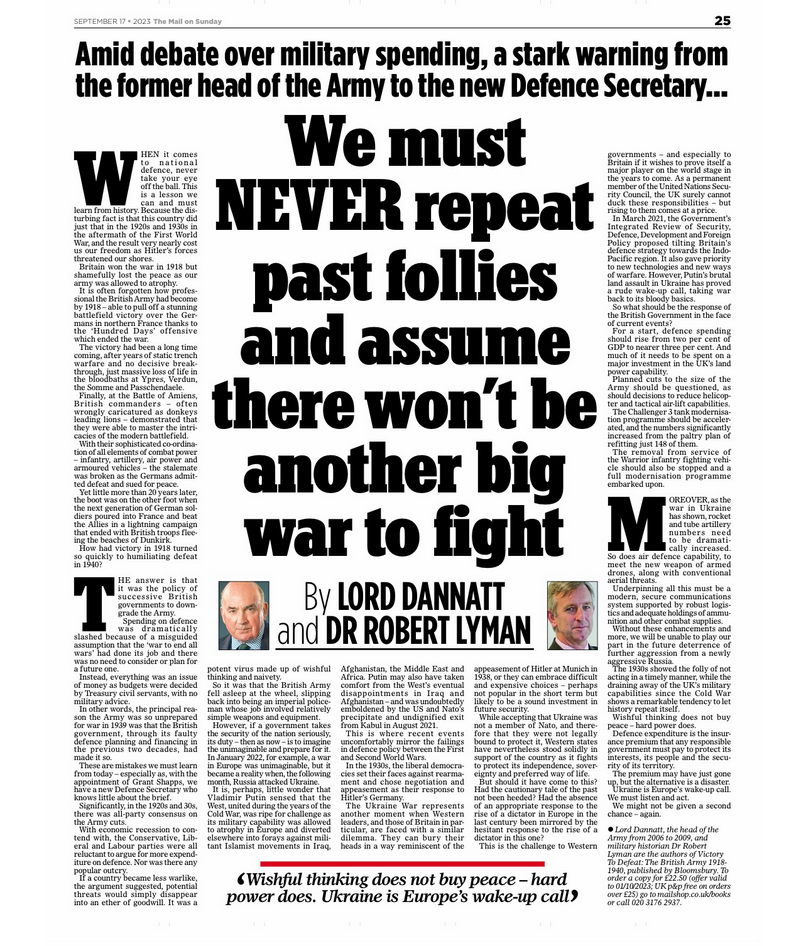
WHEN IT comes to national defence, never take your eye off the ball. That is a lesson we can and must learn from history. Because the disturbing fact is that this country did just that in the 1920s and 1930s in the aftermath of the First World War and the result very nearly cost us our freedom as Hitler’s forces threatened our shores.
Britain won the war in 1918 but then shamefully lost the peace as our army was allowed to atrophy.
It is often forgotten how professional the British Army had become by 1918, to pull off a stunning battlefield victory over the Germans in northern France in the final Hundred Days of the war.
It had been a long time coming after years of static trench warfare and no decisive breakthrough, just massive loss of life in the blood baths at Ypres, Verdun, the Somme and Passchendaele.
But finally, at the Battle of Amiens, British commanders — often wrongly caricatured as dunderheads and “donkeys” leading lions – demonstrated that they were able to understand and master the intricacies of the modern battlefield. With their sophisticated co-ordination of all elements of combat power — infantry, artillery, air power, armour — the stalemate was broken.
Modern war-fighting skills, technology and methods — learned at great cost in lives over the previous three-and-a-half years — secured victory for the British Army and its allies in 1918 as the Germans admitted defeat and sued for peace.
And yet little more than 20 years later, the boot was on the other foot as the next generation of German soldiers poured into France and defeated the Allies in a lightning campaign that ended with British troops fleeing from the beaches of Dunkirk.
How had victory in 1918 turned so quickly to defeat and humiliation in 1940?
The answer is that it had become the deliberate policy of successive British governments to downgrade the Army — a lesson we must learn today, with a new Defence Secretary who knows little about the brief.
Spending on defence was dramatically slashed amid an ill-thought-through assumption that there would not be another major war within ten years and so.
So far as the then government was concerned, the “war to end all wars” (as the Great War was dubbed) had done its job. There was no need to consider or plan for a future one, whether in policy, financial or practical terms. Everything was an issue of money as budgets were decided by Treasury civil servants with no military advice.
The principal reason why the Army was so unprepared for war in 1939 was that the British government, through faulty defence planning and financing in the previous two decades, made it so.
September 15, 2023
Learning to handle mules to accompany Chindit columns in WW2
Robert Lyman posted some interesting details from veteran Philip Brownless of how British troops in India had to learn how to handle mules and abandon their motor transport in order to get Chindit columns into Japanese territory in Burma:
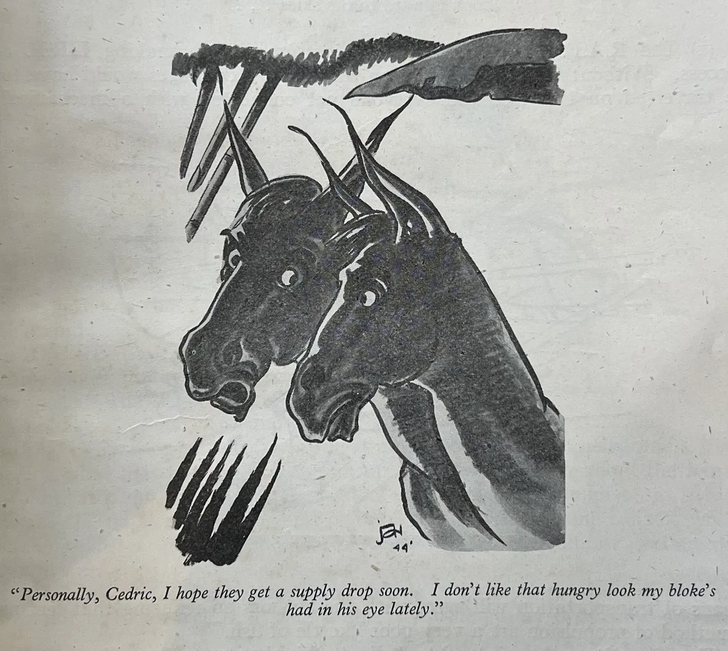
A fabulous drawing from Jungle, Jungle, Little Chindit (1944)
Soon after our return from the Arakan front in the autumn of 1943, we were in central India, and had been told that the whole division was to be handed over to General Wingate and trained to operate behind the Japanese lines. All our motor transport was to be taken away and we were to be entirely dependent upon mules for our transport.
The C.O. one evening looked round the mess and then said to me “You look more like a country bumpkin than anybody else. You will go on a veterinary course on Tuesday and when you come back you will take charge of 44 Column’s mules.”
I had never met one of these creatures before. On arriving at Ambala I reported to the Area Brigade Major who wasn’t expecting me and seemed to have no clue about anything. He said “You’d better go down to the Club and book in”. I reported to the Club, a comfortable looking establishment, and they seemed to have a vague idea that a few bodies like me might turn up on a course and were apologetic that I would have to sleep in a tent but otherwise could enjoy the full facilities of the Club. I was shown the tent, an EPIP tent or minor marquee, with a coloured red lining and golden fleur de lys all over it, (very Victorian) with a small office extension with table and chair in front and another extension at the back with bath, towel rail and a fully bricked floor. Having lived either in a tent or under the stars in both the desert and the Arakan for the last 2 years, this struck me as luxury indeed. Even better, I took on a magnificent bearer, with suitable references, whom I found later was some kind of Hindu priest. I soon got used to having my trouser legs held up for me to put my feet in, and being helped into the rest of my clothes. I had a comfortable 3 weeks learning all about mules.
I discovered all sorts of things like the veterinary term “balls”, which were massive pills which were given to the mule by – first of all grabbing his tongue and pulling it out sideways so he couldn’t shut his mouth on your arm, and then gently throwing the ball at his epiglottis and making sure it went down. Then you let go of his tongue and gave him a nice pat. One of our lecturers, an Indian warrant officer, knew his stuff well and was so pleased about it that when he asked a question he would give you the answer himself. He liked being dramatic and loved to finish a description of some fatal ailment by saying “Treatment, bullet”.
Many of the men in our battalion were East Enders; others came from all over Essex. A few were countrymen, two were Irish and knew all about horses, one sergeant had been in animal transport and one invaluable soldier had been an East End horse dealer. The large majority had had nothing to do with animals: however, the saving grace was that English soldiers seem to be naturally good with animals and soon learned to handle them well. I arranged to get some instruction from the nearby unit of Madras Sappers and Miners and we borrowed a handful of trained mules from them for the men to practise handling, tying on loads and learning to talk to them.
Then came the great day when we were to draw up our main complement of animals, about 70 mules and 12 ponies. We were dumped at a small railway station. It was all open ground and there was a team of Army Veterinary Surgeons to allocate fairly between the three battalions, the Essex, the Borders and the Duke of Wellington’s. Lieut. Jimmy Watt of the Borders was a pal of mine: he and I, with a squad of men were to march them back nearly 100 miles to our camp, sleeping each of the five nights under the stars. As soon as we arrived at the disembarkation site I got all our mule lines laid out, with shackles (used to tie mules fore and aft) and nosebags ready. I had also picked up the tip that the mules would be wild, having spent three days in the train, and almost impossible to hold, so I instructed our men to tie them together in threes before they got off the train. As all three pulled in different directions, one muleteer could hold them. Not everybody had learned this trick so the result was that wild mules were careering all over the place, impossible to catch. When our first handful of mules arrived, they were quickly secured in a straight line and fed. They were familiar with lines like this and cooled down at once, long ears relaxed and tails swishing amiably. When the wild mules careering round saw this line, they said to themselves “We’ve done this before” and came and stood in our lines. We shackled them and I picked out the moth-eaten ones and sent them back to the vets who kept sending polite messages of thanks to Mr. Brownless for catching them. We finished up with a very good set of mules. Jimmy Watt and I had a bit of a conscience about the Duke of Wellington’s so we picked them out a really good pony. We felt even worse a few weeks later when it was sent back to Remounts with a weak heart! The Brigade Transport Officer visited us the second evening so Jimmy Watt and I walked him round rather quickly, chatting hard, to approve the allocation of animals, and he agreed with our arrangement.
In a highly optimistic mood early on, I decided to practise a river crossing. We marched several miles out from camp to a typical wide sandy Indian river, 300 yards across, made our preparations, i.e. assembling the two assault boats, making floating bundles of our clothes and gear by wrapping them in groundsheets, unsaddling the animals, and assembling at the water’s edge. A good sized detachment of muleteers was posted on the opposite bank ready to catch the mules. The mules waded into the shallow water but no one could get them to move off. We tried all sorts of inducements in vain and then suddenly, one sturdy little grey animal decided to swim and the whole lot immediately followed. Calamity ensued! Mules are very short sighted and could only dimly see the opposite bank but downstream was a bright yellow sandy outcrop and they all made for this. The muleteers on the other bank, when they realised what was happening, ran through the scrub and jungle as fast as they could, but the mules arrived first and bolted off into the wilds of India. I swam my pony across with my arm across his withers and directing him by holding his head harness, the gear was ferried across and the mule platoon, with one pony, began the march back to camp. Deeply depressed, I wondered how to tell the C.O. I had lost all his mules and imagined the court martial which awaited me (or, serving under General Wingate, would I be shot out of hand?) An hour and a half later we came in sight of the camp and to my utter astonishment I could see the mules in their lines. When I arrived at the mule lines, the storeman met me and said that the whole lot had arrived at the double and had gone to their places. He had merely gone along the lines, shackling them and patted their noses. Salvation! I kept quiet for a bit but it got out and I was the butt of much merrymaking.
September 11, 2023
How the Russian Army Collapsed
The Great War
Published 9 Sept 2023As 1917 began, the Russian army was larger and better-equipped than ever before. Within weeks, the Tsar and his dynasty were gone, and by the summer, the Russian army was disintegrating before the eyes of its generals — but how exactly did one of the most powerful armies in the world collapse?
(more…)
September 9, 2023
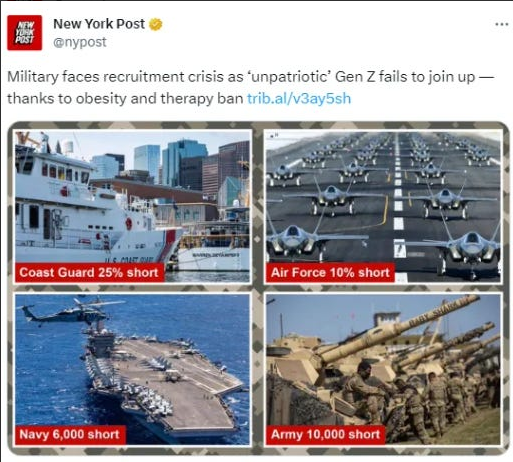
The US military’s recruiting crisis
As I joked earlier this year after one or another of the US services reported falling significantly short of their recruiting goal, “I find this hard to believe now that Uncle Sugar is not only willing to fund your gender transition, but will then guarantee that you won’t be sent into a combat zone.” Kulak has been reading some histories of the 20th century and was surprised to find that the recruiting problem faced by most military organizations in that time was having too many good recruits:
This was after WW1! Millions of young men had just died as part of regiments many little different than this. And yet there was this much demand from young men to be part of the martial world.
This is because the Military and military life was ACTUALLY a good career move, and ACTUALLY formed life long bonds in the early 20th century.
Amidst the population boom of the early 20th century and all the excess young men with little inheritance… the military and militia life was a major vehicle for social mobility and aspiration and forming social connections…
So what changed? Why is it almost completely the opposite in early 21st century America?
These attitudes survived the world wars, even the western front of WW1 …
But they were devoured by Vietnam and the Civil Rights era.
Implicit in a lot of 19th and 20th century militarism was the vision of “Every Soldier a Citizen, Every Citizen a Soldier” this ethos was first expressed during the french revolution … It was aspirational. The subjects divorced from the state and military were now armed and able to participate in civic and military life, they were now citizens … of course by the early 20th century this sounds very menacing… Soldiers must obey orders, every day … if every citizen is a soldier, and bound to obey, on pain of death, that’s Totalitarianism.
You can make a strong case that US military recruiting never fully recovered from the Vietnam era, even through the temporary boost of the post-9/11 patriotic rush.
America has gone from over 1% of the population actively serving at any one time to nearly a third of that.
The “Professionalization” of the US military to an “All Volunteer force” has in effect just been a cover for this collapse in recruiting capacity.
America’s military isn’t significantly structurally different. These aren’t really professionals.
Your average 3 year contract private isn’t making some obscene Yuppie amount of money for his ambitious professional commitment. A private makes under 30k a year. A Second Lieutenant, with a university degree and years of professional development, who may have had to plan out his career from 16 years old getting a Congressman’s letter of recommendation to attend West Point or another service academy … Makes 40-60k a year.
US GDP per capita is 72k. If that Lieutenant had gone to a second tier school and gotten a Computer Science degree he’d be making 6 figures and have vastly more control over his life.
It’s not a good career move, in the 1780s or 1900s and ambitious scion of a decayed noble family desiring to conquer the world might want to become an artillery officer… Today he wants to work on wall street or at Google.
Even if you’re starting out from a very rough place there ar almost certainly a dozen better things you could do to advance yourself faster, for better money, and with less effort than joining the Military.
The only appeal of the US military, for decades now, has been to people who really want to escape their situation, who really felt they needed to hard reboot their life, or who are really drawn to military life out of sheer love of it.
And then the Army went woke.
The long-serving senior officers of every branch of the US military are now locked in to pushing diversity in all its manifold ways, to the point of knowingly discouraging non-diverse service members out of the way to make room for this month’s gender, racial, or other quotas.
So America’s effective recruitment capacity and civic feeling will continue to collapse even as Americans hate each other and their government even more.
You think recruit capacity is bad now? Wait til they imprison Trump.
September 4, 2023
QotD: Historical rice farming versus wheat or barley farming
At the same time, the irrigation demands for effective production of wet-rice requires a lot of labor to build and maintain. Fields need to be flooded and drained; in some cases (particularly pre-modern terrace farming) this may involve moving the water manually, in buckets, from lower fields to higher ones. Irrigation canals connecting paddies can make this job somewhat easier, as can bucket-lifts, but that still demands moving quite a lot of water. In any irrigation system, the bunds need to be maintained and the water level carefully controlled, with also involves potentially quite a lot of labor.
The consequence of all of this is that while the rice farming household seems to be roughly the same size as the wheat-farming household (that is, an extended family unit of variable size, but typically around 8 or so members), the farm is much smaller, with common household farm sizes, even in the modern period, clustering around 1 hectare (2.47 acres) in comparison to the standard household wheat farms clustered around 4-6 acres (which, you may note with the yield figures above, lands us right back at around the same subsistence standard).
Moreover, rice cultivation is less soil dependent (but more water dependent) because wet-rice farming both encourages nitrogen fixation in the soil (maintaining the fertility of it generally without expensive manure use) and because rice farming leads naturally to a process known as pozdolisation, slowly converting the underlying soil over a few years to a set of characteristics which are more favorable for more rice cultivation. So whereas with wheat cultivation, where you often have clumps of marginal land (soil that is too wet, too dry, too rocky, too acidic, too uneven, too heavily forested, and so on), rice cultivation tends to be able to make use of almost any land where there is sufficient water (although terracing may be needed to level out the land). The reliance on the rice itself to “terraform” its own fields does mean that new rice fields tended to under-produce for the first few years.
The result of this, so far as I can tell, is that in well-watered areas, like much of South China, the human landscape that is created by pre-modern rice cultivation is both more dense and more uniform in its density; large zones of very dense rice cultivation rather than pockets of villages separated by sparsely inhabited forests or pasture. Indeed, pasture in particular seems in most cases almost entirely pushed out by rice cultivation. That has very significant implications for warfare and I have to admit that in reading about rice farming for this post, I had one of those “oh!” moments of sudden understanding – in this case, how armies in pre-modern China could be so large and achieve such massive local concentrations. But as we’ve discussed, the size of an army is mainly constrained by logistics and the key factor here is the ability to forage food locally, which is in turn a product of local population density. If you effectively double (or more!) the population density, the maximum size of a local army also dramatically increases (and at the same time, a society which is even more concentrated around rivers is also likelier to allow for riverine logistics, which further improves the logistical situation for mass armies).
But it also goes to the difficulty many Chinese states experienced in maintaining large and effective cavalry arms without becoming reliant on Steppe peoples for horses. Unlike Europe or the Near East, where there are spots of good horse country here and there, often less suited to intensive wheat cultivation, most horse-pasturage in the rice-farming zone could have – and was – turned over to far more productive rice cultivation. Indeed, rice cultivation seems to have been so productive and suitable to a sufficient range of lands that it could push out a lot of other kinds of land-use, somewhat flattening the “ideal city” model that assumed wheat and barley cultivation.
Bret Devereaux, “Collections: Bread, How Did They Make It? Addendum: Rice!”, A Collection of Unmitigated Pedantry, 2020-09-04.
August 19, 2023
QotD: The third system (or “Modern system”) of war
What happens when two current-day modern systems meet? We don’t really know, though there is a lot of speculation. One of the things which made the conflict between Azerbaijan and Armenia so closely watched last year (in 2020, for those reading this later) was that it provided a chance to see two sides both with (sometimes incomplete) access to the full modern kit of war – not only tanks, jets and artillery, but cyber warfare, drones and so on. The results remain to be much discussed analyzed, but it may well be that a fourth system of war is in the offing, defined by the way that drone-based airpower combined with electronic surveillance and cyber-warfare redefined the battle-space and allowed Azerbaijan in particular to project firepower deep into areas where Armenian forces considered themselves safe.
But I shouldn’t get too off track. The point of all of this is that these systems of war are not merely different, they are so radically different that armies created in one system often fundamentally fail to understand the others (thus the tendency for second and third system armies to treat first system war as some strange new innovation in war, when it is in fact the oldest system by far). As we’re going to see, the aims, experiences and outcomes of these systems are often very different. They demand and inculcate different values and condition societies differently as well.
Bret Devereaux, “Collections: The Universal Warrior, Part IIa: The Many Faces of Battle”, A Collection of Unmitigated Pedantry, 2021-02-05.
August 14, 2023
QotD: The US Army in the Korean War
The Army needed legions, but society didn’t want them. It wanted citizen-soldiers.
But the sociologists are right — absolutely right — in demanding that the centurion view of life not be imposed upon America. In a holy, patriotic war — like that fought by the French in 1793, or as a general war against Communism will be — America can get a lot more mileage out of citizen-soldiers than it can from legions.
No one has suggested that perhaps there should be two sets of rules, one for the professional Army, which may have to fight in far places, without the declaration of war, and without intrinsic belief in the value of its dying, for reasons of policy, chessmen on the checkerboard of diplomacy; and one for the high-minded, enthusiastic, and idealistic young men who come aboard only when the ship is sinking.
The other answer is to give up Korea-type wars, and to surrender great-power status, and a resultant hope of order — our own decent order — in the world. But America is rich and fat and very, very noticeable in this world.
It is a forlorn hope that we should be left alone.
In the first six months America suffered a near debacle because her Regular Army fighting men were the stuff of legions, but they had not been made into legionaries.
America was not more soft or more decadent than it had been twenty years earlier. It was confused, badly, on its attitudes toward war. It was still bringing up its youth to think there were no tigers, and it was still reluctant to forge them guns to shoot tigers.
Many of America’s youth, in the Army, faced horror badly because they had never been told they would have to face horror, or that horror is very normal in our unsane world. It had not been ground into them that they would have to obey their officers, even if the orders got them killed.
It has been a long, long time since American citizens have been able to take down the musket from the mantelpiece and go tiger hunting. But they still cling to the belief that they can do so, and do it well, without training.
This is the error that leads some men to cry out that Americans are decadent.
If Americans in 1950 were decadent, so were the rabble who streamed miserably into Valley Forge, where von Steuben made soldiers out of them. If American society had no will to defend itself, neither did it in 1861, at First Manassas, or later at Shiloh, when whole regiments of Americans turned tail and ran.
The men who lay warm and happy in their blankets at Kasserine, as the panzers rolled toward them in the dawn, were decadent, by this reasoning.
The problem is not that Americans are soft but that they simply will not face what war is all about until they have had their teeth kicked in. They will not face the fact that the military professionals, while some have ideas about society in general that are distorted and must be watched, still know better than anyone else how a war is won.
Free society cannot be oriented toward the battlefield — Sparta knew that trap — but some adjustments must be made, as the squabbling Athenians learned to their sorrow.
The sociologists and psychologists of Vienna had no answer to the Nazi bayonets, when they crashed against their doors. The soldiers of the democratic world did.
More than once, as at Valley Forge, after Bull Run, and Kasserine, the world has seen an American army rise from its own ashes, reorient itself, grow hard and bitter, knowledgeable and disciplined and tough.
In 1951, after six months of being battered, the Eighth Army in Korea rose from its own ashes of despair. No man who was there still believes Americans in the main are decadent, just as no man who saw Lieutenant General Matt Ridgway in operation doubts the sometime greatness of men.
T.R. Fehrenbach, This Kind of War: A Study in Unpreparedness, 1963.
August 7, 2023
The Longest Year in Human History (46 B.C.E.)
Historia Civilis
Published 24 Apr 2019
(more…)
August 1, 2023
QotD: US Army culture before the Korean War
A sergeant, by shouting at some sensitive yardbird, could get his captain into a lot of trouble. For the real effect of the Doolittle recommendations was psychological. Officers had not been made wholly powerless — but they felt that they had been slapped in the teeth. The officer corps, by 1946 again wholly professional, did not know how to live with the newer code.
One important thing was forgotten by the citizenry: by 1946 all the intellectual and sensitive types had said goodbye to the Army — they hoped for good. The new men coming in now were the kind of men who join armies the world over, blank-faced, unmolded — and they needed shaping. They got it; but it wasn’t the kind of shaping they needed.
Now an N.C.O. greeted new arrivals with a smile. Where once he would have told them they made him sick to his stomach, didn’t look tough enough to make a go of his outfit, he now led them meekly to his company commander. And this clean-cut young man, who once would have sat remote at the right hand of God in his orderly room, issuing orders that crackled like thunder, now smiled too. “Welcome aboard, gentlemen. I am your company commander; I’m here to help you. I’ll try to make your stay both pleasant and profitable.”
This was all very democratic and pleasant — but it is the nature of young men to get away with anything they can, and soon these young men found they could get away with plenty.
A soldier could tell a sergeant to blow it. In the old Army he might have been bashed, and found immediately what the rules were going to be. In the Canadian Army — which oddly enough no American liberals have found fascistic or bestial — he would have been marched in front of his company commander, had his pay reduced, perhaps even been confined for thirty days, with no damaging mark on his record. He would have learned, instantly, that orders are to be obeyed.
But in the new American Army, the sergeant reported such a case to his C.O. But the C.O. couldn’t do anything drastic or educational to the man; for any real action, he had to pass the case up higher. And nobody wanted to court-martial the man, to put a permanent damaging mark on his record. The most likely outcome was for the man to be chided for being rude, and requested to do better in the future.
Some privates, behind their smirks, liked it fine.
Pretty soon, the sergeants, realizing the score, started to fraternize with the men. Perhaps, through popularity, they could get something done. The junior officers, with no sergeants to knock heads, decided that the better part of valor was never to give an unpopular order.
The new legions carried the old names, displayed the old, proud colors, with their gallant battle streamers. The regimental mottoes still said things like “Can Do”. In their neat, fitted uniforms and new shiny boots — there was money for these — the troops looked good. Their appearance made the generals smile.
What they lacked couldn’t be seen, not until the guns sounded.
T.R. Fehrenbach, This Kind of War: A Study in Unpreparedness, 1963.
July 23, 2023
Explained: What Is Pace Sticking?
Forces News
Published 18 Sept 2021A pace stick is a tool made of two pieces of timber that are hinged at the top.
Each summer, 18 pace sticking armed forces teams from around the world come together in an international competition at the Royal Military Academy Sandhurst.
We look at what pace sticking involves, and the history behind it.
(more…)
July 17, 2023
Uncancelled History with Douglas Murray | EP. 06 George Washington
Nebulous Media
Published 27 Dec 2022Allen Guelzo joins Douglas Murray on this episode to discuss George Washington. From his early childhood to his years as president, the two analyze the founding father’s legacy. Should the first president stay cancelled?
(more…)
July 6, 2023
QotD: Liberalizing the US Army after WW2
And here it ruined them.
They had lived their lives in semibitter alienation from their own culture (What’s the matter, Colonel; can’t you make it on the outside?) but now they were sought after, offered jobs in business, government, on college campuses.
Humanly, the generals liked the acclaim. Humanly, they wanted it to continue. And when, as usual after all our wars, there came a great civilian clamor to change all the things in the army the civilians hadn’t liked, humanly, the generals could not find it in their hearts to tell the public to go to hell.
It was perfectly understandable that large numbers of men who served didn’t like the service. There was no reason why they should. They served only because there had been a dirty job that had to be done. Admittedly, the service was not perfect; no human institution having power over men can ever be. But many of the abuses the civilians complained about had come not from true professionals but from men with quickie diplomas, whose brass was much more apt to go to their heads than to those of men who had waited twenty years for leaves and eagles.
In 1945, somehow confusing the plumbers with the men who pulled the chain, the public demanded that the Army be changed to conform with decent, liberal society.
The generals could have told them to go to hell and made it stick. A few heads would have rolled, a few stars would have been lost. But without acquiescence Congress could no more emasculate the Army than it could alter the nature of the State Department. It could have abolished it, or weakened it even more than it did — but it could not have changed its nature. But the generals could not have retained their new popularity by antagonizing the public, and suddenly popularity was very important to them. Men such as Doolittle, Eisenhower, and Marshall rationalized. America, with postwar duties around the world, would need a bigger peacetime Army than ever before. Therefore, it needed to be popular with the people. And it should be made pleasant, so that more men would enlist. And since Congress wouldn’t do much about upping pay, every man should have a chance to become a sergeant, instead of one in twenty. But, democratically, sergeants would not draw much more pay than privates.
And since some officers and noncoms had abused their powers, rather than make sure officers and noncoms were better than ever, it would be simpler and more expedient — and popular — to reduce those powers. Since Americans were by nature egalitarian, the Army had better go that route too. Other professional people, such as doctors and clergymen, had special privileges — but officers, after all, had no place in the liberal society, and had better be cut down to size.
T.R. Fehrenbach, This Kind of War: A Study in Unpreparedness, 1963.


