
Now the besieger’s side of the equation may seem like an odd place to start a primer on fortifications, but it actually makes a fair bit of sense, because the capabilities of a potential attacker is where most thinking about fortification begins. Siegecraft, both offensive and defensive, is a case of “antagonistic co-evolution“, a form of evolution through opposition where each side of the relationship evolves new features in response to the other: neither offensive siege techniques nor fortifications evolve in isolation but rather in response to each other.
In many ways the choice of where to begin following that process of evolution is arbitrary. We could in theory start anywhere from the very distant past or only very recently, but in this case I think it makes sense to begin with the early Near Eastern iron age because of the nature of our evidence. While it is clear that siege warfare must have been an important part of not only bronze age warfare but even pre-bronze age warfare, sources for the details of its practice in that era are sparse (in part because, as we’ll see, siege warfare was a sort of job done by lower status soldiers who often didn’t figure much into artwork focused on royal self-representation and legitimacy-building).
But as we move into the iron age, the dominant power that emerges in the Near East is the (Neo-)Assyrian Empire, the rulers of which make a point of foregrounding their siegecraft as part of a broader program of discouraging revolt by stressing the fearsome abilities of the Assyrian army (which in turn had much of its strength in its professional infantry). Consequently, we have some very useful artistic depictions of the Assyrian army doing siege work and at the same time some incomplete but still very useful information about the structure of the army itself. Moreover, it is just as the Assyrian Empire’s day is coming to a close (collapse in 609) that the surviving source base begins to grow markedly more robust (particularly, but not exclusively, in Greece), giving us dense descriptions of siege work (and even some manuals concerning it) in the following centuries, which we can in turn bring to the Assyrian evidence to better understand it. So this is a good place to start because it is the earliest point where we are really on firm ground in terms of understanding siegecraft in some detail. This does mean we are starting in medias res, with sophisticated states already using complex armies to assault fairly complex, sophisticated fortifications, which is worth keeping in mind.
That said, it should be noted that this is hardly beginning at the beginning. The earliest fortifications in most regions of the world were wooden and probably very simple (often just a palisade with perhaps an elevated watch-post), but by the late 8th century, well-defended sites (like walled cities) already sported sophisticated systems of stone walls and towers for defense. That caveat is in turn necessary because siegecraft didn’t evolve the same way everywhere: precisely because this is a system of antagonistic co-evolution it means that in places where either offensive or defensive methods (or technologies) took a different turn, one can end up with very different results down the line (something we’ll see especially with gunpowder).
Bret Devereaux, “Collections: Fortification, Part I: The Besieger’s Playbook”, A Collection of Unmitigated Pedantry, 2021-10-29.
March 2, 2024
QotD: Early siege warfare
February 25, 2024
QotD: From the M1903 Springfield to the M1 Garand
Lt. General George Patton famously called the M1 Garand “the greatest battle implement ever devised“, a quote often repeated reverently in the context of World War II nostalgia. The US Government after the war gave away millions of M1 Garands, making it a popular civilian rifle for hunting and competitive shooting.
But nostalgia aside, it is also possible to view, from the high perch of hindsight, the M1 Garand as a missed opportunity. The most advanced battle rifle of World War II ultimately looked back too much to the past rather than pointing the way to the future. During its development, senior military officials applied the perceived lessons of the Spanish American War to a rifle designed to solve the problems of the Great War. This intervention prevented the M1 Garand from becoming something closer to a modern assault rifle, with an intermediate power cartridge and higher magazine capacity. The army was in no hurry to ditch the rifle that had won World War II, meaning that the United States did not field its first true assault rifle until two decades after the concept had been invented by the Germans in 1943 and soon successfully adapted by the Soviets in 1947. The first American assault rifle, the M16, would not debut until 1965.
First a necessary caveat: rifles were not the decisive weapon in World War II. For the most part the small arms deployed by the United States had been designed to fight World War I: the Browning Automatic Rifle (1918), the M1919 Browning Medium Machine Gun (as the date implies, first fielded in 1919) and the M2 Browning heavy machine gun, designed in 1918 and so good it is still used over a century later. In contrast, German machine guns were somewhat more recent in design: the MG 34 (as the name implies, first fielded 1934) and the MG 42. During the war, the Germans invented the first true assault rifle, the StG 44.
The secret sauce of the US Army by 1944-45 had little to do with firearms at all: it was a combination of ready mobility through motorization combined with deadly artillery and close air support, enabled by an unmatched communication system that allowed forward observers to direct and adjust fires to lethal effect. The American way of war was rooted in fleets of trucks and jeeps, networks of radios and heaps of shells. Having a nice semi-automatic rifle was ancillary to a conflict like World War II. But the M1 Garand is a useful window into the vagaries of military procurement and technological innovation, which require developers to at once predict the operational environment of the future and analyze the lessons of the past.
Throughout the 1920s, officers at the Infantry School in Fort Benning experimented with new tactics that they hoped would again allow for mobile infantry combat and avoid the trench stalemate of World War I. The basic solution was some form of “fire and maneuver”, in which one section of a unit (say a squad or platoon) would lay down a sufficient base of small arms fire to suppress the enemy so as to facilitate the other section’s advance. By alternating suppression and assault the element might leapfrog its way forward, even against entrenched enemy machine guns.
For such a tactic to work, infantry platoons needed a lot of firepower. Some might come from light machine guns, like the Browning Automatic Rifle, which was issued to individual infantry squads. But it was generally realized that individual infantrymen needed to be capable of a far higher rate of fire than could be provided by the standard issue rifle, the bolt-action M1903 Springfield, fed from a five round magazine. To this end, the US government set about developing a semi-automatic rifle.
The charge was taken up by John C. Garand, a Canadian-born, self taught firearms designer who worked for the Springfield Armory in Massachusetts. Garand’s solution to make the rifle self-loading was to insert a piston beneath the barrel. When the gunpowder exploded in the cartridge, the gas produced in the explosion propelled the bullet out the barrel. But some gas was bled off into a cylinder below the barrel (which gives the M1 its peculiar appearance of seeming to have two barrels); the pressure of the gas in the cylinder drove a piston.3 This piston attached to an operating rod which pushed the bolt of the rifle back, ejecting the spent casing, and allowing a spring in the internal magazine to insert another cartridge into the chamber before a separate spring pushed the operating rod forward and closed the bolt for the next shot, all in a fraction of a second.
Garand had initially worked on a rifle chambering the standard .30-06 cartridge used by the M1903 Springfield rifle (the .30 indicates that the bullet had a diameter of .30 inches, while the 06 indicates that the cartridge had been adopted in 1906; the round is often pronounced “thirty-ought-six”. But when a rival designer named John Pedersen, also affiliated with Springfield Armory, developed a semi-automatic design that chambered a lighter .276 (7mm) round, Garand retooled his project for the lighter round as well, producing a prototype known as the T3, with subsequent refinements labeled the T3E1 and T3E2. The smaller round meant that the internal magazine of the T3E1/2 could accept clips of 10 bullets, doubling the magazine capacity of the M1903 Springfield.
Army officials were very interested in the new round, but wanted proof that a lighter bullet would be sufficiently lethal in combat. A series of grisly ballistic tests were therefore ordered, pitting the .276 round against the traditional .30-06. In 1928, anesthetized pigs were shot through with both rounds. To the surprise and consternation of traditionalists, the .276 did far more damage in the so-called “Pig Board”. This is not paradoxical: the lighter round was more likely to “tumble”, precisely because it was lighter and so more likely to have its trajectory disrupted by bone and tissue; the tumble meant that more of the kinetic energy was expended inside the target, causing far more damage. The .30-06, meanwhile, as a more powerful round, was more likely to punch clean through, retaining its kinetic energy to keep moving forward after passing through the target. Eventually, tests of this sort would be used to sell the army on the lethality of the 5.56mm round used by the M16/M4, which has an even greater tumble, and causes even more grievous injuries. Out of concern that the fat bodies of pigs did not accurately replicate the human teenagers that the new round was designed to kill, a new test was inflicted upon goats, seen as more appropriately lean and therefore better analogs. The result was the same in favor of the .276 (a lighter .256 performed even better). With two rounds of tests vindicating the .276, the Army demanded that its new rifle chamber the .30-06. The final decision was made by Douglas MacArthur himself.
The .30-06 round itself had been the product of a painful lesson learned during the Spanish American War. Here, American troops, armed with Krag M1892 rifles, had found themselves badly out-ranged by Spanish troops armed with Mausers; the famous charge up San Juan Hill occurred after US troops had advanced for some distance under a hail of unanswered rifle fire. Given the importance of sharp shooting to the American military mythos, getting handily outranged and outshot by Spanish forces was a painful embarrassment. The first order of business had been to adopt the Mauser design: the M1903 Springfield was essentially a modified Mauser, as the US government had licensed a number of Mauser’s patents. By upgrading the M1903 to take the heavy .30-06 round, the Army ensured that soldiers could engage targets over a kilometer away. Beyond the deeply ingrained “lessons learned” from the Spanish American War, the mythos of the deadly American sharpshooter was strongly entrenched. Even as disruptors at Benning developed new infantry tactics that stressed volume of fire over accuracy, the phantoms of buck skinned frontiersmen sniping at British redcoats from a thousand paces still occupied the headspace of military leaders; they wanted a rifle with long distance accuracy. The sights on the M1 Garand adjust out to 1200 yards.
But MacArthur’s reasoning seems to have been primarily motivated by administrative and logistical concerns, as he cited the generic difficulties of fielding a lighter round. Some of these challenges may have been related to production and distribution of a sufficient stockpile of new caliber ammunition. There may have also been a concern with the new round complicating the logistics of line companies. The army also used .30-06 for the BAR and Browning medium machine gun, and having all of these shoot the same round in theory simplified the supply of line companies, and allowed for cross-leveling between weapons systems. Similar concerns have the US Army maintaining a policy of only having 5.56mm weapons at the squad level (thus the M4 and M249 Squad Automatic Weapon both shoot 5.56, and the SAW can shoot from M4 magazines).4 Still, MacArthur’s concerns seem unfounded in hindsight. The United States was about to produce billions of bullets during World War II. American troops were about to be so lavishly supplied that distributing two types of bullets would have been readily feasible given the soon to be proven quality of American logistics.5
With MacArthur’s edict, Garand retooled his rifle back to the .30-06 caliber, and his design was finally accepted in 1936. But the larger and more powerful round required a design change: the internal magazine now took clips of eight bullets instead of ten. Two rounds may not sound like much, but every bullet can be precious in a firefight, and this represented a 20% reduction in magazine capacity. Spread over a company sized element, the reduced clip capacity represented over two-thousand fewer rounds that a company commander could expect to fire and maneuver with. Indeed, the M1’s volume of fire proved generally insufficient to suppress the enemy on its own during the war, evidenced by the habit of equipping rifle squads with two Browning Automatic Rifles, instead of one. Marine divisions by the end of the war often deployed three BARs per squad.6
Michael Taylor, “Michael Taylor on The Development of the M1 Garand and its Implications”, A Collection of Unmitigated Pedantry, 2023-09-08.
1. TM 9-1005-222-12.
2. Thus George Wilson, a platoon leader and later company commander in the Fourth Infantry Division, describing a platoon scout stumbling upon the enemy: “The second scout emptied the eight round clip in his M-1 so fast it seemed like a machine gun … the rest of us moved very cautiously and found three dead enemy soldiers in the road.” (G. Wilson. If You Survive. Ivy, 1987).
3. John Garand’s initial design, and early production M1s, had a gas trap inserted over the muzzle to catch the gas after the bullet had exited; when this proved prone to fouling, a design modification drilled a small hole in the barrel just before the muzzle to allow the gas to bleed into the cylinder, most M1 Garands had this “gas port” system.
4. In 2023, US Army infantry will begin transition to the M7 carbine and M250 Squad Automatic weapon, which will both use a 6.8mm bullet, out of concerns that the 5.56 NATO is insufficient to penetrate body armor.
5. Editor’s Note: I agree with Michael here in principle: US logistics could have managed this. But I would also note that part of the reason American logistics were so good is that they applied MacArthur’s reasoning to everything, reusing vehicle chassis, limiting the number of different ammunition calibers and demanding interchangeable parts across the whole range of military equipment. Take one of those decisions away and the whole still functions. Take all of them away and one ends up with the mess that was German production and logistics.
6. Editor’s Note: BAR goes BARRRRRRRRRRR.
February 18, 2024
Does the Chieftain Fit Into … a Ford Model T
The Chieftain
Published Nov 19, 2023Filmed during a down-moment on a maintenance day at the Ontario Regiment Museum. The Model T is small and so old that I have to ask someone else at the end of the video how to drive it.
(more…)
February 17, 2024
QotD: Lessons for today from the decline of the Western Roman Empire
Luttwak has a charmingly racist bit about how some client states have the IQ and sophistication to understand the true nature of the arrangement, while others are too dumb or barbaric to remember who’s boss without having their faces regularly rubbed in it. In the Roman case, the former camp contained the various Hellenistic kingdoms in Asia Minor and the Levant, who didn’t need legionaries standing around and supervising them, because they could imagine the existence of those legionaries and what they would do to them if provoked. The latter camp included many of the Germanic tribes, who tended to forget their place if the legions weren’t garrisoned within eyeshot, and even then would rise up in fruitless rebellion every couple of generations. We can make this marginally less racist by positing something more like a spectrum of how tolerable the client arrangement was, and consequently a spectrum of how coercive it had to be. The Greeks were relatively compatible culturally with the Romans, and the warrior spirit of their ancestors had been sufficiently sanded down that they didn’t mind being told what to do. The Germans were more foreign, and also retained the barbarian’s yearning for freedom, so a careful eye had to be kept on them.
A true cynic might think that there was something similar going on with America’s imperial dependencies … sorry, with America’s “allies”. There are no American garrisons in Canada, because the Canadians are culturally-compatible, and also because they’ve been thoroughly cowed and do not dream of an independent national destiny. But look overseas, for instance at some of our Middle Eastern “allies”, and you will see a situation more analogous to the Germanic tribes. What a coincidence that these same “allies” host a much heavier American military presence! Even here, however, the situation isn’t strictly coercive, and insofar as it is, the coercion is mostly outsourced to local elites. Those elites, in turn, can mostly be handled with carrots: the imperial power subsidizes their trade and security arrangements, not to mention keeps them in charge of their respective countries! The Romans commonly rewarded loyal clients with citizenship and a cushy sinecure for a job well done. It would be rude of us to do otherwise.
Maybe this was already obvious to everyone else, but reading the “rules-based international order”1 as a concealed hegemon/client system feels a bit like having the skeleton key to understanding current events. Like why do European countries so often act in ways contrary to their own economic or geopolitical self-interest, but consonant with America’s interest? How do the political and business elites of these countries maintain such an impressive unified front in the face of popular discontent? Why do the rulers of all these very different countries have seemingly identical tastes, worldviews, and mannerisms? What is the meaning of “populism,” and why do people treat it like it’s a single, consistent thing, despite the fact that “populist” parties in different countries often seek diametrically opposite policies?
Just pretend, imagine with me, that these European “allies” are client kingdoms. They are permitted a certain amount of latitude, but when the chips are down they do not have an independent foreign policy. Their ruling classes are client rulers that administer certain territories, and there is tacit agreement with the imperial overlord on what they may and may not do. Over time, the client rulers identify less and less with their countrymen, more and more with their counterparts in other client states, and most of all with the distant metropole, whose social approval they desperately desire. The “populists” are simply the anti-imperial party, in whatever country. The thing the “populists” have in common is a desire to be free of the suffocating imperial embrace,2 but they all have a thousand different stupid ideas about what to do with that freedom. This includes the “populists” in the United States itself, by the way. The American Empire is called that because it started here, but it has long-since burst free of the host in which it incubated, and the rot of our own political institutions can be understood as our transformation into the biggest client kingdom of them all.
None of what I’ve said above is meant to be a value judgment. I think many people resist the notion that America is an empire because empires are “bad” and we’re obviously the good guys. But others, including myself not too long ago, resist it because we have an overly-simplistic notion of what an empire looks like, especially what it looks like from the inside. Empires exist on a spectrum — America’s subjects certainly have more ability to act independently than Rome’s did. But many empires also go to some lengths to conceal their true nature. Around the time of the birth of Christ, the official story in many of the lands ruled by Rome was that Rome was merely their largest trading partner and a staunch military ally. Some of them might even have believed it.
John Psmith, “REVIEW: The Grand Strategy of the Roman Empire by Edward Luttwak”, Mr. and Mrs. Psmith’s Bookshelf, 2023-11-13.
1. The rules-based international order which has no rules, isn’t based, and opposes order.
2. They may also have in common the payments made to their bank accounts by the empire’s enemies.
February 15, 2024
Israel as an “Eschatological Garrison State”
Big Serge outlines why Israel was compelled by its geostrategic position to react as strongly as possible to the October 7th atrocities along the southern border with Gaza:

“Israeli flag, Tel Aviv, Star of David” by Tim Pearce, Los Gatos is licensed under CC BY 2.0 
 .
.
It is almost impossible to find a dispassionate analysis of the Israeli-Arab conflict, simply because it sits directly upon a concatenation of ethno-religious fault lines. Palestinians are the object of concern for many of the world’s nearly two billion Muslims, particularly in the Arab world, who tend to view Gaza’s suffering and humiliation as their own. Israel, on the other hand, is a subject of rare agreement between American evangelicals (who believe that the nation state of Israel has relevance to Armageddon and the fate of Christianity) and the more secular American governing blob, which treats Israel as an American outpost in the Levant. To this, we can add the emerging religion of anti-colonialism, which views Palestine as something like the next great liberation project, akin to ending apartheid in South Africa or Gandhi’s campaign for Indian independence.
My goal is not to convince any of the aforementioned people that their views are wrong, per se. Instead, I would like to argue that, despite these many powerful emotional-religious currents, much of the Israeli-Arab conflict can be understood in fairly mundane geopolitical terms. Despite the enormous psychological stakes that billions of people have in the subject matter, it still unfolds itself to a relatively dispassionate analysis.
The root of the problems lay in the peculiar nature of the Israeli state. Israel is not a normal country. By this, I mean neither that it is a special, providential country (as an American evangelical might say), nor that it is a uniquely wicked root of all evil. Rather, it is extraordinary in two important ways that relate to its function and geopolitical calculus, rather than its moral content.
First, Israel is an Eschatological Garrison State. This is a particular form of state which perceives itself as a sort of redoubt against the end of all things, and accordingly becomes highly militarized and highly willing to dispense military force. Israel is not the only such state to have existed in history, but it is the only obvious one extant today.
A historical comparison may help explain. In 1453, when the Ottoman Empire at last overran Constantinople and brought an end to the millennia-old Roman imperium, early medieval Russia found itself in a unique position. With the fall of the Byzantines (and the previous schism with western papal Christianity), Russia was now the only Orthodox Christian power remaining in the world. This fact created a sense of world-historic religious siege. Surrounded on all sides by Islam, Roman Catholicism, and Turko-Mongol Khanates, Russia became a prototypical Eschatological Garrison State, with a high degree of cooperation between Church and State and an extraordinary level of military mobilization. The character of the Russian state was indelibly formed by this sense of being besieged, of being the last redoubt of authentic Christianity, and the consequent need to extract a high volume of manpower and taxes to defend the garrison state.
Israel is much the same, though its sense of eschatological terror is of a more ethno-religious sort. Israel is the only Jewish state in the world, founded in the shadow of Auschwitz, besieged on all sides by states with which it has fought several wars. Whether this justifies the kinetic aspects of Israeli foreign policy is not the point. The simple fact is that this is Israel’s innate self conception. It is an eschatological redoubt for a Jewish population that sees itself as having nowhere else to go. If one refuses to acknowledge the central Israeli geopolitical premise — that they would do anything to avoid a return to Auschwitz — one will never make sense of their actions.
February 13, 2024
“I am a proud member of the Airfix generation”
I didn’t realize that Peter Caddick-Adams is the same age as me, but it does seem that our interests pretty much ran parallel for a while:
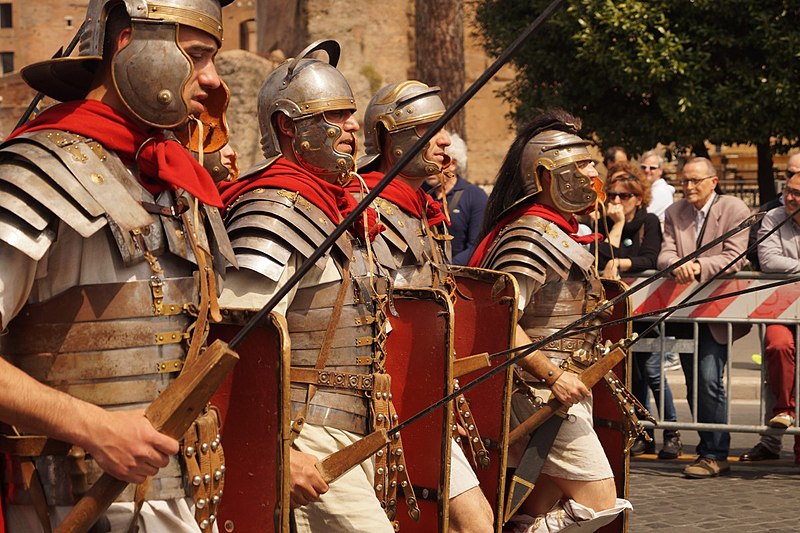
Re-enactors in Roman legionary gear, 19 May, 2021.
Original photo from https://pxhere.com/en/photo/883133 via Wikimedia Commons.
I am a proud member of the Airfix generation. The desire (less so the ability) to assemble and paint plastic model kits of aircraft, tanks and ships hit me squarely between the eyes on my tenth birthday in 1970. Several aunts and uncles had arrived at the same solution to bring out my inner Spitfire on the same day. Who needed the high of polystyrene cement and Humbrol enamel when you could refight D-Day across your bedroom floor with kits costing as little as 1/6d? Although Airfix was the premium producer of scale kits, other competing brands included Frog, Tamiya, Monogram, Hasegawa and Revell. I wish I knew what I did with them all, but many of the aircraft I recall casting out of upstairs windows, set on fire by match and candle. Looking back, I can see how it sewed the seeds of my becoming a professional military historian decades later. From little acorns, eh?
Two years later, I discovered I was interested in anything historical when my parents packed us into a train (great excitement in itself) for a trip to London. Although long past the days of steam, I can remember my father walking me down to thank the engine driver for getting us safely into Euston and then the true adventure began. The arrival at the British Museum to see the Tutankhamun Exhibition, which ran from March to December 1972. When it ended, besides the young Caddick-Adams, 1.6 million visitors had passed through the exhibition doors, making it the most popular attraction in the museum’s history. My favourite art class activity thereafter altered from drawing Spitfires and Messerschmitts chasing each other across every page to depicting ghostly, golden burial masks. Ever since, I have held an unbelievably soft spot for the old BM, always remembering that due to its vastness, it is best to go there to see something specific, rather than wander hither and thither, lost in its many treasures.
Then in 1977, when studying Ancient History for “A” Level, it was the turn of the Royal Academy in Piccadilly to capture my imagination with its Pompeii AD 79 exhibition. Mosaics, personal possessions, wall paintings and plaster casts of Romans and their animals caught in the moment of death as toxic gases, ashes, molten rock and pulverized pumice froze them forever, like insects in amber, likewise left a profound mark on my understanding of the bigger wheels of history.
The other day I was more than happy to be reunited with my old friend, the British Museum, this time hosting another Roman exhibition, which promises to be every bit as impactful as the Tutankhamun and Pompeii antecedents. Just unveiled, Legion: Life in the Roman Army is an inspired portrayal of an institution which numbered around 450,000 at its peak in AD 211 (33 legions and c. 400 auxiliary regiments), although numbers always fluctuated. The first amazing realisation is how little archaeological evidence remains of this vast organisation that endured for many centuries. The second is how well the scanty remnants in this exhibition have been preserved and interpreted.
Here, the British Museum has assembled the best surviving examples of arms, armour and personal possessions from collections around the world, in over 200 artefacts from 28 lenders. Though we view gleaming bronze helmets, swords long-rusted into scabbards, a pile of near-fossilised chainmail, it is incredible to think that there is only one intact example remaining of all those hundreds of thousands of rectangular and curved legionary shields (called a scutum), still bearing its decoration and crimson dye. This one comes from Syria.
There are some fine funerary carvings of Roman officers from around the empire, then we encounter some of the battlefield detritus including breastplate armour found near Kalkriese, in the Teutoburgerwald of Lower Saxony. This is where a coalition of Germanic tribes led by a rebel chieftain called Arminius ambushed 3 legions led by Publius Quinctilius Varus in 9 AD. The story of discovering this battle terrain was as dramatic as the assault itself. It was the result of a meticulous British soldier who combed an area north of his base at Osnabrück with a metal detector in 1987. Major Tony Clunn recorded each discovery of Roman coins and sling shot, making it possible to reconstruct the route taken by Roman legionaries under Varus and determine where they were ambushed and massacred.
February 12, 2024
Look at Life – Amphibian DUKW (1962)
Classic Vehicle Channel
Published Apr 23, 2020The military have finished with their amphibious truck know as the DUKW. They’re sold off to the general public for use in civilian life, including divers and even a group of monks.
February 11, 2024
QotD: Learning and re-learning the bloody art of war
The Athenian commanders before Salamis, it is reported, talked of art and of the Acropolis, in sight of the Persian fleet. Beside their own campfires, the Greek hoplites chewed garlic and joked about girls.
Without its tough spearmen, Hellenic culture would have had nothing to give the world. It would not have lasted long enough. When Greek culture became so sophisticated that its common men would no longer fight to the death, as at Thermopylae, but became devious and clever, a horde of Roman farm boys overran them.
The time came when the descendants of Macedonians who had slaughtered Asians till they could no longer lift their arms went pale and sick at the sight of the havoc wrought by the Roman gladius Hispanicus as it carved its way toward Hellas.
The Eighth Army, put to the fire and blooded, rose from its own ashes in a killing mood. They went north, and as they went they destroyed Chinese and what was left of the towns and cities of Korea. They did not grow sick at the sight of blood.
By 7 March they stood on the Han. They went through Seoul, and reduced it block by block. When they were finished, the massive railway station had no roof, and thousands of buildings were pocked by tank fire. Of Seoul’s original more than a million souls, less than two hundred thousand still lived in the ruins. In many of the lesser cities of Korea, built of wood and wattle, only the foundation, and the vault, of the old Japanese bank remained.
The people of Chosun, not Americans or Chinese, continued to lose the war.
At the end of March the Eighth Army was across the parallel.
General Ridgway wrote, “The American flag never flew over a prouder, tougher, more spirited and more competent fighting force than was Eighth Army as it drove north …”
Ridgway had no great interest in real estate. He did not strike for cities and towns, but to kill Chinese. The Eighth Army killed them, by the thousands, as its infantry drove them from the hills and as its air caught them fleeing in the valleys.
By April 1951, the Eighth Army had again proved Erwin Rommel’s assertion that American troops knew less but learned faster than any fighting men he had opposed. The Chinese seemed not to learn at all, as they repeated Chipyong-ni again and again.
Americans had learned, and learned well. The tragedy of American arms, however, is that having an imperfect sense of history Americans sometimes forget as quickly as they learn.
T.R. Fehrenbach, This Kind of War: A Study in Unpreparedness, 1963.
February 10, 2024
QotD: When Manchuria became Manchukuo
Further unpleasantness ensued in the wake of World War I, when both Imperial Russia and Republican China collapsed. The Japanese had a big railroad project of their own going in the Kwantung Leased Territory, which was threatened by the chaos. Moreover, the big Japanese railroad project had grown — as Japanese industrial concerns tend to do — into a ginormous, all-encompassing combine known as Mantetsu.
So far, so recondite, I suppose, but stop me if this part sounds familiar: Mantetsu was so big, and so shady, that it was all but impossible to tell where “the guys running Mantetsu” ended and “the Japanese government” began. And it gets better: Thanks to the Japanese Empire’s distinctive (to put it mildly, and kindly) administrative structure, it was equally hard to tell where “the Japanese government” ended and “the Japanese military” began. Even better — by which I mean much, much worse, but again feel free to stop me when this sounds familiar — “the Japanese military” was itself composed of several wildly different, mutually hostile chains of command, all competing with each other for political power, economic access, and glory. Best of all — by which, again, I mean worst — since Mantetsu was so big, and so wired-in to every level of the Japanese government, it basically got its own army, which was effectively separate even from the Army High Command back in Tokyo.
Here again, the granular details are insanely complex, and I’m not qualified to walk you through them, but the upshot is: Thanks to all of the above, plus the active enmity of the rapidly-rearming Soviet Union and the rapidly-accelerating chaos of the Warlord Period in China, Japan’s foreign policy ended up being dictated by the Kwantung Army, with almost no reference to even the High Command, let alone the civilian politicians, back in Tokyo. A particular warlord giving the Mantetsu Board of Directors — or, you know, whoever — grief? No problem — boom! Oh, that didn’t solve the problem, and now the politicians are dragging their feet? Might as well blow up a different part of your own railway, seize a whole bunch of territory on that flimsy pretext, and set up a puppet government to give you cover …
I don’t expect y’all to follow all the links right away, so trust me on this: Nobody involved in any of that stuff ranked higher than colonel. Indeed, the guy most “responsible” — if that’s really the word — for all of this stuff was a staff pogue, also a colonel, named Kanji Ishiwara. He and another staff pogue, Seishiro Itagaki, who was head of the Kwantung Army’s intelligence section, orchestrated the Japanese invasion of China, and while it’s oversimplifying things a bit too much to say those two clowns started World War II in the Pacific, I’m not stopping you from saying it.
From there, events took on a logic of their own. The rest of the Army was soon committed to the war in North China, which rapidly became the war in all the rest of China. The Navy, not wanting to let the Army hog all the glory, had gotten in on the war a few years prior to the Marco Polo Bridge, and soon enough they were causing all kinds of international grief on their own account. Put simply, but not unfairly, you had the Navy chasing the Army, and the Army chasing itself, all across China, with the civilian politicians lagging way behind in the rear, desperately trying to catch up, or even just figure out what the hell was going on …
Severian, “Lessons from Manchuria”, Rotten Chestnuts, 2021-04-21.
January 12, 2024
QotD: Rome’s Italic “allies”
The simple (and perhaps now increasingly dated) way I explain this to my students is that Rome follows the Goku Model of Imperialism: I beat you, therefore we are now friends. Defeated communities in Italy (the system is different outside of Italy) are made to join Rome’s alliance network as socii (“allies”), do not have tribute imposed on them, but must supply their soldiers to fight with Rome when Rome is at war, which is always.
It actually doesn’t matter for us how this expansion was accomplished; rather we’re interested in the sort of order the Romans set up when they did expand. The basic blueprint for how Rome interacted with the Italians may have emerged as early as 493 with the Foedus Cassianum, a peace treaty which ended a war between Rome and [the] Latin League (an alliance of ethnically Latin cities in Latium). To simplify quite a lot, the Roman “deal” with the communities of Italy which one by one came under Roman power went as follows:
- All subject communities in Italy became socii (“allies”). This was true if Rome actually intervened to help you as your ally, or if Rome intervened against you and conquered your community.
- The socii retained substantial internal autonomy (they kept their own laws, religions, language and customs), but could have no foreign policy except their alliance with Rome.
- Whenever Rome went to war, the socii were required to send soldiers to assist Rome’s armies; the number of socii in Rome’s armies ranged from around half to perhaps as much as two thirds at some points (though the socii outnumbered the Romans in Italy about 3-to-1 in 225, so the Romans made more strenuous manpower demands on themselves than their allies).
- Rome didn’t impose tribute on the socii, though the socii bore the cost of raising and paying their detachments of troops in war (except for food, which the Romans paid for, Plb. 6.39.14).
- Rome goes to war every year.
- No, seriously. Every. Year. From 509 to 31BC, the only exception was 241-235. That’s it. Six years of peace in 478 years of republic. The socii do not seem to have minded very much; they seem to have generally been as bellicose as the Romans and anyway …
- The spoils of Roman victory were split between Rome and the socii. Consequently, as one scholar memorably put it, the Roman alliance was akin to, “a criminal operation which compensates its victims by enrolling them in the gang and inviting them to share to proceeds of future robberies” (T. Cornell, The Beginnings of Rome (1995)).
- The alliance system included a ladder of potential relationships with Rome which the Romans might offer to loyal allies.
Now this isn’t a place for a long discussion of the Roman alliance system in Italy (that place is in the book I am writing), so I want us to focus more narrowly on the bolded points here and how they add up to significant changes in who counted as “Roman” over time. But I should note here that while I am calling this a Roman “alliance system” (because the Romans call these fellows socii, allies) this was by no means an equal arrangement: Rome declared the wars, commanded the armies and set the quotas for military service. The “allies” were thus allies in name only, but in practice subjects; nevertheless the Roman insistence on calling them allies and retaining the polite fiction that they were junior partners rather than subject communities, by doing things like sharing the loot and glory of victory, was a major contributor to Roman success (as we’ll see).
First, the Roman alliance system was split into what were essentially tiers of status. At the top were Roman citizens optimo iure (“full rights”, literally “with the best right”) often referred to on a community basis as civitas cum suffragio (“citizenship with the vote”). These were folks with the full benefits of Roman citizenship and the innermost core of the Roman polity, who could vote and (in theory, though for people of modest means, only in theory) run for office. Next were citizens non optimo iure, often referred to as having civitas sine suffragio (“citizenship without the vote”); they had all of the rights of Roman citizens except for political participation in Rome. This was almost always because they lived in communities well outside the city of Rome with their own local government (where they could vote); we’ll talk about how you get those communities in a second. That said, citizens without the vote still had the right to hold property in Roman territory and conduct business with the full protection of a Roman citizen (ius commercii) and the right to contract legal marriages with Roman citizens (ius conubii). They could do everything except for vote or run for offices in Rome itself.
Next down on the list were socii (allies) of Latin status (note this is a legal status and is entirely disconnected from Latin ethnicity; by the end of this post, Rome is going to be block-granting Latin status to Gauls in Cisalpine Gaul, for instance). Allies of Latin status got the benefits of the ius commercii, as well as the ability to move from one community with Latin status to another without losing their status. Unlike the citizens without the vote, they didn’t automatically get the right to contract legal marriages with Roman citizens, but in some cases the Romans granted that right to either individuals or entire communities (scholars differ on exactly how frequently those with Latin status would have conubium with Roman citizens; the traditional view is that this was a standard perk of Latin status, but see Roselaar, op. cit.). That said, the advantages of this status were considerable – particularly the ability to conduct business under Roman law rather than what the Romans called the “ius gentium” (“law of peoples”) which governed relations with foreigners (peregrini in Roman legal terms) and were less favorable (although free foreigners in Rome had somewhat better protections, on the whole, than free foreigners – like metics – in a Greek polis).
Finally, you had the socii who lacked these bells and whistles. That said, because their communities were allies of Rome in Italy (this system is not exported overseas), they were immune to tribute, Roman magistrates couldn’t make war on them and Roman armies would protect them in war – so they were still better off than a community that was purely of peregrini (or a community within one of Rome’s provinces; Italy was not a province, to be clear).
The key to this system is that socii who stayed loyal to Rome and dutifully supplied troops could be “upgraded” for their service, though in at least some cases, we know that socii opted not to accept Roman citizenship but instead chose to keep their status as their own community (the famous example of this were the allied soldiers of Praenesti, who refused Roman citizenship in 211, Liv. 23.20.2). Consequently, whole communities might inch closer to becoming Romans as a consequence of long service as Rome’s “allies” (most of whom, we must stress, were at one point or another, Rome’s Italian enemies who had been defeated and incorporated into Rome’s Italian alliance system).
But I mentioned spoils and everyone loves loot. When Rome beat you, in the moment after you lost, but before the Goku Model of Imperialism kicked in and you became friends, the Romans took your stuff. This might mean they very literally sacked your town and carried off objects of value, but it also – and for us more importantly – meant that the Romans seized land. That land would be added to the ager Romanus (the body of land in Italy held by Rome directly rather than belonging to one of Rome’s allies). But of course that land might be very far away from Rome which posed a problem – Rome was, after all, effectively a city-state; the whole point of having the socii-system is that Rome lacked both the means and the desire to directly govern far away communities. But the Romans didn’t want this land to stay vacant – they need the land to be full of farmers liable for conscription into Rome’s armies (there was a minimum property requirement for military service because you needed to be able to buy your own weapons so they had to be freeholding farmers, not enslaved workers). By the by, you can actually understand most of Rome’s decisions inside Italy if you just assume that the main objective of Roman aristocrats is to get bigger armies so they can win bigger battles and so burnish their political credentials back in Rome – that, and not general altruism (of which the Romans had fairly little), was the reason for Rome’s relatively generous alliance system.
The solution was for Rome to essentially plant little Mini-Me versions of itself on that newly taken land. This had some major advantages: first, it put farmers on that land who would be liable for conscription (typically placing them in carefully measured farming plots through a process known as centuriation), either as socii or as Roman citizens (typically without the vote). Second, it planted a loyal community in recently conquered territory which could act as a position of Roman control; notably, no Latin colony of this sort rebelled against Rome during the Second Punic War when Hannibal tried to get as many of the socii to cast off the Romans as he could.
What is important for what we are doing here is to note that the socii seem to have been permitted to contribute to the initial groups settling in these colonies and that these colonies were much more tightly tied to Rome, often having conubium – that right of intermarriage again – with Roman citizens. The consequence of this is that, by the late third century (when Rome is going to fight Carthage) the ager Romanus – the territory of Rome itself – comprises a big chunk of central Italy […] but the people who lived there as Roman citizens (with and without the vote) were not simply descendants of that initial Roman citizen body, but also a mix of people descended from communities of socii throughout Italy.
Bret Devereaux, “Collections: The Queen’s Latin or Who Were the Romans, Part II: Citizens and Allies”, A Collection of Unmitigated Pedantry, 2021-06-25.
January 7, 2024
QotD: The US Army between 1945 and 1950
The trouble is, different men live by different myths.
There are men who would have a society pointed wholly to fighting and resistance to Communism, and this would be a very different society from the one Americans now enjoy. It might succeed on the battlefield, but its other failures can be predicted.
But the infantry battlefield also cannot be remade to the order of the prevailing midcentury opinion of American sociologists.
The recommendations of the so-called Doolittle Board of 1945-1946, which destroyed so much of the will — if not the actual power — of the military traditionalists, and left them bitter, and confused as to how to act, was based on experience in World War II. In that war, as in all others, millions of civilians were fitted arbitrarily into a military pattern already centuries old. It had once fitted Western society; it now coincided with American customs and thinking no longer.
What the Doolittle Board tried to do, in small measure, was to bring the professional Army back into the new society. What it could not do, in 1946, was to gauge the future.
By 1947 the United States Army had returned, in large measure, to the pattern it had known prior to 1939. The new teen-agers who now joined it were much the same stripe of men who had joined in the old days. They were not intellectuals, they were not completely fired with patriotism, or motivated by the draft; nor was an aroused public, eager to win a war, breathing down their necks.
A great many of them signed up for three squares and a sack.
Over several thousand years of history, man has found a way to make soldiers out of this kind of man, as he comes, basically unformed, to the colors. It is a way with great stresses and great strains. It cannot be said it is wholly good. Regimentation is not good, completely, for any man.
But no successful army has been able to avoid it. It is an unpleasant necessity, seemingly likely to go on forever, as long as men fight in fields and mud.
One thing should be made clear.
The Army could have fought World War III, just as it could have fought World War II, under the new rules. During 1941-1945 the average age of the United States soldier was in the late twenties, and the ranks were seasoned with maturity from every rank of life, as well as intelligence.
In World War III, or any war with national emotional support, this would have again been true. Soldiers would have brought their motivation with them, firmed by understanding and maturity.
The Army could have fought World War III in 1950, but it could not fight Korea.
T.R. Fehrenbach, This Kind of War: A Study in Unpreparedness, 1963.
December 31, 2023
The British army in Northern Ireland, 1966-1975
Patrick Mercer reviews Huw Bennett’s Uncivil War: The British Army and the Troubles, 1966-1975 for The Critic:
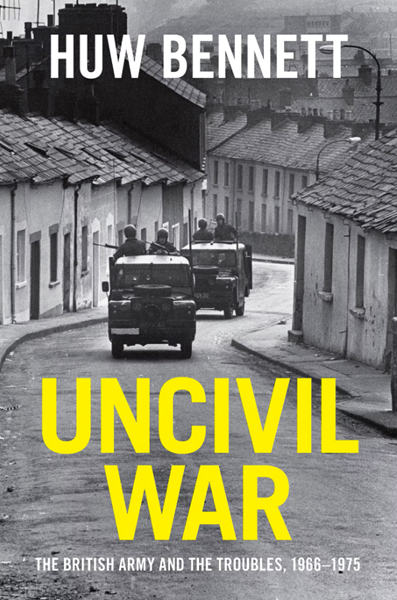
Seen from today’s perspective, the litany of campaigns Britain fought between the World Wars seems unimportant. Yet disasters such as the Jallianwala Bagh massacre in Amritsar in April 1919, and the depredations of the Auxiliaries or Black and Tans in Ireland at much the same time, imperilled imperial strategy. [Richard Dannatt & Robert Lyman’s] Victory to Defeat underlines the actions of relatively small numbers of troops which threatened to unhinge whole campaigns. It makes the perfect counterpoint to Huw Bennett’s Uncivil War, which covers the opening years of the crisis in Northern Ireland in meticulous detail.
Bennett looks at operations in Northern Ireland only up until 1975 — arguably the most intense period — with a promise of further volumes to follow. This is the first, comprehensive attempt to deal in parallel with the political aspects of the campaign as well as the purely military ones. Although densely written, Uncivil War gives a very readable account of the first of three decades of conflict which dominated the everyday life of most of the combat arms of the Army. It now seems ironic, though, that Ulster was always treated as something of a sideshow when compared with the “real soldiering” of deterring the Soviets in Germany.
Central to Bennett’s book is the debacle of “Bloody Sunday” in January 1972, when paratroopers ran amok in Londonderry at a point of the campaign when the IRA was exhausted and finding it almost impossible to recruit. Politically, there might have been a breakthrough; militarily the terrorists were teetering on collapse, but one black sheep unit and the ham-fisted response by the chain of command galvanised the IRA. With a rifle’s crack, they guaranteed bloodshed for years to come.
If ever a victory was turned into defeat in modern times, this was it. Bennett pulls no punches in pointing that out. The interesting contrast with Lyman and Dannatt’s work is that no matter how much had been learnt from the Second World War, the doctrine that emerged could only be tested by blank firing exercises in Germany. Whilst the highly unlikely possibility of a war in Europe was constantly analysed, very little strategic thinking was put into the grinding, long-term campaign in Ulster that was actually killing people.
Certainly there were political initiatives and the intelligence machinery was constantly evolving, but the many battalions and regiments who were charged with everyday deterrence and occasional attrition wandered the streets with little imagination or flair, often only seeming to provide targets for the terrorists. If war against the Soviets was remote, bombs, snipers and ambushes in Ulster were certain. By contrast, the Field Service Pocket Book (India) of 1930 laid out clear advice and principles for operations on the North-West Frontier. In Ulster, we just blundered on.
If the lessons of 1918 were neglected, those that led to victory in 1945 were carefully studied, although any coherent tactical doctrine took until the 1980s to be published. Perversely, the operations that followed both world wars were much the same: small, far-flung, post-imperial scuffles which owed little to “conventional” fighting. Indeed, it might be argued that the real lessons that the Army needed to heed after 1945 were not those of a European war, but those which might have prepared it for long years in Northern Ireland or the former colonies.
December 29, 2023
QotD: The Hanoverian “reverse takeover of the British monarchy by the Germans”
Music was a language that united the English and the Germans. The key figure was, of course, Handel — the first and pre-eminent but by no means the last Anglo-German composer. Born in Halle, Georg Friedrich Händel had briefly been George I’s Kapellmeister in Hanover yet had already established himself in England before the Prince Elector of Hanover inherited the British throne in 1714.
In London — then in the process of overtaking Paris and Amsterdam to become the commercial capital of Europe — he discovered hitherto undreamt-of possibilities. There he founded three opera companies, for which he supplied more than 40 operas, and adapted a baroque Italian art form, the oratorio, to suit English Protestant tastes.
His coronation music, such as the anthem, “Zadok the Priest”, imbued the Hanoverian dynasty with a new and splendid kind of sacral majesty. But he also added to its lustre by providing the musical accompaniment for new kinds of public entertainment, such as his Music for the Royal Fireworks: 12,000 people came to the first performance.
Along with music, the Germans brought a focus on military life. Whereas for the British Isles, the Civil War and the subsequent conflicts in Scotland and Ireland had been something of an aberration, war was second nature to German princes. Among them, George II was not unusual in leading his men into battle, although he was the last British monarch to do so.
Still, the legacy of such Teutonic martial prowess was visible in the late Queen’s obsequies: uniforms and decorations, pomp and circumstance, accompanied by funeral marches composed by a German, Ludwig van Beethoven. Ironically, the German state now avoids any public spectacle that could be construed as militaristic, yet most Germans harbour boundless admiration for the way that the British monarchy enlists the ceremonial genius of the armed services.
Even more important was the German contribution to the uniquely British creation of constitutional monarchy.
Each successive dynasty has left its mark on the monarchy’s evolution: from the Anglo-Saxons and Normans (the common law) to the Plantagenets (Magna Carta and Parliament) and Tudors (the Reformation). Only the Stuarts failed this test, at least until 1688. Even after the Glorious Revolution, the Bill of Rights and other laws that conferred statutory control over the royal prerogative, the constitutional settlement still hung in the balance when Queen Anne, the last Stuart ruler, died in 1714.
Coming from a region dominated by the theory and practice of absolute monarchy, the Hanoverians had no choice but to adapt immediately and seamlessly to the realities of politics in Britain, where their role was strictly limited. Robert Walpole and the long Whig ascendancy, during which the doctrine of parliamentary sovereignty embedded itself irrevocably, could not have taken place without the acquiescence and active support of the new dynasty.
George III has been accused of attempting to reverse this process. The charge is unjust. Rather, as Andrew Roberts demonstrates in his new biography, he was “a monarch who understood his extensive rights and duties under the constitution”. He still had the right to refuse royal assent to parliamentary bills, but in half a century he never once exercised his veto (the last monarch to do so was the Stuart, Queen Anne in 1708).
At a time when enlightened despotism was de rigueur on the Continent, the Hanoverians were content to participate in an unprecedented constitutional experiment in their newly acquired United Kingdom. It was neither the first Brexit, nor the last, but it happened courtesy of a Royal Family that was still very German.
Daniel Johnson, “Why Germany mourned our Queen”, The Critic, 2022-10-30.
November 30, 2023
Men and Morale: Canadian Army Training in the Second World War
WW2TV
Published 1 Feb 2023Men and Morale: Canadian Army Training in the Second World War
Part of Canadian Week on WW2TV With Megan HamiltonThe Canadian Army of the Second World War spent more time preparing and training their citizen soldiers then they did in sustained action. This chiefly took place across Canada and in the United Kingdom. Adequate training functioned as a cradle for collective action, morale, empowerment, self-confidence, and, ultimately, success in battle. Yet, due to a number of factors, a sufficient standard of training was not always achieved by all.
There were limits to the Canadian Army’s ability to control the morale of its men as it created a vast organization from scratch. Training camp experiences varied, influenced by factors such as food, weather, comfort, group cohesion, leadership, skill level, discipline, social activities, and interactions with local civilians. In fact, it required a constant negotiation between camp leadership and the rank and file. Drawing from her research on both the Canadian and wider Commonwealth armies, Megan’s presentation will explain why soldiers’ morale in training was a difficult, yet vital, balancing act.
Originally from Vernon, British Columbia, Megan Hamilton is a social and military historian of the 20th century. She has an Honours Bachelor of Arts degree from Wilfrid Laurier University and a Master of Arts degree from the University of Waterloo. Her federally-funded master’s research focused on the Canadian experience of the Second World War, specifically the Vernon Military Camp. Megan’s work has been published by a number of platforms and in 2022 she won the Tri-University History Program’s top essay prize for master’s students.
She is currently located in London, England, where she has begun a fully-funded PhD at King’s College London and the Imperial War Museum, supervised by Dr. Jonathan Fennell. Her dissertation is a study of Second World War army training across the Commonwealth.
(more…)
November 16, 2023
The US military may need to find a modern-day Patroclus
John Carter explains why the sudden swerve in US military recruitment from all-diverse-all-the-time to an ad that might have been created in the 1960s … and why it still won’t help:

He is the very essence of a modern major general.
Sing, o muse, of the wrath of Achilles, son of Peleus, that brought countless ills upon the Achaeans …
Thus opens the foundational epic of European civilization.
Achilles is angry because his woman, Briseis, has been appropriated by Agamemnon, the leader of the Greeks. He expresses this discontent by going on strike. While the rest of the Greek army fights and dies outside the walls of Troy, Achilles lounges in his tent, content to sit out the combat until Agamemnon comes to his senses and returns his war bride. If Achilles were simply any other warm body with a spear, this wouldn’t be such a big deal, but he is Achilles – the greatest warrior of the Heroic Age. Without him, the Greeks are at a severe disadvantage. Achilles’ petulance is therefore a problem for Agamemnon.
The lesson is hardly a subtle one. Kings and generals need to keep their soldiers happy. They especially need to keep their best soldiers happy. If they don’t – for instance, by taking their women from them – morale will suffer, and they may well find themselves without the crucial support of their warriors when it most matters.
Washington seems to have missed that lesson, and now, they’re paying the price.
For the last decade they have been relentlessly and mercilessly whipping American whites: defaming them as racists, mocking their intelligence and manliness, tearing down their statues, erasing the names of their ancestral heroes, replacing their fictional archetypes with diverse doppelgangers in the media, disadvantaging them in education and employment, demanding that they attend racial struggle sessions. The list of outrages and humiliations is long and all too familiar, permeating as it does every one of our institutions.
But now, the Empire of Lies faces a problem.
War has returned to the world. History, its rumoured demise notwithstanding, once again stalks the land. Russia mauls the Ukraine; Israel is beset with enemies; the Empire’s influence in Africa frays by the day; China salivates over Taiwan.
Meanwhile the American domestic economy, long since hollowed out by the extractive rent-seeking of financial parasites, lurches from one crisis to the next. The Great Satan remains powerful, for the present, but the young bucks can scent that the silverback is not what he used to be. Their provocations increase in daring and intensity. If they aren’t slapped down, their boldness will only increase.
The criminal regime that has insinuated itself into the halls of American power is running against a clock. They must have a war to cover the slow collapse of their fake economy. They must have a war to prevent rival regimes from displacing their American golem. But their golem is crumbling. Therefore they must have a war sooner rather than later, because with every moment of delay America becomes weaker, while China and Russia become stronger.
Their problem is that no one wants to fight for them.
The core warrior population of America has always been the Scots-Irish of the Appalachian regions, the good ol’ boys of the South, and the farm boys of the Midwest. Hillbillies and rednecks, in other words. Many families from these areas have multi-generational traditions of service. Dad served in Vietnam, Grampa in WWII, Great-Grandpa in the Great War, and Great-Grandpa’s Pappy fought under Lee in the War of Northern Aggression.
These are precisely the white populations that have been singled out for the most unrelenting and vicious racial abuse over the last several decades. They are the one group that it’s okay to defame in the media, depicted as ignorant, bigoted, backwards, and inbred. The people running Hollywood seem to have a special disgust for them. For generations they have born this with a sort of stoic good cheer, accepting their role as the heel in the great kayfabe of American political drama even as they shouldered a disproportionate burden of blood, tears, and sweat in America’s imperial wars.
The events of the last two decades seem to have put an end to that. It wasn’t just the psychotic frenzy of race communism that gripped the regime’s mind, although that certainly played a factor as the military has hardly been immune to it. Who wants to serve in an armed forces that has thrown meritocracy in the trash to make sure the commissioned ranks include as many strong black lesbians as possible, that spends more time making sure the enlisted ranks understand the nuances of pronoun usage and the finer points of critical race theory than training for war? Demoralizing as all that has been, the absolutely pointless debacle of the Neocon Forever War in the Middle East has played at least as large a role.


