Quotulatiousness

August 19, 2023

QotD: The third system (or “Modern system”) of war

Filed under: History, Military, Quotations, Technology — Tags: , , , — Nicholas @ 01:00

Armies in this modern system [discussed here] still aim to control territory, as with second-system war, but they no longer square off in open fields. Rather, relying on cover and concealment to mitigate the overwhelming firepower a modern battlefield covered with machine guns, artillery and airpower, they aim to disorient and overwhelm the decision-making capabilities of their enemy with lightning mechanized offensives.

What happens when two current-day modern systems meet? We don’t really know, though there is a lot of speculation. One of the things which made the conflict between Azerbaijan and Armenia so closely watched last year (in 2020, for those reading this later) was that it provided a chance to see two sides both with (sometimes incomplete) access to the full modern kit of war – not only tanks, jets and artillery, but cyber warfare, drones and so on. The results remain to be much discussed analyzed, but it may well be that a fourth system of war is in the offing, defined by the way that drone-based airpower combined with electronic surveillance and cyber-warfare redefined the battle-space and allowed Azerbaijan in particular to project firepower deep into areas where Armenian forces considered themselves safe.

But I shouldn’t get too off track. The point of all of this is that these systems of war are not merely different, they are so radically different that armies created in one system often fundamentally fail to understand the others (thus the tendency for second and third system armies to treat first system war as some strange new innovation in war, when it is in fact the oldest system by far). As we’re going to see, the aims, experiences and outcomes of these systems are often very different. They demand and inculcate different values and condition societies differently as well.

Bret Devereaux, “Collections: The Universal Warrior, Part IIa: The Many Faces of Battle”, A Collection of Unmitigated Pedantry, 2021-02-05.

August 14, 2023

QotD: The US Army in the Korean War

Filed under: Asia, History, Military, Quotations, USA, WW2 — Tags: , , , — Nicholas @ 01:00

Korea was the kind of war that since the dawn of history was fought by professionals, by legions. It was fought by men who soon knew they had small support or sympathy at home, who could read in the papers statements by prominent men that they should be withdrawn. It was fought by men whom the Army — at its own peril — had given neither training nor indoctrination, nor the hardness and bitter pride men must have to fight a war in which they do not in their hearts believe.

The Army needed legions, but society didn’t want them. It wanted citizen-soldiers.

But the sociologists are right — absolutely right — in demanding that the centurion view of life not be imposed upon America. In a holy, patriotic war — like that fought by the French in 1793, or as a general war against Communism will be — America can get a lot more mileage out of citizen-soldiers than it can from legions.

No one has suggested that perhaps there should be two sets of rules, one for the professional Army, which may have to fight in far places, without the declaration of war, and without intrinsic belief in the value of its dying, for reasons of policy, chessmen on the checkerboard of diplomacy; and one for the high-minded, enthusiastic, and idealistic young men who come aboard only when the ship is sinking.

The other answer is to give up Korea-type wars, and to surrender great-power status, and a resultant hope of order — our own decent order — in the world. But America is rich and fat and very, very noticeable in this world.

It is a forlorn hope that we should be left alone.

In the first six months America suffered a near debacle because her Regular Army fighting men were the stuff of legions, but they had not been made into legionaries.

America was not more soft or more decadent than it had been twenty years earlier. It was confused, badly, on its attitudes toward war. It was still bringing up its youth to think there were no tigers, and it was still reluctant to forge them guns to shoot tigers.

Many of America’s youth, in the Army, faced horror badly because they had never been told they would have to face horror, or that horror is very normal in our unsane world. It had not been ground into them that they would have to obey their officers, even if the orders got them killed.

It has been a long, long time since American citizens have been able to take down the musket from the mantelpiece and go tiger hunting. But they still cling to the belief that they can do so, and do it well, without training.

This is the error that leads some men to cry out that Americans are decadent.

If Americans in 1950 were decadent, so were the rabble who streamed miserably into Valley Forge, where von Steuben made soldiers out of them. If American society had no will to defend itself, neither did it in 1861, at First Manassas, or later at Shiloh, when whole regiments of Americans turned tail and ran.

The men who lay warm and happy in their blankets at Kasserine, as the panzers rolled toward them in the dawn, were decadent, by this reasoning.

The problem is not that Americans are soft but that they simply will not face what war is all about until they have had their teeth kicked in. They will not face the fact that the military professionals, while some have ideas about society in general that are distorted and must be watched, still know better than anyone else how a war is won.

Free society cannot be oriented toward the battlefield — Sparta knew that trap — but some adjustments must be made, as the squabbling Athenians learned to their sorrow.

The sociologists and psychologists of Vienna had no answer to the Nazi bayonets, when they crashed against their doors. The soldiers of the democratic world did.

More than once, as at Valley Forge, after Bull Run, and Kasserine, the world has seen an American army rise from its own ashes, reorient itself, grow hard and bitter, knowledgeable and disciplined and tough.

In 1951, after six months of being battered, the Eighth Army in Korea rose from its own ashes of despair. No man who was there still believes Americans in the main are decadent, just as no man who saw Lieutenant General Matt Ridgway in operation doubts the sometime greatness of men.

T.R. Fehrenbach, This Kind of War: A Study in Unpreparedness, 1963.

August 7, 2023

The Longest Year in Human History (46 B.C.E.)

Filed under: Europe, History — Tags: , , , , , , , — Nicholas @ 02:00

Historia Civilis
Published 24 Apr 2019
(more…)

August 1, 2023

QotD: US Army culture before the Korean War

Filed under: History, Military, Quotations, USA, WW2 — Tags: , , , — Nicholas @ 01:00

The Doolittle Board of 1945-1946 met, listened to less than half a hundred complaints, and made its recommendations. The so-called “caste system” of the Army was modified. Captains, by fiat, suddenly ceased to be gods, and sergeants, the hard-bitten backbone of any army, were told to try to be just some of the boys. Junior officers had a great deal of their power to discipline taken away from them. They could no longer inflict any real punishment, short of formal court-martial, nor could they easily reduce ineffective N.C.O.’s. Understandably, their own powers shaky, they cut the ground completely away from their N.C.O.’s.

A sergeant, by shouting at some sensitive yardbird, could get his captain into a lot of trouble. For the real effect of the Doolittle recommendations was psychological. Officers had not been made wholly powerless — but they felt that they had been slapped in the teeth. The officer corps, by 1946 again wholly professional, did not know how to live with the newer code.

One important thing was forgotten by the citizenry: by 1946 all the intellectual and sensitive types had said goodbye to the Army — they hoped for good. The new men coming in now were the kind of men who join armies the world over, blank-faced, unmolded — and they needed shaping. They got it; but it wasn’t the kind of shaping they needed.

Now an N.C.O. greeted new arrivals with a smile. Where once he would have told them they made him sick to his stomach, didn’t look tough enough to make a go of his outfit, he now led them meekly to his company commander. And this clean-cut young man, who once would have sat remote at the right hand of God in his orderly room, issuing orders that crackled like thunder, now smiled too. “Welcome aboard, gentlemen. I am your company commander; I’m here to help you. I’ll try to make your stay both pleasant and profitable.”

This was all very democratic and pleasant — but it is the nature of young men to get away with anything they can, and soon these young men found they could get away with plenty.

A soldier could tell a sergeant to blow it. In the old Army he might have been bashed, and found immediately what the rules were going to be. In the Canadian Army — which oddly enough no American liberals have found fascistic or bestial — he would have been marched in front of his company commander, had his pay reduced, perhaps even been confined for thirty days, with no damaging mark on his record. He would have learned, instantly, that orders are to be obeyed.

But in the new American Army, the sergeant reported such a case to his C.O. But the C.O. couldn’t do anything drastic or educational to the man; for any real action, he had to pass the case up higher. And nobody wanted to court-martial the man, to put a permanent damaging mark on his record. The most likely outcome was for the man to be chided for being rude, and requested to do better in the future.

Some privates, behind their smirks, liked it fine.

Pretty soon, the sergeants, realizing the score, started to fraternize with the men. Perhaps, through popularity, they could get something done. The junior officers, with no sergeants to knock heads, decided that the better part of valor was never to give an unpopular order.

The new legions carried the old names, displayed the old, proud colors, with their gallant battle streamers. The regimental mottoes still said things like “Can Do”. In their neat, fitted uniforms and new shiny boots — there was money for these — the troops looked good. Their appearance made the generals smile.

What they lacked couldn’t be seen, not until the guns sounded.

T.R. Fehrenbach, This Kind of War: A Study in Unpreparedness, 1963.

July 23, 2023

Explained: What Is Pace Sticking?

Filed under: Britain, Military — Tags: — Nicholas @ 02:00

Forces News
Published 18 Sept 2021

A pace stick is a tool made of two pieces of timber that are hinged at the top.

Each summer, 18 pace sticking armed forces teams from around the world come together in an international competition at the Royal Military Academy Sandhurst.

We look at what pace sticking involves, and the history behind it.
(more…)

July 17, 2023

Uncancelled History with Douglas Murray | EP. 06 George Washington

Filed under: Britain, History, Military, Politics, USA — Tags: , , , , , — Nicholas @ 02:00

Nebulous Media
Published 27 Dec 2022

Allen Guelzo joins Douglas Murray on this episode to discuss George Washington. From his early childhood to his years as president, the two analyze the founding father’s legacy. Should the first president stay cancelled?
(more…)

July 6, 2023

QotD: Liberalizing the US Army after WW2

Filed under: History, Military, Quotations, USA — Tags: , , , — Nicholas @ 01:00

In 1861, and 1917, the Army acted upon the civilian, changing him. But in 1945 something new happened. Suddenly, without precedent, perhaps because of changes in the emerging managerial society, professional soldiers of high rank had become genuinely popular with the Public. In 1861, and in 1917, the public gave the generals small credit, talked instead of the gallant militia. Suddenly, at the end of World War II, society embraced the generals.

And here it ruined them.

They had lived their lives in semibitter alienation from their own culture (What’s the matter, Colonel; can’t you make it on the outside?) but now they were sought after, offered jobs in business, government, on college campuses.

Humanly, the generals liked the acclaim. Humanly, they wanted it to continue. And when, as usual after all our wars, there came a great civilian clamor to change all the things in the army the civilians hadn’t liked, humanly, the generals could not find it in their hearts to tell the public to go to hell.

It was perfectly understandable that large numbers of men who served didn’t like the service. There was no reason why they should. They served only because there had been a dirty job that had to be done. Admittedly, the service was not perfect; no human institution having power over men can ever be. But many of the abuses the civilians complained about had come not from true professionals but from men with quickie diplomas, whose brass was much more apt to go to their heads than to those of men who had waited twenty years for leaves and eagles.

In 1945, somehow confusing the plumbers with the men who pulled the chain, the public demanded that the Army be changed to conform with decent, liberal society.

The generals could have told them to go to hell and made it stick. A few heads would have rolled, a few stars would have been lost. But without acquiescence Congress could no more emasculate the Army than it could alter the nature of the State Department. It could have abolished it, or weakened it even more than it did — but it could not have changed its nature. But the generals could not have retained their new popularity by antagonizing the public, and suddenly popularity was very important to them. Men such as Doolittle, Eisenhower, and Marshall rationalized. America, with postwar duties around the world, would need a bigger peacetime Army than ever before. Therefore, it needed to be popular with the people. And it should be made pleasant, so that more men would enlist. And since Congress wouldn’t do much about upping pay, every man should have a chance to become a sergeant, instead of one in twenty. But, democratically, sergeants would not draw much more pay than privates.

And since some officers and noncoms had abused their powers, rather than make sure officers and noncoms were better than ever, it would be simpler and more expedient — and popular — to reduce those powers. Since Americans were by nature egalitarian, the Army had better go that route too. Other professional people, such as doctors and clergymen, had special privileges — but officers, after all, had no place in the liberal society, and had better be cut down to size.

T.R. Fehrenbach, This Kind of War: A Study in Unpreparedness, 1963.

June 13, 2023

After the Great War, the British army failed to plan for future conflicts

Filed under: Britain, History, Military, Weapons — Tags: , , , — Nicholas @ 03:00

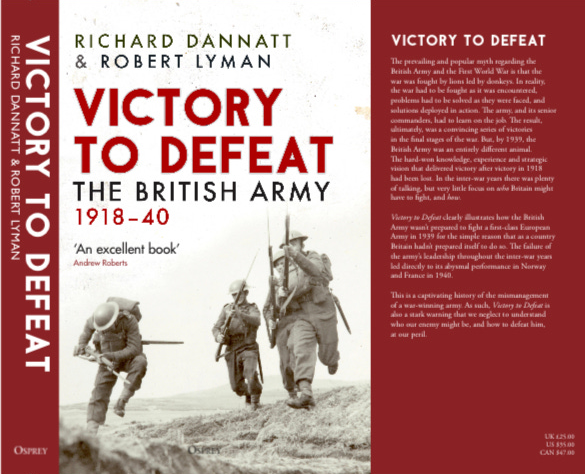
Robert Lyman outlines why Britain in general and the British army in particular were so materially and intellectually unready for the war that broke out in 1939:

… the British Army was catastrophically unprepared for war in 1939. But it wasn’t just the Army that was unprepared. Despite a last-minute rush to re-arm, so too was the whole country. In Britain a deep-seated passivity had set in following the end the Great War. This belied the reality that in Europe the ending of the war in fact opened the door to unheralded political chaos and instability that was in time to overcome the forces of stability and would lead directly to yet another devastating war. In the years immediately following the arrival of peace in 1918 Britain hoped it could close the door on any future European or continent commitment and return to the halcyon days when its only security commitments were the defence of its widely flung Empire.

The weakness at the heart of British planning for war was a direct reflection of Britain’s strategic, political, societal and economic situation during the inter-war period. Britain – both the British public and the country’s various governments – simply wasn’t mentally prepared to go to war again so soon after the trauma of the Great War. As a result, it made no proper preparation for another full-on industrial war against a peer opponent on the continent. This was fundamentally a failure of political and military imagination; the inability to think through what a potential war might look like and to prepare for this possibility accordingly.

We have identified five primary causes of the decline of British military effectiveness in 1939. In the first place there was no clear strategic plan for the Army. Strategies are determined by having a clear understanding of who a future enemy might be. Following the end of the Great War, until the late 1930s no one seemed bothered to define this essential point of direction. There was a remarkably inadequate grand strategic conversation (i.e., at a national, governmental level) about the purpose, structure, and nature of the Army. There was plenty of talking, but very little of it focused on realistic determination as to who it might have to fight, and how. This was a problem, because it meant that Britain was unable to determine the precise structure its armed forces needed to be, and its cost. Was the focus of the army to be the continent, or the Empire, or both? No one knew. As a result, the last known plan reasserted itself – Imperial defence, à la 1914. This meant that the army wasn’t structured or equipped to fight a specified enemy in a defined set of circumstances. Instead, the British Army and its cousin, the Indian Army, was expected to be a generic jack-of-all-trades, without the structure, doctrine, training, or equipment to fight the type of war it had become the master of in 1918. While there was some doctrine, and considerable doctrinal debate, little was anchored in a clear definition of what future war was expected to look like. There was no operational design for the British Army derived directly from an analysis of the threat it faced. If it had done, the BEF would have been thoroughly prepared for the German Blitzkrieg in France and the Low Countries in 1940 or the similar Japanese Kirimoni Sakusen in 1941 and 1942. The British Army wasn’t prepared to fight a first-class European Army in 1939 for the simple reason that Britain hadn’t prepared itself to do so. Likewise, when it came to fighting the Japanese in 1941 and 1942 in Malaya and Burma, the British found that not only had it failed to prepare adequately for a potential Japanese invasion of its vulnerable Far Eastern colonies, but that it had no idea as to how to fight the Imperial Japanese Army. There were two connected failures here. The first was one of strategic preparedness, the blame for which was both governmental and strategic. The second was of training, doctrine and military preparedness by the British Army in Europe and Asia to fight. When they emerged out of their assault boats at Kota Bahru on the morning of 8 December 1942 the Japanese could as well have come from Mars, given how little the British knew about them and their warfighting methods.

Second, as a country, Britain was unprepared both politically and culturally for another war so soon after the last. In 1919 the country seemed to want to look backward to embrace the days of peace that had preceded the cataclysm of war, to drape itself with Edwardian comfort. It was tired and disillusioned, and felt no victor’s triumph. The country looked to itself, and to its Empire, eschewing the complications of commitments on continental Europe that had recently resulted in the loss of so much blood. The losses sustained in the Great War resulted in the overwhelming national sentiment that war must never again be undertaken as a form of politics. Clausewitz was dead. Part of this sentiment evidenced itself in the rise of pacifism. In the army, a pervasive belief existed that the Great War was an aberration, and nothing like it would again afflict western civilisation. Any lessons from the war were therefore irrelevant to the future structures or doctrine of the British Army, for whom the defence of the Empire was the crucial issue. But whether it liked it or not, the world was changing fast, in ways that Britain struggled to comprehend and from which it could not ultimately escape. The Russian Revolution, the rise of fascist dictators in Europe, isolationism in the USA (except for a new American assertiveness in Asia) and the increasing militancy of Japan, began changing the global landscape in ways that were hard to understand for a country seemingly once in total charge of the certainties of statecraft. Now it struggled to find its way in a new world of tension, turmoil and rapid change.

Third, no one in the British Army thought to capture the reasons for operational success in 1918. The dramatic reduction in troops numbers at the end of the Great War meant that those best able to convert the learning from 1918 into doctrine left for civilian life, taking their knowledge and experience with them. It was never recovered. There was therefore no template in the years afterward on which to build a successful military doctrine based on the successful warfighting experience that had culminated in the victories of 1918.

Fourth, political naivety led to a dramatic economic stringency being applied, including the underlying Treasury assumption in the early 1920’s of the ‘Ten Year Rule’, an assumption that kept rolling over, year after year. This meant that there wasn’t enough money to do what was necessary to protect British interests from impending harm. The Army butter was thinly spread on the imperial bread, with the result that insufficient investment was made in the core of the army’s warfighting capability. This stringency was exacerbated by the impact of the Great Depression at the end of the 1920s into the early years of the next decade.

May 31, 2023

QotD: The second system of war

Filed under: History, Military, Quotations — Tags: , , — Nicholas @ 01:00

Agriculture created a stationary population that both wouldn’t move but which could also be dominated, subjugated and have their production extracted from them. Their wealth was clustered in towns which could be fortified with walls that would resist any quick raid, but control of that fortified town center (and its administrative apparatus of taxation) meant control of the countryside and its resources. Taking such a town meant a siege – delivering a large body of troops and keeping them there long enough to either breach the walls or starve the town into surrender. This created a war where territorial control was defined by the taking of fixed points.

In such war, the goal was to deliver the siege. But delivery of the siege meant a large army which might now be confronted in the field (for it was unlikely to move by stealth, being that it has to be large enough to take the town). And so to prohibit the siege from being delivered, defenders might march out and meet the attackers in the field for that pitched battle. In certain periods, siegecraft or army size had so outpaced fortress design that everyone rather understood that after the outcome of the pitched battle, the siege would be a forgone conclusion – it is that unusual state of affairs which gives us the “decisive battle” where a war might potentially be ended in a stoke (though they rarely were).

We may term this the second system of war. It is the system that most modern industrial and post-industrial cultures are focused on. Our cultural products are filled with such pitched battles, placed in every sort of era of our past or speculative future. It is how we imagine war. Except that it isn’t the sort of war we wage, is it?

Because in the early 1900s, the industrial revolution resulted in armies possessing both amounts of resources and levels of industrial firepower which precluded open pitched battles. All of those staples of our cultural fiction of battles, developed from the second system – surveying the enemy army drawn up in battle array, the tense wait, then the furious charge, coming to grips with the enemy in masses close up – none of that could survive modern machine guns and artillery.

Bret Devereaux, “Collections: The Universal Warrior, Part IIa: The Many Faces of Battle”, A Collection of Unmitigated Pedantry, 2021-02-05.

May 25, 2023

The Hoplite Heresy: Why We Don’t Know How the Ancient Greeks Waged War

Filed under: Europe, Greece, History, Military — Tags: , , , , , — Nicholas @ 02:00

The Historian’s Craft
Published 9 Feb 2023

Hoplites are probably one of the first things that come to mind when one thinks of “Ancient Greece”. Equipped with a bronze spear and wearing bronze armor or a linothorax, and hefting the aspis — the hoplite‘s bronze shield — they fought in phalanxes. The classic mode of fighting in this formation was the “othismos“, the push, with the aim being to disrupt the enemy phalanx and break their formation. But, over the past few decades, views on hoplite warfare have been called into question and seriously revised, because there are problems in the source material. So, what are these problems, and how do historians of Ancient Greece understand hoplite warfare?

(more…)

May 13, 2023

Arnold Ridley – “Private Charles Godfrey” – a real story from Dad’s Army

Filed under: Britain, History, Humour, Media, WW1, WW2 — Tags: , , , , , — Nicholas @ 02:00

The History Chap
Published 1 Feb 2023

The story of Arnold Ridley — Private Charles Godfrey — Dad’s Army

After my last video all about Lance Corporal Jones in Dad’s Army I have been inundated by requests for the real story of another character from the classic comedy series: Private Godfrey.

Private Charles Godfrey, played by Arnold Ridley, is an ageing and slightly doddery member of the Walmington-on-Sea Home Guard platoon. His comrades are somewhat surprised and concerned when he announces that he was a conscientious objector during the First World War. However, thanks to his sister, the platoon learn his real (well, fictitious as it is a TV comedy show) story. Godfrey was indeed a conscientious objector but like many others he did volunteer to serve his country – just not to kill. Many men who felt likewise, joined the Army Medical Corps. Whilst not fighting they not only served their country and played a valuable role in the war effort but they also put themselves in harm’s way. Many of them became stretcher bearers, going out into no man’s land to fetch the wounded to safety. And many were decorated for their bravery.
William Coltman, became the most decorated NCO in the entire British army during the First World War … and he never fired a shot in anger!

I will be telling the story of William Coltman VC in the near future.

Private Charles Godfrey was awarded the Military Medal for bravery during the battle of the Somme.

What makes Godfrey’s character all the more fascinating is that his actor, Arnold Ridley, was no conscientious objector but a volunteer in World War One. he was severly injured at the battle of the Somme in 1916 and discharged the following year.

Indeed, his injuries would influence how he played his character in Dad’s Army.

After the war, Ridley became a play writer. Arnold Ridley penned over 30 pays, the most famous of which was The Ghost Train written in 1923.

At the outbreak of the Second World War he once more volunteered to serve his country. Following the battle of Boulogne in 1940, he was evacuated to Britain, having been injured, once more, he was again given a medical discharge.

For the rest of the war he worked for ENSA – the forces entertainment organisation — and was a member of his local Home Guard. He continued his acting career through the 1940’s and 50’s before landing the role of Private Charles Godfrey in Dads Army in 1968. He was ever-present until the show ended in 1977. By then he was 81 years old.

Arnold Ridley died in 1984 and is buried in Bath Abbey.
(more…)

May 2, 2023

Si vis pacem, para bellum

Filed under: Government, Military, Politics, USA — Tags: , , — Nicholas @ 03:00

CDR Salamander suggests that the “War Gods of the Copybook Headings” are not happy with us, and he’s probably right:

Relief at the entrance of the Cultural Center of the Armies (formerly the Serviceman’s Casino) of Madrid (Spain), showing the Latin phrase Si vis pacem, para bellum (If you want peace, prepare for war).
Photo by Luis Garcia (Zaqarbal) via Wikimedia Commons.

Mindsets are universal.

Yes, no one can see the future. Of course, it is easy to play “got-cha” in hindsight. Yes to all the excuses … but that isn’t the point.

Two things to keep in mind as you read the below:

  1. Our “experts” may lack broad expertise. Always question. Defer only when earned.
  2. We have a horrible record of predicting even the predictable for a whole host of reasons, most bureaucratic.
  3. At peace, assume you have leaders who can only imagine peace unless they actively demonstrate otherwise, that they will plan and act in line with their priors. When war comes, it will be up to others to fix things (as they say in the movies, “When they get in trouble, they send for the sons of bitches“.). The harder peacetime leaders are pressed by those who understand the constants of history, the less difficult the fix will be when war comes.

This is one of the virtue/vice dualities of democratic states. In peacetime, there is no political appetite for military spending and no political party will be eager to provide the opportunity to be accused of warmongering. An opposition party might briefly call attention to defects in the standing military, but only to embarrass the governing party, not because they would address the problem if they were in power. There may be widespread passive support for the military, but this isn’t represented at the ballot box because there are always far more urgent issues that drive how the voters allocate their support … and military spending is a lot of money put into things that don’t fix the roads, improve public health, address law and order concerns, or clean the environment.

Peacetime military establishments are huge bureaucracies at the best of times, and those who want to rise through the bureaucracy need to learn how use the same tools, schemes, and stratagems as in every other civil service organization. The longer a country has been at peace, the less capable the military administration will be of transitioning to a war footing. If you haven’t seen war in twenty years or more, then every officer up to the very top of the chain of command got there not for being a good soldier/sailor/airman but for being a good peacetime manager and administrator. This is totally normal, as is the massive disruption when a real war is imminent. If you’re lucky, some of those administrators-in-uniform can make the transition to being combat leaders quickly, but many of them will not be able or willing (it’s just human nature to resent and resist sudden change of long-standing practice).

Well meaning people can be wrong. Just because they are well meaning and have tenure-reputation-rank should not mean that everyone has to defer to them or their plans.

Good leaders with sound ideas and well developed plans will welcome hard questions and informed challenges.

Bad leaders with weak ideas and compromised plans will be defensive, flinty, and more often than not will resort to appeals to authority or credentialism. Those are your warning signs.

Sadly, highly isolated decision nodes — think the Transformationalists in the first half of the ’00s — don’t think they are wrong. They have filtered their information sources and filled out their staffs with either clones or the obsequious — often found in the same person.

They are the ones who have a blinkered focus on usually something far on the horizon that can’t be measured right now — but is very attractive to them for reasons of either a broader ignorance, ego, or monetary.

They don’t fully accept “risk” – they dismiss it.

In the area of national security — such a mindset and practice can create an existential crisis and it comes from hubris.

Smart people who are so convinced of their wisdom without humility will filter out any concerns, and won’t allow questions that might challenge their wisdom.

They may be right as they didn’t, mostly, get to where they were by being wrong — and they don’t consider they may not be and hedge accordingly.

Dad’s Army: What Was The Military Career of Lance Corporal Jones?

Filed under: Britain, History, Humour, Military, WW1, WW2 — Tags: , , , , — Nicholas @ 02:00

The History Chap
Published 25 Jan 2023

Lance Corporal Jack Jones is one of the most loved characters in the classic British comedy Dad’s Army. Constantly referring to his exploits in the Sudan, the North West Frontier (India) and the First World War.

So I thought I would make a short video exploring his long (& fictitious) military career.

The local butcher, Jack Jones, is a member of Walmington-on-Sea Home Guard during World War Two. This fictitious Home Guard unit are the stars of the classic BBC comedy: Dad’s Army.

What I found amazing is that the BBC created a back story for the character of Lance Corporal Jones. researching the medal ribbons that Jones wears on his Home Guard uniform I have put together a timeline of his military career in the 1st battalion, Warwickshire Regiment.

The story starts when young Jack Jones joins the Royal Warwickshire’s in 1884 as a drummer boy. He is to spend 31 years serving in the British army where he participates in the Gordon Relief Expedition, the re-conquest of Sudan under General Kitchener, the Boer War, the North West Frontier of India, and the First World War.

(more…)

April 29, 2023

Justin can’t let Joe steal his thunder on this critical issue!

Justin Trudeau’s love of the vastly expensive and utterly useless virtue signal is almost unmatched among western leaders, but as Bruce Gudmundsson relates here, some of Joe Biden’s lower-echelon cronies in the Pentagram Pentagon have put up a virtue signal that will be very hard for Justin to top:

In the United States, the president enjoys the privilege of appointing 4,000 of his supporters to positions within the Executive Branch. When the president is a Democrat, the best connected of these invariably prefer perches in the vast social service bureaucracy, there to reign (but rarely rule) over like-minded civil servants.* Those with the fewest friends, alas, end up in the Pentagon.

I’m honestly surprised that the number of direct appointees is so low … I’d have guessed at least ten times that number. I was vaguely aware that the formal “spoils” system was broken up late in the 19th century, but the US federal government and its various arms-length agencies are several orders of magnitude larger than they were back then.

The appointees who suffer the latter fate know nothing of the work they supposedly supervise. Indeed, having been raised in homes in which there were “no war toys for Christmas”, they cannot distinguish a sailor from an airman, let alone explain the difference between a soldier and a Marine. What is worse, like impoverished Regency belles, obliged to spend the Season wearing last year’s frocks, Defense Department Democrats live in constant fear of losing caste.

With this in mind, it is not surprising that the aforementioned appointees embrace, with great enthusiasm, projects of the sort they can discuss at Georgetown cocktail parties. During the Obama years (2009-2017), many of these bore the brand of “green energy”. (No doubt, the appointees in question made much of the double entendre.) As might be expected, many of these programs went into hibernation during the presidency of Donald Trump (2017-2021), only to spring back to life after the inauguration (in 2021) of Joseph Biden.

In a recent post on his Substack, the indispensable Igor Chudov lays bare the folly of one of these initiatives. Part of the Climate Strategy unveiled by the US Army in 2022, this plan calls for the progressive replacement, over the course of twenty-eight years, of petroleum dependent cars, trucks, and tanks with their battery-powered counterparts.

I mean, on the plus side, it would mean that wars could only take place on sunny days (for solar-powered tanks) or windy days (for wind-powered tanks). The sheer stupidity of the notion would be laughable, except they really seem to be serious about military combat vehicles running on batteries recharged with solar cells, windmills, or unicorn farts. I’d call it peak Clown World, but it’s a safe bet that they can get even crazier without working up a sweat.

Searching for an appropriate graphic to go with this article, I found this gem at Iowa Climate Change from back in 2021:


    * Lest you think, Gentle Reader, that this post serves a partisan political purpose, I will mention that am convinced that the one Republican political appointee with whom I am well-acquainted is a knucklehead of the first order. Indeed, if I ever manage to locate the proper forms, I intend to nominate him for a place of particular honor in the Knucklehead Hall of Fame.

Okinawa 1945: Planning Operation ICEBERG

Filed under: Britain, History, Japan, Military, Pacific, USA, WW2 — Tags: , , , — Nicholas @ 02:00

Army University Press
Published 7 Dec 2021

On 1 April 1945, U.S. forces invaded the Japanese home island of Okinawa. It was the largest joint amphibious assault mounted during World War II in the Pacific Theater. The invasion of Okinawa was the culmination of three years of operations in the Pacific against Imperial Japan. The film explores the planning and preparation for Operation ICEBERG from September 1944 to 1 April 1945.

“Okinawa 1945: Planning Operation ICEBERG” examines the U.S. Army operations process as well as planning by echelon from field army, corps, and division with special emphasis on current Joint doctrine. This film is the first in a two-part series covering Operation ICEBERG and the U.S. Tenth Army’s securing of Okinawa.
(more…)

« Newer PostsOlder Posts »

Powered by WordPress