
Adrian Goldsworthy. Historian and Novelist
Published 7 Aug 2024We take a look at Caesar Augustus, the first emperor (or princeps) of Rome and the great nephew of Julius Caesar. Ancient sources — and Shakespeare and Hollywood — depict him as politician and no soldier in contrast to Mark Antony. How true is this? More importantly, how did the man who created the imperial system and re-shaped society change the Roman army?
This video is based on a talk I gave in 2014 at the Roman Legionary Museum in Caerleon — a museum and adjacent sites, well worth a visit for anyone in or near South Wales.
January 16, 2025
Augustus and the Roman Army – the first emperor and the creation of the professional army
Comments Off on Augustus and the Roman Army – the first emperor and the creation of the professional army
January 12, 2025
Big Serge updates War Plan Red for a 2025 invasion of Justin Trudeau’s “post-national” “genocide” state
After the farcical attempt by outgoing PM Justin Trudeau to pretend that he somehow has changed his mind and now likes and wants to defend the country he’s described variously as a “post-national state” with no core beliefs, steeped in white supremacy and misogyny, and still engaged in “genocide”, Big Serge suggests the US invasion plan should change like this:
When Trump invades Canada, the key will be rapid advances in the opening 48 hours to take advantage of Canada’s odd force disposition.
The country’s political and economic center of gravity is the urban corridor from Toronto to Montreal, but a significant share of the Canadian Army is dispersed, with large garrisons in Quebec, Halifax, and the western provinces. Only handful of brigades are garrisoned in the critical theater.
The war will be won quickly and decisively, without massive destruction of Canadian cities, if American forces can establish blocking positions to isolate the urban corridor from peripheral Canadian garrisons. In this maneuver scheme, we utilize highly mobile elements including 1st Cavalry Division and airborne forces to block the highways into Toronto, while an eastern screening group isolates the urban centers from reinforcements scrambling in from Quebec.
We envision inserting HIMARS at operational depths via Chinook slings, saturating Canadian road traffic with rocketry. A mobile firebase (“Firebase Maple”) will be established north of Toronto near Lake Simcoe that will have a dominant position over the city’s northern approach.
With reinforcements unable to scramble into the critical theater and Toronto severed from the cities in the eastern corridor, the Canadian 31st and 32nd Brigade Groups will be isolated and destroyed. Unconditional surrender is anticipated within 14 days.
If there is a Canadian insurgency, we’re calling it the Maplejideen.
As an addendum, artillery airlifted onto Isle Royale in Lake Superior will support an advance out of Minnesota towards Thunder Bay, which will add an additional level of interdiction on Canadian reinforcements moving eastward by rail.
People are so mad about this!
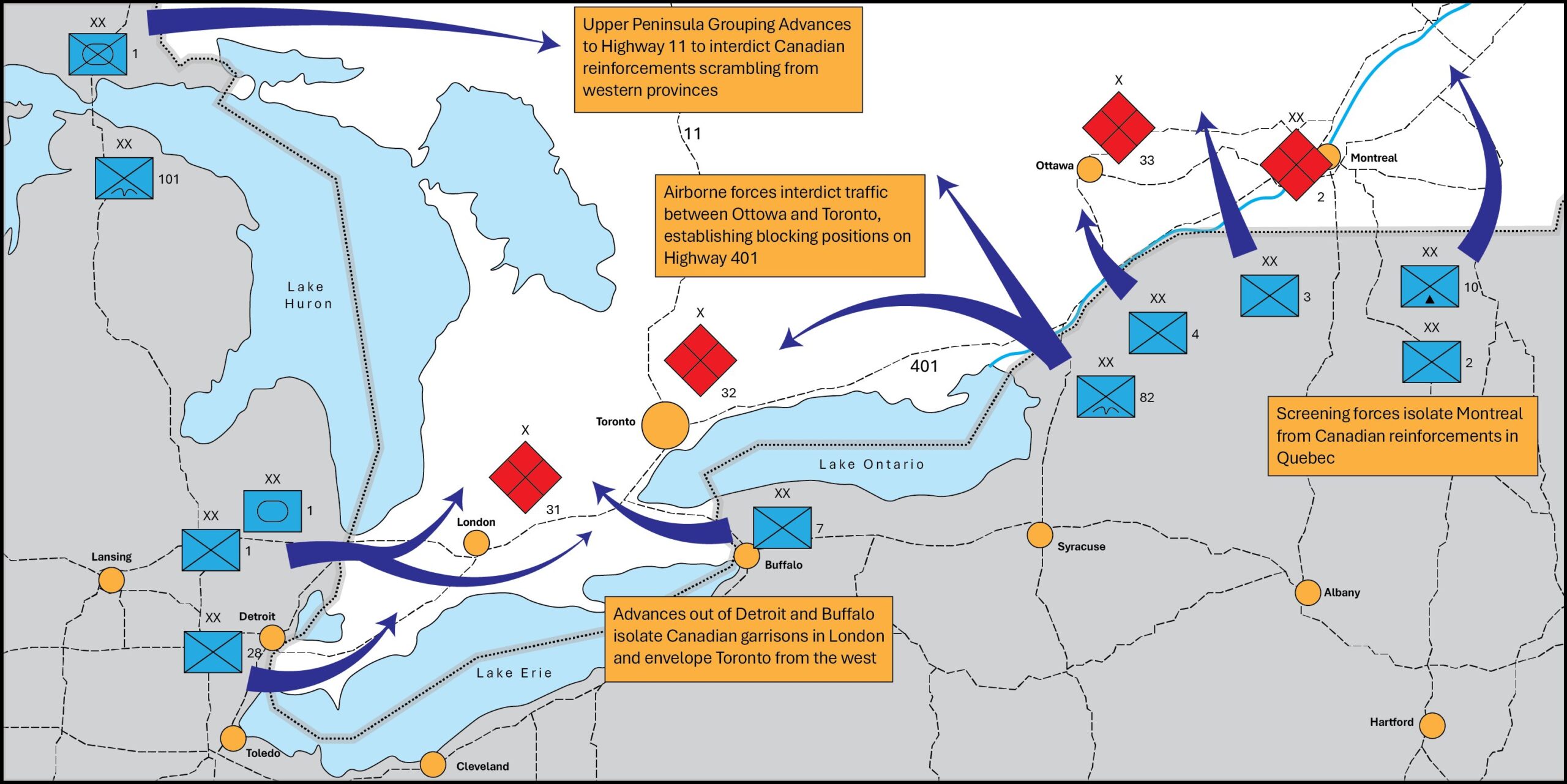
And after much kerfuffle among the easily trolled, he suggests:
There’s no community note on this post which means it has been fact checked as true by real patriots.
As to why Trump would want to invade a frozen failed state on the brink of bankruptcy, even Big Serge doesn’t have an answer.
QotD: Kaiser Wilhelm II
Following the all-too brief reign of Frederick III, his son Wilhelm II, grandson of the first German Emperor, took power in 1888 (known as the “year of the three emperors”). From the start, the young Wilhelm was determined not to be the reserved figure of his grandfather and still less the liberal reformer that his ill-fated father had wished to be. Instead, Wilhelm believed it was his right and duty to be directly involved in the country’s governing.
This was completely incompatible with Bismarck’s system, which had centralized power upon his own person. With uncharacteristic focus and subtlety, Wilhelm sought to reclaim the power that his grandfather had ceded to the chancellor. This was not to prove especially difficult; Bismarck’s position had always relied upon his indispensability to the emperor. Thus, when Bismarck offered his resignation (as he often did during disputes) Wilhelm merely accepted it. The last great man of the wars of unification had now disappeared from the balance.
While the German Empire never became a true autocracy, Wilhelm succeeded in creating what historian, and biographer of the Kaiser, John C. Röhl called a “personalist” system.1 The Kaiser had significant power over personnel. Promotions in the officer corps required his assent. Advancement within civil service (from which civilian ministers were appointed) was also dependent on his favor. By exercising this power, Wilhelm was able to ensure the highest levels of the German government were men agreeable to his point of view. Though they were not mere “yes men”, Wilhelm ensured that they were knowingly dependent on his favor for their position. The Kaiser — even to the end of the monarchy — exercised considerable “negative power” (as Röhl termed it.)2 While Wilhelm’s ability to actively make policy was limited, anything he disapproved of was simply not proposed.
Wilhelm II’s reign marked a departure from the more restrained leadership of his predecessors, as he sought to assert direct influence over the German Empire’s governance and military affairs. This shift toward a more “personalist” system, where loyalty to the Kaiser outweighed true statesmanship, weakened the effectiveness of German leadership and contributed to its eventual strategic missteps. The rigid adherence to the Schlieffen Plan and the technocratic focus on material advantages, such as firepower and mobility, overshadowed the need for adaptable strategic thinking. These failures in both leadership and military planning set the stage for Germany’s disastrous involvement in World War I, where an empire led by personalities rather than policies was ill-prepared for the complexities of modern warfare. Ultimately, Wilhelm’s influence and the culture of sycophancy he fostered played a pivotal role in leading Germany down the path of ruin.
Kiran Pfitzner and Secretary of Defense Rock, “The Kaiser and His Men: Civil-Military Relations in Wilhelmine Germany”, Dead Carl and You, 2024-10-02.
1. John C. G. Röhl, Kaiser Wilhelm II: A Concise Life (Cambridge: Cambridge University Press. 2014).
2. Negative power refers to the ability of an actor or group to block, veto, or prevent actions, decisions, or policies from being implemented, rather than directly initiating or shaping outcomes.
Comments Off on QotD: Kaiser Wilhelm II
January 11, 2025
We Produced a Video with 22 Students from the University of Zürich (Hoplite Revolution Debate)
SandRhoman History
Published 22 Sept 2024In this video, we will look at the core arguments in the hoplite revolution debate to provide you with 1) an overview of the debate itself, 2) a glimpse into warfare in ancient Greece, and 3) evidence of why historical revisionism is necessary. To achieve this, we will follow a similar overview used in a seminar we taught at the University of Zürich in the spring of 2024. Throughout the video, the participants of this seminar will contribute the expertise they have acquired by providing critical information about the ancient primary sources they analysed during the seminar.
Chapters:
00:00 Revisionism, really?!
04:21 19th Century Germany and Ancient Greece
05:39 A Hoplite Revolution?
11:53 Political Implications
16:19 Agonal Warfare (Fair War?)
22:49 Training and Discipline
25:53 Phalanx Formation
30:13 Exclusivity of Hoplites
33:04 Revisionist Battle
36:46 History is not the past.
(more…)
Comments Off on We Produced a Video with 22 Students from the University of Zürich (Hoplite Revolution Debate)
QotD: “Composite” pre-gunpowder infantry units
This is actually a very old concept. The Neo-Assyrian Empire (911-609 BC) is one of the earliest states where we have pretty good evidence for how their infantry functioned – there was of course infantry earlier than this, but Bronze Age royal records from Egypt, Mesopotamia or Anatolia tend to focus on the role of elites who, by the late Bronze Age, are increasingly on chariots. But for the early Iron Age Neo-Assyrian empire, the fearsome effectiveness of its regular (probably professional) infantry, especially in sieges, was a key component of its foreign-policy-by-intimidation strategy, so we see a lot more of them.
That infantry was split between archers and spear-and-shield troops, called alternately spearmen (nas asmare) or shield-bearers (sab ariti). In Assyrian artwork, they are almost always shown in matched pairs, each spearman paired off with a single archer, physically shielding the archer from attack while the archer shoots. The spearmen are shown with one-handed thrusting spears (of a fairly typical design: iron blade, around 7 feet long) and a shield, either a smaller round shield or a larger “tower” shield. Assyrian records, meanwhile, reinforce the sense that these troops were paired off, since the number of archers and spearmen typically match perfectly (although the spearmen might have subtypes, particularly the “Qurreans” who may have been a specialist type of spearman recruited from a particular ethnic group; where the Qurreans show up, if you add Qurrean spearmen to Assyrian spearmen, you get the number of archers). From the artwork, these troops seem to have generally worked together, probably lined up in lines (in some cases perhaps several pairs deep).
The tactical value of this kind of composite formation is obvious: the archers can develop fire, while the spearmen provide moving cover (in the form of their shields) and protection against sudden enemy attack by chariot or cavalry with their spears. The formation could also engage in shock combat when necessary; the archers were at least sometimes armored and carried swords for use in close combat and of course could benefit (at least initially) from the shields of the front rank of spearmen.
The result was self-shielding shock-capable foot archer formations. Total War: Warhammer also flirts with this idea with foot archers who have their own shields, but often simply adopts the nonsense solution of having those archers carry their shields on their backs and still gain the benefit of their protection when firing, which is not how shields work (somewhat better are the handful of units that use their shields as a firing rest for crossbows, akin to a medieval pavisse).
We see a more complex version of this kind of composite infantry organization in the armies of the Warring States (476-221 BC) and Han Dynasty (202 BC – 220 AD) periods in China. Chinese infantry in this period used a mix of weapons, chiefly swords (used with shields), crossbows and a polearm, the ji which had both a long spearpoint but also a hook and a striking blade. In Total War: Three Kingdoms, which represents the late Han military, these troop-types are represented in distinct units: you have a regiment of ji-polearm armed troops, or a regiment of sword-and-shield troops, or a regiment of crossbowmen, which maneuver separately. So you can have a block of polearms or a block of crossbowmen, but you cannot have a mixed formation of both.
Except that there is a significant amount of evidence suggesting that this is exactly how the armies of the Han Dynasty used these troops! What seems to have been common is that infantry were organized into five-man squads with different weapon-types, which would shift their position based on the enemy’s proximity. So against a cavalry or chariot charge, the ji might take the front rank with heavier crossbows in support, while the sword-armed infantry moved to the back (getting them out of the way of the crossbows while still providing mass to the formation). Of course against infantry or arrow attack, the swordsmen might be moved forward, or the crossbowmen or so on (sometimes there were also spearmen or archers in these squads as well). These squads could then be lined up next to each other to make a larger infantry formation, presenting a solid line to the enemy.
(For more on both of these military systems – as well as more specialist bibliography on them – see Lee, Waging War (2016), 89-99, 137-141.)
Bret Devereaux, “Collection: Total War‘s Missing Infantry-Type”, A Collection of Unmitigated Pedantry, 2022-04-01.
Comments Off on QotD: “Composite” pre-gunpowder infantry units
January 6, 2025
If you’ve ever been in any military organization, you’ve encountered this
Shady Maples on the frequent issue needing a particular piece of equipment, but … bureaucracy:
Have you heard the one about the soldier and supply technician?
Soldier: I need a sleeping bag.
Supply Tech: We’re not issuing sleeping bags right now.
Soldier: I can see a sleeping bag on the shelf right there.
Supply Tech: But that’s my last sleeping bag! If I issued that one then I wouldn’t have any left in stock. I need to keep at least one sleeping bag in stock in case someone needs it.
Soldier: Yes! That someone is me! I need the sleeping bag!
Supply Tech: Look, my job is to keep the shelves stocked. See the sign on the door? It says Stores, not Gives. If I give you that sleeping bag then we’ll be out of stock.
Soldier: But I need the sleeping bag.
Supply Tech: You’ll have to come back after we restock.
Soldier: Fine, when are you restocking sleeping bags?
Supply Tech: When we’ve depleted our current stock.
This is barely a joke, I’m convinced it’s a script that supply techs learn in Borden.1 A common variant involves a soldier trying to get a piece of kit ahead of a training exercise. The supply tech tells them they can’t have the kit because they don’t need it. If the soldier needed the kit then it would be issued to them and since it’s not issued to them they don’t need it. I have personally had that conversation multiple times with everyone from lowly supply techs to quartermasters up to Life Cycle Material Managers in ADM(Mat). A notable one involved asking the depot in Montreal to send my unit a specific piece of optical equipment2 which we desperately needed, only to be told that they could not release that kit to us because the Army divesting it. My unit had just taken on a new capability that required this kit, why were they throwing this equipment away? “Nobody uses it anymore.” But I’ll use it, I’m telling you that I’m going to use it! My appeal failed, the depot had to divest because no one used the kit and they wouldn’t let us use the kit because they had to divest. I subsisted by borrowing equipment from other units off-the-books.
Pic related, from Patrick McKenzie.
There is a deep and difficult-to-articulate emotion that I feel whenever I have interactions like this. It’s a middle shade of anger, frustration, sadness, and loathing triggered by a people who so are so lost in process that they stop caring about real-world outcomes. Via Scott Alexander’s Links For December, I just learned? that Scott Aaaronson coined the term “blankface” for people like this:
What exactly is a blankface? He or she is often a mid-level bureaucrat, but not every bureaucrat is a blankface, and not every blankface is a bureaucrat. A blankface is anyone who enjoys wielding the power entrusted in them to make others miserable by acting like a cog in a broken machine, rather than like a human being with courage, judgment, and responsibility for their actions. A blankface meets every appeal to facts, logic, and plain compassion with the same repetition of rules and regulations and the same blank stare — a blank stare that, more often than not, conceals a contemptuous smile.
Once, my 2IC3 was trying to access a childcare benefit intended to reimburse members for babysitting when they are in the field or called in for overnight duties. My 2IC enquired about reimbursement but word came down from Ottawa that she wasn’t eligible since since had not used a licenced childcare provider. Nevermind that there are no licenced providers offering overnight childcare in our geographic area. When my 2IC submitted a grievance for her exclusion from the policy, the grievance analyst rejected it on the grounds that, since she never applied for the benefit (after being told she wasn’t eligible), she had not technically been denied anything. The analyst recommended applying for the benefit in order to be denied and then submitting another grievance based on that denial. At a time when the CAF is desperately trying to attract and retain female leaders, you know what really makes our case? Nickle-and-diming single moms over $70 of childcare. The analyst’s rejection letter made me feel like maybe Ted Kacynski had a point.
In his blog post, Scott Aaronson used Dolores Umbridge as the canonical example of a blankface. Umbridge is conspicuous do-gooder who uses her positional authority to make life miserable for everyone around her. As the story progresses and she accrues more power to her office, it becomes apparent that her virtuous posturing conceals a cruel authoritarian heart. Scott noted that:
The most despicable villain in the Harry Potter universe is not Lord Voldemort, who’s mostly just a faraway cipher and abstract embodiment of pure evil, no more hateable than an earthquake. Rather, it’s Dolores Jane Umbridge, the toadlike Ministry of Magic bureaucrat who takes over Hogwarts school, forces out Dumbledore as headmaster, and terrorizes the students with increasingly draconian “Educational Decrees”. Umbridge’s decrees are mostly aimed at punishing Harry Potter and his friends, who’ve embarrassed the Ministry by telling everyone the truth that Voldemort has returned and by readying themselves to fight him, thereby defying the Ministry’s head-in-the-sand policy.
Voldemort is evil, yes, but he is a moral agent who chooses and sacrifices according to his principles. The series pits his perverse will-to-power against the protagonists heroic defence of good. Unlike Voldemort, Umbridge doesn’t have any vision or principles, her only goal appears to be rigorous application of Ministry rules and procedures. She is not an agent of evil so much as its midwife, allowing evil to spread by obstructing any effort to stop it.
1. CFB Borden is the home of Canadian Forces Logistics Training Centre, a place that nobody says anything good about, especially the loggies.
2. This piece of kit was specialized enough that I would effectively dox myself if I told you what it was.
3. 2IC: Second-In-Command.

Comments Off on If you’ve ever been in any military organization, you’ve encountered this
December 30, 2024
QotD: The auxilia troops of the Imperial Roman armies
But almost immediately we see the emergence of a new system for incorporating non-Romans, this time provincial non-Romans, into the Roman army. These troops, called auxilia (literally, “helpers”) first appear in the Civil Wars, particularly with Caesar‘s heavy reliance on Gallic cavalry to support his legions (which at this time seem not to have featured their own integrated cavalry support, as they had earlier in the republic and as they would later in the empire). The system is at this point very ad hoc and the auxiliaries here are a fairly small part of Roman armies. But when Augustus sets out to institutionalize and stabilize the Roman army after the Battle of Actium (31BC) and the end of the civil wars, the auxilia emerge as a permanent, institutional part of the Roman army. Clearly, they were vastly expanded; by 23 AD they made up half of the total strength of the Roman army (Tac. Ann. 4.5) a rough equivalence that seems to persist at least as far as the Constitutio Antoniniana in 212.
Of course it was no particular new thing for the Romans to attempt to use their imperial subjects as part of their army. The Achaemenid army had incorporated a bewildering array of subject peoples with their own distinctive fighting styles, a fact that Achaemenid rulers liked to commemorate […] The Seleucid army at Magnesia (189) which the Romans defeated also had numerous non-Macedonian supporting troops: Cappadocians, Galatians, Carians, Cilicians, Illyrians, Dahae, Mysians, Arabs, Cyrtians and Elamites. At Raphia (217) the Ptolemaic army incorporated Egyptian troops into the phalanx for the first time, but also included Cretans, Greek mercenaries, Thracians, Gauls and Libyans, inter alia. Most empires try to do this.
The difference here is the relative performance that Rome gets out of these subject-troops (both the socii and the auxilia). Take those examples. Quite a number of the ethnicities on Xerxes monument both served in the armies of Darius III fighting against Alexander but then swiftly switched sides to Alexander after he won the battles – the Ionians, Egypt, and Babylon greeted Alexander as a liberator (at least initially) which is part of why the Achaemenid Empire could crumble so fast so long as Alexander kept winning battles. Apart from Tyre and Gaza, the tough sieges and guerilla resistance didn’t start until he reached the Persian homeland. The auxiliaries in the Seleucid army at Magnesia famously fell apart under pressure, whereas the Roman socii stuck in the fight as well as the legions; our sources give us no sense at any point that the socii were ever meaningfully weaker fighters than the legions (if anything, Livy sometimes represents them as more spirited, though he has an agenda here, as discussed). And the Ptolemaic decision to arm their Egyptian troops in the Macedonian manner won the battle (turns out, Egyptians could fight just as well as Greeks and Macedonians with the right organization and training) but their subsequent apparent decision not to pay or respect those troops as well as their Macedonians seems to have led quite directly to the “Great Revolt” which crippled the kingdom (there is some scholarly argument about this last point, but while I think Polybius’ pro-Greek, anti-Egyptian bias creeps in to his analysis, he is fundamentally right to see the connection (Plb. 5.107). Polybius thinks it was foolish to arm non-Greeks, but the solution here to saving the Ptolemaic kingdom would have been arming the Egyptians and then incorporating them into the system of rule rather than attempting to keep up the ethnic hierarchy with a now-armed, angry and underpaid underclass. The Greek-speakers-only-club system of Ptolemaic rule was unsustainable in either case, especially with Rome on the horizon).
By contrast, the auxilia were mostly very reliable. The one major exception comes from 69 AD – the “Year of the Four Emperors” to give some sense of its chaos – when the Batavian chieftain Julius Civilis (himself an auxiliary veteran and a Roman citizen) revolted and brought one ala and eight cohorts drawn from the Batavi (probably around 4,500 men or so) with him, out of an empire-wide total of c. 150,000 auxilia (so maybe something like 3.3% of the total auxilia). Indeed, the legions had worse mutinies – the mutiny on the Rhine (Tac. Ann. 1.16ff in 14AD) had involved six legions (c. 30,000 troops, nearly a quarter of Rome’s 25 legions at the time). This despite the fact that the auxilia were often deployed away from the legions, sometimes in their own forts (you’ll see older works of scholarship suggest that the auxilia were kept logistically dependent on the legions, but more recent archaeology on exactly where they were has tended to push against this view). Indeed, the auxilia were often the only military forces (albeit in small detachments) in the otherwise demilitarized “senatorial” provinces (which comprised most of the wealthy, populous “core” of the empire); they could be trusted with the job, provided they weren’t the only forces in their own home provinces (and after 69, they never were). And the auxilia fought hard and quite well. The Romans occasionally won battles with nothing but the auxilia, was with the Battle of Mons Graupius (83 AD, Tac. Agricola 35ff) where the legions were held in reserve and never committed, the auxilia winning the battle effectively on their own. Viewers of the Column of Trajan’s spiral frieze have long noted that the auxilia on the monument (the troop-types are recognizable by their equipment) do most of the fighting, while the legions mostly perform support and combat engineering tasks. We aren’t well informed about the training the auxilia went through, but what we do know points to long-service professionals who were drilled every bit as hard as the famously well-drilled legions. Consequently, they had exactly the sort of professional cohesion that we’ve already discussed.
Why this difference in effectiveness and reliability? The answer is to be found in the difference in the terms under which they served. Rather than being treated as the disposable native auxiliaries of other empires, the Romans acted like the auxilia mattered … because they did.
First of all, the auxilia were paid. Our evidence here is imperfect and still much argued about, but it seems that auxilia were paid 5/6ths of the wages of the legionary counterparts, with the cavalry auxilia actually paid more than the infantry legionaries. While it might sound frustrating to be systematically paid 1/6th less than your legionary equivalent, the legions were paid fairly well. The auxilia probably made in wages about as much as a normal day-laborer, but the wage was guaranteed (something very much not the case for civilian laborers) and while the cost of their rations was deducted from their pay, that deduction was a fixed amount that seems to have been set substantially below the market value of their rations, building in another subsidy. Most auxiliaries seem to have been volunteers, because the deal in being an auxiliary was good enough to attract volunteers looking to serve a full tour of duty (around 20 years; this was a long-service professional army now so joining it meant making a career out of it).
And most importantly, eventually (perhaps under Tiberius or shortly thereafter) the auxilia began to receive a special grant of citizenship on finishing that tour of duty, one which covered the soldier, and any children he might have had by his subsequent spouse (including children had, it seems, before he left the army; Roman soldiers in this period were legally barred from contracting legal marriages while serving, so the grant is framed so that it retroactively legitimizes any children produced in a quasi-marriage when the tour of service is completed). Consequently, whereas a soldier being dragooned or hired as a mercenary into other multi-ethnic imperial armies might end his service and go back to being an oppressed subject, the Roman auxiliary, by virtue of his service, became Roman and thus essentially joined the ruling class at least in ethnic status. Auxiliaries also clearly got a share of the loot when offensive warfare happened and while there is a lot of debate as to if they also received the praemia (the large retirement bonus legionaries got), epigraphically it is pretty clear that auxiliaries who were careful with their money could establish themselves fairly well after their service. I should also note that what we see of auxiliaries suggests they were generally well armed (with some exceptions, which may have more to do with stereotyped depictions of certain kinds of “barbarians” than anything else): metal helmets, mail shirts (an expensive and high quality armor for the period), oval shields, a spear and the spatha – a Roman version of the classic Gallic one-handed cutting sword – are the standard visual indicator in Roman artwork for generic “auxiliaries”. That is actually a fairly high-end kit; it is no surprise that the auxilia could win battles with it.
The attentive should already be noting many of the components of the old socii system now in a new form: the non-Roman troops serve under similar conditions with the Romans, get similar pay and rations (forts occupied by the auxilia show no deviation from the standard Roman military diet), a share of loot and glory and can finally be rewarded for loyal service by being inducted into the Roman citizen body itself (which could mean their sons might well enroll in the legions, a thing which does seem to have happened, as we do see a fair bit of evidence for “military families” over multiple generations).
(For those looking for more detail on the auxilia, a lot of this is drawn from a book I have already recommended, Ian Haynes, Blood of the Provinces: The Roman auxilia and the Making of Provincial Society from Augustus to the Severans (2013). Also still useful for the history of the development of the auxilia is D.B. Saddington, The Development of the Roman auxiliary Forces from Caesar to Vespasian (1982); this is, alas, not an easy book to find as it is – to my knowledge – long out of print, but your library may be able to track down a copy.)
Bret Devereaux, “Collections: The Queen’s Latin or Who Were the Romans, Part V: Saving and Losing and Empire”, A Collection of Unmitigated Pedantry, 2021-07-30.
Comments Off on QotD: The auxilia troops of the Imperial Roman armies
December 16, 2024
QotD: Movie and video game portrayals of generalship in pre-modern armies
This is also true, of course, in films. Our friend Darius III from Alexander (2004) silently waves his hand to mean “archers shoot!” and also “chariots, charge!” and then also “everyone else, charge!” Keeping in mind what we saw about the observation abilities of a general on horseback, you can well imagine how able Darius’ soldiers will have been to see his hand gestures while they were on foot from a mile or so away. Yet his army responds flawlessly to his silent arm-gestures. Likewise the flag-signalling in Braveheart‘s (1995) rendition of the Battle of Falkirk: a small banner, raised in the rear is used to signal to soldiers who are looking forward at the enemy, combined with a fellow shouting “advance”. One is left to assume that these generals control their armies in truth through telepathy.
There is also never any confusion about these orders. No one misinterprets the flag or hears the wrong orders. Your unit commanders in Total War never ignore or disobey you; sure the units themselves can rout, but you never have a unit in good order simply ignore your orders – a thing which happened fairly regularly in actual battles! Instead, units are unfailingly obedient right up until the moment they break entirely. You can order untrained, unarmored and barely armed pitchfork peasant levies to charge into contact with well-ordered plate-clad knights and they will do it.
The result is that battleplans in modern strategy games are often impressive intricate, involving the player giving lots of small, detailed orders (sometimes called “micro”, short for “micromanagement”) to individual units. It is not uncommon in a Total War battle for a player to manually coordinate “cycle-charges” (having a cavalry unit charge and retreat and then charge the same unit again to abuse the charge-bonus mechanics) while also ordering their archers to focus fire on individual enemy units while simultaneously moving up their own infantry reserves in multiple distinct maneuvering units to pin dangerous enemy units while also coordinating the targeting of their field artillery. Such attacks in the hands of a skilled player can be flawlessly coordinated because in practice the player isn’t coordinating with anyone but themselves.
Bret Devereaux, “Collections: Total Generalship: Commanding Pre-Modern Armies, Part II: Commands”, A Collection of Unmitigated Pedantry, 2022-06-03.
Comments Off on QotD: Movie and video game portrayals of generalship in pre-modern armies
December 13, 2024
Modern (western) armies never seem to have enough infantry, no matter how high-tech the battlefield gets
Over the last century, one of the apparent constants in military doctrine has been that the latest and greatest technical innovation has somehow eclipsed the importance of boring old infantry units. Tanks were the future! No, tactical airpower was the future! No, nuclear weapons were the future! No, airmobile and helicopter units were the future! No, drones are the future! Yet every time the guns started firing, the limiting factor always seemed to be “not enough infantry” (at least among western militaries). You definitely needed more specialist and support units to handle the latest whizzy toys being deployed, yet it was still the infantry who mattered in the end. That’s just me noodling … it’s only loosely related to the rest of the post.
In my weekly recommendations list from Substack, they included this post from Bazaar of War which discusses the changes in organization of tactical and operation level units over time to best meet the needs of the modern battlefield:

Command post for a single battalion-sized element in a brigade combat team.
Photo by Sgt Anita Stratton, US Army.
Modern ground forces are torn between two competing demands, for infantry and for enablers. Urban operations and large-scale combat over the past decade demonstrate that infantry remains just as essential as ever. Yet that same infantry needs a lot of low-level support just to survive and remain effective: drone operators, EW, and engineers, not to mention armor and artillery. This poses an obvious dilemma for force management—not least when faced with competing demands for air, naval, and missile assets—but also raises questions about force structure.
Organizing the Force
One of the key decisions in how future wars will be fought is what will be the primary tactical unit. Inevitably, certain command levels are much more important than others: those which require greater freedom from higher headquarters than they allow their own subordinates. This partly comes down to a question of where the combined-arms fight is best coordinated, which in turn depends heavily on technology.
This has varied a lot over time. The main tactical formation of the Napoleonic army was the corps, which had organic artillery, cavalry, and engineers that allowed it to fight independent actions with a versatility not available to smaller units. The Western Front of World War II was a war of divisions at the tactical level and armies at the operational, a pattern which continued through the Cold War. The US Army shifted to a brigade model during the GWOT era, on the assumption that future deployments would be smaller scale and lower intensity; only recently has it made the decision to return to a divisional model. Russia also switched to a brigade model around this time, although more for cost and manpower reasons.
Tweaking the Hierarchy
At the same time, certain echelons have disappeared altogether. The subdivisions of Western armies reached their greatest extent in World War I, as new ones were added at the extremities of the model standardized during the French Revolution: fireteams/squads to execute trench raids, army groups to manage large sections of the front. At the same time, cuts were made around the middle. Machine guns were pushed from the regimental level down to battalions over the course of the war, reducing the number of these bulkier regiments in a division; this accordingly eliminated the need for brigades as a tactical unit.
This continued with the next major war. More organic supporting arms and increased mobility made combat more dispersed, creating the need for supply, communications, intelligence, and medical support at lower levels. As units at each echelon grew fatter, it became too cumbersome to have six separate headquarters from battalion to field army. Midway through World War II, the Soviets followed the Western example of eliminating brigades, and got rid of corps to boot (excepting ad-hoc and specialized formations). During the Cold War, the increasing use of combined arms at a lower level caused most NATO militaries to eliminate the regiment/brigade distinction altogether: the majority favored the larger brigade, which could receive supporting units to fight as a brigade combat team, although the US Marines retained regiments as brigades in all but name (the French, by contrast, got rid of most of their battalions, preferring regiments formed of many companies).
Comments Off on Modern (western) armies never seem to have enough infantry, no matter how high-tech the battlefield gets
December 6, 2024
Hegseth is clearly unfit to be Secretary of Defense because LOOK! A SQUIRREL!
I don’t recall having heard Pete Hegseth’s name before Trump nominated him to be the next Secretary of Defense, but Chris Bray clearly thinks the accusations are purely partisan:
Pete Hegseth is being Kavanaughed. And the only people dumb enough to fall for it are Republican senators.
I was willing to hear arguments that Hegseth wasn’t the best choice for Secretary of Defense. In his 40s, he’s on his third marriage, and while the rape allegation from his visit to a conservative conference in Monterey is clearly false, I was wide open to the argument that his actions demonstrated poor judgment. I was prepared to hear an argument. Like many combat veterans, Hegseth had some post-war chaos in his life. Discussion was merited.
But the more these arguments have been made, the dumber they’ve become. We’ve seen this play, and we know the third act: more heat, less light, the descent into completely irrational ranting.
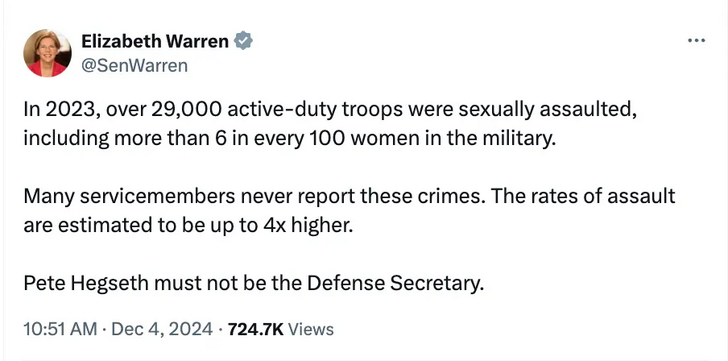
Let’s pretend to take this number at face value, for the sake of argument, though Warren is egregiously misrepresenting the estimate about unreported assaults. Let’s just look at the structure of the claim: In 2023, while Lloyd Austin was the Secretary of Defense, 29,000 troops were sexually assaulted. Therefore, Pete Hegseth must never become the Secretary of Defense.
This is the kind of argument people make when they’re piling on, in an atmosphere of hysteria. It has no logic or order to it, and it does the opposite of the thing it’s intended to do: It depicts current leadership as failures, while arguing against a course correction. Bob punched me in the face, which proves that John is very bad. This is currently the logical structure of half the “news”.
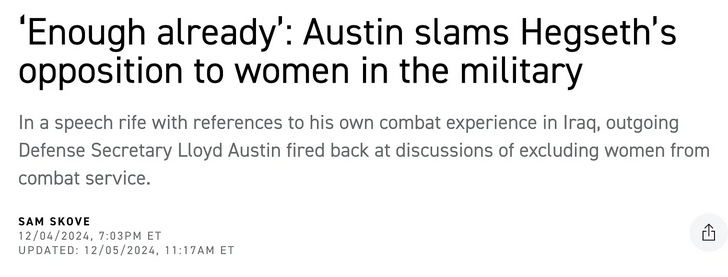
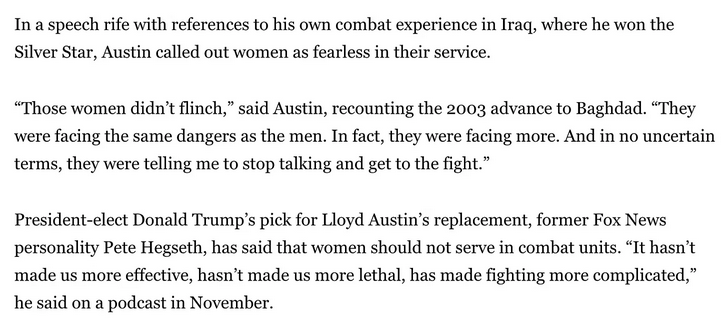
In another Martha-do-you-hear-yourself moment, Lloyd Austin himself recently attacked Hegseth for arguing that women shouldn’t serve in the combat arms:
But read this carefully, and look for the own-goal:
Women serving in combat are facing more danger than men, Austin said.
Therefore, women should serve in combat. Explain the logic, Lloyd. Amazingly, the journalist who reported Austin’s comments missed the implications, mindlessly typing up the claim that women in combat are in more danger than men, then — next paragraph! — framing that statement as a rebuke to someone who warned that the service of women in combat “made fighting more complicated.” We’re not discussing; we’re ritually lining up behind our teams.
Comments Off on Hegseth is clearly unfit to be Secretary of Defense because LOOK! A SQUIRREL!
November 22, 2024
QotD: Pre-modern armies on the move
(As an aside: one my enduring frustrations is the tendency of pre-modern strategy games to represent most flat areas as “plains” of grassland often with a separate “farmland” terrain type used only in areas of very dense settlement. But around most of the Mediterranean, most of the flat, cleared land at lower elevations would have been farmland, with all of the obstructions and complications that implies; rolling grasslands tend to be just that – uplands too hilly for farming.)
The other problem is pathfinding and geolocation. Figuring out where you off-road overland with just a (highly detailed) map and a compass is sufficiently difficult that it is a sport (Orienteering). Prior to 1300, armies in the broader Mediterranean world were likely to lack both; the compass (invented in China) arrives in the Mediterranean in the 1300s and detailed topographical maps of the sort that hikers today might rely on remained rare deep into the modern period, especially maps of large areas. Consequently it could be tricky to determine an army’s exact heading (sun position could give something approximate, of course) or position. Getting lost in unfamiliar territory was thus a very real hazard. Indeed, getting lost in familiar territory was a real hazard: Suetonius records that Julius Caesar, having encamped not far from the Rubicon got lost trying to find it, spent a whole night wandering trying to locate it (his goal being to make the politically decisive crossing with just a few close supporters in secrecy first before his army crossed). In the end he had to find a local guide to work his way back to it in the morning (Suet. Caes. 31.2). So to be clear: famed military genius Julius Caesar got lost trying to find a 50 mile long river only about 150 miles away from Rome when he tried to cut cross-country instead of over the roads.
Instead, armies relied on locals guides (be they friendly, bought or coerced) to help them find their way or figure out where they were on whatever maps they could get together. Locals in turn tend to navigate by landmarks and so are likely to guide the army along the paths and roads they themselves use to travel around the region. Which is all as well because the army needs to use the roads anyway and no one wants to get lost. The road and path network thus becomes a vital navigational aid: roads and paths both lead to settlements full of potential guides (to the next settlement) and because roads tend to connect large settlements and large settlements tend to be the objectives of military campaigns, the road system “points the way”. Consequently, armies rarely strayed off of the road network and were in most cases effectively confined to it. Small parties might be sent out off of the road network from the main body, but the main body was “stuck” on the roads.
That means the general does not have to cope with an infinitely wide range of maneuver possibilities but a spiderweb of possible pathways. Small, “flying columns” without heavy baggage could use minor roads and pathways, but the main body of the army was likely to be confined to well-traveled routes connecting large settlements.
Bret Devereaux, “Collections: Logistics, How Did They Do It, Part III: On the move”, A Collection of Unmitigated Pedantry, 2022-08-12.
Comments Off on QotD: Pre-modern armies on the move
November 21, 2024
1966: Chieftain Tank Simulator | Tomorrow’s World | Retro Tech | BBC Archive
BBC Archive
Published Jul 15, 2024“All the tension, the excitement, and indeed the technical demands of driving a modern tank into battle … but, in fact, I haven’t moved a yard.”
Raymond Baxter test drives the British Army’s Chieftain tank simulator, used for training tank drivers. The illusion is created using a large 1:300 scale model of the battlefield, a computer, and a roving mirror connected to a television camera. The battlefield can be altered simply by swapping out the model trees and buildings.
Mr Baxter can attest to how realistic the experience is, and it costs just one tenth of the price of training in a real Chieftain tank.
Clip taken from Tomorrow’s World, originally broadcast on BBC One, 28 September, 1966.
Comments Off on 1966: Chieftain Tank Simulator | Tomorrow’s World | Retro Tech | BBC Archive
November 18, 2024
QotD: Napoleon and his army
Napoleon’s easy rapport with his troops also gives us some glimpses of his freakish memory. On multiple occasions he chats with a soldier for an hour, or camps with them the eve before a battle; and then ten years later he bumps into the same guy and has total recall of their entire conversation and all of the guy’s biographical details. The troops obviously went nuts for this kind of stuff. It all sort of reminds me of a much older French tradition, where in the early Middle Ages a feudal lord would (1) symbolically help his peasants bring in the harvest and (2) literally wrestle with his peasants at village festivals. Back to your point about the culture, my anti-egalitarian view is that that kind of intimacy across a huge gulf of social status is easiest when the lines of demarcation between the classes are bright, clear, and relatively immovable. What’s crazy about Napoleon, then, is that despite him being the epitome of the arriviste he has none of the snobbishness of the nouveaux-riches, but all of the easy familiarity of the natural aristocrat.
True dedication to the welfare of those under your command,1 and back-slapping jocularity with the troops, are two of the attributes of a wildly popular leader. The third2 is actually leading from the front, and this was the one that blew my mind. Even after he became emperor, Napoleon put himself on the front line so many times he was practically asking for a lucky cannonball to end his career. You’d think after the fourth or fifth time a horse was shot out from under him, or the guy standing right next to him was obliterated by canister shot, the freaking emperor would be a little more careful, but no. And it wasn’t just him — the vast majority of Napoleon’s marshals and other top lieutenants followed his example and met violent deaths.
This is one of the most lacking qualities in leaders today — it’s so bad that we don’t even realize what we’re missing. Obviously modern generals rarely put themselves in the line of fire or accept the same environmental hardships as their troops. But it isn’t just the military, how many corporate executives do you hear about staying late and suffering alongside their teams when crunch time hits? It does still happen, but it’s rare, and the most damning thing is that it’s usually because of some eccentricity in that particular individual. There’s no systemic impetus to commanders or managers sharing the suffering of their men, it just isn’t part of our model of what leadership is anymore. And yet we thirst for it.
Jane and John Psmith, “JOINT REVIEW: Napoleon the Great, by Andrew Roberts”, Mr. and Mrs. Psmith’s Bookshelf, 2023-01-21.
1. When not flinging them into the face of Prussian siege guns.
2. Okay, there are more than three. Some others include: deploying a cult of personality, bestowing all kinds of honors and awards on your men when they perform, and delivering them victory after victory. Of course, Napoleon did all of those things too.
Comments Off on QotD: Napoleon and his army
November 11, 2024
In memoriam
A simple recognition of some of our family members who served in the First and Second World Wars:
The Great War
 Private William Penman, Scots Guards, died 16 May, 1915 at Le Touret, age 25
(Elizabeth’s great uncle)- Private Archibald Turner Mulholland, Argyll & Sutherland Highlanders, mortally wounded 25 September, 1915 at Loos, age 27
(Elizabeth’s great uncle) - Private David Buller, Highland Light Infantry, died 21 October, 1915 at Loos, age 35
(Elizabeth’s great grandfather) - Private Harold Edgar Brand, East Yorkshire Regiment. died 4 June, 1917 at Tournai.
(My first cousin, three times removed) - Private Walter Porteous, Durham Light Infantry, died 4 October, 1917 at Passchendaele, age 18
(my great uncle, who had married the day before he left for the front and never returned) - Corporal John Mulholland, Argyll & Sutherland Highlanders, wounded 2 September, 1914 (shortly before the First Battle of the Aisne), wounded again 29 June, 1918, lived through the war.
(Elizabeth’s great uncle) - John Eleazar (“Ellar”) Thornton, (ranks and dates of service unknown, served in the Royal Garrison Artillery, the East Surrey Regiment, and the Essex Regiment (dates of service unknown, but he likely joined the RGA in 1899). Put on the “Z” list after the war — recall list. He died in an asylum in 1943.
(my grandfather’s eldest brother) - Henry (Harry) Thornton, (uncertain) Lancashire Fusiliers. (We are not sure it is him as there were no identifying family or birth date listed. Rejected for further service.)
(my grandfather’s second older brother)
The Second World War
- Flying Officer Richard Porteous, Royal Air Force, survived the defeat in Malaya, was evacuated to India and lived through the war.
(my great uncle) - Able Seaman John Penman, Royal Navy, served in the Defensively Equipped Merchant fleet on the Atlantic convoys, the Murmansk Run (we know he spent a winter in Russia at some point during the war) and other convoy routes, was involved in firefighting and rescue efforts during the Bombay Docks explosion in 1944, lived through the war.
(Elizabeth’s father. We received his Arctic Star medal in July, 2024.) - Private Archie Black (commissioned after the war and retired as a Major), Gordon Highlanders, captured during the fall of Singapore (aged 15) and survived a Japanese POW camp (he had begun to write an autobiography shortly before he died)
(Elizabeth’s uncle) - Elizabeth Buller, “Lumberjill” in the Women’s Timber Corps, an offshoot of the Women’s Land Army in Scotland through the war.
(Elizabeth’s mother) - Trooper Leslie Taplan Russon, 3rd Royal Tank Regiment, died at Tobruk, 19 December, 1942 (aged 23).
Leslie was my father’s first cousin, once removed (and therefore my first cousin, twice removed). - Reginald Thornton, rank and branch of service unknown, hospitalized during the war with shellshock and was never discharged back into civilian life. He died in York in 1986.
(my grandfather’s youngest brother)
My maternal grandfather, Matthew Kendrew Thornton, was in a reserved occupation during the war as a plater working at Smith’s Docks in Middlesbrough. The original design for the famous Flower-class corvettes came from Smith’s Docks and 16 of the 196 built in the UK during the war (more were built in Canada). My great-grandmother was an enthusiastic ARP warden through the war (she reportedly enjoyed enforcing blackout compliance in the neighbourhood using the rattle and whistle that came with the job).
For the curious, the Commonwealth War Graves Commission the Royal British Legion, and the Library and Archives Canada WW1 and WW2 records site provide search engines you can use to look up your family name. The RBL’s Every One Remembered site shows you everyone who died in the Great War in British or Empire service (Canadians, Australians, New Zealanders, South Africans and other Imperial countries). The CWGC site also includes those who died in the Second World War. Library and Archives Canada allows searches of the Canadian Expeditionary Force and the Royal Newfoundland Regiment for all who served during WW1, and including those who volunteered for the CEF but were not accepted.
In Flanders fields the poppies blow
Between the crosses row on row,
That mark our place; and in the sky
The larks, still bravely singing, fly
Scarce heard amid the guns below.We are the Dead. Short days ago
We lived, felt dawn, saw sunset glow,
Loved and were loved, and now we lie
In Flanders fields.Take up our quarrel with the foe:
To you from failing hands we throw
The torch; be yours to hold it high.
If ye break faith with us who die
We shall not sleep, though poppies grow
In Flanders fields.Lieutenant Colonel John McCrae, MD Canadian Army Medical Corps (1872-1918)
Here is Mark Knopfler’s wonderful song “Remembrance Day” from his Get Lucky album, set to a slideshow of British and Canadian images from World War I through to more recent conflicts put together by Bob Oldfield:
Comments Off on In memoriam
November 9, 2024
History of SAW (Squad Automatic Weapon) use in the US Army
Forgotten Weapons
Published Jul 26, 2024The first squad automatic weapon used by the US Army was the French Mle 1915 Chauchat, which was the primary LMG or automatic rifle for troops in the American Expeditionary Force in World War One. At that time, the Chauchat was a company-level weapon assigned where the company commander thought best. In World War Two, the Chauchat had been replaced by the BAR, and one BAR gunner was in each 12-man rifle platoon. The BAR was treated like a heavy rifle though, and not like a support weapon as light machine guns were in most other armies.
After Korea the value of the BAR was given more consideration and two were put in each squad instead of one, but the M14 replaced the BAR before it could gain any greater doctrinal importance. The M14 was intended to basically go back to the World War Two notion of every man equipped with a very capable individual weapon, and the squad having excellent flexibility and mobility by not being burdened with a supporting machine gun. The M60 machine guns were once again treated as higher-level weapons, to be attached to rifle squads as needed.
After Vietnam, experiments with different unit organization — and with the Stoner 63 machine guns — led to the decision that a machine gun needed to be incorporated into the rifle squad. This led to the request for what became the M249 Squad Automatic Weapon, and its adoption in the 1980s. At last, the American rifle squad included an organic supporting machine gun.
Today, the USMC is once again going back to the earlier model with every rifleman carrying the same weapon, now an M27 Individual Automatic Rifle. The Army may also change its organizational structure with the new XM7 and XM250 rifle and machine gun, but only time will tell …
(more…)
Comments Off on History of SAW (Squad Automatic Weapon) use in the US Army


