Quotulatiousness

April 28, 2019

The Battle of Lützen – 1632 – The 30 Years War (in Swedish, with English sub-titles)

Gripen
Published on 3 Dec 2015

One of the bloodiest battles of the Thirty Years War. Sweden vs. the Holy Roman Empire. A mass grave has been found, with the victims from the battle. Are they Swedish/Finnish soldiers or German mercenaries?

(This Swedish documentary has English subtitles).

From the comments:

Blah b
2 years ago
This documentary is often painful to watch, the way inexperienced modern people with no sense of empathy project their values onto those times. They weren’t “defenseless men standing still”. Armies had learned the hard way that massed musket fire won battles. If everybody is looking for cover and looking out for themselves, you can never operate such rigid units.

So the individual soldier was harshly drilled to indeed stand still even with cannonballs tearing through his unit, or another unit standing 30-80 meters away. Because if individuals acted as individuals, the battle would be lost and the army would be destroyed.

But when that machine operated, it would win battles. The system invented by Maurice of the Netherlands ensured that if you were attacking a group of musketeers, every 20-25 seconds, they could deliver a crushing volley that can kill or injure 10-25% of a another unit, that means they only needed 2-3 salvos to achieve a local victory. Untrained units would literally never touch a musketeer, as his unit would’ve routed the attackers before they got within touching range.

Also there were no standing armies, there was no national identity as such. Mercenaries were totally acceptable. Mercenaries could become very loyal and reliable if paid on time [and] consistently, and would easily crush national armies that usually lacked the routine of professional soldiers. Loyalty and your identity was constructed differently. It would’ve been perfectly normal for me to utterly hate and maybe kill my neighbours if they were of a different religion. Otherwise, a Swedish protestant from far away was an ally with the right ideas. I wouldn’t have been able to understand him and everything would be alien about him, but I’d consider him a friend, and Catholics from the next village where I’d lived all my life would be enemies.

Unless the king comes around and says the Catholics are friends. Because the king is appointed by God who runs the world on a day to day [basis], and you obey without question. If the king says it’s so, that means God himself agrees and says it’s so, and you don’t question God. Loyalty until death is about the least you owed your king in those days.

People who can’t understand how such things worked historically, really should not be making documentaries…

January 23, 2019

A new beginning for the Middle East: The Cyrus Cylinder and Ancient Persia

Filed under: History, Middle East, Religion — Tags: , , , , , , — Nicholas @ 02:00

The British Museum
Published on 18 Jul 2014

The Cyrus Cylinder is one of the most famous objects to have survived from the ancient world. It was inscribed in Babylonian cuneiform on the orders of Persian King Cyrus the Great (559-530 BC) after he captured Babylon in 539 BC.

The cylinder is often referred to as the first bill of human rights as it appears to encourage freedom of worship throughout the Persian Empire and to allow deported people to return to their homelands. It was found in Babylon in modern Iraq in 1879 during a British Museum excavation.

January 1, 2019

The Greatest Ancient Empire you have never heard of … The Mitanni

Filed under: History, Middle East — Tags: , , , , , — Nicholas @ 02:00

Epimetheus
Published on 4 Oct 2018

The Greatest Ancient Empire you have never heard of … The Mitanni

The Mitanni capital city of Washukanni has never been identified although there are a few locations “mounds” where the city is most likely located. It will be one of the most exciting and illuminating discoveries when this ancient capital is unearthed — (I hope it happens in my lifetime) — if there are tablets there (maybe even a library!) that could very much rewrite the history of the middle east and civilization. I have been fascinated by the Mitanni for quite some time and I am very happy to share this video with you all 😊 I hope you enjoy, and it stirs your curiosity!

Support new videos from Epimetheus on Patreon! 😀
https://www.patreon.com/Epimetheus1776

Mitanni, Hurrians, Mitanni empire, Egyptian empire, Hittite empire, Babylon, bronze age, bronze age collapse, bronze age empires, bronze age great kings, Mesopotamia, ancient middle east, ancient Mesopotamia, Mesopotamia documentary, Mitanni documentary, greatest ancient empire, most powerful ancient empire, Babylonian empire, bronze age diplomacy, Nefertiti, tushratta, Akhenaten, Suppiluliuma, Assyria, Assyrian empire, Washukanni, Kurtiwaza, Shattiwaza, Shaushtatar, chariots, chariot warfare, the Mitanni, Babylonian empire, ancient near east, Hurrian migration, documentary Mitanni, lost empires, ancient egypt, bronze age chariots, ancient civilization, lost civilization, lost empire, discovered civilization, most powerful ancient empire

December 15, 2018

Who were the Sea People? Bronze Age Collapse

Epimetheus
Published on 24 Nov 2018

Operation Odysseus Playlist link- https://www.youtube.com/playlist?list…

My Patreon-https://youtu.be/wUmPluCC27Q
Who were the Sea People? and the Bronze Age Collapse

December 9, 2018

MYSTERIOUS ‘Sea People’ And Their Unknown Origins

Filed under: Greece, History, Middle East — Tags: , , , , — Nicholas @ 02:00

Beyond Science
Published on 28 Aug 2017

Who were these mysterious sea people?

November 29, 2018

El Zotz – Lost City of the Bats

Filed under: Americas, History, Science — Tags: , , — Nicholas @ 04:00

Lindybeige
Published on 28 Nov 2018

The Maya built many cities that even now are reappearing from the jungles of Central America. The first video of many in a series.

Support me on Patreon: https://www.patreon.com/Lindybeige

I was not paid to make this video, but INGUAT paid for my flights, accommodation, and activities.

Lindybeige: a channel of archaeology, ancient and medieval warfare, rants, swing dance, travelogues, evolution, and whatever else occurs to me to make.

▼ Follow me…

Twitter: https://twitter.com/Lindybeige I may have some drivel to contribute to the Twittersphere, plus you get notice of uploads.

website: http://www.LloydianAspects.co.uk

November 20, 2018

QotD: Why do we drink?

Filed under: Health, History, Quotations, Wine — Tags: , , , — Nicholas @ 01:00

Alcoholic beverages, like agriculture, were invented independently many different times, likely on every continent save Antarctica. Over the millennia nearly every plant with some sugar or starch has been pressed into service for fermentation: agave and apples, birch tree sap and bananas, cocoa and cassavas, corn and cacti, molle berries, rice, sweet potatoes, peach palms, pineapples, pumpkins, persimmons, and wild grapes. As if to prove that the desire for alcohol knows no bounds, the nomads of Central Asia make up for the lack of fruit and grain on their steppes by fermenting horse milk. The result, koumiss, is a tangy drink with the alcohol content of a weak beer.

Alcohol may afford psychic pleasures and spiritual insight, but that’s not enough to explain its universality in the ancient world. People drank the stuff for the same reason primates ate fermented fruit: because it was good for them. Yeasts produce ethanol as a form of chemical warfare — it’s toxic to other microbes that compete with them for sugar inside a fruit. That antimicrobial effect benefits the drinker. It explains why beer, wine, and other fermented beverages were, at least until the rise of modern sanitation, often healthier to drink than water.

What’s more, in fermenting sugar, yeasts make more than ethanol. They produce all kinds of nutrients, including such B vitamins as folic acid, niacin, thiamine, and riboflavin. Those nutrients would have been more present in ancient brews than in our modern filtered and pasteurized varieties. In the ancient Near East at least, beer was a sort of enriched liquid bread, providing calories, hydration, and essential vitamins.

[…]

Indirectly, we may have the nutritional benefits of beer to thank for the invention of writing, and some of the world’s earliest cities — for the dawn of history, in other words. Adelheid Otto, an archaeologist at Ludwig-Maximilians University in Munich who co-directs excavations at Tall Bazi, thinks the nutrients that fermenting added to early grain made Mesopotamian civilization viable, providing basic vitamins missing from what was otherwise a depressingly bad diet. “They had bread and barley porridge, plus maybe some meat at feasts. Nutrition was very bad,” she says. “But as soon as you have beer, you have everything you need to develop really well. I’m convinced this is why the first high culture arose in the Near East.”

Andrew Curry, “Our 9,000-Year Love Affair With Booze”, National Geographic, 2017-02.

October 20, 2018

Cavalry was a stupid idea

Filed under: History, Military, Technology — Tags: , — Nicholas @ 04:00

Lindybeige
Published on 28 Aug 2016

The Great Courses Plus free trial: http://ow.ly/fA12302OFSt

Riding a horse into battle is not a technique easy to adopt. The first man to suggest it may have been laughed at.

Support me on Patreon: https://www.patreon.com/Lindybeige

A long ramble by me. Possibly I should have done one video about Celtic/Roman four-pommelled saddles, and a separate one about how cavalry took a long time to develop.

I wasn’t quite at my peak while making this one. I came back from abroad with a virus, and had spent the previous day coughing.

Lindybeige: a channel of archaeology, ancient and medieval warfare, rants, swing dance, travelogues, evolution, and whatever else occurs to me to make.

▼ Follow me…

Twitter: https://twitter.com/Lindybeige I may have some drivel to contribute to the Twittersphere, plus you get notice of uploads.

website: www.LloydianAspects.co.uk

September 25, 2018

Amazons – fierce fighting tribe or just ancient Greek porn?

Filed under: Europe, Greece, History — Tags: , , , — Nicholas @ 02:00

Lindybeige
Published on 21 Jun 2011

You can believe in them if you want, but if you do, you should out of fairness to other mythological characters believe in giants, cyclopes, griffins, and gorgons.

www.LloydianAspects.co.uk

August 30, 2018

A Drone at Pompeii

Filed under: Europe, History, Italy, Science — Tags: , , , — Nicholas @ 02:00

pdvaeriennes
Published on Mar 3, 2015

August 25, 2018

Mediterranean trade in the Iron Age

Filed under: Economics, Europe, History, Middle East — Tags: , , , , — Nicholas @ 03:00

Jan Bakker, Stephan Maurer, Jörn-Steffen Pischke, and Ferdinand Rauch look at the relationships between trade and economic growth around the Mediterranean during the Iron Age:

Economists often point out the benefits of trade, yet empirical evidence for these benefits has been hard to come by and tends to be recent. This column goes back to the first millennium BC to analyse the growth effects of one of the first major trade expansions in human history: the systematic crossing of the open sea in the Mediterranean by the Phoenicians. A strong positive relationship between connectedness and archaeological sites suggests a large role for geography and trade in development even at such an early juncture in history.

The effects of free trade inspire a lot of public debate these days, and policies to restrict trade are gaining in prominence. Economists since Adam Smith and David Ricardo have typically pointed out the benefits of trade. Yet empirical evidence for these benefits has been much harder to come by and is much more recent. In particular, empirical economists have tried to demonstrate that more open economies or more integrated markets see faster growth. The relationship between these two variables is not much disputed; the more difficult question is whether this is due to trade causing growth or richer economies being more open.

[…]

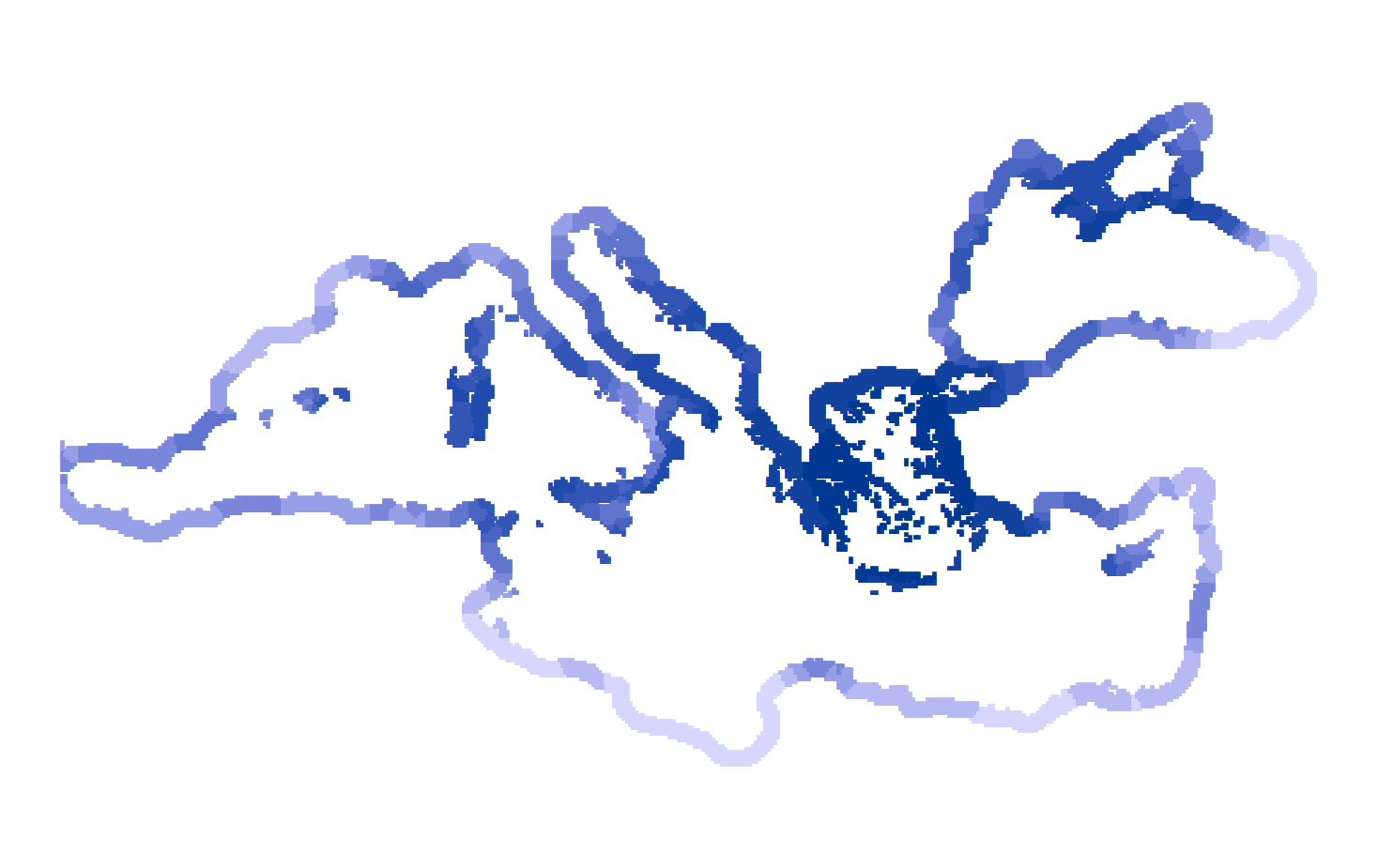
To analyse whether this increased trade also caused growth, we exploit the fact that open sea sailing creates different levels of connectedness for different points on the coast. The shape of the coast and the location of islands determineshow easy it is to reach other points, which might be potential trading partners, within a certain distance. We create such a measure of connectedness for travel via sea. Figure 1 shows the values of this measure on a map and demonstrates how some regions, for example the Aegean but also southern Italy and Sicily, are much better connected than others.

We use this measure of connectedness as a proxy for trading opportunities.

Figure 1 Log connectedness at 500km distance

Note: Darker blue indicates better connected locations.

Measuring growth for an early period of human history is more difficult as we have no standard measure of income, GDP, or even population. We quantify growth by the presence of archaeologic sites for settlements or urbanisations. While this is clearly not a perfect measure, more sites should imply more human presence and activity. We then relate the number of active archaeological sites in a particular period to our measure of connectedness.

We find a large positive relationship between connectedness and archaeological sites. The effect of connections on growth in the Iron Age Mediterranean are up to twice as large as the effects Donaldson and Hornbeck (2016) found for US railroads. Although these results are unlikely to be directly comparable, the magnitudes suggest a large role for geography and trade in development even at such an early juncture in history.

July 28, 2018

Historical vandalism at Stonehenge

Filed under: Britain, History — Tags: , , — Nicholas @ 03:00

Jocelyn Sears on the barbaric “souvenir” habits of 18th century English “tourists”:

A photograph of Stonehenge taken in July 1877 by Philip Rupert Acott
Via Wikimedia Commons

In 1860, a concerned tourist wrote to the London Times decrying the “foolish, vulgar and ruthless practice of the majority of visitors” to Stonehenge “of breaking off portions of it as keepsakes.” Today, taking a hammer and chisel to a Neolithic monument seems like obvious vandalism, but during the Victorian era, such behavior was not only common but expected.

English antiquarian tourists, who were mostly upper class, had developed the habit of taking makeshift relics from the historical sites they visited during the 18th century. By 1830, the practice was so widespread that the English painter Benjamin Robert Haydon dubbed it “the English disease,” writing, “On every English chimney piece, you will see a bit of the real Pyramids, a bit of Stonehenge! […] You can’t admit the English into your gardens but they will strip your trees, cut their names on your statues, eat your fruit, & stuff their pockets with bits for their musaeums.”

For centuries, both locals and visitors had taken pieces of Stonehenge for use in folk remedies. As early as the 12th century, rumors of the stones’ healing properties appear in the writing of Geoffrey of Monmouth, and in 1707, Reverend James Brome wrote that their scrapings were still thought to “heal any green Wound, or old Sore.” In the 1660s, the English antiquarian John Aubrey reported a local superstition that “pieces or powder of these stones, putt into their wells, doe drive away the Toades.”

Eventually, tourists were not just taking from Stonehenge, but also leaving their mark, too. By the middle of the 17th century, tourist graffiti was appearing on the stones. The name of Johannes Ludovicus de Ferre — abbreviated “IOH : LVD : DEFERRE” — is etched, and so is the engraving “I WREN,” which may refer to Christopher Wren, the famed architect who designed St. Paul’s Cathedral.

As early as 1740, the archaeologist William Stukeley was decrying “the unaccountable folly of mankind in breaking pieces off [the stones] with great hammers,” and by the end of the 19th century, according an 1886 commenter, “Almost every day takes some fragment from the ruins, or adds something to the network of scrawling with which the surface of the stone is defaced.”

July 19, 2018

Mucking around with Stonehenge

Filed under: Britain, History, Religion, Science — Tags: , , — Nicholas @ 06:00

Many people are still under the impression that Stonehenge was built by the Druids (debunked in this video by Siobhan Thompson). At least as many people think that the modern day stone circle is an undisturbed historical relic, and that the stones are standing today as and where they have for thousands of years. All the way back in 2001, Emma Young did a quick debunking of that theory in New Scientist:

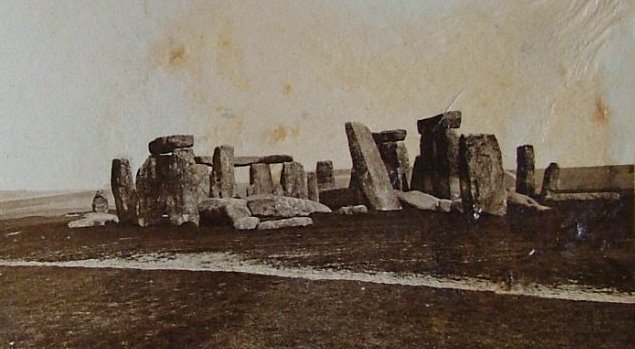
An early photograph of Stonehenge taken in July 1877 by Philip Rupert Acott
Via Wikimedia Commons


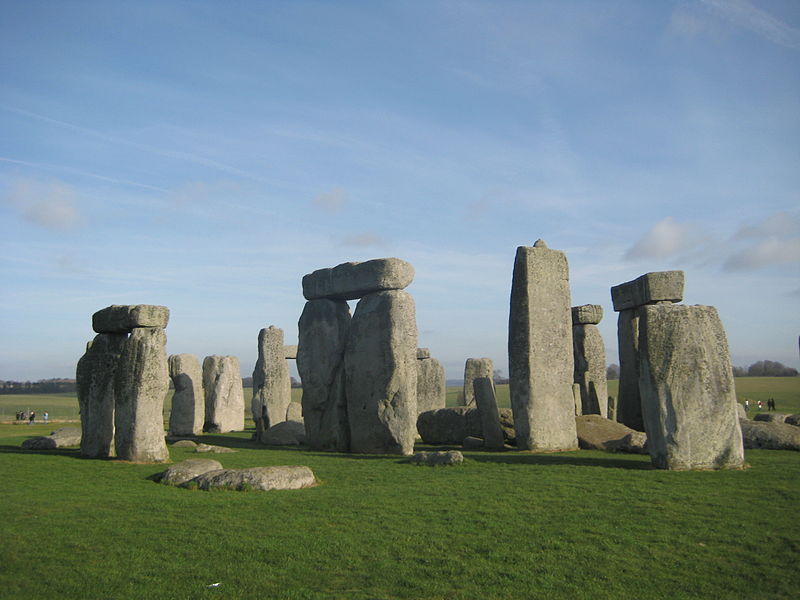
Photo from a similar angle in 2008 showing the extent of reconstruction.
Via Wikimedia Commons

Most of the one million visitors who visit Stonehenge on Salisbury Plain every year believe they are looking at untouched 4,000-year-old remains. But virtually every stone was re-erected, straightened or embedded in concrete between 1901 and 1964, says a British doctoral student.

“What we have been looking at is a 20th-century landscape, reminiscent of what Stonehenge might have looked like thousands of years ago,” says Brian Edwards, a student at the University of the West of England in Bristol.

Stonehenge isn’t the only ancient site to have been transformed in recent years, he says. “Even many of the local people in Avebury weren’t aware that a lot of the stones were put up in the 1930s,” he told New Scientist.

[…]

English Heritage says it is now considering covering the Stonehenge alteration programme in detail in the next edition of its official guidebook to the site. A decision not to include the work in official guides was taken in the 1960s, says Dave Batchelor, English Heritage’s senior archaeologist.

The first restoration project took place in 1901. A leaning stone was straightened and set in concrete, to prevent it falling.

More drastic renovations were carried out in the 1920s. Under the direction of Colonel William Hawley, a member of the Stonehenge Society, six stones were moved and re-erected.

Cranes were used to reposition three more stones in 1958. One giant fallen lintel, or cross stone, was replaced. Then in 1964, four stones were repositioned to prevent them falling.

The 1920s ‘restoration’ was the most “vigorous”, says Christopher Chippindale of the Cambridge University Museum of Archaeology and Anthropology. “The work in the 1920s under Colonel William Crawley is a sad story,” he says.

As I commented on a post back in 2010:

I imagine, given how many times Stonehenge has been mucked about with by earlier enthusiasts, there must be much misleading data has to be sifted and re-sifted before any definite discoveries can be announced. Stonehenge has been fascinating people for centuries and there are probably lots of amateur investigations that may well have made the situation more confusing (think of a sixteenth century equivalent of Indiana Jones or Lara Croft with a nose for treasure).

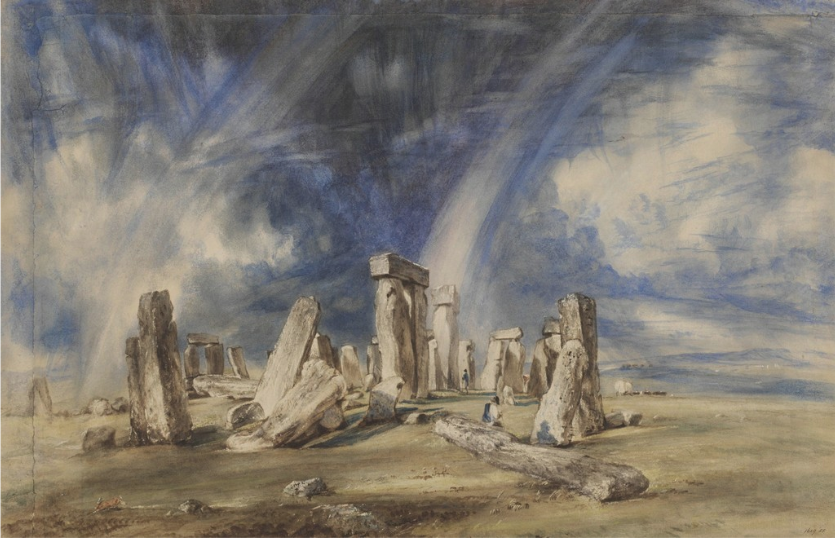
Atlas Obscura recently had a set of photos of Stonehenge taken in 1867 likely featuring the family of Colonel Sir Henry James, of the Ordnance Survey. There’s also a watercolour by John Constable from around 1835 showing a very different, more ruin-y monument:

May 29, 2018

ESR’s thumbnail sketch on the origins of the Indo-European language families

Filed under: Asia, Europe, History — Tags: , , , — Nicholas @ 05:00

When you mash historical linguistics hard enough into paleogenetics, interesting things fall out:

The steppe extends roughly from the Dniepr to the Ural or 30° to 55° east longitude, and from the Black Sea and the Caucasus in the south to the temperate forest and taiga in the north, or 45° to 55° north latitude.
Via Wikipedia

What we can now say pretty much for sure: Proto-Indo-European was first spoken on the Pontic Steppes around 4000 BCE. That’s the grasslands north of the Black Sea and west of the Urals; today, it’s the Ukraine and parts of European Russia. The original PIE speakers (which we can now confidently identify with what archaeologists call the Yamnaya culture) were the first humans to domesticate horses.

And – well, basically, they were the first and most successful horse barbarians. They invaded Europe via the Danube Valley and contributed about half the genetic ancestry of modern Europeans – a bit more in the north, where they almost wiped out the indigenes; a bit less in the south where they mixed more with a population of farmers who had previously migrated in on foot from somewhere in Anatolia.

The broad outline isn’t a new idea. 400 years ago the very first speculations about a possible IE root language fingered the Scythians, Pontic-Steppe descendants in historical times of the original PIE speakers – with a similar horse-barbarian lifestyle. It was actually a remarkably good guess, considering. The first version of the “modern” steppe-origin hypothesis – warlike bronze-age PIE speakers domesticate the horse and overrun Europe at sword- and spear-point – goes back to 1926.

But since then various flavors of nationalist and nutty racial theorist have tried to relocate the PIE urheimat all over the map – usually in the nut’s home country. The Nazis wanted to believe it was somewhere in their Greater Germany, of course. There’s still a crew of fringe scientists trying to pin it to northern India, but the paleogenetic evidence craps all over that theory (as Cochran explains rather gleefully – he does enjoy calling bullshit on bullshit).

Then there have been the non-nutty proposals. There was a scientist named Colin Renfrew who for many years (quite respectably) pushed the theory that IE speakers walked into Europe from Anatolia along with farming technology, instead of riding in off the steppes brandishing weapons like some tribe in a Robert E. Howard novel.

Alas, Renfrew was wrong. It now looks like there was such a migration, but those people spoke a non-IE language (most likely something archaically Semitic) and got overrun by the PIE speakers riding in a few thousand years later. Cochran calls these people “EEF” (Eastern European Farmers) and they’re most of the non-IE half of modern European ancestry. Basque is the only living language that survives from EEF times; Otzi the Iceman was EEF, and you can still find people with genes a lot like his in the remotest hills of Sardinia.

Even David Anthony, good as he is about much else, seems rather embarrassed and denialist about the fire-and-sword stuff. Late in his book he spins a lot of hopeful guff about IE speakers expanding up the Danube peacefully by recruiting the locals into their culture.

Um, nope. The genetic evidence is merciless (though, to be fair, Anthony can’t have known this). There’s a particular pattern of Y-chromosome and mitochondrial DNA variation that you only get in descendant population C when it’s a mix produced because aggressor population A killed most or all of population B’s men and took their women. Modern Europeans (C) have that pattern, the maternal line stuff (B) is EEF, and the paternal-line stuff (A) is straight outta steppe-land; the Yamnaya invaders were not gentle.

How un-gentle were they? Well…this paragraph is me filling in from some sources that aren’t Anthony or Cochran, now. While Europeans still have EEF genes, almost nothing of EEF culture survived in later Europe beyond the plants they domesticated, the names of some rivers, and (possibly) a murky substratum in some European mythologies.

The PIE speakers themselves seem to have formed, genetically, when an earlier population called the Ancient Northern Eurasians did a fire-and-sword number (on foot, that time) on a group of early farmers from the Fertile Crescent. Cochrane sometimes calls the ANEs “Hyperboreans” or “Cimmerians”, which is pretty funny if you’ve read your Howard.

May 28, 2018

Middle East: Palmyra Today – Afterword – Extra History

Filed under: History, Middle East, Religion — Tags: , , , — Nicholas @ 02:00

Extra Credits
Published on 31 Oct 2015

Learn about Odenathus, King of Palmyra: http://bit.ly/1GDsDvz
____________

Palmyra is an embodiment of our shared past, but right now it’s under the control of ISIS. They have destroyed the antiquities that remind us of our shared past. We would like to take a moment to honor Dr. Khaled al-Assad, the museum director who gave his life rather than reveal the locations of more Palmyrene relics for ISIS to destroy.

« Newer PostsOlder Posts »

Powered by WordPress