
Quotulatiousness

May 29, 2018

ESR’s thumbnail sketch on the origins of the Indo-European language families

Filed under: Asia, Europe, History — Tags: , , , — Nicholas @ 05:00

When you mash historical linguistics hard enough into paleogenetics, interesting things fall out:
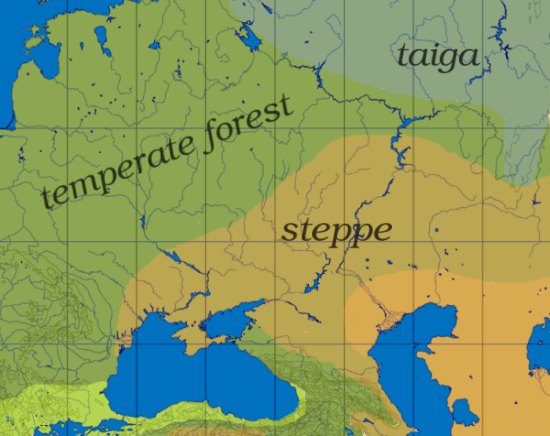
The steppe extends roughly from the Dniepr to the Ural or 30° to 55° east longitude, and from the Black Sea and the Caucasus in the south to the temperate forest and taiga in the north, or 45° to 55° north latitude.
Via Wikipedia

What we can now say pretty much for sure: Proto-Indo-European was first spoken on the Pontic Steppes around 4000 BCE. That’s the grasslands north of the Black Sea and west of the Urals; today, it’s the Ukraine and parts of European Russia. The original PIE speakers (which we can now confidently identify with what archaeologists call the Yamnaya culture) were the first humans to domesticate horses.

And – well, basically, they were the first and most successful horse barbarians. They invaded Europe via the Danube Valley and contributed about half the genetic ancestry of modern Europeans – a bit more in the north, where they almost wiped out the indigenes; a bit less in the south where they mixed more with a population of farmers who had previously migrated in on foot from somewhere in Anatolia.

The broad outline isn’t a new idea. 400 years ago the very first speculations about a possible IE root language fingered the Scythians, Pontic-Steppe descendants in historical times of the original PIE speakers – with a similar horse-barbarian lifestyle. It was actually a remarkably good guess, considering. The first version of the “modern” steppe-origin hypothesis – warlike bronze-age PIE speakers domesticate the horse and overrun Europe at sword- and spear-point – goes back to 1926.

But since then various flavors of nationalist and nutty racial theorist have tried to relocate the PIE urheimat all over the map – usually in the nut’s home country. The Nazis wanted to believe it was somewhere in their Greater Germany, of course. There’s still a crew of fringe scientists trying to pin it to northern India, but the paleogenetic evidence craps all over that theory (as Cochran explains rather gleefully – he does enjoy calling bullshit on bullshit).

Then there have been the non-nutty proposals. There was a scientist named Colin Renfrew who for many years (quite respectably) pushed the theory that IE speakers walked into Europe from Anatolia along with farming technology, instead of riding in off the steppes brandishing weapons like some tribe in a Robert E. Howard novel.

Alas, Renfrew was wrong. It now looks like there was such a migration, but those people spoke a non-IE language (most likely something archaically Semitic) and got overrun by the PIE speakers riding in a few thousand years later. Cochran calls these people “EEF” (Eastern European Farmers) and they’re most of the non-IE half of modern European ancestry. Basque is the only living language that survives from EEF times; Otzi the Iceman was EEF, and you can still find people with genes a lot like his in the remotest hills of Sardinia.

Even David Anthony, good as he is about much else, seems rather embarrassed and denialist about the fire-and-sword stuff. Late in his book he spins a lot of hopeful guff about IE speakers expanding up the Danube peacefully by recruiting the locals into their culture.

Um, nope. The genetic evidence is merciless (though, to be fair, Anthony can’t have known this). There’s a particular pattern of Y-chromosome and mitochondrial DNA variation that you only get in descendant population C when it’s a mix produced because aggressor population A killed most or all of population B’s men and took their women. Modern Europeans (C) have that pattern, the maternal line stuff (B) is EEF, and the paternal-line stuff (A) is straight outta steppe-land; the Yamnaya invaders were not gentle.

How un-gentle were they? Well…this paragraph is me filling in from some sources that aren’t Anthony or Cochran, now. While Europeans still have EEF genes, almost nothing of EEF culture survived in later Europe beyond the plants they domesticated, the names of some rivers, and (possibly) a murky substratum in some European mythologies.

The PIE speakers themselves seem to have formed, genetically, when an earlier population called the Ancient Northern Eurasians did a fire-and-sword number (on foot, that time) on a group of early farmers from the Fertile Crescent. Cochrane sometimes calls the ANEs “Hyperboreans” or “Cimmerians”, which is pretty funny if you’ve read your Howard.
May 28, 2018

Middle East: Palmyra Today – Afterword – Extra History

Filed under: History, Middle East, Religion — Tags: , , , — Nicholas @ 02:00

Extra Credits
Published on 31 Oct 2015

Learn about Odenathus, King of Palmyra: http://bit.ly/1GDsDvz
____________

Palmyra is an embodiment of our shared past, but right now it’s under the control of ISIS. They have destroyed the antiquities that remind us of our shared past. We would like to take a moment to honor Dr. Khaled al-Assad, the museum director who gave his life rather than reveal the locations of more Palmyrene relics for ISIS to destroy.

May 13, 2018

QotD: The lost works of Epicurus

Filed under: Books, Greece, History, Quotations — Tags: , , , , — Nicholas @ 01:00

[Most of the original writings of Epicurus have been lost.] There are the elaborate refutations of Epicureanism by Cicero and Plutarch. These inevitably outline and sometimes even quote what they are attacking. There are hundreds of other references to Epicurus in the surviving literature of the ancient world. Some of these are useful sources of information. Some are our only sources of information on certain points of the philosophy.

During the past few centuries, scholars have been trying to read the charred papyrus rolls from a library in Herculaneum buried by the eruption of Vesuvius in 79 AD. Some of these contain works by Philodemus of Gadara, an Epicurean philosopher of the 1st century BC. Much of this library remains unexcavated, and most of the rolls recovered have not really been examined. There are hopes that a complete work by Epicurus will one day be found here.

Above all else, though, is the De Rerum Natura of Lucretius. He was a Roman poet who died around the year 70 BC. His epic, in which he claims to restate the physical doctrines of Epicurus, was unfinished at the time of his death, and it is believed that Cicero himself edited the six completed books and published the text roughly as it has come down to us. This is one of the greatest poems ever written, and perhaps the strangest of all the great poems. It is also the longest explanation in a friendly source of the physical theories of Epicurus.

Therefore, if anyone tries to say in any detail what Epicurus believed, he will not be arguing from strong authority. If we compare the writings of any extant philosopher with the summaries and commentaries, we can see selective readings and exaggerations and plain misunderstandings. How much of what Karl Marx really said can be reliably known from the Marxist and anti-Marxist scholars of the 20th century? Even David Hume, who wrote very clearly in a very clear language, seems to have been consistently misunderstood by his 19th century critics. For Epicurus, we may have reliable information about the main points of his ethics and his physics. We have almost no discussions of his epistemology or his philosophy of mind. Anyone who tries writing on these is largely guessing.

All this being said, enough has survived to make a general account of the philosophy possible. Epicurus appears to have been a consistent thinker. Though it may only ever be a guess — unless the archaeologists in Herculaneum find the literary equivalent of Tutankhamen’s tomb — we can with some confidence proceed from what Epicurus did say to what he might have said. Certainly, we can give a general account of the philosophy.

Sean Gabb, “Epicurus: Father of the Enlightenment”, speaking to the 6/20 Club in London, 2007-09-06.

April 4, 2018

3,200 Year Old Stone May FINALLY Solve SEA PEOPLE Mystery

Filed under: History, Middle East, Science — Tags: , , , , — Nicholas @ 02:00

Beyond Science
Published on 12 Oct 2017

Was it solved?

April 2, 2018

Vikings – did they actually exist?

Filed under: Britain, Europe, History — Tags: , , , — Nicholas @ 04:00

Lindybeige
Published on 9 Oct 2015

The term ‘Viking’ is used inaccurately most of the time. Scandinavia was home to many Norse-speaking farmers, fishermen, carpenters, and cheese-makers, who spent between none and very little of their time carrying out sea raids.

Lindybeige: a channel of archaeology, ancient and medieval warfare, rants, swing dance, travelogues, evolution, and whatever else occurs to me to make.

The Five Forms of Ancient Egyptian Writing!

Filed under: History, Middle East — Tags: , , , — Nicholas @ 02:00

The Study of Antiquity and the Middle Ages
Published on 12 Mar 2018

In this brief video I discuss the five different forms of writing in Ancient Egypt!

March 21, 2018

Playing with Pleasure l HISTORY OF SEX TOYS

Filed under: Health, History — Tags: , , — Nicholas @ 02:00

IT’S HISTORY
Published on 19 Sep 2015

Erotic sex toys like dildos are no modern day invention. Thousands of years ago, stone phalli already served their purposes contributing to lust and passion. Throughout history more inventions like the vibrator have been developed to improve catering to our desire. Although love toys have been around for more than 20.000 years, society and religions have been struggling with their acceptance. Almost as long as they have existed.

March 19, 2018

Prehistoric migrations

Filed under: Europe, History, Science — Tags: , , , — Nicholas @ 05:00

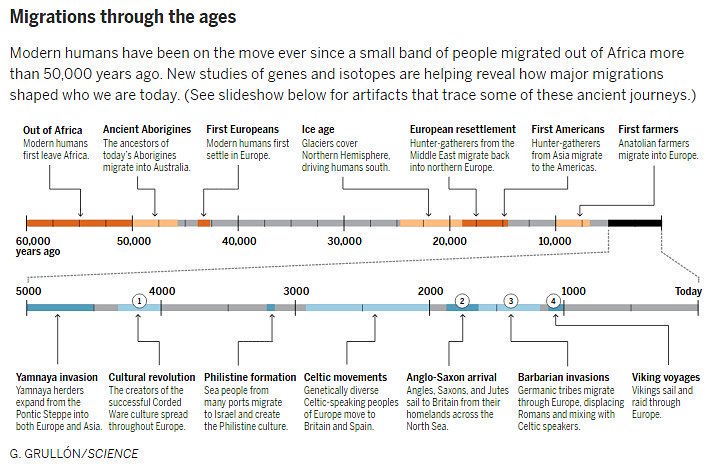
In a Science article from last year, Ann Gibbons discusses the ancient migrations that can now be traced using DNA analysis:

After World War II, many scholars recoiled from studying migrations, in reaction to the Nazi misuse of history and archaeology. The Nazis had invoked migrations of “foreign” groups to German territory to justify genocide. “The whole field of migration studies was ideologically tainted,” says archaeologist Kristian Kristiansen of the University of Gothenburg in Sweden. Some researchers also resisted the idea that migration helped spread key innovations such as farming, partly because that might imply that certain groups were superior.

Nor did researchers have a reliable method to trace prehistoric migrations. “Most of the archaeological evidence for movement is based on artifacts, but artifacts can be stolen or copied, so they are not a real good proxy for actual human movement,” says archaeologist Doug Price of the University of Wisconsin in Madison, who tracks ancient migration by analyzing isotopes. “When I started doing this in 1990, I thought people were very sedentary and didn’t move around much.”

Today, however, new methods yield more definitive evidence of migration, sparking an explosion of studies. The isotopes Price and others study are specific to local water and food and thus can reveal where people grew up and whether they later migrated. DNA from ancient skeletons and living people offers the “gold standard” in proving who was related to whom.

The new data confirm that humans have always had wanderlust, plus a yen to mix with all manner of strangers. After the first Homo sapiens arose in Africa, several bands walked out of the continent about 60,000 years ago and into the arms of Neandertals and other archaic humans. Today, almost all humans outside Africa carry traces of archaic DNA.

That was just one of many episodes of migration and mixing. The first Europeans came from Africa via the Middle East and settled there about 43,000 years ago. But some of those pioneers, such as a 40,000-year-old individual from Romania, have little connection to today’s Europeans, Reich says.

His team studied DNA from 51 Europeans and Asians who lived 7000 to 45,000 years ago. They found that most of the DNA in living Europeans originated in three major migrations, starting with hunter-gatherers who came from the Middle East as the glaciers retreated 19,000 to 14,000 years ago. In a second migration about 9000 years ago, farmers from northwestern Anatolia, in what is now Greece and Turkey, moved in.

That massive wave of farmers washed across the continent. Ancient DNA records their arrival in Germany, where they are linked with the Linear Pottery culture, 6900 to 7500 years ago. A 7000-year-old woman from Stuttgart, Germany, for example, has the farmers’ genetic signatures, setting her apart from eight hunter-gatherers who lived just 1000 years earlier in Luxembourg and Sweden. Among people living today, Sardinians retain the most DNA from those early farmers, whose genes suggest that they had brown eyes and dark hair.

H/T to PaleoAnthropology+ for the link.

March 10, 2018

QotD: The beginnings of archaeology

Filed under: History, Middle East, Quotations, Science — Tags: , , — Nicholas @ 01:00

It is now forty-five summers since, at age eighteen, I stood myself in the ruins of Ninevah — across the Tigris from Mosul in post-modern Iraq, the seat of Christian Assyria. Gentle reader may be aware that the Assyrians, Yazidis, Armenians, Turkmen, Shabaki, and for that matter, a portion of the Arabs who once lived around that town have been slaughtered or exiled over the last two years by the Daesh. The self-styled “Islamic Caliphate” has also made a show of demolishing Mosul’s remarkable Museum, and the more celebrated ancient monuments, starting with the purported tombs of Jonah and several other Old Testament prophets.

How one wishes that the French and British, rivals for archaeological glory from the early Victorian age, had succeeded in floating more of the treasures they had uncovered, on great rafts down the Mesopotamian rivers to Basrah and the sea — and then by ship to safe new homes in the Louvre and British Museum. That was the heroic age of “Orientalism,” when under the burning sun, and the noses of Ottoman administrators, and in the face of Arab raids and depredations — goaded by an excited popular interest in the recovery of deep Biblical history — the lost kingdoms and empires of the Near and Middle East were being rediscovered. Not only the tireless spadework, but the ingenious decoding of ancient tablets found in subterranean libraries of clay, extended our detailed knowledge of the human past by thousands of years.

This was a gentleman’s contest, and I am struck by the way, without rules or treaties, the French and the British (later joined by Germans, and eventually Americans, Poles, Italians, and even Canadians) peacefully recognized each other’s stakeholdings and claims, and honoured each other’s adventurers and scholars. So much of what we now reflexively condemn as “European Imperialism” was conducted at a level of civilization that is unimaginable today. We ritually sneer at digging practices that were primitive and inexact, forgetting that our own “modern methods” were being devised by these men, as they went along, starting only from rumour and wild surmise.

David Warren, “With Layard to Ninevah”, Essays in Idleness, 2016-07-05.

March 4, 2018

QotD: Rousseau’s “Noble Savage” myth

Filed under: Europe, History, Quotations — Tags: , , , , — Nicholas @ 01:00

The concept of a primeval matriarchy may be regarded, on one level, as a modern incarnation of the Golden Age myth, a belief found in primitive societies throughout the world that during the infancy of the human race mankind lived in perfect peace and harmony in a world of abundance. The Garden of Eden is the biblical take on the legend. In the Bible story however, as in all traditional accounts, there was a “Fall” from grace, after which strife and hardship entered the world. The Fall, or Original Sin, represented an implicit acceptance of human imperfection and in a way accounted for the violence and discord of life by pointing the finger of blame at humanity as a whole and the individual in particular. The essential imperfection of human nature was recognized by all ancient societies, and is a theme which we encounter in the works of the Chinese philosophers as well as those of India and Greece. With Rousseau and the Enlightenment, however, there came a change. Reacting against the rationalism and industrialization of the eighteenth century, Rousseau and his fellow proto-romantics adopted a sentimentalized view of ancient and primitive man, arguing that human nature, in its pristine form, was not “fallen” at all, and that human beings had in modern times been corrupted by an exploitative and degenerate economic system.

Rousseau’s Noble Savage has caused untold harm over the past two centuries as totalitarians of various hues sought to foster and free the inherent nobility of humanity by destroying the corrupt and exploitative economic systems which had supposedly turned people into butchers and criminals. Both fascism and communism trace a direct line of descent to Rousseau, as do anarchism and the various extremist ecology movements of our time.

Feminism, too, is a branch of Rousseau’s tree, though it has other wellsprings. Marx and Freud, of course, with their negative attitudes to Christianity and Christian civilization in general, contributed much to feminism. Marx in particular emphasized how “bourgeois” Christian society had oppressed women, and called for the abolition of the family and complete sexual liberation. Freud contributed by his claim that neuroses and mental illness in general were the result of sexual repression. But the myth of a primeval matriarchy also owed much to students of mythology such as James Frazer and (more especially) Robert Graves. Archaeology too played its part, as scholars began to uncover ancient images of goddesses and female deities from various parts of the globe. The Palaeolithic epoch, the earliest age of homo sapiens, revealed small statuettes of clay, ivory and bone, depicting some form of Mother Goddess. Perhaps the most influential archaeological discoveries, however, came from Crete, where between 1900 and 1905 Sir Arthur Evans uncovered a splendid pre-Greek civilization where women and female deities apparently enjoyed a privileged position.

Emmet Scott, “The Myth of the Primeval Matriarchy”, The Gates of Vienna, 2016-07-13.

January 8, 2018

Forests in the olden days

Filed under: Britain, Environment, History — Tags: , , — Nicholas @ 04:00

Lindybeige
Published on 20 Apr 2016

Forests and woodland in the ancient and medieval worlds didn’t look the way they show in the movies.
Support me on Patreon: https://www.patreon.com/Lindybeige

More archaeology videos here: https://www.youtube.com/playlist?list…

I visited a local wildlife sanctuary based in a wood. In order to attract birds, they left the woods unmanaged, so that the undergrowth and rotting falling trees afforded good habitat for insects and ground-nesting birds. I talk about a few things, including climax vegetation, the burning of woods by hunter-gatherers, the medieval practices of coppicing and pollarding, and the way a modern managed woodland (the sort that you almost always see in the movies) looks neither like a heavily-managed medieval wood nor a wilderness unmanaged wood.

Lindybeige: a channel of archaeology, ancient and medieval warfare, rants, swing dance, travelogues, evolution, and whatever else occurs to me to make.

December 2, 2017

Breaking news from 55 BC

Filed under: Britain, History — Tags: , , , , , — Nicholas @ 05:00

Despite the written records left by Julius Caesar, Cicero, and Tacitus, until now there had apparently been no physical evidence of Caesar’s invasion of Britain:

… a chance excavation carried out ahead of a road building project in Kent has uncovered what is thought to be the first solid proof for the invasion.

Archaeologists from the University of Leicester and Kent County Council have found a defensive ditch and javelin spear at Ebbsfleet, a hamlet on the Isle of Thanet.

The shape of the ditch at Ebbsfleet, is similar to Roman defences at Alésia in France, where a decisive battle in the Gallic War took place in 52 BC.

Experts also discovered that nearby Pegwell Bay is one of the only bays in the vicinity which could have provided harbour for such a huge fleet of ships. And its topography echoes Caesar’s own observations of the landing site.

Dr Andrew Fitzpatrick, Research Associate from the University of Leicester’s School of Archaeology and Ancient History said: “Caesar describes how the ships were left at anchor at an even and open shore and how they were damaged by a great storm. This description is consistent with Pegwell Bay, which today is the largest bay on the east Kent coast and is open and flat.

“The bay is big enough for the whole Roman army to have landed in the single day that Caesar describes. The 800 ships, even if they landed in waves, would still have needed a landing front 1-2 km wide.

“Caesar also describes how the Britons had assembled to oppose the landing but, taken aback by the size of the fleet, they concealed themselves on the higher ground. This is consistent with the higher ground of the Isle of Thanet around Ramsgate.”

Thanet has never been considered as a possible landing site before because it was separated from the mainland until the Middle Ages by the Wanstum Channel. Most historians had speculated that the landing happened at Deal, which lies to the south of Pegwell Bay.

November 27, 2017

Sea Peoples: The 1200 BC System Collapse

Space And Intelligence
Published on 7 May 2017

In the 12th century B.C., after centuries of brilliance, the civilized and globalized world of the Bronze Age came to an abrupt and cataclysmic end. Kingdoms fell like dominoes over the course of just a few decades. No more Minoans or Mycenaeans. No more Trojans, Hittites, or Babylonians. The thriving economies and cultures of the late second millennium B.C., which had stretched from Greece to Egypt and Mesopotamia, suddenly ceased to exist, along with writing systems, technology, and monumental architecture. Could it happen again?

November 4, 2017

The End of Civilization (In the Bronze Age): Crash Course World History 211

Filed under: History, Middle East — Tags: , , , , , , — Nicholas @ 02:00

CrashCourse
Published on 3 Oct 2014

In which John Green teaches you about the Bronze Age civilization in what we today call the middle east, and how the vast, interconnected civilization that encompassed Egypt, The Levant, and Mesopotamia came to an end. What’s that you say? There was no such civilization? Your word against ours. John will argue that through a complex network of trade and alliances, there was a loosely confederated and relatively continuous civilization in the region. Why it all fell apart was a mystery. Was it the invasion of the Sea People? An earthquake storm? Or just a general collapse, to which complex systems are prone? We’ll look into a few of these possibilities. As usual with Crash Course, we may not come up with a definitive answer, but it sure is a lot of fun to think about.

October 15, 2017

The end of the Bronze Age

Filed under: History, Middle East, Science — Tags: , , , , , — Nicholas @ 03:00

Colby Cosh linked to an article discussing a convoluted survival from about 1180BC (the image was preserved, but the work itself was destroyed in the late 19th century), which casts some light on the fall of the great Bronze Age cultures of the eastern Mediterannean:

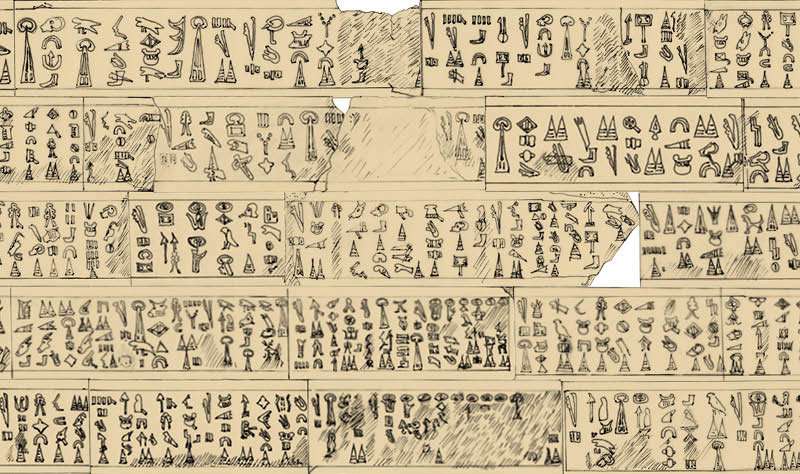
Luwian Hieroglyphic inscription by the Great King of Mira, Kupanta-Kurunta, composed at about 1180 BC.
Credit: Luwian Studies

The 35-cm tall limestone frieze was found back in 1878 in the village of Beyköy, approximately 34 kilometers north of Afyonkarahisar in modern Turkey. It bears the longest known hieroglyphic inscription from the Bronze Age. Soon after local peasants retrieved the stones from the ground, the French archeologist Georges Perrot was able to carefully copy the inscription. However, the villagers subsequently used the stones as building material for the foundation of their mosque.

From about 1950 onwards, Luwian hieroglyphs could be read. At the time, a Turkish/US-American team of experts was established to translate this and other inscriptions that during the 19th century had made their way into the collections of the Ottoman Empire. However, the publication was delayed again and again. Ultimately, around 1985, all the researchers involved in the project had died. Copies of these inscriptions resurfaced recently in the estate of the English prehistorian James Mellaart, who died in 2012. In June 2017, Mellaart’s son Alan handed over this part of the legacy to the Swiss geoarcheologist Dr. Eberhard Zangger, president of the Luwian Studies foundation, to edit and publish the material in due course.

[…]

The inscription and a summary of its contents also appear in a book by Eberhard Zangger that is being published in Germany today: Die Luwier und der Trojanische Krieg – Eine Forschungsgeschichte. According to Zangger, the inscription was commissioned by Kupanta-Kurunta, the Great King of Mira, a Late Bronze Age state in western Asia Minor. When Kupanta-Kurunta had reinforced his realm, just before 1190 BC, he ordered his armies to storm toward the east against the vassal states of the Hittites. After successful conquests on land, the united forces of western Asia Minor also formed a fleet and invaded a number of coastal cities (whose names are given) in the south and southeast of Asia Minor, as well as in Syria and Palestine. Four great princes commanded the naval forces, among them Muksus from the Troad, the region of ancient Troy. The Luwians from western Asia Minor advanced all the way to the borders of Egypt, and even built a fortress at Ashkelon in southern Palestine.

« Newer PostsOlder Posts »

Powered by WordPress


