
Historigraph
Published 15 Oct 2022On May 21st 1982, the United Kingdom landed thousands of troops at San Carlos Water in the Falkland Islands, to begin their recapture from Argentina. But only hours after arriving, British forces were under intense attack, as the Argentine air force attempted to push the troops clambering ashore back into the sea. This was the Battle of San Carlos.
0:00 – Intro
0:37 – Britain’s Invasion Plans
2:59 – Bespoke Post
4:16 – The Argentine Onslaught
8:46 – Attack on Coventry and Conveyer
(more…)
October 19, 2022
South Atlantic D-Day: Battle of San Carlos – Falklands War
Comments Off on South Atlantic D-Day: Battle of San Carlos – Falklands War
October 11, 2022
A tribute to the F-101 ‘Voodoo’ Fighter
Matsimus
Published 4 Jun 2022The McDonnell F-101 Voodoo is a supersonic jet fighter which served the United States Air Force (USAF) and the Royal Canadian Air Force (RCAF).
Initially designed by McDonnell Aircraft Corporation as a long-range bomber escort (known as a penetration fighter) for the USAF’s Strategic Air Command (SAC), the Voodoo was instead developed as a nuclear-armed fighter-bomber for the USAF’s Tactical Air Command (TAC), and as a photo reconnaissance aircraft based on the same airframe. An F-101A set a number of world speed records for jet-powered aircraft, including fastest airspeed, attaining 1,207.6 miles (1,943.4 km) per hour on 12 December 1957.[1] They operated in the reconnaissance role until 1979.
Delays in the 1954 interceptor project led to demands for an interim interceptor aircraft design, a role that was eventually won by the B model of the Voodoo. This required extensive modifications to add a large radar to the nose of the aircraft, a second crew member to operate it, and a new weapons bay using a rotating door that kept its four AIM-4 Falcon missiles or two AIR-2 Genie rockets hidden within the airframe until it was time to be fired. The F-101B entered service with USAF Air Defense Command in 1959 and the Royal Canadian Air Force in 1961. US examples were handed off to the USAF Air National Guard where they served until 1982. Canadian examples remained in service until 1984.
(more…)
Comments Off on A tribute to the F-101 ‘Voodoo’ Fighter
September 7, 2022
“For those brave right-wing Americans… if you want to fight against the country, you need an F-15. You need something little more than a gun.”
Kurt Schlichter begs to differ with Joe Biden’s “Triumph of the Shrill” warmongering from last week:

Hmmmm, but do they? Really?
Grandpa Badfinger’s premise is that all you tens of millions of semi-fascists out there with your AR-15s would have no shot stopping the woke military, which would eagerly crush you with their potent force package of F-15s and esoteric pronouns. It is a flawed premise on more grounds than one column can cover (hence my book), but we need to focus and that means we will need to overlook some important questions. These important questions include:
– Why do you imagine your sorry band of socialist creeps who treat the Constitution like Jerry Nadler treats his boxers constitutes “the country”?
– The useless senior officer corps aside, why do you believe the normals who make up the vast majority of America’s combat forces will gleefully butcher their friends and family for the amusement of a bunch of Chardonnay-swilling blue checks?
– Have you ever heard of Afghanistan?
Let’s focus on his key sound bite. Gun vs. Jets … who ya got?
I’m putting my money on the guns. You dumb progressives can go for the jets and the points.
Now, let’s start raising the kind of facts that tend to undermine the soundbite that launched a thousand MSNBCgasms.
First up, what does a gun do? What does a fighter-bomber do?
Well, a gun gives an individual soldier – and that’s what civilian freedom fighters would be – the ability to dominate the space on the ground around them out to a couple hundred meters of open territory (let’s not argue about maximum effective ranges, or the fact that civilians have a lot of weapons that outrange the 5.56mm weapons systems currently used by the military – a weapon system whose bullets Mr. 10% Off The Top thinks fly “five times as rapidly as a bullet shot out of any other gun“). In other words, a gun controls space on the ground. Coincidentally, the ground happens to be where people live.
A jet fighter dominates air space and keeps other planes away. Few people actually live in the air. Now, a jet fighter bomber like the F-15 can drop bombs on the enemy – which is, according to Crusty, us freedom-loving American citizens. Of course, this kind of tactical employment works to support guys on the ground dominating terrain with guns. Planes don’t hold territory; they help soldiers hold territory. So, it’s an apples and oranges thing at the threshold, which is appropriate since the whole discussion Slow Joe began is pretty much Fruit Loops.
Biden assumes he’s got soldiers to support with his jets. How many? Who knows? Some. But lots of colonels and generals, the kind who add (he/him) or (zip/zap) to their official signature blocks – would salute and carry out order to kill other Americans. Hey, maybe they can win this war and finally get one in the “Win” column after three decades! They’re due!
But the problem for them is quantity. There are tens of millions of American patriots with guns, AR-15s being only one color in the rainbow of freedom-defending firearms. Real diversity is 5.56mm alongside 7.62mm and .30-06 and 12 gauge and .45 and others, all firing together for a brighter tomorrow. So, there better be a lot of airplanes to balance out millions of patriots.
Um, how many fighter-bombers do we have anyway?
Well, let’s give America’s Greatest Matlock Superfan the benefit of the doubt and include all types of fighter-bombers – F-25s, F-16s, F-18s, F-35s and even A-10s. Let’s see – there are about 1750 planes for the Air Force, about 1100 planes for the Navy, and maybe 300 for the Marines, so call it 3150 aircraft. Okay, where are they? You have to have them here in America if you want to kill Americans for refusing to obey, so how many are in the continental United States and available for Hunter’s Dad’s open season on dissidents?
Call it two-thirds. We have lots of planes forward deployed – Europe, Asia, on ships. He’s got about 2000 aircraft to use to kill other Americans – that’s what he was saying, so we’ll take him at his slurred, semi-coherent word. Add maybe another 400 combat drones in the USA.
Now, there’s a thing called the OR Rate – operational readiness. That’s the percentage of planes that are ready to go at a given time. Planes need maintenance. They break, and even routine use requires massive upkeep efforts. And parts can be hard to get, especially when you are spending all your money on woke nonsense. What’s the real OR Rate? I don’t know – it’s probably classified and, as we know, today exposing classified material is bad and we can’t wait for it to go back to being A-OK when Hillary does it again, or when someone leaks something classified to the NYT or WaPo and they publish it. Let’s assume 75% – that loud laughing you just heard is military aviation professionals scoffing at a consistent 75% OR Rate.
This means President Gumby has 1500 planes and 300 drones to suppress those millions of dissenters. Hey, that’s 36 aircraft a state!
Comments Off on “For those brave right-wing Americans… if you want to fight against the country, you need an F-15. You need something little more than a gun.”
August 24, 2022
Serbia ensures that we still have fresh concerns this summer
CDR Salamander on yet more potential trouble in the Balkans that has drawn some serious attention from the US Air Force:

USAF B-52 Stratofortress near the North Pole on 31 July, 2016 during the Polar Roar exercise.
Detail of original USAF photo by Senior Airman Joshua King via Wikimedia Commons.
I know everyone is busy and all … but you need to keep an eye on the usual problem areas.
You would think one war in Europe at a time would be enough, but you should never underestimate the Serbs.
As with most of us who were on active duty in the 1990s, I have more than a passing interest in the former Yugoslavia — and invested my quota of effort in its wars.
Later in my career I later served in NATO with Slovenes, Croatians, and N. Macedonians. I’ve vacationed a few times in Slovenia and Croatia. One of my daughters has studied, twice, in Serbia.
I keep an eye on it … and thankfully so are some smart people in The Pentagon.
The Balkans is always on the edge and has been for centuries, so it is only natural that now and then it bubbles over.
You may have missed with all the other news that the frozen conflict in Kosovo was throwing sparks again. That is why on Friday I tilted my head a bit with this announcement;
Two U.S. Air Force B-52 Stratofortress aircraft assigned to the 23rd Bomb Squadron currently operating out of RAF Fairford, United Kingdom, will conduct low approach flyovers over Southeastern Europe scheduled on August 22.
The purpose of each flyover is to demonstrate U.S. commitment and assurance to NATO Allies and partners located in Southeastern Europe. Additionally, this will provide citizens an opportunity to take photos, videos, and enjoy the aircraft flying overhead.
That told me that the Balkans desk has run their concerns up the chain and whatever they briefed was enough to greenlight a not insignificant display.
Sure enough, off it went Monday;
A pair of U.S. Air Force B52 strategic bombers on Monday flew low over the Croatian resort of Dubrovnik and three other NATO-member states in the region as a sign of support amid the Russian aggression in Ukraine.
In addition to the walled Croatian tourist resort of Dubrovnik, the aircraft flew over the government headquarters in Skopje, North Macedonia, the downtown Skanderbeg Square in the Albanian capital, Tirana, and up the Adriatic coast of Montenegro.
The Balkans and the Adriatic Sea have lately seen increased military, intelligence and propaganda activity by Moscow, which considers the region of its strategic interest because of its access to the Mediterranean.
Serbia is about Russia’s last friend in Europe and make no mistake … the Serbs do not consider borders settled anywhere — they are just waiting for the moment to be ripe.
Comments Off on Serbia ensures that we still have fresh concerns this summer
August 16, 2022
Nimble, Sleek, And Almost Useless In A Real Fight; the story of the Canadair CF-5 Freedom Fighter
Polyus Studios
Published 8 May 2021Don’t forget to like the video and subscribe to my channel!
Support me on Patreon – https://www.patreon.com/polyusstudiosThe multi-role CF-5 was intended to replace the nuclear-armed CF-104 Starfighter and CF-101 Voodoo squadrons with a conventional warfighter. However, as an air superiority fighter, it was useless against all but the oldest relics in the Warsaw Pact arsenal. It fared little better as a close air support tactical fighter, thanks to its short range, relatively small weapons load, lack of all-weather navigation, and its inability to survive in a sophisticated, integrated air defense environment. Despite this, 240 were built in Canada and served with the Canadian Armed Forces for 27 years, not as a replacement for the existing fleet, but as an addition to them no one in the military seemed to really want. So why did Canada operate the CF-5? As you might well have assumed, the story behind the acquisition and operation of the CF-5 is a complicated one.
(more…)
Comments Off on Nimble, Sleek, And Almost Useless In A Real Fight; the story of the Canadair CF-5 Freedom Fighter
August 12, 2022
The 1983 “Gimli Glider” Incident
TheHistoryGuy
Published 27 Apr 2022Captain Sully’s US Airways Flight 1549 lost its engines almost immediately after takeoff, after reaching an altitude of only 2,800 feet. In 1983, a very different flight lost power at a staggering 41,000 feet, and the pilots had no choice but to try to land the plane without engines.
(more…)
Comments Off on The 1983 “Gimli Glider” Incident
July 31, 2022
Look at Life — Pipeline (1961)
ian16th Jones
Published 20 Aug 2017Refuelling at Sea and in the Air 1960’s style
Comments Off on Look at Life — Pipeline (1961)
July 29, 2022
Nightmare Fuel For Soviet Submarines; the story of the Canadair CP-107 Argus
Polyus Studios
Published 4 Dec 2020Don’t forget to like the video and subscribe to my channel!
Support me on Patreon – https://www.patreon.com/polyusstudiosIn its day the Argus was the most formidable anti-submarine warfare platform fielded by any NATO country. Canadair adapted the Bristol Britannia into a highly effective low and slow sub hunter. This gave Maritime Air Command the edge in the North Atlantic. It served on the front-line of the Cold War and kept the Soviet submarine threat in check for almost 25 years.
(more…)
Comments Off on Nightmare Fuel For Soviet Submarines; the story of the Canadair CP-107 Argus
July 27, 2022
Poland and South Korea Ink Huge Arms Deal
Ed Nash’s Military Matters
Published 26 Jul 2022Poland and South Korea are apparently on the verge of signing a huge arms deal that will replace much of the heavy frontline equipment of the Polish Army.
Sources for this video can be found at the relevant article on:
https://militarymatters.online/
(more…)
Comments Off on Poland and South Korea Ink Huge Arms Deal
July 26, 2022
Flying Failures – Christmas Bullet (The Worst Plane Ever Built)
Ruairidh MacVeigh
Published 25 Dec 2020Merry Christmas everyone! 😀
To coincide with this most special of holidays, in this episode of Flying Failures we will be examining the dubious history of the Christmas Bullet, a divisive little plane that could either be seen as the brainchild of a man whose ambition outweighed his abilities, or perhaps one of the greatest cons in aviation history, a con that left two planes destroyed, two test pilots dead, and the US taxpayer several million dollars out of pocket.
(more…)
Comments Off on Flying Failures – Christmas Bullet (The Worst Plane Ever Built)
July 1, 2022
More than just the iconic Snowbirds demonstrator aircraft: the story of the Canadair CT-114 Tutor
Polyus Studios
Published 13 Apr 2019Support me on Patreon – https://www.patreon.com/polyusstudios
The humble Canadair CT-114 Tutor, or “Toot” as it was affectionately called, trained every fast aircraft pilot in the RCAF from the mid-1960 through past the turn of the century. But it wasn’t just Canadians who benefited from its outstanding training qualities, the Tutor trained hundreds of pilots from other NATO and friendly countries. Today only the famous Snowbirds flight demonstration team continue to fly the jet and as the airframes age and fewer remain available, they too will eventually retire one of Canada’s most iconic jets.
**One of the Toots had a rather unique history that’s worth mentioning in detail. The first production CL-41G serial number 2201 was built in Montreal and delivered to Malaysia in 1967. It saw combat near the border with Thailand and after it was retired from military service in 1986, was sold to an American flight school in Michigan. It was then sold to the actor and accomplished pilot John Travolta. He flew it until 2001 when he donated it to a school in Florida who have kept it flying to this day.**
Aircraft mentioned:
CL-41A Tutor
CL-41R
CL-41G Tebuan
CF-104 Starfighter
CT-133 Shooting Star
AT-16 Harvard trainerMusic:
Denmark – Portland Cello ProjectResearch sources:
Canada Aviation and Space Museum Aircraft, Canadair Tutor by Bill Upton (huge thanks to Mr. Upton for his fine work)
https://www.militaryfactory.com/aircr…
http://www.royalaviationmuseum.com/78…
http://www.geocities.ws/faisal4589/te…
http://www.rwrwalker.ca/CAF_Tutor_det…
http://www.warbirdalley.com/tutor.htm
http://www.rcaf-arc.forces.gc.ca/en/a…
https://ingeniumcanada.org/aviation/c…
http://www.canadianflight.org/content…
https://www.wingsmagazine.com/operati…0:00 Introduction
1:48 Initial Development
4:04 The Tutor is Born
8:30 CL-41R Starfighter Radar Trainer
10:26 The Tutor enters service
13:13 Air Demonstration Squadrons
15:36 Heavily Armed Tutor
17:49 Proposed Advanced Variants
19:08 Upgrades and Final Flights
21:09 ConclusionCanadair CT-114 Tutor; The iconic Snowbirds demonstrator and NATO pilot training jet
#Snowbirds #RCAF #CanadianAerospace

Comments Off on More than just the iconic Snowbirds demonstrator aircraft: the story of the Canadair CT-114 Tutor
June 27, 2022
Look at Life — The Jumping Jets (1965)
PauliosVids
Published 20 Nov 2018The revolutionary vertical take-off capacity of the RAF Kestrel.
[Wikipedia: “The Hawker P.1127 and the Hawker Siddeley Kestrel FGA.1 are the British experimental and development aircraft that led to the Hawker Siddeley Harrier, the first vertical and/or short take-off and landing (V/STOL) jet fighter-bomber.
“Development began in 1957, taking advantage of the Bristol Engine Company’s choice to invest in the creation of the Pegasus vectored-thrust engine. Testing began in July 1960 and by the end of the year the aircraft had achieved both vertical take-off and horizontal flight. The test program also explored the possibility of use upon aircraft carriers, landing on HMS Ark Royal in 1963. The first three aircraft crashed during testing, one at the 1963 Paris Air Show.
“Improvements to future development aircraft, such as swept wings and more powerful Pegasus engines, led to the development of the Kestrel. The Kestrel was evaluated by the Tri-partite Evaluation Squadron, made up of military pilots from the United Kingdom, the United States, and West Germany. Later flights were conducted by the U.S. military and NASA.
“Related work on a supersonic aircraft, the Hawker Siddeley P.1154, was cancelled in 1965. As a result, the P.1127 (RAF), a variant more closely based on the Kestrel, was ordered into production that year, and named Harrier – the name originally intended for the P.1154 – in 1967. The Harrier served with the UK and several nations, often as a carrier-based aircraft.”]

Comments Off on Look at Life — The Jumping Jets (1965)
June 13, 2022
Lightning fast interceptor turned nuclear strike bomber: the Canadair CF-104 Starfighter
Polyus Studios
Published 29 Sep 2020Don’t forget to like the video and subscribe to my channel!
Support me on Patreon – https://www.patreon.com/polyusstudiosThis is an UPDATED version of the video. It includes many changes and corrections to the original video. Many thanks to Gary Watson for all his contributions!
Starting in 1959 Canadair began building Canada’s fastest jet at their plant in Montreal. It was designed as a sleek high altitude and high speed interceptor, but was adapted for low level ground strike missions with conventional and nuclear weapons. It was the Canadair CF-104 Starfighter, Canada’s missile with a man in it.
0:00 Introduction
0:33 Historical Context
2:01 Design Choice
4:15 Canadair’s Production Run
6:50 Configuration and Specifications
11:04 Nuclear Strike Role
12:13 Operational History
16:06 Conventional Role
17:53 Retirement and Replacement
19:28 Accidents, Controversy and Legacy
22:56 ConclusionMusic:
“Denmark” – Portland Cello ProjectResearch Sources:
Canadair CF-104 Starfighter by Harold A. Skaarup (http://silverhawkauthor.com/canadian-…)
Canadair CF-104 Starfighter by Canadian Starfighter Association (http://canadianstarfighterassociation…)
CF-104 Flight Operations by Air Force Museum of Alberta (https://www.rcaf.museum/history/rcaf-…)
Story of the F-104 Starfighter in Norwegian Service by Bjorn Hafsten (http://starfighter.no/hist-en3.html)
Starfighters with Turkey by Joe Baugher (http://www.joebaugher.com/usaf_fighte…)
ASN Aviation Safety Database by Aviation Safety Network (http://aviation-safety.net/wikibase/d…)
Starfighter by David L. Bashow (Fortress Publication, 1990, ISBN: 0-919195-12-1)
Photography credit 6mins10sec: Gary WatsonFootage Sources:
Personal Footage – Gary Watson
Cold War Fighter Pilot – Ken Castle, CD, Flight-Lieutenant (ret’d) – Canada Aviation and Space Museum (https://youtu.be/sEUOFyPLL94)
CF 104 Baden Soellingen 1965 – Gordon Price (https://youtu.be/4UZ9PE58Eq0)
CF104 Germany 1983/4 441 Squadron CAF – Tom Hammond (https://youtu.be/xrqjAKHflCo)
Great Planes Lockheed F-104 Starfighter – Discovery Channel (1996)
Avro Canada CF 100 Canuck – Avro (1956)#Starfighter #CanadianAerospace #PolyusStudios
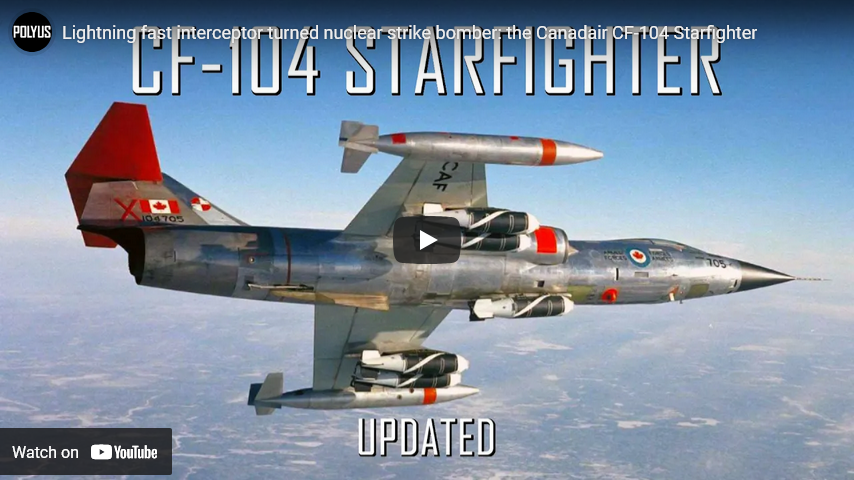
Comments Off on Lightning fast interceptor turned nuclear strike bomber: the Canadair CF-104 Starfighter
June 8, 2022
The Story Behind the Dambuster Raid – WW2 Special
World War Two
Published 7 Jun 2022The thousand-bomber offensive was about to begin as Air-Marshall Harris was assembling his forces. Yet one man was to challenge his strategy. The aircraft designer Barnes Wallis thought: “What if there was a way to destroy Germany’s industrial might not by simply dropping thousands of bombs over its cities, but by a precision strike against its dams?” For this, a new kind of bouncing bomb was to be delivered.
(more…)
Comments Off on The Story Behind the Dambuster Raid – WW2 Special
June 1, 2022
How To Kill A U-Boat – WW2 Special
World War Two
Published 31 May 2022How to kill a U-Boat? The threat of the illusive and nearly undetectable submarines had been on the mind of every Allied naval planner since the Great War. As the Kriegsmarine once more unleashed its wolfpacks to the high seas, it became a race against time to find a way to stop the deadly stalkers from beneath the surface.
(more…)
Comments Off on How To Kill A U-Boat – WW2 Special


