
Polyus
Published 14 Aug 2020When Soviet or unidentified aircraft approached Canadian airspace in the 1960s and 70s, they were met by an iconic cold war interceptor. Armed with both conventional and nuclear weapons, they were a formidable foe in their day. It served to support NORAD and protect the Northern approaches into the North American heartland during the height of the Cold War. Although it was neither designed nor built in Canada, the reliable Voodoo remains a Canadian Cold War icon and was well loved by its ground crews and pilots.
0:00 Introduction
0:29 McDonnell F-101A development
1:06 F-101B Interceptor
3:11 Canada becomes involved with the Voodoo
4:15 The Nuclear question
5:08 Comparison with contemporaries
5:36 Operational History
8:04 Legacy and Retirement
8:48 Conclusion
(more…)
July 8, 2023
Canada’s Nuclear-Armed Cold War Interceptor: the story of the McDonnell CF-101 Voodoo
May 24, 2023
Darne Model 1933: An Economic & Modular Interwar MG
Forgotten Weapons
Published 15 Feb 2023The Darne company was one of relatively few private arms manufacturers in France, best known for shotguns. During World War One they got into the machine gun trade, making licensed Lewis guns for the French air service. After making a few thousand of those, Regis Darne designed his own belt-fed machine gun in 1917. A large order was placed by the French military, but it was cancelled before production began because of the end of the war.
Darne continued to develop this design in the 1920s, while also producing sporting arms to keep the business running. The gun was intended mostly as an aircraft gun, but designed in a rather modular fashion, easily made into both magazine-fed and belt-fed infantry versions as well as downing, wing, and observer aerial models. It was actually bought by the French Air Force, as well as several other countries during the inter-war period.
The example we are looking at today is an infantry configuration, with a bipod and light-profile barrel. It is chambered for the French 7.5x54mm cartridge, and is officially the Model 1933 (one of the last iterations made).
(more…)
March 28, 2023
The Rise of the US Army Air Forces
World War Two
Published 27 Mar 2023The United States Army Air Force, USAAF, is the most powerful air force in the world. Alongside the Royal Air Force, it is winning the air war against the Luftwaffe. But things weren’t always like this. At the outbreak of war, the USAAF could not hold a candle to its allies or enemies. How have the Americans managed to turn things around?
(more…)
March 15, 2023
An Aircraft Carrier Without A Deck? | The Remarkable Brodie Landing System
Rex’s Hangar
Published 21 Sept 2022Today we’re taking a look at the remarkable Brodie Launch System. This device could be used on land or aboard ships, and it was designed to provide accessibility for light aircraft in extremely remote locations during WW2.
(more…)
March 1, 2023
Mauser WW1 Flyer’s Rifle: the Flieger Selbstlader Karabiner 1916
Forgotten Weapons
Published 1 Nov 2022Paul Mauser dedicated much of his life to the development of a practical semiauto military rifle, and did manage to have a design that was used in combat by Germany in World War One. It began with the model 06/08, a short-recoil, flap-locked design made in both rifle and pistol form. The short recoil idea was disliked by the military for a shoulder rifle, and so Mauser redesigned it to be inertially locked with a fixed barrel. This was sold in small numbers as a sporting rifle, and tested by the military a few years before the war. Once war began, Mauser once again submitted the design for use in an infantry configuration, but the system was too delicate for infantry combat. A second pattern was made for use by fliers, and this was accepted and used in service for that brief period between the introduction of military aviation and the adoption of aerial machine guns.
Designated the FSK-16 (FliegerSelbstladeKarabiner 1916), it was used primarily by balloon and Zeppelin crews. With a large magazine and self-loading action, it was much better for use in aircraft than the typical bolt action infantry rifles — and there was no mud to get into the action while airborne.
(more…)
February 17, 2023
Spy ballooning has a remarkably long history (that’s clearly still ongoing)
In The Line, Scott Van Wynsberghe outlines the history of balloons in wartime and (as many are now aware from recent events) in peacetime:
China’s balloon spying is shocking on so many levels that you can take your pick. There is the ultra-flagrant violation of foreign sovereignty, the stunningly surreal air of denial exhibited by Beijing, and the fearful sense that something in the world order just lurched. There is also puzzlement: what, balloon spying is still a thing? Indeed it is, and its centuries-long history is instructive as to what China is now doing. It also makes clear that the U.S. is no innocent victim here but rather a past offender with a cleaned-up act.
Among the first major studies of aerial reconnaissance was a book brought out by military author Glenn B. Infield way back in 1970. In a way, Infield was charting unknown territory. When he addressed balloons in particular, he traced their use in spying to the many wars associated with the French Revolutionary and Napoleonic eras. In 1794, he related, the French military officer Jean-Marie-Joseph Countelle made an ascent at the city of Maubeuge in order to monitor enemy forces in the area. In the process, Countelle became the first balloon spy.
As technology improved, other firsts followed. By the 1850s, cameras were mounted on French military balloons. In the 1860s, during the American Civil War, Union forces battling the Confederacy used balloons trailing telegraphic wires, which transmitted immediate updates from the balloonists. Yet technology cut both ways. By the early 1900s, balloons had a nemesis in sight, in the form of winged and powered aircraft.
The inevitable showdown occurred in the First World War, and it was ugly. Large numbers of observation balloons were used by all sides in the conflict, and WWI historian Denis Winter claims the Germans alone deployed 170 of them in France by 1917. Typically, such balloons were tethered in place near the frontline, floating at several thousand feet, with telephone wires dangling to the ground. Although they seemed vulnerable, they were actually protected from below by anti-aircraft units, which blasted at any enemy plane that got too close. However, the reverse was also true, with balloons themselves being fired at from the ground. By 1915, says aviation writer Ralph Barker, the British were losing at least a dozen balloons a month from all forms of enemy action. Those balloonists who were not shot to pieces often had to bail out, putting their faith in parachutes that did not always work. (Horrified onlookers called them “balloonatics.”) The fighter pilots responsible for much of this mayhem — which they called “balloon-busting” — may not have had an easy time, but some of them scored heavily, with one Frenchman named Coiffard tallying 28 balloons. Although observation balloons managed to make it to the end of the war, it was a near-run thing. According to author Linda Hervieux, nobody after the war was talking about repeating that experience in any future fighting.
[…]
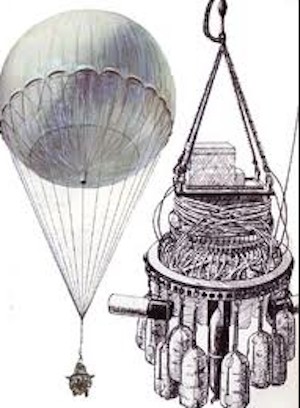
Once the Second World War was underway, some propaganda leafleting did occur, but secret balloon activity seemed to be at a low level. That was very misleading, because one of the tensest moments in ballooning history was playing out in the background, but it occurred amid so much security that the entire tale took years to emerge. In 1944, Japan launched the first of over 9,000 bomb-rigged balloons across the Pacific. Robert C. Mikesh, in a comprehensive 1973 monograph issued by the Smithsonian Institution, noted that almost a thousand of the balloons may have reached North America, but the true number is unknowable, because so many came down in remote wilderness. (One was found by forestry workers in British Columbia as late as 2014.) Mikesh tabulated 285 known incidents, ranging from Alaska all the way south to Baja California and as far inland as Manitoba. Both the U.S. and Canada clamped down hard on any news about the balloons, for fear of providing Tokyo valuable feedback about the results of the campaign. (In other words, balloon counterintelligence became a priority.) In general, the balloons did not cause a lot of harm, but one of them slaughtered six people in Oregon in 1945. By a strange fluke, one of the few groups in the U.S. that knew the full story of the balloons was an element of the Black community. The all-Black 555th Parachute Infantry Battalion was sent to the U.S. West to handle emergencies caused by the balloons.
The remains of a Japanese balloon bomb found in the Monashee Mountains near Lumby, BC in 2014. It was detonated on-site by the bomb disposal unit of Maritime Forces Pacific of the Royal Canadian Navy.
There is a strong temptation to blame the Japanese balloon bombs for what happened next, because the U.S. unaccountably entered the Cold War as the most pugnacious exponent of clandestine ballooning up to that time. Whatever the explanation, the epic struggle between the United States and the Union of Soviet Socialist Republics plunged U.S. ballooning into a tangle of psychological warfare, shadowy science, under-the-table finances, and clandestine belligerence indistinguishable from military attacks. Plus, UFOs and breakfast foods were involved (seriously).

February 12, 2023
When the institutions are failing, we must depend on the individuals
Chris Bray wraps up several earlier posts here in “Victory in the Moments”:
We see the implosion of a country that has worked well, and of a culture that has worked well. We see that things that have worked are moving hard toward being things that don’t work. Marriage and family connections are declining sharply, birthrates are plummeting, Americans are surviving on their credit cards, colleges provide increasingly little education at an increasingly absurd cost, a staggeringly expensive military is becoming functionally ineffective, public health measures reverse the health of the public. See also Darren Beattie on the Ricky Vaughn trial, or Vincent Floyd’s description of teaching woke students as a black professor who got the full Cultural Revolution treatment, or the FBI’s intel memo warning that traditional Catholicism is terrorism-adjacent, or the disgusting whistleblower revelations coming out of the evil human slaughterhouse of a pediatric gender-affirmation clinic, or Christopher Buskirk’s essay on “An Age of Decay”. Yes: evil prevails, and decline is here.
In response, the national political class and its courtiers in the “mainstream” political press offer Dr. Seuss stories like BUZZ GROWS AROUND KLOBUCHAR, completely meaningless gibbering that doesn’t have anything to do with anything. Clearly, no help is coming, and no rescue operation is being organized. Institutions are fully self-interested, working solely on capturing their share of a shrinking pie. Financialization and performativity prevail over operational function.
However.
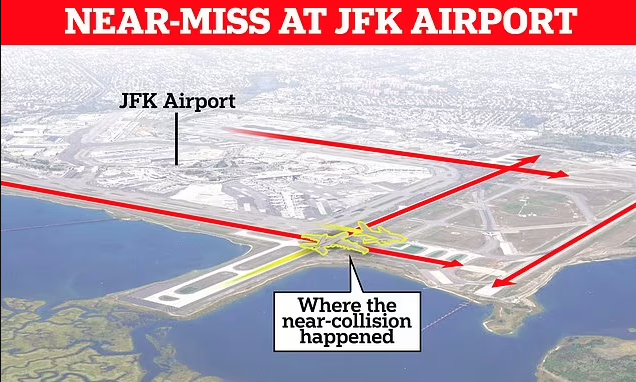
I wrote earlier this week about the recent appearance of startling runway near-misses, and about a warning from a longtime pilot that those kinds of incidents are becoming more common. But wind the tape back a bit: Commercial aviation is emerging from, or arguably still in, a long-period of historically astonishing safety. You’ll find a chart here of safety data from US airlines over the last couple of decades. That number in the center with the decimal point represents fatal accidents per 100,000 departures:
Why?
Flying is inherently dangerous; the early American pilot Ernest Gann, who flew mail routes by dropping out of the clouds to look for highway intersections with a road map on his lap (and navigated from California to Hawaii by flying an azimuth, counting elapsed hours, and checking his math with a sextant), titled his memoirs Fate is the Hunter, and opened the book with a pages-long dedication to all of his dead colleagues.
Politics didn’t solve much of anything. The long path to shockingly safe commercial aviation mostly didn’t pass through Congress, though they’d probably be willing to take credit for it. Flying didn’t become safer because Elizabeth Warren said so. Instead, pilots got better at teaching pilots how to fly safely, and working together as crews, and airlines developed better maintenance practices, and airports and airlines improved technology and procedures. Researchers and regulators played a significant role, but pilots didn’t work on making flying safer because the government made them — they made flying safer so they’d be less likely to kill people, in an expression of professionalism and craft. The airline industry adopted CRM, and then later the FAA mandated it.
Who made commercial aviation safe? Tens of thousands of pilots and mechanics and airline managers and air traffic controllers and ramp managers and marshallers, practitioners who did their work with focus and care. To a significant degree, individual pride and diligence, aggregated into the way airlines work, made commercial aviation safe. Regulators and investigators policed the margins, catching bad practices, but they didn’t make the culture of professionalism in aviation.

Avro Vulcan: What made the Vulcan the best V bomber?
Imperial War Museums
Published 28 Apr 2021The Avro Vulcan Bomber, the most famous of the British V bombers, is known for its distinctive howl and delta wing. Initially one of the delivery agents of Britain’s independent nuclear deterrent during the Cold War, the Vulcan later fulfilled another role, undertaking the longest bombing raid in history for Operation Black Buck in the Falklands Campaign of 1982. One of the first operational RAF aircraft with a delta wing, this impressive Cold War jet has never lost its appeal. In this video, events and experiences coordinator Liam Shaw takes us through the extraordinary history and technological achievements of the Avro Vulcan. We go into the cockpit and hear first-hand from the people who flew this unique machine throughout its long and remarkable history.
(more…)
February 9, 2023
Attractive VTOL autogyro with unrealised potential; the story of the Avian 2/180 Gyroplane
Polyus
Published 10 Jan 2019The Avian 2/180 Gyroplane was a project that rose from the ashes of the Avro Arrow cancellation. Five former employee formed their own company and set out to build a new kind of autogyro. Their Gyroplane could take off and land vertically and could fly at speeds up to 265 km/h. Although it never made any sales, it is an impressive project that deserves some attention.
(Also sorry for the flickering in the video. I did my best to limit it but the source video didn’t give me much to work with.)
(more…)
January 18, 2023
Ask Ian: Why No German WW2 50-Cal Machine Guns? (feat. Nick Moran)
Forgotten Weapons
Published 20 Sep 2022From Nathaniel on Patreon:
“Why didn’t Germany or Axis powers have a machine gun similar to the American M2?”Basically, because everyone faced the choice of a .50 caliber machine gun or 20mm (or larger) cannons for anti-aircraft use, and most people chose the cannons — including Germany. There were some .50 caliber machine guns adopted by Axis powers, most notably the Hotchkiss 1930, a magazine-fed 13.2mm gun that was used by both Italy and Japan (among others). However, the use of the .50 caliber M2 by the US was really a logistical holdover form the interwar period. The M2 remained in production because it was adopted by US Coastal Artillery as a water-cooled anti-aircraft gun, and commercial sales by Colt were slim but sufficient to keep the gun in development through the 20s and 30s. It was used as a main armament in early American armor, but obsolete in this role when the war broke out.
However, with the gun in production and no obvious domestic 20mm design, the US chose to simply make an astounding number of M2s and just dump them everywhere, from Jeeps to trucks to halftracks to tanks to self-propelled guns. And that’s not considering the 75% of production that went to coaxial and aircraft versions …
Anyway, back to the question. The German choice for antiaircraft use was the 20mm and 37mm Flak systems, and not a .50 MG on every tank turret. And so, there was really no motive to develop such a gun. The Soviets did choose to go the US route, though, and developed the DShK-38 for the same role as the US M2 — although it was made in only a tiny fraction of the quantity of the M2.
(more…)
December 18, 2022
A Super Bomber to Break Japan – WW2 – 225 – December 17, 1943
World War Two
Published 17 Dec 2022This war has now lasted as long as the Great War did, but there’s no signs of it slowing. The Soviets have three offensives going on on the Eastern Front, in Italy the Allies are attacking at San Pietro and over the Moro River, in the Pacific there are Allied landings on New Britain, but in Pacific Command, the big talk is all about a new super bomber.
(more…)
November 30, 2022
Victorious Italians, Swedish Turnips, and Battlefield Songs – OOTF 29
World War Two
Published 29 Nov 2022Rommel disliked Italian officers, but how bad were the troops during the North Africa Campaign? DID German pilots use skip-bombing in the Atlantic? AND what kind of wartime songs did soldiers sing? Find out in this episode of Out of the Foxholes!
(more…)
November 27, 2022
The Biggest Lie of WWII? The Myth of the Norden Bombsight
Flight Dojo
Published 16 Jun 2022I think most of us, at some point, have had someone say to us “You know, we went to the moon with less computing power than your iPhone” or something to that effect. What you may not know, though, is that less than a century ago, a 2000-piece mechanical computer that lacked a single transistor or chip was the most closely guarded military secret of the Allied war effort. Or, at least, the second most.
Before being overshadowed by the Manhattan Project, the U.S. Navy spent billions helping Carl Norden develop a mechanical computer with one job and one job only: to determine the point at which a level-flying bomber would need to drop its bombs to achieve “pinpoint accuracy” on an intended target.
When it was completed, Mr. Norden famously claimed that the sight was so accurate that it was capable of putting a bomb inside a pickle barrel. And if it could, then war would be revolutionized, or so the powers-at-be thought. The idea was simple: fly your bombers above the enemy’s air defenses, above the reach of their flak batteries, faster than their fighters could fly, and drop your bombs, with pinpoint accuracy, on crucial industrial sites, robbing the enemy of their ability to manufacture the equipment they need to wage a war in the first place.
The only problem was that everything about the Norden Bombsight turned out to be a myth. Not just the obviously mythical bits, like the fact that the crosshairs in the site itself were actually webs from a Black Widow, or that, instead, the reticle was made from the strands of hair of a young Midwestern girl, but everything, the accuracy, the secrecy, and even the fact that it was the only bombsight used in the war.
So how can this be? Until two weeks ago, I believed that the Norden Bombsight was an ingenious piece of equipment that more than any other singular device, changed the tides of WWII in favor of the allies. So why do we still believe in the Norden Bombsight?
Because, as it turns out, myths are useful, not just to the Army Air Corps, the Carl Norden Company, and Hollywood, but to us, the public. As it turns out, they can help us swallow hard truths about the war we’d prefer to avoid.
(more…)
November 25, 2022
Canada’s all-purpose VTOL transport that could have changed everything; the Canadair CL-84 Dynavert
Polyus Studios
Published 14 Jul 2018The program that developed the CL-84 lasted for almost 20 years and produced one of the most successful VTOL aircraft ever, as far as performance. Canadair produced four Dynavert’s over those 20 years and two of them crashed. In fact one crashed twice. The story of the great CL-84 is one of perseverance and missed potential.
(more…)
November 5, 2022
A working flight simulator, no computers necessary
Tom Scott
Published 4 Jul 2022There are only a few working Link Trainers left in the world: but before microprocessors, before display screnes, half a million pilots learned the basics of instrument flying inside one. More: https://www.most.org/explore/link-fli…
(more…)


