
Between the foreignness and the sheer, overwhelming size of the topic, it might seem impossible to conduct an adequate survey of the history, vocabulary, and vibe of eating, Chinese-style, for Western readers. But that’s why we have Fuchsia Dunlop. She’s an Englishwoman, but she trained as a chef at the Sichuan Higher Institute of Cuisine (the first Westerner ever to do so). She’s written some of the best English-language cookbooks for Chinese food, and now she’s written this book: her attempt to communicate the totality of the subject she loves and which she’s spent her life studying. But the topic is just too damn big to take an encyclopedic or even a systematic approach, and so she wisely doesn’t try. Instead she writes about the weirdest and tastiest and most emblematic meals she’s had, and ties each one back to the main topic. So the book lives up to its name. Like a banquet, it doesn’t try to give you a thorough academic knowledge of anything, but rather a feast for the senses and a feel for what a cuisine is like.
What is it like? Well, Dunlop barely manages to cover this in a 400-page book, so I hesitate even to try, but let me hit a few of the high points. First, diversity. China is a continent masquerading as a country, both in population and in geographic extent, so its cuisine is comparably diverse. Most cooking traditions have one or two basic starches, China has four or five.1 China extends through every imaginable biome, from rainforest to tundra, desert to marshlands, and much of the genius of Chinese food lies in combining the delicious bounties offered up by this kaleidoscope in interesting or unexpected ways.
One way to think of Chinese eating is that much of it is a sort of “internal” fusion cuisine. Because China was ruled from very early on by a centralized bureaucracy with a fanaticism for river transport, the process of culinary remixing has been going on for much longer than it has in most places. The Roman Empire could have been like this, but the shores of the Mediterranean all have pretty similar climates, so there were fewer ingredients to start the process with. Already very early in Chinese history, before the 7th century, we hear of the imperial city being supplied with:
oranges and pomelos from the warm South, […] the summer garlic of southern Shanxi, the deer tongues of northern Gansu, the Venus clams of the Shandong coast, the “sugar crabs” of the Yangtze River, the sea horses of Chaozhou in Guangdong, the white carp marinated in wine lees from northern Anhui, the dried flesh of a “white flower snake” [a kind of pit viper] from southern Hubei, melon pickled in rice mash from southern Shanxi and eastern Hubei, dried ginger from Zhejiang, loquats and cherries from southern Shanxi, persimmons from central Henan, and “thorny limes” from the Yangtze Valley.
If we think of chefs as artists, the Chinese ones have since ancient times had the advantage of an outrageously diverse set of paints. But these ingredients aren’t combined willy-nilly, without respect for their time or place of origin. The Chinese practically invented the concept of terroir, and their organicist conception of the universe in which everything is connected to everything else implied strict rules about which foods were to be eaten when, both for maximum deliciousness and to ensure cosmic harmony.
In the first month of spring, [the emperor] was to eat wheat and mutton; in summer, pulses and fowl; in autumn, hemp seeds and dog meat; in winter, millet and suckling pig. An emperor’s failure to observe the laws of the seasons would not only cause disease, but provoke crop failure and other disasters.
The obsessions with freshness and seasonality come to their culmination in the one area where Chinese cuisine stands head and shoulders above all others: green vegetables. In the West, “eating your greens” is a punishment, or at best a chore, and it’s easy to see why. In much of the world vegetables are bred for yield and transportability, kept in refrigerators for weeks, and then boiled until no trace of flavor remains. Dunlop and I have one thing in common: when we’re not in China, of all the delights of Chinese cooking it’s the green vegetables that we miss the most.
When I bring American friends to a real Chinese restaurant, sometimes they’re shocked that the vegetable dishes cost the same amount as the main courses. Why does a side dish cost so much? But no Chinese person would ever think of a vegetable course as a “side” dish, they’re part of the main attraction, and more often than not they’re the stars of the show. In the West, you can now get decent baak choy, but this is just one of the dozens and dozens of leafy greens that the Chinese regularly consume, many of them practically impossible to find outside Asia.
My own favorite is the sublime choy sum. I remember once getting off a transoceanic flight, starving and exhausted, and being offered a bowl of it over plain white rice. The greens had been scalded for a few seconds with boiling water, then tossed around a pan for no more than a minute — just long enough that the leaves were so tender they seemed to dissolve in your mouth, but the stems still held snap and crunch. The seasoning was subtle — maybe a few cloves of garlic, some salt, a splash of wine or vinegar. Just the right amount to bring out the deep, earthy flavors of the vegetable, to somehow make them brighter and more forward, but not to overpower them.2 It was one of the most delicious things I’ve ever eaten. I think I’ll still remember it when I am old.
Did you notice that in the previous paragraph I spent almost as much time describing the texture of the food as its flavor? That’s no coincidence. Of course the Chinese care about flavor, everybody does (except the British, ha ha), but relative to many other culinary traditions the Chinese put a disproportionate emphasis on the texture of their food as well. I’ll once again draw on a bastardized version of the Whorf hypothesis: English is a big language with a lot of borrowings, so we have a correspondingly large number of words for food textures. Imagine explaining to a foreigner the difference between “crunchy” and “crisp”, or between “soft” and “mushy”. That is already more semiotic resolution than most languages have when it comes to the mouthfeel of their food, but Chinese takes it to a whole ‘nother level.
John Psmith, “REVIEW: Invitation to a Banquet by Fuchsia Dunlop”, Mr. and Mrs. Psmith’s Bookshelf, 2024-02-05.
- One of them, potatoes, has a particularly fraught history. Potatoes started seriously spreading in China right around the time of the mass famines that accompanied the collapse of the Ming dynasty. Accordingly, they got a reputation of being food for poor people. They’ve never really managed to overcome this association, and are generally shunned by the Chinese, especially in high-end cuisine, despite several government campaigns to encourage people to eat them since they’re nutritious and easy to grow in arid conditions.
- There’s a pattern in Chinese gastronomy where extremely intense, over-the-top flavors are a bit low-status, and flavors so pure and subtle they verge on bland are what the snooty people go for. This is true across regions (the in-your-face food of Sichuan is less valued than the cuisine of the Cantonese South, or the cooking traditions of Zhejiang in the East), but it’s also true within regions (in Sichuan, the food of Chongqing is much spicier than the food of Chengdu, and correspondingly lower status).
March 5, 2026
QotD: Chinese cooking
March 4, 2026
Jean Raspail’s The Camp of the Saints
Like many, I’ve heard of Jean Raspail’s novel The Camp of the Saints but I’ve never seen a copy of it for sale and I certainly haven’t actually read it myself. At Postcards From Barsoom, John Carter discusses a rare thing: a newly translated printing of the book that iscurrently available for sale:
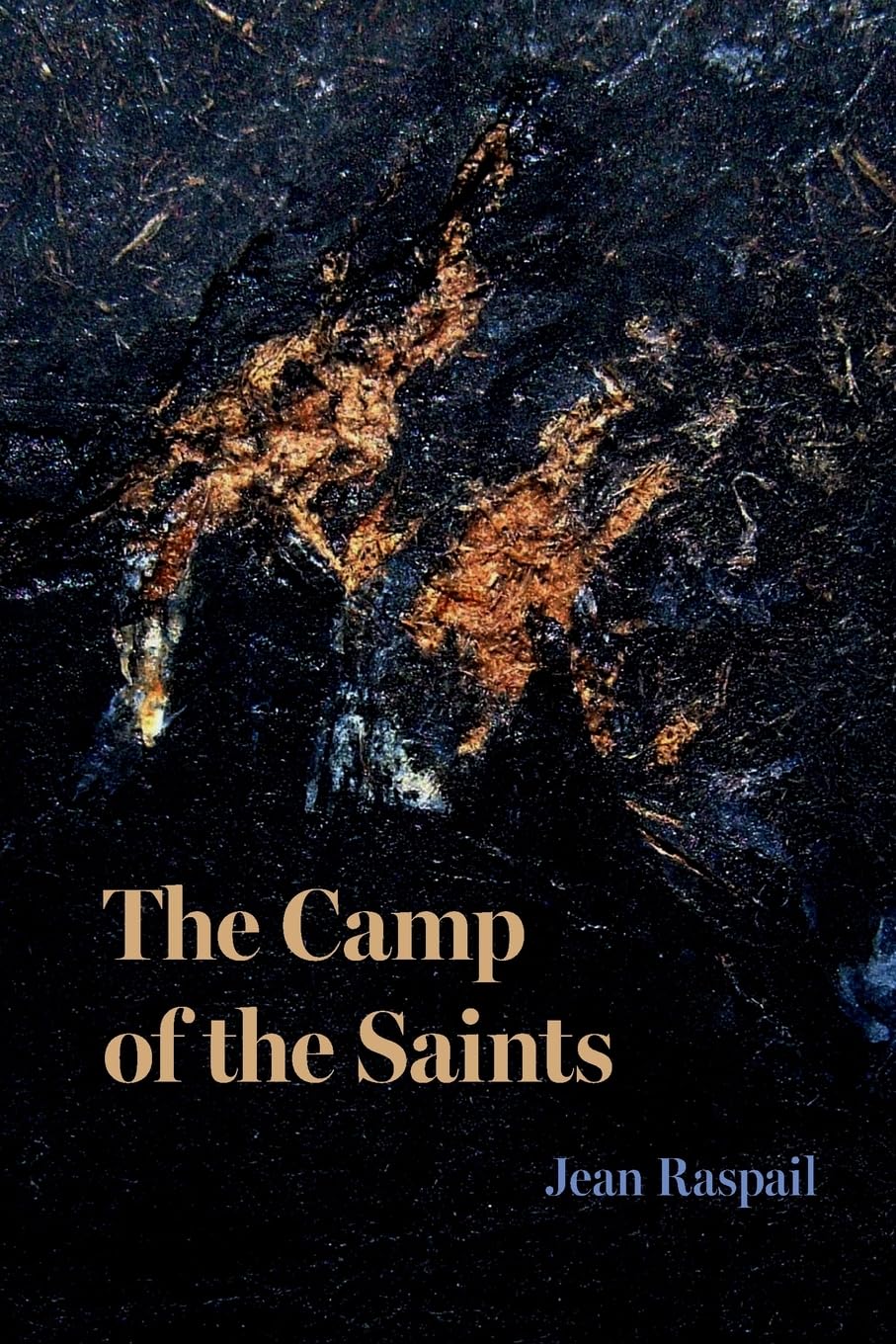
To call The Camp of the Saints prescient undersells it. At times, Raspail seems to be downright prophetic. Pope Benedict XVI plays a prominent role (albeit this is a character who could not be more different from Cardinal Ratzinger). Raspail also correctly predicted that Rhodesia would become Zimbabwe, which may have been easily foreseeable when Raspail was composing the work but still did not formally happen until 1980, seven years after the novel’s publication; while Raspail was writing, the Rhodesian Bush War was still in full swing. The Rhodies fought until the bitter end to prevent the breadbasket of Africa from being turned into Africa’s basketcase.
The Camp of the Saints is sometimes described as a dystopian novel, which should be read alongside 1984, Brave New World, Fahrenheit 451, Slaughterhouse 5, and C. S. Lewis’ That Hideous Strength. There’s something to be said for this interpretation. You get a pretty good description of the modern world with the Venn diagram overlap of the total state’s panoptic tyranny, the flattening of the human spirit into a mass-produced Last Man via the endless consumption of mass-produced trivial amusements, the death of literary curiosity, the imposition of forced egalitarianism, demon-worshipping transhumanist technocracy, and Raspail’s civilizational collapse via obsequious moral inversion.
Like every good dystopia, however, The Camp of the Saints is first and foremost a satire of the modern world, a warning about where things will head if certain sociopolitical trends are taken to their natural conclusion. Raspail’s work does not take place in some science-fictional near future, as the majority of other dystopias do: its world is technologically and politically indistinguishable from the world Raspail lived in, and still all too recognizable to us. It has been derided as a far-right racist tract, and Raspail’s depiction of the third world horde that subsumes the West is far from flattering, but his venom is directed primarily at the West’s own spineless cultural thought-leaders and political elites, who he identifies as the true and only possible architects of the world-historic catastrophe that he predicts.
The Camp of the Saints also has all the key tropes of a zombie apocalypse story.
The third world horde is depicted as a vast, ravenous, mindless beast comprised of individual members who are not at all fearsome or intimidating, but which triumphs through sheer numbers and slow but relentless advance, and which is defended by its revolting appearance and overpowering, nauseating stench. The migrants are the most wretched products of the slums of Calcutta, malnourished and sickly, afflicted by every kind of congenital defect, infectious disease, infirmity, and skin infection. Their leader is a monstrous, drooling idiot dwarf with lidless eyes, a toothless sphincter for a mouth, and stumps for limbs, who rides about on the shoulders of a giant coprophage. They make their way from India packed like human sardines in a fleet of rusting, dilapidated plague ships, wallowing their way towards Europe through the nauseating miasma that arises from the swamp of corpse-littered shit that they leave in their wake, spending their days listlessly staring out to sea and mindlessly copulating amidst their own putrifying filth. Merely to look upon the migrant horde is to be transfixed with a kind of a religious terror, overcome by its ugliness, paralyzed by pity. Soldiers forced to take even the smallest of aggressive actions against the horde, with only a few exceptions, throw down their weapons and run, not because they are terrified of the horde itself, but because they are terrified of their own conscience should they strike down a defenseless, pitiable wretch. In a few cases, soldiers take their own lives after being made to shoot. The horde’s primary weapon is the crushing psychological pressure that slams down on the souls all who behold it; better to give up and accept the inevitable than suffer the torment of fighting against it.
When the horde encounters a westerner, one of two things happens. Either the westerner is immediately killed by being trampled underfoot or torn limb from limb, or he is smoothly assimilated into the horde, becoming by and by indistinguishable from the innumerable wretches that comprise it. The zombies either eat you, or turn you into a zombie. Women of course are assimilated by rape.
Not everyone succumbs right away, of course. At the end of the novel a small group of psychologically resilient Frenchmen led by an army colonel and a right-wing government minister fall back to an abandoned mountain village. Inside the village’s borders they establish a micocosm of the old, pre-invasion French civilization. They defend their redoubt simply by shooting any migrants or white “assimilates” (as they immediately take to calling them) who get too close. The migrants and assimilates are easily seen, a constant presence shambling in the distance; they are just as easily picked off, being slow and unarmed, and the village’s inhabitants soon take to treating the hunt as a sport. Of course this refuge does not last long: the French air force, in what is implied to be its last act (for the new world will not be able to maintain airplanes) wipes the last surviving Frenchmen out in an airstrike. Racism can’t be tolerated, you see.
Finally, there are the delusional lunatics who imagine that they can befriend or master the horde, turning it to their own purposes or making common cause with it, and who are therefore instrumental in opening the gates to their and everyone else’s doom. Upon actually encountering the horde the madmen find only death or assimilation; the horde is utterly indifferent to any expression of friendship.
The Korean War Week 89: Is There Such Thing As Soviet Neutrality? – March 3, 1952
The Korean War by Indy Neidell
Published 3 Mar 2026The UN is not just worried that the Communists have strong air power, they’re worried that because they can’t produce more jets quickly enough, the Communist advantage in the skies will soon become insurmountable, but they at least have plans to try and stave that off. They also have plans for rotating in fresh troops, but those plans have stumbling blocks of their own, as do the negotiations about who might be part of a post-armistice supervisory team, specifically the USSR, whom the US does not see as “neutral” with regard to this war.
00:00 Intro
00:54 Recap
02:05 Supervisory Team
03:29 45th and 40th Divisions
07:14 POW Repatriation
10:29 Communist Air Power
15:52 Notes
16:36 Summary
16:55 Conclusion
(more…)
Epic bad takes – “Justin Trudeau wasn’t a bad prime minister”
On the social media site formerly known as Twitter, L. Wayne Mathison responds to someone who we shouldn’t mock, because perhaps he was dropped on his head too many times as a child or perhaps he’s a card-carrying member of the Liberal Party:
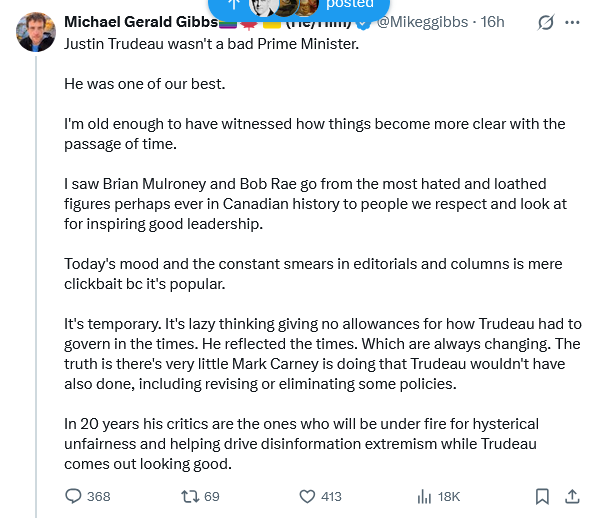
There’s a reflex in Canadian politics that drives me nuts. If you criticize a prime minister hard enough, someone eventually says, “You’re just emotional. History will fix it.”
No. History doesn’t fix weak math.
Let’s stop pretending this is about vibes. Under Justin Trudeau, federal spending didn’t just rise during COVID. It exploded before it. Deficits were normalized in good years. Productivity flatlined. GDP per capita drifted backward relative to the U.S. Housing costs detached from incomes. Regulatory layers multiplied while investment quietly left for friendlier jurisdictions.
That isn’t hysteria. That’s structural decline.
The “he governed for the times” excuse is soft thinking. Leaders are supposed to anticipate trade-offs, not amplify them. When you stack carbon taxes, capital constraints, pipeline cancellations, and endless approval timelines onto a resource economy, you don’t get moral progress. You get stalled growth and capital flight. Then you blame grocers and global headwinds.
And let’s be blunt. The brand was performance politics. Identity theatre. International applause. But governance is boring. It’s about compounding effects. Interest payments. Productivity curves. Regulatory drag. Trudeau governed like narratives create wealth.
They don’t.
Even his defenders quietly admit course corrections were needed. If policies now require rollback or “revision”, that’s not vindication. That’s damage control.
Time won’t turn fiscal drift into foresight. It won’t convert stagnant productivity into hidden genius. Mulroney is respected because NAFTA and fiscal reforms strengthened the country long term. Results earned that.
If in twenty years Canada’s energy capacity, housing stock, productivity, and fiscal health look stronger because of Trudeau’s foundations, fine. I’ll concede it.
But if the next generation is still digging out from regulatory paralysis and debt overhang, nostalgia won’t rewrite the ledger.
Simple standard. Did living standards rise sustainably?
If not, no amount of mood reframing saves the record.
Larry Thorne Biography Part 2: Green Berets in Vietnam
Forgotten Weapons
Published 4 Oct 2025Welcome back to Part II of our biography on Lauri Törni / Larry Thorne with author and researcher Kari Kallonen. Today we are covering Thorne’s life and exploits after emigrating to the United States. He joined the US Army, then 10th Special Forces Group in Germany, and was one of the original Green Berets in Vietnam until his death in a helicopter crash in October 1965. His remains were only recovered in 1999, and Mr. Kallonen was part of the team that traveled to Vietnam for the recovery effort.
(more…)
QotD: Socialism
Ivor Thomas, The Socialist Tragedy, 1951.
March 3, 2026
Iran in the news
I haven’t bothered trying to keep up with the firehose of “news” about the combined US/Israeli operations against the Islamic State, as much of what is initially reported will be re-stated, retracted, refuted, and other words starting with “R” until something vaguely resembling objective analysis can be done. There are uncounted mainstream, specialist, and advocacy sites and there’s no point trying to keep up with them (for me, anyway). Here are a few bits of internet flotsam on issues arising from Operation Brass Balls (or whatever name they chose for it):
First up, J.D. Tuccille on the legality around President Trump’s decision to strike Iran:
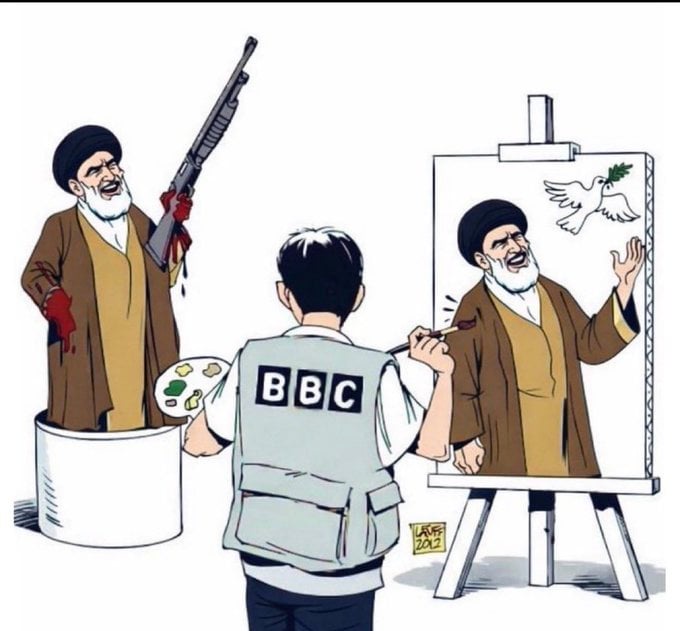
The BBC has a long history of … careful wording in describing events in Iran since 1979. I don’t think this cartoon is unfair in portraying that.
The world is undoubtedly a better place after the killing of Iran’s supreme leader Ayatollah Ali Khamenei and roughly 40 of his murderous colleagues by joint Israeli and American military strikes. Iran’s Islamist regime has slaughtered its own people while encouraging terrorism around the world for decades. But those strikes carry serious risks and costs. Are they worth the tradeoffs? The Trump administration should have made its case to Congress and the already skeptical public and satisfied the Constitution’s requirements by doing so.
War Without Debate
On Saturday, the U.S. and Israel launched much-anticipated strikes after claiming negotiations with the Iranian regime over the status of its nuclear weapons program had stalled.
“A short time ago, the United States military began major combat operations in Iran,” President Donald Trump announced. “Our objective is to defend the American people by eliminating imminent threats from the Iranian regime — a vicious group of very hard, terrible people. Its menacing activities directly endanger the United States, our troops, our bases overseas, and our allies throughout the world. For 47 years the Iranian regime has chanted ‘death to America’ and waged an unending campaign of bloodshed and mass murder, targeting the United States, our troops, and the innocent people in many, many countries.”
True enough. The president recited a litany of crimes in which the Islamist regime has been implicated, including the 1983 bombing of the U.S. Marine barracks in Beirut by Iranian proxy Hezbollah, and the October 7, 2023, Hamas attack on Israel, which Iranian forces helped plan. To this list we can add the attempted assassinations of Iranian dissident Masih Alinejad in Brooklyn and of then-presidential candidate Trump himself. Trump also called out Iran’s efforts to acquire nuclear weapons. And he urged the suffering Iranian people, who have weathered brutal attempts to suppress protests, to take advantage of the military strikes to overthrow the regime.
Unfortunately, this was the first time many Americans — members of the public and lawmakers alike — heard the Trump administration make a somewhat coherent argument for taking on Iran’s government. It came as strikes were already underway despite the Constitution reserving to Congress the responsibility to “provide for the common Defence”, “to declare War”, “to raise and support Armies”, and “to provide and maintain a Navy”. Lawmakers were informed of the attack on Iran, but only after the country was committed to hostilities and their related dangers and expense.
Congress and the People Were Never Consulted
“I am opposed to this War,” Rep. Thomas Massie (R–Ky.) objected. “This is not ‘America First’. When Congress reconvenes, I will work with @RepRoKhanna to force a Congressional vote on war with Iran. The Constitution requires a vote, and your Representative needs to be on record as opposing or supporting this war.”
Rep. Ro Khanna (D–Calif.) shares Massie’s skepticism towards military action. He and Massie might have voted against authorizing war with Iran even if they’d heard the administration’s arguments. Or perhaps they and other lawmakers would have been persuaded. We don’t know, because the president didn’t make a case until bombs and missiles had already been launched.
Andrew Doyle on the need for regime change:

The end point of armed conflict is impossible to predict. In her book On Violence (1970), the philosopher Hannah Arendt argued that when it comes to political violence, “the means used to achieve political goals are more often than not of greater relevance to the future world than the intended goals”. However well planned and executed, wars have a tendency to spiral out of control in ways never envisaged.
Whether Donald Trump’s decision to attack Iran will pay off depends upon the fates as much as anything else. The goal is regime change, which – given the appalling tyranny under which the Iranian people have suffered for five decades – is admirable and just. Yet the numerous unknown variables make this war the biggest risk that Trump has yet taken as president.
This war has the potential to escalate and engulf the entire region. Iran is already striking neighbouring Arab states allied with the US in a scattershot and desperate manner. With the death of the Ayatollah, it may be that the regime will be forced into a ceasefire while it seeks to re-establish its power. Yet the scenes of wild celebration on the streets of Iran would suggest that domestic revolution is its greatest threat. If the Islamic Revolutionary Guard Corps (not the country’s national army, but a kind of Praetorian guard for the mullahs) can be turned, the regime will fall.
Perhaps the worst case scenario is a widespread power struggle between competing militias and separatist groups. The IRGC itself could fragment, and we may see the kind of chaos that ensued after the Iraq war of 2003. The Trump administration has the advantage of the latest military technology and will insist that this enterprise will never require “boots on the ground”. It may be right, but who knows what factions will emerge with no centralised authority?
Those of us without a crystal ball should get used to the phrase: “we don’t know”. Various social media pundits are asserting with absolute certainty where all of this will lead. They would be wise to exercise greater caution. After the Twelve-Day War last June in which Israel and the US destroyed much of Iran’s nuclear infrastructure and air defence capabilities, many on the “America First” right were quick to prophesy the advent of World War III. Their claims to clairvoyance were unfounded.
CDR Salamander argues in favour of the punitive expedition as a legitimate tool in the nation’s war locker:
I support the strikes on Iran because it firmly fits into a view I have held on the use of national military power for decades, based on thousands of years of military practice. If you are not up to speed with the thousands of Americans dead and maimed by the Islamic Republic and its proxies over the last 47 years, then I have nothing more to discuss with you.
While I understand the academic argument of many that before any action takes place, there is a whole series of hoops, barriers, and puzzles of our own creation that we need to go through — I firmly believe that not only are those Constitutionally unnecessary for punitive expeditions in 2026, if done, needed and deserved strikes like we have seen in Iran could not take place without
Fortunes were made, institutions funded, and employment justified for legions under the old and failed post-WWII process swamp and GWOT nomenklatura that gave us unending and stillborn conflicts. To go that route again wouldn’t just be folly, it would be a self-destructive folly to refuse to change in the face of evidence.
I’ve seen older versions of OPLANS for Iran. Huge, bloody, and frankly undoable. They were only that way because they met the requirements of an old system that everyone nodded their heads to because all the smart people from Johns Hopkins, Harvard, Princeton and all the usual places said we had to do it this way.
Enough. Bollocks to all that. They have been measured the last quarter century and have been found wanting.
A series of events since October 7, 2023, including the 2024 election, has opened a window to do what we have not been able to do for a whole host of reasons — and there is a debt waiting to be paid.
We’ve been here before with Iran. In the modern context, we sank two warships and three speedboats of the Islamic Republic of Iran Navy in 1988 during Operation Praying Mantis as punishment for damaging USS Samuel B. Roberts (FFG 58) and Iran’s mining international waters in the Persian Gulf. We’ve played slap-n-tickle with them here and there while they have brutalized us at every turn when they are not brutalizing their own people.
Yes, it’s personal — but part of the reason we have been hesitant is that our national security intellectuals have been stuck in a world view that prevented action, by design.
Though not exclusive, the Powell Doctrine’s “Pottery Barn Rule” (that it appears he got from one of Thomas Frack’n Friedman’s columns), made it appear that we could only take action if we took the entire country and then remade it in our image.
We know how that operationalized over the last couple of decades.
We’ve done plenty of punitive expeditions in our nation’s history — but in the last few decades as a certain pedigree of policy maker held sway over our national security doctrine, it fell out of favor.
They failed the nation. Their institutions failed the nation. Their worldview was little more than a self-licking ice cream cone of self-regard.
There are also those who can find the funny aspects of any serious situation:
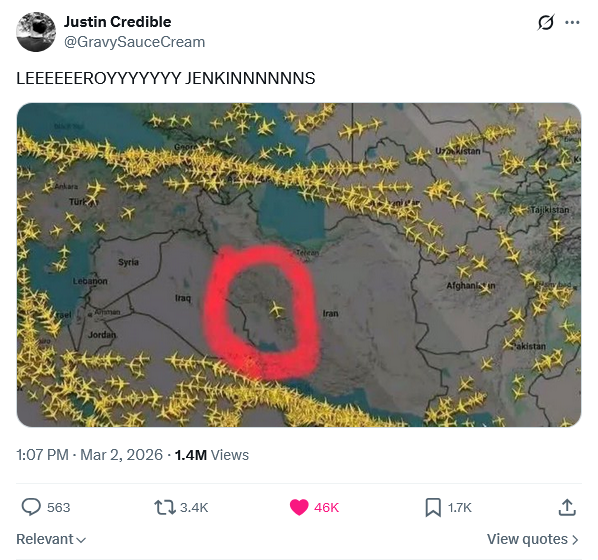
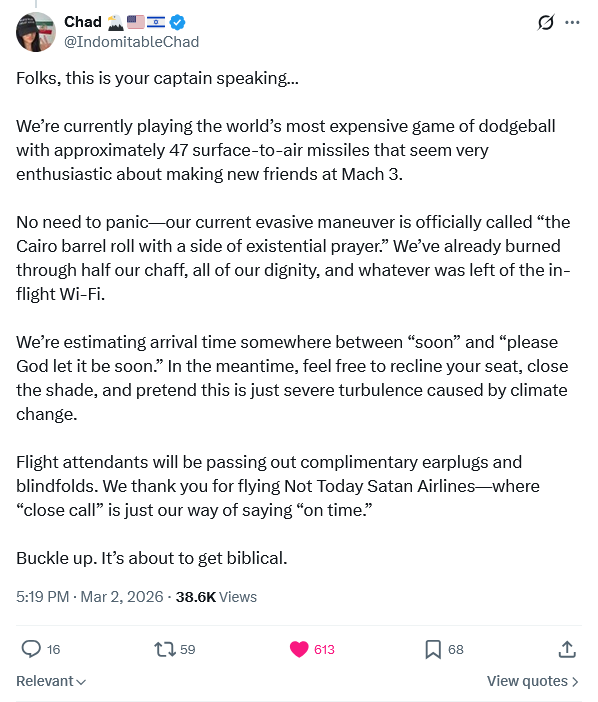
New name for Vancouver incoming in 3 … 2 … 1…
The Canadian federal government is not eager to share the details of a new agreement they’ve signed with the Musqueam First Nation that apparently cedes most of the city of Vancouver to the band, casting the property rights of two million people into legal limbo:
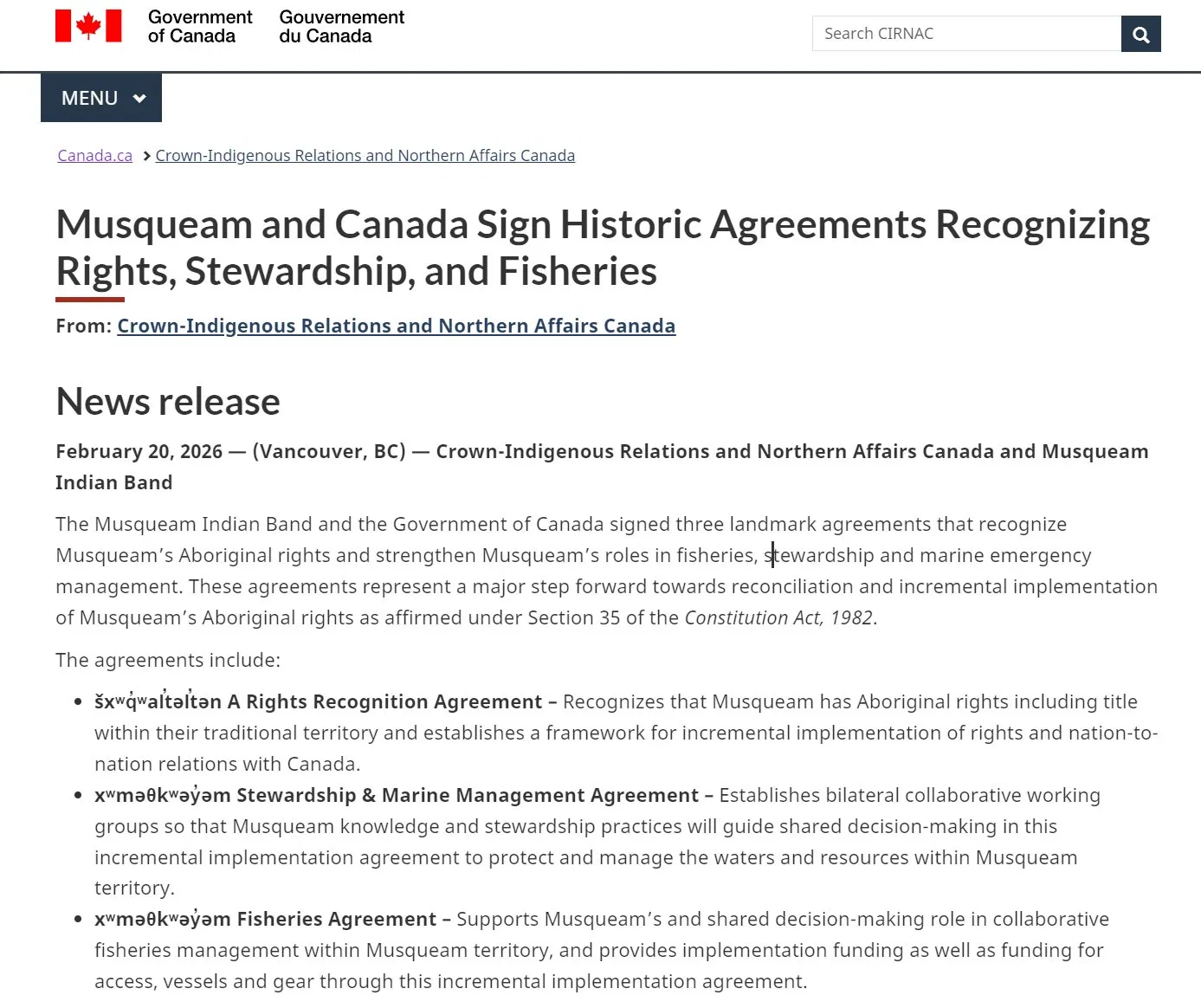
The Liberal government is refusing to publicly release an agreement with the Musqueam Indian Band that recognizes Aboriginal title over a vast area of British Columbia, including Metro Vancouver and surrounding areas, potentially affecting nearly two million people.
Buried in a seemingly mundane fisheries announcement put out on February 20th, the acknowledgement could radically undermine property rights in one of Canada’s largest and most populated metropolitan regions.
On February 20, Crown-Indigenous Relations and Northern Affairs Canada issued a news release with little fanfare titled “Musqueam and Canada Sign Historic Agreements Recognizing Rights, Stewardship and Fisheries”.
The news release reads: Canada “recognizes that Musqueam has Aboriginal rights including title within their traditional territory and establishes a framework for incremental implementation of rights and nation-to-nation relations with Canada”.
That phrase “including title” refers to Aboriginal title. Under Canadian constitutional law, Aboriginal title is a contentious but increasingly recognized property interest, affirmed by recent court rulings, including the controversial Cowichan decision. Courts have recognized Aboriginal title as a prior and senior right to land that critics say threatens fee simple title or traditional private property ownership in Canada.
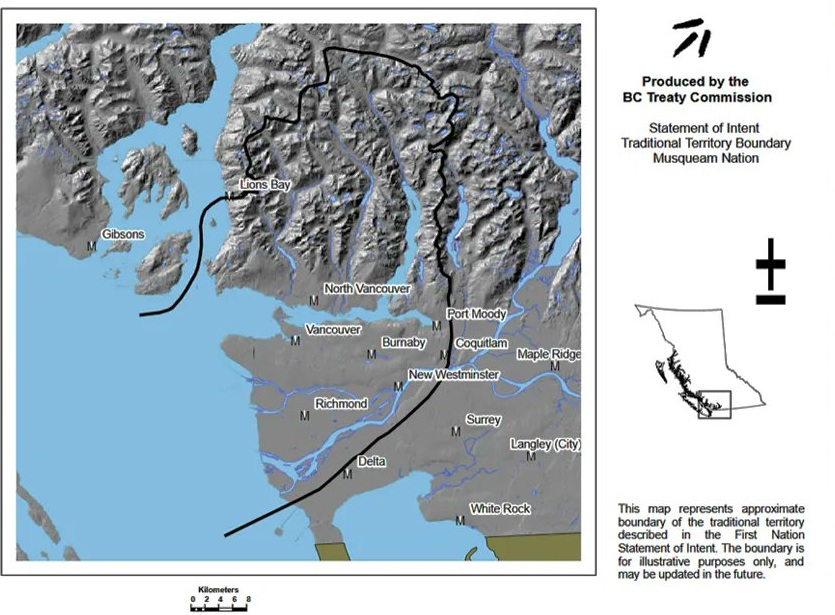
The Musqueam Indian Band’s traditional territory encompasses virtually all of Metro Vancouver, including Vancouver, West Vancouver, North Vancouver, Burnaby, Richmond, New Westminster, parts of Delta and Surrey and other regions.
Based on 2021 census and other data, that territory is home to an estimated 1.8 million British Columbians.
The federal government has now formally recognized in writing Musqueam Indian Band’s Aboriginal title over that territory, yet Crown-Indigenous Relations and Northern Affairs Canada refuses to make the agreement public.
The February 20 announcement specifically refers to the “šxʷq̓ʷal̕təl̕tən Rights Recognition Agreement”, described as recognizing Musqueam’s Aboriginal rights, “including title” and establishing a framework for implementation.
Musqueam Chief Wayne Sparrow emphasized the Aboriginal title component directly in the release:
Our Musqueam community celebrates these historic agreements as a step forward in our path to Reconciliation. In signing these agreements, the Government of Canada is acknowledging Musqueam’s Aboriginal title and rights to our traditional territory and recognizing our expertise in both marine management and fisheries management.
But when Juno News requested a copy of the agreement from Crown-Indigenous Relations, the department’s media relations spokesperson Eric Head confirmed receipt of the request and then cut communication altogether, even when pressed to ask if the agreement would be made public.
The Deadly Job of a Victorian Baker
Tasting History with Max Miller
Published 2 Sept 2025Large, gingery loaf of bread
City/Region: England
Time Period: 1857In order to make expensive wheat flour go further, Victorian bakers added things to it of varying edibility. While potato, corn, and pea flour were used, so was ground up plaster of paris, chalk dust, and a powder called alum. Alum made the flour very white, but is also toxic in large quantities.
This loaf, made only with wholesome, edible ingredients, would have been on the fancier side of a bakery’s offerings with the addition of lots and lots of powdered ginger. This bread really surprised me, as it tastes like a normal loaf of bread at first, but then the heat and the flavor of the ginger comes through afterwards.
Ginger Loaf, or Rolls.
Mix intimately two ounces of good powdered ginger, — called in the shops prepared ginger, — and a little salt, with two pounds of flour, and make it into a firm but perfectly light dough with German or brewer’s yeast, [and 1 pint milk] in the usual manner; [to rise one hour or until quite light: to be kneaded down and left again to rise until light]. Bake it either in one loaf, or divide it into six or eight small ones.
The proportion of ginger can be much increased if desired; but the bread should not then be habitually eaten for a long continuance, as the excess of any stimulating condiment is often in many ways injurious.
— The English Bread-Book by Eliza Acton, 1857
QotD: The rise of archives-based history in the late Middle Ages
All of this, I suggest, is because people increasingly thought factual accuracy was important. And that only comes with the increasing sense of linear time. The chronicles of the first two or three Crusades, for instance, are filled with wild exaggerations and impossible claims … but they’re not lies. They just serve a different purpose. They’re called “histories”, but that’s a misleading translation (of the word historia, I’ll admit). What they really are is much closer to exempla — saints’ lives, that kind of thing. Their point isn’t “This and that actually happened”; it’s more like “Let us all praise God, for the wondrous things he allowed us to do!”
Gesta Francorum means “deeds of the French”, but in the sense of “The wonders done in God’s name,” not “a list of battles and their outcomes”.
Severian, “The Ghosts (II)”, Founding Questions, 2022-05-18.
March 2, 2026
A Day in the Life of an Ensh*ttificator
Forbrukerrådet – Norwegian Consumer Council
Published 27 Feb 2026Digital products and services keep getting worse. In the new report Breaking Free: Pathways to a fair technological future, the Norwegian Consumer Council has delved into enshittification and how to resist it. The report shows how this phenomenon affects both consumers and society at large, but that it is possible to turn the tide.
Read more on: https://www.forbrukerradet.no/breakin…
(more…)
Remember this when they tell you grocery prices are high because of greedy corporations
On the social media site formerly known as Twitter, L. Wayne Mathison explains why the headline profits of grocery stores bear almost no relation to the far smaller actual profits in the grocery retail market:

“Leader IGA” by daryl_mitchell is licensed under CC BY-SA 2.0 

 .
.
The 32% Illusion: A Grocer’s View from Behind the Till
I used to own the IGA in Hamiota. Small town. Thin margins. Real bills. So when I hear that Loblaw Companies Limited is raking in “31–32% profit”, I don’t get angry. I get tired.
Here’s the move. Take a gross margin number. Call it profit. Add a dash of politics. Serve hot.
Gross margin is revenue minus cost of goods sold. That’s it. It doesn’t include payroll, hydro, insurance, property tax, refrigeration repairs at 2 a.m., shrink, theft, advertising, transport, interest, or the banker breathing down your neck. Net profit is what’s left after all of that. In grocery, that number floats around 2 to 3 percent in a good year. Some years less. Some years negative.
When I ran my store, payroll alone could swallow most of the gross margin. Then add freight. Then add utilities. Manitoba winters are not kind to freezers. Then add spoilage. Bananas do not care about your ideology. They rot on schedule.
People think grocers “set prices”. That’s half true at best. Suppliers raise costs. Fuel goes up. Wages rise. Carbon costs ripple through trucking and farming. You pass it on or you close. It’s arithmetic, not greed.
Now here’s the uncomfortable part. Food inflation hurts. It hurts seniors. It hurts young families. It hurts the clerk stocking shelves. But blaming a 30% “profit margin” is a shortcut. It feels good. It’s wrong.
Big chains make money on scale, pharmacy, cosmetics, financial services. Those categories carry higher margins than milk and bread. That lifts the consolidated gross margin number. It does not mean grocery aisles are printing cash.
We should argue about competition. We should argue about supply management. We should argue about taxes embedded at every step of the chain. Good. Let’s do that. But at least use the right numbers.
I spent years watching pennies. Grocers survive on volume and efficiency. A few cents per dollar is the game. Always has been.
If you want lower food prices, focus on input costs, transport, energy, regulation, and competition. Start there.
And before sharing the next viral graphic, ask one question: gross or net?
That single distinction separates outrage from reality.
Ghostbusters: Ignore the Rules, Save the World
Feral Historian
Published 31 Oct 2025It’s a comedy classic, and even funnier when you realize that it’s about shady small-businessmen saving the world by ignoring government regulations.
(more…)
QotD: King Stephen and “the anarchy”
At this point, I ought to mention that the year is 1120; the young man is William Adelin, heir to the throne of England; and the “ferry” is the infamous White Ship.
Anyway, back to the story: the wine keeps flowing and, before long, the crew are drunk too. Not far out of port, the ship hits a submerged rock and rapidly sinks.
In all, hundreds are drowned — and yet that is just the start of the tragedy.
William’s father, King Henry I, had gone to great lengths to proclaim an heir. As the son of William the Conqueror, he knew just how messy succession could get. He had himself inherited the throne from his brother, William Rufus. This second William had died of a chest complaint — specifically, an arrow in the lungs (the result of a hunting “accident”). Henry was determined that his son would inherit the throne without mishap — and so carefully prepared the ground for a smooth transfer. Indeed, the name “Adelin” signified that the third William was the heir apparent.
The sinking of the White Ship left Henry with one remaining legitimate heir, his daughter Matilda. She was a formidable character, also known as Empress Maud (by virtue of her first marriage to the Holy Roman Emperor). She was, nevertheless, a woman — a big problem in an age when monarchs were expected to lead their men in battle. When Henry died in 1135, Maud’s cousin — Stephen of Blois — seized the throne. This was widely welcomed by the English nobility, but Maud wasn’t giving up easily, and she had powerful allies. Her second husband was Geoffrey, Count of Anjou; her illegitimate half-brother, Robert of Gloucester, was a wealthy baron; and her uncle was King David I of Scotland.
Stephen was assailed on all sides — by Geoffrey in Normandy, by Robert in England, by invading Scots and rebellious Welshmen. The civil war (if that’s what you can call this multi-sided free-for-all) dragged on for almost 20 years. There weren’t many set-piece battles, but there was lots of looting and pillaging in which countless nameless peasants perished.
In the end it was the death of another heir — Stephen’s son, Eustace — that opened the way to peace. The war-weary king agreed that Maud’s son (the future Henry II) would succeed him. And thus “The Anarchy” came to end: two decades of pointless devastation — and all because some young fool got pissed on a boat.
Peter Franklin, “Why Boris needs an heir apparent”, UnHerd, 2020-08-17.
March 1, 2026
The American Revolutionaries – when you don’t want a king, but you do want someone king-ish
On Substack Notes, John Carter shared this post by Theophilus Chilton, saying:
Fascinating. The American founders were explicitly trying to revive a stronger form of monarchical executive authority with the presidency, as a deliberate corrective to the relatively powerless Crown of the British Constitution, which had been effectively neutered by the doctrine of parliamentary supremacy.
Along similar lines, the American Bill of Rights was in most ways simply a restatement of the ancient rights of Englishmen.
So, of course, I had to go read the post:
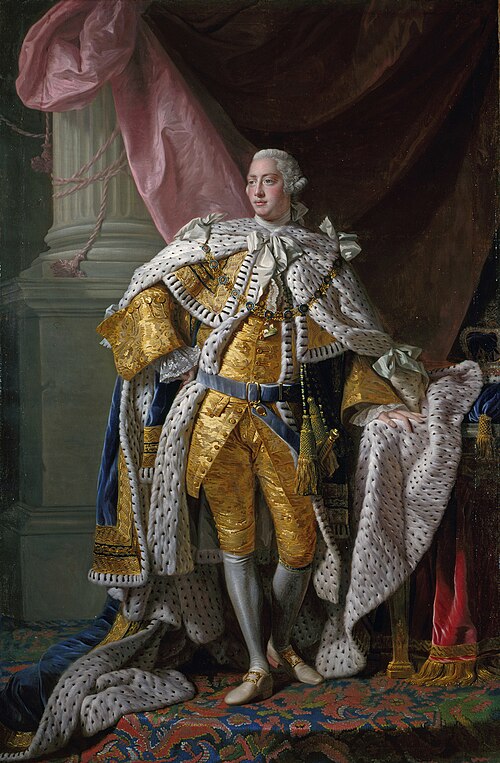
Too “kingly” but also not “kingly” enough for America’s Founding Fathers.
King George III in his Coronation robes.
Oil painting by Allan Ramsay (1713-1784) circa 1761-1762. From the Royal Collection (RCIN 405307) via Wikimedia Commons.
Recently, I’ve been reading an interesting book about 18th century political philosophy entitled The Royalist Revolution: Monarchy and the American Founding. In this work the author, Eric Nelson, guides the reader through the various aspects of the great inter-whiggish debates that roiled the American colonies prior to independence, and which then continued afterwards. One of the main premises is that a major faction within this debate — and indeed the one which ended up prevailing in the end — understood the relationship between colonies and mother country to be founded upon the king of Britain’s personal proprietorship over the colonies. This Patriot position was opposed by the Loyalist position which saw the colonies as existing under the laws and rule of Parliament.
Now this might seem strange to generations of Americans who grew up learning in school that the American revolutionaries fought against the great tyrant King George III who was set upon grinding the American colonies under his bootheel of oppression. That view would be quite surprising to many of the participants on the Patriot side, many of whom actually appealed to King George, both publicly and in private correspondence, to exercise kingly prerogative and overturn the various duties, laws, and taxes which Parliament had laid upon the colonies. This, indeed, was the crux of the Patriot argument, which is that because the colonies were originally founded under the personal demesne of the British King, they remained so even despite the temporary abolishment of the monarchy after the execution of Charles I in 1649. In the interregnum between that and the Glorious Revolution and restoration of a stable monarchy that was accepted by all classes as legitimate in 1688, Parliament had illegitimately usurped authority over the colonies. Because it was Parliament which was laying the Intolerable Acts and all the other complaints which the Americans had, it was Parliament against whom they wished to be protected.
But these Patriots were pining after a situation which no longer existed. In point of fact, the British kings since the Glorious Revolution had left whatever prerogative powers they might still have had unused. So it was with George III, who rejected the American colonists’ calls for him to intervene, knowing that doing so would have provoked a constitutional crisis in Britain which he would not have won. As a result, the American colonists chose to make their final break with the British monarchy and throw in their lot for independence, buttressed by Thomas Paine’s fleetingly persuasive but ultimately ineffectual pamphlet Common Sense.
However, after independence, the colonists were faced with providing their own governance. Initially, this was attempted under the Articles of Confederation, as well as their state constitutions, all of which were very whiggish in principle. They were also inadequate to the task. As every student who took high school civics knows, the solution to this was the Constitution of 1789.
Typically, students are taught that the new Constitution was designed to strengthen the ability of the federal government to handle the various issues that applied to the confederation of states as a whole. What we don’t generally hear, however, is that much of this included strengthening the roles and powers of the president to include several areas of prerogative powers which exceeded even the powers then available to the kings of Britain. The stock view of the Constitution is that it “was created to prevent anyone from getting too much power!” The actuality is that the Constitution was crafted, in part, to expand presidential power and create what was viewed at the time as a literally monarchical chief executive. Opponents of this described the proposed executive as “the foetus of monarchy”. Supporters often defended it on the basis that parliaments and congresses, if left unchecked by a strong executive whose interest was drawn from the body of the whole people, would themselves become the greatest threats to the liberties of the people.
The Founders who proposed this enhancement of the executive didn’t do this in a vacuum. Indeed, they had a century and a half of history about this very subject to draw from first-hand. Fresh in the collective mind of every Englishmen, both in the home country and in the colonies, were the English Civil Wars of the previous century. Beginning with the revolt of the parliamentarian army in 1642 through the regicide of Charles I in 1649, the protectorate of Oliver Cromwell, the attempted restoration of the House of Stuart under James II, until the final deposition of James and his replacement with William, Prince of Orange in the Glorious Revolution of 1688, Englishmen had a long series of examples from which to draw various conclusions.
So yes, they could see the parliamentarian excesses that took place during the Protectorate. Current in the collective national mind were the overreaches (whether real or imagined) of Parliament both during the interregnum and in the century since the acquisition of the throne by the House of Hanover. As noted above, among these overreaches, at least as viewed by many in the American colonies, was parliamentary interference in the affairs of the colonies, viewed as transgressions into the rightful domain of the king’s purview. Hence, by a strange twist, the Loyalists who opposed American independence before and during the Revolution were generally the more whiggish of the two sides, throwing in their lot with the parliamentary oligarchies. The Patriots, on the other hand, were desperately trying to get the king to reassert his royal prerogatives and intervene by reasserting his perceived rights to directly rule the colonies, something of a modified “high/low vs. the middle” type of scenario.


