Quotulatiousness

May 23, 2021

Portlanders “have developed rituals, devotions, and self-criticisms to fight ‘systemic racism’ and ‘white supremacy'”

Filed under: Education, Politics, USA — Tags: , , , , — Nicholas @ 05:00

In City Journal, Christopher F. Rufo talks about the “child soldiers of Portland”:

“Portland, Oregon” by Ben Amstutz is licensed under CC BY-NC 2.0

There are only a few places on earth where radicals and their children ritualistically burn the American flag and chant “Death to America”: Tehran, Baghdad, Beirut, Kabul, Ramallah — and Portland, Oregon.

The City of Portland, a cloud-covered metro on the south bank of the Columbia River, has become known for its political protesters. Anarchists, Communists, ecofascists, and various other agitators regularly denounce the police, politicians of both parties, and America itself, and flag-burning has become part of the protesters’ liturgy. Last summer, protesters associated with Antifa upped the ante with chants of “Death to America” and participated in months of violent protests to avenge the death of George Floyd while he was in police custody in Minneapolis. Children as young as four marched with the crowd to the federal courthouse, raising the Black Power fist and chanting “Fuck the Police!”

Famously the “whitest city in America”, Portland has become the unlikely headquarters of race radicalism in the United States. The city has elevated white guilt into a civic religion; its citizens have developed rituals, devotions, and self-criticisms to fight “systemic racism” and “white supremacy”. The culminating expression of this orthodoxy is violence: street militias, calling themselves “antiracists” and “antifascists”, smash windows and torch the property of anyone transgressing the new moral law.

We might be tempted to dismiss this as the work of a few harmless radicals “keeping Portland weird”, but in recent years, their underlying ideology on race has become institutionalized. The city government has adopted a series of Five-Year Plans for “equity and inclusion”, shopkeepers have posted political slogans in their windows as a form of protection, and local schools have designed a program of political education for their students that borders on propaganda.

I have spent months investigating the structure of political education in three Portland-area school districts: Tigard-Tualatin School District, Beaverton School District, and Portland Public Schools. I have cultivated sources within each district and obtained troves of internal documents related to the curriculum, training, and internal dynamics of these institutions. We can best understand the political education program in Portland schools by dividing it into three parts: theory, praxis (or practice), and power. The schools have self-consciously adopted the “pedagogy of the oppressed” as their theoretical orientation, activated it through a curriculum of critical race theory, and enforced it through the appointment of de facto political officers within individual schools, generally under the cover of “equity and social-justice” programming. In short, they have begun to replace education with activism.

The results are predictable. By perpetuating the narrative that America is fundamentally evil, steeping children in race theory, and lionizing the Portland rioters, they have consciously pushed students in the direction of race-based “revolution”. In the language of the Left, the political education programs in Portland-area districts constitute a “school-to-radicalism pipeline”: a training ground for child soldiers. This is not hyperbole: some of the most active and violent anarchist groups in Portland are run by teenagers, and dozens of minors were arrested during last year’s riots. These groups have taken up the mantle of climate change, anticapitalism, antifascism, and Black Lives Matter — whatever provides a pretext for violent “direct action”.

Contrary to those who believed that the end of the Trump presidency would bring a “return to normalcy”, the social and political revolution in Portland has only accelerated under President Joe Biden. On Inauguration Day, teenage radicals marched through southeast Portland, smashing the office windows of the state Democratic Party and unfurling large banners with hand-painted demands: “We don’t want Biden, we want revenge”; “We are ungovernable”; “A new world from the ashes”. Intoxicated by revolution and enabled by their elders, Portland’s kids are not all right.


AF is short of fresh water – WW2 – 143 – May 23, 1942

Filed under: Britain, Germany, History, Japan, Military, Pacific, Russia, USA, WW2 — Tags: , , , , , — Nicholas @ 04:00

World War Two
Published 22 May 2021

Soviet Foreign Minister Molotov arrives in London to meet with Churchill, but at home in the USSR the Germans have launched an instantly successful offensive. In North Africa and Malta the British are building up, unaware that Erwin Rommel is just about to strike, and an American ruse discovers secret Japanese attack plans.
(more…)

Peter Zeihan’s geographic-based perspective on world history

Filed under: Books, Economics, History — Tags: , , , — Nicholas @ 03:00

In another of the reader-contributed book reviews for Scott Alexander’s Astral Codex Ten, a look at The Accidental Superpower: The Next Generation of American Preeminence and the Coming Global Disorder by Peter Zeihan:

Zeihan’s primary models are influenced by his geographic-based perspective on how our world works. As he puts it in the introduction, “Geopolitics is the study of how place [rivers, mountains, etc.] impacts … everything.” Early chapters discuss what he calls the balance of transport, which is roughly easy transport within a country (for economic development and forming political and cultural ties) and hard transport from outside of it (for defense). These transport issues are inherently tied to geography. What’s the best way to move things? Water-based transportation is extremely cheap. Think 17 cents per container mile vs. $2.40 for semis on an American highway, with a more extreme disparity for other countries, trade between continents, and populations in hard-to-access places. On the defensive side of that equation, geographic features on borders such as deserts, mountains, and oceans get Zeihan’s attention.

He uses ancient Egypt to illustrate a great balance of transport. The reliable water and rich soil of the Nile’s floodplains created near-perfect farming conditions, and the Nile itself allowed easy travel and trade throughout the valley. Combined with impenetrable desert borders, this geography “was one of the few places in the world where there was enough water to survive, and enough security to thrive.” Because of that, the “geography nearly guaranteed that the Egyptians would be on the road to civilization.” He gives us a quick run through Egyptian history to tell a story of that road, beginning with the settlement of the area about eight thousand years ago, consolidation into a single kingdom more than five thousand years ago, and then stagnation as the increasingly centralized government devoted more labor to monument building rather than technological progress, eventually being conquered by seafaring people seeking to rule the Mediterranean.

*****

To escape our pre-civilization/hunter-gatherer days – Zeihan refers to this as “when life sucked” – the mechanism that he identifies is basically a typical economist’s story. Sedentary agriculture as invented by the Egyptians and other ancient cultures became a transformative technology, letting populations grow and devote labor and resources to non-farming purposes. From this, we got specialization, increased production, trade (particularly where there was easy transportation – population centers were always near water) and capital formation in a self-reinforcing cycle. For thousands of years after this transformative technology was introduced, incremental improvements in agriculture and other areas followed, but “a robust, secure, and sustainable food supply” was the base of any civilization.

This cycle accelerated when we harnessed a couple of new packages of technologies over the last six-hundred years. He lumps the source of much progress together with the terms deepwater navigation and industrialization. The first is everything needed to sail the seas, from shipbuilding capabilities to compasses to weapons. Industrialization is exactly what you’re thinking of. He simplifies it as the combination of labor and capital with higher-output energy sources like oil and coal to put productivity on steroids.

Zeihan gives us a story of the Ottoman Empire entering a prolonged decline as deepwater navigation technologies took off in the fourteenth century. These technologies enabled the European powers (first Portugal and Spain, and then England) to capture increasing shares of trade with Asia, dropping prices in Europe and depriving the Ottomans of much of the income to which they had grown accustomed. Most significantly, they turned “the ocean from a death sentence to a sort of giant river.” Trade became global, but it was still mostly among people with nearby water-based transportation.

Industrialization technologies changed that. Steam and coal brought power to mining and transportation, and along with interchangeable parts, improved manufacturing. Chemical breakthroughs led to fertilizers (improving crop yields), and with more transportation options, more land was brought into cultivation. Improvements in cements in the 1820s enabled larger buildings and infrastructure. These technologies continually improved the productivity cycle that began with agriculture.

Zeihan concludes a chapter on America with the “nuts and bolts” of how countries rule the world. “The balance of transport determines wealth and security. Deepwater navigation determines reach. Industrialization determines economic muscle tone. And the three combined shape everything from exposure to durability to economic cycles to outlook.” As we’ll see shortly, he really likes America’s position on all of these factors. But first, we need to understand the other analytical tool that informs Zeihan’s model.

Where is Scandinavia?

Filed under: Europe, History — Tags: , , , , , , — Nicholas @ 02:00

CGP Grey
Published 25 Mar 2015

Grey Merch: https://cgpgrey.com/merch

Grey on Twitter: https://twitter.com/cgpgrey

QotD: The psychological impact of extended lockdowns

Claudio Grass (CG): A lot has been said and written about the economic and financial impact of the covid crisis and all the lockdowns and restrictions that came with it. However, the mental health implications haven’t really received the attention they arguably merit, at least not by mainstream media or government officials. Over the last year, we saw self-reported depression rates creep up in many Western nations, while excessive alcohol consumption and the abuse of prescription drugs also jumped. Do such trends raise concerns over longer-term problems or will we all simply snap back to normal once the crisis is over?

Theodore Dalrymple (TD): The first thing to say is that I do not like the term “mental health.” Was Isaac Newton mentally healthy, or Michelangelo? I think part of the problem is very concept of mental health. It implies that there is some state or condition of mind deviation from which is analogous to illness. Once this idea takes hold, it is clearly up to an expert to cure the person, or better still prevent him from getting ill in the first place. This expectation cannot be met, but the idea that it can be makes people more fragile.

Second, people clearly vary much in their response to confinements, lockdowns, closures of resorts of entertainment, etc. For myself, I have reached the age of misanthropy or self-sufficiency when these things make comparatively little difference to my life. I have plenty of space and plenty of things to do, in essence reading and writing. But that does not make me mentally healthier than a young man who is frustrated because he cannot play football with his friends and becomes ratty – moreover living in a very confined space.

Depression is so loosely defined a term that it has become almost valueless as a diagnosis. How often have you heard someone say “I’m unhappy” rather than “I’m depressed?” The semantic shift is very important. The proper response to someone who says that he is depressed is to give him antidepressants, even though these don’t work in the majority of cases, except as a placebo, and have potential side-effects. It is always tempting for people who are unhappy to drink alcohol – to drown their sorrows, as we say. Of course, if you drink too much, you might become really and truly depressed. A person who did not respond to the current situation with a little gloom would be odd.

Claudio Grass, “Theodore Dalrymple: Self-Control And Self-Respect Have Become Undervalued”, The Iconoclast, 2021-02-17.

May 22, 2021

Guns in the Movies – like this S&W Model 29

Filed under: Media, USA, Weapons — Tags: , , , — Nicholas @ 02:00

Forgotten Weapons
Published 10 Feb 2017

Today we have not so much an examination of a specific firearms, but rather a look at how Clint Eastwood’s film portrayal of Dirty Harry Callahan drove a huge wave of popularity of the Smith & Wesson Model 29 — “the most powerful handgun in the world.”

http://www.patreon.com/ForgottenWeapons​

Cool Forgotten Weapons merch! http://shop.bbtv.com/collections/forg…​

If you enjoy Forgotten Weapons, check out its sister channel, InRangeTV! http://www.youtube.com/InRangeTVShow

QotD: King Edward I

Filed under: Britain, History, Humour, Quotations — Tags: , , , — Nicholas @ 01:00

Long before Henry III had died (of a surfeit of Barons, Bonifaces, etc.) Edward I had taken advantage of the general confusion and of the death of Simon de Montfort (probably of a surfeit of Vergers) to become King before his reign had begun.

Edward I was thus a strong King, and one of the first things he did was to make a strong arrangement about the Law Courts. Hitherto there had been a number of Benches there, on all of which a confused official called the Justinian had tried to sit. Edward had them all amalgamated into one large Bench called the King’s Bench, and sat on it himself.

Edward I, who had already (in his Saladin days) piously decimated several thousand Turks at Nazareth, now felt so strong that he decided to Hammer the Scots, who accordingly now come right into History.

The childless Scotch King Alexander the Great had trotted over a cliff and was thus dead; so the Scots asked Edward to tell them who was King of Scotland, and Edward said that a Balliol man ought to be. Delighted with this decision the Scots crossed the Border and ravaged Cumberland with savage ferocity; in reply to which Edward also crossed the Border and, carrying off the Sacred Scone of Scotland on which the Scottish Kings had been crowned for centuries, buried it with great solemnity in Westminster Abbey.

This was, of course, a Good Thing for the Scots because it was the cause of William the Wallace (not to be confused with Robert Bruce), who immediately defeated the English at Cambuskenneth (Scotch for Stirling) and invaded England with ferocious savagery. In answer to this Edward captured the Bruce and had him horribly executed with savage ferocity. Soon after, Edward died of suffocation at a place called Burrowin-the-Sands and was succeeded by his worthless son Edward II.

W.C. Sellar & R.J. Yeatman, 1066 And All That, 1930.

May 21, 2021

Andrew Potter – “the greatest gift you can give a generation is to ignore them”

Filed under: Cancon, Media, Quotations, Technology, USA — Tags: , , , — Nicholas @ 05:00

In The Line Andrew Potter speaks up for those forgotten folks who were born after the end of the Baby Boom but before the Millennials appeared:

Generation X Word Cloud Concept collage background
Best Motivation Blog: What Generation Is X https://fatinsl.info/?arsae=https%3A%2F%2Fbestmotivationblog.blogspot.com%2F2020%2F04%2Fwhat-generation-is-x.html

… just as a sense of futurelessness, futility and invisibility catalyzed the original Generation X mentality in the early 90s (as well as the music, art, film and writing that mentality made manifest), this atavistic indignation spurred [Generation X author Douglas] Coupland to write his wonderful screed. It’s great stuff, with quotable lines in every paragraph. (I especially liked “Immunology is not a smorgasbord. How dare you make us subsidize your cluelessness with our bodies.”)

But I want to take issue with the claim that this is a case of Gen X getting screwed yet again. As a fully paid-up member of Gen X, I’ve grown to appreciate over the decades the extent to which the greatest gift you can give a generation is to ignore them.

Let’s back up a bit. Does Generation X even exist? Does any generation exist for that matter? Sociologists and demographers argue that the concept of a “generation”, be it Boomer, Millennial, Zoomer, what have you, is just the result of confusing cohort effects with generational effects. The idea of distinct generations might be good for selling soft drinks or cars or condos or nostalgia, but there is nothing remotely predictive or explanatory about it.

But as I’ve argued before, this just misunderstands what a generation is, and the role they play in our ongoing cultural self-understanding. Whatever else it is, a generation is something that has its own tastes and moods and fashions and jargon, its own sense of what is in and what is out, what is cool and what’s square, and who belongs and who does not. In short, more than anything else a generation is a scene. It is about who and what you claim as your own, and who claims you.

A big part of what helps define a generation are the battles it chooses to fight. The Boomers spent decades obsessed with their countercultural campaign against The Man, while Millennials have spent their time and energy mining the deepest recesses of identity politics. As for Generation X, our principal preoccupation was the question of authenticity and the fear of selling out.

It is hard to underestimate the role of technology in all of this. It is commonly argued that a generation is formed by the technological ecosystem in which it grows up, and while there’s obviously something to that, what is important for Gen X is not what our technology allowed us to do, but what it protected us from.

In particular, what we were protected from was surveillance. I don’t know a single person I grew up with who doesn’t thank their lucky stars that there were no cellphones with cameras around when we were growing up, that there was no Twitter or Facebook or YouTube or TikTok. I can’t imagine what it is like to grow up under the glaring distributed panopticon of social media, knowing that all your friends, everyone at your school, and even your parents are watching your every move, judging your every utterance.

Life Inside a Japanese PoW Camp – WW2 Special

Filed under: Britain, History, Japan, Military, Pacific, USA, WW2 — Tags: , , , , — Nicholas @ 04:00

World War Two
Published 20 May 2021

The inhuman, torturous, and deadly Japanese PoW Camps famous from Bridge over the River Kwai, Merry Christmas Mr. Lawrence, Empire of the Sun, and more recently Unbroken are a world of abuse and mistreatment managed by willfully incompetent and sadistically brutal men.
(more…)

Mission creep – to “make the web giants pay”, the feds will “need” to regulate everything Canadians view or post online

Filed under: Cancon, Government, Liberty — Tags: , , , , , , , — Nicholas @ 03:00

Michael Geist explains why we can safely discount any new lies that the Heritage Minister spews about his Bill C-10 censorship bill:

Canadian Heritage Minister Steven Guilbeault has tried to deflect public concern with the regulation of user generated content under Bill C-10 by claiming the intent is to make the “web giants” pay their fair share. Yet according to an internal government memo to Guilbeault signed by former Heritage Deputy Minister Hélène Laurendeau released under the Access to Information Act, the department has for months envisioned a far broader regulatory reach. The memo identifies a wide range of targets, including podcast apps such as Stitcher and Pocket Casts, audiobook services such as Audible, home workout apps, adult websites, sports streaming services such as MLB.TV and DAZN, niche video services such as Britbox, and even news sites such as the BBC and CPAC.

The regulations would bring the full power of CRTC regulation over these sites and services. This includes requiring CRTC registration, disclosure of financial and viewership data, Canadian content discoverability requirements (yes, that could mean Canadian discoverability for pornography services), and mandated payments to support Canadian film, television, and music production. The list also notably identifies potential regulation of Youtube Music, Snapchat Originals, and other social media services whose supposed exclusion has been cited as the rationale to extend regulation to user generated content.

The document was obtained by Postmedia journalist Anja Karadeglija, who first reported it last weekend, focusing on departmental warnings about the importance of excluding user generated content from the scope of regulation in Bill C-10 and the necessity of Sections 2.1 and 4.1 (Section 4.1 was removed by the government). The memo states:

    Social media services like YouTube and Facebook greatly expand the number of individuals and other entities that can be said to be transmitting programs over the Internet. This provides an important limitation on the application of the Act by ensuring that under the Act the CRTC cannot regulate the audio or video communications of individuals (or other entities) simply because they use a social media service.

The government obviously ignored the warning and removed the limitation. The document continues by identifying a non-exhaustive list of services that “are likely to regulated under the Act.” The department acknowledges that some services may be exempted by the CRTC, though there are no specifics in the bill that identify thresholds for exemptions. Even if exempted, services may still be required to register with the CRTC and provide confidential commercial data in order to obtain an exemption. Indeed, the default approach is that all services are subject to Canadian regulation, leading to a dizzying array of regulated services identified by the department.

Emphasis mine.

Tank Chats #107 | T-62 | The Tank Museum

Filed under: History, Military, Russia, Weapons — Tags: , , , , — Nicholas @ 02:00

The Tank Museum
Published 9 Oct 2020

Here The Tank Museum’s Curator David Willey discusses the Soviet T-62, including its development and service life. Introduced in 1962, it was a further evolution of the T-55 series, which David discussed in Tank Chat #104.

Support the work of The Tank Museum on Patreon: ► https://www.patreon.com/tankmuseum
Visit The Tank Museum SHOP & become a Friend: ► tankmuseumshop.org

Twitter: ► https://twitter.com/TankMuseum
Instagram: ► https://www.instagram.com/tankmuseum/
#tankmuseum #tanks

QotD: Avoid situations that can “escalate fast”

Filed under: Law, Quotations, USA, Weapons — Tags: , , — Nicholas @ 01:00

… we don’t know what sort of history these neighbors had leading up to this. Still, it’s a good example of why it’s a good idea to not just start cussing people in public.

Also, this is an answer to the question “You mean you carry a gun when you’re just doing yard work or shoveling snow?” Oh hell yes I do.

Also also, this is why I generally try and avoid getting involved in anyone else’s crazy day.

If someone’s acting up in public, I can apologize and disengage from the situation. If I really feel the need to, I can go complain about them on social media in private later and nobody’s gonna pop off and trigger a gunfight if I do.

If you carry a gun, any altercation can escalate into a gunfight. Deescalate. Avoid altercations.

Lastly, there is a problem experienced by people who haven’t been exposed to interpersonal violence of any type; they have no experience in reading the differences between bluffing and the real deal. It’s why you see these “You ain’t gonna shoot me!” situations.

People waving a gun just to let you know they have a gun is a very real phenomenon and doesn’t necessarily mean violence is imminent; they’re just letting you know that certain off-ramps from the situation are closed. Okay, you have a gun and I need to stop pushing. Cool, cool.

This guy? He was not that guy.

People say “You wouldn’t…” to people who are practically lighting off signal rockets to tell you that oh, yes the fuck they would and are, in fact, fixin’ to.

Tamara Keel, “Finding Out”, View From the Porch, 2021-02-05.

May 20, 2021

True Beginner: Learn to Crosscut by Hand!

Filed under: Tools, Woodworking — Tags: , — Nicholas @ 06:00

Rex Krueger
Published 19 May 2021

Follow a true beginner in learning efficient and proper sawing technique!

More video and exclusive content: http://www.patreon.com/rexkrueger
Get a good saw and other tools! (Scroll down)
(more…)

The Birth Control Movement and Eugenics – A Curious Link | B2W: ZEITGEIST! I E.18 – Winter 1923

Filed under: Books, Britain, Europe, Greece, Health, History, Law, Media — Tags: , , , , , — Nicholas @ 04:00

TimeGhost History
Published 19 May 2021

In the winter of 1923, a controversial activist takes a Catholic doctor to trial for libel. The proceedings capture a much bigger moment in the history of the interwar period: the controversial — but inherent — link between birth control and eugenics.
(more…)

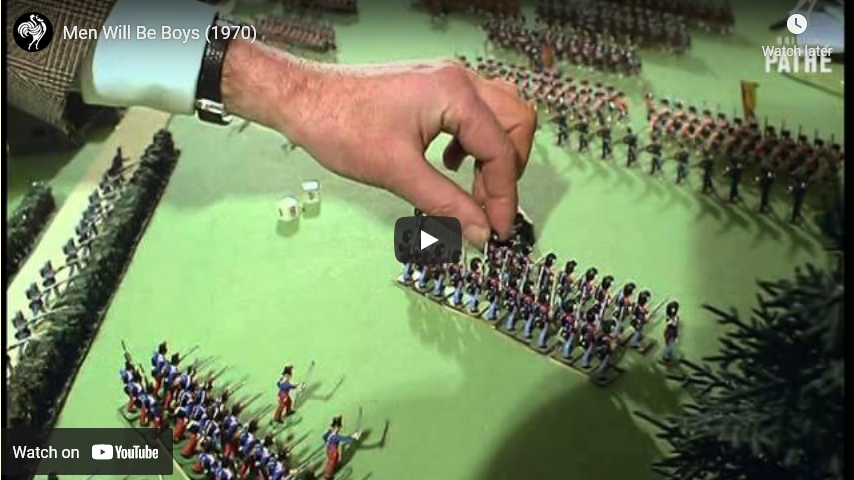
Men Will Be Boys (1970)

Filed under: Britain, Gaming, History, Railways — Tags: , , , — Nicholas @ 02:00

British Pathé
Published 13 Apr 2014

Men will be boys. Various locations.

M/S men round lake with boats. C/U man in lake with waders with model boat. C/U another man with model boat. Man lighting boiler. C/U engine working. M/S as model of paddle boat moves through water. M/S paddle boat on water. In foreground a swan. C/U another model boat going through water. M/S pan scale model of Hitler’s yacht. M/S men playing with model cars on race track. C/U cars going round race track. C/U men’s hands on controls. C/U men looking at cars go past. L/S of cars going round race track.

L/S men playing war games with model soldiers. on large table. C/U as man moves soldiers out of line laying them on ground. M/S man moves horses forward. C/U hand placing cannon into position. C/U hand places horse troops in position. M/S lines of soldier. Hand places another in position. M/S of troops being moved.

M/S Mr Victor Martin and wife go through gate by railway crossing dressed up in their uniforms, carrying lamps etc. M/S as they make their way to their signal boxes. C/U railway notice ‘By Midland Railway’. Pa off notice to show Mr Martin approaching his signal box. M/S Martin going into signal box. M/S Mrs Martin going into signal box. C/U Mrs Martin going into signal box. C/U interior. Mr Martin hanging up his jacket inside signal box. He then sits at the controls. C/U signal controls working. C/U of Mr Martin operating signals. Camera zooms back and we see train going past him along track. C/U model train over track. C/U Mrs Martin working in her signal box.

M/S Mrs Martin working signal controls. C/U Mrs Martin. M/S showing trains going over track. C/U trains moving. Camera zooms out to show tracks . C/U trains moving. C/U looking along tunnel showing trains moving. C/U exterior. Signals working. Then camera pans to show where the trains run on an enclosed section out in the open. C/U goods train and passenger train moving. M/S Interior. Trains going over track and Mr Martin at controls.
FILM ID:2241.18

A VIDEO FROM BRITISH PATHÉ. EXPLORE OUR ONLINE CHANNEL, BRITISH PATHÉ TV. IT’S FULL OF GREAT DOCUMENTARIES, FASCINATING INTERVIEWS, AND CLASSIC MOVIES. http://www.britishpathe.tv/

FOR LICENSING ENQUIRIES VISIT http://www.britishpathe.com/​

British Pathé also represents the Reuters historical collection, which includes more than 136,000 items from the news agencies Gaumont Graphic (1910-1932), Empire News Bulletin (1926-1930), British Paramount (1931-1957), and Gaumont British (1934-1959), as well as Visnews content from 1957 to the end of 1984. All footage can be viewed on the British Pathé website. https://www.britishpathe.com/

« Newer PostsOlder Posts »

Powered by WordPress