Tasting History with Max Miller
Published 11 Nov 2025Creamy pumpkin soup served in a hollowed out pumpkin
City/Region: France
Time Period: 1651This is one of the first recipes for pumpkin soup where we can be sure that the pumpkin they’re referring to is a new world pumpkin. This cookbook was written by François Pierre de la Varenne, who’s credited with leading the shift away from highly spiced medieval and renaissance foods into what we would call French haute cuisine. He was into showcasing the flavor of the key ingredient in whatever he made, and this soup does it.
The cloves, onion, and pepper are there but subtle, and the pumpkin really shines through. You can use canned pumpkin to make this soup even easier, and serving it in a hollowed out pumpkin adds some festive flair. It’s simple, delicious, and would be a great addition to any holiday or autumnal table.
Pumpkin Soup with Milk
Cut up a pumpkin and cook it as above [in water and salt], then pass it through a strainer with some milk and boil it with butter, seasoned with salt, pepper, and onion stuck [with cloves], and serve with yolks of eggs thinned [with some broth].
— Le cuisinier françois by François Pierre de la Varenne, 1651
May 5, 2026
A 375 Year Old French Recipe for Pumpkin Soup
QotD: Why China never adopted war elephants
If I have any readers familiar with the armies of China during the Warring States, Han Dynasty or Three Kingdoms Period, they may have already guessed my conclusion for China. China never flirted with the war elephant the way the great powers of the ancient Mediterranean did, although the Han in particular had far greater resources than any of these save imperial Rome and far easier access to elephants to boot. Chinese emperors received elephants and elephant handlers often enough as tribute or spoils from war. And yet, no war elephants. As Trautmann (2015) notes, “the absence of the war elephant in China is … the result of a deliberate choice”.
Trautmann (2015) finds the solution in land-use patterns: China had simply converted so much of its pasture and forest to crop-land, in a densely settled city-and-agriculture land-use pattern that incorporating large numbers of elephants was not just prohibitive, but also culturally foreign. And there’s something to this, though I don’t buy it completely. Absolutely, Chinese land-use patterns would make elephants a lot more expensive to maintain than in India or even Rome. Highly productive farmland would likely have to be turned over to elephant pasture. That said, Chinese rulers had embraced the chariot and cavalry, so such things could be done, if the military or political calculus made them worth doing. But they weren’t done.
Instead, I tend to think that the same basic calculus that applied for Rome applies neatly for China – elephants fare poorly in societies with access to large numbers of disciplined infantrymen who can be trained in anti-elephant tactics. And this was certainly true of China, which had disciplined infantry to spare. Also, Han armies seem to have relied on close integration of missile weapons and polearms, meaning that they had the same sort of integrated light infantry support that the legion of the Roman Republic did. Later Chinese armies, as Trautmann briefly notes, had no problem defeating elephants in battle.
As with Rome, in China, elephants seem to have been a military solution looking for a problem to solve – and never found it. For one Chinese dynasty after another, the major military threats were either peer competitors (during periods of political fragmentation) whose disciplined infantry armies were no more vulnerable to elephants than Rome’s, or else steppe nomads. Given the tremendous logistical difficulties of operating even small armies out on the open steppe, attempting to take war elephants there would have been the height of stupidity. Elephants weren’t going to stop the Mongols – to be fair, not much stopped the Mongols (we’ll get into India, Mughals and elephants next time).
Bret Devereaux, “Collections: War Elephants, Part II: Elephants against Wolves”, A Collection of Unmitigated Pedantry, 2019-08-02.
May 4, 2026
Our genetic heritage and our culture
On Substack, Helen Dale and Lorenzo Warby look at our genetic inheritance and how it continues to shape our culture:
From Wikipedia:
The Neolithic Y-chromosome bottleneck refers to a period around 5000 BC where the diversity in the male y-chromosome dropped precipitously across Africa, Europe and Asia, to a level equivalent to reproduction occurring with a ratio between men and women of 1:17. Discovered in 2015, the research suggests that the reason for the bottleneck may not be a reduction in the number of males, but a drastic decrease in the percentage of males with reproductive success in Neolithic agropastoralist cultures, compared to the previous hunter gatherers.
The development of farming and then animal herding greatly increased the number of humans — which continued to have evolutionary consequences for our species — and created productive assets (farms and animal herds) worth fighting over. Successful male teams (typically organised as clans) wiped out unsuccessful male teams and took their women as spoils.
Hence, there is a dramatic bottleneck in male lineages but not in female lineages. This pattern stopped with the development of chiefdoms and especially states, though not so much on the Steppes, whose states were more like super-chiefdoms and where intense competition over resources (and women) continued.1
This had consequences. A major one is that the male expression of human genes became dramatically better at forming and maintaining teams — as there was drastic selection pressure for that — but the female expression of human genes did not.
This is why young schoolboy sporting teams regularly crush adult women’s national teams in team sports such as soccer. It is not that schoolboys have the strength advantage over women associated with adult men (they are often not particularly advantaged around age 14-15). It’s simply that human males are much more likely to “get” teamwork at a visceral level.
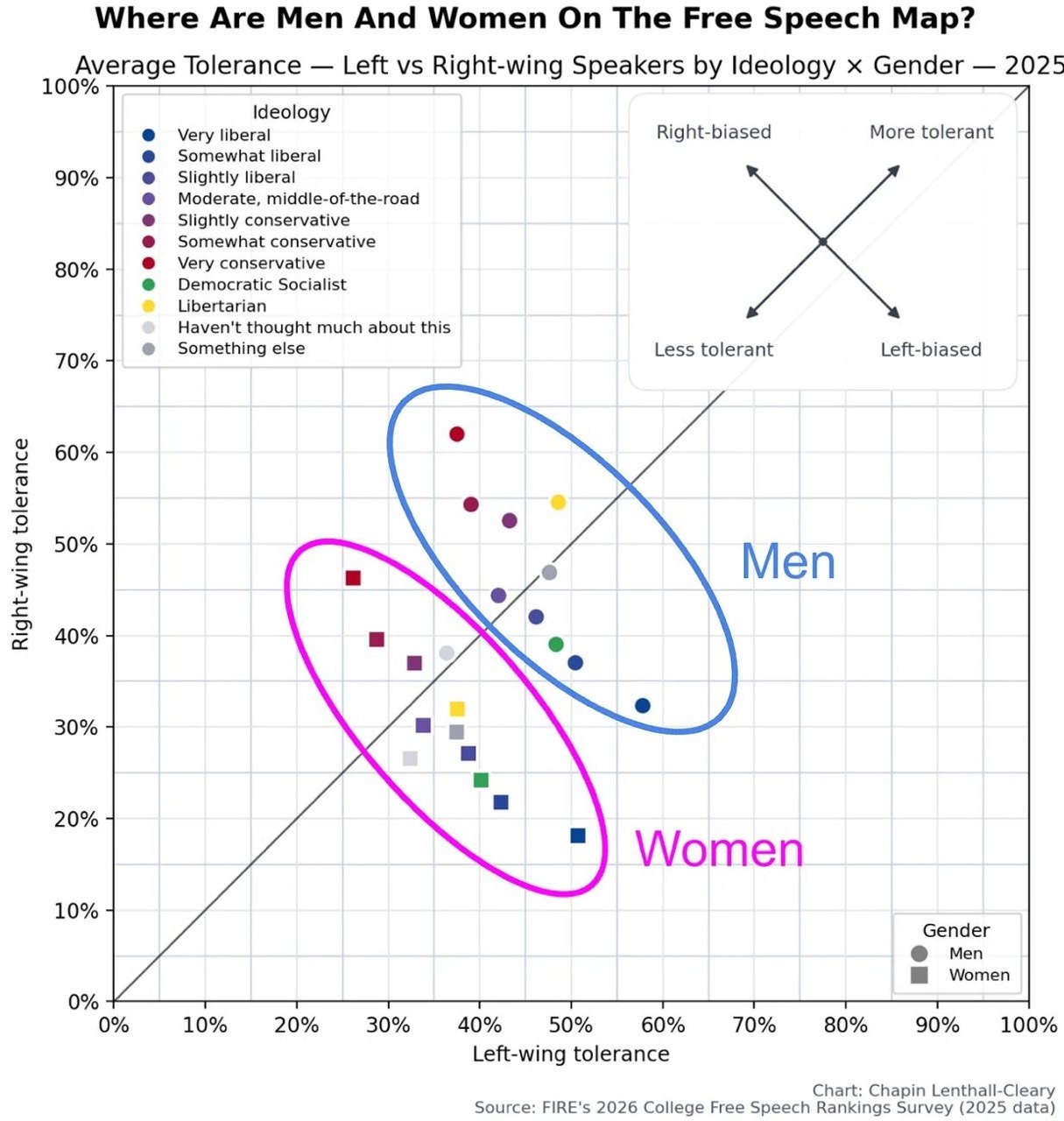
At least some of the differences in the statistical distribution of cognitive traits between men and women comes from this genetic bottleneck’s intense selection pressure differences. This is particularly clear in social patterns. For instance, men readily form hierarchies — often using physical cues such as height to do so.
Men focus on roles, suppressing or otherwise managing their emotions to do so. They regularly test each other — hence ragging each other, making appalling jokes, etc. Such mechanisms generate trust, as they test whether you will fold under pressure, whether one can say outrageous things and still get support. Hence the popular quip:
Men insult each other but they don’t mean it. Women compliment each other but they also don’t mean it.
Men roast each other as tests because so much male interaction is about teamwork, and the roles and reliability that requires, while women typically look to emotional connection. Given that the latter requires a lot of interaction to build up trust, yes, female friendships can be quite intense, but relations between human females can also be viciously unstable and fissile.
These differences have other social consequences. Men are notably more positive about free speech than women, because men often see speech as a test while women are more likely to see it as a threat. As universities have feminised, the male-female differences on free speech among students have become more pronounced. Men are systematically more tolerant of alternative points of view than are women.
Orwell’s famous comment in his novel 1984:
It was always the women, and above all the young ones, who were the most bigoted adherents of the Party, the swallowers of slogans, the amateur spies and nosers-out of unorthodoxy.
Was a great novelist doing what great novelists do: noticing.
As part of the teamwork focus, men tend to be the social solidarity sex while women are not. Women are much less likely to have friends of lower socio-economic status than are men. For women, such friends are much less likely to be worth the emotional investment. For men, they may be useful members of a future team.
As institutions, occupations and public discourse become more feminised, there has been a shift in patterns of language. A massive study of patterns of language use found a dramatic shift since the 1980s, such that:
our results suggest that over the past decades, there has been a marked shift in public interest from the collective to the individual, and from rationality toward emotion.
All this means that male-dominated institutions and spaces will be generally better, often much better, at generating and managing feedback than female-dominated spaces. When people note that feminising institutions and occupations have a strong tendency to become less functional, it is precisely because they are worse at generating and managing feedback, and at generating and maintaining trust.
- This paper attempts to explain the extreme narrowing of surviving male lineages by the adoption of patrilineal systems and polygyny. While the shift to patrilineal systems in itself does increase unequal lineage success—as does polygyny—much of the point of the shift to patrilineality was precisely that warriors who grow up together are better warrior teams.
Moreover, there is considerable evidence of violence after the shrinkage of male lineages dramatically slowed — and then reversed — with the development of chiefdoms, and especially states. These suppressed violence, but not patrilineality or polygyny. In many societies, polygyny actually intensified with the rise of states.
The bottleneck effects continued to echo down populations. The extraordinary reproductive success of particular male lineages is associated either with pastoralist violence and conquest and/or early state creation. Further, the notion that the majority of male lineages just passively accepted their reproductive exclusion flies in the face of a huge amount of evidence — especially as the examples of very successful pastoral lineages occurred in societies with notoriously high levels of violence, including as raiders, such as across the Steppes and in Ireland.
Moreover, polygyny is associated with higher rates of violence, single-spouse marriage with higher social cohesion. Nor was the creation and maintenance of states typically a peaceful process: periodic violent peaks in Chinese history, for example, were extraordinary. It was precisely the creation of a reproductively-excluded underclass that provided so much of the impetus for the banditry and mass peasant revolts that are such a feature of Chinese history. So, while patrilineality and polygyny were definitely factors in the wildly differentiated success rates of male lineages, considerable levels of violence and contestation over resources and women — that selected in favour of male teamwork — were clearly also very much in play.

Public housing perpetuates the poverty it was supposed to cure
In The Critic, John Wills explains that public housing organizations, like any organization with perverse incentives, will never solve the problem of providing enough housing for those who cannot afford it:

Homes Fit for Heroes – Dagenham
“These are typical examples of the housing on the Becontree Estate. Initially 25000 homes were built by the London County Council between 1921 and 1934. These homes fit for the heroes of WW1 had all mod cons gas, water and electricity with inside toilets and bathrooms. A further 2000 homes were built before WW2. The Becontree estate was the biggest council estate in the world.”
Image and description from geograph.uk. Photo by Glyn Baker – CC BY SA 2.0
There is a moment, familiar to anyone who has spent serious time inside a housing association, when the institutional logic becomes impossible to ignore.
Perhaps you are sitting in a meeting, reviewing the organisation’s performance: voids are down, rent arrears are within tolerance, development pipeline is healthy and the regulator is satisfied. By every measure the sector uses to evaluate itself, things are going well.
Outside the window, however, the waiting list has not reduced. The families in temporary accommodation are the same families (or families very much like them), who were there five years ago. In short, the problem the organisation was created to solve is precisely as large as it was when the meeting began.
Despite these demonstrable facts, nobody in the meeting thinks this is strange. Nobody considers the organisation a failure. The metrics are, after all, fine.
I spent a decade working at a senior level in housing associations. I left as I became disillusioned with a model that has evolved to measure everything except the thing that matters.
The founding logic was sound enough: postwar Britain faced a housing crisis that was specific, urgent and — crucially — finite. Tens of thousands of homes had been destroyed or damaged, men had died in enormous numbers, and a baby boom was placing acute pressure on stock that was already inadequate before the war started. Social Housing was therefore a rational response to a bounded problem: build homes, house people and alleviate a crisis that would, in time and as a result of the initial centralised effort, resolve itself. You might also apply the same logic to slum clearance a decade later: deplorable housing stock needed replacing, and the state needed a mechanism to do it. The model remained defensible so long as everyone understood that success meant crossing a defined finish line.
However, nobody thought to define that finish line. The problem here is that once you remove the time horizon from an organisation tasked with solving a problem, the organisation’s survival becomes contingent on the problem’s persistence, not its resolution. This is not a conspiracy and it requires no bad actors, nor even a conscious decision to perpetuate matters. It is simply what institutions do when the incentives are wrong. As a thought-experiment, imagine that the eradication of smallpox had been incentivised not by the goal of total global elimination, but instead by vaccines administered, clinics built or healthcare workers employed. What would the probability be of us continuing to battle smallpox into the 21st Century? I cannot be certain, but suspect it would be considerably higher than nil.
The regulatory framework for social housing has compounded the error rather than correcting it. Regulators, quite reasonably, dislike hoarded capital. A registered social landlord (RSL) sitting on large reserves and doing nothing with them is, from a regulator’s perspective, a problem to be solved. The solution the sector has converged on is growth — more stock acquired, more homes built, larger balance sheets, bigger organisations and more services and people employed to deliver them. The key metric of a healthy RSL is therefore its size: which is to say, the scale of the problem it exists to address. (To test this proposition, ask someone in housing to describe their organisation. The chances are the first words out of their mouth will be the number of homes they manage). An organisation genuinely succeeding in its mission — one that is housing fewer people because fewer people in its area of operations need housing — under the current framework would look like a failure. It would be encouraged to merge with a larger, more “successful” neighbour, which is to say one that has accumulated more evidence of unresolved housing need.
Chief Narcissist of the Supreme Court of Canada
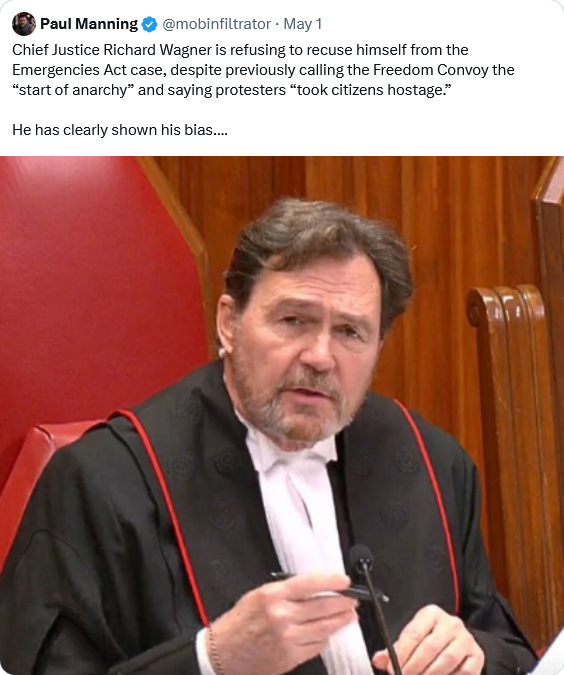
On the social media site formerly known as Twitter, David Knight Legg explains why the Chief Justice should recuse himself from deliberation on an upcoming Supreme Court case involving the Freedom Convoy 2022:
Canada’s Chief Justice Richard Wagner has installed a lifelike bronze bust of himself in our highest court.
It should be called “Narcissus Canadiannus”
– There is no precedent for something this vulgar in the history of the Court. It should be taken down. Richard fancies himself.
– Richard also fancies his own opinion on things. He violated legal due process and the Court’s reputation by publicly accusing the Convoy — who protested backwards federal Covid policies that were soon dropped — of “anarchy” and “hostage taking”.
Now that the Convoy’s freedom of speech, assembly and due process rights have been asserted by lower courts the Supreme Court has to consider the appeal of the federal govt and weigh the rights of citizens against the decision of the federal government to impose the Emergencies Act to suspend those rights.
Wagner’s lack of judicial discretion in the first instance makes his recusal from such an important rights-defining case important because it signals not just fairness in the content of the decision but in the way the decision gets reached by the highest Court.
He has already shown his bias. Any decision against the convoy poisons the integrity of the Court if he remains present.
But Richard — the man with the bust of himself in our Court — doesn’t imagine himself under the law he imposes on others. He hasn’t completed any graduate work in law or published any academic work in law, philosophy or jurisprudence so it’s hard to know how he justifies himself in these matters.
Ironically, he has a reputation for warning others — including those far more qualified in formal jurisprudence than he is — not to critique Canadian judges like himself or their (increasingly bizarre and politicized) decisions.
But, from the Magna Carta onwards, Richard should know that in law as in politics dissent is democracy.
The dissent of the Convoy and the growing critique of Richards own bizarre behaviour and inability to articulate a judicial philosophy is exactly what’s needed to save Canada — and the Court’s reputation as a place where justice — not the ego of the Justices — is at stake.
Richard should recuse himself. And remove that vulgar bust from the Supreme Court.
#SCC #RuleOfLaw

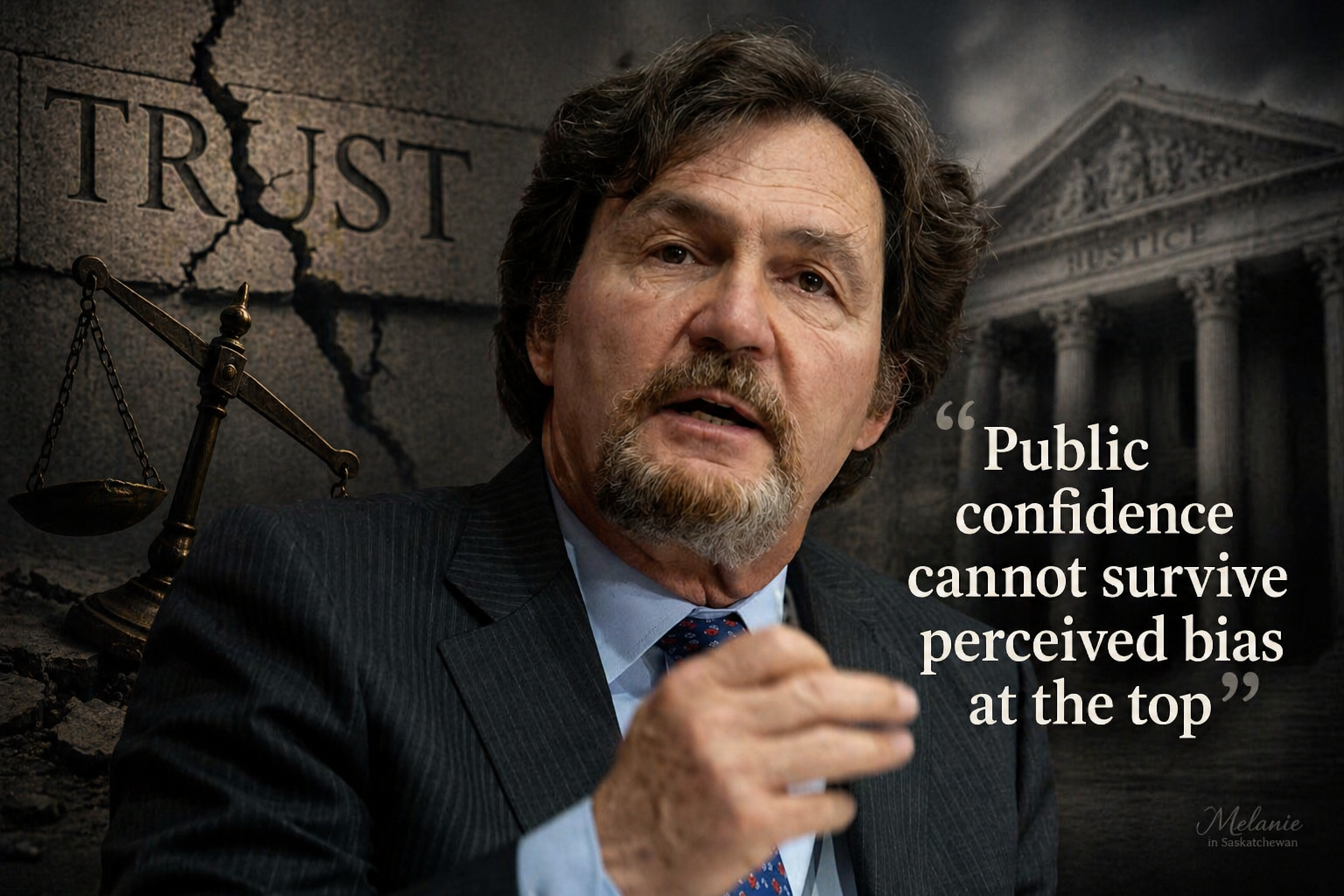
Melanie in Saskatchewan also has concerns, expressed as an open letter to the Chief Justice:
To Chief Justice Richard Wagner,
Your refusal to recuse yourself from the Emergencies Act appeal, as reported in the National Post, is not a demonstration of judicial confidence. It is a failure of judgment at a moment that demanded restraint.
Image from Melanie in Saskatchewan
You have justified your decision on the basis that your prior public comments did not address the specific legal questions before the Court. That argument may satisfy a narrow, technical reading of judicial conduct. It does not satisfy the standard Canadians are entitled to expect from the Chief Justice of the Supreme Court.
The governing principle is not whether you commented on the precise statutory interpretation of the Emergencies Act. It is whether a reasonable and informed person would conclude that your previously expressed views could influence your assessment of the case.
You publicly characterized the convoy as the “budding start of anarchy”, described residents as being “taken hostage”, and spoke in terms that conveyed clear condemnation of the events and participants. Those were not neutral observations. They were judgments about the nature, legitimacy, and perceived threat posed by the very situation now under review.
This appeal is not a retrial. It does not exist to rehear evidence or relitigate the convoy as though the past can be reset. Appellate review in Canada is focused on whether the law was correctly interpreted and properly applied to established facts, with significant deference given to the findings already made by the lower courts.
That distinction matters.
[…]
As Chief Justice, you are not merely a participant in this case. You are the steward of the reputation of the Supreme Court of Canada itself. That reputation rests not on assertions of impartiality, but on decisions that demonstrate it beyond reasonable doubt. In choosing not to recuse yourself under these circumstances, you have not strengthened that reputation. You have placed it at risk, at a time when public confidence in national institutions is already fragile. The damage may not be immediate, but it is real, and it is yours to own.
Gentleman’s Relish (Patum Peperium) – Weird Stuff In A (Sort Of A) Can #142
Atomic Shrimp
Published 16 Aug 2020Here’s something I have been meaning to feature on the channel for a little while — it’s a savoury anchovy paste that has been in continuous production in England since 1828 — the Georgian Era.
For more information about this product, start here: https://en.wikipedia.org/wiki/Gentlem…
The music for the spoon segment is called “Forever Yours” by Wayne Jones – from the YouTube Audio Library
QotD: Saint Hillary
Kelly was the most relentlessly savage chronicler of the Clinton administration, and of the Clintons personally, but his opening shot was so subtle you had to squint to see what he was doing. In a long feature story that appeared in the New York Times Magazine in May of 1993 under the that’s-not-a-compliment title, “Saint Hillary”, Kelly very quietly mocked Hillary as a preening know-it-all who didn’t know much of anything. He wrote that she represented “the message of the preacher”, with a way of speaking that delivered a stream of moral lectures, as if she had the authority and the wisdom to direct others in the act of moral reconstruction. If you click on the link and read the whole story, you’ll want to watch for the transitional paragraph, the switch from mostly description to mostly derision. It begins with the words, “It is at this point that some awkward questions arise”. Next paragraph: “If it is necessary to remake society, why should Hillary Rodham Clinton get the job?”
It becomes less kind from there. Kelly described a meeting between Hillary Clinton and the progressive Jewish editor and activist Michael Lerner, who (Kelly says) offered a vision of “unintentionally hilarious Big Brotherism”. And then: “The reason Lerner’s proposals for the application of the politics of meaning focus so heavily on bureaucratic irrelevancies is the same reason Mrs. Clinton is struggling still with words”. Self-delusion, unawareness of political realities, hard-headed self-importance, unaware bumbling in an unearned sense of certainty. A moralizer, but not moral, unwise but committed to the appearance of wisdom.
Remember, this story appeared in 1993, in the opening months of the Clinton presidency. Michael Kelly was opening a political era with a dismissal, rolling his eyes at the Clinton project as it began. “Saint Hillary”, they called it. The New York Times used to publish things like this.
Chris Bray, “Saint Hillary the Bluntly Obtuse”, Tell Me How This Ends, 2026-01-30.
Update, 5 May: Welcome, Instapundit readers! Have a look around at some of my other posts you may find of interest. I send out a daily summary of posts here through my Substack – https://substack.com/@nicholasrusson that you can subscribe to if you’d like to be informed of new posts in the future.
May 3, 2026
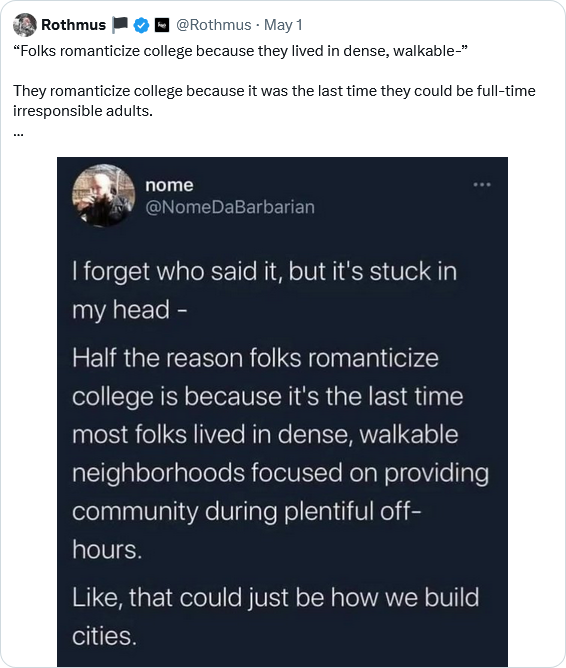
Reasons people romanticize their college experience
On the social media site formerly known as Twitter, Devon Eriksen responds to comments about people wanting the world to be like they remember their time at college:
People romanticize college because for four years of their lives they:
1. Had all the rights of adults but none of the responsibilities.
2. Lived in a closed community with sealed borders that kept out low IQs and anti-socials.
3. Were young, energetic, healthy, and attractive.
4. Were thrown together with a bunch of similar people who had no predefined power- or need-based relationship with them, which is how friendships form.
This last is the important one, especially as fertility rates decline.
People with children transition to making friends with other parents of children in the same age group, because events and networks centered around those children throw them together with other parents in the same way.
But childless people have few or no opportunities to make friends after college. So they are left with a slow dwindling circle of college based relationships, remembering the days when it was all easy, and they weren’t so isolated, and they didn’t have to work so hard.
Couple that with having to complete with infinity immigrants in the job market, so they can pay taxes to support infinity boomers and government bureaucrats, while being passed over for the best jobs and careers in favor of infinity DEI incompetents, who they also have to support …
Well, for a lot of people born into what was once the American middle class, college was their first and last experience of an adult life wherein they weren’t being systematically and deliberately routed into the formation of a new underclass.
A special form of underclass who are still expected to be productive enough to materially support all the non-producing people who were positioned as their social superiors despite being their intellectual inferiors.
So, yeah, they wish they could go back to college.
Is anyone surprised by this?
How to Declare a Live Person Legally Dead – Death of Democracy 14 – Q2 1936
World War Two and Spartacus Olsson
Published 2 May 2026In Q2 1936, Adolf Hitler consolidated power after the Rhineland gamble, tightening the machinery of dictatorship while projecting strength abroad. As Hermann Göring took control of Germany’s economic lifelines and Heinrich Himmler centralized the police, the regime accelerated its transformation into a fully integrated police state.
Behind Olympic pageantry and propaganda triumphs like Max Schmeling’s victory, the Nazi system deepened repression. Courts enforced the Nuremberg Laws with chilling logic, reducing Jewish citizens to a state of “civil death”, while Joseph Goebbels expanded total control over media and public discourse.
At the same time, Germany’s economy bent further toward war, with dwindling foreign reserves and rising dependence on autarky. Yet domestically, resistance remained minimal as propaganda, fear, and perceived stability drove growing public support.
Globally, the quarter exposed the weakness of the League of Nations during Italy’s conquest of Abyssinia, saw Léon Blum’s rise in France, and witnessed the outbreak of the Arab Revolt in Palestine — signs of a world drifting toward instability.
This episode examines how dictatorship consolidates not just through terror, but through law, economics, and consent — and why, by mid-1936, meaningful resistance inside Germany had largely vanished.
Useful intellectual idiot case study: Malcolm Caldwell
Occasionally, Substack suggests a writer or a particular post that its algorithm deems likely to be of interest to me. This post from a few weeks ago by Mark Manson definitely fit the bill. He ranges over a variety of cases starring intellectuals suddenly discovering reality, starting with a particular British useful idiot’s collision with reality:
On December 19th, 1978, Malcolm Caldwell, a professor at the University of London boarded a plane to Cambodia for a historic trip. It was an opportunity so rare, so special, that Caldwell genuinely believed it could potentially change the world.
Three days later, Caldwell would die in one of the dumbest ways imaginable.
Malcolm Caldwell was the consummate intellectual. He had spent his entire life studying Southeast Asian history and economic development. He had written hundreds of articles and over a dozen books on the subject. He was a professor and researcher at one of the most prestigious universities in the world and was celebrated and supported for his views.
Much of his work dealt with English colonialism in Asia and its dire political consequences. As a result, Caldwell evolved into a staunch Marxist, far to the left of the leftiest leftist who ever lefted.
Just to give you an idea how far left we’re talking, Caldwell visited North Korea in the 1960s and came away saying good things about it. When the Vietnam War started, Caldwell tried to host a fundraiser in London … for the Vietcong.
So when communist revolutionaries took control of Cambodia, Caldwell showed enthusiastic support. The new communist leader of Cambodia was a man by the name of Pol Pot and he had radical new ideas of how to achieve a communist utopia — ideas that had existed in Marxist thought but had yet to actually be attempted in any communist country. Caldwell had been waiting for decades for a communist revolutionary who fully implemented his Marxist dreams. Caldwell came to believe Pol Pot was his man.
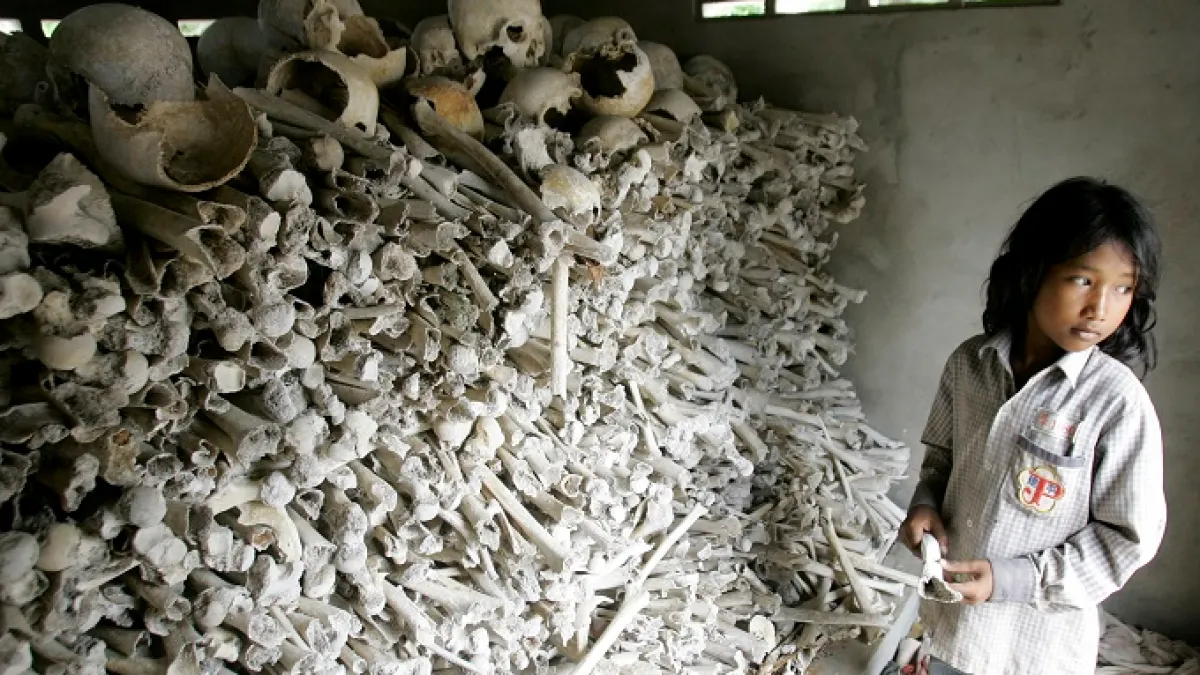
Bones recovered from the Killing Fields in Cambodia. Pol Pot’s regime killed nearly 2 million people in less than five years.
Image from Mark Manson.But the truth was that Pol Pot was as insane as he was cruel. And it was pretty obvious to anyone paying attention. Upon taking power, Pol Pot nationalized the all land, kicked out or killed all foreigners, and began a sweeping genocide against the educated class. In the four years Pol Pot was in power, it’s estimated that he was responsible for the death of more than 20% of the country’s population.
But when news of the genocide and atrocities began to leak out of Cambodia, Caldwell refused to believe it. He defended Pol Pot’s regime and wrote off the atrocities as simply more western capitalist propaganda. His unwavering support eventually earned him an exclusive invitation to visit Cambodia by Pol Pot’s government. Caldwell accepted. And in December of 1978, he boarded that fateful flight to Asia.
Once there, Caldwell toured the country. He met the leadership and learned about their policies firsthand. But the climax of his trip was the last evening — a private audience with Pol Pot himself. Reportedly, Caldwell was “euphoric” with excitement and anticipation. Once in private, Caldwell and Pol Pot had a long intellectual conversation. In his enthusiasm, Caldwell began sharing some of his ideas for the Cambodian regime. He began to offer feedback and dare I say, potentially even a little criticism. Pol Pot, not used to being lectured to by a professor, promptly had Caldwell killed that night.
Malcolm Caldwell is what I like to refer to as an intelligent idiot. A man with an encyclopedic breadth of knowledge and understanding, a world-class mind with powerful thoughts, and yet absolutely no idea how to apply any of it.
The Extremely Rare Folding Stock Beretta 38/43
Forgotten Weapons
Published 12 Dec 2025The Beretta Model 38 SMG was a very successful design, and a folding-stocked version of it was a natural development. Beretta first made a prototype of such a thing in 1941, but it never went into production — possibly because Italy ceased to have an effective paratrooper corps after El Alamein. However, many of the design elements from this experiment saw use in the simplified 38/42 and 38/44 models of the Beretta SMG. Late in the war, a small batch of folding-stocked guns were actually produced (one source says about 200) specifically for the RSI. This was the puppet government Germany operated in northern Italy after the country surrendered to Allied forces.
This particular example came out of the Balkans, and managed to acquire a Yugoslav national crest along the way — although I don’t know the details of how. Thanks to Limex for giving me access to this extremely rare piece to film for you guys!
(more…)
QotD: Communism, nationalism and literature
According to Orwell, “As early as 1934 or 1935 it was considered eccentric in literary circles not to be more or less ‘left’, and in another year or two there had grown up a left-wing orthodoxy that made a certain set of opinions absolutely de rigueur on certain subjects”. In other words, many writers became communists, which meant they constantly had to decide whether to toe the line or shut up, depending on the circumstances: “Every time Stalin swaps partners”, Orwell wrote, “‘Marxism’ has to be hammered into a new shape … Every Communist is in fact liable at any moment to have to alter his most fundamental convictions, or leave the party. The unquestionable dogma of Monday may become the damnable heresy of Tuesday, and so on.”
Orwell also explained how communism replaced the patriotic and religious feelings that members of the English intelligentsia believed they had transcended: “All the loyalties and superstitions that the intellect had seemingly banished could come rushing back under the thinnest of disguises. Patriotism, religion, empire, military glory — all in one word, Russia. Father, king, leader, hero, savior — all in one word, Stalin”. Is it any wonder that Orwell, witnessing these endless intellectual and moral contortions, the shameless propaganda, and the constant stream of wartime lies and distortions, was drawn to a writer who didn’t regurgitate any orthodoxies or toe any lines? Miller gave his readers “no sermons, merely the subjective truth”.
Matt Johnson, “George Orwell, Henry Miller, and the ‘Dirty-Handkerchief Side of Life'”, Quillette, 2020-10-05.
May 2, 2026
“… a New York Times bestseller!”
I thought this was well-known years ago, but it still apparently surprises people to learn that the famous New York Times bestseller list is … not actually in any way a valid measurement of book popularity and sales:
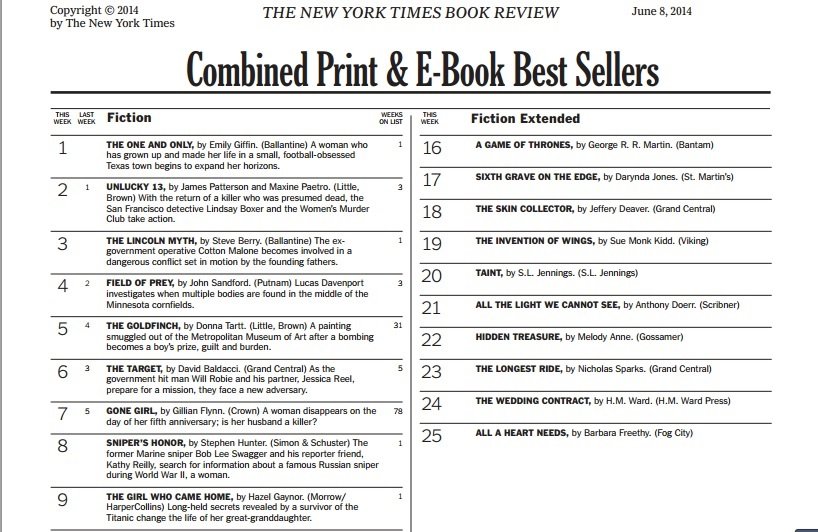
For those of you not familiar with the total scam that is the NYT bestseller list, as a NYT bestseller myself, it’s utter bullshit. It’s not an actual list of bestsellers. It’s “curated editorial”.
As in, stuff they like gets on there, and stuff they don’t like doesn’t. Or stuff they like places higher, and stuff they don’t like but obviously sells too much to deny its a bestseller gets on there lower.
I still tell people I’m a NYT bestseller because most regular normies think that actually means something impressive, and it’s just quicker to say that to establish that you’re a certain level. Within the actual publishing industry its fairly meaningless and everybody knows it.
In reality I made it on there a couple of times early on in my career before they realized who I am and what I’m into (the totally wrong politics, loudly!), because then it was like a post it note got stuck on the wall there saying FUCK THIS GUY, because after that no matter how many copies I sold, even if I was mud stomping half their list in actual sales, I wasn’t getting on there ever again.
Everybody is aware of this scam. The key to getting on the list is the NYT wanting to promote you. They don’t actually track all book sales. They track certain “reporting stores” (which are supposed to be secret but we all know how they are). But then the NYT takes whatever reality is and massages it to fit their narrative.
It isn’t just to keep wrong thinking pariahs like me off there either. I’ve got friends who are apolitical or even mildly liberal who still make the list, but who get bumped down a bunch of spaces from what they should be because there’s somebody else with a new book out the NYT wants to fluff.
Even when the NYT isn’t putting its finger on the scale, it also only measures velocity, as in how many books sold that week. So if you sell 20k copies that week, but never sell another book again, you’re a bestseller. But a guy who sells 1k copies a week every week for an entire year, is not.
Also, I don’t know if it is still this way, because I quit paying attention to what makes the NYT list years ago after I understood what a joke it was, but it was only for physical books, not ebooks, not audio. And there are authors who crush it in ebook who sell very few physical copies in stores. I don’t know if this is still the case on what they claim to track or not today.
So basically it is a biased list of what one small part of the industry sells in a short period of time that the NYT then tweaks to ignore reality if they feel like it anyway. And this isn’t just my opinion as a disgruntled former NYT bestseller, this has gone to court. Authors have sued the NYT which is where the “editorial” thing comes from.
This gets some attention periodically when somebody really famous raises a stink about it. A couple years ago it was Elon. Before that it was Mike Rowe. Etc. But then regular people all forget and go back to thinking the NYT‘s bestseller list isn’t as full of shit as everything else the NYT does.
Cancelled chancellor?
The German Chancellor’s future looks unhappy, and eugyppius notes that even the lapdog mainstream media outlets who praised him last year are now publishing calls for his ouster:
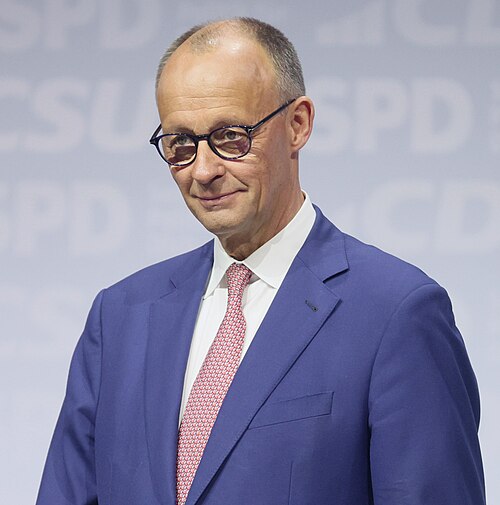
German Chancellor Friedrich Merz, 5 May 2025.
Photo by Sandro Halank for Wikimedia Commons.
Merz has always been just some loser. He’s a third-rate talentless politician and in this much like his predecessor, Olaf Scholz. Both are mere caricatures, what happens when you mimeograph overmuch the last century’s tired political styles. These kinds of chancellors will continue to exist only so long as they can be sold to the geezers of the Federal Republic’s care homes by the amateurish marketing campaigns of a complicit state media as the incarnation of far-sighted competence and (more importantly) bourgeois respectability.
Early in 2025, Merz had the chance to seize a measure of power for himself and make facts. He could have forged a deal with Alternative für Deutschland on the most important questions, established a minority government and set about force-marching the obese German state through necessary reforms. It might’ve torn his party apart, he might’ve failed, there would’ve been a huge fight, but whatever happened nobody would ever forget Chancellor Merz. Instead, the Pigeon Chancellor let a lot of deranged Antifa street protesters and screeching women with parareligious concerns about atmospheric carbon dioxide concentrations dissuade him from the only reasonable path. Instead of making history, he chose to spend the first year of his chancellorship making the Social Democrats fat and happy at the expense of the nation. Most don’t even hate Merz, because hate like love has to be be earned. He inspires nothing more than mildly scornful indifference.
Everyone who was not a complete idiot knew that Merz’s mad coalition with the Social Democrats could never work. Yet the man has been lionised in the international press and even in centre-right domestic papers like the Frankfurter Allgemeine Zeitung as a serious reformer. These people told us Merz would rebuild the Bundeswehr, reduce insane social spending, impose fiscal discipline, solve the migroid problem and restore economic growth. Even if the leftoid half of the German establishment press didn’t embrace all these myths, they nevertheless worked hard to make Merz seem presentable, serious and viable. He was worth a shot, he would do his best, and after the crazy Scholz years Germany was back on solid footing.
Now, in the the space of about two weeks, the entire myth of Chancellor Merz has collapsed. Major papers that used to defend his government and praise his prospects are suddenly saying it’s over. They’re writing front-page editorials in the spirit of stuff I was posting here over a year ago. Merz appears at town-hall meetings where he gets asked how he’s made life better in Germany and before he can answer the audience just laughs at his stupid ass. His coalition partners say he’s doing a terrible job. Back-benchers from his own party are calling his political strategy a failure to his face and leaking it afterwards to the press so everyone knows what they said.
Still worse, people from the Chancellery are talking to the tabloids. They’re explaining that Merz’s government has been hanging by a thread since at least last December; that his party thinks he’s a pushover whom the SPD constantly manipulates; that often Merz just absorbs the opinions of whatever person he last talked to and so his handlers have to limit his contacts to keep him from going off-message in insane ways; that Merz is now almost totally isolated, having burned through most of his close confidants; and that nobody has any solutions or ideas and increasingly everybody doubts that the Chancellor has the talents to save himself.
Progressives instinctively side with the “oppressed” side of any argument
On the social media site formerly known as Twitter, Devon Eriksen responds to a posted talking point:
Someone once observed that in any conflict, leftists will always side with whichever demographic causes the most social harm.
This creates a hierarchy, with White men (the primary civilization-builders) at the bottom, and third-world Muslims at the top.
Here’s why how this works.
In a healthy society, people who build civilization are revered, and people who cause social harm are despised. And there is a hierarchy that runs in the opposite order, with respect and resources going to those who serve civilization.
This creates a natural opportunity for power-hungry subversives. They can recruit each layer of this hierarchy by exploiting their resentment against those above them. All they must do is frame their merit-based status as unearned “privilege”.
White women were recruited to leftism by stoking their resentment of White men, and promising elevation above them.
What the White women were not told is that they would be placed beneath everyone else.
Often literally.
Black people were recruited by exploiting their resentment of Whites … but they weren’t told that every benefit they received would eventually be taken away and given to third world immigrants.
Homosexuals were promised elevation above the “breeders” (because children are needed for civilization, and sodomy is not), but no one told them that the trannies would rule over them.
And no one told the trannies that Muslim community would be allowed to segregate and oppress them far more brutally than the most ardent of White bigots.
The most brutal irony of all is that all of these groups who are recruited to fight for leftism end up far more brutally oppressed that they ever were by mainstream prosocial White society.
Because natural civilizational hierarchies are based on contribution.
There’s a certain amount of prejudice which exists because people can reason inductively, but if you are a mixed race lesbian engineer who can actually who build useful shit, then it’s at least possible for people to eventually overcome their surprise, and break you off a nice house in the suburbs and some forbearance wherein people don’t really talk about the real relationship between you and your “roommate”.
Under leftism inverted hierarchies, you have no such chance.
Sure, during the transitional phase you’ll be elevated for being a mixed-race lesbian, regardless of whether you can do anything useful or not. But then, the Muslims will be allowed to throw you off a roof when it’s time to pander to them, in turn.
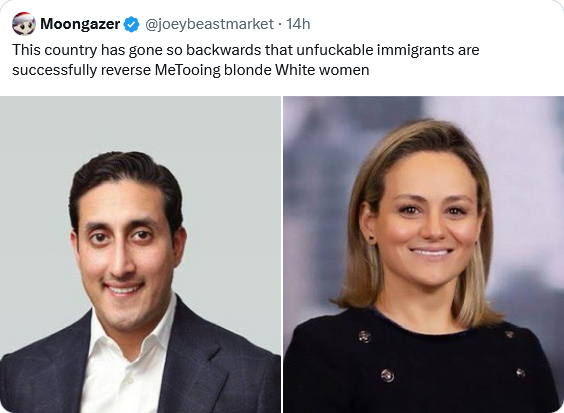
This White (or White-passing) woman probably voted straight democrat and cheered for “MeeeeeeeeeeeeeeeeeeeeeeToo”, to avenge her resentment against White men in general. She probably never dreamed that she would, in turn, not only be thrown under the bus, but that she would be targeted by the precise same weapons her sisters were given to unseat White men with.
And @jk_rowling found out in vivid, larger-than-life detail what happens to White feminists when the left has a new darling to cater to, who can be used to unravel some still-intact piece of civilization.
You see, by the early 21st century, the left had no more use for White feminists, because everything the left wanted to use them to destroy was already destroyed. Women were already spending their twenties and thirties on cubicle jobs and abortions, instead of marriages and children. The workforce was already doubled, and the price of labor had already crashed. Fertility rates were already dropping, and people were already marrying late, or never.
It was time to recruit a new wrecking ball, to turn against some other corner of the edifice of order, and the price of that was easy to pay … just confiscate everything you once gave them, and give it to the trannies instead.
The actual bodies of the White feminists (as well as all other women, and their daughters), could be used again, sold out to third world men who want to rape them, all by simply turning a blind eye.
And the best perk of all of this is that they’ll still vote for you.
Because reversing course requires admitting a mistake.