
World War Two
Published 18 Dec 2021Just a few weeks ago massive offensives were launched in North Africa and the Soviet Union, against the Axis. These operations and offensives have now morphed into fully fledged campaigns, and the nature of these theatres of the war has been transformed.
(more…)
December 19, 2021
Guadalcanal Life Expectancy: 30 Days- WW2 – 173 – December 18, 1942
Comments Off on Guadalcanal Life Expectancy: 30 Days- WW2 – 173 – December 18, 1942
“Instant replay” in the NFL
Severian talks about the surprising statistical results when the NFL introduced “instant replay”:

I was a big NFL fan when they first started debating the now-standard “instant replay challenge” rules. Like most people, I was all for it — geez, these refs are terrible, video’s the way to go. My only worry was that if every call those numbnuts obviously screwed up got reviewed, games would last 12 hours …
But a funny thing happened: As with most people, my respect for the refs went way, way up once they put in the video challenge rules. Yeah, they screw up one or two calls per game, the challenges prove that … but that’s one or two out of hundreds, which is a phenomenal success rate. Not only that, even the very toughest calls — the ones that draw the red flags — they get right, or at least not-wrong (football is nothing if not Hegelian), about half the time. Put it through all the techno-whizbangery you want — slow it down to molasses-in-winter speed, run it through one of those Blade Runner image enhancers — and it’s still pretty much a coin toss, at least half the time. And the refs are making those calls at full speed, from dramatically different angles.
In other words, I learned a lesson in applied statistics. Before instant replay, if you’d asked me to guess, as objectively as possible, how many calls per game the refs blew, I’d have said something like “four or five, tops”. (I suppose we must pause here to note, for the benefit of anyone who still follows the NFL for some reason, that I’m not talking about bullshit like the “tuck rule” or whatever the fuck a “catch” is supposed to be these days, which even the refs don’t seem to understand; I’m talking stuff like “Did he fumble?” or “They missed the ball spot by a yard or two”). I certainly wouldn’t go any higher than that, and if you told me that an independent auditing firm had reviewed ten seasons’ worth of game tape and came up with a hard number of 2.6 calls per game, I’d roll with it, no problem.
If you then told me that this represents a “failure rate” of well under 1%, well, I’m not sure I want to go through all the math to check you, but I’d believe it, because I know something about how the game is played. I don’t want to get too far off track here, but for the benefit of casual fans and especially non-American readers, there are 11 men on a football team, and all of them have the opportunity to do all kinds of illegal stuff on every single play. Call it 65 plays per game (the first rough number I could find with a five second internet search), and that’s … well, my math doesn’t go that high, but let’s just say it’s a lot of opportunities for fouls. And that’s not counting all the other stuff refs have to do — that they have the opportunity to get wrong — on nearly every play: Marking the ball spot, determining where a guy went out of bounds, and so on.
The important thing to note is how far my emotional perceptions of the game diverge from statistical reality. Let’s stipulate that all the math up there results in a “success rate” of 99.993%. I’d buy that … Intellectually I’d buy it, because I know a bit about how math works, and a lot more about how football works, but note my first impression when they started talking about instant replay: “Oh God yes, these guys suck, they blow so many calls that games are going to last 12 hours if they review all the calls those lousy refs obviously miss.”
Emotion beats math, every time.
And note that I’m talking about refs in general here. In general, they blow calls all the time (the emotional me said), but when it comes to my team in particular, well, they’ve obviously got it out for us. They screw up an entire season’s worth of calls every time my team plays, and all those screwups go the opponents’ way!
I’m kidding, but I’m not joking. I got to see this process firsthand, and that’s the second lesson instant replay taught me: “Indisputable video evidence,” as the phrase is, don’t mean squat when you’ve got your heart and soul in it.
Every NFL fan knows that the refs hate their particular team and love their most hated rival, and no amount of indisputable evidence will shake that belief. NFL fans are rather like progressives in that way …
Comments Off on “Instant replay” in the NFL
Canada’s almost functional flying saucer; the story of the Avro Canada VZ-9 Avrocar
Polyus Studios
Published 14 Jul 2018Support me on Patreon – https://www.patreon.com/polyusstudios
The Avro Canada VZ-9AV Avrocar: Canada’s first attempt at vertical take off and landing aircraft. Although the concept ultimately turned out to be a dead-end, the engineers and designers at Avro experimented with bold new ideas. Their concepts would push the limits of the imagination and reflected the extreme technological optimism of its time.
Music:
Denmark – Portland Cello ProjectResearch Sources:
“Declassified: America’s Secret Flying Saucer” – https://www.popularmechanics.com/mili…
Avro Canada VZ-9 Avrocar – https://www.aviationsmilitaires.net/v…
Avrocar: Canada’s Flying Saucer: The Story of Avro Canada’s Secret Projects by Bill Zuk (2001)
How to Build a FLYING SAUCER – https://declassification.blogs.archiv…
LaesieWorks – AVROCAR VZ-9AV – http://www.laesieworks.com/ifo/lib/AV…
The Living Moon – Project Silverbug – The Avrocar – http://www.thelivingmoon.com/49ufo_fi…Footage Sources:
Avrocar I Progress Report 01/02/1958 – 05/1959 – US National Archives (~1959)
Disc Flight Development, Avrocar I Progress Report, 05/02/1959 – 04/12/1960 – US National Archives (~1960)
Avrocar Continuation Test Program and Terrain Test Program, 06/01/1960 – 06/14/1961 – US National Archives (~1959)
Tiltwing Versatility – San Diego Air and Space Museum (~1971)Aircraft mentioned:
Project Y
Project Y-2
Project PV 704
Project 1794
Project Silverbug
Weapon System 606A
VZ-9AV Avrocar
CL-84 Dynavert#Avrocar #CanadianAerospace #Polyus

Comments Off on Canada’s almost functional flying saucer; the story of the Avro Canada VZ-9 Avrocar
QotD: Sun Tzu’s Art of War reworked for the 21st Century by General Mark Milley
… here at The Babylon Bee, we’re legit journalists, so we’ve got the exclusive scoop. Here are some excerpts from the upcoming revision of The Art of War:
“If you think you might attack an enemy, pick up the phone and give ’em a heads up. It’s only fair.”
“You have to be careful not to surprise your enemy. They really don’t like it.”
“Treason is not treason if it is the lesser of two treasons.”
“Know thy pronouns, and know thy enemy’s pronouns.”
“The supreme art of war is to surrender to your enemy without fighting.”
“All war is white rage.”
“If you surrender, you can never lose.”
“If thy commanding officer sends mean tweets, thou need not follow orders or the chain of command.”
“The enemy of my friend is my friend.”
“Keep your friends close and your enemies on speed dial.”
“You can not betray the one to which you were never loyal.”
“Ask not what your country can do for you, but what you can do for China.”
“When retreating, leave most of thy armaments behind so you know what you’ll be up against next time.”
“Chinese bros before American hoes.”
“He who turns on bad orange man gets big book deal.”
“General Milley Is Releasing A Revised Version Of The Art Of War — And We’ve Got Exclusive Excerpts”, BabylonBee, 2021-09-17.
Comments Off on QotD: Sun Tzu’s Art of War reworked for the 21st Century by General Mark Milley
December 18, 2021
The bully doesn’t actually want you to do this one thing they demand, they want your constant submission to all demands
Charles Eisenstein on the ongoing relationship between the citizens of most western countries and their governments:

The relationship between our governing authorities and the public today bears many similarities to the abuser-victim dynamic. Facing a bully, it is futile to hope that the bully will relent if you don’t resist. Acquiescence invites further humiliation. Similarly, it is wishful thinking to hope that the authorities will simply hand back the powers they have seized over the course of the pandemic. Indeed, if our rights and freedoms exist only by the whim of those authorities, conditional on their decision to grant them, then they are not rights and freedoms at all, but only privileges. By its nature, freedom is not something one can beg for; the posture of begging already grants the power relations of subjugation. The victim can beg the bully to relent, and maybe he will — temporarily — satisfied that the relation of dominance has been affirmed. The victim is still not free of the bully.
That is why I feel impatient when someone speaks of “When the pandemic is over” or “When we are able to travel again” or “When we are able to have festivals again.” None of these things will happen by themselves. Compared to past pandemics, Covid is more a social-political phenomenon than it is an actual deadly disease. Yes, people are dying, but even assuming that everyone in the official numbers died “of” and not “with” Covid, casualties number one-third to one-ninth those of the 1918 flu; per-capita it is one-twelfth to one-thirty-sixth. As a sociopolitical phenomenon, there is no guaranteed end to it. Nature will not end it, at any rate; it will end only through the agreement of human beings that it has ended. This has become abundantly clear with the Omicron Variant. Political leaders, public health officials, and the media are whipping up fear and reinstituting policies that would have been unthinkable a few years ago for a disease that, at the present writing, has killed one person globally. So, we cannot speak of the pandemic ever being over unless we the people declare it to be over.
Of course, I could be wrong here. Perhaps Omicron is, as World Medical Association chairman Frank Ulrich Montgomery has warned, as dangerous as Ebola. Regardless, the question remains: will we allow ourselves to be held forever hostage to the possibility of an epidemic disease? That possibility will never disappear.
Another thing I’ve been hearing a lot of recently is that “Covid tyranny is bound to end soon, because people just aren’t going to stand for it much longer.” It would be more accurate to say, “Covid tyranny will continue until people no longer stand for it.” That brings up the question, “Am I standing for it?” Or am I waiting for other people to end it for me, so that I don’t have to? In other words, am I waiting for the rescuer, so that I needn’t take the risk of standing up to the bully?
If you do put up with it, waiting for others to resist instead, then you affirm a general principle of “waiting for others to do it.” Having affirmed that principle, the forlorn hope that others will resist rings hollow. Why should I believe others will do what I’m unwilling to do? That is why pronouncements about the inevitability of a return to normalcy, though they seem hopeful, carry an aura of delusion and despair.
In fact, there is no obvious limit to what people will put up with, just as there is no limit to what an abusive power will do to them.
H/T to Perry de Havilland for the link.
Comments Off on The bully doesn’t actually want you to do this one thing they demand, they want your constant submission to all demands
History Summarized: Minoan Greece
Overly Sarcastic Productions
Published 17 Dec 2021The classical Greeks weren’t the first kids on the Aegean block. Long before Athens’ golden age, before Homer, and even before the Trojan War, there was a civilization on the island of Krete. The land of King Minos was home to beautiful palaces, a fascinatingly-complex economy, and something approximating Bull-Cthulu. It’s a fun time, let’s jump in.
SOURCES & Further Reading: The Greeks: An Illustrated History by Diane Cline for National Geographic, The Greeks: A Global History by Roderick Beaton, Lectures from The Great Courses Plus — “Being Minoan and Mycenaean” from The Other Side of History: Daily Life in the Ancient World by Robert Garland, and “Minoan Crete” & “Schliemann & Mycenae” from Ancient Greek Civilization by Jeremy McInerney. And I have a university degree in Classical Studies.
Our content is intended for teenage audiences and up.
PATREON: https://www.Patreon.com/OSP
PODCAST: https://overlysarcasticpodcast.transi…
DISCORD: https://discord.gg/osp
MERCH LINKS: http://rdbl.co/osp
OUR WEBSITE: https://www.OverlySarcasticProductions.com
Find us on Twitter https://www.Twitter.com/OSPYouTube
Find us on Reddit https://www.Reddit.com/r/OSP/

Comments Off on History Summarized: Minoan Greece
King James and the search for ready cash
In the latest Age of Invention newsletter, Anton Howes outlines how and why England’s new Stuart king found himself in desperate financial straits very early in his reign:

King James I (of England) and VI (of Scotland)
Portrait by Daniel Myrtens, 1621 from the National Portrait Gallery via Wikimedia Commons.
… after a generous honeymoon period of about a year, he and his government soon discovered that they were leaking cash. Despite eliminating the costly wars in Spain and in Ireland, James still had to pay off the debts that his predecessor Elizabeth I had incurred in fighting them. And he had a more extensive, and expensive, royal family to support. He traded the one-off expenses of war for the ongoing expenses of a profligate court.
This may sound like a good deal. James effectively stopped the English Crown splashing out money on really big but infrequent expenses, while increasing its ongoing expenditure — like refraining from buying a new car every few years, while spending a lot more each month eating out at restaurants.
But the Crown’s sources of revenue were ill-suited to this change. The funding for wars had been voted to Elizabeth by Parliament, usually as and when the need arose. Such expenditures were matters of national interest, and she otherwise just relied on other sources of income — ongoing taxes like customs duties, or simply the rent from her lands. When the one-off “subsidies” granted to her by Parliament had not quite been sufficient to cover the costs of the wars, Elizabeth had made up the difference by keeping her own ongoing expenses as low as possible, and took out loans to fill any gaps. It also helped that in the years before crises, Elizabeth had tried to run a surplus, building up a war-chest of cash to dip into.
So switching to the new pattern of expenditure was not straightforward. To increase the Crown’s ongoing expenses, it would have to find more sources of ongoing income, especially as it was already in deficit and had loans to pay off. It was politically impossible for James to ask Parliament for extra one-off subsidies to help him bridge the gap, as some of Elizabeth’s subsidies from 1601 had yet to even be collected. He did actually test the waters about what would happen if he did ask, just in case, but when the matter was raised by some would-be sycophants, it was met with outrage. As one member of Parliament angrily put it, “we have no sheep that yields two fleeces in the year.”
The country was already feeling over-taxed, there were no looming crises to justify such extra taxation, and even if there were, such one-off measures would be unsustainable. James needed to find revenue streams to match his spending leak — and ideally, to even exceed it. His ministers fretted about getting the Crown back into surplus again, to build up another war-chest. Who knew when the next war or rebellion might arise.
So when James called his first Parliament in 1604, it was not really to ask for one-off subsidies as Elizabeth had so often done. Instead, he and his ministers focused on outlining a series of financial deals.
Comments Off on King James and the search for ready cash
Saturnalia
Historia Civilis
Published 17 Dec 2016Io, Saturnalia!
Patreon | http://historiacivilis.com/patreon
Donate | http://historiacivilis.com/donate
Merch | http://historiacivilis.com/merch
Mailing List | http://historiacivilis.com/mailinglist
Twitter | http://historiacivilis.com/twitter
Website | http://historiacivilis.comMusic is:
“I //\\ I,” by Discount Fireworks

Comments Off on Saturnalia
QotD: The Game of Life
Life, as it is often called, was conceived as a modern take on a board game designed in 1860 … called the Checkered Game of Life …
By 1960, the Checkered Game of Life had disappeared from most American game tables. It had been replaced by such as entrants as Monopoly, which rewarded winners with riches, punished losers with penury and became one of the top-selling board games in the United States during the Depression. Mr. Klamer’s task, as assigned by the Milton Bradley Co., was to create a game to mark the company’s 100th anniversary … With the assistance of colleagues … Mr. Klamer updated [the Checkered Game of Life] for the aspirations of contemporary players. For instance, players of the new version would choose between a “business” route, which afforded an immediate salary, and “college”, which promised a larger but delayed one … To board game enthusiasts, the Game of Life was a beauty: a marvel of topography with raised roads that players traversed in their station-wagon game pieces. According to the volume Timeless Toys: Classic Toys and the Playmakers Who Created Them, by Tim Walsh, Life was “the first three-dimensional game board using plastic.” … Destinations in the 1960 version included “Millionaire Acres” — or the “Poor Farm”.
From “Reuben Klamer, toy inventor who created the Game of Life, dies at 99” (WaPo).
I played that game when it was new in the 1960s, and I guess those 3-dimensional aspects and the built-in spinner were pretty exciting. But what a drag it made life seem! You’re a peg in a car and you gather family members to fill the hole in the car and keep driving till you get to the end. At least the end wasn’t called Death.
And it seems that this is where we Baby Boomers learned we’d better go to college. The game had determined the income difference. But you didn’t even have any fun in college or learn anything deep. You just upped your earning potential, and the point of life/Life was to make the most money. What an awful game!
Ann Althouse, “Life as it is often called, was conceived as a modern take on a board game designed in 1860 … called the Checkered Game of Life“, Althouse, 2021-09-17.
Comments Off on QotD: The Game of Life
December 17, 2021
German States Vote For Unity – Battle of Nuits-St. Georges 1870 I GLORY & DEFEAT Week 23
Real Time History
Published 16 Dec 2021Sign up for Curiosity Stream and get Nebula bundled in and SAVE 26%: https://curiositystream.com/realtimeh…
While the German delegations arrive in Versailles to set in motion the unification of the German states into a German Reich, the people in nearby Paris are starving and their army is still fighting in the countryside.
» THANK YOU TO OUR CO-PRODUCERS
John Ozment, James Darcangelo, Jacob Carter Landt, Thomas Brendan, Kurt Gillies, Scott Deederly, John Belland, Adam Smith, Taylor Allen, Rustem Sharipov, Christoph Wolf, Simen Røste, Marcus Bondura, Ramon Rijkhoek, Theodore Patrick Shannon, Philip Schoffman, Avi Woolf,» OUR PODCAST
https://realtimehistory.net/podcast – interviews with historians and background info for the show.» LITERATURE
Arand, Tobias: 1870/71. Der Deutsch-Französische Krieg erzählt in Einzelschicksalen. Hamburg 2018Gouttman, Alain: La grande défaite. 1870-1871. Paris 2015
» SOURCES
Hérisson, Maurice d’: Journal d’un officier d’ordonnance. Paris 1885Kriegsgeschichtliche Abteilung des Großen Generalstabs (Hrsg.): Der deutsch-französische Krieg 1870-71. 2.2. Berlin 1880
Kürschner, Joseph (Hrsg.): Der große Krieg 1870-71 in Zeitberichten. Leipzig o.J. (1895)
Meisner, Heinrich Otto (Hrsg.): Kaiser Friedrich III. Das Kriegstagebuch von 1870/71. Berlin, Leipzig 1926
Pietsch, Ludwig: Von Berlin nach Paris. Kriegsbilder 1870-71. Berlin 1871
Schikorsky, Isa (Hrsg.): “Wenn doch dies Elend ein Ende hätte”. Ein Briefwechsel aus dem Deutsch-Französischen Krieg 1870/71. Köln, Weimar, Wien 1999
» OUR STORE
Website: https://realtimehistory.net»CREDITS
Presented by: Jesse Alexander
Written by: Cathérine Pfauth, Prof. Dr. Tobias Arand, Jesse Alexander
Director: Toni Steller & Florian Wittig
Director of Photography: Toni Steller
Sound: Above Zero
Editing: Toni Steller
Motion Design: Philipp Appelt
Mixing, Mastering & Sound Design: http://above-zero.com
Maps: Battlefield Design
Research by: Cathérine Pfauth, Prof. Dr. Tobias Arand
Fact checking: Cathérine Pfauth, Prof. Dr. Tobias ArandChannel Design: Battlefield Design
Contains licensed material by getty images
All rights reserved – Real Time History GmbH 2021
Comments Off on German States Vote For Unity – Battle of Nuits-St. Georges 1870 I GLORY & DEFEAT Week 23
Those Olympic rings are more than just tarnished
In First Things, George Weigel notes the, ah, Olympian disdain for mere morality and human decency is far from a new thing as the IOC prepares for the Beijing games in 2022:
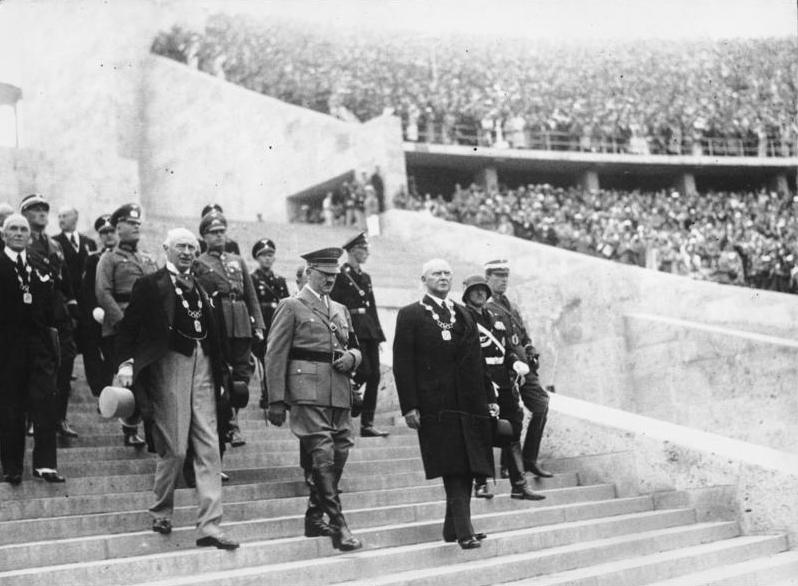
Google translation of the original German caption: “Before the ceremonial opening of the XI Olympic Games. Together with the members of the International and National Olympic Committee, the Führer and Reich Chancellor enters the stadium through the marathon gate. On the left of Adolf Hitler [Henry] Graf Baillet-Latour, on the right His Excellency [Theodor] Lewald.”
German Federal Archives (Accession number Bild 183-G00372) via Wikimedia Commons.
In July 2016, as we were sitting on the fantail of the Swiss sidewheeler Rhone while she chugged across Lake Geneva, my host pointed out the city of Lausanne, where a massive, glass-bedecked curvilinear building was shimmering in the summer sun. “Isn’t that the headquarters of the International Olympic Committee?” I asked. When my friend replied in the affirmative, I said, “I thought I smelled it.”
That rank odor — the stench of greed overpowering the solidarity the Olympics claim to represent — has intensified recently.
Even the casual student of modern Olympic history knows about the August 1936 Berlin Games, at which America’s Jesse Owens, a black man, took four gold medals and trashed Hitler’s Aryan supremacy myth. Fewer may be aware that, in February that year, the Olympic Winter Games were held in the Bavarian town of Garmisch-Partenkirchen. How, we ask today, could two Olympics be held in the Third Reich? How could people not know?
There was some controversy about holding the summer and winter Olympics under Nazi auspices. But in 1936, the German situation was not as comprehensively ghastly as it would become in later years. Yes, the Dachau concentration camp for political prisoners had opened in March 1933, and the Nuremberg Laws banning Jews from German citizenship and prohibiting marriage between Jews and “Aryans” had been enacted in 1935. The horrors of the Kristallnacht pogrom in November 1938 were two years in the future, however, and the satanic Wannsee Conference to plan the “Final Solution” to the “Jewish Question” would come six years later. Clear-minded people ought to have discerned some of the implications of the Nuremberg Laws. But the industrialized mass slaughter of millions, simply because they were children of Abraham, was beyond the imagination of virtually everyone.
So Hitler and his thugs temporarily behaved themselves (sort of) in the run-up to the Garmisch-Partenkirchen and Berlin Olympics. And the International Olympic Committee could salve whatever conscience it had in those days and proceed with the games.
The IOC has no excuses today, two months before the XXIV Olympic Winter Games open in Beijing. Because today, everyone knows.
Comments Off on Those Olympic rings are more than just tarnished
Death Squads Arrive in North Africa – WAH 048 – December 1942, Pt. 1
World War Two
Published 16 Dec 2021Despite Allied occupation, the situation of the Jews in North Africa hardly improves, in newly German-occupied Tunisia it deteriorates. Meanwhile, the world learns more of the details of the Holocaust — they cannot believe their ears.
(more…)
Comments Off on Death Squads Arrive in North Africa – WAH 048 – December 1942, Pt. 1
Scott Alexander on the risk of ancient plagues returning
The other day, Scott Alexander responded to a hair-on-fire New York Magazine piece of hysteria-mongering about climate change warming up arctic zones that may still harbour ancient plagues that can return:
I’m a little nervous talking about this, because I am not a microbiologist. But I haven’t seen the proper experts address this properly, so I’ll try, and if I’m wrong you guys can shout me down.
(Also, the real microbiologists are apparently “self-injecting [3.5 million year old bacteria] just out of curiosity” and we should probably stay away from them for now)
I think we probably don’t have to worry very much about ancient diseases from millions of years ago.
Animal diseases can’t trivially become contagious among humans. Sometimes an animal disease jumps from beast to man, like COVID or HIV, but these are rare and epochal events. Usually they happen when the disease is very common in some population of animals that lives very close to humans for a long time. It’s not “one guy digs up a reindeer and then boom”.
If a plague is so ancient that it’s from before humans evolved, it’s probably not that dangerous. In theory, it could be dangerous for whatever animal it originally evolved for — a rabbit plague infecting rabbits, or an elephant plague infecting elephants. And then maybe after many rabbits are infected, some human might eat an infected rabbit and get unlucky, and the plague might mutate to affect humans. But I don’t think this is any more likely than any of the zillion plagues that already infect rabbits jumping to humans, and nobody is worrying about those.
The story about anthrax is a distraction. The fact that someone got anthrax from a corpse frozen in permafrost is irrelevant; there is anthrax now, and you could get it from a perfectly fresh corpse or living animal if you wanted. It’s adapted to animals and it can’t spread from person to person. Just because you got an irrelevant-to-humans modern animal disease when you dug up a modern animal, doesn’t mean you’re going to get a dangerous-to-humans disease from an ancient animals.
But I’m more concerned about recent human plagues coming back.
Not bubonic plague; that one is another distraction. The reason we don’t get more Black Deaths isn’t because yersinia pestis died off or mellowed out. It’s because we have good sanitation and pest control.
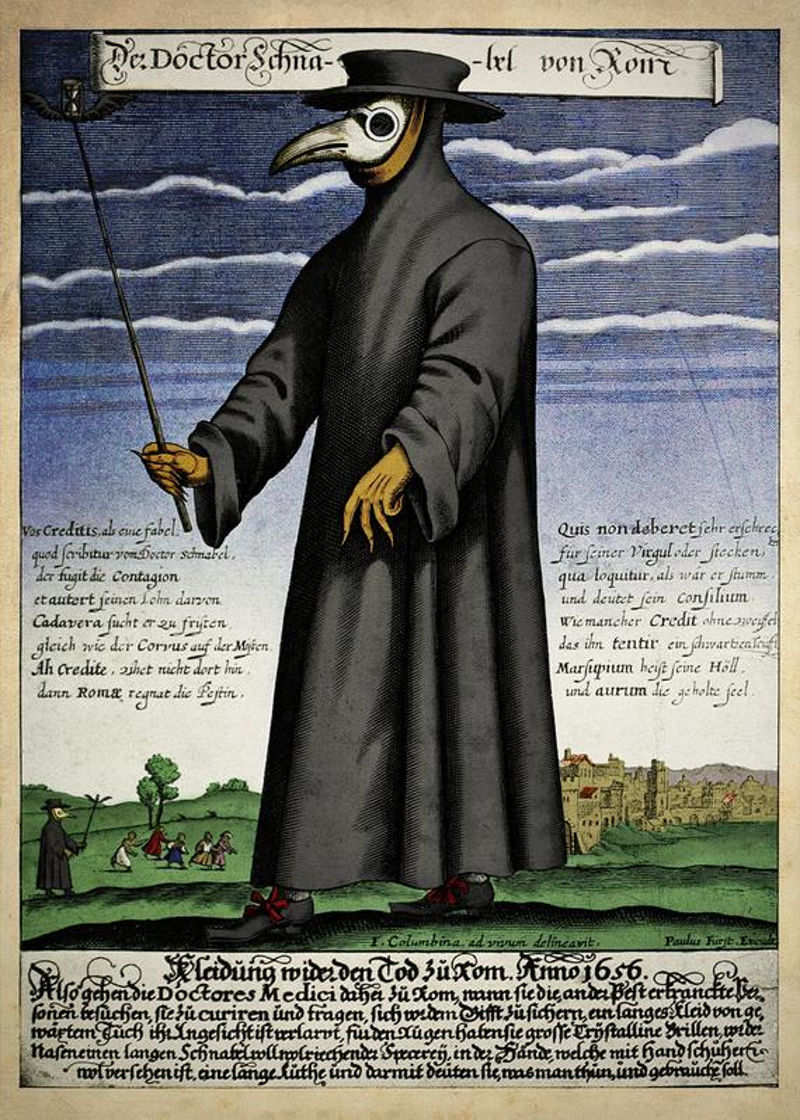
And doctors whose knowledge of medicine doesn’t begin and end with “look like a creepy bird”
But the 1918 Spanish flu has, as far as I know, legitimately died out. Lots of people like saying that in a sense it’s still with us. This NEJM paper (with a celebrity author!) points out that it’s the ancestor of all existing flu strains. But most of these flu strains are less infectious than it was. This didn’t make sense to me the first, second, or third time I asked about it: why would a flu evolve into an inferior flu? Sure, it might evolve into a less deadly flu because it’s perfectly happy being more infectious but less deadly. But I think the Spanish flu was also especially infectious; so why would it evolve away from that?
Comments Off on Scott Alexander on the risk of ancient plagues returning
SA80 History: L22A2 and Experimental L85 Carbines
Forgotten Weapons
Published 24 May 2017Armament Research Services (ARES) is a specialist technical intelligence consultancy, offering expertise and analysis to a range of government and non-government entities in the arms and munitions field. For detailed photos of the guns in this video, don’t miss the ARES companion blog post:
http://armamentresearch.com/british-e…
One of the original design intentions of the SA80 project was to replace the infantry rifle and the submachine gun with a single weapon that could fulfill both roles — hence the choice of a bullpup configuration. This would, theoretically, allow rifle ballistics and also SMG handling and maneuverability. As with most bullpup projects, however, this plan did not last. It quickly became clear that a shortened version of the L85 rifle could be made, which would be more suitable for troops who would previously have been issued submachine guns — notably aircraft and armored vehicle crews.
Today we take a look at a couple of early prototypes of these carbines which did not go into production. We also examine an L22A2 carbine, which did become standard issue in 2003 for some units. This carbine includes all of the H&K A2 pattern upgrades, and was given the A2 designation despite there never being an adopted L22A1.
http://www.patreon.com/ForgottenWeapons
Cool Forgotten Weapons merch! http://shop.bbtv.com/collections/forg…
If you enjoy Forgotten Weapons, check out its sister channel, InRangeTV! http://www.youtube.com/InRangeTVShow

Comments Off on SA80 History: L22A2 and Experimental L85 Carbines
QotD: The Kafkatrap that is known as “white feminism”
Many describe Franz Kafka’s disenchanted fables as tragic. And this is certainly true. But they are also farcical. To watch someone being relentlessly wrong can be grimly enjoyable — as long as you’re not the person in question.
The term white feminism, as it is commonly used today, is a classic example of the Kafka Trap. If you show too much interest in the lives of people of colour, you risk being accused of white saviourism — which is another way of saying you have a suspiciously condescending attitude to people of colour. But if you don’t show enough interest, you are insufficiently intersectional. You only care about the white, middle-class cisgendered women in your social circle.
White feminism is a classic example of the Kafka Trap because whatever you do is either too much or not enough. You are never right.
Tomiwa Owolade, “The problem with white saviours”, UnHerd.com, 2021-09-12.
Comments Off on QotD: The Kafkatrap that is known as “white feminism”


