
World War Two
Published 30 Apr 2022The Allies launch a deception operation to hide their intent of soon attacking Sicily, but first, they’ll actually have to secure Tunisia, and it is slow going. A German offensive in the Caucasus grinds to a halt, and German U-boats are suddenly finding themselves unable to destroy Allied shipping in the Atlantic.
(more…)
May 1, 2022
The race for Tunisia turns into a crawl – WW2 – 192 – April 30, 1943
Comments Off on The race for Tunisia turns into a crawl – WW2 – 192 – April 30, 1943
Despite the ever-present smartphone, people are still reading actual books in pretty good numbers
In the latest SHuSH newsletter, Kenneth Whyte provides some mildly hopeful numbers for both readers and writers:
I was having coffee this week with a former star journalist who now (like so many) works in a journalist-adjacent industry. “Who reads books?” she wondered.
It’s a question I’m often asked by journalists who these days get a lot of their information from Twitter. The chore of keeping up with their feed leaves little time for anything else. My guest still read books and belongs to a book club, but she asked the question all the same.
According to the authorities at the PEW Institute, 77% of Americans read books in 2021 (or, to be more precise, read one or more books in one or more format—print, audiobook, ebook). That’s not bad considering only 86% of American adults can read.
Only 21% of women read no books, and 26% of men. Eighty per cent of white people read books (as compared to 62% of Hispanics).
Good news for the future of book reading: 81% of adults under the age of fifty read books compared to 72% of adults over the age of fifty.
More on the demographics: 69% of those earning less than $30,000 a year read books, while 85% of those earning over $75,000 read books; 61% of those with a high-school (or less) education read books; 89% of college graduates read books.
According to PEW, the average reader manages twelve a year.
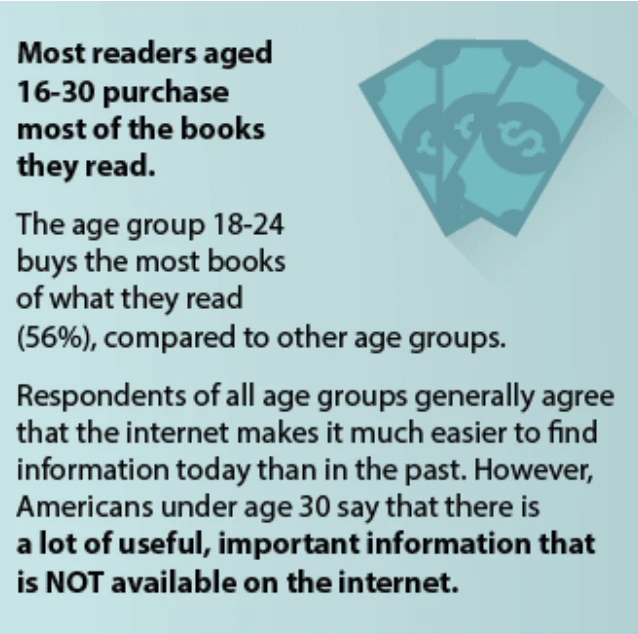
There is some evidence that reading is a declining habit: according to the Bureau of Labor Statistics, average time spent reading for pleasure declined from twenty-three minutes a day to seventeen minutes a day from 2005 to 2017. But the least decline was among young adults, 18 to 34 (less than 1%).
In fact, there is good evidence that the much-maligned millennials read more than their parents, and they overwhelmingly prefer hard copies to digital books. Even better, the millennials pay for their books:
Sinking of the General Belgrano – Falklands War Documentary
Historigraph
Published 30 Apr 2022Go to https://squarespace.com/historigraph to get a free trial and 10% off your first purchase of a website or domain.
Falklands War series:
[1] Invasion of the Falklands https://youtu.be/BUYp3Wqz00A
[2] Recapture of South Georgia https://youtu.be/4mCZBpX4pxsTo help support the creation of more videos, consider supporting on Patreon:
https://www.patreon.com/historigraph#FalklandsWar #Historigraph #Belgrano
Come join the historigraph discord: https://discord.gg/ygypfs3BEB
Buy Historigraph Posters here! historigraph.creator-spring.com
This video was sponsored by Squarespace.
► Twitch: https://www.twitch.tv/historigraph
► Second Channel: https://www.youtube.com/channel/UCpIj…
► Twitter: https://twitter.com/historigraph
► Instagram: https://www.instagram.com/historigraphSources for the Falklands War Series (so far):
Max Hastings & Simon Jenkins, Battle for the Falklands
https://archive.org/details/battlefor…
Martin Middlebrook, Operation Corporate
Martin Middlebrook, Battle for the Malvinas
Mike Norman, The Falklands War There and Back Again: The Story of Naval Party 8901
Kenneth Privratsky, Logistics in the Falklands War
Sandy Woodward, One Hundred Days
Paul Brown, Abandon Ship
Julian Thompson, No Picnic
John Shields, Air Power in the Falklands Conflict
Edward Hampshire, The Falklands Naval Campaign 1982
Hugh McManners, Forgotten Voices of the Falklands
Cedric Delves, Across an Angry Sea: The SAS in the Falklands War
Rowland White, Vulcan 607
Vernon Bogdanor, “The Falklands War 1982” lecture https://www.youtube.com/watch?v=a9bWw…
Arthur Gavshon, The sinking of the Belgrano https://archive.org/details/sinkingof…
Gordon Smith, Battle Atlas of the Falklands War 1982 by Land, Sea and Air
http://www.naval-history.net/NAVAL198…
Hansard- https://api.parliament.uk/historic-ha…
Recording of Thatcher’s statement to the Commons is from https://www.youtube.com/watch?v=HvbhV…Music Credits:
“Rynos Theme” Kevin MacLeod (incompetech.com)
Licensed under Creative Commons: By Attribution 4.0 License
http://creativecommons.org/licenses/b…“Crypto” Kevin MacLeod (incompetech.com)
Licensed under Creative Commons: By Attribution 4.0 License
http://creativecommons.org/licenses/b…“Stay the Course” Kevin MacLeod (incompetech.com)
Licensed under Creative Commons: By Attribution 4.0 License
http://creativecommons.org/licenses/b…Other music and SFX from Epidemic Sound

Comments Off on Sinking of the General Belgrano – Falklands War Documentary
The Victorian-era “guarantee fund” model for risky enterprises
In the latest Age of Inventions newsletter, Anton Howes wonders why we don’t have a modern equivalent to the funding mechanism that helped create the Great Exhibition of 1851 and other events that provided benefits to the public without government backing:
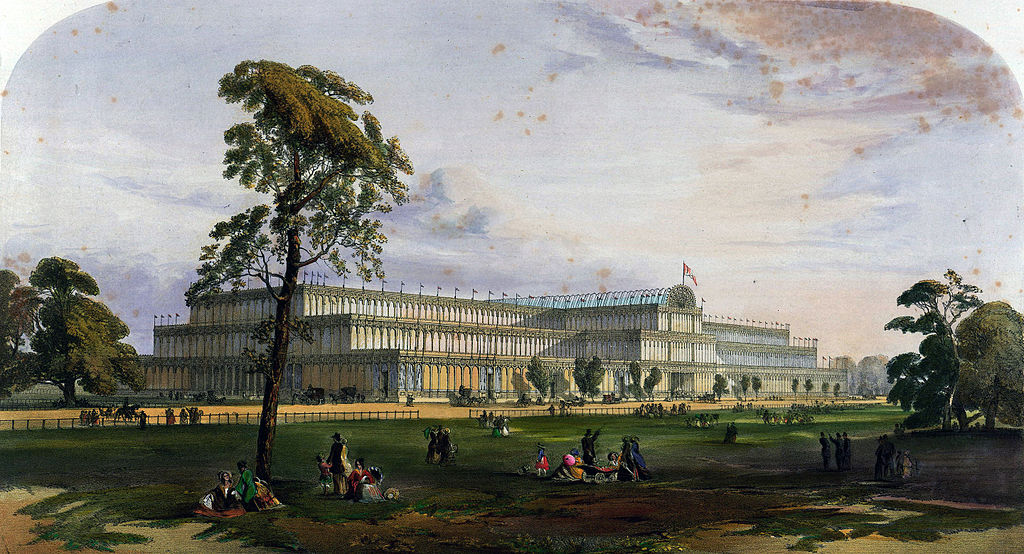
The Crystal Palace from the northeast during the Great Exhibition of 1851.
Image from the 1852 book Dickinsons’ comprehensive pictures of the Great Exhibition of 1851 via Wikimedia Commons.
As I’ve mentioned before, exhibitions of industry were not just celebrations of technological progress, but could become engines for progress as well. For the inventors, artists, and engineers who exhibited, the events were a direct inducement to improvement. And for the public who visited, the events exposed them to what was possible, encouraging them to raise their demands as both consumers and citizens, ideally inspiring them to become future innovators too.
But how was it all paid for? Unlike its national-level precursors in France, the Great Exhibition was not a state-run event. Even more remarkably, its organisers also failed to raise anywhere near enough private subscriptions to cover their costs. Instead, they used something that called a “guarantee fund”.
Instead of asking for donations from supporters up-front, the organisers asked them to commit to covering the exhibitions potential losses up to certain amounts — to be paid only if the money was required. Based on the security provided by this crowdsourced guarantee fund, the organisers then raised an ordinary bank loan in order to get the cash they needed to actually hold the event. Crucially, the guarantors didn’t actually have to spend anything unless the event made a loss, and if the event broke even or even made a surplus thanks to ticket fees, then they would never spend a penny at all. (Luckily for them, that’s exactly what happened in 1851, and for many later exhibitions too.)
What’s interesting to me about the guarantee fund is that I can’t quite think of anything quite like it today. There are perhaps more individualised versions of it, like when a neighbour or friend acts as a guarantor for a mortgage. And governments sometimes provide guarantees for certain sectors or industries too. There have also been a few profit-making versions of it in certain industries, where the guarantors potentially get some share of the upside too (“Names” at the Lloyds of London insurance and reinsurance market sounds similar, though even these are disappearing). But I’ve not seen anything like what the Victorians did, essentially using a guarantee fund to leverage philanthropy.
This is surprising to me. It seems like it has a lot of major advantages, especially for those who might want to replicate the exhibitions of industry today, or indeed for any kind of capital-intensive philanthropic endeavour that could eventually be expected in some measure to pay for itself. (I can’t help but think it would be useful in efforts to speed up the de-carbonisation of the economy, for example — a potential application that I’ve been exploring in my conversations with the people at Carbon Upcycling.)
Consider that with a guarantee fund anyone able to afford the risk could considerably increase the philanthropic value of their assets. Say that you could afford to donate £100 right away, but could donate three times that amount at a pinch (e.g. by having to liquidate some funds in shares). You could thus guarantee £100 each to three different causes, potentially without ever actually having to donate it, and knowing that in the worst case scenario you would never have to spend more than the £300 you can afford.
After all, those signing up to the guarantee fund essentially chose what their maximum liability would be if the event were to make a loss. If they were confident in the event’s success, then they probably believed that they would not have to pay anything at all. And if not, they had at least named the maximum donation they might eventually be asked to give.
Comments Off on The Victorian-era “guarantee fund” model for risky enterprises
Various Guns – Bren Gun (1940)
British Pathé
Published 13 Apr 2014Various guns – Bren gun.
Item on the Bren Gun. L/S parachutists falling to earth. After seeing various machine guns of the recent past, including the Browning BAR and French Chauchat machine gun, we see the manufacture and firing of the Bren gun. There is also a diagrammatic sequence showing the workings of the gas operated machine gun.
FILM ID:1292.13A VIDEO FROM BRITISH PATHÉ. EXPLORE OUR ONLINE CHANNEL, BRITISH PATHÉ TV. IT’S FULL OF GREAT DOCUMENTARIES, FASCINATING INTERVIEWS, AND CLASSIC MOVIES. http://www.britishpathe.tv/
FOR LICENSING ENQUIRIES VISIT http://www.britishpathe.com/
British Pathé also represents the Reuters historical collection, which includes more than 136,000 items from the news agencies Gaumont Graphic (1910-1932), Empire News Bulletin (1926-1930), British Paramount (1931-1957), and Gaumont British (1934-1959), as well as Visnews content from 1957 to the end of 1984. All footage can be viewed on the British Pathé website. https://www.britishpathe.com/

Comments Off on Various Guns – Bren Gun (1940)
QotD: How Thomas Sowell abandoned Marxism
The brilliant Thomas Sowell, when in college, considered himself a Marxist. Asked what changed him, Sowell said, “Evidence.”
After completing undergrad at Harvard and obtaining a master’s in economics, Sowell landed a summer internship with the Department of Labor. While there, he researched the impact of minimum wage law on employment. Sowell learned two things, both of which he found startling. First, minimum wage laws create job loss by pricing the unskilled out of the labor force. Second, Sowell discovered that “the people in the labor department really were not interested in that, because the administration of the minimum wage was supplying one-third of the money that was keeping the labor department going. … I realized that institutions have their own agendas and their own incentives.” In short, Sowell found that the Department of Labor did not care about the real-world effects of the minimum wage law. He credits this experience, this search for evidence, with having the “biggest” impact on his thinking.
Larry Elder, “If $15 Minimum Wage Is Such a Good Idea, Why Did AOC’s Bar Close Down?”, TownHall.com, 2019-03-21.
Comments Off on QotD: How Thomas Sowell abandoned Marxism
April 30, 2022
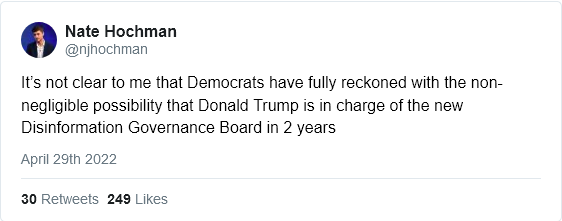
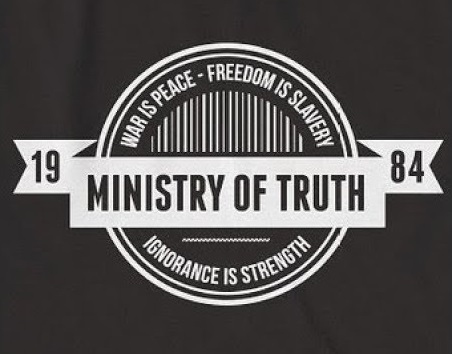
Welcome to the Ministry of Truth, aka the “Disinformation Governance Board”
Jim Treacher wraps up some of the noteworthy events of the week, including the almost-too-Orwellian-to-be-true “Disinformation Governance Board”:
The Department of Homeland Security just created something called the “Disinformation Governance Board”. Apparently, “Ministry of Truth” was too on-the-nose. All they can do anymore is scream about Russia, yet now they’ve dreamed up a propaganda org with the initials DGB. Great branding, geniuses!
I can’t put it any better than this:
Dems just spent four years screaming about the government because they weren’t in charge of it. Then they forgot all about that and immediately started amassing power again, which inevitably will be handed over to their enemies the next time the Dems are voted out of office. They never think about that, because thinking isn’t really what they do. As soon as their foes grab the levers of power the left has assembled, they’ll just start screaming about “fascism”.
Fortunately, there’s a useful logo for the new organization floating around the internet:
Comments Off on Welcome to the Ministry of Truth, aka the “Disinformation Governance Board”
God Help These British Agents – WW2 – Spies & Ties 16
World War Two
Published 28 Apr 2022We’ve seen it time and time again in this war. Supposed Allies arguing with each other instead of fighting the enemy. But when SOE and MI6 begin vying for leadership of Britain’s secret war, it’s more than cross words. Now there are lives at stake.
(more…)
Comments Off on God Help These British Agents – WW2 – Spies & Ties 16
“The NFL Draft is not socialism. It’s capitalism on steroids”
Peter Jacobsen refutes the claim that the NFL Draft is like socialism:

Once we recognize that teams aren’t really business competitors, and insofar as there is athletic competition it’s tempered to maximize profit, the claim that the draft is socialism rings pretty hollow.
But, as if this weren’t enough, history also debunks the claim that the draft is a socialist institution.
In 1934, Minnesota Gophers’ senior running back, Stan Kostka, led his team to an undefeated season and made himself the top prospect for professional teams. As a result, teams engaged in a bidding war which ended in Stan going to the (no longer existing) Brooklyn Dodgers.
As a result of the bidding war, Kostka became the highest paid player in the NFL (with a $5,000 contract).
The owner of the Philadelphia Eagles was so mad about losing the bidding war that he proposed the idea of the draft to the NFL the following year.
So, in other words, the NFL draft started as a way for team owners to cooperate to keep player wages below where they would be if bidding wars were allowed.
To be fair, I haven’t read everything Marx wrote. But something tells me a system where capital owners cooperate to keep employer bidding wars from occurring isn’t praised in some obscure work he and Engels published. In fact, this is about as opposite to Marx as you can get.
In the modern day, players have formed unions to combat owner cooperation, but the point remains the same. The NFL is a highly sophisticated organizational structure that allows athletic competitors to cooperate in the goal of making money.
So, insofar as Americans enjoy the exciting games created by the draft system, they don’t have socialism to thank. Instead they should thank the cooperation facilitated by self-interest channeled through the free market.
The NFL Draft is not socialism. It’s capitalism on steroids.
Comments Off on “The NFL Draft is not socialism. It’s capitalism on steroids”
Tank Chats #145 Conqueror | The Tank Museum
The Tank Museum
Published 14 Jan 2022► JOIN OUR PATREON: Our Patreons have already enjoyed Early Access and AD free viewing of our weekly YouTube video! Consider becoming a Patreon Supporter today: https://www.patreon.com/tankmuseum
► TIMESTAMP:
00:00 – INTRO
00:28 – FEATURES
(more…)
Comments Off on Tank Chats #145 Conqueror | The Tank Museum
QotD: The position of helots in Spartan society
We are very poorly informed about the helots. Our snobbish sources … are, for the most part, singularly uninterested in them, so we’re left putting together a patchwork of information. That in turn leads into situations where students of ancient Greece can can up with the wrong impression if they don’t have all of the sources in mind (we’ll see this is a common trend with Sparta – reading just Xenophon or just Plutarch can be deeply misleading).
First, let us dispense with the argument, sometimes offered, that the helots were more like medieval serfs than slaves as we understand the ideas and thus not really slaves – this is nonsense. Helots seem to have been able to own moveable property (money, clothing etc), but in fact this is true of many ancient slaves, including Roman ones (the Romans called this quasi-property peculium, which also applied to the property of children and even many women who were under the legal power (potestas) of another). Owning small amounts of moveable property was not rare among ancient non-free individuals (or, for that matter, other forms of slavery).
No, what legally separated helots from douloi (chattel slaves in most Greek societies) was that they were slaves of the Spartan state rather than of individual Spartans – this had nothing to do with any sense of greater freedom they might have had. Indeed, Plutarch relates the saying that “in Sparta the free man is more free than anywhere else in the world, and the slave more a slave” (Plut. Lyc. 28.5). He can only be referring to the helots here. Indeed, Plutarch’s statement is telling – the helots were treated poorly by the standards of ancient chattel slavery, which is, I must stress, an incredibly low bar. Ancient societies treated enslaved people absolutely horribly and yet somehow the helot lot was commonly thought worse.
But the final word on if we should consider the helots fully non-free is in their sanctity of person: they had none, at all, whatsoever. Every year, in autumn by ritual, the five Spartan magistrates known as the ephors declared war between Sparta and the helots – Sparta essentially declares war on part of itself – so that any spartiate might kill any helot without legal or religious repercussions (Plut. Lyc. 28.4; note also Hdt. 4.146.2). Isocrates – admittedly a decidedly anti-Spartan voice – notes that it was a religious, if not legal, infraction to kill slaves everywhere in Greece except Sparta (Isoc. 12.181). As a matter of Athenian law, killing a slave was still murder (the same is true in Roman law). One assumes these rules were often ignored by slave-holders of course – we know that many such laws in the American South were routinely flouted. Slavery is, after all, a brutal and inhuman institution by its very nature. The absence of any taboo – legal or religious – against the killing of helots marks the institution as uncommonly brutal not merely by Greek standards, but by world-historical standards.
We may safely conclude that the helots were not only enslaved persons, but that of all slaves, they had some of the fewest protections – effectively none, not even protections in-name-only.
But what do the helots do?
The answer is mostly “they farm” but getting more specific than that get sticky fast. But we may try to keep this brief: helots were enslaved agricultural laborers. Helots were owned not by individual spartiates, but by the Spartan state, where they were assigned – through whatever method we do not know – to work the plots of land (kleroi, see above) assigned to the spartiates who, as noted above, were forbidden from engaging in any kind of productive labor. The helots seem to have lived in their own villages and settlements – no great surprise, as the Messenian helots seem to have been far more numerous than the Laconian ones and the spartiates themselves did not live in Messenia in any great numbers. It does seem that the Messenian helots were gathered in a smaller number of nucleated villages rather than split up as farmsteads, probably to make it easier for the small number of spartiates stationed there to keep watch on them. And they seemed to have produced not only simple cereal staples, but the full range of agricultural products: wheat (Xen Lac. 5.3 – we’ll come back to this), barley, grapes and wine, figs, olives and olive oil, cheese, textiles (wool) and animal products, including meat and fish.
Bret Devereaux, “Collections: This. Isn’t. Sparta. Part II: Spartan Equality”, A Collection of Unmitigated Pedantry, 2019-08-23.
Comments Off on QotD: The position of helots in Spartan society
April 29, 2022
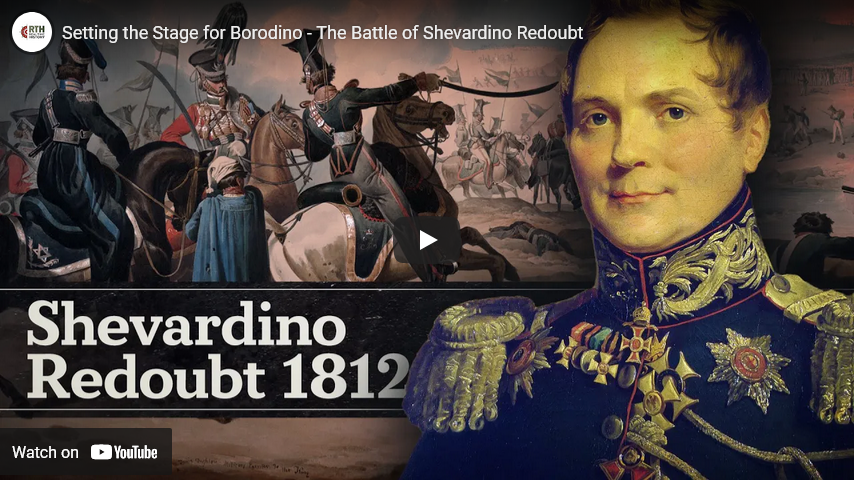
Setting the Stage for Borodino – The Battle of Shevardino Redoubt
Real Time History
Published 28 Apr 2022Support us on Patreon: https://patreon.com/realtimehistory
Napoleon’s advancing army had finally spotted the entire Russian Army before them, the stage was set for the deciding clash of the Russian campaign at the small village of Borodino. Before the armies could duke it out, Napoleon wanted to eliminate a forward defensive position on the Russian left flank: The Shevardino Redoubt.
» THANK YOU TO OUR CO-PRODUCERS
John Ozment, James Darcangelo, Jacob Carter Landt, Thomas Brendan, Kurt Gillies, Scott Deederly, John Belland, Adam Smith, Taylor Allen, Rustem Sharipov, Christoph Wolf, Simen Røste, Marcus Bondura, Ramon Rijkhoek, Theodore Patrick Shannon, Philip Schoffman, Avi Woolf,» SOURCES
Boudon, Jacques-Olivier. Napoléon et la campagne de Russie en 1812. 2021.
Lieven, Dominic. Russia Against Napoleon. 2010.
Mikaberidze, Alexander. The Battle of Borodino: Napoleon against Kutuzov. 2007.
Rey, Marie-Pierre. L’effroyable tragédie: une nouvelle histoire de la campagne de Russie. 2012.
Zamoyski, Adam. 1812: Napoleon’s Fatal March on Moscow. 2005.» OUR STORE
Website: https://realtimehistory.net»CREDITS
Presented by: Jesse Alexander
Written by: Jesse Alexander
Director: Toni Steller & Florian Wittig
Director of Photography: Toni Steller
Sound: Above Zero
Editing: Toni Steller
Motion Design: Toni Steller
Mixing, Mastering & Sound Design: http://above-zero.com
Digital Maps: Canadian Research and Mapping Association (CRMA)
Research by: Jesse Alexander
Fact checking: Florian WittigChannel Design: Simon Buckmaster
Contains licensed material by getty images
Maps: MapTiler/OpenStreetMap Contributors & GEOlayers3
All rights reserved – Real Time History GmbH 2022
Comments Off on Setting the Stage for Borodino – The Battle of Shevardino Redoubt
Kalevala – The most epic national epic
Mandelin
Published 2 Feb 2021Kalevala is the national epic of Finland. But if you have no time to read through all the 22,795 verses, but still want to learn more about this epic Finnish epic, this video contains most of the important things you need to know about.

Comments Off on Kalevala – The most epic national epic
QotD: The Rooftop Koreans
The year was 1992, 27 years ago right about now, and the city was Los Angeles. Several police officers who got into a videotaped brawl with a petty criminal named Rodney King were acquitted of beating him up. The city exploded. It was chaos.
I was a first-year law student, back a year from the Gulf War, and I had just joined the California Army National Guard. My unit was the 3rd Battalion, 160th Infantry, and we got called up early the first night and were on the streets for three long weeks. Making it even more delightful was the fact that the unit was in Inglewood, which was pretty much on fire. They burned most everything around, except our armory – that would have gone badly for them – and the Astro Burger.
My battalion commander grabbed then-First Lieutenant Schlichter, and we went all over the city in his humvee as he led his deployed and dispersed troops. Our soldiers came, in large part, from the areas most effected by the riots, and they were notably unpleasant to the thugs and criminals who quickly discovered our guys had no patience for nonsense. One dummy discovered that the hard way when he tried to run over some Guard soldiers from another battalion; he had a closed casket funeral.
The city went insane. Order simply ceased to exist. It was Lord of the Flies. I remember a cop totally breaking down because everything was completely out of control.
But I had a M16A1 – a real assault rifle – and I had a bunch of buddies with M16A1s. The regular folks … not so much. The decent people of LA were terrified, and with good reason. See, the dirty little secret of civilization is that it’s designed to maintain order when 99.9% of folks are orderly. But, say, if just 2% of folks stop playing by the rules … uh oh. Say LA’s population was 15 million in 1992 … that’s 300,000 bad guys. There were maybe 20,000 cops in all the area agencies then, plus 20,000 National Guard soldiers and airman, plus another 10,000 active soldiers and Marines the feds brought in. Law enforcement is based on the concept that most people will behave and that the crooks will be overwhelmed by sheer numbers of officers. But in the LA riots, law enforcement was massively outnumbered. Imposing order took time.
And until then, our citizens were on their own, at the mercy of the mob. Betting that the cavalry was going to come save you was a losing bet.
LA’s Korean shopkeepers knew that. They operated many small businesses in some of the least fashionable areas of Los Angeles, and they were already widely hated by activists, being scapegoated for problems and pathologies that long pre-dated their immigration to Southern California. So, they became targets for the mobs.
Bad decision by the mobs.
See, most of these Koreans had done their mandatory service in the Republic of Korea’s Army. Those ROK soldiers are the real deal – the Norks are not a theoretical threat and the South Korean army does not spend a lot of time talking about feelings. They were some solid dudes. So, when the local dirtbags showed up for some casual looting, they noticed the rooftops were lined with hardcore guys packing some serious heat, including the kind of scary rifles that the Democrats want to ban.
The Rooftop Koreans.
It did not take long for the bad guys to realize that the Rooftop Koreans were not playing games – they were playing for keeps. The mob went away in search of softer targets.
There’s a lesson there.
Kurt Schlichter, “Be A Rooftop Korean”, Townhall.com, 2019-05-02.
Comments Off on QotD: The Rooftop Koreans
April 28, 2022
Work ANYWHERE with New Tools and Smart Techniques
Rex Krueger
Published 27 Apr 2022No shop is no problem with just a couple tools & a little ingenuity.
Patrons get all plans for FREE: http://www.patreon.com/rexkrueger
Build the Lightweight Traveler’s Bench & Japanese Sawhorses (Links Below)
(more…)
Comments Off on Work ANYWHERE with New Tools and Smart Techniques


