
Rex Krueger
Published 27 Apr 2022No shop is no problem with just a couple tools & a little ingenuity.
Patrons get all plans for FREE: http://www.patreon.com/rexkrueger
Build the Lightweight Traveler’s Bench & Japanese Sawhorses (Links Below)
(more…)
April 28, 2022
Work ANYWHERE with New Tools and Smart Techniques
Comments Off on Work ANYWHERE with New Tools and Smart Techniques
Britain’s Incredible Recapture of South Georgia – Falklands War Documentary
Historigraph
Published 27 Apr 2022Go to https://squarespace.com/historigraph to get a free trial and 10% off your first purchase of
a website or domain.In just three weeks after the Argentinian invasion of the Falkland islands, Britain threw together a task force out of thin air, sailed it 8000 miles around the world and started taking its territory back. This is how it happened.
Made with thanks to the Fleet Air Arm Musuem in Yeovilton, Somerset. https://www.fleetairarm.com/
To help support the creation of the rest of the Falklands series, consider supporting on Patreon:
https://www.patreon.com/historigraph#Falklands40 #Historigraph
Come join the historigraph discord: https://discord.gg/ygypfs3BEB
Buy Historigraph Posters here! historigraph.creator-spring.com
► Twitch: https://www.twitch.tv/historigraph
► Second Channel: https://www.youtube.com/channel/UCpIj…
► Twitter: https://twitter.com/historigraph
► Instagram: https://www.instagram.com/historigraph
Thumbnail credit Daniel Behennec: https://www.naval-history.net/FxDBMis…Sources for the Falklands War Series (so far):
Max Hastings & Simon Jenkins, Battle for the Falklands
https://archive.org/details/battlefor…
Martin Middlebrook, Operation Corporate
Martin Middlebrook, Battle for the Malvinas
Mike Norman, The Falklands War There and Back Again: The Story of Naval Party 8901
Kenneth Privratsky, Logistics in the Falklands War
Sandy Woodward, One Hundred Days
Paul Brown, Abandon Ship
Julian Thompson, No Picnic
John Shields, Air Power in the Falklands Conflict
Edward Hampshire, The Falklands Naval Campaign 1982
Hugh McManners, Forgotten Voices of the Falklands
Cedric Delves, Across an Angry Sea: The SAS in the Falklands War
Rowland White, Vulcan 607
Vernon Bogdanor, “The Falklands War, 1982” lecture https://www.youtube.com/watch?v=a9bWw…
Arthur Gavshon, “The sinking of the Belgrano” https://archive.org/details/sinkingof…
Gordon Smith, Battle Atlas of the Falklands War 1982 by Land, Sea and Air
http://www.naval-history.net/NAVAL198…
Hansard- https://api.parliament.uk/historic-ha…
Recording of Thatcher’s statement to the Commons is from https://www.youtube.com/watch?v=HvbhV…Music Credits:
“Rynos Theme” Kevin MacLeod (incompetech.com)
Licensed under Creative Commons: By Attribution 4.0 License
http://creativecommons.org/licenses/b…“Crypto” Kevin MacLeod (incompetech.com)
Licensed under Creative Commons: By Attribution 4.0 License
http://creativecommons.org/licenses/b…“Stay the Course” Kevin MacLeod (incompetech.com)
Licensed under Creative Commons: By Attribution 4.0 License
http://creativecommons.org/licenses/b…Other music and SFX from Epidemic Sound

Comments Off on Britain’s Incredible Recapture of South Georgia – Falklands War Documentary
Why yeast extract is in tons of foods (and why it’s delicious)
Adam Ragusea
Published 13 Dec 20212008 paper in which Turkish scientists found 50ºC for 24 hours is the best time and temp for yeast autolysis: https://www.researchgate.net/publicat…
1916 paper in which American scientists found that yeast extract cured beriberi in pigeons fed only white rice, because B vitamins: https://www.google.com/books/edition/…
1995 book chapter covering Justus Von Liebig’s experiments with yeast extract: https://www.google.com/books/edition/…
2002 press release from the Marmite company covering their history (much more thorough than what’s currently on their website): http://webarchive.loc.gov/all/2002111…
Vegemite. There, I said it.

Comments Off on Why yeast extract is in tons of foods (and why it’s delicious)
QotD: The NFL Draft
NFL scouts can (and do) measure just about everything about a prospect prior to the draft, but they can’t quantifiably measure heart and leadership, two of the most important yet undervalued skills a quarterback can possess.
Every year they draft these big, strong, good-looking guys that can chuck it a country mile. And three years later they turn out to be Joey Harrington or Tim Couch or Jeff George or some other bust who couldn’t lead a hungry lineman to free barbeque, let alone an entire team to a championship.
Dan Wetzel, “Follow the Leader”, Yahoo! Sports, 2006-04-27.
Comments Off on QotD: The NFL Draft
April 27, 2022
Why It Sucked To Be on a Merchant Ship in World War Two – WW2 Special
World War Two
Published 26 Apr 2022Serving on board a merchant ship during the Second World War was a hazardous endeavor. Stalked by submarines, attacked by surface raiders, and hunted by bombers, the convoys and individual cargo ships faced constant danger on their routes across the seas. And that is in addition to the job’s typical hazards. But what was life like for a regular sailor on board these ships? And what motivates a man to sign up for such a dangerous job?
(more…)
Comments Off on Why It Sucked To Be on a Merchant Ship in World War Two – WW2 Special
“We’re healthy from the bottom up, and sick from the top down.”
Chris Bray has a bit of fun at David French’s expense:
In the 1830s, British merchants with trade routes from India had forced open an enormous market for opium in China, and were pouring the product into the country, producing a lucrative addiction crisis. (Queen Victoria, the first Sackler.) But the Qing Dynasty had run China with a firm hand since the first half of the 17th century, and the emperors of the dynasty had long regarded themselves as, to use an academic term from the field of political science, The Shit. In 1839, Commissioner Lin Zexu sent a huffy letter to the British monarch, warning her that her tedious little pissant country over there in Nowhereville was trifling with a vast and dangerous power:
Our celestial empire rules over ten thousand kingdoms! Most surely do we possess a measure of godlike majesty which ye cannot fathom! Still we cannot bear to slay or exterminate without previous warning …
The British responded with naval artillery, and the limits of the Qing Dynasty’s power were revealed with the greatest possible clarity. Commissioner Lin had an image of himself, an understanding of his place in the world and the meaning of his nation’s power, that couldn’t survive an encounter with reality.
So: David French. In his own version of Commissioner Lin’s letter, French warns this week that American institutions most surely do possess a measure of godlike majesty which ye cannot fathom, yet ye weak and depraved subjects of these potent institutions offer not thine gratitude. It’s insane. He doesn’t see the world he’s describing, so his description doesn’t have anything to do with the people he’s talking to, and he has no idea.
Before I say anything else, though, I have to point out that I recently described the American crisis like this: “We’re healthy from the bottom up, and sick from the top down.” French does the opposite, describing institutions that are undermined by the dreadful human material beneath them: “Our government is imperfect, but if this republic fractures, its people will be to blame.” Wreckers and saboteurs have undermined the otherwise successful five year plan, you see. The problem is bottom-up.
This is exactly the same beat patrolled by “real conservatives” like Max Boot and Tom Nichols, who endlessly warn that the fat dumb peasants lack the sense to lick the hands of their capable superiors. These are very strange men.
Here, watch French do his thing:
The people disproportionately driving polarization in the United States are not oppressed minorities, but rather some of the most powerful, most privileged, wealthiest people who’ve ever lived. They enjoy more freedom and opportunity than virtually any prior generation of humans, all while living under the protective umbrella of the most powerful military in the history of the planet.
It’s simply an astonishing level of discontent in the midst of astonishing wealth and power.
Tell me the comparison to Commissioner Lin isn’t perfect. Does not our wealth and power astonish you!?!?
As French writes about the privileged creatures who live “under the protective umbrella of the most powerful military in the history of the planet,” the Taliban rules Afghanistan. A reminder: The Taliban controlled about half of that country in September of 2001; then the most powerful military in the history of the planet invaded, and fought the Taliban for two full decades, at the cost of thousands of lives and trillions of dollars, the result of which is that the Taliban now controls … all of the country. The implosion of the American effort in Afghanistan happened last fucking year, and we’ve somehow already taken care to forget the details of that goat rodeo. What was the plan?

Comments Off on “We’re healthy from the bottom up, and sick from the top down.”
Airtronics PSRL: An American RPG (with demo shot…for real!)
Forgotten Weapons
Published 27 Dec 2021https://utreon.com/c/forgottenweapons/
http://www.patreon.com/ForgottenWeapons
Cool Forgotten Weapons merch! http://shop.forgottenweapons.com
Thanks to Jeff Folloder and Airtronics USA, I have a chance today to look at and test-fire a PSRL (Precision Shoulder-fired Rocket Launcher) — in essence, an American-made RPG-7. The rocket we are using here is a Bulgarian-made training round with an inert warhead and live booster and rocket.
Contact:
Forgotten Weapons
6281 N. Oracle 36270
Tucson, AZ 85740

Comments Off on Airtronics PSRL: An American RPG (with demo shot…for real!)
QotD: Competition
This was the promise of the classical economists: capitalism will optimize for consumer convenience, while keeping businesses themselves lean and hungry. And it was Marx’s warning: businesses will compete so viciously that nobody will get any money, and eventually even the capitalists themselves will long for something better. Neither the promise nor the warning has been borne out: business owners are often comfortable and sometimes rich. Why? Thiel says it’s because they have escaped competition and become at least a little monopoly-like.
Thiel hates having to describe how businesses succeed, because he thinks it’s too anti-inductive to reduce to a formula:
Tolstoy opens Anna Karenina by observing “All happy families are alike; each unhappy family is unhappy in its own way.” Business is the opposite. All happy companies are different: each one earns a monopoly by solving a unique problem. All failed companies are the same: they failed to escape competition.
Scott Alexander, “Book Review: Zero to One”, Slate Star Codex, 2019-01-31.
Comments Off on QotD: Competition
April 26, 2022
The Crusades: Part 1 – The Long Prehistory
seangabb
Published 23 Jan 2021The Crusades are the defining event of the Middle Ages. They brought the very different civilisations of Western Europe, Byzantium and Islam into an extended period of both conflict and peaceful co-existence. Between January and March 2021, Sean Gabb explored this long encounter with his students. Here is one of his lectures. All student contributions have been removed.
(more…)
Comments Off on The Crusades: Part 1 – The Long Prehistory
A new guide to classical architecture
In The Critic, Ptolemy Dean reviews The Layman’s Guide to Classical Architecture by Quinlan Terry:

Trained in the bleakly grey era of the late 1950’s, the classical architect Quinlan Terry has achieved a remarkable legacy. At the time he embarked on his architectural career, the profession was locked firmly in the postwar austerity of flat-roofed perfunctory modernism, with planar walls of exposed aggregate concrete or unadorned “stretcher bond” brickwork.
This was the “machine age” of mass production of buildings, and it is sometimes hard to remember how restrictive this period must once have been, as so much has happened since. To the more hard-line practitioners of those times, any suggestion of creating buildings with ornament was considered at best eccentric but more often offensive and worthy of censure.
This beautifully produced red-cloth-covered hardback book is therefore a fitting record of a lifetime’s work of studying, drawing and creating new classical buildings. Such buildings are generally defined by the application of the five classical orders of columns handed down to us by the ancient Greeks and Romans. They are beautifully illustrated and explained in this book. There have been centuries of creative re-use of these Classical orders. Italian Renaissance, Palladians, Georgians, Victorians and Edwardians across the world have all offered ever inventive, fresh, new and distinctive reinterpretations of the Classical architectural language.
But, with the arrival of the International Modern Movement, the literal application of classical architecture was dramatically reduced and it was no longer taught in mainstream schools of architecture. For almost a century, Classicism has been seen as largely irrelevant in new building design. This book sets out to explain, in layman’s terms, what each part of the classical assembly is called and how the components can be developed and composed into a harmonious building.
Quinlan Terry’s classical buildings, which are illustrated in elegantly drawn elevations and crisp black and white photographs, illustrate that the selection and interpretation of the language of classicism is a highly personalised choice. Quinlan’s first employer, from 1962, had been Raymond Erith, to whom this book is dedicated. Erith was a gentle practitioner based in rural Essex who weathered the worst of the postwar austerity until his death in 1973.
After that time, and in part due to Erith and Terry’s joint achievement, the climate for making traditionalist buildings steadily improved, and the occasional country house commissions multiplied and expanded into full scale classical country houses on a substantial scale both here and in the United States.
Comments Off on A new guide to classical architecture
History of Rome in 15 Buildings 06. The Pantheon
toldinstone
Published 27 Sep 2018The sixth building in our History of Rome, the Pantheon, epitomizes the most stable Roman building material and the most restless Roman emperor – concrete and Hadrian, respectively. This episode discusses the peculiarities of both in some detail.
If you enjoyed this video, you might be interested in my book Naked Statues, Fat Gladiators, and War Elephants: Frequently Asked Questions about the Ancient Greeks and Romans. You can find a preview of the book here:
https://toldinstone.com/naked-statues…
If you’re so inclined, you can follow me elsewhere on the web:
https://www.reddit.com/r/AskHistorian…
https://www.instagram.com/toldinstone/To see the story and photo essay associated with this video, go to:
https://toldinstone.com/the-pantheon/Thanks for watching!

Comments Off on History of Rome in 15 Buildings 06. The Pantheon
QotD: “Boris Lloyd George”
But more than any other twentieth-century PM, the last Liberal premier embodied the ambition, promiscuity and shameless indifference to rules and conventions that have driven Boris Johnson’s critics mad. Boris might be a mountebank, but Lloyd George was the mountebank’s mountebank.
Had he been prime minister during the Covid pandemic, would he have held parties at Number 10? The answer is obvious. He wouldn’t just have invited you to a party, he’d have sold you a peerage and made a move on your wife while you were still hanging up your coat.
Lloyd George was brilliantly funny. He was patriotic. He had the common touch. He was also, to quote Max Hastings on his modern-day successor, a “cavorting charlatan”, a “bully”, a “rogue” and a “scoundrel”, who “would not recognise truth, whether about his private or political life, if confronted by it in an identity parade”. And like Boris, he never hid it; quite the reverse. “My supreme idea is to get on,” he wrote to his future wife, Maggie Owen, during their courtship. “I am prepared to thrust even love itself under the wheels of my Juggernaut if it obstructs the way.” He meant every word.
According to one of his own aides, Lloyd George was “mental on matters of sex. In his view, a man and a woman could not possibly be friends without sexual intercourse.” That sounds familiar. Like Boris, he could never be entirely sure how many children he had. Within months of his marriage to the stolid and long-suffering Maggie, he had already strayed, impregnating a Liberal activist known only as Mrs J.
Not content with also impregnating his wife’s cousin Kitty, he also had affairs with “Mrs Tim” who was married to his friend Timothy Davies, as well as Julia Henry, another Liberal MP’s wife. He also carried on for decades with his secretary, Frances Stevenson, whom he forced to have at least two abortions. And there were many more — so many that nobody has ever produced a definitive count.
At the time, people joked that Lloyd George had a child in every town in Britain. The story goes that one day his son Dick went into a pub and fell into conversation with a stranger who looked just like him. The stranger eventually confessed that Lloyd George was indeed his father, and was secretly paying him £400 a year. To cap it all, some biographers suggest that Lloyd George also slept with Dick’s troubled wife, Roberta — and this when he was well into his sixties! By these standards, even Boris seems a paragon of fidelity.
Dominic Sandbrook, “How to bring down a Prime Minister”, UnHerd, 2022-01-14.
Comments Off on QotD: “Boris Lloyd George”
April 25, 2022
“We live in such a degraded information environment that we can’t get to discussions of principle”
Chris Bray on the increasing inability or deliberate choice of most legacy media outlets to avoid presenting basic facts in favour of pitching a scenario with the preferred outcome prepackaged and largely predigested for the consumer to accept uncritically:
Over and over again, journalism doesn’t begin to accurately describe; consuming it, we don’t get to the starting line of a functioning political discourse, which is just knowing what’s happening, more or less. We’re buried in fakery, in representations of reality that have no connection to reality. […]
I wrote last week about the disappearance of basic information on the criminal justice system in Los Angeles County, where I live. We have an ongoing debate over our Woke DA’s policy choices — but the more I look at the debate, the more I’m sure it’s a debate about nothing, because the slogans used to represent the DA’s policy choices really don’t seem to begin to reflect the reality of the DA’s actual policy choices. The slogans look from here like cover words, chaff fired as a rhetorical countermeasure to cloud the air. I’ve been trying to get clear information from people in Los Angeles County government, which has been … interesting, so stay tuned on that question. But what are we debating if we’re exchanging our thoughts on the empty fakery the DA is deploying to prevent us from noticing what he’s doing?
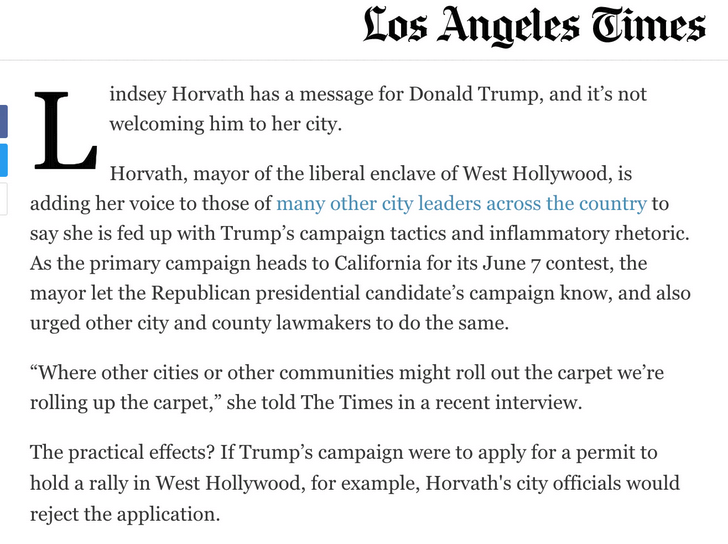
Back in 2016, the vapid mayor of a tiny city in Los Angeles County boldly announced that she had banned Donald Trump from her community, ordering city staff to burn the witch. Journalists reported it straight: TRUMP BANNED FROM LOCAL CITY.
It was left to lawyers with a media presence to seriously examine all of the problems with the remarkable claim that a part-time small-town mayor owns a personal fiefdom and can ban people from it. A not-especially-gifted politician with ambitions for higher office made up some nonsense to get herself in the news, and it worked. But the news was about nothing, because she had no authority to do the thing she announced in the press release.
This is more than half of the news: Noise with nothing it, a press release from an idiot typed up by idiots. What debate over questions of principle can proceed on the foundation of an informational void? (“I’m for empty hole!” “Oh yeah, well I’m against empty hole!”)
We’re beginning to solve some big pieces of that problem with alternative media, which is why you’re hearing so much complaining about misinformation. “Our democracy,” that hilarious phrase that doesn’t mean what it says, relies on the screen of fakery. Nothing happens until we punch enough holes in that screen.
Comments Off on “We live in such a degraded information environment that we can’t get to discussions of principle”
The Jews Fight Back – WAH 057 – April 24, 1943
World War Two
Published 24 Apr 2022The war against Naziism is escalating on all fronts — in the War Against Humanity the main battleground is now the Warsaw Ghetto.
(more…)
Comments Off on The Jews Fight Back – WAH 057 – April 24, 1943
Trudeau’s Liberals shocked to discover that not everyone wants the internet censored
The free segment of The Line‘s weekend round-up looked at the federal government’s gone-wrong public consultation about their proposed internet censorship Online Harms bill:

Your Line editors have been diligently seeking out educated comment about the Liberals’ forays into Internet regulation and censorship; as we suspected, they are finding out the hard way that determining which speech is fit to be heard is a philosophical fools’ errand. Only a very little research into the history of liberal norms around free speech could have spared them the trouble, but, alas, this seems to be the lesson that every generation needs to re-learn from first principles.
Well, a little out-of-school learning landed in the laps of the Liberals back in September of last year via a seven-page letter written by Michele Austin, then-Twitter Canada’s head of public policy. She took the government’s proposed Online Harms Bill to task in a submission that was only revealed when this country’s lone Internet warrior, Saint Michael Geist (*sign of the cross*), filed an Access To Information request revealing Austin’s scathing critique.
To wit:
Sacrifices freedom of expression to the creation of a government run system of surveillance of anyone who uses Twitter. Even the most basic procedural fairness requirements you might expect from a government-run system such as notice or warning are absent from this proposal. The requirement to “share” information at the request of Crown is also deeply troubling.
It’s rare to see a piece of proposed legislation so poorly conceived, so profoundly over-reaching, that virtually every organization asked to comment on it proves to be against it. But so it was. As Geist notes, even organizations that one would imagine to be at least nominally in favour of a regulatory regime intended to crack down on unequivocally harmful Internet carcinomas like child porn, hate speech, and terrorism, in fact came out against it. The National Association of Friendship Centres, Canadian Centre for Child Protection, Safe Harbour Outreach Project, Centre for Israel and Jewish Affairs, and the National Council of Canadian Muslims all noted that the government’s proposal stood to do much more harm to their respective communities than it would prevent.
Again, even a little bit of historical research would have demonstrated that those dastardly, evil, liberal values of “free speech” have traditionally done more to help marginalized communities than hinder them. But we digress.
Heritage Minister Pablo Rodriguez has subsequently announced the government would halt its Online Harms Bill, presumably in the wake of the disastrous consultation process. So the protests did, indeed, work. But as Geist rightly notes, the fact that he even had to spend months formally seeking out these submissions to be publicly released ought to raise serious questions about this government’s commitment to openness and transparency in how it approaches one of the most foundational freedoms we have as citizens. This is not a government that is philosophically well equipped, nor technically able, to control access to information in the way it so clearly wishes to. Something to keep in mind when evaluating its other Internet bills, C-11 and C-18.
I used to regularly post links to Michael Geist’s work, but at some point in the last few months his RSS feed went down and I stopped getting updates. I’ve relinked to his Twitter feed, which hopefully will provide notice when he publishes something on this file.
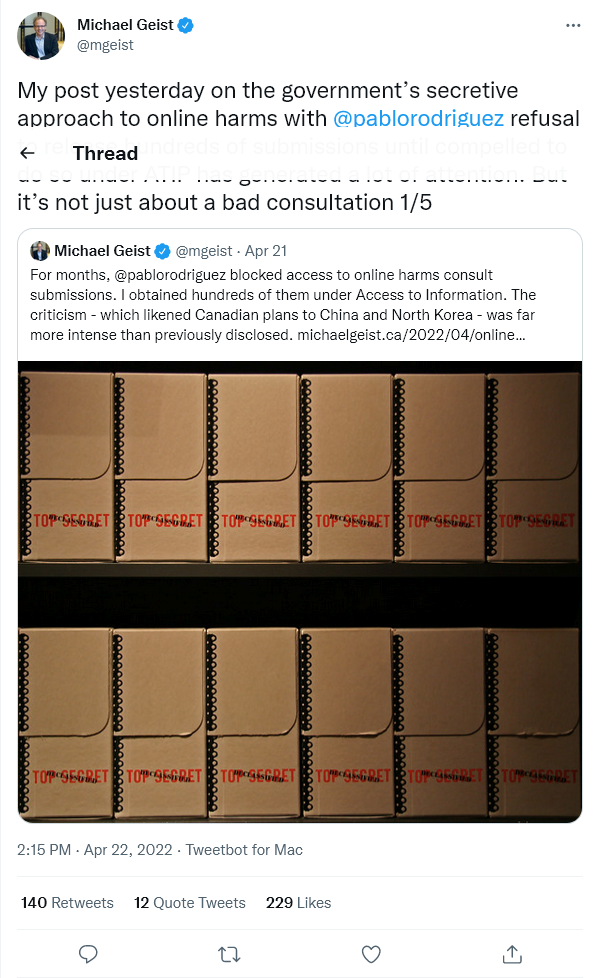
Today’s post identifies at least four problems. First, lack of transparency runs counter to promises of an open, transparent government. @justintrudeau even introduced a bill on open by default in 2014. Disclosures only via ATIP are not transparency. 2/5
Second, notion that the government was simply consulting on some ideas and will now course correct requires Canadians to overlook the reality that the actual plan was to introduce this as a bill last year. This was the Internet regulation plan. 3/5
Third, “What We Heard” report from @pablorodriguez significantly understated the extent of the public criticism and feedback. Recommendations omitted, criticisms softened. Having now seen the actual submissions, I feel misled. 4/5
Most importantly, this is part of a larger Internet regulation plan:
1️⃣Bill C-11 opens the door to regulating user generated content
2️⃣Bill C-18 mandates payments for links
3️⃣Online harms wasn’t an outlier. It reflects plan for regulating the Internet.
5/5
Comments Off on Trudeau’s Liberals shocked to discover that not everyone wants the internet censored


