
A surprising number of people retain from childhood the idea that there is a fixed amount of wealth in the world. There is, in any normal family, a fixed amount of money at any moment. But that’s not the same thing.
When wealth is talked about in this context, it is often described as a pie. “You can’t make the pie larger,” say politicians. When you’re talking about the amount of money in one family’s bank account, or the amount available to a government from one year’s tax revenue, this is true. If one person gets more, someone else has to get less.
I can remember believing, as a child, that if a few rich people had all the money, it left less for everyone else. Many people seem to continue to believe something like this well into adulthood. This fallacy is usually there in the background when you hear someone talking about how x percent of the population have y percent of the wealth. If you plan to start a startup, then whether you realize it or not, you’re planning to disprove the Pie Fallacy.
What leads people astray here is the abstraction of money. Money is not wealth. It’s just something we use to move wealth around. So although there may be, in certain specific moments (like your family, this month) a fixed amount of money available to trade with other people for things you want, there is not a fixed amount of wealth in the world. You can make more wealth. Wealth has been getting created and destroyed (but on balance, created) for all of human history.
Suppose you own a beat-up old car. Instead of sitting on your butt next summer, you could spend the time restoring your car to pristine condition. In doing so you create wealth. The world is — and you specifically are — one pristine old car the richer. And not just in some metaphorical way. If you sell your car, you’ll get more for it.
In restoring your old car you have made yourself richer. You haven’t made anyone else poorer. So there is obviously not a fixed pie. And in fact, when you look at it this way, you wonder why anyone would think there was. *
Kids know, without knowing they know, that they can create wealth. If you need to give someone a present and don’t have any money, you make one. But kids are so bad at making things that they consider home-made presents to be a distinct, inferior, sort of thing to store-bought ones — a mere expression of the proverbial thought that counts. And indeed, the lumpy ashtrays we made for our parents did not have much of a resale market.
* In the average car restoration you probably do make everyone else microscopically poorer, by doing a small amount of damage to the environment. While environmental costs should be taken into account, they don’t make wealth a zero-sum game. For example, if you repair a machine that’s broken because a part has come unscrewed, you create wealth with no environmental cost.
Paul Graham, “How to Make Wealth”, Paul Graham, 2004-04.
June 28, 2022
QotD: The economic pie fallacy
June 27, 2022
High Altitude Research Project and the Martlet Launch Vehicles; Gerald Bull’s dream of a space gun
Polyus Studios
Published 26 Jun 2022Support me on Patreon – https://www.patreon.com/polyusstudios
In 1968, 7 countries were operating satellites in orbit, while only 3 countries had the ability to launch one themselves. But they were on the verge of being joined by a Canadian university. Starting in the early 1960s, Montreal, Quebec based McGill University developed and began testing an ambitious concept to place small satellites into orbit. It was the culmination of decades of pioneering work across multiple fields. It was the High Altitude Research Project and the Martlet orbital launch vehicle.
Music:
Denmark – Portland Cello Project
Your Suggestions – Unicorn HeadsChapters:
0:00 Introduction
0:28 Bull’s early career
3:00 Birth of the Program
7:47 Getting HARP off the ground
10:52 Martlet 1
13:26 Early Martlet 2
15:41 Martlet 3
18:05 Enhanced Martlet 2s
21:40 Other HARP Guns
24:19 Quest for an Orbital Capability, the 2G-1
27:53 Satellite Delivery Model, Martlet 4
30:27 Advanced gun research
31:30 Hard times for HARP
32:30 Bull’s Ambition Gets The Best Of Him
35:28 Legacy of the HARP Project

It’s not clear where the money will come from to fund the recently announced NORAD upgrades
Aside from sticking knives in the backs of political critics, Justin Trudeau’s government loves announcing new programs and additional spending more than anything else. The boring, workaday details like actually implementing the newly announced programs … well, that sometimes gets forgotten in the rush to make new announcements. In this case, the recent announcement that Canada will be spending Cdn$4.9 billion to upgrade our contribution to NORAD for continental defence — and to no real surprise for anyone who’s been paying attention — it’s not clear even to the head of the Canadian Armed Forces just where that money is actually supposed to come from:

Canada’s defence chief says he doesn’t yet know where the money is coming from for $4.9 billion in promised upgrades to NORAD radar and surveillance systems.
In an interview with The West Block‘s Mercedes Stephenson, Gen. Wayne Eyre was asked about growing questions facing the government to detail their spending plan on NORAD upgrades.
Sources have told Global News the military is uncertain about where the funds are coming from, and that there are meetings happening at the department trying to determine how much of the money is new. Those sources say there are significant concerns that the money may not be new, and may need to be re-capitalized from within the existing defence budget.
“I haven’t completely figured out myself the source of funds for this,” Eyre said.
“So I can’t say definitively where it’s coming from. I will say, though, the announcement was welcome.”
Eyre was also asked whether the military is planning any departmental cuts in order to be able to allocate $4.9 billion to the NORAD upgrades.
“We haven’t looked at cutting. But as always, we have to look at rebalancing,” he said.
“The force that we have today is not the force that we need to support tomorrow. So we need to look at force structure. Do we have it in the right place? Do we need to look at rerolling of units so that they undertake roles that are more relevant for the future security environment? That is all important.”
Global News has asked for clarity on the question to Defence Minister Anita Anand’s office.
No answer has yet been received.
Look at Life — The Jumping Jets (1965)
PauliosVids
Published 20 Nov 2018The revolutionary vertical take-off capacity of the RAF Kestrel.
[Wikipedia: “The Hawker P.1127 and the Hawker Siddeley Kestrel FGA.1 are the British experimental and development aircraft that led to the Hawker Siddeley Harrier, the first vertical and/or short take-off and landing (V/STOL) jet fighter-bomber.
“Development began in 1957, taking advantage of the Bristol Engine Company’s choice to invest in the creation of the Pegasus vectored-thrust engine. Testing began in July 1960 and by the end of the year the aircraft had achieved both vertical take-off and horizontal flight. The test program also explored the possibility of use upon aircraft carriers, landing on HMS Ark Royal in 1963. The first three aircraft crashed during testing, one at the 1963 Paris Air Show.
“Improvements to future development aircraft, such as swept wings and more powerful Pegasus engines, led to the development of the Kestrel. The Kestrel was evaluated by the Tri-partite Evaluation Squadron, made up of military pilots from the United Kingdom, the United States, and West Germany. Later flights were conducted by the U.S. military and NASA.
“Related work on a supersonic aircraft, the Hawker Siddeley P.1154, was cancelled in 1965. As a result, the P.1127 (RAF), a variant more closely based on the Kestrel, was ordered into production that year, and named Harrier – the name originally intended for the P.1154 – in 1967. The Harrier served with the UK and several nations, often as a carrier-based aircraft.”]

QotD: Perfectionism
It has blighted more lives than autism, destroyed more potential work than brain damage, stopped more achievement than mis-education. It can devour entire civilizations, and arguably has. […] If you’re an artist or even just a “creator” or worker: a writer, an artist, a programmer, a cook, holy heck, even a house cleaner, you know exactly what I’m talking about.
There’s this odd tendency to be more dissatisfied with our work the better we do and then to decide not to do things because, what the heck, it will never be good enough.
The way it blights lives is … interesting. As in I’ve seen perfectionists utterly ruin themselves by doing nothing. Oh, you want to write/create/climb your work ladder? But you look at your work and you know you’re not good enough because you can see flaws, so why even try. And then you do nothing. And then … and then you’re 65 and you’ve done nothing and achieved nothing in your life, and it’s a miracle if you came close to supporting yourself. (And the only reason you’ve done so is because you did some job you considered was menial and didn’t matter, so your perfectionism didn’t infect THAT.)
If you’re a true perfectionist, you also never had any relationships. Because even though you’re far from the ideal mate, you judge every potential by tagging up defects. If you can’t have perfection, why bother.
The very smart are extremely susceptible to this, but everyone can fall into the trap. If you care or know enough about any field, the flaws in your own (and others) work will stand out glaringly and in relief and then you can’t do ANYTHING.
Of course, the more you practice and know the more flaws you see. And it eventually shuts you down. I catch myself in this trap frequently to the point of being amazed when semi-pro anthos buy my work, because I’m sure it’s the worst thing ever written. And I can shut myself down for years. (I’m not alone, I know you know other writers with this problem.)
Sarah Hoyt, “The Flaw in Flawless”, According to Hoyt, 2019-02-27.
June 26, 2022
Two Hundred Weeks of War – WW2 – 200 – June 25, 1943
World War Two
Published 25 Jun 2022The Allies make some preliminary moves ahead of their next big operation in the Solomon Island as well as a few before their impending invasion of Sicily. Meanwhile, in the Soviet Union, Soviet citizens are laying over a million mines in anticipation of the impending German attack at Kursk.
(more…)
The Toronto District School Board draws inspiration from Kurt Vonnegut’s “Harrison Bergeron”
It’s normally a good thing when people in positions of power and influence have clearly understood the lessons from many sources, including speculative fiction. In the case of the Toronto District School Board (TDSB), this isn’t the way it’s supposed to work:

The year was 2081, and everybody was finally equal. They weren’t only equal before God and the law. They were equal every which way. Nobody was smarter than anybody else. Nobody was better looking than anybody else. Nobody was stronger or quicker than anybody else. All this equality was due to the 211th, 212th, and 213th Amendments to the Constitution, and to the unceasing vigilance of agents of the United States Handicapper General.
Thus begins Kurt Vonnegut Jr.’s famous short story “Harrison Bergeron”. The satire story paints the picture of a dystopian future where absolute equality has been achieved thanks to various handicapping devices that force all the smart, good-looking, and talented people down to the same intellect, looks, and skills as everyone else. The rationale, of course, is that it wouldn’t be fair to let them get ahead because of their privilege while others are left behind.
The story has enduring appeal because it asks a question that strikes at the heart of our culture, namely, how much are we willing to sacrifice excellence in the name of equality? Should those who are endowed with more privilege or talent be allowed to reach their potential, even if it means others have fewer opportunities, or should those who are less gifted be given an equal chance at success, even if it means holding the gifted back?
The Toronto District School Board (TDSB) seems to have chosen the latter approach. In May, the board’s Trustees voted to approve the Student Interest Programs Policy, which will change the way students are admitted into specialized arts, athletics, and STEM programs. Currently, admission into most of these programs is based on various “assessments of ability” such as auditions, portfolios, and report card marks. But starting in September 2023, these assessments will be scrapped and replaced with a random selection from students who express interest in the programs. In short, equality will take precedence over excellence.
“It is our responsibility to take action to improve access for all students where we identify systemic barriers,” said Alexander Brown, Chair of the TDSB. “This new policy will ensure a greater number of students have access to these high quality programs and schools while reducing barriers that have long-prevented many students from even applying.”
Unsurprisingly, the move was first proposed by the board’s Enhancing Equity Task Force.
“The idea that your child entered one of these programs because of his talent, which he had the privilege of cultivating, I don’t think is appropriate in a public school system,” said Trustee Robin Pilkey. “We need to make sure people have access to all programs.”
To paraphrase, “it wouldn’t be fair to let them get ahead because of their privilege.” Sound familiar?
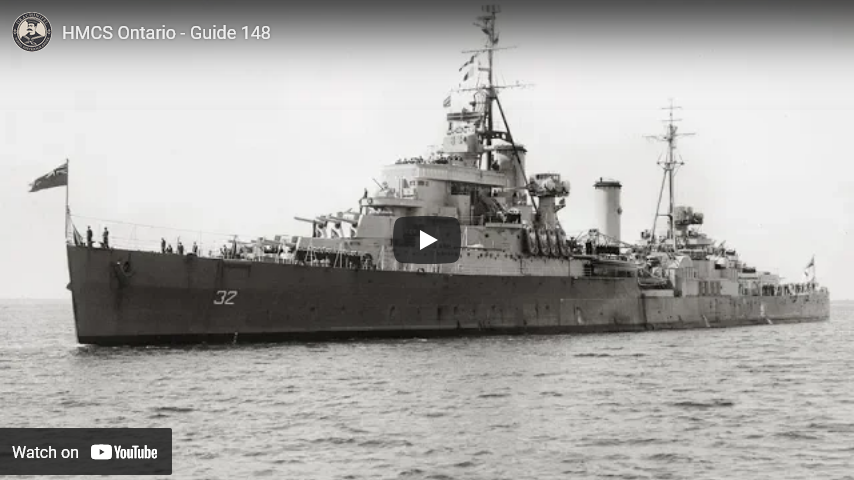
HMCS Ontario – Guide 148
Drachinifel
Published 12 Oct 2019HMCS Ontario, last of Canada’s cruisers and a Minotaur class vessel, is the second subject of the day.
Want to support the channel? – https://www.patreon.com/Drachinifel
Want a shirt/mug/hoodie – https://shop.spreadshirt.com/drachini…
Want a medal? – https://www.etsy.com/uk/shop/Drachinifel
Want to talk about ships? https://discord.gg/TYu88mt
Want to get some books? www.amazon.co.uk/shop/drachinifel
Drydock Episodes in podcast format – https://soundcloud.com/user-21912004
QotD: Breaking the trench stalemate with strategic air power
What no one could have known in WWI was not merely that the technology for effective conventional strategic bombing wasn’t ready, but that it would probably never be ready. Interwar air-power theorists, seeing the potential of strategic airpower to bypass the trench stalemate by flying over it began to try to work out how this would be done. Giulio Douhet (1869-1930) argued that future wars would be fought and won in the air, with fleets of bombers using high explosives and chemical weapons to massacre enemy civilian centers, until civilians forced their governments to surrender. Douhet was not alone; his vision of airpower as shared, for instance, by the “father of the RAF”, Hugh Trenchard (1873-1956).
This concept, “morale bombing” as it is sometimes called, probably deserves its own post discussing its failures. But in brief, the concept was tested, with far larger amounts of bombs than Douhet or any other interwar theorist could have ever dreamed of, during WWII. The argument by air theorists that high altitude bombers could not be stopped was proved false when the British did exactly this, stopping German bombers over Britain in 1940. Moreover, terror bombing against civilian targets in Britain didn’t lead to surrender, but hardened resolve. Likewise, “morale” bombing against German targets by the allies didn’t lead to surrender, but hardened resolve. Later efforts to demoralize the North Vietnamese through a American bombing campaign in the Vietnam War didn’t lead to surrender, but hardened resolve. More recent efforts to demoralize or destroy terrorists and the Taliban through the use of airpower hasn’t lead to surrender, but rather hardened resolve. Likewise, efforts by the Syrian regime to defeat various opposition groups in Syria through the use of chemical weapon-based terror bombing didn’t lead to surrender (siege-and-starve tactics did), but hardened resolve.
It turns out the fundamental premise of the entire idea of morale bombing – that being bombed will make people want to stop fighting – was flawed. Morale bombing has been, depending on how hard you squint at the US air campaign over Japan in WWII (including the use of nuclear weapons) successful either once (out of many attempts) or never. In most cases, the sustained bombing of civilian centers has been shown to increase a population’s willingness to resist, making the strategy worse than useless.
The case for strategic bombing against industrial targets is marginally better, but only marginally. While airpower advocates, particularly in the United States promised throughout WWII that bombing campaigns against German industry could lead to the collapse of the German war machine, in the end many historians posit that the real achievement of the campaign was to lure the Luftwaffe into the air where it could be destroyed, thus denying the German army of air cover and close air support, particularly on the Eastern Front. Some dimunition of German industrial capabilities was accomplished (though it is not clear that this ever approached the vast resources poured into producing the large numbers of extremely expensive bombers used to do it, though the allies had such an industrial advantage over Germany, forcing the Germans to fight in expensive ways in the sky was a winning trade anyway), but the collapse of German industry never happened. As Richard Overy notes, German industrial output continued to rise during strategic bombing and only began to fall as a result of the loss of territory on the ground. Needless to say, “strategic bombing can sucker the enemy into wasting their close air support” was not the result that airpower advocates had promised, nor could it have broken the stalemate.
I don’t want to oversimplify the continued debate over the efficacy of strategic airpower here too much so let’s just say that the jury is still very much out as to if strategic airpower works even with modern technology; it certainly wouldn’t have worked with WWI era technology.
Bret Devereaux, “Collections: No Man’s Land, Part II: Breaking the Stalemate”, A Collection of Unmitigated Pedantry, 2021-09-24.
June 25, 2022
The Public Choice Model in … grand strategy?
One of the readers of Scott Alexander’s Astral Codex Ten has contributed a review of Public Choice Theory and the Illusion of Grand Strategy by Richard Hanania. This is one of perhaps a dozen or so anonymous reviews that Scott publishes every year with the readers voting for the best review and the names of the contributors withheld until after the voting is finished:
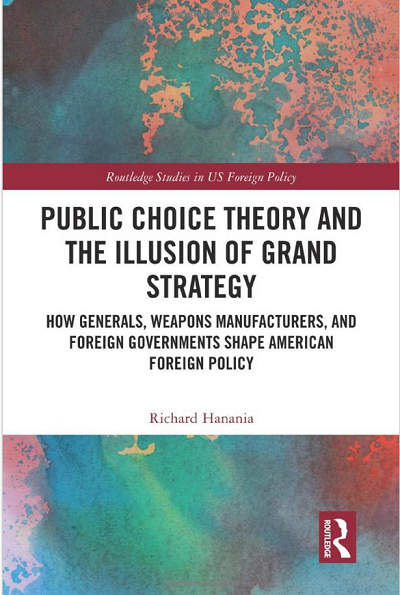
[In Public Choice Theory And The Illusion Of Grand Strategy], Richard Hanania details how a public choice model (imported from public choice theory in economics) can explain the United States’ incoherent foreign policy much better than the unitary actor model (imported from rational choice theory in economics) that underlies the illusion of American grand strategy in international relations (IR), in particular the dominant school of realism. As the subtitle “How Generals, Weapons Manufacturers, and Foreign Governments Shape American Foreign Policy” suggests, American foreign policy is driven by special interest groups, which results in millions of deaths for no good reason.
In the unitary actor model, the primary unit of analysis of inter-state relations is the state as a monolithic agent capable of making rational decisions (forming coherent, long-term “grand strategy”) from cost-benefit analysis based on preference ranking and expected “national interest” maximisation.
In the public choice model, small special-interest groups that reap a large proportion of the benefits from a policy (concentrated interests) are much more incentivised to lobby for a policy than the general public who pay for a negligible portion of the cost of the policy (diffused interests) are incentivised to lobby against. The former can coordinate much easier than the latter that has to overcome rational ignorance (the cost of educating oneself about foreign policy outweighs any benefit an one can expect to gain as individual citizens cannot affect foreign policy) and the society-wide collective action problem (irrational for every citizen to cooperate in the prisoner’s dilemma especially if individual gain is negligible) resulting in inefficient (not-public-good-maximising) policymaking i.e. government failure.
And more specifically on the use of Public Choice Theory:
Public choice theory was developed to understand domestic politics, but Hanania argues that public choice is actually even more useful in understanding foreign policy.
First, national defence is “the quintessential public good” in that the taxpayers who pay for “national security” compose a diffuse interest group, while those who profit from it form concentrated interests. This calls into question the assumption that American national security is directly proportional to its military spending (America spends more on defence than most of the rest of the world combined).
Second, the public is ignorant of foreign affairs, so those who control the flow of information have excess influence. Even politicians and bureaucrats are ignorant, for example most(!) counterterrorism officials — the chief of the FBI’s national security branch and a seven-term congressman then serving as the vice chairman of a House intelligence subcommittee, did not know the difference between Sunnis and Shiites. The same favoured interests exert influence at all levels of society, including at the top, for example intelligence agencies are discounted if they contradict what leaders think they know through personal contacts and publicly available material, as was the case in the run-up to the Iraq War.
Third, unlike policy areas like education, it is legitimate for governments to declare certain foreign affairs information to be classified i.e. the public has no right to know. Top officials leaking classified information to the press is normal practice, so they can be extremely selective in manipulating public knowledge.
Fourth, it’s difficult to know who possesses genuine expertise, so foreign policy discourse is prone to capture by special interests. History runs only once — the cause and effect in foreign policy are hard to generalise into measurable forecasts; as demonstrated by Tetlock’s superforecasters, geopolitical experts are worse than informed laymen at predicting world events. Unlike those who have fought the tobacco companies that denied the harms of smoking, or oil companies that denied global warming, the opponents of interventionists may never be able to muster evidence clear enough to win against those in power with special interests backing.
Hanania’s special interest groups are the usual suspects: government contractors (weapons manufacturers [1]), the national security establishment (the Pentagon [2]), and foreign governments [3] (not limited to electoral intervention).
What doesn’t have comparable influence is business interests as argued by IR theorists. Unlike weapons manufacturers, other business interests have to overcome the collective action problem, especially when some businesses benefit from protectionism. By interfering in a foreign state, the US may build a stable capitalist system propitious for multinationals, but can conversely cause a greater degree of instability and make it impossible to do business there; when business interests are unsure what the impact of a foreign policy will be for their bottom line, they should be more likely to focus their lobbying efforts elsewhere.
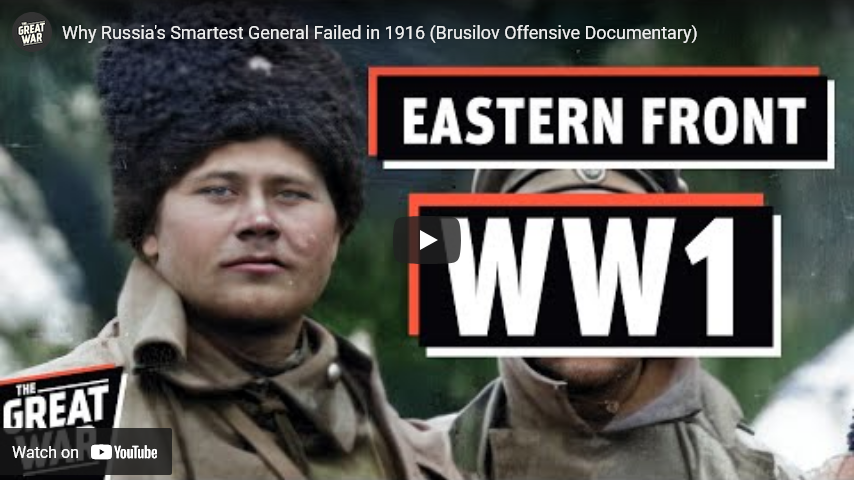
Why Russia’s Smartest General Failed in 1916 (the Brusilov Offensive)
The Great War
Published 24 Jun 2022Sign up for Curiosity Stream and get Nebula bundled in and SAVE 26%:
https://curiositystream.com/thegreatwarThe start of the Brusilov Offensive was the most successful Russian military operation during the First World War. It crippled the Austro-Hungarian Army and forced the Germans to divert troops from Verdun. But the Brusilov Offensive ultimately was a failure and cost the Russians an enormous number of men. What went wrong?
» SUPPORT THE CHANNEL
Patreon: https://www.patreon.com/realtimehistory» THANKS TO OUR CO-PRODUCERS
John Ozment, James Darcangelo, Jacob Carter Landt, Thomas Brendan, Kurt Gillies, Scott Deederly, John Belland, Adam Smith, Taylor Allen, Rustem Sharipov, Christoph Wolf, Simen Røste, Marcus Bondura, Ramon Rijkhoek, Theodore Patrick Shannon, Philip Schoffman, Avi Woolf, Emile Bouffard, William Kincade, Daniel L Garza, Stefan Weiß, Matt Barnes, Chris Daley, Marco Kuhnert, Simdoom» SOURCES
Buttar, Prit, Russia’s Last Gasp: The Eastern Front 1916-1917, (Oxford: Osprey Publishing, 2016)Dowling, Timothy C., The Brusilov Offensive, (Indianapolis: Indiana University Press, 2008)
Golovin, Nicholas, “Brusilov’s Offensive: The Galician Battle of 1916”, The Slavonic and East European Review, Volume 13, Number 39, (1935)
Schindler, John, “Steamrollered in Galicia: The Austro-Hungarian Army and the Brusilov Offensive, 1916”, War in History, Volume 10, Number 1, (2003)
Stone, David R., The Russian Army in the Great War: The Eastern Front, 1914-1917, (Lawrence, KS: University Press of Kansas, 2015)
Tunstall, Graydon A., “Austria-Hungary and the Brusilov Offensive of 1916”, The Historian, Volume 70, Issue 1, (2008)
Uzefovich, Alexis M., “Russia in the World War, 1914-1918”, The Military Engineer, Volume 33, Number 190, (1941)
» OUR SISTER CHANNEL
https://youtube.com/realtimehistory»CREDITS
Presented by: Jesse Alexander
Written by: Jesse Alexander
Director: Toni Steller & Florian Wittig
Director of Photography: Toni Steller
Sound: Toni Steller
Editing: Toni Steller
Motion Design: Toni Steller
Mixing, Mastering & Sound Design: http://above-zero.com
Research by: Jesse Alexander
Fact checking: Florian WittigChannel Design: Yves Thimian
Contains licensed material by getty images
Maps: MapTiler/OpenStreetMap Contributors & GEOlayers3
All rights reserved – Real Time History GmbH 2022
Kenneth Whyte announces the Sutherland House Prize
If the Canada Council for the Arts — the most important prize-awarding organization in Canadian literature — decides to ignore the majority of works of history in their award schemes, what can the Canadian literary community do about it? Sutherland House reacts by creating their own prize for those works deemed no longer prize-worthy by the Canada Council:

Almost from the start of this newsletter in May 2019, we’ve been concerned with the crisis in Canadian nonfiction publishing.
It began with our realization (SHuSH 10 and SHuSH 17) that the Canada Council had decided that books relying primarily on facts as opposed to the author’s voice are not art. Personal history, personal memoir, personal essay meet the Canada Council’s standard for art and are therefore eligible for grants and awards. Objective fact-based journalism, essays, histories, biographies, business and science writing, not so much.
We were bothered by the notion that the distance an author chooses to take from a subject (first person, say, versus third-person) is what makes or breaks a work of art. Same goes for an author’s fidelity, or lack thereof, to verifiable fact.
It also seemed bonkers that a government agency like the Canada Council would bail on researched nonfiction in favor of works in which the subjective experience of the writer is primary at a time when the rest of the government was so panicked over the lack of reliable fact-based information in the public sphere that it was pumping more than $500 million into our failing newspaper chains. If Ottawa was genuinely concerned about the quality of public discourse in Canada and the information available to the electorate, it would be directing the Canada Council to rescind its policy and support fact-based nonfiction to the same levels as fiction, poetry, and personal literature.
SHuSH pursued the issue. We explained why Canada Council funding matters: most publishers in Canada would be out of business or much reduced without their grants, so they naturally produce books that keep them in the money. Researched nonfiction is expensive and time-consuming to produce at the best of times; when it’s relatively disadvantaged by arts funders, it begins to disappear. It’s no accident that the shortlists of all the major nonfiction prizes in Canada have been dominated by memoir in recent years.
(We’ve always been at pains to add that we have nothing against memoir — we publish our share — but it is no substitute for well-researched, fact-based nonfiction. We need investigative journalism, history, biography, politics, current affairs, science & health books if we’re going to understand ourselves and our times.)
Colonial Berthiers: 1902 Indochina and 1907 Senegalese
Forgotten Weapons
Published 21 Jul 2017http://www.patreon.com/ForgottenWeapons
The sharpshooters of the French colonial forces in Indochina (the Tirailleurs Indochinois) had never been issued Lebel rifles, and were still using single shot Gras rifles at the turn of the century. The Indochinese soldiers were rather short statured, and the Lebel was simply too long for them to use efficiently. The colonial government requested a special weapon for these men, and the result was the 1902 Berthier.
The Berthier carbine was much more compact than the Lebel, and it was also less expensive to manufacture and simpler to instruct troops with. So after some brief experimentation, a version was produced with a 25 inch (635mm) long barrel, which was a nice balance between the carbines and the Lebel rifle. In my opinion, the 1902 is the ideal size for a Berthier, and I think it handles best of all the different variations made.
An initial production run of 22,500 of these 1902 rifles was made by Chatellerault between 1902 and 1912. A second batch of about 25,000 more would be produced in the 1920s, but we will discuss these in a separate video, as they incorporated the 1916 upgrades.
With the successful implementation of the Berthier in the Indochinese colonial forces, it would stand out as an obvious solution for the need to upgrade the arms of France’s African colonial troops as well. These soldiers were not short, but also had outdated Gras rifles, and Lebel production was no longer active by 1907. As a result, a further lengthened Berthier was suggested for the Senegalese troops, with a barrel 31.5 inches (800mm) long; equal to that of the Lebel. This was accepted into service, and 25,000 were manufactured by Chatellerault between 1907 and the beginning of the Great War in 1914.
With the urgent need for more rifles because of World War One, the 1907 Berthier (renamed to the 1907 Colonial and issued to colonial troops besides just the Senegalese as of 1908) would attract the interest of the military because it was cheaper to manufacture than the Lebel, and still in active production. The result would be the 07/15 Berthier, which would become a dual standard infantry rifle alongside the 1886 Lebel in the war.
If you enjoy Forgotten Weapons, check out its sister channel, InRangeTV! http://www.youtube.com/InRangeTVShow

QotD: The Left’s long march through the institutions
Once they were in, they of course credentialized everything, such that the cultural-transmission professions — journalism, education, even art and music — suddenly required college training … and all the trainers were Reds. Ever wonder why you seemingly have to have a fucking Master’s Degree to get your lit-wank novel published? Seriously: read the author bio of any of the flavor-of-the-minute wunderkinder that get their painfully quirky dreck blurbed in the New York Times Review of Books — every blessed one of them has some kind of advanced degree in “creative writing”. All those graduate-level “creative writing” programs aren’t just make-work for otherwise unemployable Eng-Lit PhDs, in other words. They’re what the Union of Soviet Writers was in the USSR: The guarantors of politically-reliable content.
That’s the setup. Ready for the twist?
They won, but they don’t know it. Not only was the Revolution televised, it’s still being televised, 24 hours a day, on 587+ satellite cable channels and umpteen digital streaming services. Eugene V. Debs’s wettest wet dream couldn’t compare to Current Year America. The SJWs are like the Seekers, out there desperately trying to prepare the world for the UFOs … but the UFO already landed in their backyard, and they were too busy trying to save the world to see it.
That’s why widespread political violence is inevitable, and damn soon. Nancy Pelosi may be the nastiest evil old bitch to ever slime through the halls of Congress, but she’s not stupid. She’s just in an impossible situation. She’s the leader of an organization that didn’t manage its True Believers, and now she’s fucked either way. […]
That’s what the old-school Commies didn’t see coming. Those poor deluded fools really thought that “intellectual” was an adjective. The Russian word for the noun version is intelligentsia, and they gave the Soviet Union no end of trouble — Stalin had to send boxcars of them to Siberia fairly regularly to keep them in line. In the West, though, they really thought that you can have an “intellectual” steelworker, or dockhand, or farmer, and the like. They were counting on it, in fact — see “community colleges were all Red fronts”, above.
Instead, “intellectual” is the True Believer’s self-chosen job description. You can meet some fearsomely learned people in your day-to-day, but the only people you’ll ever meet who use the word “intellectual” without sneering are Media types and their panty-sniffers in the ivory tower. They’re extremely useful idiots, which is why none of Palsy Pelosi’s predecessors sent them to Siberia like they should’ve. And now it’s too late.
Severian, “If the UFO Actually Comes, Part II”, Rotten Chestnuts, 2019-09-26.
June 24, 2022
“… most of the ‘mental health crisis’ is just loneliness”
Ed West believes we’re suffering so many social ailments because we’re social creatures, evolutionarily speaking, and modern society has reduced or eliminated so many traditional community social gatherings — made far, far worse by arbitrary lockdown rules and harsh enforcement during the Wuhan Coronavirus panicdemic. He’s talking specifically about Britain and Europe, but the same definitely applies here in North America:
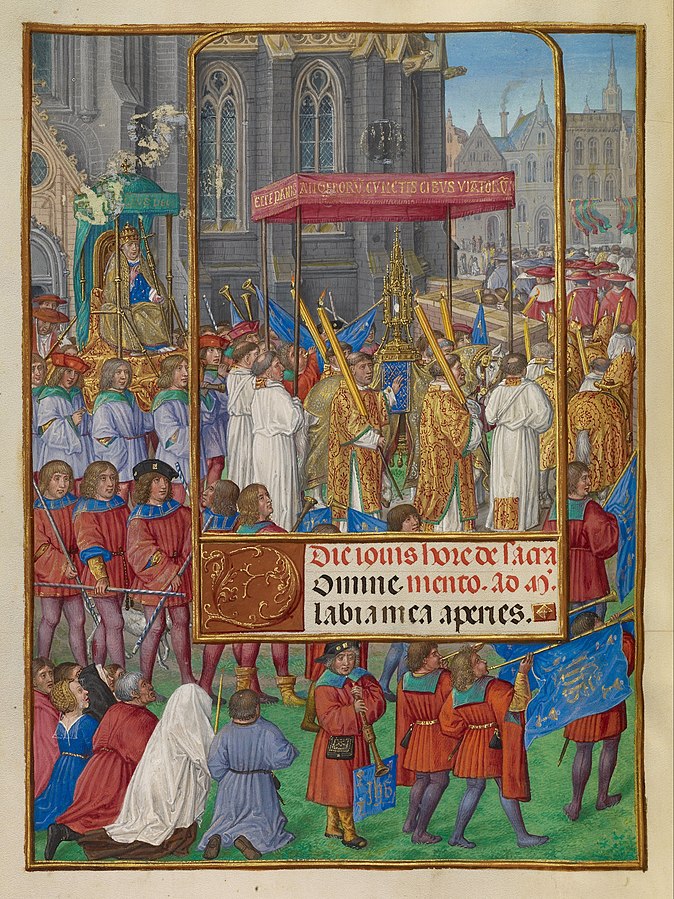
“Procession for Corpus Christi” attributed to Master of James IV of Scotland (Flemish, before 1465 – about 1541), illuminator.
Original illumination in the Getty Center Collection via Wikimedia Commons.
Last week, for example, most of continental Europe got a holiday to mark Corpus Christi, once a huge event in England but killed off by the Reformation. Why can’t we have a holiday too? It was 27 degrees in London last Thursday — it would have been great.
We’re all aware, on some subconscious level, that there is a need for communal feasts and holidays, and in some ways the idea of a June procession to celebrate the official religion has made a comeback with Pride. The feast-shaped hole in our lives is why, from time to time, the great and the good come up with very boring ideas for substitutes feasts, the latest being “Celebration Day”. The idea is for “one day in the year when we can all take a pause in our busy lives to reflect, remember and celebrate the lives of people no longer here”. You mean, like the feast of All Saints’ and All Souls’, which again was a huge part of our calendar once and is still marked in Catholic countries? Like that one?
[…]
Contrary to the fashionable Noughties takes about the evils of supernatural belief, religion has huge psychological benefits. There is a vast array of evidence showing that attending religious ceremonies increases dopamine responses in the brain. Overcoming our fear of death is not even the key part; it is meeting other people and taking part in a common ritual, which has huge benefits, including reduced risk of suicide or addiction. Religious attendance is “associated with lower psychological distress” and “related to higher well-being”.
Modernity, diet and substance abuse may have slightly increased rates of extreme mental illness such as schizophrenia, while social media has allowed people with personality disorders to become prevalent, especially in politics. But most of the “mental health crisis” is just loneliness. People attend fewer communal events because of the decline of religion, they see other people less regularly and they have fewer friends — of course they’re unhappy! Humans are not just social mammals, we are ultra-social by the standards of other species; that’s why we need common rituals and why we’re chasing that religious feeling everywhere and can’t find it. It is why, as Madeline Grant wrote in the Telegraph this week, that as well as progressive institutions adopting religious-type feasts, even exercise classes increasingly resemble Mass.
Lockdown, traumatic though it was, was merely an extreme version of the trend towards solitude already underway (with working from home, online shopping and various other lockdown activities on the rise before 2020). Most traditional societies would consider our everyday lives in non-Covid times to be a form of lockdown, with historically very unusual levels of isolation. That is why the extreme loneliness of lockdown gave rise to ersatz rituals such as Clap for Carers.
Yet you just can’t beat the real thing. As Parker wrote at the time, ritual decline was a real sadness in our lives: “From the Middle Ages until the first half of the 20th century, Whitsun and the week that followed was the chief summer holiday of the year in Britain. It was a time for all kinds of communal merry-making, varying over the centuries but consistent in spirit: the season for feasts and fairs, dancing and drinking, school and church processions, and generally having a good time.”


