
World War Two
Published 25 Jun 2026Magda Goebbels was one of the most infamous women in Hitler’s inner circle. Known as the wife of Nazi Propaganda Minister Joseph Goebbels and often treated as an unofficial “First Lady” of the Third Reich, she helped project an image of family, elegance, and loyalty while standing beside one of history’s most murderous regimes. But her story ends in one of the darkest acts of the Second World War.
As Berlin collapsed in 1945, Magda Goebbels took her six children into Hitler’s Führerbunker. Offered chances to escape, she refused. One day after Hitler’s suicide, she helped murder her own children with cyanide, claiming that a world without National Socialism was not worth living in.
In this episode of our new format, Baddies and Battleaxes, Anna Deinhard returns to tell the story of Magda Goebbels: socialite, Nazi fanatic, mother, accomplice, and child murderer. Her life reveals how women in the Third Reich were not always passive bystanders. Some, like Magda, actively embraced Nazi ideology, helped legitimize the regime, and chose loyalty to Hitler over humanity itself.
This is the story of the Nazi “First Lady” who followed fascism all the way into the bunker.
Who should Anna cover next in Baddies and Battleaxes? Tell us which heroines and villainesses of WW2 you want to see in a future episode.
June 26, 2026
Magda Goebbels: The Nazi Mother Who Murdered Her Children
No “capital formation”, please: we’re Canadian
On the social media site formerly known as Twitter, L. Wayne Mathison identifies one of the biggest reasons the Canadian economy is falling ever further behind other industrialized nations:
AI-generated image from L. Wayne Mathison
Canada does not have a talent shortage.
It has a capital formation shortage.
In Q1 2026, Canada managed one growth-stage VC deal. One. Worth $1M.
That is lemonade-stand money in a global tech race.
The U.S. pulled in $267.2B in VC investment. Capital is not confused. It goes where risk is rewarded, scale is possible, and success is not treated like a moral offence.
Carney and the Liberals keep talking about “building the economy” while presiding over a country where founders raise seed money here, then scale somewhere else.
That is the real brain drain.
Not just doctors. Not just engineers. Builders. Founders. Investors. People who can turn ideas into payrolls.
They look at Canada and see taxes, red tape, weak productivity, political favouritism, and a government more interested in managing decline than getting out of the way.
Carney was sold as the adult in the room. OK. Then explain this: why is Canada producing press releases while the Americans are producing companies?
Because capital can smell fear.
And right now, Canada smells like a country that punishes ambition, subsidizes failure, and calls it fairness.

Sparta vs Athens 2(c): Spartan Childhood – The Agōgē, Infant Inspection, and State Brutality
seangabb
Published 8 Feb 2026Greece: A Brief History, c.700 BC – 500 AD
This segment goes straight to the ancient evidence. Using Plutarch’s Life of Lycurgus (with the passages shown on-screen), I explain how Sparta understood itself: infant inspection and exposure, the collective upbringing of boys in the agōgē, deliberate hunger and deprivation, enforced endurance, and the suppression of private loyalties in favour of loyalty to the state.
This is not presented as scandal. Plutarch often writes admiringly, which is precisely why the text is so revealing. The system is coherent. It is also terrifying. Sparta did not merely train soldiers. It manufactured them, beginning at birth.
QotD: The submarine war against Japan
The Second World War witnessed two concurrent campaigns by which submarines were used in an attempt to economically isolate and degrade an island nation enemy. One of these attempts was remarkably successful. In the Pacific, US Submariners sunk millions of tons of Japanese shipping — more shipping, in fact, than Japan had possessed at the outbreak of war. A brutally effective submarine campaign against Japanese tankers affected a near perfect starvation of Japan’s war machine: after intaking 40% of East Indies crude production in 1942, only 5% would reach Japanese shores in 1944. This was a cataclysmic decline which Japan could not survive, owed largely to the 155 tankers sunk by American submarines in 1943 and 1944. In the final year of the war, American boats were able to undertake the ultimate dream of submarine theorists: a close blockade of the Japanese home islands, with American submariners prowling practically every inlet and bay.
The success of the American submarine campaign was genuinely astonishing, and created a near perfect asphyxiation of the Japanese war economy, with imports of virtually every vital industrial input plummeting to near zero by 1944. Admiral Charles Lockwood, who commanded the Submarine Force Pacific Fleet, was probably only slightly boasting when he later told an instructor at the Naval Academy:
Now don’t teach those midshipmen that the submariners won the war. We know there were other forces fighting there, too. But if they kept the surface forces and the flyboys out of our patrol areas we would have won the war six months earlier.
Despite the phenomenal success of America’s submarine operations against Japan, the American war on Japanese shipping generally receives scant attention. To take just one example, Francis Pike’s magisterial and colossal tome on the Pacific War relegates American submarine operations to an appendix. In contrast, there is an astonishing volume of literature devoted to the war’s other grand submarine campaign: the so-called Battle of the Atlantic. Germany’s famous U-boats attempted a similarly strategic interdiction war against shipping to the British home isles. Unlike the American submarine force in the Pacific, however, the U-boats failed.
Big Serge, “Wolf Packs: Battle of the Atlantic”, Big Serge Thought, 2025-12-12.
June 25, 2026
Credit card fee cap: a great idea, with the best of intentions … what possibly could go wrong?
Nobody likes credit card fees — except the banks that issue credit cards — so politicians figure that they can please the voters at no cost and mandate limits to the fees that credit card companies can charge. But who is going to suffer for this “at no cost” bit of rule-making?

“Credit Cards” by Sean MacEntee is licensed under CC BY 2.0 
 .
.
Two years ago, Illinois passed crowd-pleasing restrictions on credit card interchange fees, which are better known as “swipe fees”. The ban on charging fees on processing payments for tips and taxes has now been delayed twice by skeptical federal judges and lawmakers worried that they’ve crafted a financial mess. These interventions may be saving the state from itself, as a new report points out that the law threatens to hurt consumers, small retailers, and local financial institutions.
Delayed Ban on Fees for Processing Taxes and Tips
Passed as part of a 2024 revenue bill, the Interchange Fee Prohibition Act (IFPA) defines “interchange fee” as “a fee established, charged, or received by a payment card network for the purpose of compensating the issuer for its involvement in an electronic payment transaction”. It adds: “An issuer, a payment card network, an acquirer bank, or a processor may not receive or charge a merchant any interchange fee on the tax amount or gratuity of an electronic payment transaction if the merchant informs the acquirer bank or its designee of the tax or gratuity amount as part of the authorization or settlement process for the electronic payment transaction”.
“Although merchants have long advocated for this change, banking and payment industry representatives argue that it imposes an undue hardship by forcing them to process certain components of transactions without compensation,” attorneys Thomas V. Panoff and Maxwell Earp-Thomas noted for the National Law Review at the time. They also commented that the law could force Illinois payments to be processed differently than those originating in the rest of the country and the world beyond.
The situation is now being fought in court and in public between advocates who argue the fees are hidden costs and opponents who say they’re an industry-standard means to cover the cost of business.
[…]
Overall, Illinois lawmakers’ attempt to please the crowd by mandating lower costs looks poised to create a mess that could leave the state’s consumers, small banks, and retailers with higher costs and fewer choices if financial institutions leave to avoid headaches.
“To protect the integrity of the checkout experience and avoid driving financial providers from the Illinois market, the IFPA must be either repealed or overturned”, concludes Swedberg.
Credit card fees are undoubtedly burdensome for consumers and retailers. Ultimately the best way to avoid them is the traditional way: Use cash.
Passively shaping public opinion is one of big tech’s favourite techniques
In the portion of this post above the paywall, Celina shows a good example of how social engineering doesn’t have to be blatant to be effective:
Before reading further, open a new browser tab and type the search term “married white woman” into Google Images. Scroll through the first several rows of results. What do you see?
The output which is consistently replicated across different devices and geographic locations is a deluge of mixed-race couples. The output is overwhelmingly dominated by images of white women intimately paired with black or non-white men. To the casual observer passively consuming this digital output, the presentation establishes an immediate baseline for normalcy. The volume and priority of these specific demographic pairings create the distinct impression that such relationships are the standard, ubiquitous, and foundational reality of modern Western society.
Yet, when we contrast this algorithmic simulation with reality, a massive discrepancy emerges. Statistically, interracial marriages remain a distinct minority of overall unions in the United States and across the broader Western world. According to comprehensive data from the Pew Research Center, in 2020, only 11% of all married couples in the United States were interracial or interethnic. When we drill down into the specific pairing that dominates the aforementioned image search, the numbers shrink even further. Marriages specifically between a white woman and a black man account for a mere 7% of that already small 11% sliver of intermarriages. In absolute terms, out of over 51 million married white women in the United States, less than 1% are married to black men.
Despite this statistical rarity, the digital simulation feels entirely “normal” to the modern consumer because media giants like Google, alongside massive stock photography conglomerates like Getty Images and Shutterstock, consciously and relentlessly curate it that way. This immense disparity between reality is the result of neutral, blind code cataloging human existence. It is an intentional act of social enforcement, by artificially elevating specific demographic pairings, media platforms execute a subtle but pervasive socio-cultural engineering project.
It can thus be argued that this engineered visual output serves a distinct ideological purpose: pushing European women toward demographic change and eroding the visual primacy of the homogeneous nuclear family that built and sustained Western nation-states for centuries. When digital representations are manipulated to consistently overwrite physical realities, a significant ontological shift occurs within the host population. The native majority is conditioned to view their own demographic decline as an organic, inevitable, and morally righteous progression. This forces us to confront the question: If images precede and dictate reality, who is engineering our extinction?


I’m long out of the habit of watching TV, so when the NFL season gets started and I’m presented with three-plus hours per week of commercial TV to watch my favourite team play, I can’t help but notice that most commercials that include representations of married couples are inter-racial or non-white. The advertisers are also presenting a small minority of marriages in North America as being the overwhelming majority in their TV ads. Why might they want to do that?
Formerly Peru’s First Lady, Keiko Fujimori is now President in her own right
The new President of Peru, Keiko Fujimori, faces a big economic challenge to her nation:

With just over 99% of ballots counted, Keiko Fujimori holds a lead of roughly 40,000 votes over Roberto Sánchez — less than half a percentage point, and the third consecutive Peruvian presidential contest decided by a margin that narrow. Sánchez led through the early days of counting, carried by rural and highland turnout; but the overseas votes, which broke for Fujimori above 63%, pulled the result the other way as the tally crossed 95%.
The outcome is no longer seriously in doubt. What remains in doubt is whether a victory this narrow constitutes a mandate to govern, or merely a turn to occupy the office in impotence.
Fujimori has never held executive power. What she inherits, however, is a name: her father, Alberto Fujimori, governed Peru from 1990 to 2000, stabilizing a hyperinflationary economy and crushing the Shining Path insurgency, albeit with darkly authoritarian techniques for which he was later convicted. Long known as Peru’s answer to Venezuela’s Hugo Chávez, Fujimori has cast a long shadow over Peruvian politics ever since.
Keiko served as his First Lady through the latter half of the 1990s, then built her own career: a congresswoman from 2006 to 2011, and the leader of Fuerza Popular (“Popular Force”) since. She spent 13 months in pretrial detention on corruption charges tied to Odebrecht financing; a court voided the case in January 2025. She has run for president four times, losing the previous three runoffs by margins under a single percentage point before, now, winning her fourth.
Her governing history is, as a result, tied deeply to her father’s. She has spent two decades defending it rather than living it, which is itself a kind of qualification in a country where economic memory often prevails over institutional memory. The model her father installed — trade liberalization, fiscal orthodoxy, an open door to foreign capital — has outlasted eight changes of president in ten years. The claims of Fujimorismo — the governing-economic doctrine named for Fujimori that has dominated ever since his time — is that it alone can be trusted to keep that model standing.
Keiko Fujimori’s flagship commitments are, consequently, the two pillars of Fujimorismo itself: a hard line on crime, and an unapologetic defense of the market economy.
The security platform proposes deploying the military against organized crime and prison disorder, taking inspiration both from Peru’s own recent past, and Nayib Bukele’s divisive tactics in El Salvador. Alongside this, the platform promises expanding video surveillance, and modernizing this apparatus through the use of artificial intelligence to detect corruption in public contracting. She insists that her father’s system’s abuses will not be repeated.
The economic platform is a much-needed deregulatory shock: cutting investment-approval timelines by 40%, reducing the fiscal deficit from 2.2% to 1% of GDP, and shrinking the state. As for exactly how that shrinking will be achieved besides the aforementioned measures, Keiko is not clear.
Nevertheless, both pillars of the plan were sold on a single word, repeated at her closing rally and in her final debate: order, against the chaos she says the left represents.
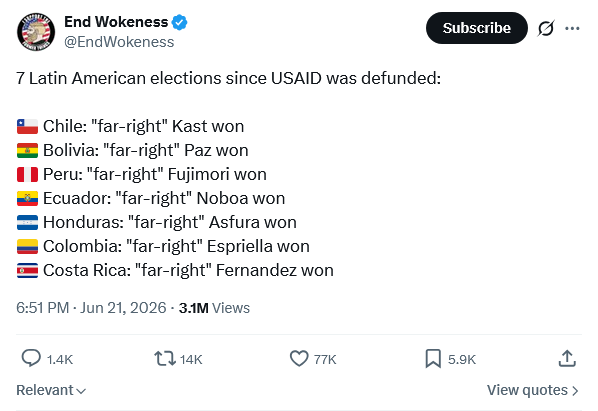
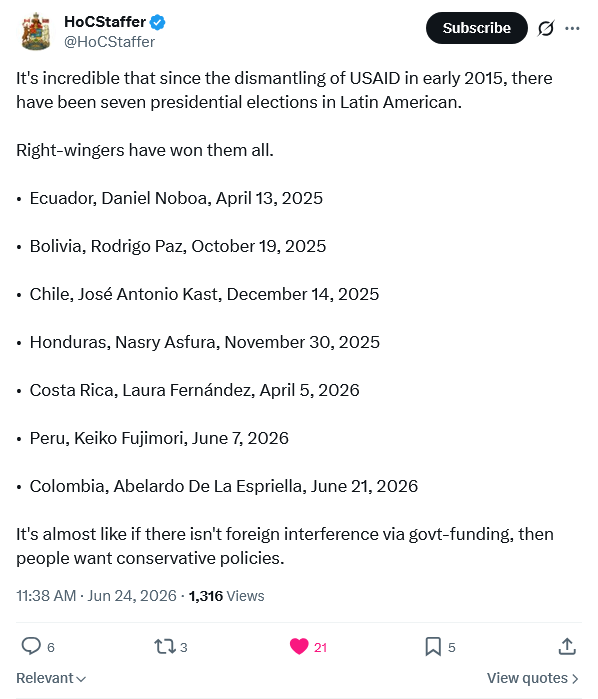
In counterpoint to recent claims that cutting USAID funding cost the lives of millions of children who depended on those funds, taking away USAID support in much of South America led to a number of electoral changes:
Why Britain voted for Brexit
Pat Condell explains some of the reasons British voters chose Brexit over staying in the EU back in 2016:

Why did we vote for Brexit ten years ago? Because we understood that the core purpose of the European Union is to destroy the independent countries of Europe by opening the borders and transforming a diverse continent of sovereign nations into a single homogenous political bloc governed by a committee of unelected bureaucrats, as a model for the planned global dictatorship.
Obviously, you’re not going to get many votes for that if you just lay it out for people, so you start with something innocuous like trade.
You say “Let’s harmonise our trade arrangements and everything will run more smoothly.”
And people say “Yes, that sounds like a good idea.”
Then you say “While we’re at it, let’s give this small group of people the power to organise all this from one place, and everything will run more smoothly.”
“Well, I suppose that makes sense. We want things to run smoothly.”
Then it’s “Actually, let’s give these people the power to make our laws and override our parliament and justice system, and everything will run much more smoothly.”
“Hold on a second, I don’t know about that …”
“You fascist. You racist. You xenophobe. You bigot. You pig ignorant little Englander. You vermin. You scum.”
Although that attitude certainly helped to tip the balance, the most important reason we voted for Brexit is that politicians had no right to sign away the governance of the UK to a foreign entity, but that is what they did, while pretending it was about trade. They lied to us, and they tried to cheat us out of our country.
That is why we voted for Brexit, and it’s why we’re now being punished for our disobedience by traitors who refuse to secure the border and who are allowing our country to be flooded with millions of unwanted and incompatible immigrants and illegally invaded and occupied by an army of dangerous military age men in whose presence no woman or child is safe.
Forced mass immigration from hostile and barbarous cultures is punishment for Brexit. Our country is being purposely destroyed for not voting the way we were told.
Coenders’ Bolt-Less Last Ditch Bolt Action Rifle
Forgotten Weapons
Published 4 Feb 2026When the German Army tested last-ditch Volkssturm rifles late in World War Two, one of the particularly obscure submissions was August Coenders’ Coenders-Rochling Volkssturmkarabiner. This was a bolt-action rifle chambered for 8mm Mauser with a 5-round magazine. However, instead of using a traditional bolt action system it had a fixed breechblock and the handle was attached to the barrel. Cycling the action meant unlocking the barrel and sliding it forward, while the breechblock held the fired case in place. When the barrel was fully forward, the next round in the magazine would kick out the empty case, and pull the barrel rearward seated the next cartridge, ready to fire. In testing, the rifle was, frankly, terrible.
Thanks to the Springfield Armory National Historic Site for giving me access to this unique specimen from their reference collection to film for you! Don’t miss the chance to visit the museum there if you have a day free in Springfield, Massachusetts: https://www.nps.gov/spar/index.htm
(more…)
QotD: Division of domestic work, 1970s onward
The Women’s Liberation Movement wanted many things in 1970, but one of the most important was freedom from “unpaid domestic servitude at home”.
Again, this is Straight Outta Engels, from 1884. Even back in 1970, we could all yell “Read another book!” Someone ought to rewrite The Origin of the Family, Private Property and the State with a few quidditch matches in it; it’d be on the bestseller list until the sun’s a cinder.
Half a century later, most women are still waiting for their freedom. Women still do far more domestic and care labour than men.
I find this extremely hard to believe. So I checked their source, which is a very scientific-sounding site called “The Conversation”. You’ll just have to click it for yourself, since I can’t figure out how to screenshot just the little graphic they have, but if you do, you’ll notice a couple things straight off:
First, this data is from Australia. Which is bullshit, because look, y’all, I’ve seen the Mad Max movies, and nobody’s doing any domestic labor in Australia. Their main settlement is ruled by Tina Turner, for fuck’s sake, and the Prime Minister runs around in a thong and a hockey mask. Sweet cars, though, I’ll give them that.
The other thing you’ll notice is that the “Australian Bureau of Statistics” — I’m pretty sure that’s the motorized hang glider guy — has obviously been having fun with the scalar functions in whatever post-apocalyptic version of Excel they’ve got down there. The bars for “did no unpaid domestic work” look dramatic … but they represent a mere seven point difference. (And do you see what I mean? Apparently 29% of Australian men, and 22% of Australian women, do no unpaid domestic labor whatsoever. By my math, that’s a quarter of the country stewing in its own filth. I know, I know … I’m amazed it’s that low).
The bars for “5-14 hours”, though, show a fractional difference: Women do a whopping 0.3% more. And again, this is Australia, but even if we assume that “unpaid domestic labor” is stuff like “wiping the blood from the somehow intact windshield of the last of the V-8 interceptors”, 5-14 hours is what you might call “the outer limits of normal for a working stiff”. Admittedly I live in a two-bedroom apartment, not a house, but I’m a bit of a neat freak, and “an hour a day” is about all I do. Vacuum the floors and scrub the toilets on Sunday, that’s two hours tops. I’ll be generous and say I spend another 3-4 doing the squeegee thing to my shower walls after I bathe, and loading the dishes in the washer, and giving the counters a quick wipedown once or twice a week, etc.
The real difference comes in the “15-29 hours” and “30 hours or more” categories, and you have to be very, very Smart indeed to find that “problematic”, since those are stay-at-home moms. In other words, they do that “unpaid domestic labor” by choice. Because “the care and feeding of the next generation”, not to mention “the deep, primal satisfaction one gets from seeing a little life grow that you helped create” don’t really count as pay.
Since the 1960s, more and more women have taken up paid employment, but a problem remains: how would their unpaid domestic work be replaced?
Gosh, that IS a problem! And as the Australians have shown us, the answer seems to be “just stew in your own filth”. It’s a solution America’s single gals, at least, seem to have embraced with kamikaze-level enthusiasm. Back in the days, I’d always insist on taking a girl back to my place, because condoms don’t cover the entire body and her place was always, and I do mean always, a certifiable biohazard. I’d rather do a striptease in Chernobyl’s reactor core than do anything in an American woman’s bedroom, and their bathrooms are pits of unspeakable Lovecraftian horror.
Severian, “SJWs Always Project”, Founding Questions, 2022-08-08.
June 24, 2026
The importance of proper maps on strategic thinking
CDR Salamander considers the use of maps — appropriate maps — to be critical for both military and civilian strategists. And the most common kind of map most people encounter is one of the worst, because it conceals more than it reveals:
If I am ever invited into someone’s personal study, office, or library — especially someone who puts themselves forward as a national security type — one of the things I not-so-subtly look for is maps, charts, or better yet, a globe.
Yes, I will judge you. It matters.
I have seen exceptionally credentialed and powerful uniformed and civilian leadership here and in Europe have an almost comical ignorance of the world in which they hold access to levers of almost unimaginable power. From a complete disinterest bordering on criminal unawareness of the bottom topography of the Baltic and Taiwan Strait, to not knowing where the Cape of Good Hope is, or even what a Great Circle Route is.
That kind of ignorance gets people killed.
They got their positions of power and influence for a whole host of reasons, but an understanding of geography and the ability to read a map was probably not one of them.
[…]
If someone says, “When you look at a map of the world …”, more likely than not, what will pop into your mind will be what is at the top of the post, the Mercator Projection.
That may be one of the contributing factors to inadequate strategic thinking in the modern age.
Of course, any attempt to represent a three-dimensional object on a two-dimensional format is going to create some problems.
You need multiple perspectives, and often the one that best serves in helping you understand the challenge of the moment.
As we continue to argue the point here, we don’t need a new force design, or national strategy, we need a national understanding.
We need to understand the fact we are a maritime and aerospace power, and those are the two domains where the majority of fighting in any war against the People’s Republic of China is going to take place.
It has a unique set of challenges that have nothing to do with politics, people, culture or anything from man; it has to do with the interface of land, water, time, and distance.
As we learned and then forgot from WWII, any war in the far reaches of the Pacific requires range, scale, and the logistics system that appreciates both and can sustain the fight forward.
[…]
What are the top-5 even the novice should get?
- AUKUS is a must-succeed. Don’t balk. Don’t stutter. Don’t be difficult. Make it work. It reinforces our left flank. Australia and the Philippines are our shield and redoubt.
- Taiwan is the stopper that keeps the PRC relatively contained. If you lose that, Guam is your new front line.
- A strong Japan and South Korea must be made stronger and closer. They are our right flank.
- What does the PRC want? Once you accept that they want everything from the line drawn from Alaska to New Zealand to their coast under their uncontested control, but are more than happy to let us have everything on the other side, then you understand what they have been doing for decades in the small island nations in the Southwest Pacific.
- People grow up with maps that emphasize Europe and the North Atlantic. This projection breaks that mental fixation, putting Europe and the North Atlantic in a minor corner of the map, almost an afterthought that barely catches the eye.
A slightly more recognizable version [of the Spilhaus Projection] is below.


This is why the media didn’t want to share the murderer’s manifesto
In short, it does not support the narrative. Ezra Levant shares the details of the manifesto left behind by an Alberta man after he killed a police officer in Côte-des-Neiges, a Jewish section of Montreal the other day:

READ HIS MANIFESTO: The Montreal murderer was a Jew-hating Communist censor
The murderer in Montreal has been named: Seth Hatfield, from Alberta. He murdered a policeman in a shooting spree in a Jewish neighbourhood in Montreal.
Soon afterwards, government journalists at the CBC and elsewhere started describing a manifesto that he had left behind. But none of them published the actual document — they just quoted the odd phrase from it, and called him an “incel”. That’s a term for someone who was “involuntarily celibate”, or someone who didn’t do well with women. The usual suspects were doing the media circuit claiming that Hatfield was a “right wing” extremist.
But if that was true, why was the manifesto being shown only to selected, government-friendly journalists? Why were the rest of us blocked from seeing it for ourselves?
Well, that just changed. Rebel News has acquired a copy of the full, 104-page manifesto. You can read it for yourself right here: https://rebelnews.com/manifesto_reveals_alleged_montreal_gunman_s_antisemitic_far_left_and_incel_ideology
It’s true that the murderer had extreme ideas about women. But that was only a small part of his world view. In most of the rest of his rambling remarks, he was indistinguishable from left-wing politicians like Bernie Sanders, Avi Lewis, or half the Liberal cabinet.
He praised Communism. He called for the abolition of private property. He railed against the Jews, and Zionism. And — like Mark Carney himself — he demanded the censorship of the Internet.
Read the manifesto of a crazed, left-wing extremist.
And never forget: the mainstream media lies to you about everything important.
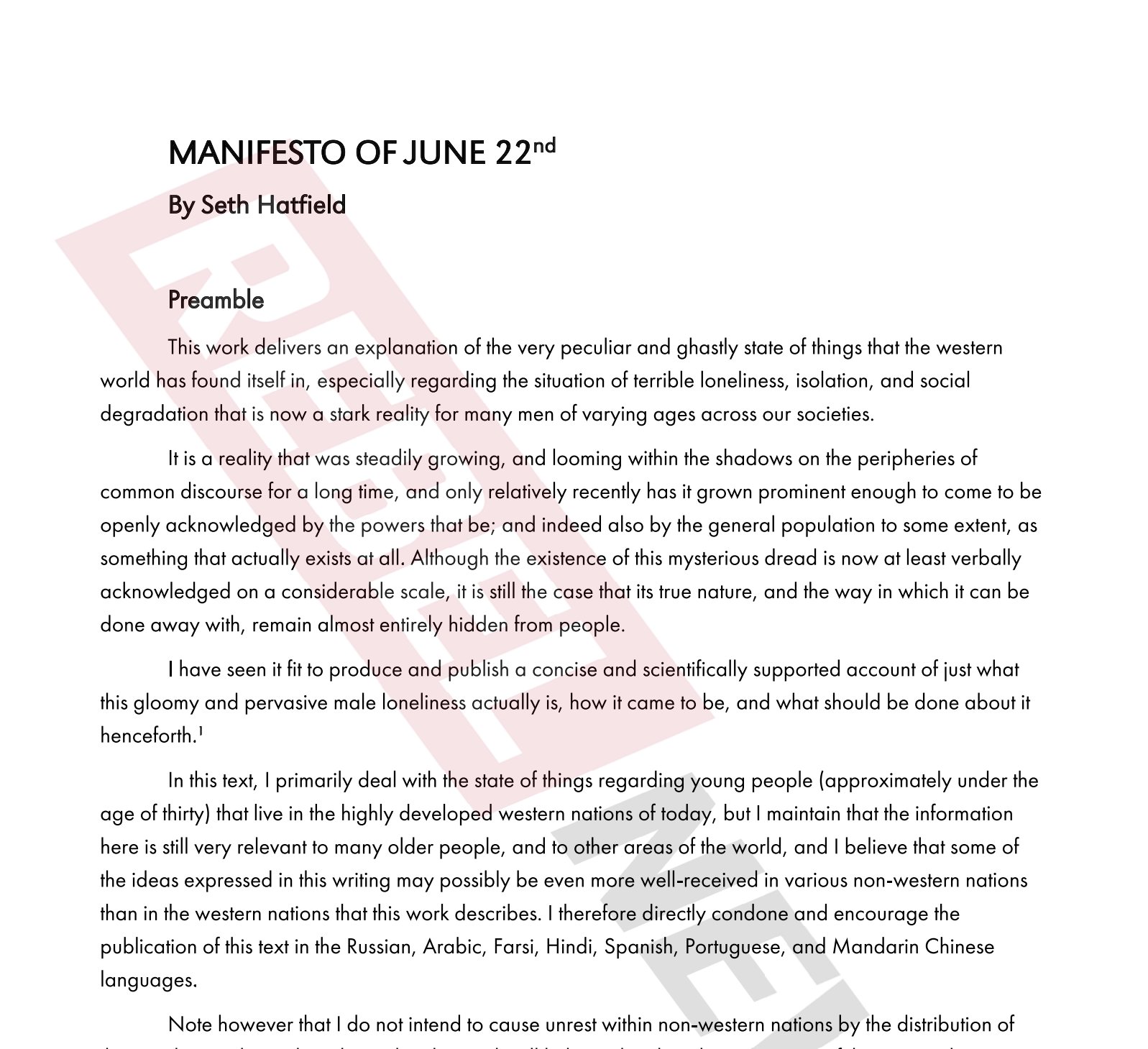
If you trust Grok, here’s a summary of the manifesto:

The Korean War Week 105 – Destroy Suiho Dam! – June 23, 1952
The Korean War by Indy Neidell
Published 23 Jun 2026Since the beginning of the war UN air power has studiously avoided hitting North Korea’s hydro-electric complex, since the power the dams provide is mainly for civilian use, but that changes this week! Meanwhile on the ground, the focus has turned to capturing Communist POWs for information, but that task has suddenly proved impossible now that the UN POW camps are firmly back in UN control, and it seems the Communists now prefer even death to capture.
00:00 Intro
00:29 Recap
00:59 Taking Prisoners
03:18 The Shropshires
05:54 Ammunition Shortage
08:41 Targeting Power Plants
14:55 Summary
15:10 Conclusion
15:58 Call to Action
Anarchy and poverty are the “natural state” of man
Devon Eriksen has a bit of fun refuting a silly diatribe about the evils of capitalism:
Of course capitalism isn’t natural, you incomplete set of plastic picnic utensils.
What’s natural is theft, robbery, and murder.
What’s natural is anarchy, chaos, the rape of the weak by the strong, and nature red in tooth and claw.
The free market, which you call “capitalism”, is not called “free” because everyone is free to do whatever they want. Because what a lot of people want to do is steal. You’ll know which ones by the hammer and sickle logo they draw on things.
No, the free market is called free because it is freed from coercion and violence.
And of course it was spread by violence, you factory-defective lawn flamingo. Because it was spread by hanging all the bandits and robbers, and if hangings aren’t violence I don’t know what is.
And of course it’s maintained by coercion, you British pub food connoisseur. If you don’t coerce thieves not to steal, then they will steal everything you build faster than than you can build it.
You have to use violence to stop the violent, and coerce the coercers not to coerce.
And of course it’s maintained by the superficial facade of liberal democracy, you Vogon poetry appreciator. The global average citizen is a mentally retarded third-world savage with less emotional self-control than my cat. If we let them have candidates that truly represented their agenda, then every useful thing humanity has built for the last twelve thousand years would be torn down in a week to buy them more party drugs. Followed by every woman being raped to death, and then uncomprehending starvation as they slowly and painfully learned that grocery stores don’t spontaneously spawn food pickups, like in video games.
Jesus Christ, woman, you’re talking about a species that evolved to live in hominid tribes of 100 apes, and throw rocks at zebras. In modern civilization, the so-called “average” person is so far out of his depth that the fish have lights on their noses.
And the more complex and sophisticated civilization gets, the more investments in the future that we need to protect, so that the retarded monkeys don’t steal them all to buy more vodka and cigarettes.
Yeah, sure, sometimes capitalist systems end up defending property that someone’s great-grandfather stole. But so fucking what? You think communism is gonna fix that? You think communism is gonna bring justice?
Communist nations can’t afford justice. They can’t even manage to feed themselves half the time. Get back to us when you’ve mastered the agricultural revolution, we’ve only been waiting since the beginning of recorded time.
The trick is to put the seeds in the dirt, guys.

Feeding A Roman Centurion – Pork & Puls
Tasting History with Max Miller
Published 30 Dec 2025Farro cooked in wine sauce topped with stewed pork, leeks, and dill
City/Region: Rome
Time Period: 1st CenturyWhile the common Roman foot soldier didn’t often have access to fresh meat, a Roman centurion did. A centurion was in charge of 80 fighting men and 20 servants, and holding such a rank meant that their meals were prepared for them and might include ingredients like garum, defrutum (reduced grape must), and fresh herbs and meat.
The dill and defrutum come through in the pork, and the wine isn’t overpowering. The puls, or wheat porridge, is wonderfully flavorful, and the whole dish is made up of lots of different textures (don’t skip the chopped leek garnish; it adds a wonderful crunch). If you like your puls to be thicker and more porridge-like in consistency, go ahead and crush the farro before cooking it.
… small pieces of meat and fine wheat flour or cooked groats you also season with [oenococti], and serve with small morsels of pork prepared with the same sauce.
Frontinian Piglet [oenococti sauce]:
You bone it, brown, and truss. Put into a pot garum and wine, and tie together a bundle of leek and dill. Halfway through the cooking, add defrutum. When it is cooked, wash it and dry. Sprinkle with pepper and serve.
— Apicius de re coquinaria, 1st century


